Best ZEISS Lenses of 2026

People go looking for Zeiss glass by name because of the coating: the T* multilayer coating is what keeps a bright window from blooming across the frame and gives a specular highlight a clean, round edge instead of a smear. A lens can be razor sharp and still render ugly, and that difference is what you're paying for. The catch is that the badge alone doesn't tell you what you're getting — some of these are autofocus lenses co-developed for mirrorless bodies, and others are manual-focus glass for DSLRs.

We've spent the past 10 months shooting with seven of them, on E-mount, X-mount, and EF-mount bodies, and the sharpness and the way they drew out-of-focus backgrounds held up across the board. What separated them was everything around the image: how fast and how quietly they focused, how much they weighed after a long day on a strap, and whether the frames justified the asking price.

One thing worth knowing before you scroll: focal length will change your pictures more than the name on the barrel will, so the pick that works for tight portraits is rarely the one that lives on the camera for travel. Which is roughly how the list below shakes out.

Keeper Score summarizes customer ratings and review volume. Read it alongside the product details and trade-offs. How the score works.

1

Best Overall

Sonnar T* FE 35mm f/2.8 ZA

90 /100
Keeper Score Outstanding

Key details

Mount
Sony E (full frame)
Weight
4.23 oz
Focal Length
35mm
Maximum Aperture
f/2.8
Check Price on Amazon

The 35mm f/2.8 weighs 120 grams and takes a 49mm filter, and those numbers matter less than what they do to the camera they're attached to. On a full-frame Sony body the whole kit becomes something you carry on a strap all afternoon without thinking about it. It's the lens we reached for most often when we weren't working to a shot list.

Sharpness earns it the top spot here. Wide open at f/2.8 the corners are already clean, which is not what we expected from something this small, and the T* coating gives files the contrast and saturation people mean when they talk about the Zeiss look. Stopping down to f/5.6 doesn't buy much, because there wasn't much left to gain.

The f/2.8 maximum is the honest trade. This is a daylight and street lens first; after dark you'll be pushing ISO where the 50mm f/1.4 on this list wouldn't make you. There's visible vignetting wide open too, simple to correct and largely gone by f/4.

Close focus is 1.15 feet — enough for a coffee cup, not enough for a flower. What stayed with us was how often the little lens was already mounted when something worth photographing happened.

Pros

  • Sharp into the corners wide open
  • 120 grams, so it lives on the camera
  • T* coating delivers color and contrast
  • Dust- and moisture-resistant barrel

Cons

  • Autofocus can feel slow in dim light
  • Zeiss premium for a relatively slow f/2.8 prime
Our verdict

The best first Zeiss for most Sony shooters: tiny, sharp into the corners, and easy to carry every single day.

Check Latest Price
2

Best for Portraits

Batis 85mm f/1.8

89 /100
Keeper Score Excellent

Key details

Mount
Sony E
Focal Length
85mm
Focus Display
OLED distance and depth-of-field readout
Maximum Aperture
f/1.8
Check Price on Amazon

A focus-distance readout on the lens barrel sounds like a novelty until you're working at f/1.8 in low light and want to know exactly where the plane of focus sits. The Batis puts that on a small OLED display along with the depth of field, and we ended up checking it far more often than we expected.

For portraits it's the pick of this group. 85mm gives you a working distance that doesn't crowd people, f/1.8 separates them from the background cleanly, and the skin tones and color that come out of it are the most persuasive argument for Zeiss glass here. If people are what you photograph, start with this one.

The metal barrel is sealed against dust and spray, and the autofocus is quiet enough for the situations where a chattering lens is a problem. Eye AF is quick and confident in good light; in a dim studio full of strobes it's less dependable, so plan on confirming focus rather than trusting it.

The OLED display, the sealing and the rendering all point the same way: this is a specialist's lens rather than a default. Pair it with the 35mm f/2.8 and you have most of what a full-frame Sony kit actually needs.

Pros

  • Creamy, well-controlled background separation
  • OLED readout for distance and depth of field
  • Sealed metal construction
  • Quiet, accurate autofocus in good light

Cons

  • Adds 1.1 pounds to a small mirrorless body
Our verdict

If people are what you photograph, this is the Zeiss to buy — the rendering is the best argument on this page.

Check Latest Price
3

Best Zoom

Vario-Tessar T* FE 24-70mm f/4

85 /100
Keeper Score Excellent

Key details

Mount
Sony E
Weight
15 oz
Focal Range
24-70mm
Maximum Aperture
f/4
Check Price on Amazon

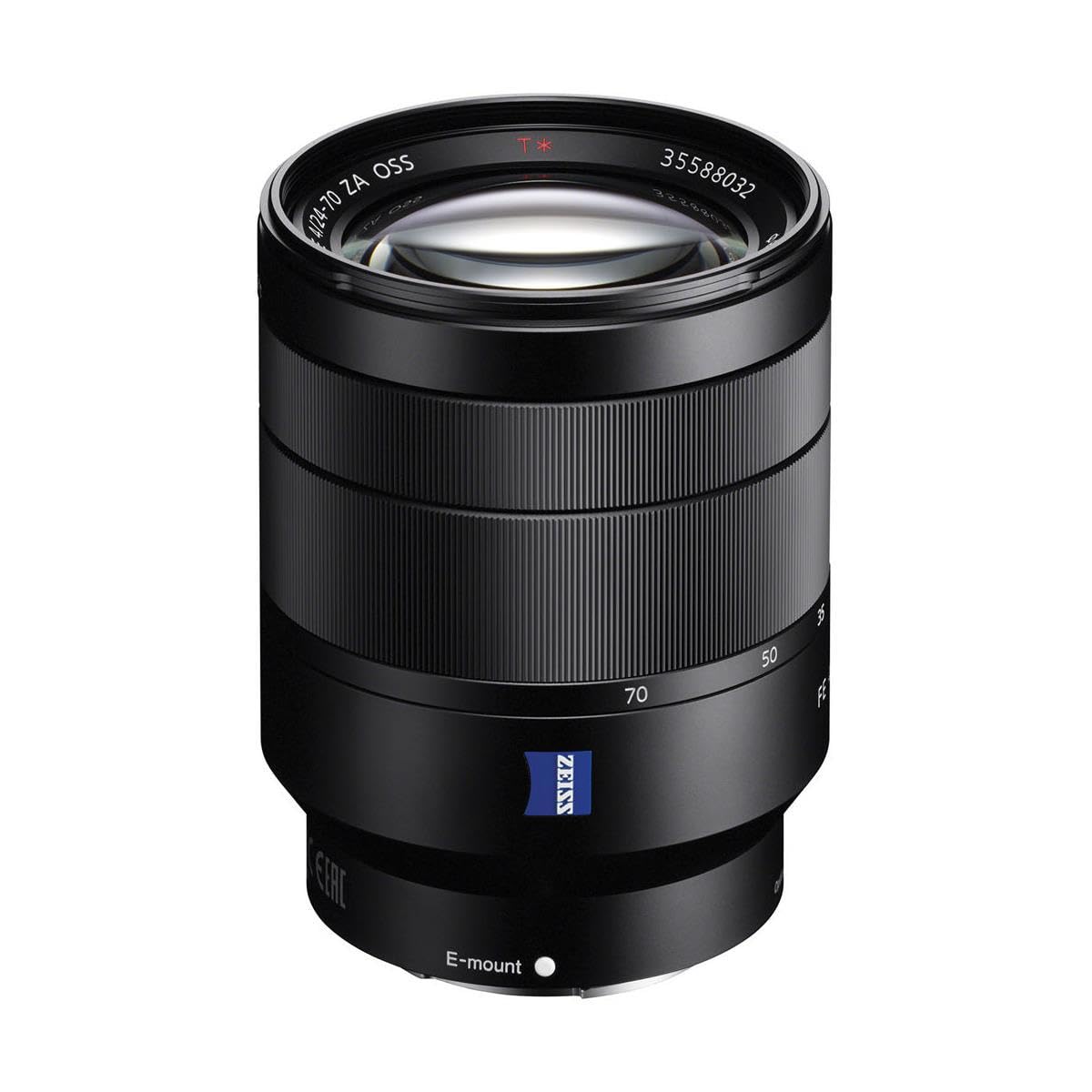
Every other lens on this page is a prime; this is the one that covers a whole trip without a bag change. The 24-70mm f/4 runs from wide to short telephoto, weighs 426 grams, and on a full-frame Sony body it's the difference between photographing what's in front of you and missing it while you swap glass.

It's sharp right through the range, with consistent performance at 24mm and at 70mm, and the T* coating gives it the same saturated, contrasty look as the rest of these lenses. We came home from a week of walking with very little to throw away.

The focus ring is where it shows its age. It's focus-by-wire, with no mechanical connection to the elements, and pulling focus by hand for video is imprecise enough that we stopped trying. Autofocus does the work instead: quick, quiet, and good enough for a crowded room.

Worth knowing: on an APS-C body the range becomes 36-105mm, which is a genuinely useful travel zoom, and the lens balances well on the smaller bodies.

Pros

  • 24-70mm covers a whole day out
  • 426 grams is light for a full-frame zoom
  • Sharp and contrasty across the range
  • Fast, quiet autofocus for events

Cons

  • f/4 maximum aperture limits indoor and evening work
Our verdict

The one to buy if you can't stop and change lenses — a light, sharp full-frame zoom for travel and events.

Check Latest Price
4

Best Low-Light Prime

Planar T* FE 50mm f/1.4 ZA

80 /100
Keeper Score Excellent

Key details

Mount
Sony E
Focal Length
50mm
Diaphragm Blades
11
Maximum Aperture
f/1.4
Check Price on Amazon

F/1.4 at 50mm is a specific tool. It's the difference between shooting a room at ISO 3200 and shooting it at ISO 800, and between a background that goes soft and one that goes away entirely. This is the lens in the group built for that.

Eleven aperture blades and aspherical elements give it the smoothest out-of-focus rendering here, and the T* coating keeps contrast intact when there's a bright window in the frame. The aperture ring has a de-click switch, which sounds like a footnote and isn't: it makes the lens genuinely usable for video, and it's one of the few controls of its kind in this group.

You buy this for a reason — receptions, weddings, any room where the light is what it is. If most of your shooting happens at f/5.6 and above, the 35mm f/2.8 does much the same job and you'll never notice the difference. That's the honest dividing line, and it's worth deciding which side you're on before you order.

One practical note: it takes 72mm filters, so the 49mm set that fits the 35mm won't go on it. Budget for the thread as well as the lens.

Pros

  • f/1.4 aperture for available light
  • Eleven blades for smooth backgrounds
  • De-clickable aperture ring and AF/MF switch
  • Sharp from center to corner

Cons

  • Heaviest and bulkiest lens here
Our verdict

Buy it for the light: an f/1.4 standard that turns dark rooms and busy backgrounds into a clean frame.

Check Latest Price
5

Best for Canon DSLRs

Classic Planar T* 50mm f/1.4 ZE

78 /100
Keeper Score Very Good

Key details

Focus
Manual only
Mount
Canon EF
Focal Length
50mm
Maximum Aperture
f/1.4
Check Price on Amazon

There's no autofocus here. The Classic Planar 1.4/50 ZE is a manual-focus lens in a metal barrel with a Canon EF mount, and that single fact sorts the buyers from the browsers.

For the people it suits, it's the most satisfying lens in this group to actually use. Nine blades give highlights a rounded shape, the T* coating delivers the rich, saturated color the Zeiss name was built on, and the focus ring is geared long and damped heavily enough that you can feel the plane of focus move under your fingers. Our keeper rate went up once we stopped rushing it.

It's soft wide open at f/1.4, which is a rendering choice as much as a limitation and is gone by f/2. The focus throw runs roughly two full turns from infinity to close focus: wonderful for precision, hopeless for anything that moves.

The practical bit is the viewfinder. On a DSLR you're focusing through the stock screen, which isn't built for confirming an f/1.4 plane, so expect to bracket focus until you learn the lens. Adapted to a mirrorless body with focus peaking it becomes far easier — and it rewards the patience with pictures that look like nothing else here.

Pros

  • All-metal build that feels like an object worth owning
  • Rounded nine-blade bokeh
  • Rich, saturated color from the T* coating
  • Long, heavily damped focus ring

Cons

  • Manual focus only
Our verdict

The most satisfying lens here to use slowly, provided you shoot Canon and want to focus it yourself.

Check Latest Price
6

APS-C Walkaround

Sonnar T* E 24mm f/1.8 ZA

77 /100
Keeper Score Very Good

Key details

Mount
Sony E (APS-C)
Focal Length
24mm
Minimum Focus
6.2 inches
Maximum Aperture
f/1.8
Check Price on Amazon

Six point two inches is close enough that the hood almost touches what you're photographing. The 24mm f/1.8 focuses to a quarter life size, which turns a wide prime into something you can point at a plate of food, a detail, or a face without backing across the room.

On an APS-C body it's a 36mm equivalent, the classic reportage length, and it's sharp across the frame wide open, with the contrast and color the rest of these lenses deliver. Seven blades keep background highlights round rather than hexagonal.

Where it earns its place is the combination: a 36mm-equivalent field of view that also focuses to six inches. Nothing else here does both, and if that's the picture you keep failing to get, the arithmetic stops mattering.

Pros

  • Focuses to 6.2 inches at quarter life size
  • Sharp across the frame wide open
  • Strong color and contrast
  • 7.9 ounces on an APS-C body

Cons

  • Priced above the full-frame 35mm here
Our verdict

The APS-C wide that doubles as a near-macro — buy it if 36mm equivalent and six inches of close focus are the shots you keep missing.

Check Latest Price
7

Fujifilm Bodies

Touit 1.8/32

82 /100
Keeper Score Excellent

Key details

Mount
Fujifilm X
Weight
7.41 oz
Focal Length
32mm
Maximum Aperture
f/1.8
Check Price on Amazon

Fujifilm shooters get exactly one Zeiss autofocus lens on this page, and it's this one. The Touit 1.8/32 is built for the X mount, so there's no adapter in the chain and no compromise on the body's own controls.

32mm on Fuji's APS-C sensor works out to roughly 48mm, close enough to a true standard that it stays on the camera the way a 50mm does on full frame. The T* coating and the floating-elements design are the parts doing the work: contrast holds up shooting into a window, and the corners stay clean as you focus closer.

At f/1.8 with seven blades the background goes soft-edged rather than dramatic, which suits documentary work better than it suits anything showier.

It's a walkaround standard, not a lens for reach or spectacle. Buy it because you want the T* rendering in a small Fuji kit — and because at 7.41 ounces it asks nothing of you to carry.

Pros

  • T* coating holds contrast in backlight
  • Sharp with a distinctive contrast and color signature
  • 7.41 ounces on an X-mount body

Cons

No notable drawbacks to flag.

Our verdict

The only Zeiss autofocus lens for Fujifilm X here, and worth it for the rendering rather than the specifications.

Check Latest Price

How We Chose and Tested These Zeiss Lenses

We started with the current lineup of Zeiss and Zeiss co-developed lenses, sorted them by mount so every pick could be shot on a body we actually own, then filtered by price tier and by whether the lens was still readily available. That left seven lenses spanning E-mount, X-mount, and EF-mount, from a wide prime to a standard zoom. Each one stayed mounted for weeks rather than minutes, and the whole round ran 10 months.

For sharpness and image quality, I shot the same brick wall and a sheet of newsprint at every aperture from wide open to f/8, then pushed the files to 100 percent and looked at the corners, not the center. For bokeh, I photographed string lights on a balcony at dusk and backlit leaves, wide open, checking whether the highlight circles had onion rings in them or hard-edged cat's-eye shapes near the frame edge. The zoom got the same treatment at both ends of its range, since a zoom can be strong at one end and soft at the other.

Autofocus got the most brutal test we have: a friend's dog sprinting toward the camera while I held a burst and counted keepers, then the same lens at a dim restaurant table to see whether it hunted. The manual-focus lens we judged by feel — how much travel the ring had and whether it moved smoothly enough for critical focus at f/1.4. I weighed each lens on a kitchen scale and carried one body-and-lens combo in a shoulder bag for a full day of walking, and at the end I printed my favorite frames at 11x14 and asked myself honestly whether I'd pay the price again.

How to Choose a Zeiss Lens

Start with the mount, not the name

The Batis is built for Sony E, the Touit is built for Fujifilm X, and the Classic ZE range is Canon EF, while the Sony ZEISS lenses all take Sony E and fit both full-frame and APS-C bodies. That one check eliminates most of this list, and it's worth doing before you fall for a rendering you can't mount.

The mount also tells you what kind of lens you're getting. Every Classic ZE is manual focus, because Zeiss built that line for DSLR shooters who want to focus by hand. If that sounds like a chore rather than a pleasure, stay in the autofocus camp and shop the E-mount lenses.

Pick a focal length you already shoot

On full frame, 24mm is wide, 35mm is the reportage standard, 50mm is the neutral eye-level view and 85mm is portraits. On APS-C, multiply by 1.5: the 35mm f/2.8 becomes a 52mm, the 24mm f/1.8 becomes a 36mm, and the Touit's 32mm becomes a 48mm. The classic mistake is buying a full-frame focal length for a crop body and discovering you've bought a short telephoto.

If you can't name the field of view you shoot most, scroll back through the last couple of hundred frames on your card. The answer is almost always sitting there, and it's more reliable than any chart.

Aperture, and what the extra stop weighs

An f/1.4 prime and an f/2.8 prime are a couple of stops apart, which is the difference between shooting a dim room at ISO 800 and shooting it at ISO 3200. That's real, and so is the cost: the 35mm f/2.8 is 120 grams, the 50mm f/1.4 is the heaviest lens here.

The trap is buying the fast lens for the badge and then shooting at f/5.6 outdoors all day, where the small lens does the same job while you carry a fraction of the weight. Be honest about the aperture you actually use.

Rendering is the reason; sharpness is table stakes

Modern lenses are sharp, and what separates these is how they draw. The T* coating does real work on contrast and flare, the diaphragm blade count shapes out-of-focus highlights, and the color is what people actually notice in a finished picture. A Zeiss is bought for that, not for a resolution number.

Judge one at the aperture you'll shoot it at, in the light you'll shoot it in. A test frame at f/8 on a sunny afternoon tells you almost nothing about a lens you'll use at f/1.8 indoors.

Controls you actually touch

Focus-by-wire rings, geared mechanical rings, de-clickable aperture rings and OLED distance displays all change how a lens feels in the hand, and none of them appear in a sharpness chart. For video, an aperture ring you can de-click matters more than a marginal gain in resolution. For moving subjects, autofocus speed matters more than anything else on this page.

Match the controls to the work. A tactile manual focus ring is a joy for landscapes and an obstacle at a wedding.

Frequently Asked Questions

Final Verdict

Buy the 35mm f/2.8 first. It's sharp into the corners wide open, small enough that you stop noticing it's there, and it suits almost any day of shooting — which is exactly what a first Zeiss should do.

If you photograph people, the Batis 85mm f/1.8 is the better lens for that job and the better buy. If you can't change lenses mid-shoot, the 24-70mm f/4 covers the whole trip. And if you shoot Canon and want the Zeiss experience at its most tactile, the manual-focus Classic Planar is the one that feels like an object worth owning.