Best Sony Wide-Angle Lenses of 2026

An ultra-wide lens is the fastest way to make a scene feel bigger than it is — a whole room, a whole street, a whole ridge line in one frame without backing into a wall. The tradeoff: the wider the glass, the harder it is to keep the corners sharp and the verticals straight.

My team and I spent about a year shooting with eight of them, from a 9mm APS-C prime that weighs less than a paperback to a full-frame 14mm that costs more than my first car. They came along on dim hotel corridors, crowded market streets at dusk, and one very cold sunrise on a ridge.

Here's what first-time buyers get wrong: focal length matters more than aperture. A 14mm swallows a room; a 20mm still behaves when you point it at people, and it's the one most of us left on the camera. Don't shop for bokeh here either — you only get real background separation up close and wide open. The picks below run from tiny crop-sensor primes to fast full-frame zooms.

Keeper Score summarizes customer ratings and review volume. Read it alongside the product details and trade-offs. How the score works.

1

Best Overall

Sony FE 20mm F1.8 G

93 /100
Keeper Score Outstanding

Key details

Weight
13.2 oz
Focal Length
20mm
Max Aperture
f/1.8
Sensor Coverage
Full-frame and APS-C
Check Price on Amazon

Twenty millimeters is the width we reach for first, and this is the lens that makes the case. Its 94-degree view takes in a small room or a whole treeline without the hard corner stretch that a 14mm puts on everything near the edges. That difference matters more than the numbers suggest: a 20mm frame still looks like a place, where a 14mm frame often looks like a lens.

The f/1.8 aperture is what separates it from the zooms here. Wide open it holds a handheld interior at a shutter speed you can live with, and it keeps stars as points rather than smears, which is why night skies and dim rooms are where this lens earns its keep. Two XD linear motors move focus quickly and, usefully for video, almost silently.

At 13.2 ounces it balances on a compact body instead of pulling it forward, and it is the lens we leave mounted when we do not know what we will be shooting. Focus is close enough to fill the frame with a coffee cup or a flower while the background stays straight, which turns a wide angle into something you can use for details too.

The limit is built into the focal length: in a tight bedroom or a small bathroom, 20mm has you backing into a wall. That is the one situation where the 16mm or the 14mm below earns its place. Everywhere else, from landscape to street to a walk after dark, this is the safest place in this group to put your money.

Pros

  • 94-degree view with clean corners
  • f/1.8 for night skies and dim rooms
  • 13.2 ounces on a full-frame body
  • Quiet dual XD linear motors

Cons

  • Runs out of width in tight interiors
Our verdict

We recommend it to most full-frame Sony shooters: 94 degrees looks wide without looking warped, f/1.8 handles night scenes, and 13.2 ounces rides all day.

Check Latest Price
2

Best Full-Frame Ultra-Wide

Sony FE 16mm f/1.8 G

85 /100
Keeper Score Excellent

Key details

Weight
10.7 oz
Focal Length
16mm
Max Aperture
f/1.8
Sensor Coverage
Full-frame
Check Price on Amazon

Thirteen degrees is the whole pitch. Next to the 20mm, this lens takes in a hallway, a lobby, or the front of a car without pushing you into a corner, and it reaches 107 degrees without the fisheye curl people expect from anything this wide.

We think it is the more interesting of the two for anyone who photographs rooms for a living, because the extra width changes where you can stand rather than just how much fits. Autofocus stops at 0.15 m; switching to manual focus gets you to 0.13 m, which is close enough to put a plant, a hand, or a shoe near the front element and watch it grow into a real foreground instead of a smudge.

At 304 grams it will not pull a compact body forward on a gimbal, and the 11-blade diaphragm keeps out-of-focus highlights round rather than angular. Two XD linear motors handle focus quickly and quietly. It has no stabilization of its own, so pair it with a body that does.

It also costs less than our top pick, which makes the extra width easier to justify if rooms and streetscapes are most of what you shoot. Think of it as the lens you add when 20mm has started to feel like a compromise.

Pros

  • 107-degree view for interiors
  • 304 grams with an f/1.8 aperture
  • 0.13 m close focus in manual
  • 11-blade aperture for round highlights

Cons

  • Anything near the frame edge stretches
Our verdict

The better pick when your work happens indoors: 107 degrees, 304 grams, and close focus that lets a foreground object loom.

Check Latest Price
3

Best for Astrophotography

Sony FE 14mm f/1.8 GM

90 /100
Keeper Score Outstanding

Key details

Focal Length
14mm
Max Aperture
f/1.8
Angle Of View
114 degrees
Sensor Coverage
Full-frame
Check Price on Amazon

Fourteen millimeters at f/1.8 is an unusual pairing, and it is the reason this lens exists. A 114-degree view gathers an enormous amount of sky at an aperture that lets you expose it in a single frame, which is exactly the job for night work, and the same combination gets you through a dim interior without a tripod.

What surprised us is the weight. At 460 grams it is lighter than several lenses here that cover less sky, so it hangs off a compact body rather than dragging it forward. Two XD linear motors snap focus into place, and the nine-blade circular aperture keeps out-of-focus highlights round when you open it up.

The cost is partly money and partly discipline. Fourteen millimeters is a specialist's width: expect to crop a good share of daytime frames, and expect to work close to whatever is in the foreground so the frame has a bottom as well as a top. When the shot is right, no other lens here pairs this width with f/1.8.

Pros

  • 114 degrees at f/1.8
  • 460 grams for a 14mm f/1.8
  • Fast, quiet XD linear motors
  • Clean rendering wide open

Cons

  • Premium price for a specialist width
Our verdict

Astrophotographers should start here: 114 degrees at f/1.8, 460 grams, and a nine-blade aperture that keeps highlights round.

Check Latest Price
4

Best for APS-C Vlogging

Sony E 11mm F1.8

91 /100
Keeper Score Outstanding

Key details

Weight
10.6 oz
Focal Length
11mm
Max Aperture
f/1.8
Sensor Coverage
APS-C
Check Price on Amazon

The arm's-length problem is real: a 24mm equivalent puts your chin at the edge of the frame and not much else in it. On APS-C, 11mm covers 104 degrees, roughly a 16.5mm full-frame view, which is the difference between a talking head and a scene.

We like it for video specifically, not just for the width. The internal focus design means the front of the lens does not extend while it works, so a gimbal stays balanced, and Sony shaped the optics to keep focus breathing and angle-of-view shifts small. Those are the two things that make an otherwise good lens look amateur on a moving shot.

At 10.56 ounces it adds almost nothing to a small body, and the two linear motors focus quietly enough to keep on-camera audio clean. It takes standard 55mm filters, so a screw-on ND is all you need for bright outdoor shooting.

The corners are the compromise: whatever sits in them, whether a hand, a chair, or a second person, gets stretched. Keep your subject centered and let the room fall away at the edges, and the exaggeration starts working for you instead of against you.

Pros

  • 104-degree view at arm's length
  • 10.56 ounces on a small body
  • Internal focus keeps gimbals balanced
  • Low focus breathing for video

Cons

  • APS-C sensor coverage only
Our verdict

This is the lens we point APS-C vloggers toward: a 104-degree view holds your face and the room behind it on a small body.

Check Latest Price
5

Best Budget Pick

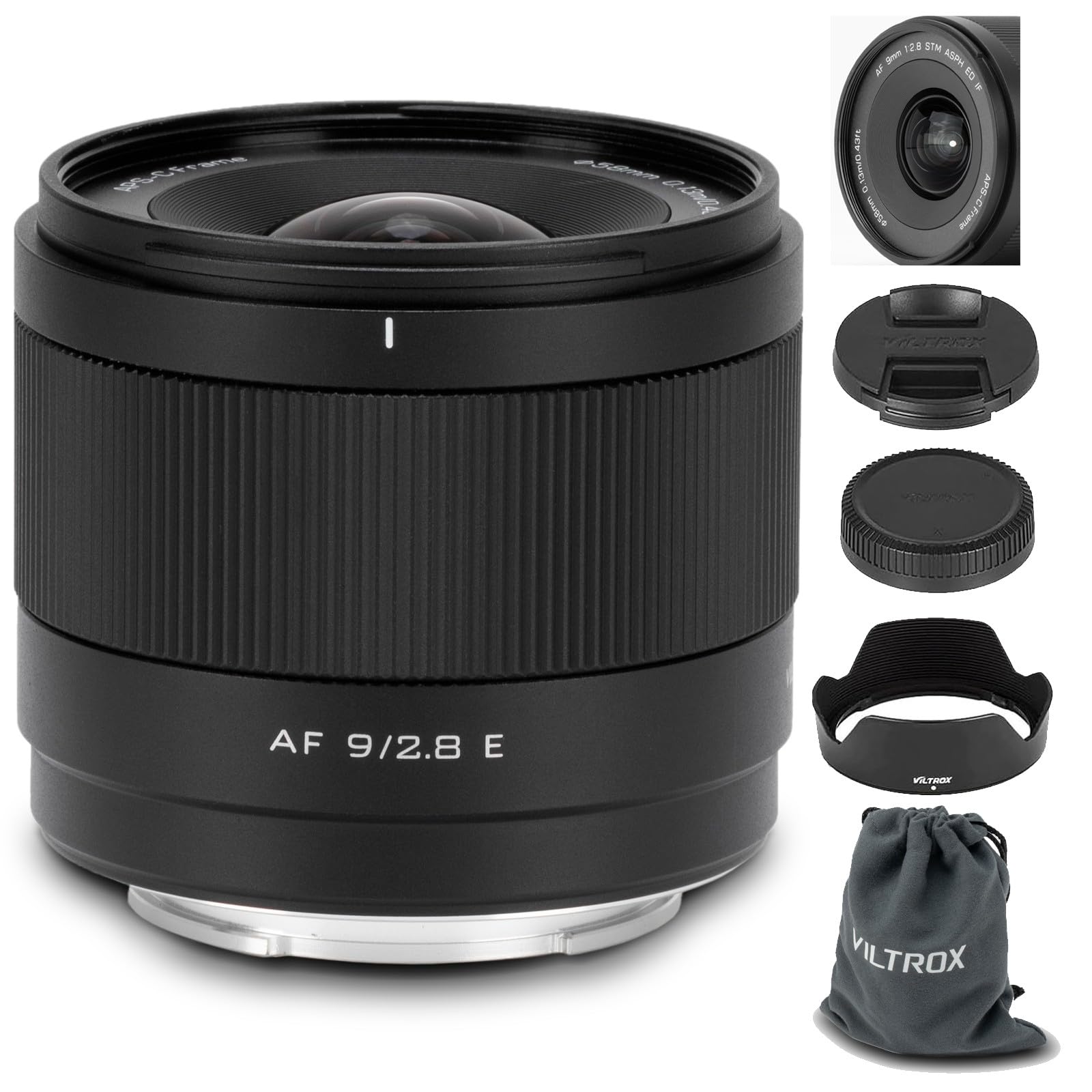
Viltrox 9mm F2.8

90 /100
Keeper Score Outstanding

Key details

Focal Length
9mm
Max Aperture
f/2.8
Angle Of View
113.8 degrees
Sensor Coverage
APS-C
Check Price on Amazon

Nine millimeters on APS-C works out to about a 13.5mm full-frame view, wider than everything here bar the Laowa, and it sits in the lowest price tier in this group. That combination is the reason it is on the list: a 113.8-degree autofocus lens you can add to a small kit without rearranging your budget.

At 175 grams it is lighter than the Sony 11mm, and the 0.13 m minimum focus distance lets you put the front element almost on top of whatever you want to exaggerate: a shell, a bicycle wheel, a dog's nose. Autofocus runs through an STM motor with eye and face detection and is quick enough for handheld video.

The optics are more elaborate than the price tier suggests, with 13 elements in 11 groups including two aspherical and three low-dispersion elements, and the result is a lens that behaves like a much more expensive one in good light. It is the lens to buy when you want to find out whether 113 degrees suits how you see before spending more.

Pros

  • 113.8-degree view for the lowest outlay
  • 175 grams on an APS-C body
  • 0.13 m close focus for big foregrounds
  • Eye and face detection autofocus

Cons

  • Stretched corners at 9mm
Our verdict

A serious amount of width for the least money here: 113.8 degrees on APS-C, 175 grams, and close focus that makes small things loom.

Check Latest Price
6

Best Wide Zoom

Sony FE 16-35mm F2.8 GM II

87 /100
Keeper Score Excellent

Key details

Weight
1.2 lb
Focal Length
16-35mm
Max Aperture
f/2.8
Sensor Coverage
Full-frame
Check Price on Amazon

Covering 16, 20, 24, 28, and 35mm in one barrel sounds like the obvious answer until you set it beside a prime. The GM II is the version that makes the argument work: light for a full-frame f/2.8 zoom, and sharp enough at the edges that the corners do not decide your crop.

We reach for it when changing lenses is not an option: an event, a market, a hike where the framing changes every thirty seconds. The constant f/2.8 holds exposure and depth of field steady as you zoom, and the 11-blade aperture keeps highlights round when you open it up.

Autofocus is smooth and quiet, and the design minimizes focus breathing and axial shift, so it holds up for video as well as stills. It is the lens for the trip where you can only bring one, and the one we pack when the bag has room for a single mount.

Pros

  • Five focal lengths in one barrel
  • 544 grams for a full-frame f/2.8 zoom
  • Quiet, smooth autofocus for video
  • Minimized focus breathing and axial shift

Cons

  • Most expensive lens here
  • A stop slower than the f/1.8 primes
Our verdict

If you want one lens instead of three, this is the one: 16-35mm at a constant f/2.8, and light enough to carry all day.

Check Latest Price
7

Best APS-C Zoom

Sigma 10-18mm F2.8 DC DN

88 /100
Keeper Score Excellent

Key details

Weight
9.17 oz
Focal Length
10-18mm
Max Aperture
f/2.8
Sensor Coverage
APS-C
Check Price on Amazon

Two hundred sixty grams is the number that matters here. An f/2.8 zoom covering 15-27mm equivalent that still leaves a compact body feeling compact is rare, and it is why this one stays on the camera through a trip instead of living in the bag.

The constant aperture is the other half of the appeal. Unlike a kit zoom that dims as you zoom in, this holds f/2.8 from 10mm to 18mm, so the exposure you set at the wide end still works when you tighten up, which is useful in a market or on a street at dusk. It stays sharp out to the edges and keeps barrel distortion modest, and that matters when a room's straight lines fill the frame.

Autofocus is quick and quiet enough for handheld video, and the 67mm filter thread means one polarizer or ND set can be shared with the rest of a small kit. The 10mm end still stretches anything in the corners, so leave a little room around your subject and crop the rest.

Pros

  • Constant f/2.8 across 10-18mm
  • 260 grams for travel
  • Sharp edge to edge
  • 67mm filters shared with a small kit

Cons

  • APS-C sensor coverage only
Our verdict

Our pick for APS-C travel: 15-27mm equivalent at a constant f/2.8, and 260 grams that will not weigh down a small body.

Check Latest Price
8

Compact F/2.8 Zoom

Sony FE 16-25mm f/2.8 G

88 /100
Keeper Score Excellent

Key details

Focal Length
16-25mm
Max Aperture
f/2.8
Minimum Focus
18 cm at 24mm manual focus
Sensor Coverage
Full-frame
Check Price on Amazon

Eighteen centimeters at 24mm, in manual focus, is the specification that sets this zoom apart from the two 16-35s here. That is close enough to put the front element near a tabletop and still hold the room behind it, which is the kind of shot a longer wide zoom makes you work for.

The coverage is the second reason it earns a place: 107 degrees at 16mm, a constant f/2.8, and a barrel compact enough to leave mounted on a small body. Two linear motors keep focus quick and quiet, and the 11-blade aperture keeps out-of-focus highlights round rather than polygonal.

It also sits a price tier below the GM zoom, which is the argument for it against that lens if the range covers the way you frame. For interiors, architecture, and gimbal work that rarely goes past 24mm, it is the more sensible purchase of the two.

Pros

  • 18 cm close focus at 24mm
  • Constant f/2.8 across 16-25mm
  • 107 degrees at the wide end
  • Two linear motors for quiet focus

Cons

  • Long end stops at 25mm
Our verdict

The compact f/2.8 zoom for wide-end shooters: 107 degrees, two linear motors, and close focus that puts the front element near the table.

Check Latest Price
9

Video and Gimbals

Sony FE PZ 16-35mm F4 G

90 /100
Keeper Score Outstanding

Key details

Weight
16 oz
Focal Length
16-35mm
Max Aperture
f/4
Sensor Coverage
Full-frame
Check Price on Amazon

Power zoom is the reason this lens exists, and it is a feature you appreciate only after trying to zoom by hand on a gimbal. Four XD linear motors drive the system, the zoom speed is controllable from the lens or a compatible camera, and the response is slow enough for a deliberate push and quick enough when the shot is getting away.

We also appreciate how little it weighs: 16 ounces with an internal zoom that does not extend, so it stays balanced on a small gimbal and does not front-weight a compact body. Image quality holds up, with sharp results and clean color across the range.

For video-first shooters who want one lens from 16 to 35, this is the most practical thing in the group. It is also the one lens here that a second operator can drive from a remote or a compatible camera, which matters once you are running more than one angle.

Pros

  • Smooth power zoom with variable speed
  • 16 ounces with internal zoom
  • Three independent control rings
  • Remote zoom control for a second operator

Cons

  • f/4 limits available-light shooting
Our verdict

Built for moving pictures: power zoom, internal barrel, and 16 ounces that stay balanced on a gimbal from 16 to 35mm.

Check Latest Price
10

Tight Interiors

Laowa 10mm f/2.8 Zero-D AF

85 /100
Keeper Score Excellent

Key details

Focal Length
10mm
Max Aperture
f/2.8
Angle Of View
130.4 degrees
Sensor Coverage
Full-frame
Check Price on Amazon

A 130.4-degree angle of view is beyond anything else in this guide, and it changes what a photograph of a room can contain. Straight walls stay straight, because the Zero-D design holds horizontal and vertical lines true out to the corners, and that is the whole reason interior and real estate photographers put up with a lens this wide.

The rest of the package is unexpected at this price tier. Fifteen elements in nine groups, a 12 cm minimum focus distance that lets you shoot wide-angle macro-style with a subject almost touching the glass, a 77mm front thread so you can still use filters, and autofocus that keeps up with handheld work.

At 0.93 lb it is light enough to carry as a specialty lens rather than a commitment. This is the lens you keep for the shots nothing else can take, like a whole bathroom in one frame or a staircase from the bottom step, rather than the one you leave mounted all day.

Pros

  • 130.4-degree rectilinear view
  • Near-zero distortion keeps walls straight
  • 12 cm close focus for wide-angle macro
  • 77mm front thread for filters

Cons

  • Faces and objects warp near the edges
Our verdict

For real estate and tiny rooms: 130.4 degrees of rectilinear view that keeps walls straight, with autofocus and a 77mm filter thread.

Check Latest Price

How We Tested Wide-Angle Lenses for E-Mount Cameras

The shortlist started with every E-mount wide-angle we could find, full-frame and APS-C, primes and zooms alike. We cut anything too heavy to carry all day, anything that covered a narrower field of view than the category promises, and anything that didn't earn its price next to a close sibling. Eight lenses made the cut, and each one spent about a year in rotation on real shoots.

Most of the testing happened where wide lenses earn their keep: tight interiors where I had to shoot from a corner, streets at dusk, a rocky overlook at sunrise, and one genuinely dark field for night skies. At each location I shot the same frames at the widest aperture and again stopped down, then compared the corners at 100 percent — looking for softness, color fringing along rooflines, and how badly straight edges bowed.

Autofocus got its own pass: I walked toward the camera, tracked cyclists crossing the frame, and shot handheld video while talking to the lens. We noted how often it grabbed the background instead of the subject, and whether the motor was audible in a quiet room. Weight we judged by carrying each lens on a strap for a full day and by how it balanced on a small body.

For bokeh, I got as close as each lens would focus and shot wide open at backlit leaves and string lights, checking whether highlights stayed round or turned into rings. Sharpness, weight, and autofocus decided most of the rankings; value broke the ties.

How to Choose a Sony Wide-Angle Lens

Decide how wide, then pick the lens

Twenty to 24mm is the everyday wide: enough for a landscape or a roomy interior, not so much that the corners call attention to themselves. Fourteen to 16mm is for architecture, tight rooms, and night skies, where you need the whole space and can work close to fill the foreground. On APS-C, 9 to 11mm lands in the same territory.

The trap is assuming wider always fits more in. Past about 16mm the corners stretch, foreground objects grow, and anything near the edge of the frame starts to look wrong. Pick the widest lens that still lets you keep your subject out of the corners, not the widest one you can afford.

Full-frame or APS-C decides more than the mount

Every lens here mounts on a Sony E body, which makes coverage easy to overlook. A full-frame lens on an APS-C body crops to a 1.5x view, so a 16mm becomes a 24mm. An APS-C lens on a full-frame body pushes the camera into crop mode and throws away the resolution you paid for.

Buy for the body you expect to keep. On an a6700 or a ZV-E10, the Sigma 10-18mm and the Sony 11mm are built for that sensor. If a full-frame body is the plan, stay with the FE lenses.

What a stop of aperture is worth

An f/1.8 prime gathers roughly a stop and a third more light than an f/2.8 zoom. In a dim room that is the difference between 1/30 second and 1/15 second; at night it is the difference between a usable frame and a smear. It also gives autofocus more to work with in low light.

If you shoot handheld interiors, events after dark, or the night sky, pay for the aperture. If most of your work happens in daylight and you need three focal lengths without changing lenses, a constant f/2.8 zoom is the better trade.

Autofocus and video details you notice later

Focus breathing is the quiet killer of wide-angle video: the framing shifts as the lens hunts, and a shot that looked fine on the monitor looks wrong on the timeline. Linear-motor designs are faster and quieter, and several lenses here are built to suppress breathing and angle-of-view shifts.

On a gimbal, internal focus and internal zoom matter as much as weight, because a barrel that extends throws off the balance mid-shot. For stills, eye and face detection plus a quiet motor are the features worth checking.

Weight is the lens you actually carry

This group runs from 175 grams to 544 grams, and the practical difference is whether the lens lives on the camera or in the bag. A 544-gram f/2.8 zoom can replace two or three primes that weigh a few hundred grams each, so the math often favors the zoom for travel and the prime for a single afternoon.

Try the camera with the lens mounted before you commit. A wide lens on a small body can feel front-heavy, and a lens you leave at home is worth nothing.

Frequently Asked Questions

Final Verdict

Buy the Sony FE 20mm F1.8 G. It is wide enough for almost everything, from landscape and street to most interiors and vlogging; light enough to live on the camera; and fast enough to keep shooting after the sun goes down. That combination is why it is the default here rather than the widest or the cheapest option.

If rooms rather than scenes are your subject, the 16mm f/1.8 G buys you thirteen more degrees and a closer focus. On APS-C, the 11mm F1.8 is the same idea sized for a small body.