Best Tamron Lenses of 2026

For years I shot with first-party glass out of pure habit, until a friend handed me her Tamron zoom at a wedding and I spent the entire reception with it. What changes your mind isn't the spec sheet — it's getting a fast, constant aperture across a whole zoom range for roughly the price of a single prime. That's the fix these lenses offer: aperture and reach you couldn't otherwise afford, in a bag you'll actually carry.

We've spent the better part of a year on this — ten months, eight lenses, from the wide end through the long telephotos — and the differences come down to things you notice on hour three of a shoot. Focus speed. Focus noise. Whether the stabilization actually holds at the long end. And what the whole rig weighs on your shoulder by the time you pack up.

Here's what first-time buyers get wrong: the headline aperture is not the spec that decides whether you love a lens. A fast zoom is the reason you buy, but the reason you keep reaching for it is quieter autofocus and a weight that doesn't end your day early. The eight below earned their spot in my bag for exactly those reasons.

Keeper Score summarizes customer ratings and review volume. Read it alongside the product details and trade-offs. How the score works.

1

Best Overall

Tamron 28-75mm f/2.8 Di III VXD G2

90 /100
Keeper Score Outstanding

Key details

Weight
19 oz
Close Focus
7.1 in. at 28mm
Focal Length
28-75mm
Maximum Aperture
f/2.8 constant
Check Price on Amazon

Nineteen ounces and 4.6 inches is what a constant f/2.8 full-frame standard zoom looks like when nobody is showing off, and that's precisely why it took the top spot in our testing: you can leave it mounted for a whole day and forget it's there. Of everything Tamron makes for Sony E-mount, this is the one that does the most jobs for the most people.

Twenty-eight millimeters at the wide end is the compromise, and it's a fair one. It isn't the 24mm some standard zooms start at, so tight interiors will have you backing into a wall — but the payoff is a barrel that stays small and a long end at 75mm that frames a real portrait. On an APS-C body the same lens behaves like a 42-112mm, which is a fast portrait zoom and a perfectly good reason to buy it for an a6700 or an FX30.

The spec that sold us is close focus: 7.1 inches at the wide end with a 1:2.7 magnification ratio. That's near-macro from a standard zoom — enough to fill the frame with a flower or a plate of food without swapping glass, and the sort of capability that quietly changes how you shoot a walk.

Autofocus runs on Tamron's VXD linear motor, which is quick and quiet in decent light; in dim, low-contrast scenes it can hunt before it locks, so budget for a few missed frames at a reception or an indoor match. The fluorine coating on the front element is the small detail we keep appreciating: fingerprints and spray wipe off instead of smearing.

Pros

  • Constant f/2.8 through the whole range
  • 19 oz and 4.6 inches
  • 1:2.7 close focus at 7.1 inches
  • Works on full-frame and APS-C bodies

Cons

  • No optical stabilization; relies on body IBIS
Our verdict

The default Tamron for Sony full-frame: a compact constant f/2.8 standard zoom that stays on the camera all day and focuses close enough to stand in for a macro.

Check Latest Price
2

Best for Sony APS-C

Tamron 17-70mm f/2.8 Di III-A VC

93 /100
Keeper Score Outstanding

Key details

Focal Length
17-70mm
Stabilization
VC optical
Maximum Aperture
f/2.8 constant
Full-frame Equivalent
25.5-105mm
Check Price on Amazon

If your camera is APS-C — an a6400, a6600, a6700, an FX30, a ZV-E10 — this is the lens that does the most jobs with the fewest excuses. The 17-70mm range works out to 25.5-105mm in full-frame terms, wide enough for a room and long enough for a head-and-shoulders portrait, and it holds f/2.8 the entire way.

Stabilization is the part we care about most. Tamron's VC is tuned to work alongside Sony's APS-C bodies, and on a camera without in-body stabilization — the a6400 or the ZV-E10 — it's what makes handheld video viable rather than wobbly. On an FX30 or a6600 with IBIS, it's belt and braces.

At 1.2 pounds it isn't a small lens, and on an a6400 it makes the camera noticeably front-heavy; the bigger bodies balance it better. That's the price of a constant aperture, and anyone shooting events or handheld video will pay it happily.

The close-focus figure is the surprise. Set the zoom to 17mm, get within 7.5 inches, and you get the room-eating, exaggerated perspective that makes a wide-angle interesting — a trick that usually costs a separate prime. For an APS-C shooter building one bag, this is the lens to build it around.

Pros

  • Constant f/2.8 from 17mm to 70mm
  • VC stabilization for unstabilized bodies
  • Near-macro at 7.5 inches at the wide end
  • 25.5-105mm equivalent covers most of a day

Cons

  • 1.2 lb makes a compact body front-heavy
Our verdict

For Sony APS-C bodies this is the most complete standard zoom here: 25.5-105mm equivalent at f/2.8, with stabilization that handheld video needs.

Check Latest Price
3

Best All-In-One

Tamron 28-200mm f/2.8-5.6 Di III RXD

90 /100
Keeper Score Outstanding

Key details

Weight
20.3 oz
Close Focus
7.5 in. at 28mm
Focal Length
28-200mm
Maximum Aperture
f/2.8-5.6
Check Price on Amazon

If the 28-75mm is the lens for someone who knows what they're shooting, this is the lens for someone who doesn't yet. Two hundred millimeters of reach and a 28mm wide end in a 4.6-inch, 20.3-ounce barrel is the entire pitch: it stands in for the three-lens bag most people drag along on a trip.

The aperture is the trade, and it's worth understanding before you buy. f/2.8 belongs to the wide end only; the lens closes down steadily as you zoom, so at 200mm you're leaning on daylight or ISO. What you get back is the freedom to frame a face across a courtyard and then turn around for the street behind you without changing glass.

This is the one we take when we don't know what we'll be shooting. Sharpness holds across the range, which is the part that matters when the alternative is carrying more, and the zoom lock switch exists for a reason — a barrel this long will creep when it's hanging at your side.

Close focus is the sleeper specification: 7.5 inches at the wide end at 1:3.1, and 1:3.8 all the way out at 200mm, so a market stall or a bug on a leaf fills the frame without a macro lens. Autofocus can hunt in low light, where the linear motors elsewhere in this list lock on faster.

Pros

  • 28-200mm covers a three-lens bag
  • 20.3 oz and 4.6 inches for the range
  • Close focus at both ends of the zoom

Cons

  • f/2.8 ends at the wide end; slow by 200mm
Our verdict

Buy it if you want one lens instead of three: 28-200mm of reach in a 20-ounce barrel makes it the best travel companion in this group.

Check Latest Price
4

Best Telephoto Zoom

Tamron 70-180mm f/2.8 Di III VC VXD G2

91 /100
Keeper Score Outstanding

Key details

Weight
30.2 oz
Focal Length
70-180mm
Stabilization
VC optical
Maximum Aperture
f/2.8 constant
Check Price on Amazon

Twenty millimeters is the price of admission: this stops at 180mm where a 70-200 goes to 200. What it buys is a constant f/2.8 telephoto that weighs 30.2 ounces and measures 6.2 inches — light enough to handhold through a whole match instead of bracing on a monopod.

For indoor sport, weddings, and stage work it's the most convincing telephoto in this group. The VXD motor tracks quickly, the VC adds handheld steadiness, and the lens is sharp wide open, which is the combination that matters when the light is poor and flash isn't an option.

Close focus is the underrated part: 11.8 inches at 70mm. That's near enough to shoot rings, hands, and table details at a reception without swapping to a macro, and 33.5 inches at 180mm still gets you a tight portrait. The 20mm shortfall is real if you're shooting the far touchline; indoors, it's the better trade.

Pros

  • Constant f/2.8 all the way to 180mm
  • VC stabilization for handheld work
  • 11.8-inch close focus at 70mm
  • 30.2 oz is light for a fast telezoom

Cons

  • 20mm less reach than a 70-200
Our verdict

The fast telephoto for indoor sport, weddings, and stage work: constant f/2.8 to 180mm, stabilization, and 30 ounces you can handhold all day.

Check Latest Price
5

Best Budget Telephoto

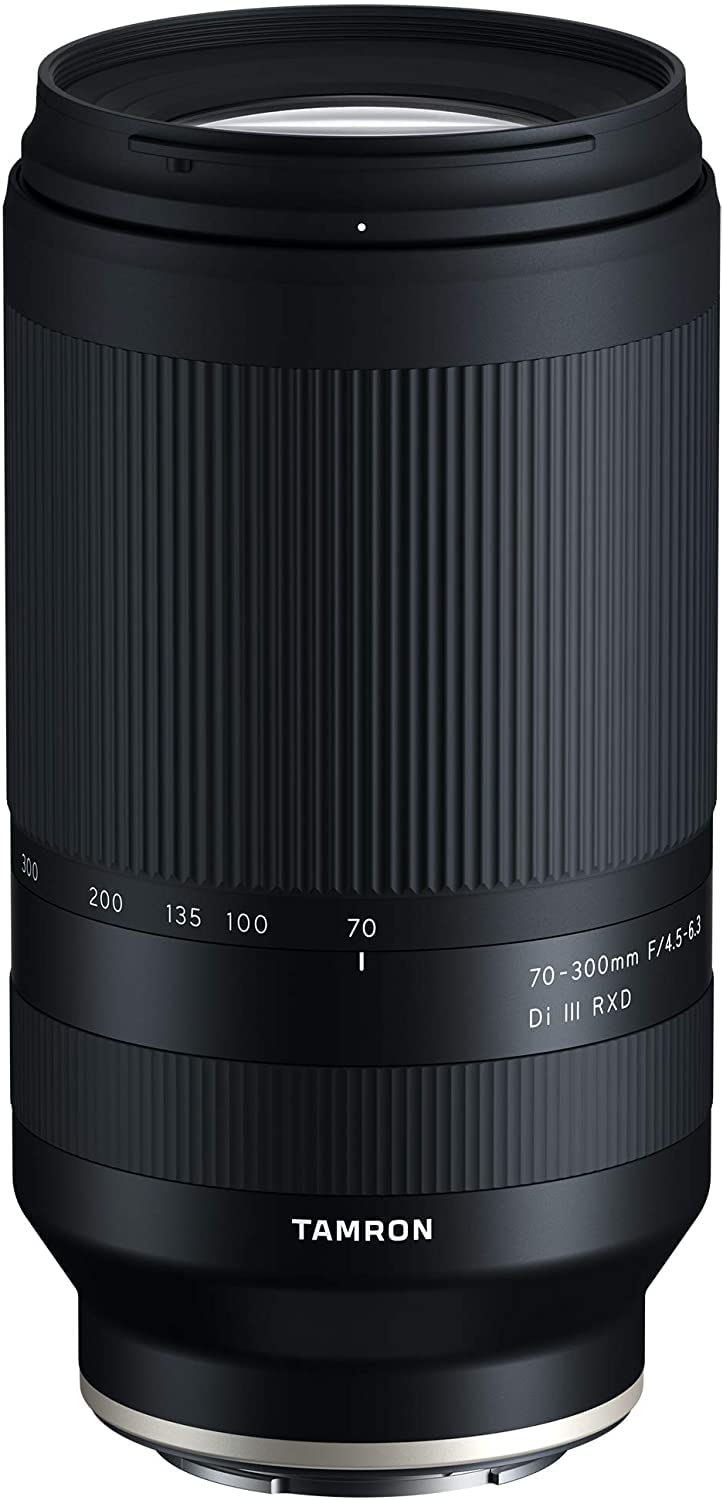
Tamron 70-300mm f/4.5-6.3 Di III RXD

92 /100
Keeper Score Outstanding

Key details

Weight
1.2 lb
Close Focus
31.5 in. at 70mm
Focal Length
70-300mm
Maximum Aperture
f/4.5-6.3
Check Price on Amazon

Reach for the money is the argument, and it's a strong one: this is the cheapest way to 300mm in this group, and it does it in a 1.2-pound barrel that occupies the same slot in your bag as a standard zoom.

On a full-frame body you get 70-300mm. On APS-C that becomes 105-450mm, which is a serious amount of reach for wildlife and field sports at this end of the range. The moisture-resistant construction is more than the price suggests, and the BBAR coating keeps contrast intact when you're working toward a bright sky.

Close focus is short for a telezoom: 31.5 inches at 70mm, and 59.1 inches at 300mm where the 1:5.1 ratio lets you fill the frame with a flower from five feet away. That half-macro behavior at the long end is not what anyone expects from a budget telezoom.

The caveats are light and steadiness. f/6.3 at the long end makes it a daylight lens, and with no VC it depends on your body's IBIS — fine on an a7, less so on an a6400. For a first long lens, though, 300mm at 1.2 pounds is hard to argue with.

Pros

  • Least expensive way to 300mm here
  • 1.2 lb for a full-frame telephoto zoom
  • 1:5.1 close-up at the long end

Cons

  • f/6.3 at 300mm is a daylight aperture
  • No optical stabilization
Our verdict

The least expensive route to 300mm here, and light enough to bring along — pair it with a stabilized body and plenty of light.

Check Latest Price
6

Best Ultra-Wide

Tamron 11-20mm f/2.8 Di III-A RXD

89 /100
Keeper Score Excellent

Key details

Weight
11.8 oz
Focal Length
11-20mm
Maximum Aperture
f/2.8 constant
Full-frame Equivalent
16.5-30mm
Check Price on Amazon

Eleven millimeters on a Sony APS-C body is 16.5mm in full-frame terms and a 109.5-degree angle of view — the sort of wide that bends a room's corners and makes a small interior read as a space rather than a box.

The constant f/2.8 is what makes it more than a novelty: handheld interiors at dusk, and at 11mm a night sky without a tracker. It's 11.8 ounces and 3.4 inches, small enough to live in a bag as the second lens, and the 5.9-inch close focus at 11mm with 1:4 magnification means a foreground object can loom over an entire room behind it.

We think the trade is straightforward. It stops at 30mm equivalent, so it's a specialist, and a specialist that earns its space — there's no stabilization, but at these focal lengths your hands are the least of the problem. For interiors, architecture, and any frame where you can't back up, it's the widest useful answer here.

Pros

  • 16.5mm equivalent with a constant f/2.8
  • 11.8 oz and 3.4 inches long
  • 5.9-inch close focus at 11mm

Cons

  • Long end stops at 30mm equivalent
  • No optical stabilization
Our verdict

The ultra-wide for Sony APS-C: 16.5mm equivalent at f/2.8 in an 11.8-ounce barrel, which is why it earns a place in a small bag.

Check Latest Price
7

Best for Wildlife

Tamron 150-500mm f/5-6.7 Di III VC VXD

87 /100
Keeper Score Excellent

Key details

Weight
4.1 lb
Focal Length
150-500mm
Stabilization
VC, three modes
Maximum Aperture
f/5-6.7
Check Price on Amazon

Five hundred millimeters, stabilized, in a barrel one person can carry to a hide: that's the pitch, and it's a persuasive one. On APS-C the same lens runs 225-750mm equivalent, which is a startling amount of reach for something this size.

The VC has three modes, and the panning one is why this works for motorsport and birds in flight — it steadies the vertical while you follow a subject across the frame. The Flex Zoom Lock holds the zoom where you set it, which matters more than it sounds when the lens is pointed at the sky and gravity is trying to shorten it.

The tripod collar is a detail we noticed immediately: it rotates and is Arca-type, so it drops into most ball heads and gimbals without an extra plate, and the strap loops on the collar take the load off the lens mount. That's the kind of design decision that shows someone was thinking about how these lenses get carried.

At 4.1 pounds it's a lens you support rather than carry, and f/6.7 at 500mm means good light or high ISO — a monopod helps more than the stabilization does. Neither is a reason to skip it; both are reasons to plan the shot.

Pros

  • 500mm with three-mode VC
  • Rotating Arca-type collar with strap loops
  • Flex Zoom Lock holds the focal length

Cons

  • 4.1 lb wants a monopod or tripod
  • f/6.7 at 500mm needs good light
Our verdict

For birds, wildlife, and field sports: 500mm of reach with stabilization and a proper tripod collar, at a weight you'll want to support.

Check Latest Price
8

Events and Portraits

Tamron 35-150mm f/2-2.8 Di III VXD

89 /100
Keeper Score Excellent

Key details

Weight
41.1 oz
Close Focus
13 in. at 35mm
Focal Length
35-150mm
Maximum Aperture
f/2-2.8
Check Price on Amazon

An f/2 zoom running from 35mm to 150mm is really two or three primes in one barrel, and that's the whole reason to consider it: an event shooter can go from a full-length portrait at f/2 to a tight frame at 150mm without changing lenses or missing the moment.

The cost is weight. At 41.1 ounces and 6.2 inches it's the heaviest lens here by a wide margin, and a full day around your neck is a workout. On a gripped body with a proper strap it's manageable; on a compact body it's the wrong pairing, and you'll feel it in your wrist by mid-afternoon.

Close focus of 13 inches at the wide end covers details the range alone wouldn't suggest, the VXD motor is quiet enough for video, and the moisture-resistant build shrugs off a damp afternoon. If you shoot events for money and want one lens, this is a serious answer — just budget for the chiropractor.

Pros

  • f/2 at 35mm through f/2.8 at 150mm
  • Covers snapshot to portrait without a swap
  • 13-inch close focus at the wide end

Cons

  • 41.1 oz is the heaviest lens here
  • No optical stabilization
Our verdict

A one-lens solution for events: f/2 at 35mm and f/2.8 at 150mm, provided you can live with 41 ounces on the camera all day.

Check Latest Price
9

Compact Wide Zoom

Tamron 20-40mm f/2.8 Di III VXD

87 /100
Keeper Score Excellent

Key details

Length
3.4 in.
Weight
12.9 oz
Focal Length
20-40mm
Maximum Aperture
f/2.8 constant
Check Price on Amazon

Twenty to forty is barely a 2x zoom, which sounds limiting until you notice it's the slice most people actually shoot: wide enough for a room or a street, long enough for a half-body portrait, and fast enough at f/2.8 to hold a shutter speed indoors.

At 3.4 inches and 12.9 ounces it keeps a compact full-frame body feeling compact — on an a7C II or an a7 III the pairing is small enough to carry without deciding to. Because the aperture is constant, moving the zoom doesn't move your exposure, so you can compose with the ring and stop thinking about it.

Our take is that this is a second lens rather than an only lens, and a very good second lens. It pairs naturally with a 70-180mm or a 70-300mm, and at 12.9 ounces it's often the difference between carrying the camera and leaving it at home. If you need a room's corners, 20mm won't reach them — that's ultra-wide territory — but between a street scene and a portrait, it's the lens that stays on.

Pros

  • Constant f/2.8 in 12.9 oz
  • Lives on a compact full-frame body
  • Exposure stays put as you zoom

Cons

  • 20mm is wide, not ultra-wide
  • No optical stabilization
Our verdict

A compact wide zoom for full-frame bodies: 20-40mm at f/2.8 in 12.9 ounces, at its best as a second lens beside a telephoto.

Check Latest Price
10

Lightweight Wide Prime

Tamron 24mm f/2.8 Di III OSD M1:2

86 /100
Keeper Score Excellent

Key details

Weight
7.6 oz
Focal Length
24mm
Maximum Aperture
f/2.8
Maximum Magnification
1:2
Check Price on Amazon

One focal length, 7.6 ounces, 2.5 inches long, and a half-life-size magnification ratio: this is the smallest and least expensive lens in the group, and it's the one that behaves least like a cheap lens when you open the files.

Twenty-four millimeters is a useful compromise for a walkaround prime — wide enough for a street or a group, not so wide that faces at the edges stretch. We like it most for the close focus: at 4.7 inches and 1:2, you can shoot the texture of a wall or a flower at arm's length, which is a strange and genuinely useful thing for a wide-angle to do.

The OSD focus motor is the weak point. It's accurate but slow, and audible enough that autofocus will land on a video's soundtrack; for stills of anything that isn't moving quickly, that's fine, and manual focus on a 24mm is easy enough to do by feel. Buy it as a light, sharp, close-focusing wide prime and it delivers.

Pros

  • 7.6 oz and 2.5 inches long
  • 1:2 magnification at 4.7 inches
  • Sharp with strong color and contrast

Cons

  • Autofocus is slow and audible
Our verdict

A tiny, sharp 24mm with half-size close focus — buy it for stills and manual focus, not for video autofocus.

Check Latest Price

How We Tested Eight Lenses Over Ten Months

We started with the full E-mount lineup and cut it down by the focal ranges people actually shoot — wide, standard, all-in-one, telephoto — and by whether the price made sense against what else sits in that slot. That left eight lenses, which we bought or borrowed at retail and shot for ten months on the same two camera bodies so the comparison stayed honest.

Most of the testing happened where these lenses actually live: a Saturday farmers market for tracking people walking toward the camera, a dim restaurant for low-light autofocus, a high school soccer field for the telephotos, an empty apartment interior for the wide angles, and a three-day hiking trip to see how the weight felt by the end of each day.

At every stop we shot bursts wide open and counted how many frames actually locked on, listened for focus noise in a quiet room, and compared the same scene at maximum aperture and two stops down to see how much corner sharpness the faster setting gave up. Stabilization was judged handheld at dusk and at the long end, where it matters most, and every lens went onto a kitchen scale before we carried it around for a full day.

Nothing was rated off a spec sheet. A lens that reads beautifully on paper and hunts in a dim room doesn't make the list, and the ones that survived ten months of this are the ones that stayed out of the way while we were shooting.

How to Choose a Tamron Lens for Sony Mirrorless

Start with the sensor, not the spec sheet

Tamron's E-mount line splits into Di III, which covers full-frame, and Di III-A, which is APS-C only. A full-frame lens works on a crop body with a 1.5x penalty — the 28-75mm becomes a 42-112mm — while an APS-C lens on a full-frame body is a crop-mode compromise at best.

Hold these numbers: 17-70mm becomes 25.5-105mm, 11-20mm becomes 16.5-30mm, and 150-500mm becomes 225-750mm. Read the letters in the model name before anything else on the page.

Constant aperture or more reach

A constant f/2.8 keeps your exposure the same at every focal length and gives you shallower depth of field for separation. A variable aperture buys range instead. The 28-200mm is the cleanest illustration: f/2.8 at 28mm, closing down as you zoom, in exchange for 200mm in a small barrel.

If you photograph people in dim rooms, take the constant aperture and give up the long end. If you shoot outdoors and would rather not change lenses, take the reach.

What stabilization actually buys

VC appears on the 17-70mm, 70-180mm, and 150-500mm here, and it earns its keep in two situations: long focal lengths, where every millimeter of shake is magnified, and handheld video on a body without in-body stabilization, like an a6400 or a ZV-E10.

On a stabilized body it's additive rather than essential. Worth paying for at 200mm and beyond, close to irrelevant at 20mm.

Read the focus motor

VXD linear motors are the fast, quiet ones — the 28-75mm, 70-180mm, 35-150mm, 150-500mm, and 20-40mm use them, and they're what you want for tracking and for autofocus in video. RXD stepping motors, in the 17-70mm, 28-200mm, 70-300mm, and 11-20mm, run quietly but can hunt in low contrast. The older OSD motor in the 24mm is accurate and audible.

If you shoot video with autofocus on, the motor matters more than anything on the spec sheet.

The lens you carry is the one you use

Weights here run from 7.6 ounces to 41.1 ounces, and that difference decides whether a lens leaves the house. A 41-ounce 35-150mm is a working events lens that lives on a strap; a 7.6-ounce 24mm disappears into a jacket pocket.

Be honest about how you carry a camera before you buy the faster, longer, heavier option.

Frequently Asked Questions

Final Verdict

The 28-75mm f/2.8 Di III VXD G2 is the one we point most Sony full-frame owners to first: constant f/2.8, 19 ounces, and a 7.1-inch close focus that turns a standard zoom into a detail lens. If your body is APS-C, the 17-70mm f/2.8 is the better buy — the same constant aperture, plus stabilization and a wider equivalent view. And if you want to stop changing lenses on a trip, the 28-200mm is the one that stays mounted.

Buy the 28-75mm unless a specific job sends you elsewhere: long reach, a true ultra-wide, or a camera body without in-body stabilization.