Best V-Mount Batteries of 2026

Capacity, weight, and airline rules pull against each other in this category, and that tension is basically the whole buying decision. A brick big enough to run a light and a monitor through a full afternoon is usually too heavy to hang off a gimbal and too bulky to fly with; the sub-100Wh packs that sail through security are the ones you'll be swapping out at lunch. Plenty of shooters end up owning two for exactly that reason, which is worth knowing before you buy the biggest number on the shelf.

I've rigged cameras around these packs for years, and the spec sheet still tells you almost nothing about a real shoot day. Over the past six months my team ran 12 of them through actual work: monitor rigs, LED panels, laptop top-ups, and a lot of time rattling around in camera bags.

The ones that earned a permanent spot were the ones where runtime, port layout, and weight lined up without a compromise I'd have to think about at six in the morning. Here's how each of them landed.

Keeper Score summarizes customer ratings and review volume. Read it alongside the product details and trade-offs. How the score works.

1

Best Overall

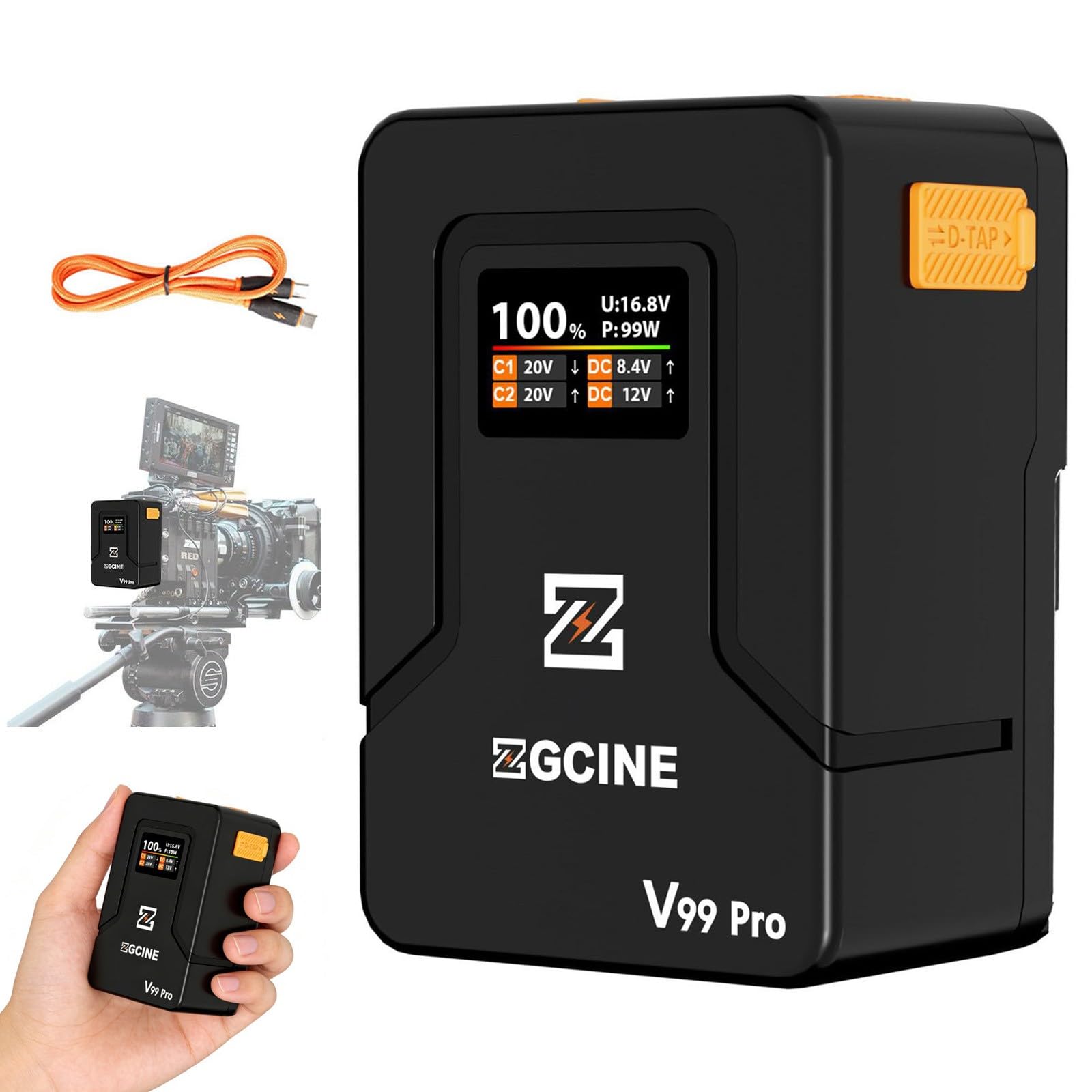
ZGCINE V99 Pro

92 /100
Keeper Score Outstanding

Key details

Ports
2x USB-C, D-Tap, BP, 8.4V DC, 12V DC
Capacity
94.72Wh
USB-C PD
100W bidirectional
Full Recharge
1.5 hours with 100W charger
Check Price on Amazon

Watt-hours settle the first question with any V-mount, and this one lands at 94.72Wh, under the hundred-watt-hour line that separates a pack you carry on from one you negotiate over at the desk. That single figure is why we hand it to most people. The rest backs it up: a 100W USB-C port that runs in both directions, a second USB-C, D-Tap, BP and two DC barrels, and a 1.1-inch OLED reporting voltage, remaining capacity and draw instead of four vague bars.

Recharge speed is where it pulls ahead of packs that cost more. On a 100W charger it fills in roughly 1.5 hours, which in practice means a lunchtime top-up covers the rest of the day. Because the USB-C port is bidirectional, the brick that charges the pack can also run a laptop or a phone when the shoot turns into an edit, and the second USB-C lets a camera and a monitor share the pack without a splitter.

At 0.6 kg it sits mid-pack for weight rather than qualifying as a mini, which matters more on a gimbal than on a shoulder rig. For one brick that covers travel days, studio days and laptop duty, we have not found a better balance in this set.

Pros

  • Airline-legal 94.72Wh with 100W PD both ways
  • Recharges in about 1.5 hours on a 100W charger
  • Two USB-C, D-Tap, BP and dual DC ports
  • OLED shows voltage, draw and remaining capacity

Cons

  • Single D-Tap output
  • 100W charger sold separately
Our verdict

We recommend it as the default: 94.72Wh keeps it in the carry-on band, 100W USB-C runs both ways, and a 1.5-hour recharge means one brick covers a travel day.

Check Latest Price
2

Best Warranty

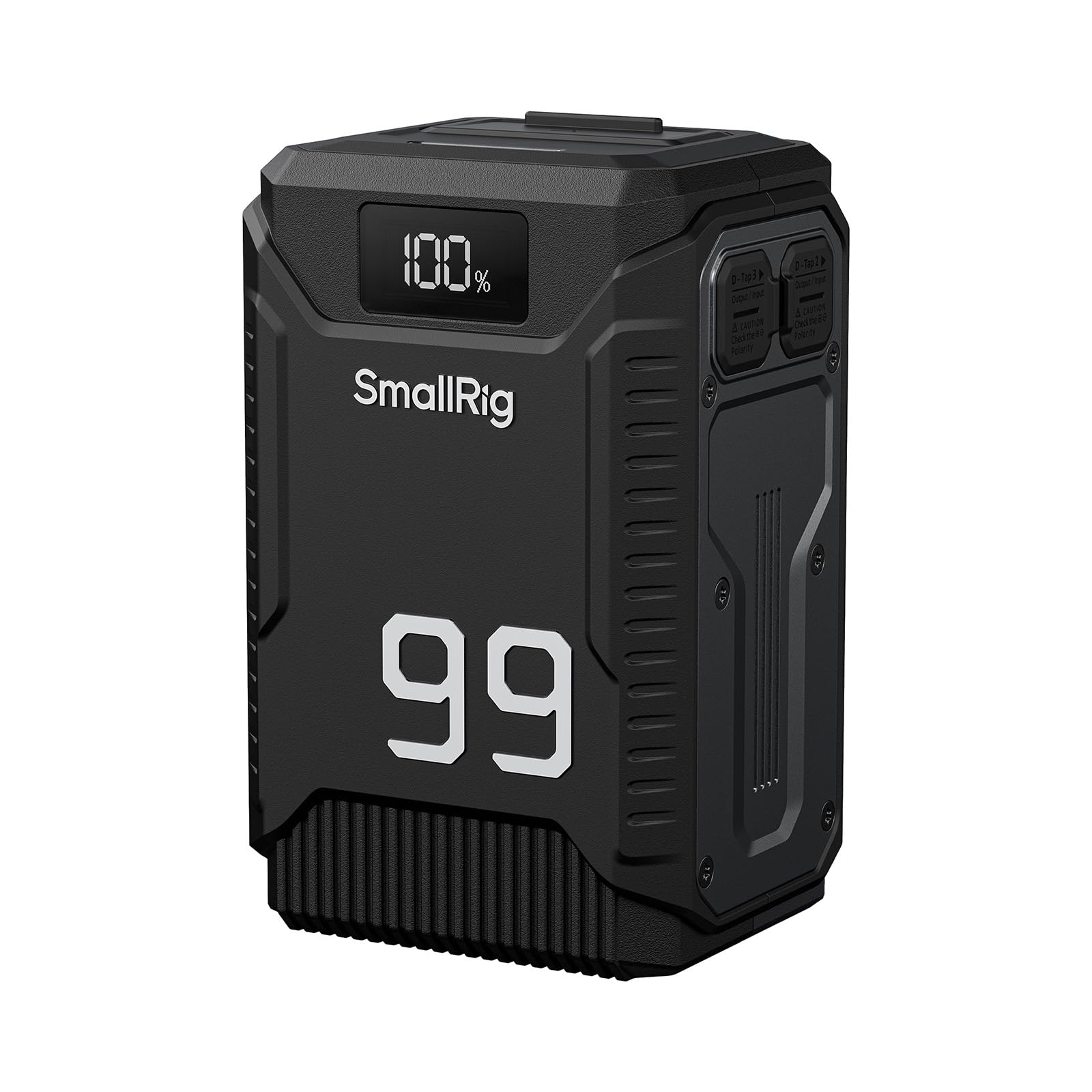
SMALLRIG VB99 SE

93 /100
Keeper Score Outstanding

Key details

Ports
USB-C, USB-A, D-Tap, BP, 8V DC, 12V DC
Weight
1.31 lb
Capacity
99Wh
USB-C PD
65W bidirectional
Check Price on Amazon

Two years of warranty is the reason this one is on the page. SmallRig is the only maker here backing a pack for that long, and for a battery that gets swapped on and off a plate twice a day, the gap between one year and two is the gap between a consumable and a piece of kit. Underneath it is a solid 99Wh brick at 595 g with six ports and an OLED.

The port set is the widest in this group for older gear: USB-C, USB-A, D-Tap, BP, and both DC barrel sizes, 8V on 5.5 by 2.1mm and 12V on 5.5 by 2.5mm. That covers monitors, transmitters and follow focuses still wired for a barrel plug, which is more than the USB-C-first packs manage. The OLED is the configurable sort that shows what each port is drawing rather than a bare percentage, and 99Wh keeps it just under the carry-on threshold.

We reach for it on multi-day shoots, where a brick dying mid-week is what wrecks a schedule, and on rigs that have to keep working after a normal warranty window would have closed. That is the trade it asks for: money up front, support later.

Pros

  • Two-year warranty, the longest in this group
  • 99Wh sits just under the carry-on threshold
  • USB-C, USB-A, D-Tap, BP and dual DC barrels
  • Configurable OLED shows per-port status

Cons

  • 65W charging, slowest of the 99Wh packs here
  • Costs about twice our top pick
Our verdict

We point people here for the two-year warranty: 99Wh, six ports and a configurable OLED in a 595 g body, with slower charging as the trade.

Check Latest Price
3

Best High-Capacity Value

NEEWER PS150E

90 /100
Keeper Score Outstanding

Key details

Capacity
150Wh
USB-C PD
100W bidirectional
Full Recharge
2.5 hours with 120W charger
Airline Status
Not air safe
Check Price on Amazon

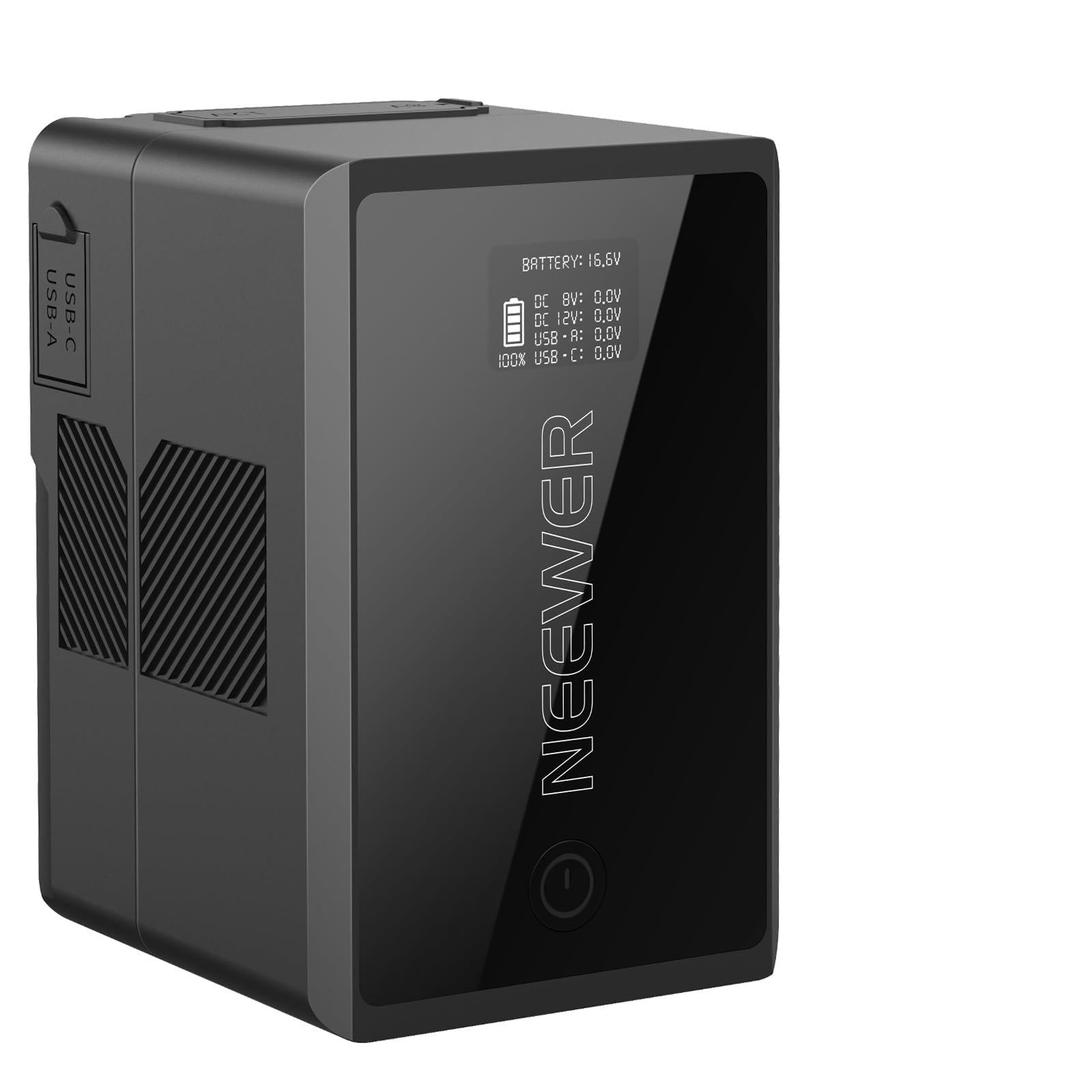
NEEWER's own listing calls the 150Wh cell in this pack not air safe, and that line decides where it lives: the car, the studio, the cart, not your carry-on. Accept it and you get a lot of capacity for midrange money in a body NEEWER describes as palm-sized at 4.4 by 2.9 by 3 inches, which is smaller than 150Wh has any right to be.

The specification we care about most is the 100W USB-C port, bidirectional, which refills the pack in about 2.5 hours on a 120W charger and can run a laptop when the day turns into an edit. Simultaneous USB-A and USB-C discharge tops out at 100W total, the six-port spread includes D-Tap, BP and both DC barrels, and the 1.12-inch OLED flags abnormal conditions rather than just a percentage. On a cart or a light stand, this is the brick we grab to stop thinking about runtime.

Half again the capacity of a 99Wh pack is the whole argument: on a monitor or a light, that is the difference between finishing a day and swapping mid-afternoon. It is the sensible middle for anyone who shoots in one place and is tired of carrying three small bricks.

Pros

  • 150Wh in a palm-sized body
  • 100W USB-C in both directions
  • Six ports including D-Tap, BP and dual DC
  • OLED flags fault conditions, not just charge

Cons

  • 800 g pulls on a small rig
  • 120W charger sold separately
Our verdict

Our pick when the work never leaves the ground: 150Wh and 100W USB-C for midrange money, in a palm-sized body.

Check Latest Price
4

Best for LED Lights

REYTRIC 300Wh

88 /100
Keeper Score Excellent

Key details

Weight
1,800 g
Capacity
300Wh (20,400mAh)
In The Box
5A D-Tap charger and D-Tap cable
Max Output
14.8V / 15A
Check Price on Amazon

Three hundred watt-hours at 14.8V and 15A makes this a light battery first and a camera battery second. The current rating is the interesting part: a COB or panel that drains a 99Wh brick inside an hour will run a setup or two off this, and it is the only pack here built around that job. We treat it as the studio's power block, not a rig battery.

It is also the most complete package in the group. The battery, a 5A D-Tap charger and a D-Tap cable all come in the box, where most of these packs sell you the brick and leave the charging to you. The 5A charger matters as much as the capacity, halving the wait against a 2A unit, so a pair of these can rotate through a shooting day without a dead block on the bench.

At 1.8 kg it belongs on a stand, a cart or a floor plate; nobody is hanging it off a cage for handheld work, and that is fine, because a light does not move much. If your day is one light and one camera in one room, this is the pack that stops you thinking about power.

Pros

  • 300Wh and 15A output for power-hungry lights
  • Includes a 5A D-Tap charger and cable
  • A lot of watt-hours for midrange money

Cons

  • Far beyond carry-on limits at 300Wh
Our verdict

We buy this one for the lights: 300Wh at 15A, with the charger and D-Tap cable included, and a weight that keeps it on a stand.

Check Latest Price
5

Best Budget Kit

REYTRIC 95Wh

92 /100
Keeper Score Outstanding

Key details

Ports
D-Tap, USB-A
Capacity
95Wh (6,600mAh)
In The Box
D-Tap charger and D-Tap cable
Full Recharge
3 hours
Check Price on Amazon

A charger and a D-Tap cable come in the box, and that detail is what puts this one ahead of packs that look cheaper on the shelf. Price a V-mount charger on its own and the advantage disappears. This is the cheaper of the two picks here that hand you a complete charging setup, and a full charge from the supplied wall plug takes about three hours.

The battery itself is old-school in a useful way: 95Wh, 14.8V, a D-Tap output and a 5V/2.1A USB port, a housing that feels solid on the plate and a mount that releases cleanly. D-Tap remains the most efficient way to feed a monitor or a light, and this pack does that job without any of the USB-C circuitry that adds cost.

For a two-brick kit we still like it. Two of these with chargers come in below a single 99Wh pack from the top of this list, and 95Wh is enough for a camera and a monitor across a shooting day. The supplied wall plug takes three hours, so plan charging around it rather than around a USB-C brick you already own.

Pros

  • Charger and D-Tap cable included
  • 95Wh under the carry-on line
  • Solid housing and clean mount release
  • Cheaper than most 99Wh packs

Cons

  • No USB-C input or output
  • D-Tap and USB sockets sit very close together
Our verdict

We recommend it as the budget kit that is actually complete: 95Wh, a charger and a D-Tap cable in the box, and no USB-C to complicate the price.

Check Latest Price
6

Best Capacity for the Money

FirstPower 121Wh

84 /100
Keeper Score Excellent

Key details

Ports
Dual D-Tap, USB-C, USB-A, BP
Weight
1.7 lb
Capacity
121Wh (8,400mAh)
USB-C PD
60W bidirectional
Check Price on Amazon

One hundred and twenty-one watt-hours for less than most of the 99Wh packs here is the entire pitch. FirstPower gets there with an 8,400mAh cell, dual D-Tap outputs, USB-C at 60W in both directions, USB-A and a BP port, in a case 5.35 by 3.62 by 2.34 inches. Nothing about the design is clever. There is just more capacity for the money.

For a rig that lives on a tripod or a shoulder, that is a straight win. A fifth more capacity than a 99Wh brick is an extra hour or two of camera and monitor, and two D-Tap outputs at this price are unusual, so camera and monitor both run without a splitter. The 60W USB-C input refills it between days, and the protection set is the standard overcharge, overvoltage, overcurrent and short-circuit group.

The cost is bulk: at 1.7 lb and 2.34 inches deep it is a noticeably bigger object on a small cage than the mini packs, and it pushes the balance forward on a short rig. On a shoulder mount or a tripod head, that weight is doing useful work.

Pros

  • 121Wh for less than most 99Wh packs
  • Dual D-Tap outputs at this price
  • 60W USB-C in both directions

Cons

  • No cable in the box
  • Over 100Wh, so check with your airline
Our verdict

Our value pick for rigs that stay on the ground: 121Wh and dual D-Tap outputs for less than most 99Wh packs here.

Check Latest Price
7

Best Mini

NEEWER PS050E

85 /100
Keeper Score Excellent

Key details

Ports
USB-C, USB-A, D-Tap, BP, 8V DC, 12V DC
Weight
12.7 oz
Capacity
50Wh (3,450mAh)
USB-C PD
45W bidirectional
Check Price on Amazon

Three hundred and sixty grams, 1.5 inches thick, and it still carries a D-Tap, a BP port, two DC barrels, USB-C, USB-A and an OLED. The PS050E is the pack we put on a small mirrorless rig when the plate and camera already weigh enough, and at that size it is the difference between a gimbal that balances and one that hunts. On a handheld setup the brick stops being the thing you notice.

The spec sheet is more complete than 50 watt-hours suggests. USB-C runs at 45W in both directions with PD3.0, QC and PPS support, USB-A and USB-C can discharge at once, the 1.12-inch OLED alerts on abnormal conditions, and the certification list includes UL and CE. It is also explicitly airline friendly, which several bigger packs here cannot claim.

The limit is draw. Fifty watt-hours goes quickly if you are feeding a bright monitor and a body that charges over USB-C, and it will not run a serious LED. Treated as a rig battery rather than a day battery, it is very good at the job.

Pros

  • 360 g and 1.5 inches thick
  • Full port set with D-Tap, BP and dual DC
  • 45W PD with PPS and QC support
  • USB-C and D-Tap cables included

Cons

  • Priced like a 99Wh pack for half the capacity
Our verdict

We reach for it on gimbals and handheld rigs: 360 g with a full port set, at a price that assumes you need the small size.

Check Latest Price
8

Light Shoulder Rigs

K&F CONCEPT V99 SE

83 /100
Keeper Score Excellent

Key details

Ports
Dual D-Tap, USB-C, USB-A, BP, 12V DC
Weight
1.16 lb
Capacity
99Wh (6,700mAh)
USB-C PD
100W bidirectional
Check Price on Amazon

At 525 g this is the lightest 99Wh pack here, and on a shoulder rig that number matters more than any other. K&F pairs it with two D-Tap ports, 100W USB-C in both directions, USB-A, BP and a 12V barrel, in a fire-resistant PC housing, and rates it airline friendly.

The money went on ports and housing rather than instrumentation. Two D-Taps and 100W PD cover a modern rig, and the fire-resistant shell is the sort of thing you only think about the day it matters. There is also an emergency light on the back panel, which is genuinely useful to find at the end of a night shoot.

Dock charging is the catch. On a V-mount charger this pack can stop short of full, and the fix is a USB-C top-off before a shoot day, so if your workflow is two bricks in a dual charger overnight, add that step or choose something else.

We rate it as a good second or third brick: light, cheap for 99Wh, with the port set a modern rig actually uses. For the one battery you buy first, the ZGCINE asks the same money and gives you a display you can diagnose from.

Pros

  • Lightest 99Wh pack here at 525 g
  • 100W USB-C and dual D-Tap
  • Rear emergency light
  • Airline-friendly 99Wh capacity

Cons

  • Indicator lights only, no voltage or draw readout
Our verdict

We treat it as a light second brick: 525 g with 100W USB-C and dual D-Tap, provided you can top it off over USB-C.

Check Latest Price
9

Outdoor and Rough Use

SMALLRIG T99

93 /100
Keeper Score Outstanding

Key details

Ports
3x D-Tap, 2x USB-C, USB-A, BP
Capacity
99Wh (6,800mAh)
USB-C PD
100W bidirectional
Durability
IP54, 5.9 ft drop-proof
Check Price on Amazon

No other pack here rates its housing for dust and water. The T99 is IP54 sealed and drop-tested to 5.9 feet, which is either the most useful line on this page or irrelevant, depending on whether your rig has been rained on or knocked off a stand. Three D-Tap outputs and two 100W USB-C ports are the other unusual part.

We rate it for outdoor and rough-handling work: documentary rigs, run-and-gun setups that live in the back of a van, anything that gets set down on concrete. The rear LED earns its place in a dark corner of a venue, and both USB-C ports take 100W in and out, so one GaN charger refills it quickly. Inside, SmallRig uses LG cells with a six-layer BMS, and 99Wh keeps it in the carry-on band.

The premium is real: it costs more than any other 99Wh pack here, and SmallRig warrants it for one year where the VB99 SE gets two. You are paying for the sealed housing and the extra D-Taps. If your gear never leaves a studio, that is money you do not need to spend.

Pros

  • IP54 sealing and a 5.9 ft drop rating
  • Three D-Tap ports plus two 100W USB-C
  • Rear LED for dim sets
  • 240W USB-C cable included

Cons

  • Heaviest 99Wh pack here at 862 g
  • No DC barrel ports, D-Tap and USB only
Our verdict

We recommend it where gear gets wet, dropped or loaded in a van: IP54 sealing, three D-Taps and dual 100W USB-C at a premium.

Check Latest Price

How We Tested These V-Mount Batteries

We started with around 40 listings and cut hard. Anything with a vague capacity claim, only one usable output, or a charger sold as a separate purchase came off the list. What survived was 12 batteries across four capacity bands, from a 50Wh mini that fits in a jacket pocket to a 300Wh brick that lives on a light stand.

Testing ran six months and followed the batteries into their actual life rather than onto a bench. They hung off monitor cages on a two-day documentary shoot, rode the back of a gimbal, powered an LED panel in a garage studio, topped up laptops and phones at a kitchen table, and went through airport security in a carry-on. Every one got weighed, mounted on a shoulder rig, and carried for a full day so we could feel what the extra ounces did by hour six, and we noted how much room each took up in a bag.

The measurements that mattered were runtime on a 60W LED panel and on a laptop, timed recharge from empty with the fastest USB-C charger each one supported, and whether the D-tap, USB-C, and USB-A outputs held up when we drew from all of them at once. We parked a USB-C power meter beside each on-board display to see whether the percentage matched reality, checked whether the port labels were readable in a dim room, and judged build quality by the V-lock latch, shell flex, and heat after 30 minutes at full draw.

Value came last, once the runtime numbers were in, and we compared minutes of light per dollar rather than milliamp-hours on the label. The batteries still get used on shoots, so if anything changes over a longer haul, this list will change with it.

How to Choose a V-Mount Battery

Watt-Hours First, Then the Carry-On Line

Capacity is where every decision starts, and the number to hold in your head is 100Wh. At or under it, the ZGCINE at 94.72Wh and the SMALLRIG at 99Wh sit in the band airlines treat as ordinary carry-on. Above it, from the 121Wh FirstPower up to the 300Wh REYTRIC, you are asking permission rather than packing. Fly more than a couple of times a year and buy under the line, then buy a second small pack before you buy one big one.

There is a second trap here: extra capacity usually arrives as extra mass, not better cells. A 150Wh pack is not a 99Wh pack with more runtime for free; it is a heavier brick, and NEEWER's own listing for the PS150E says plainly that it is not air safe. If your work never leaves the ground, the bigger pack is simply more shooting.

USB-C PD Changed the Port Math

Two wattages matter now: what goes into the pack and what comes out. A 100W USB-C input refills a 99Wh brick in about an hour and a half, 60 to 65W takes closer to two and a half hours, and 45W is an overnight job. Output is the same number in reverse, and it decides whether the same battery can run a laptop or feed a camera over PD between takes.

Weight Is a Rig Decision, Not a Spec

Grams only mean something against the mount they hang on. The mini class sits around 330 to 360 g, a standard 99Wh brick runs 525 to 600 g, sealed and high-capacity packs start at 800 g upward, and the 300Wh REYTRIC lands at 1.8 kg. Match the class to the rig: a mini on a gimbal, a 99Wh on a shoulder mount, and anything past 800 g on a stand, a cart or a floor plate.

Chargers, Cables and What's in the Box

Read the box contents before the price. Most of these packs ship as the battery alone: the ZGCINE wants a 100W charger, the NEEWER a 120W one, and FirstPower does not include a cable. Two of our picks, the REYTRIC packs, arrive with a charger and a D-Tap cable, which changes the real cost of a two-brick kit more than a small price difference does.

Then decide how you will charge. USB-C is convenient and travels; a V-mount dock charger is faster for a rotating set of bricks. If you already own a dock, check that a new pack reaches full on it, because some stop short and need a USB-C finish.

Displays, Sockets and the Long Haul

An OLED that reports voltage, draw and remaining capacity is worth more than it sounds: it tells you which device is eating the pack and whether a cell is behaving. Indicator lights are enough to decide when to swap and not much else. Then look at the parts that wear: D-Tap sockets loosen, USB-C ports take the most insertions, and closely spaced connectors can stop two cables sharing one face.

Frequently Asked Questions

Final Verdict

Buy the ZGCINE V99 Pro unless something specific about your work says otherwise. It travels without paperwork, refills in about an hour and a half on the right charger, and can run a camera, a monitor and a laptop off one brick, all for less than most of this list.

The two exceptions are worth naming. If your day is built around LED lights or a heavy cinema body in one room, the 300Wh REYTRIC is the pack that stops you thinking about power. If you never fly and want maximum capacity for the money, the 150Wh NEEWER is the one, charger and airline approval aside.