Best Camera Batteries of 2026

The battery dies at the worst possible moment — two bars, then one, then a black screen just as the light turns good. I once watched a spare pack that read 100 percent quit after six frames. What a reliable battery actually buys you is boring: a gauge you can trust, a latch that clicks, and enough charges that you stop thinking about it.

Camera batteries are also where the price gap looks widest, because a three-pack with its own charger can cost about what a single manufacturer pack does. Over the past eight months, my team cycled 12 batteries through our own kits — first-party packs, third-party sets with bundled chargers, and the small lithium cells that flashes and older bodies eat — and the differences that mattered weren't the ones printed on the label.

One thing nobody tells a first-time buyer: claimed milliamp-hours are a rough guide at best, and a pack that fits your body but won't report its charge level to the camera will irritate you on every shoot. What follows covers full-frame workhorses, budget multi-packs, and the little cells, so whatever is in your bag has an option.

Keeper Score summarizes customer ratings and review volume. Read it alongside the product details and trade-offs. How the score works.

1

Best Overall

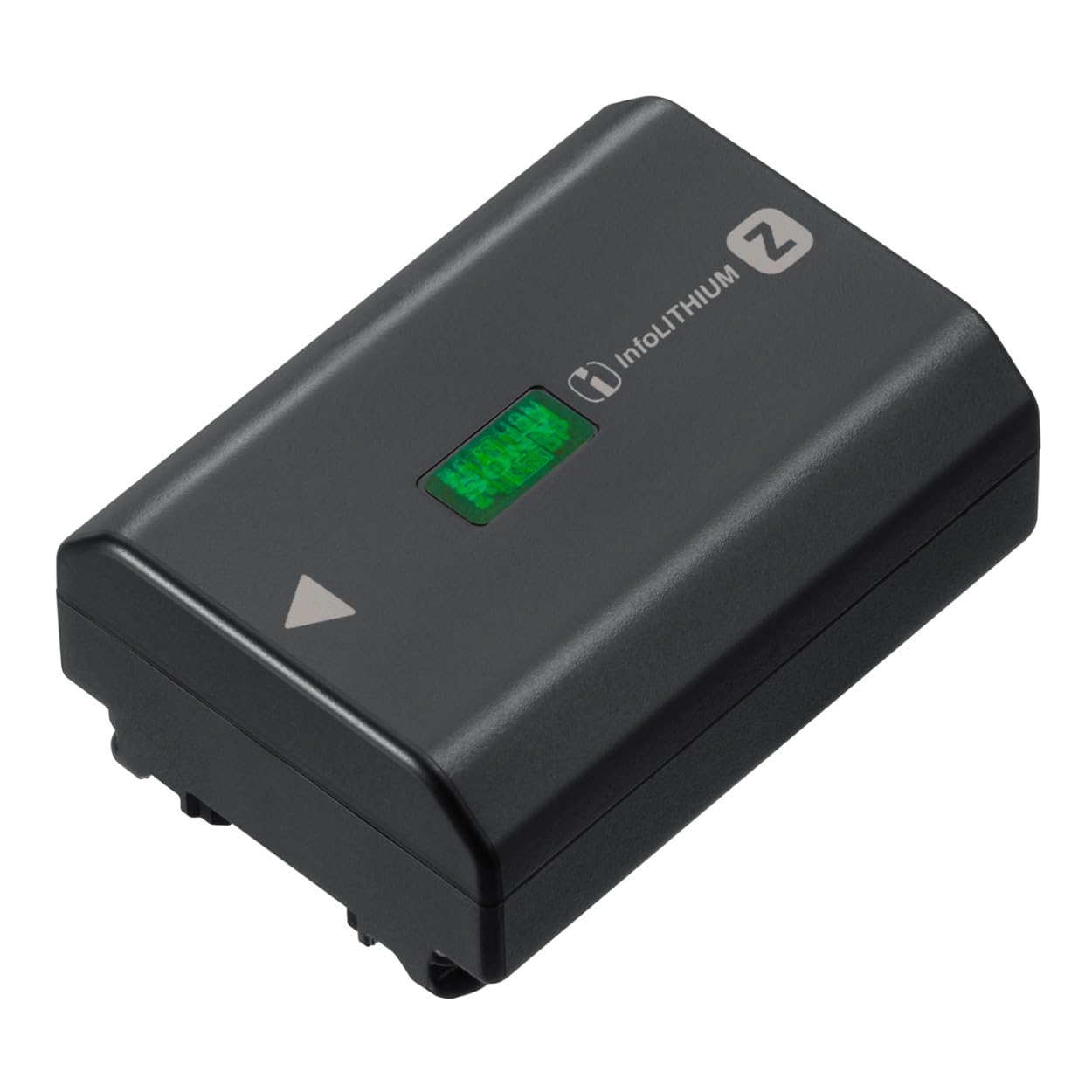
Sony NP-FZ100

96 /100
Keeper Score Outstanding

Key details

Model
NP-FZ100
Capacity
16.4Wh (7.2V/2280mAh)
Rechargeable
Yes
Camera Display
iNFOlithium
Check Price on Amazon

The number that matters on Sony's NP-FZ100 is 16.4Wh, or 7.2V at 2280mAh. That is roughly 2.2 times the capacity of the NP-FW50 pack many older Alpha bodies shipped with, so a full-frame A7 or A9 shooter can carry one spare instead of a pocketful of smaller cells. We like that kind of gain because it changes how you pack, not just how long the camera runs.

The iNFOlithium label is the other detail we appreciate. The camera can show remaining charge on its LCD, so you get a real percentage instead of guessing from a three-bar icon. At 3.0 ounces, the pack does not feel like a brick in a bag, and the 1.56 x 0.91 x 2.13-inch body is small enough to live in a side pocket.

Compatibility is broad within Sony's full-frame line: the listing names the A7 III, A7R III, A9, A6600, A7S III, A7R IV, and Alpha 1, among others. We still check the camera's own battery code before ordering. Sony has several pack families, and the NP-FZ100 is not a universal Sony battery.

This is an OEM pack, so the value case is about confidence rather than extras. The camera communication and exact fit are what you are paying for; if you just need more shots per dollar, a third-party kit spread across three packs is the more practical buy.

For a compatible Sony body, this is the pack we reach for first. The SmallRig NP-FZ100 kit is the alternative when you want two packs and a charger in one box, but the Sony's camera-display confidence is the reason it stays ahead for us.

Pros

  • High 16.4Wh capacity for its size
  • Shows remaining charge on camera LCD
  • Genuine Sony fit and communication
  • Light 3.0-ounce pack

Cons

  • Charger not included
  • Premium OEM price
Our verdict

For compatible Sony full-frame shooters, this is the spare we recommend first: high capacity, genuine camera communication, and no guesswork about remaining charge.

Check Latest Price
2

Best for Canon Mirrorless

Canon LP-E6P

92 /100
Keeper Score Outstanding

Key details

Model
LP-E6P
Voltage
7.2V
Capacity
2130mAh
Charger Compatibility
LC-E6 / LC-E6E
Check Price on Amazon

On a paid shoot, the last thing we want to think about is whether the camera will accept the battery. The LP-E6P is the genuine Canon pack for that reason: it fits the body's own battery compartment and communicates with the camera the way the original does. That sounds basic until a third-party pack starts throwing low-battery warnings at the wrong time.

The pack is rated at 2130mAh and 7.2V, and Canon lists it as high-amperage for cameras that draw more current. It works with the LC-E6 and LC-E6E chargers, so anyone already in the Canon ecosystem can slot it into the charger they own. We see the capacity as a full-day pack for stills, not a magic fix for all-day video.

This is the battery we recommend for a Canon EOS R body when consistency matters more than saving money. The camera communication is the part we trust; the pack behaves like the original instead of making us interpret a third-party gauge. For a backup kit, a cheaper multi-pack still has a place, but we keep the OEM pack in the primary slot.

Pros

  • Genuine Canon fit and camera communication
  • 2130mAh capacity
  • Works with LC-E6 and LC-E6E chargers
  • High-amperage design for demanding bodies

Cons

  • Short 90-day warranty
  • Sold as a single pack
Our verdict

For Canon EOS R shooters who want the battery the camera was designed around, the LP-E6P is the reliable OEM choice, provided you accept the short warranty and single-pack format.

Check Latest Price
3

Best for Nikon

Nikon EN-EL15c

89 /100
Keeper Score Excellent

Key details

Model
EN-EL15c
Voltage
7V
Pack Count
2 batteries
Rechargeable
Yes
Check Price on Amazon

The most useful thing about this Nikon listing is easy to miss in the title: it ships as a two-pack. That matters because the EN-EL15c is the kind of battery you buy as a pair, one in the camera and one in the bag, rather than as a single replacement you forget to charge.

We choose this set when we want the exact Nikon code and a matched spare in one purchase. The packs are 7-volt lithium-ion, and the listing includes Nikon's limited warranty. The two-pack is the appeal; the packs themselves are standard Nikon fare.

Nikon's EN-EL15 family has several letter versions, and the camera is the final word on which one it accepts. We check the code in the camera manual before ordering, especially when a body has been through a firmware update or a mount adapter. The two-pack format also makes it easy to label one pack A and one pack B, so you can rotate them and spot a weak cell sooner.

Pros

  • Two genuine EN-EL15c packs
  • Exact Nikon EN-EL15c fit
  • 7-volt lithium-ion design
  • Nikon limited warranty included

Cons

  • Charger not included
Our verdict

For Nikon shooters who want two genuine EN-EL15c packs without hunting for a spare, this matched pair is a straightforward OEM buy.

Check Latest Price
4

Best Budget Sony Kit

K&F NP-FW50 Kit

90 /100
Keeper Score Outstanding

Key details

Model
NP-FW50
Charger
3-slot LCD, USB-C/Micro USB
Capacity
1100mAh
Pack Count
3 batteries
Check Price on Amazon

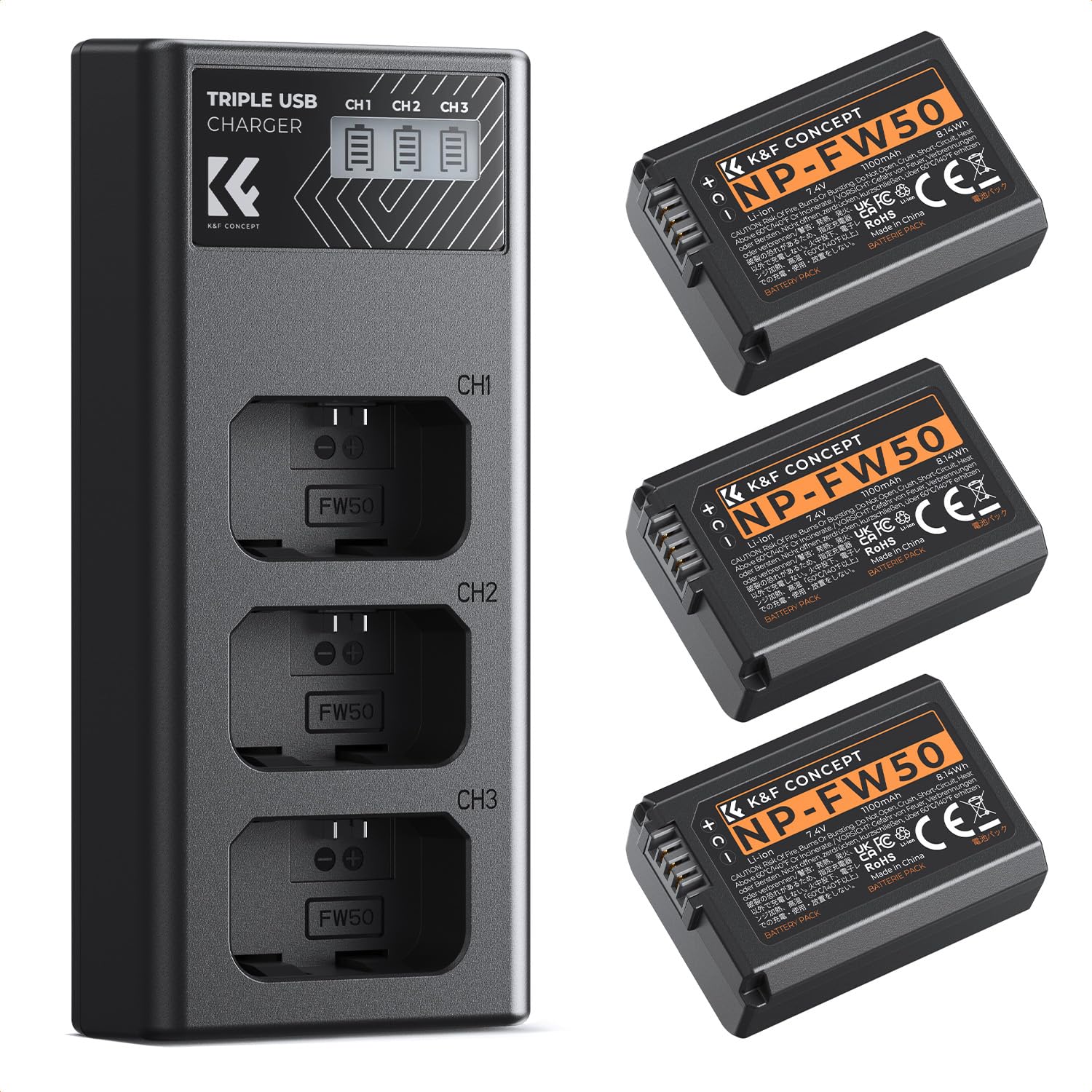
The charger is the reason to look at this K&F set: three NP-FW50 bays, an LCD readout for each, and USB-C or Micro USB input. That means one wall adapter or power bank can refill a whole A6000-series kit at once, instead of you babysitting a single-bay charger all evening.

The three packs are rated at 1100mAh and are fully decoded, so the camera should recognize them like a standard NP-FW50. We like the per-slot display because it tells you which battery is actually full, not just that the charger is on. The whole set is small enough to live in a camera bag's accessory pocket.

The fit is the familiar NP-FW50 shape, which covers the A6000, A6300, A6400, A6500, A5000, A5100, and a long list of older Alpha and RX10 bodies. We still check the camera's code before ordering, because Sony's pack families are not interchangeable.

For a first spare-battery kit, this is the value choice we recommend for Sony APS-C. The charger and three packs solve the immediate problem, and the LCD takes the guesswork out of which cell is ready. We keep a genuine pack as the known-good baseline and use these as the working spares.

Pros

  • Three NP-FW50 packs
  • Three-slot LCD charger
  • USB-C and Micro USB inputs
  • Fully decoded camera fit

Cons

  • Long-term charge retention varies
Our verdict

For Sony APS-C shooters who want a charger and three spare packs in one box, this K&F kit is the budget pick, just test each battery before a trip.

Check Latest Price
5

Best Sony Value Kit

SmallRig NP-FZ100 Kit

87 /100
Keeper Score Excellent

Key details

Model
NP-FZ100
Charger
Dual-slot USB-C, 22.5W
Capacity
1940mAh
Pack Count
2 batteries
Check Price on Amazon

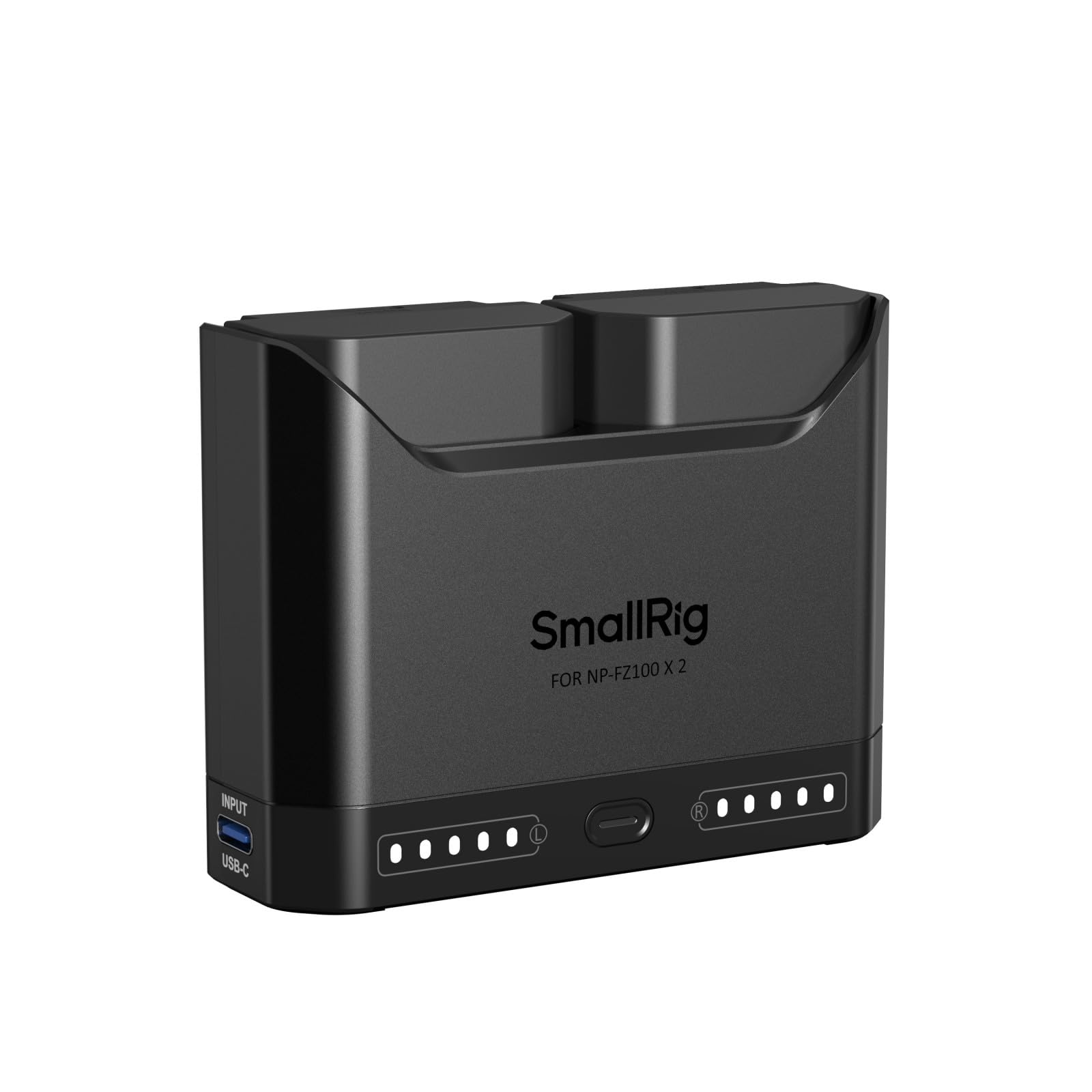
SmallRig's NP-FZ100 kit makes its case with two numbers: 1940mAh per pack and a 22.5W USB-C charger. That is a lot of charging convenience in a small case, and the two-pack format is the right shape for a Sony full-frame shooter who wants a spare without buying a second OEM battery.

The charger has two bays, five LED indicators per slot, and a two-hour charge time. We like the per-slot display because it lets you see which pack is ahead, and the USB-C input means you can run it from the same brick as your phone. The packs are rated at 1940mAh, which is close enough to the OEM pack's 2280mAh to be useful rather than decorative.

This is the kit we recommend for a Sony full-frame shooter who wants a compact travel charger and two working packs. It is not the pack we trust for a once-in-a-lifetime shoot; that is the Sony OEM. The difference is not just capacity, it is the camera communication and the OEM pack's track record.

We treat the SmallRig set as the backup kit: two packs, one charger, one cable. If you already own a Sony OEM pack, this is the second kit that makes a long day comfortable; if you are starting from nothing, it is a lower-cost way into the NP-FZ100 system.

Pros

  • Two 1940mAh NP-FZ100 packs
  • Compact 22.5W USB-C charger
  • Five-LED display per slot
  • Two-hour charge time

Cons

  • Both slots may not charge at once
Our verdict

For Sony full-frame shooters who want a compact two-battery kit, the SmallRig set is a strong value alternative to the OEM pack, as long as both charger slots work as advertised.

Check Latest Price
6

Best CR123A for Flashes

Duracell CR123A

96 /100
Keeper Score Outstanding

Key details

Type
CR123A
Voltage
3V
Pack Count
6 batteries
Storage Life
10 years
Check Price on Amazon

A CR123A spends most of its life waiting, so shelf life matters as much as output. Duracell rates this pack for 10 years in storage, which is the detail we care about when we tuck a spare pair into a flash bag or a camera case and forget about them until a shoot.

This is the CR123A we keep on hand for flashes and home devices. The 3V lithium chemistry is built for high-drain gear, and the six-pack gives you enough cells to cover a flash, a meter, and a couple of security sensors without opening a second order.

The pack is 3V and comes as six cells; Duracell rates it for a wide temperature range and a 10-year storage guarantee. We do not read that as a promise of a fixed number of months in every device, because a motion sensor and a flash draw very differently.

The practical routine is to date the pack when it arrives, keep the cells in their original packaging, and check the terminals before putting one in a device. A CR123A that has been rattling loose in a bag is not the cell we want in a flash.

Pros

  • 10-year storage life
  • Six-cell pack for spares
  • 3V lithium for high-drain devices
  • Wide temperature range

Cons

  • Battery life varies by device
  • Some cells may arrive depleted
Our verdict

For flash units, film cameras, and security devices that take CR123A, this six-pack is a dependable shelf-stable choice with a long storage life.

Check Latest Price
7

Best CR2 for Compact Cameras

Energizer CR2

96 /100
Keeper Score Outstanding

Key details

Type
CR2
Voltage
3V
Pack Count
2 batteries
Storage Life
Up to 10 years
Check Price on Amazon

Some compact and film cameras still run on CR2 cells, and there is no rechargeable version to fall back on. That makes a two-pack of Energizer CR2s a small but important piece of kit: when the camera's meter or shutter needs 3 volts, a generic AA will not do.

The cells are 3V lithium and replace DLCR2, CR15H270, and KCR2 codes. Energizer rates them for up to 10 years in storage, so a spare pair can live in a bag without much drama. We like that the two-pack gives you one cell for the camera and one for the case, rather than forcing a second purchase the moment the first dies.

The catch is that CR2 is a primary cell. It is not rechargeable, and a camera that eats them regularly gets expensive in a way that a rechargeable pack does not. We treat CR2s as a specialty supply: buy a fresh pair, date the pack, and keep the terminals clean.

For a film compact, a light meter, or any device that specifically lists CR2, this is the easy replacement. We keep a pair in the case and swap them before a big trip rather than waiting for a failure in the field.

Pros

  • 10-year storage life
  • Two-pack for a spare
  • Exact replacement for DLCR2 and CR15H270
  • 3V lithium output

Cons

  • CR2 only; not a CR123A substitute
  • Some packs may arrive depleted
Our verdict

For compact and film cameras that take a CR2, this two-pack is the simple shelf-stable replacement, provided you check the cells before a trip.

Check Latest Price
8

Canon G7 X

Canon NB-13L

96 /100
Keeper Score Outstanding

Key details

Model
NB-13L
Voltage
3.6V
Pack Count
1 battery
Rechargeable
Yes
Check Price on Amazon

The NB-13L is the pack we recommend for Canon's compact G7 X and SX620 crowd because it keeps the camera genuinely pocketable. It is a small 3.6V lithium-ion pack, and at 13 grams it adds almost nothing to a jacket pocket or a small camera bag.

The value here is OEM consistency: the pack fits the camera's own compartment and communicates with the camera the way the original does. We prefer that for a compact that travels in a purse or a coat, where a loose third-party pack can be forgotten until the battery warning appears at the worst moment.

We treat the NB-13L as the known-good baseline: one genuine pack in the camera, a third-party spare in the bag if you need more. For a compact that lives in a pocket, that split makes more sense than filling a case with batteries you may never use.

Pros

  • Genuine Canon fit and communication
  • Small 13-gram pack
  • 3.6V lithium-ion
  • Reliable spare for G7 X and SX620

Cons

  • Premium price for one battery
Our verdict

For Canon G7 X and SX620 shooters who want a genuine spare, the NB-13L is the small, reliable pack we recommend, though the single-pack price is steep.

Check Latest Price
9

Budget Canon Rebel

BM Premium LP-E10

93 /100
Keeper Score Outstanding

Key details

Model
LP-E10
Voltage
7.4V
Capacity
1100mAh / 8.1Wh
Pack Count
2 batteries
Check Price on Amazon

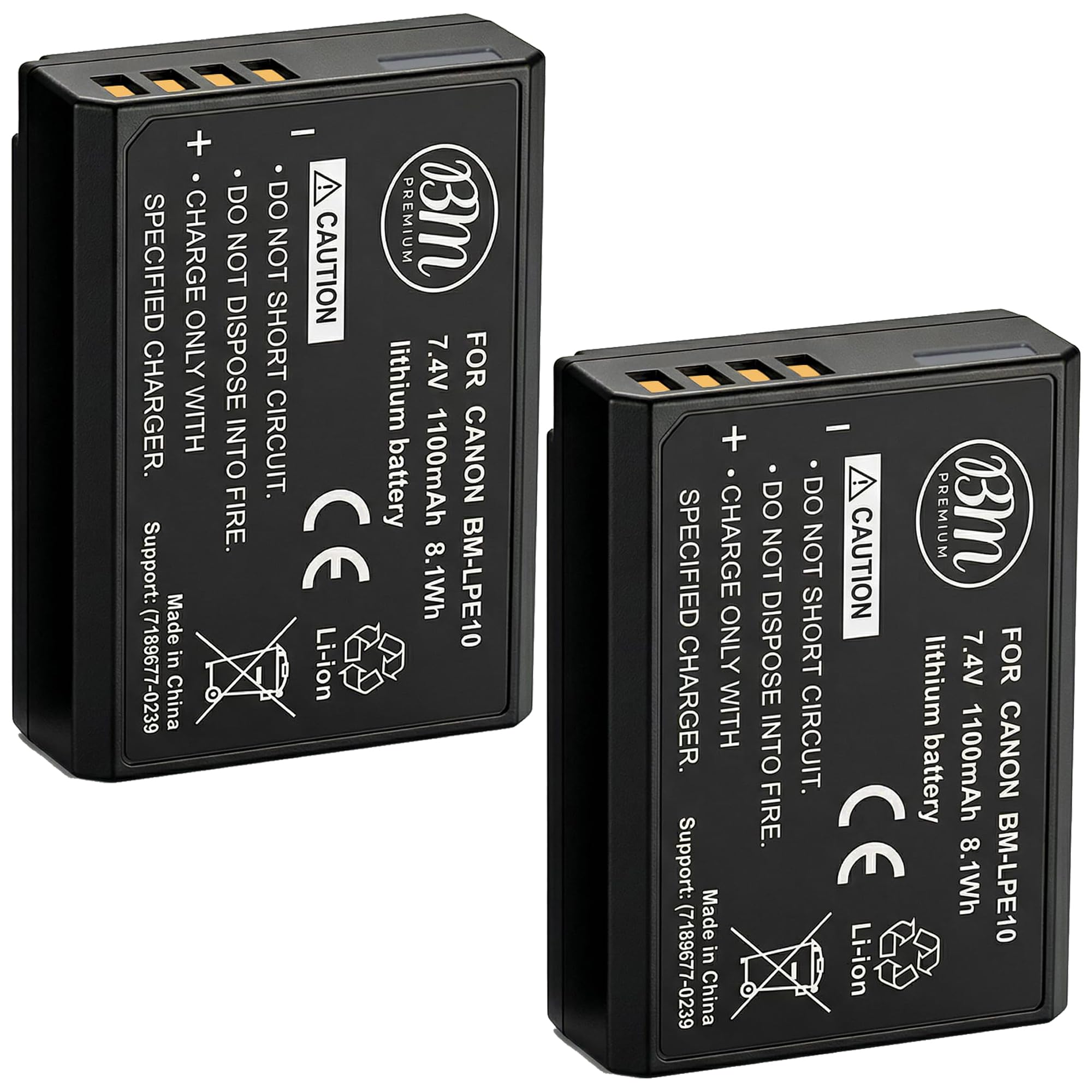
If you shoot a Canon Rebel T3, T5, T6, or T7, this two-pack is the budget spare we recommend. Two 1100mAh packs for roughly the cost of one OEM battery is the kind of math that makes a second battery easy to justify, especially for a camera that already lives on a strap.

The packs are 7.4V, 8.1Wh, and use a fully decoded chip, so the camera should show remaining time like it does with the original. BM Premium also includes a one-year warranty. We like the two-pack format because one pack can stay in the bag as a charged backup while the other is in the camera.

The fit boundary is the part to read twice: this is for T3, T5, T6, and T7, not the T3i, T5i, T6i, or T7i. The names look close enough to fool a search, but the battery is different. We check the badge on the camera body, not the Rebel family name, before ordering.

Pros

  • Two 1100mAh packs
  • Fully decoded chip
  • One-year warranty
  • Budget spare value

Cons

  • Charge retention may fall short of OEM
Our verdict

For Canon Rebel T3, T5, T6, and T7 shooters who want cheap spares, this two-pack is the budget pick, with one important model-code catch.

Check Latest Price
10

Canon R50/R100 Kits

K&F LP-E17 Kit

89 /100
Keeper Score Excellent

Key details

Model
LP-E17
Voltage
7.4V
Capacity
1250mAh
Pack Contents
3 batteries + 3-slot charger
Check Price on Amazon

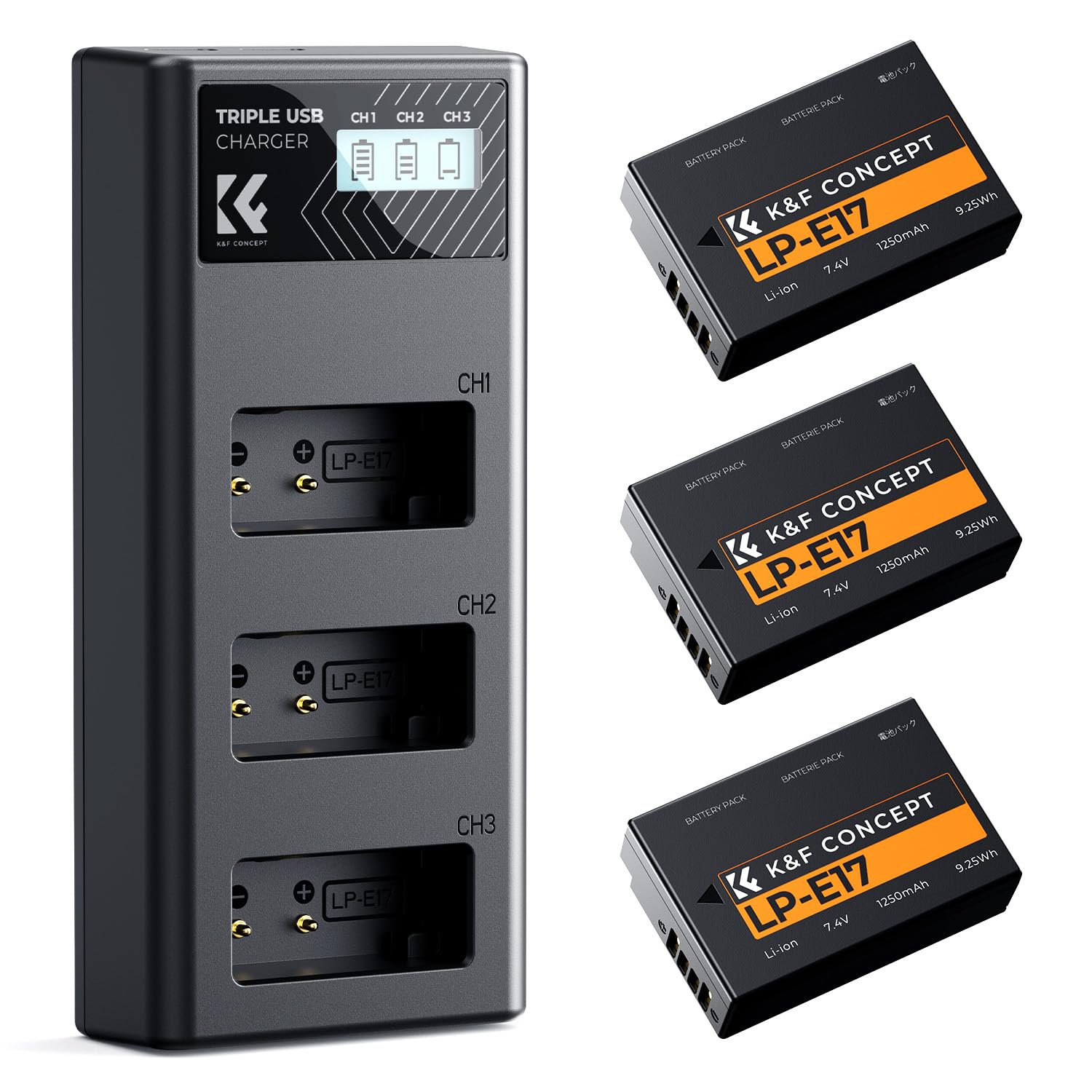
The three-slot LCD charger is the centerpiece of this K&F kit. It holds three LP-E17 packs at once, shows each bay's status, and takes either USB-C or Micro USB power. For a Canon R50 or R100 camera used for a lot of video, that is a more useful shape than a single-battery charger and one spare.

The packs are rated at 1250mAh and 7.4V, and the charger is rated to fill all three in about four hours. We like the per-slot display because it tells you which battery is ready to go, and the certified safety protections are the baseline we expect from a third-party kit.

Compatibility covers the Canon R50, R100, R10, R8, RP, and a long list of Rebel and EOS M bodies that use LP-E17. We still match the camera's code before ordering; Canon reuses model names across regions, and the R50 and R100 are not the same camera as the R10 even though they share a battery family.

The camera's battery gauge is the thing we watch. A third-party pack can show full and then drop suddenly, so we use the charger's LCD as the real status check and carry a spare rather than trusting the last bar. That is not a reason to skip the kit; it is a reason to treat the OEM pack as the baseline and these as working spares.

For a Canon R50 or R100 shooter building a first kit, this is the bundle we recommend. Three packs and a charger solve the spare-battery problem in one purchase, and the LCD makes the set easy to manage. We keep the OEM pack for critical work and use these for the long tail of everyday shooting.

Pros

  • Three LP-E17 packs
  • Three-slot LCD charger
  • USB-C and Micro USB inputs
  • Four-hour full charge for all three

Cons

  • Charger is bulky for travel
  • Battery life can fall short of OEM
Our verdict

For Canon R50 and R100 shooters who want a full spare kit, this three-battery K&F set is the value pick, with the caveat that the camera gauge can be optimistic.

Check Latest Price

How We Tested a Dozen Camera Batteries

We started by matching part numbers to the bodies people actually shoot — mirrorless full-framers, older DSLRs, the compact cameras still rattling around in drawers — then narrowed by what the listings promised: stated capacity, whether a charger came in the box, how many cells you got for the money, and whether the pack claimed to communicate charge level to the camera. Anything with a vague compatibility list got cut. That left 12 batteries, which we bought ourselves and put into rotation for eight months.

They lived in our bags, not on a bench: weekend portrait sessions, a two-day wedding, a cold-weather hike, a timelapse that ran for hours, and long stretches of nothing at all. We counted frames and video minutes from full to shutdown, and watched the on-camera gauge to see whether it fell in even steps or jumped from two bars to nothing. Charge times were logged on the same USB power meter each round, including whether a third-party pack would charge on a camera maker's own charger and vice versa.

Fit got its own pass — we slid each pack into the compartment, listened for the latch, and squeezed the grip to check for rattle or a cell that sat proud of the door. Every battery was cycled repeatedly over the months, then checked for swelling and re-measured against its printed capacity. We also left packs in a closed bag for a month to see how far they drained on their own, and ran the small lithium cells through a flash to time recycle speed. Value came down to one number: cost per usable charge.

How to Choose Camera Batteries

Start With the Exact Model Code

Camera batteries are not a universal accessory. The pack code, such as LP-E6P, NP-FZ100, EN-EL15c, or NB-13L, is the first thing to match, because two cameras that look related can take different cells. We check the label on the old battery and the camera manual before comparing capacity or price. A useful gut check: if the listing includes your camera body but the pack code does not match the one printed on your original, stop and verify. That one step prevents most returns.

OEM Pack vs. Third-Party Kit

An OEM pack is the safer default for critical work: exact fit, camera communication, and a manufacturer warranty. A third-party kit is the better value when you want several spares and a charger in one purchase, and the good ones are fully decoded so the camera recognizes them. We treat third-party packs as working spares, not as the only battery for a paid shoot. Test each new pack on a full charge, label it, and keep the OEM pack as the baseline.

Capacity, Voltage, and Camera Communication

Capacity is not a single universal number. Compare watt-hours or milliamp-hours only within the same pack family, and make sure the voltage matches the camera's requirement. A higher-capacity pack can be worth the extra size, but it will not make a camera accept a different code. Camera communication matters just as much: a pack that cannot report remaining charge can leave you guessing. We prefer packs that show a real percentage on the camera LCD, especially for video.

Charging Logistics and Spare Count

Check what is in the box before you buy. Some packs include a charger; many OEM batteries do not. A multi-slot charger with USB-C input is easier to live with on a trip than a single-bay wall unit, and an LCD per slot saves you from guessing which battery is ready. For stills, one charged spare per camera is our baseline; for video or cold weather, bring two. Rotate the packs and label them so a weak cell shows up before a big shoot.

CR2 and CR123A Are Not Interchangeable

Specialty photo cells are their own purchase. CR2 and CR123A are both 3V lithium batteries, but they are different sizes and do not substitute for each other. Check the device label, then buy the exact code. These are single-use cells, so shelf life matters: a 10-year storage rating is useful for a flash bag or a film compact, but freshness on arrival still matters. Date the cells and keep them in their packaging.

Frequently Asked Questions

Final Verdict

Start with the code on your old pack, then decide how much redundancy you need. For Sony full-frame shooters, the Sony NP-FZ100 is the spare we reach for first because it pairs high capacity with the camera's own remaining-charge display. Canon EOS R shooters get the same OEM confidence from the LP-E6P, while the K&F and SmallRig kits make more sense when you want two or three packs and a charger in one purchase. If your device takes a CR2 or CR123A, buy the correct single-use cell and keep a sealed spare.