Best Rechargeable AA Batteries of 2026

For years my kitchen drawer was a graveyard of half-used disposables, and I kept buying more because a dead remote always seemed to arrive without warning. Moving the whole house to rechargeable NiMH ended that. The right cell isn't the one with the biggest number on the label — it's the one still holding a charge when you pull it out three months later.

Over five months my team ran 16 rechargeable AAs from seven brands through the devices that actually eat batteries: game controllers, remotes, a wireless mouse, headlamps, camera flashes, a toddler's toys. We timed how long a charge lasted, how long topping up took, and whether each cell slid into a tight compartment without a fight. A pack only looks like a bargain if it also survives more than a handful of cycles.

One thing first-timers rarely hear: capacity and longevity pull against each other. The highest-capacity cells usually trade away recharge count, so for a flashlight that sits in a drawer for months, low self-discharge beats a bigger mAh number. The picks below split along that line.

Keeper Score summarizes customer ratings and review volume. Read it alongside the product details and trade-offs. How the score works.

1

Best Overall

Panasonic eneloop AA (8-Pack)

96 /100
Keeper Score Outstanding

Key details

Capacity
2,000 mAh (2,100 typical)
Pack Size
8 cells
Recharge Cycles
Up to 2,100
Charge Retention
70% after 10 years
Check Price on Amazon

Two thousand one hundred recharges is the number that decides this one for us. Cycle a set twice a month and that is decades of use before the cells fade — long enough that an eight-pack stops being a recurring purchase and becomes the thing you reach for. They also arrive charged, so the first four can go straight into a controller.

What we appreciate is the balance around that rating. Capacity is 2,000 mAh minimum and 2,100 typical, which is mid-pack here: the eneloop Pro and the Duracell pack claim 2,500 or more, and the Amazon Basics cells list 2,400. Where the standard eneloop wins is everything else — 70 percent of charge retained after ten years on a shelf, a rated floor of minus 4 degrees Fahrenheit, and double the next-highest cycle rating in this guide.

In practice that is a rotation: four in the flash or the controller, four on the charger, four charged and waiting. Eight is the right size for that rhythm, and it is why we point most people at the standard cell instead of the Pro — you give up 500 mAh and get back roughly 1,600 recharges.

The trade is real: if a speedlight is your main drain, the Pro's extra capacity pays you back in recycling time. Everywhere else — remotes, toys, a mouse, the trail of battery doors around a house — this is the set we hand people. It is also the one we have never had to coax out of a tight compartment.

Pros

  • 2,100 recharge cycles, double the next best here
  • Pre-charged, with 70% held for 10 years
  • Rated down to -4°F for cold-weather gear
  • Standard AA dimensions that drop into tight bays

Cons

  • Gives up 400-500 mAh to the capacity leaders here
Our verdict

Our pick for most households: eight pre-charged cells rated for 2,100 recharges that keep 70 percent of their charge for a decade. Buy these unless a flash or a bulk order pulls you elsewhere.

Check Latest Price
2

Best for Camera Flash

Panasonic eneloop pro AA (4-Pack)

95 /100
Keeper Score Outstanding

Key details

Capacity
2,500 mAh (2,600 typical)
Pack Size
4 cells
Recharge Cycles
Up to 500
Charge Retention
85% after 1 year
Check Price on Amazon

Capacity is the easy number to shop by, and the Pro maxes it out: 2,500 mAh minimum, 2,600 typical, the highest rating in this guide alongside Duracell's 2,500. The catch sits in the same bullet list — 500 recharges instead of 2,100. For a flash we think that trade is worth making, because what you are buying is recycling time between bursts, not a decade of drawer life.

That is the specific job. A speedlight that eats a set in an evening wants every milliamp-hour it can get, and 500 cycles is still a lot of evenings. The Pro also holds 85 percent of its charge for a year, arrives pre-charged, and carries the same minus 4 degrees Fahrenheit rating as the standard cell, so a cold-weather shoot does not change the calculation.

Two things to know. Four cells is a small pack for a device that takes four at a time, so most photographers end up with two packs and an eight-slot charger. And the Pro runs a hair wider than the standard cell, which is fine in a flash door and not always fine in a tight, spring-loaded bay — if a device is snug on ordinary AAs, try one cell before you fill it.

Pros

  • Highest capacity here at 2,600 mAh typical
  • Holds 85% of its charge for a year
  • Pre-charged and rated to -4°F

Cons

  • 500 recharges, less than a quarter of the standard cell
Our verdict

For gear that drains a set in an evening, the Pro's 2,600 mAh earns its shorter 500-cycle life; anyone recharging weekly is better served by the standard cell.

Check Latest Price
3

Best Bulk Value

Amazon Basics AA NiMH 2,400 mAh (24-Pack)

91 /100
Keeper Score Outstanding

Key details

Capacity
2,400 mAh
Pack Size
24 cells
Recharge Cycles
Up to 400
Charge Retention
50% after 1 year
Check Price on Amazon

Twenty-four cells in one box is a commitment, and it fits a particular kind of house: two kids' toys, four controllers, a mouse, a doorbell, and the string lights that come out every December. Buying at this quantity is what drops the cost per cell well below the name-brand eight-packs, and 2,400 mAh is not a budget capacity — it is higher than the standard eneloop and the Energizer pack.

We think it is the best value in bulk in this group, and not narrowly: 24 pre-charged cells, 400 recharges, half their charge still there after a year, and enough capacity to run a controller through a week of evenings. For a household converting everything at once, the math is easy — you stop deciding which device deserves a good battery.

Before the box is opened, take the tightest battery door in the house and test a single cell in it. If it drops in and out cleanly, fill everything. If it binds, that device wants a standard-dimension cell, and you have saved yourself a fight every time you change batteries.

Pros

  • 24 pre-charged cells at a low cost per battery
  • 2,400 mAh, more than the standard eneloop
  • 400 recharges with 50% held for a year

Cons

  • Runs wide in tight battery bays
  • Some cells arrive dead
Our verdict

Buy the 24-pack if you are converting a whole house at once: 2,400 mAh cells, pre-charged, at a fraction of the per-battery cost of the eight-packs.

Check Latest Price
4

Best Small Pack

Duracell Rechargeable AA (4-Pack)

95 /100
Keeper Score Outstanding

Key details

Capacity
2,500 mAh
Pack Size
4 cells
Recharge Cycles
Up to 400
Charge Retention
Up to 1 year
Check Price on Amazon

Four cells is the smallest way into rechargeables, and Duracell does not treat the small pack as an excuse to sell a weak cell: 2,500 mAh is the highest capacity rating in this guide, matched only by the eneloop Pro, which costs appreciably more per battery.

They come pre-charged, hold a charge for about a year unused, and Duracell guarantees them for ten years in storage or 400 charges, whichever comes first. That combination is what makes four cells useful rather than token: two in a camera bag, two in a drawer, and neither is flat when you reach for it.

For a first purchase we like that it does not ask you to commit to a box of 24. Four cells, a familiar name, the highest capacity of the mainstream brands here, and a storage guarantee that keeps the spares honest. Start with four, count how often they come back to the charger, and size the next order from that.

Pros

  • 2,500 mAh, the highest capacity rating here
  • Pre-charged with a ten-year storage guarantee
  • Lowest outlay of the four-cell packs here

Cons

  • Four cells will not cover a multi-device house
Our verdict

The four-pack to start with if you are new to rechargeables: 2,500 mAh cells that come pre-charged and are guaranteed for ten years in storage.

Check Latest Price
5

General Purpose

Energizer Power Plus AA (8-Pack)

95 /100
Keeper Score Outstanding

Key details

Voltage
1.2V
Capacity
2,300 mAh
Pack Size
8 cells
Recycled Content
22%
Check Price on Amazon

The words pre-charged do not appear on this pack, and that turned out to matter: our set needed a full top-up before the first device ran properly, which is the last surprise you want on the evening you have run out of disposables. Charge the whole pack the day it arrives and the annoyance disappears.

After that it is a competent, familiar cell. 2,300 mAh sits in the middle of this group, the cells are made with 22 percent recycled materials, and the design is built to resist leaks — a detail that matters in a remote that lives on a coffee table for years. We have had no trouble with ours in remotes, a kitchen scale and a couple of toys, and that undramatic record is exactly the point.

Where it lands for us: a solid eight-pack for general use, and a reasonable step up in capacity from the standard eneloop if you want a little more headroom. It is not the pack for a camera bag or a flash — that is the Pro — and Energizer does not publish a recharge count for these, which makes them harder to compare on the number that matters most.

Pros

  • Eight 2,300 mAh cells with 22% recycled content
  • Leak-resistant design for remotes and toys
  • Fits standard AA compartments

Cons

  • 2,300 mAh sits below the 2,400-2,600 mAh cells here
Our verdict

An eight-pack of 2,300 mAh cells that do everything asked of them; buy it if a familiar brand is what gets your household to switch, and charge it first.

Check Latest Price
6

Solar Path Lights

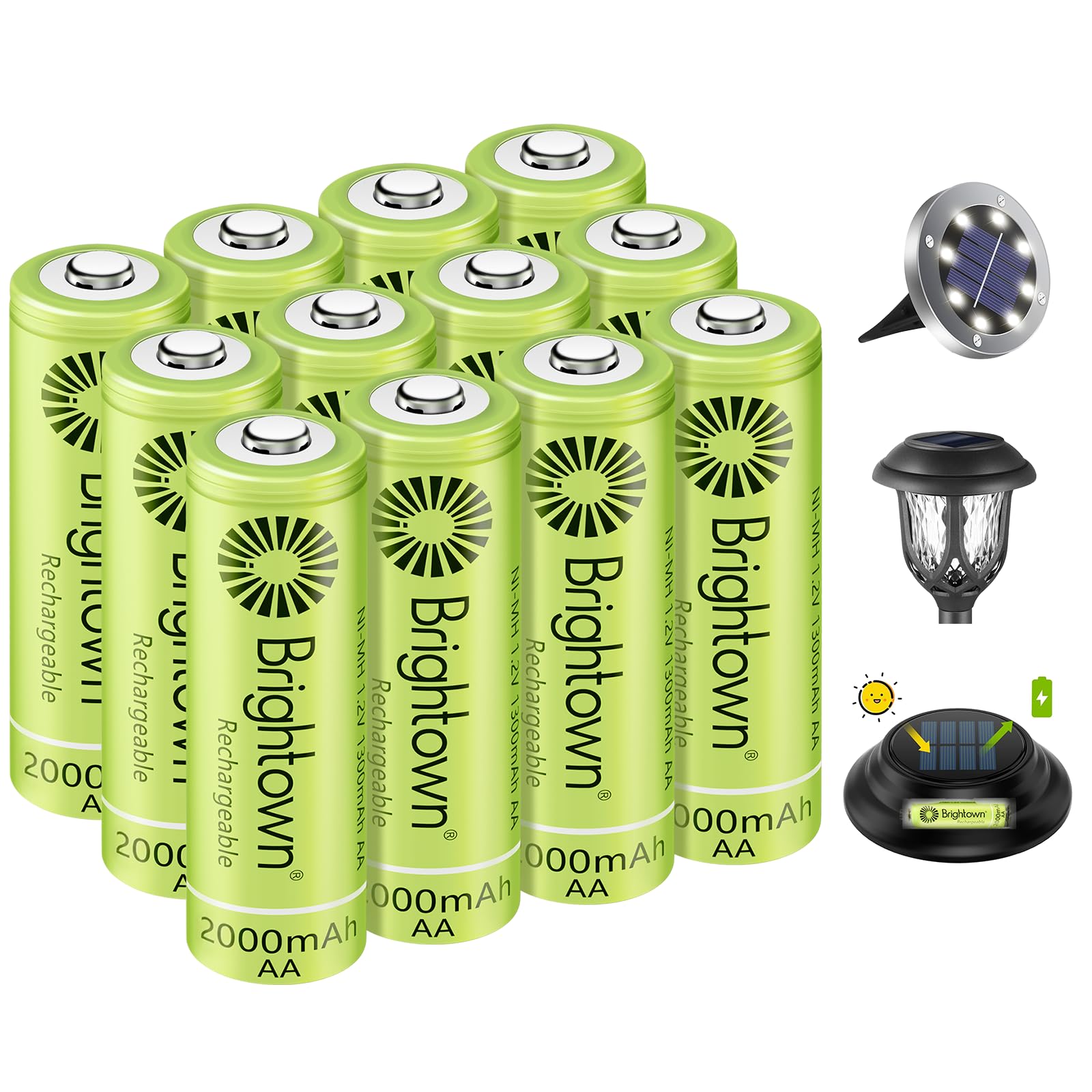
Brightown NiMH AA (12-Pack)

89 /100
Keeper Score Excellent

Key details

Capacity
2,000 mAh
Pack Size
12 cells
Factory Charge
30%
Recharge Cycles
Up to 1,000
Check Price on Amazon

Solar path lights are the reason a lot of people buy rechargeable AAs at all, and this pack is built and priced for exactly that: 12 cells at 2,000 mAh, enough to re-cell a front yard in one go without deciding which light deserves a good battery.

They arrive at roughly 30 percent charge, which Brightown says up front is a shipping-safety measure rather than a defect, so pull them all, charge them, then install. Once they were in the lights they did the one thing the job needs: come back to full on a day of sun and hold through the evening. At a rated 1,000 recharges they are not a one-season purchase.

Where the pack earns its place is the cost of covering a whole yard, and where it stops is anything you need to trust. Buy it for path lights, garden string lights and the toys that get left outside; the cells that go in a camera bag come from the eneloop pack.

Pros

  • Twelve 2,000 mAh cells for a whole yard of lights
  • Rated for 1,000 recharges
  • Lowest cost per battery in this guide
  • Charges on solar or a standard charger

Cons

  • Loses charge sitting unused
  • Some cells stop accepting a charge
Our verdict

The pack to buy when a dozen solar path lights need new cells: 2,000 mAh, rated for 1,000 recharges, and the lowest cost per battery in this guide.

Check Latest Price
7

Around-The-House Spares

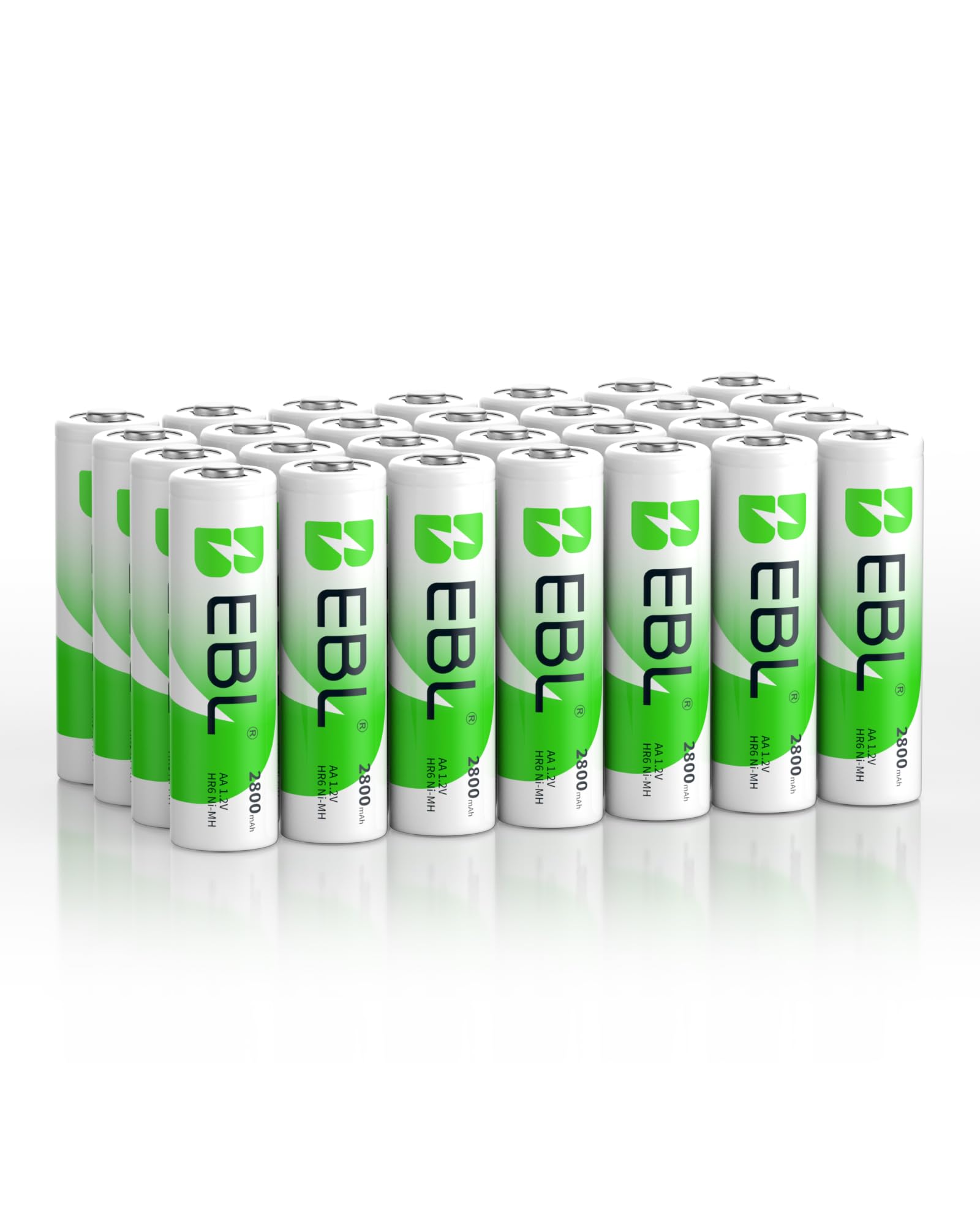
EBL AA NiMH (28-Pack)

91 /100
Keeper Score Outstanding

Key details

Voltage
1.2V
Warranty
1 year limited
Pack Size
28 cells
Pre-charged
Yes
Check Price on Amazon

Twenty-eight cells is not a rotation, it is an inventory. If a house runs on AAs — decorations in December, a drawer of remotes, toys that arrive and depart — a box this size means you stop rationing the good batteries and start putting them in everything.

The cells are NiMH at 1.2 volts, pre-charged, and backed by a 30-day return window and a one-year limited warranty. EBL sells them on capacity and the model name is AA2800, but no milliamp-hour figure is published for the cell itself, so we treat that number as a name rather than a measurement.

The practical snag with 28 cells is charging: a four-bay charger turns a full top-up into a two-day job, so this box only makes sense if you own an eight-slot charger or you are feeding devices that recharge themselves, like solar lights. Otherwise you will be cycling the same six cells and leaving 22 in the box.

So we keep it where the stakes are low — holiday lights, the remote that eats a battery a month, the toy that will be forgotten by spring. Nothing here belongs in a camera bag or a flash. For that kind of volume it earns its place: 28 cells you do not have to think about.

Pros

  • 28 cells, enough to stock a whole house
  • Pre-charged and ready to use
  • One-year limited warranty

Cons

  • Some cells fail within a year
  • Runs wide for tight compartments
Our verdict

A utility box of 28 pre-charged cells for lights, remotes and toys; buy it for volume, not for gear you need to trust.

Check Latest Price

How We Chose and Tested Rechargeable AA Batteries

We started with every NiMH AA we could find in stock — pre-charged, 1.2-volt, sold in packs anywhere from four to 28 cells — and cut anything with vague capacity claims or a mismatched voltage. That left seven brands and a shortlist covering both budget multipacks and premium low-self-discharge cells. Sixteen batteries went into rotation.

Testing ran for five months, in the places AA batteries actually live. Two cells at a time went into a game controller that gets heavy weekend use; others went into a living-room remote, a work-from-home mouse, a headlamp for evening dog walks, a camera flash, and a battery-hungry toddler toy. We wrote down the date each battery went in and the date the device died, so runtime comparisons came from real use rather than a bench.

Charging got the same treatment. Every cell ran through the same smart charger, and we timed how long each took to reach full, felt how warm it got, and noted whether the charger flagged it full at a consistent point. Fit was pass-or-fail: seat each battery in a snug compartment — a remote, a wall clock, a flashlight grip — and see whether it slid in without forcing or rattled once the lid closed.

Rechargeability was the long game. We counted cycles, watched for cells that stopped holding a full charge, and left a few pre-charged spares untouched in a drawer for two months to see what was left when we finally needed them. We're still cycling the survivors and will update if anything changes.

How to Choose Rechargeable Aa Batteries

Capacity and Cycle Life Pull Against Each Other

Milliamp-hours tell you how long a cell runs between charges. The recharge rating tells you how many times it gets to do that, and the two trade off: the 2,600 mAh eneloop Pro is rated for 500 recharges, while the 2,000 mAh standard eneloop is rated for 2,100. Neither is better in the abstract.

A flash that drains a set in an evening wants capacity. A household cycling batteries every week wants cycles. Work out which of those you will actually do before you pay for the other, and treat a big mAh number with no cycle rating beside it as half a specification.

The Fit Problem Nobody Prints on the Pack

High-capacity NiMH cells are sometimes built a little wider than a standard AA, and a wider cell can refuse to drop into a flashlight tube, a smoke detector or an older controller. It is the reason a battery can be the right size on paper and still not fit the thing in your hand.

Before committing to a 24- or 28-pack, take the tightest battery door in your house and test a single cell in it. If it binds, that device wants a standard-dimension cell — the eneloop is the one here we have never had to force.

Pre-Charged Does Not Mean Full

Almost every NiMH cell ships with some charge, and how much varies widely — Brightown is explicit that its cells leave at about 30 percent, and other packs arrive closer to full. Either way, charge a new pack before its first real job rather than discovering the shortfall in the middle of one.

The bigger question is self-discharge. A low-self-discharge cell like the eneloop holds most of its charge for years; cheaper cells can be flat in a drawer within months. If the batteries live in seasonal gear, pay for retention, not capacity.

1.2 Volts Is Not 1.5 Volts

Every NiMH AA here is a 1.2-volt cell; alkaline AAs are 1.5. Most devices do not care. A few do: some game cameras, older flashes and anything with a battery gauge calibrated to alkalines will read a freshly charged NiMH as half-empty or shut down early.

Check what the device's own instructions specify before you convert it. If it calls for alkalines only, leave that device on alkalines and spend the rechargeables elsewhere.

Your Charger Decides How Well They Perform

A smart charger that fills each slot independently gets a full charge into every cell and flags the one that has failed. A cheap timer charger fills in pairs and can cook a good cell alongside a bad one, which is how a pack rated for 1,000 recharges dies at 50.

If you already own a NiMH charger, any cell here works in it. If you do not, budget for a four- or eight-slot smart charger with your first pack; it is what makes the cycle rating on the box mean anything.

Frequently Asked Questions

Final Verdict

The standard eneloop eight-pack is the recommendation we are most confident in: 2,100 recharges, 70 percent of its charge held for a decade, cold-rated to minus 4 degrees Fahrenheit, and pre-charged out of the box. For most households that combination ends the battery aisle for years.

Two good reasons to go elsewhere. If a speedlight is the main drain, the eneloop Pro's 2,600 mAh is worth its shorter life. If you are converting a whole house at once and want the lowest cost per cell in bulk, the 24-pack of Amazon Basics is the better arithmetic — provided you test the fit in your tightest device first.