Best Sony E-Mount Lenses of 2026

The lens you leave on the camera matters more than the one in your bag. A fast standard zoom can cover a party, a trail, and a dim restaurant without a swap, but the wrong one turns a light daypack into a shoulder ache. I want a lens that makes me want to take it out — and files that hold up when I do. Over the past six months, my team and I have shot with 10 E-mount lenses, from compact zooms to long telephotos.

Sharpness and image quality get the headlines, but autofocus is what separates a lens you trust from one you fight. We noted how fast and quiet each one locked on, since a motor that whirs in a quiet room or hunts in low light can spoil the shot before sharpness matters. Weight and build quality decide whether you carry it all day; value is how many useful focal lengths it covers well.

The picks below are the ones we kept reaching for, across different budgets and shooting styles.

Keeper Score summarizes customer ratings and review volume. Read it alongside the product details and trade-offs. How the score works.

1

Best Overall

Tamron 17-70mm f/2.8 Di III-A VC

93 /100
Keeper Score Outstanding

Key details

Weight
1.2 lb
Focal Length
17-70mm
Max Aperture
f/2.8 constant
Stabilization
VC optical
Check Price on Amazon

A zoom that holds f/2.8 from 17mm all the way to 70mm is the most useful thing most APS-C Sony owners can put on the camera, and this is the one we point to first. On a 1.5x sensor the range reads like 25.5-105mm: wide enough for a room or a street, long enough to compress a portrait, and with no aperture fall-off as you zoom.

What settled it for us is how little you give up inside that range. It focuses down to 7.5 inches at the wide end, so a plate of food or a flower fills the frame without a macro lens, and the VC stabilization is tuned for handheld video as much as for stills — clips come out steady enough to use without a gimbal. Sharpness holds at f/2.8, which means you get to shoot the aperture you bought instead of stopping down to rescue the file.

The catch is format. This is an APS-C lens, so on an a7 or a1 body it will not cover the sensor, and full-frame readers should look at the Sigma 24-70mm instead. If you want the smallest possible kit, the Sigma 18-50mm does the same job at about half the weight and without stabilization. For an a6000-series or ZV-E10 body, though, this is the lens that stops the kit zoom from being the limiting factor.

Pros

  • Constant f/2.8 from 17mm to 70mm
  • VC stabilization smooths handheld video
  • Focuses to 7.5 inches at the wide end
  • Moisture-resistant with fluorine coating

Cons

  • Heavy for the APS-C bodies it suits
Our verdict

For an APS-C Sony body, this is the lens we point to first: a constant f/2.8 across a 25.5-105mm view, with stabilization and close focus built in.
Check Latest Price
2

Best Compact

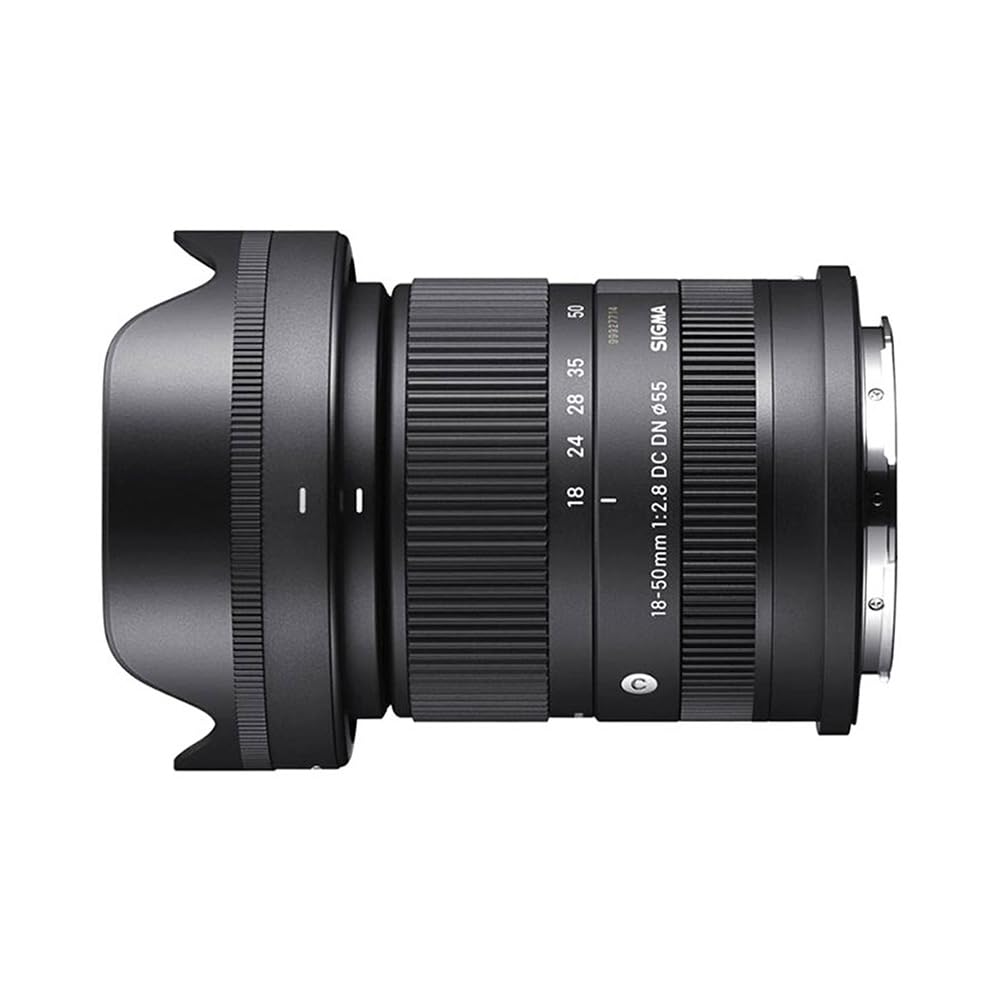
Sigma 18-50mm f/2.8 DC DN

93 /100
Keeper Score Outstanding

Key details

Weight
10.2 oz
Focal Length
18-50mm
Max Aperture
f/2.8 constant
Filter Thread
55mm
Check Price on Amazon

At 290 grams, this is the lens that makes an a6000-series body feel like a compact camera again, and that is most of why we recommend it. It's a constant f/2.8 zoom covering 18-50mm — roughly 27-75mm in full-frame terms — so it replaces the dim kit zoom without adding the bulk that usually comes with a fast lens.

The long end is where it surprised us. Zooms this small tend to soften as they extend, and this one holds detail better than we expected, which is why it tends to stay mounted rather than coming out for occasions. Focus is quick in decent light; in a low-contrast room it can hunt, so pick an edge to lock onto and recompose rather than letting it search.

The lens has no optical stabilization, and on a body without in-body stabilization — the a6100 and a6400 among them — that means watching your shutter speed in low light or accepting a higher ISO. On an a6600 or a full-frame body the gap closes, and you're left with a small, fast, sharp standard zoom that goes everywhere. Buy it for the size and the aperture.

Pros

  • 290 g keeps an APS-C kit genuinely small
  • Constant f/2.8 through the whole range
  • Holds sharpness at the long end

Cons

  • No optical stabilization
Our verdict

The compact f/2.8 zoom we recommend when size decides which camera you carry — small enough to live on the body, fast enough to replace the kit lens.

Check Latest Price
3

Best Full-Frame Standard Zoom

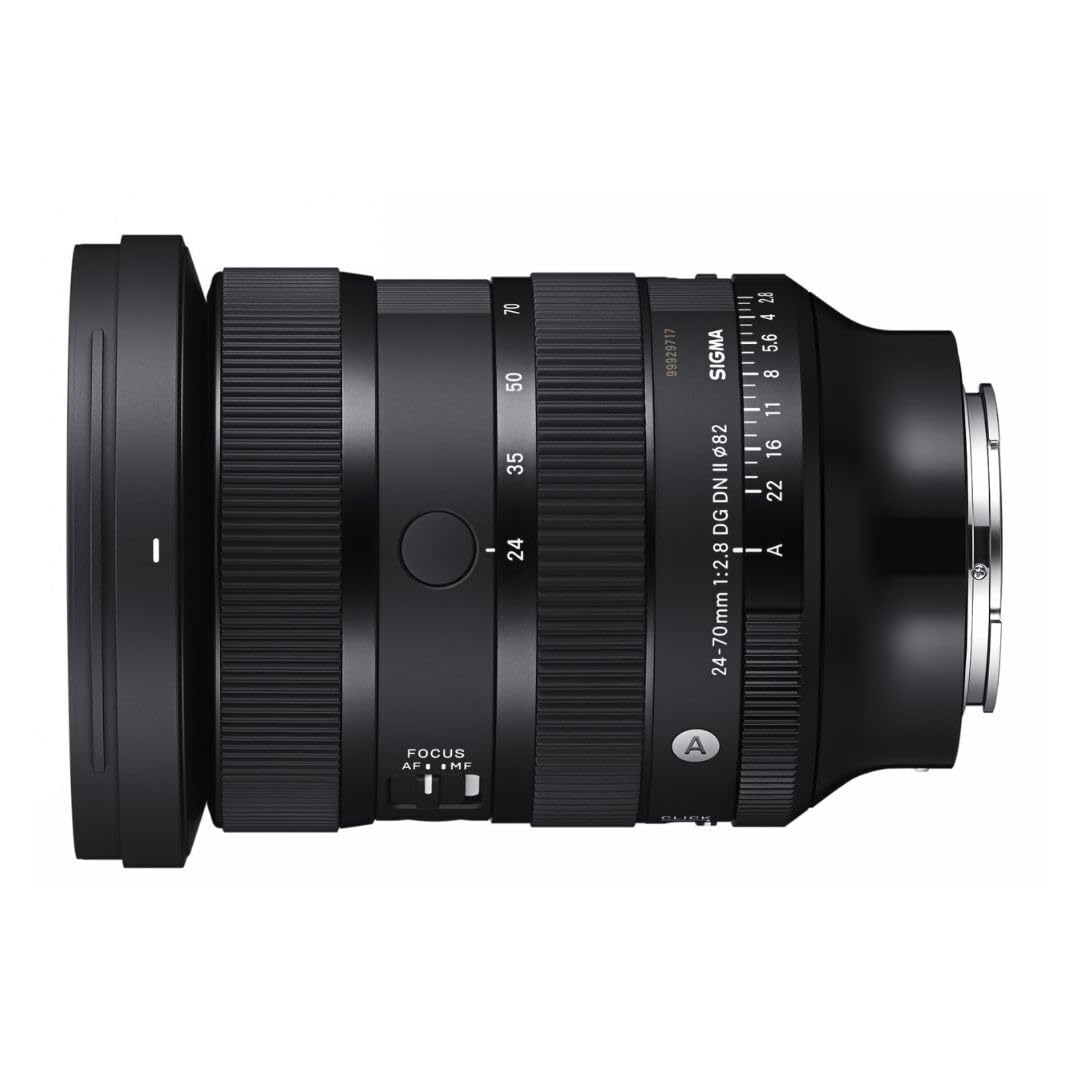
Sigma 24-70mm f/2.8 DG DN II

88 /100
Keeper Score Excellent

Key details

Weight
1.64 lb
Focal Length
24-70mm
Max Aperture
f/2.8 constant
Filter Thread
82mm
Check Price on Amazon

Six FLD elements in a standard zoom is a lot of glass pointed at one problem: making f/2.8 usable at every focal length instead of only in the middle. That's what this lens does. The corners hold together at 24mm wide open, which is where standard zooms often ask you to stop down and where a landscape or a group shot needs the whole frame.

The out-of-focus side got the same attention. An eleven-blade diaphragm keeps highlights round rather than polygonal, and backgrounds separate cleanly at f/2.8, so a portrait doesn't need a second lens. We found the autofocus fast and quiet, with a focus ring long enough to pull manually without overshooting the mark.

The case for it is consistency: it behaves the same at 24mm as at 70mm, and that matters when you're shooting an event and can't change lenses mid-moment. It has the coatings and sealing for working outdoors, and the focus stays locked on moving subjects. If carrying one lens for everything matters more than a constant aperture, the Tamron 28-200mm reaches 130mm further and gives up the f/2.8 to do it.

Pros

  • Sharp at f/2.8 across the zoom range
  • Fast, quiet autofocus
  • Eleven blades for rounder highlights

Cons

  • The heaviest lens in this guide
  • Costs more than the other full-frame pick
Our verdict

Our pick for full-frame bodies when image quality comes before everything else: sharp at f/2.8 across the range, with fast, quiet autofocus.

Check Latest Price
4

Best Budget Prime

Sony FE 50mm f/1.8

91 /100
Keeper Score Outstanding

Key details

Weight
6.6 oz
Focal Length
50mm
Max Aperture
f/1.8
Check Price on Amazon

The autofocus on this lens is slow enough and loud enough that you will hear it on a video's soundtrack, and we still think it belongs in nearly every full-frame bag. That's how much f/1.8 buys for the outlay. Fifty millimeters is close to how you see, and the wide aperture turns a dim room into something you can shoot without a flash or a tripod.

Stopped down is where it flatters you. Wide open it's soft at the edges and dreamy in a way that suits portraits and not architecture; by f/4 to f/8 it sharpens into a genuinely useful everyday lens, and the seven-blade aperture keeps background highlights round. On a high-resolution body it's visibly the inexpensive lens in the bag, but the files hold up for prints and for anything headed to a screen.

The focus noise has a workaround — manual focus for video, or a body whose subject detection does most of the work — and for stills of anything that holds still it doesn't matter at all. What you get in exchange is a 6.6-ounce lens that slips into a jacket pocket and covers the low-light gap the f/2.8 zooms can't reach.

Pros

  • f/1.8 for low light and shallow depth
  • 6.6 ounces on the camera
  • Least expensive way into a full-frame prime

Cons

  • Not weather-sealed
Our verdict

The least expensive fast prime here, and still a good one: f/1.8 and 6.6 ounces make it the low-light lens that's always in the bag.

Check Latest Price
5

Best for Reach

Sony E 70-350mm G OSS

91 /100
Keeper Score Outstanding

Key details

Weight
22 oz
Focal Length
70-350mm (105-525mm equiv.)
Max Aperture
f/4.5-6.3
Stabilization
Optical SteadyShot
Check Price on Amazon

Reach is the entire argument. On APS-C this is a 105-525mm view, which is the difference between a bird in the frame and a bird somewhere in the frame, and it does that at 22 ounces — light enough that the lens comes on the hike instead of staying in the car.

What we didn't expect was how usable it stays at the long end. Optical SteadyShot earns its keep at 350mm, where handheld frames come back clean instead of smeared, and the XD linear motor tracks moving subjects quietly enough to trust for video. Resolution holds all the way out, which is what the G badge is for.

What's left is the practical side: moisture-resistant construction, a 67mm filter thread shared with the Tamron zooms here, and a stabilizer that makes the long end genuinely handheld rather than tripod-only. For field sports and wildlife on an a6000-series body, it's the lens that makes the body worth carrying.

Pros

  • 105-525mm equivalent in a 22-ounce lens
  • XD linear motor focuses fast and quietly
  • Optical SteadyShot steadies the long end
  • G-series resolution holds to 350mm

Cons

  • f/6.3 at 350mm costs you light
  • The priciest APS-C lens here
Our verdict

The telephoto we recommend for APS-C bodies: 525mm of reach in a 22-ounce lens, with stabilization that makes handheld long shots realistic.

Check Latest Price
6

Best Travel All-In-One

Tamron 28-200mm f/2.8-5.6 Di III

90 /100
Keeper Score Outstanding

Key details

Weight
20.3 oz
Focal Length
28-200mm
Max Aperture
f/2.8-5.6
Filter Thread
67mm
Check Price on Amazon

There's a kind of trip where changing lenses is the thing that ruins the day — a market, a street, a hike where the shot is a wide view one minute and a detail forty feet away the next. A 28-200mm covers both without a bag, and this one does it at 20.3 ounces and 4.6 inches long.

The close-focus figure is the spec we didn't expect to care about. Seven and a half inches at the wide end with 1:3.1 magnification turns it into a semi-macro for flowers, food and texture, which is not what anyone expects from a 7x zoom. Image quality holds across the range in good light, and the zoom lock switch stops the barrel extending while you carry it.

There's no optical stabilization in the lens. On the full-frame bodies it suits, in-body stabilization covers that, so it costs you almost nothing; on a body without IBIS, weigh it carefully. Neither point changes our view: as the one lens you take when you can't take three, nothing else here covers as much ground.

Pros

  • 28-200mm in a 20.3-ounce body
  • Close focus of 7.5 inches at the wide end
  • Moisture-resistant with a zoom lock

Cons

  • Aperture narrows to f/5.6 at 200mm
Our verdict

The travel lens we recommend when one mount has to cover everything: 28-200mm in a 20-ounce body, with close focus that handles the small stuff too.

Check Latest Price

How We Tested E-Mount Lenses

We started by building a shortlist from current E-mount lenses in the focal ranges people actually ask about: compact standard zooms, constant-aperture zooms, fast primes, all-in-one travel zooms, and telephotos. We filtered by mount, aperture, size, weight, and price, then brought in 10 lenses and used them for six months on both APS-C and full-frame bodies.

Most testing happened where lenses live: weekend farmers markets, a few hikes, a dim restaurant birthday, a kid's soccer match, and a long travel day with one camera and one bag. We shot each lens wide open and stopped down, then compared center and corner crops at 100 percent to judge sharpness and image quality. For autofocus, we tracked a dog running across a yard and a person walking toward the camera, noting how quickly the lens locked on, whether it hunted in low light, and how often it missed.

To judge noise and weight, we focused in a quiet room with the camera's microphone close and listened for motor whine or chatter; we also weighed each lens on a kitchen scale and carried it in a sling bag for a full day. Build quality got the less glamorous test: lens hoods on and off, focus rings turned through their full range and zoom rings where present, and a week of everyday packing and unpacking. Value came last — not the sticker alone, but how many of those situations a lens handled well enough that we stopped thinking about it.

How to Choose a Sony E-Mount Lens

Check the Format Before the Focal Range

Every lens here mounts on every Sony mirrorless body, but they don't all cover the same sensor. Lenses badged FE or described as full-frame project an image circle large enough for an a7 or a1; APS-C designs like the Tamron 17-70mm and the Sony 70-350mm are built for the smaller sensor, and on a full-frame body the camera either crops the frame for you or leaves dark corners.

Going the other way is always safe: a full-frame lens on an APS-C body works perfectly, it's simply bigger and heavier than the sensor needs. Check the badge on your body first, then shop the range. Falling for a focal length you can't use is the most expensive mistake in this category.

Match the Range to What You Actually Shoot

A 24-70mm or 28-75mm on full frame, or a 17-70mm on APS-C, handles more days than anything else: wide enough for a room, long enough for a face. Superzooms like the Tamron 28-200mm stretch that to cover an entire trip, and they do it by giving up aperture and a little edge performance.

Before buying, scroll through your last few hundred photos and look at what you actually used. If most frames sit between 35mm and 70mm, a fast standard zoom will do more for you than a 10x range. And remember the number on the barrel means something different on APS-C — multiply by 1.5 to get the view you'll actually see.

Constant Aperture Is What You're Paying For

An f/2.8 zoom holds its aperture from one end to the other; a variable zoom like the 28-200mm is f/2.8 at 28mm and f/5.6 by 200mm. The constant version keeps exposure and depth of field steady as you zoom, which matters most for video, and it stays usable indoors after dark without pushing ISO.

You pay for that in size and money. If you shoot mostly outdoors in daylight, a variable zoom buys a great deal of range for the weight. If you shoot people indoors, spend on the aperture and accept the extra grams — the glass is doing the work a flash would otherwise do.

Decide Whether the Lens or the Body Stabilizes

Sony splits this across its range: the a6600 and the a7 series stabilize the sensor, while the a6100, a6400 and ZV-E10 do not. If your body is in the second group, a stabilized lens earns its keep — the Tamron 17-70mm's VC and the Sony 70-350mm's Optical SteadyShot both make handheld video and long-lens stills noticeably easier.

If your body already has in-body stabilization, a lens without it is not a problem, and you can put the money into glass instead. The Sigma 18-50mm is the clearest example: excellent on an a6600, more demanding on an a6400.

Weigh the Kit, Not Just the Lens

The lens you leave at home is the one that costs you the shot. A 745-gram Sigma 24-70mm on a full-frame body is a working setup for a planned shoot; a 290-gram Sigma 18-50mm is the one that goes everywhere. Think about the body plus lens plus spare battery, not the lens alone.

Filter threads are the quiet budget item. A 67mm thread covers the Tamron 17-70mm, the Tamron 28-200mm and the Sony 70-350mm, so one polarizer and one ND filter serve all three, while the Sigma 24-70mm takes 82mm and the Sigma 18-50mm takes 55mm. Buy the size once and stop thinking about it.

Frequently Asked Questions

Final Verdict

The Tamron 17-70mm f/2.8 earns the top spot for APS-C bodies: a constant aperture across the range you'll actually use, stabilization for handheld work, and close focus that covers the small stuff too. It is heavy for the sensor size, and that is the trade we accept for f/2.8 at 70mm.

Full-frame shooters get the equivalent in the Sigma 24-70mm f/2.8 DG DN II, which asks more weight and money in return for corners that hold wide open. And if one lens for a whole trip matters more than a fast aperture, the Tamron 28-200mm is the one that stays mounted.