Best Canon Wide-Angle Lenses of 2026

A wide-angle lens is the upgrade that changes what fits in the frame — a whole kitchen shot from the doorway, a ridge line, a street that looks like a street. The hard decisions are compatibility ones: Canon runs four mounts at once, and 16mm on a full-frame body frames nothing like 16mm on a crop sensor. We shot eight wide-angle lenses over nine months, and the ones that held up did it on corner sharpness and focus behavior in bad light, not on the headline spec.

Here's the tradeoff that rarely gets said out loud: a compact prime is the value pick and a fast zoom is the versatile one. The little 16mm f/2.8 costs a fraction of an f/2.8 zoom and disappears into a jacket pocket, but there are frames you will simply miss while you walk backward. Zooms buy framing speed in tight rooms, and stabilization earns its keep when you're handholding at dusk.

The lenses below are grouped by what they do best. Each one earned its spot on a real shoot, not in a comparison chart.

Keeper Score summarizes customer ratings and review volume. Read it alongside the product details and trade-offs. How the score works.

1

Best Overall

Canon RF 16mm F2.8 STM

92 /100
Keeper Score Outstanding

Key details

Weight
5.75 oz
Focal Length
16mm (fixed)
Minimum Focus
5.11 in. (0.26x)
Maximum Aperture
f/2.8
Check Price on Amazon

The number that keeps coming back is 163 grams. Canon's RF 16mm f/2.8 STM is smaller than a coffee cup and lighter than almost anything else in your bag, and it still puts a 108-degree view in front of a full-frame sensor at f/2.8. For anyone who has moved to an EOS R body and wants one wide lens that goes everywhere, this is the one we point to first.

The files hold up. Sharpness across the frame is what we noticed first — corners keep detail that a cheap ultra-wide smears — and color and contrast read like Canon glass rather than a budget shortcut. The trade is barrel distortion and heavy vignetting straight out of camera. JPEGs get corrected in the body; RAW files need a profile, and that correction trims a little off the edges. Once you know it, it is a non-issue.

Close focus is the surprise. It reaches 5.11 inches with 0.26x magnification, so you can put a subject almost against the front element and let the perspective do something dramatic. Autofocus is a gear-type STM, quiet enough for video and quick in decent light, though it takes its time in genuinely dim rooms. The control ring is there for aperture or ISO if you assign it.

One boundary worth stating plainly: on an APS-C R body the 1.6x crop turns this into roughly a 26mm lens, which is a wide normal rather than an ultra-wide, and RF-S owners are better served by the 10-18mm. On full frame the only real catch is the fixed focal length. There is no zoom, so you compose with your feet.

Pros

  • 163 g, so it always comes along
  • f/2.8 on a full-frame ultra-wide
  • Sharp, contrasty files across the frame
  • Focuses to 5.11 in. for 0.26x close-ups

Cons

  • Fixed 16mm, so there is no zoom range
Our verdict

Our default wide lens for full-frame RF bodies: 163 g, f/2.8, and sharp files for less than any zoom here.
Check Latest Price
2

Best Premium Zoom

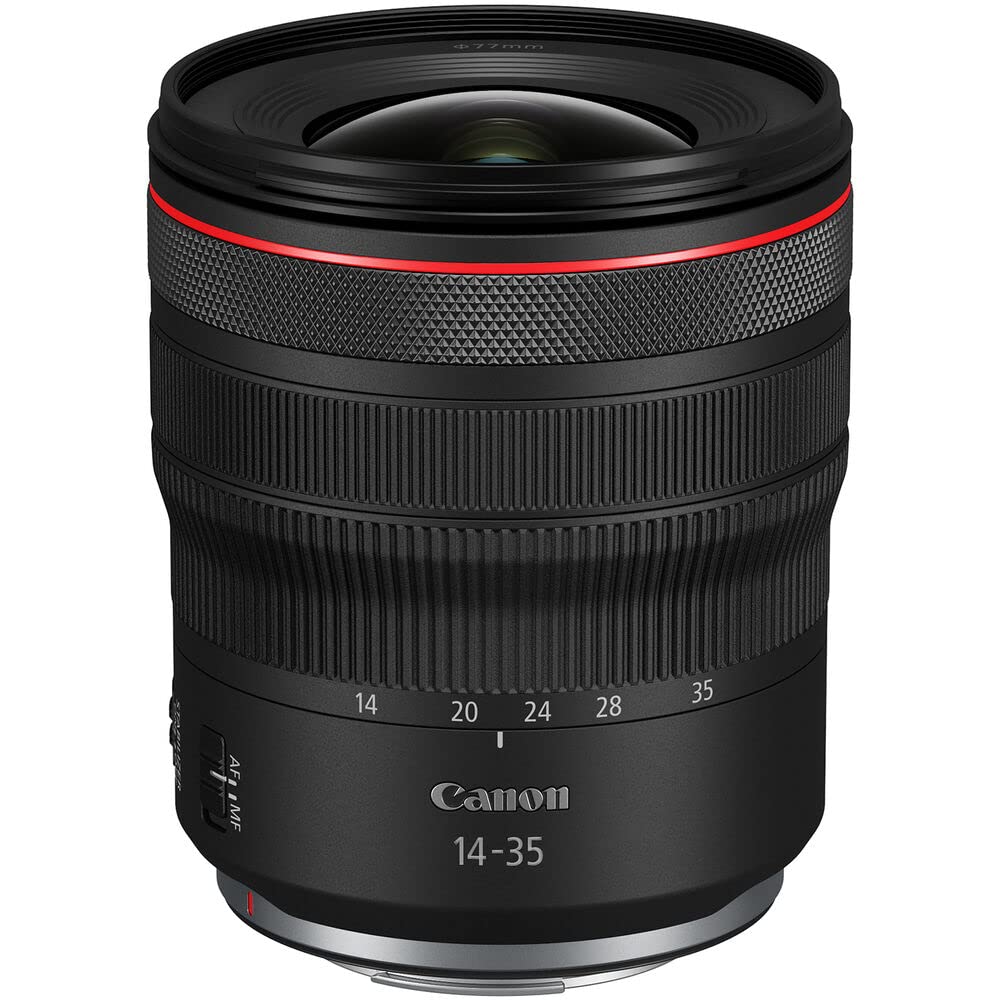
Canon RF 14-35mm F4 L IS USM

88 /100
Keeper Score Excellent

Key details

Weight
1.2 lb
Close Focus
7.9 in. (0.38x at 35mm)
Focal Length
14-35mm
Maximum Aperture
Constant f/4
Check Price on Amazon

Where our top pick stops at 16mm, this one starts at 14 and keeps going to 35. That sounds like a small difference until you are standing in a narrow kitchen or under a low ceiling: 14mm takes in a whole room without stitching, and 35mm is tight enough to shoot a portrait on the same lens.

The RF 14-35mm f/4 L IS USM is the zoom we take when a trip is mostly interiors and landscapes. L-series glass with Canon's SWC and ASC coatings, a constant f/4 aperture, optical stabilization, and fast USM autofocus in a barrel of about 544 grams — roughly the same as Canon's 85mm f/2. That combination is what earned it a place here: a professional wide zoom that does not punish you for carrying it.

Close focus is genuinely useful. It focuses down to 7.9 inches at every focal length and reaches 0.38x at 35mm, which covers detail shots and near-macro work without a lens change. The edges are the weak spot: at 14mm and f/4 the corners soften and vignette, and stopping to f/5.6 tightens them noticeably. For architecture with straight verticals you will be correcting both anyway, so it rarely costs a frame.

The catch is that constant f/4. It is fine for daylight and for stabilized interiors, but it is not an astro or event lens the way the f/2.8 15-35mm in this list is. If your wide work happens after dark, the aperture matters more than the range.

Pros

  • 14mm at the wide end, out to 35mm
  • Constant f/4 with optical stabilization
  • 0.38x magnification at the 35mm setting
  • 544 g is light for an L-series zoom

Cons

  • Constant f/4 limits low-light and astro work
  • Noticeably bigger than any wide prime here
Our verdict

The best all-round wide zoom for full-frame R bodies: 14mm reach, L-series optics, and 544 g you can carry all day.

Check Latest Price
3

Best Fast Zoom

Canon RF 15-35mm F2.8 L IS USM

93 /100
Keeper Score Outstanding

Key details

Weight
1.85 lb
Focal Length
15-35mm
Stabilization
Up to 5 stops
Maximum Aperture
Constant f/2.8
Check Price on Amazon

Eight hundred and forty grams is the honest headline. The RF 15-35mm f/2.8 L IS USM is a serious lump of glass, and after a full day on a strap you feel it. What the weight buys is the fastest wide zoom in this group: a constant f/2.8 across 15-35mm, up to 5 stops of optical stabilization, and Nano USM focus that locks on without hunting.

We put it where it belongs — dim interiors, evening streets, the kind of light where an f/4 zoom pushes your ISO two stops higher and the files start to show it. Sharpness and color are clean wide open, and the stabilization is effective enough that a hand-held shot at a slow shutter is a reasonable bet rather than a gamble. The autofocus speed is the part that surprised us most; it snaps between near and far subjects faster than the other zooms here.

Whether it earns its keep comes down to how often you shoot wide in bad light. For event and wedding work in dark rooms, that is most weekends, and the nine-blade aperture gives backgrounds a smoother falloff at f/2.8 than the f/4 options manage. For a landscape photographer who lives at f/8 on a tripod, you are paying for aperture and hauling weight you never use.

Two practical notes before you commit. It takes 82mm filters, the largest and most expensive thread in this group, so a filter set is a real additional purchase. And it is weather-sealed, which is the sort of thing you only appreciate on the day it matters.

Pros

  • Constant f/2.8 across the whole range
  • Up to 5 stops of optical stabilization
  • Nano USM focus is fast and near-silent
  • Weather-resistant L-series build

Cons

  • 840 g before you add a body
  • 82mm filters are the priciest to buy
Our verdict

The wide zoom for people who shoot wide in the dark: constant f/2.8, 5 stops of stabilization, and L-series build.

Check Latest Price
4

Best Value Full-Frame Zoom

Canon RF 15-30mm F4.5-6.3 IS STM

87 /100
Keeper Score Excellent

Key details

Weight
13.8 oz
Focal Length
15-30mm
Stabilization
Up to 5.0 stops (7.0 with IBIS)
Maximum Aperture
f/4.5-6.3
Check Price on Amazon

The first thing most people notice after buying a full-frame R body is that nothing in the bag goes wider than 24mm. Canon built this lens for exactly that person: 15mm of full-frame coverage, optical stabilization rated to 5 stops on its own and 7 with an IBIS body, all in a 390-gram barrel that does not fight for space.

We think it is the sensible first ultra-wide zoom for full frame on a budget. The 15-30 range covers interiors, landscapes, and the wide end of a walkaround without the bulk of the L zooms, and the 67mm filter thread matches the EF-S 10-18mm here, which matters if you already own filters. Close focus is 11 inches, or 5.1 inches in manual focus at the 15mm setting — near enough to fill the frame with something small and let the perspective stretch it.

The compromises are real but predictable. f/4.5-6.3 is a daylight and tripod aperture; indoors you are at a higher ISO or leaning on the stabilization for scenes that hold still. There is also a hard limit worth knowing: Canon rates this lens at roughly 24-48mm equivalent on an APS-C R body, so mounting it on an R50 or R100 gives you a standard zoom rather than a wide one.

Pros

  • 15mm full-frame coverage
  • Up to 5 stops IS, 7 with IBIS
  • 390 g and a shared 67mm thread

Cons

  • Slow f/4.5-6.3 maximum aperture
Our verdict

The least expensive route to 15mm and stabilization on a full-frame R body, provided f/4.5-6.3 suits your light.

Check Latest Price
5

Best for APS-C DSLRs

Canon EF-S 10-18mm f/4.5-5.6 IS STM

94 /100
Keeper Score Outstanding

Key details

Close Focus
0.72 ft. (0.22 m)
Focal Length
10-18mm
Stabilization
Optical IS
Maximum Aperture
f/4.5-5.6
Check Price on Amazon

This lens will not mount on a full-frame Canon, and that single fact is why it is the easiest wide-angle recommendation we can make for anyone shooting an APS-C DSLR. At 10mm on a crop body you get a 16mm-equivalent view — the whole room, the whole street, the whole sky — from a lens small enough to leave on the camera.

Image stabilization paired with an STM motor is what makes it useful for more than stills. Handheld video comes out steady, autofocus is quiet enough that on-camera audio stays clean, and it focuses down to 0.72 feet, close enough to put a subject almost against the glass and let the wide perspective exaggerate it. We kept reaching for it indoors, where a 10mm view solves a room that a kit zoom cannot.

The 10mm end is where the character lives and where the work is. Corners vignette and stretch, straight lines lean unless you keep the camera level, and architecture wants f/8 and a correction profile afterward. None of that is a defect; it is what an ultra-wide does, and it is easy to work with once you have shot a hundred frames.

The aperture is the limitation to accept rather than fix. f/4.5-5.6 is a daylight and bright-interior aperture, so a dim room pushes your ISO up or your shutter down. Everything else about the lens is sized for people who shoot because they are somewhere worth shooting.

Pros

  • 10mm gives a 16mm-equivalent view on APS-C
  • Optical IS and quiet STM autofocus
  • 0.72 ft. close focus

Cons

  • f/4.5-5.6 is a daylight aperture
  • Corners vignette at 10mm
Our verdict

The ultra-wide we recommend for APS-C DSLR owners: 16mm-equivalent coverage, stabilization, and silent autofocus at a budget tier.

Check Latest Price
6

Best for RF-S Bodies

Canon RF-S 10-18mm F4.5-6.3 IS STM

87 /100
Keeper Score Excellent

Key details

Weight
5.28 oz
Focal Length
10-18mm (16-29mm equiv.)
Maximum Aperture
f/4.5-6.3
Max Magnification
0.23x AF / 0.5x MF
Check Price on Amazon

Hold an R50 at arm's length, hit record, and this lens makes its case immediately: at 10mm there is still room in the frame for the room behind you. That is the whole point of the RF-S 10-18mm. Canon's own 16-29mm equivalent range is the vlogging and selfie focal length, and the lens weighs 5.28 ounces, so it never becomes the reason you leave the camera at home.

It is a new optical design built for mirrorless rather than a rehoused EF-S lens, and the files come back crisp with good color. Optical stabilization steadies walking shots, the STM motor stays quiet enough for on-camera audio, and it focuses to 0.23x in autofocus — 0.5x in manual focus, which is half life-size from an ultra-wide and more useful than that sounds for product and detail shots.

We think it is the default wide lens for RF-S owners, and the reason is narrow: nothing else in this group goes this wide on an RF-S body without an adapter. The trade is the f/4.5-6.3 aperture, so interiors want window light or a slow shutter. Mount it on a full-frame R body and the camera crops to APS-C automatically, which defeats the purpose.

Pros

  • 16-29mm equivalent range
  • Weighs 5.28 oz
  • 0.5x magnification in manual focus
  • Stabilization for handheld video

Cons

  • f/4.5-6.3 needs good light
Our verdict

The wide lens RF-S owners should buy first: a 16-29mm equivalent range, 5.28 oz, and stabilization built for handheld video.

Check Latest Price
7

Night Skies

Rokinon 14mm f/2.8 AE

81 /100
Keeper Score Excellent

Key details

Focus
Manual, with AE chip
Weight
1.2 lb
Focal Length
14mm (fixed)
Maximum Aperture
f/2.8-22
Check Price on Amazon

Fourteen millimeters at f/2.8 is the classic night-sky recipe, and this is the least expensive way to get there on a Canon body. The Rokinon AE14M-C is manual focus, full frame, and built like a small cannon — 1.2 pounds of metal and glass behind an ultra-multi-coated front element that shrugs off stray light.

The AE chip is what makes it livable on a modern Canon. It gives you metering, aperture control from the body, and EXIF data, so Lightroom recognizes the lens and can apply a distortion profile rather than leaving you to eyeball it. Without that chip a manual 14mm is a guessing game on a digital body, and it is the reason this version costs more than the plain one.

Focus is by hand, which is fine for landscapes and night skies where you are on a tripod and taking your time, and wrong for anything that moves. Check infinity on your own copy before a long exposure: the hard stop is not always exactly at infinity, and a small error hides in the foreground while the stars stay soft. Close focus is 10.8 inches, near enough for foreground rocks and flowers under a sky.

Wide open, the edges are softer than the center and there is some magenta fringing in high-contrast corners; stop to f/4 for landscape work and the difference is plain. For the one job most people buy it for, on a tripod, in the dark, we think it earns its place in a night kit.

Pros

  • f/2.8 at 14mm for night skies
  • AE chip gives metering and EXIF
  • Solid metal build

Cons

  • Manual focus only
  • Infinity can sit off the hard stop
Our verdict

The budget astro lens: 14mm, f/2.8, and an AE chip that gives a modern Canon body metering and EXIF, with manual focus included.

Check Latest Price
8

Full-Frame DSLRs

Canon EF 16-35mm f/2.8L II USM (Renewed)

88 /100
Keeper Score Excellent

Key details

Weight
2.2 lb
Close Focus
0.92 ft.
Focal Length
16-35mm
Maximum Aperture
Constant f/2.8
Check Price on Amazon

Buying renewed is a different transaction, and it is worth saying plainly: this is a used Canon 16-35mm f/2.8L II that has been inspected and carries a 90-day limited warranty instead of a year. If that is acceptable, you are getting a professional f/2.8 ultra-wide zoom for full-frame EF bodies at a fraction of what the current mirrorless version costs.

The lens itself is the Mark II of a workhorse: constant f/2.8 across 16-35mm, ring-type USM autofocus with full-time manual override, three aspherical elements, a nine-blade aperture, and internal focusing so the barrel does not extend. It takes 77mm filters and weighs 2.2 pounds, which is the sort of weight that balances nicely on a DSLR and noticeably less so on a small body.

Optically it is sharp and contrasty, with the smooth background falloff at f/2.8 that the f/4 zooms cannot manage, and it holds up in low light where a slower lens would force a flash. The missing piece is stabilization. That is fine for stills and less fine for handheld video, where the f/2.8 buys you light but not steadiness.

Where we land: if you shoot a full-frame EF DSLR and want f/2.8 for events, interiors, or night work, this is the value play in this list, and the 90-day warranty is the thing to weigh before you click. If you have already moved to an R body, put the money toward native glass instead.

Pros

  • Constant f/2.8 across 16-35mm
  • Ring USM with internal focusing
  • Three aspherical elements

Cons

  • No image stabilization
  • Renewed stock with a 90-day warranty
Our verdict

The cheapest route into fast full-frame EF wide shooting, if a 90-day warranty on a renewed L lens does not put you off.

Check Latest Price

How We Tested Eight Wide-Angle Lenses

We started with the current Canon lineup across RF, RF-S, EF, and EF-S, filtering by focal length, maximum aperture, stabilization, and price so the shortlist covered budget primes and L-series zooms alike. That left eight lenses, which we shot over nine months on full-frame and crop-sensor bodies, including EF glass mounted through an adapter. Price stayed in the conversation the whole way — a lens only scored well if the extra money showed up in the files.

Most of the shooting happened where wide lenses actually live: a rented lake house at sunrise, my own apartment, where I framed a kitchen and a living room from the same doorway with every lens, city sidewalks after work, a friend's reception at dusk, and three clear nights on a tripod. Each lens rode on a camera for a full day of walking so I could feel where the weight landed by hour six, and I shot handheld video to see how much of my footstep bounce the stabilization absorbed.

Image quality got the most scrutiny. I photographed the same brick wall and window grid wide open and again two stops down, then compared center and corner crops side by side; the widest zooms needed more stopping down than the primes to clean up the edges. Distortion showed up as bowed doorframes, and I noted how much in-camera correction was doing versus the glass itself.

Autofocus was judged by how it tracked people walking toward me through a dim restaurant — hunting and drifting versus a quiet, instant lock — and low light separated the f/2.8 lenses from the f/4.5-6.3 ones quickly at dusk. I also checked manual focus feel, stabilization switches, hood fit, and how each lens behaved when adapted onto a second body.

How to Choose a Canon Wide-Angle Lens

Match the mount before anything else

Canon has sold four mounts that matter here. EF and EF-S are the DSLR mounts; RF and RF-S are the mirrorless ones. The S versions are APS-C only. An EF lens fits every EOS DSLR, while an EF-S lens fits APS-C DSLRs and will not mount on a full-frame body at all. On the mirrorless side an RF lens fits any R body, and an RF-S lens fits an APS-C R body but triggers an automatic crop on a full-frame one.

That crop is the trap. Canon rates the RF 15-30mm at roughly 24-48mm coverage when it sits on an APS-C body, which means a lens we recommend as an ultra-wide stops being wide the moment it goes on the wrong camera. Read the badge on your body before you read a single specification.

Decide how wide, in full-frame terms

Convert everything to full-frame equivalents and the ranges sort themselves out. Canon's APS-C crop is 1.6x, so the 10-18mm zooms here behave like 16-29mm lenses, and a 16mm prime on full frame gives you a 108-degree view. For interiors, sweeping landscapes, and night skies, 14-16mm is the working range. For street and everyday carry, 24-28mm is wide without turning every scene frantic.

Wider is not automatically better. Below about 18mm, every straight line near the frame edge leans, and you have to compose around it. If most of what you photograph is people, a wider lens pushes them toward the corners where they will look least like themselves.

Aperture, stabilization, and the light you actually shoot in

f/2.8, f/4, and f/4.5-6.3 look like small differences on paper and behave like large ones in a dim room. A fast wide zoom is what makes dark interiors and evening streets work without flash, and it is what makes a hand-held night-sky frame possible at all. If your wide work is landscapes at f/8 on a tripod, paying for f/2.8 buys weight you carry and never use.

Stabilization is the other half of the answer. It steadies slow shutters and handheld video, and it stacks with in-body stabilization: Canon rates the 15-30mm at 5 stops on its own and 7 with an IBIS body. It does nothing for a subject that moves, though. For people in low light, aperture is the only real fix.

Focus, size, and the accessories that follow

Autofocus matters less on a wide lens than on a telephoto, but it decides whether your video is usable. STM motors are quiet and smooth, which is why the vlogging picks here use them, while Nano USM and ring USM are faster for stills. A manual-focus lens is a tripod tool: excellent for architecture and astro, wrong for anything handheld and moving.

Then there is weight and the filter thread, the cost nobody budgets for. These picks run from a pancake prime you forget you packed to an 840 g zoom you will not, and the front threads span 43mm to 82mm. A set of ND and polarizing filters sized for the big zoom costs more than the same set for a compact prime, so settle on the lens you will actually carry and buy the filters once.

Frequently Asked Questions

Final Verdict

For most people shooting a full-frame EOS R body, the Canon RF 16mm f/2.8 STM is the wide lens to buy. It weighs almost nothing, opens to f/2.8, focuses close enough for dramatic near-far shots, and costs less than any zoom here. The fixed focal length is the whole trade, and it is one most photographers happily make.

Choose differently for a reason: the RF 14-35mm f/4 L if you want one lens to cover 14mm through 35mm without giving up image quality, the RF 15-35mm f/2.8 if you shoot wide in bad light for a living, and the RF-S or EF-S 10-18mm if your body is APS-C. Match the mount first, and the rest of the decision gets much shorter.