Best Sony Telephoto Lenses of 2026

Every extra hundred millimeters of reach costs you twice: once at checkout, and again every time you pick the lens up. That's the trade no spec sheet mentions, and it's why so many long lenses end up in a closet. What matters is whether the frame is sharp when you get there, whether autofocus grabs a bird in flight, and whether you'll still want to carry it on day three of a trip.

I spend my falls shooting high school soccer, and the lenses that stayed on my camera were never the ones with the biggest numbers. Stabilization buys more at 400mm than a slightly better chart does. Over the past nine months my team and I have shot with eight of these lenses, and the gap between usable and genuinely good was wider than I expected.

Value is the other trap: these lenses are expensive, and the fastest way to waste money is paying for reach you'll never use or hauling glass so heavy it stays home. The picks below are the ones we'd buy again, for sideline afternoons and backyard birds and everything between.

Keeper Score summarizes customer ratings and review volume. Read it alongside the product details and trade-offs. How the score works.

1

Best Overall

Sony FE 70-200mm f/2.8 GM OSS II

92 /100
Keeper Score Outstanding

Key details

Weight
4 lb
Focal Length
70-200mm
Max Aperture
f/2.8
Stabilization
Optical SteadyShot
Check Price on Amazon

A 70-200mm f/2.8 is the telephoto most Sony shooters eventually talk themselves into, and this is the version we point them toward. The constant aperture is the reason: at 200mm you can still shoot at f/2.8, so indoor sports, receptions, and dim trails do not force the ISO as high as an f/4 or f/5.6-6.3 zoom. Sony's four XD linear motors make it the quickest-feeling autofocus in this group, and the lens is designed to suppress focus breathing and focus shift while zooming, which helps for both stills and video.

Sharpness is not a concern at any focal length in our use. The lens uses two aspherical elements and one XA element, and the 11-blade aperture gives backgrounds a clean, round blur that separates a subject without looking busy. We also appreciate that it accepts Sony's 1.4x and 2x teleconverters, so the 70-200mm range can grow when you need more reach. That flexibility is a big part of why it stays on the camera.

The trade-off is a listed weight of 4 pounds. That is light for a fast 70-200mm, but it is still a lens you notice after a long day. The payoff is a zoom that handles portraits, events, sports, and backyard wildlife without a second lens. If you want one telephoto that does the most jobs well, this is the one we recommend first.

Pros

  • Constant f/2.8 through the zoom
  • Fast, precise XD linear autofocus
  • Sharp optics and smooth bokeh
  • Works with 1.4x and 2x teleconverters

Cons

  • Premium price
Our verdict

We recommend the Sony 70-200mm f/2.8 GM OSS II as the best all-around telephoto here for anyone who needs speed, reach, and sharpness in one zoom.

Check Latest Price
2

Best for Wildlife Reach

Sony FE 200-600mm f/5.6-6.3 G OSS

91 /100
Keeper Score Outstanding

Key details

Weight
4.7 lb
Focal Length
200-600mm
Max Aperture
f/5.6-6.3
Stabilization
Optical SteadyShot
Check Price on Amazon

The 200-600mm's most useful design choice is the one you notice only after a long session: the barrel stays the same length as you zoom. That internal zoom keeps the balance consistent on a tripod or gimbal, and it makes the lens easier to handle in a hide or a blind. At 4.7 pounds, it is still a lens you plan around, not a casual walk-around.

Reach is the reason to choose it. At 600mm, it pulls distant birds and field-sport action close in a way a 70-200mm or 100-400mm cannot, and the five ED elements and Nano AR coating keep flare and ghosting under control. The direct-drive SSM focus is fast and quiet enough for moving subjects, and Optical SteadyShot helps when you are hand-holding at the long end.

We like it best for wildlife and sports shooters who work from a fixed position or can carry a monopod. If you need 600mm without the weight, the 100-400mm is the lighter alternative, but you give up reach. For the price, the 200-600mm is the supertelephoto we recommend first in this group.

Pros

  • Internal zoom keeps balance constant
  • 600mm reach for distant subjects
  • Sharp, flare-resistant optics
  • Fast, quiet DDSSM focus

Cons

  • Slow f/5.6-6.3 aperture
Our verdict

We recommend the Sony FE 200-600mm for wildlife and bird photographers who need 600mm and can work from a tripod or monopod.

Check Latest Price
3

Best Budget

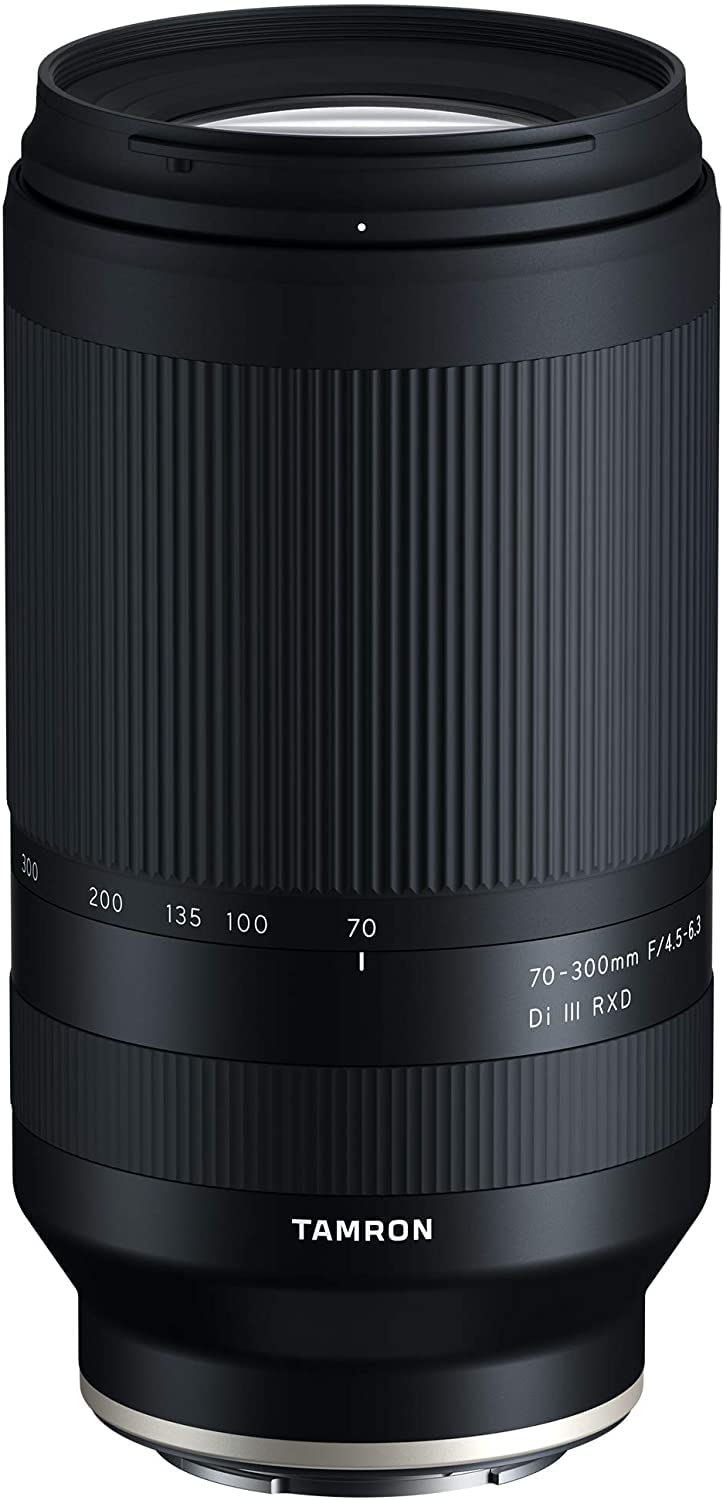
Tamron 70-300mm f/4.5-6.3 Di III RXD

92 /100
Keeper Score Outstanding

Key details

Weight
1.2 lb
Focal Length
70-300mm
Max Aperture
f/4.5-6.3
Stabilization
No
Check Price on Amazon

The Tamron 70-300mm is the lens we hand someone who wants a telephoto but does not want to carry one. At 1.2 pounds, it is the lightest full-frame-capable zoom in this group, and the 70-300mm range is enough for youth sports, travel, and backyard birds. The catch is that it has no optical stabilization. On a Sony body with in-body stabilization, that is manageable; on an older body, it is the reason to look at the 70-350mm or a 70-200mm instead.

Image quality holds up better than the price suggests. The 15-element, 10-group design uses BBAR coating, and the lens produces sharp, contrasty images in good light. The RXD autofocus is quick and quiet, and the close-focus distance of 31.5 inches at the wide end and 59.1 inches at the tele end gives you a useful near-macro option for flowers and details. It is a versatile first telephoto rather than a specialist's tool.

We recommend it for daylight shooters who want a small, affordable telephoto. It leaves room in the bag for a second body or a wider zoom, and it is the least intimidating way into long lenses in this group.

Pros

  • Very light 1.2-pound body
  • Useful 70-300mm range
  • Sharp images and close focus
  • Budget-friendly full-frame zoom

Cons

  • Slow f/4.5-6.3 aperture
Our verdict

We recommend the Tamron 70-300mm as the budget telephoto for daylight shooters who want a light, easy-to-carry zoom.

Check Latest Price
4

Best for APS-C

Sony E 70-350mm f/4.5-6.3 G OSS

91 /100
Keeper Score Outstanding

Key details

Weight
1.4 lb
Focal Length
70-350mm
Max Aperture
f/4.5-6.3
Stabilization
Optical SteadyShot
Check Price on Amazon

APS-C owners have a different telephoto decision than full-frame owners, and the 70-350mm is built for that difference. On a Sony APS-C body it behaves like a 105-525mm full-frame lens, so it covers wildlife, travel, and outdoor sports in one compact zoom. At 1.4 pounds, it is light enough to hang off a small body all day, and Optical SteadyShot helps at the long end.

We think it is the best travel and wildlife zoom in this group for Sony APS-C shooters because it pairs that reach with quick, quiet XD linear autofocus and strong corner-to-corner sharpness. The 5x zoom range is genuinely useful, and the lens is small enough to fit in a half-day pack. It is not a full-frame lens, so do not expect it to cover an A7 sensor without a crop.

For the size and reach, the trade is easy to live with. If you shoot a mix of full-frame and APS-C bodies, buy an FE lens instead; if your kit is all APS-C, this is the zoom that makes the most sense.

Pros

  • 105-525mm equivalent reach
  • Light 1.4-pound compact body
  • Optical SteadyShot stabilization
  • Fast XD linear autofocus

Cons

  • Slow f/4.5-6.3 aperture
Our verdict

We recommend the Sony E 70-350mm for APS-C shooters who want a light, stabilized 525mm-equivalent zoom without moving to full frame.

Check Latest Price
5

Best Value Supertelephoto

Tamron 150-500mm f/5-6.7 Di III VC VXD

87 /100
Keeper Score Excellent

Key details

Weight
4.1 lb
Focal Length
150-500mm
Max Aperture
f/5-6.7
Stabilization
VC image stabilization
Check Price on Amazon

At 500mm, the Tamron 150-500mm gives up 100mm to the Sony 200-600mm, but it also gives up some bulk. The barrel extends as you zoom, so it packs smaller than its reach suggests, and the 4.1-pound weight is easier to manage than the Sony's 4.7 pounds. The included Arca-type tripod mount and strap loops are the kind of details that make a long lens easier to live with.

We like the VC system for handheld work at 500mm. It offers standard, panning, and framing-priority modes, and it makes a real difference when you are tracking a bird or a runner. The optics use XLD, LD, and glass-molded aspherical elements, and the lens produces sharp, contrasty images in good light. Autofocus is fast and reliable for most subjects.

This is the supertelephoto we recommend when the Sony 200-600mm is more reach and weight than you want to carry. It is a strong value for wildlife, field sports, and landscapes that need compression.

Pros

  • 500mm reach with VC stabilization
  • More packable than the Sony 200-600
  • Sharp optics and fast AF
  • Arca-type tripod mount with strap loops

Cons

  • Slow f/6.7 aperture at 500mm
Our verdict

We recommend the Tamron 150-500mm for wildlife shooters who want stabilized 500mm reach in a more packable, less expensive supertelephoto.

Check Latest Price
6

Best Compact Telephoto

Sony FE 70-200mm f/4 Macro G OSS II

87 /100
Keeper Score Excellent

Key details

Weight
1.7 lb
Focal Length
70-200mm
Max Aperture
f/4
Maximum Magnification
0.5x
Check Price on Amazon

The 70-200mm f/4 Macro G OSS II is the odd one out here because it offers half-macro capability throughout the zoom range, and that is why we like it. You can focus close at 70mm or 200mm instead of only at the wide end. With Sony's 2x teleconverter it reaches 1:1 magnification, which turns a telephoto zoom into a genuine close-up lens for flowers, details, and product work.

At 1.7 pounds, it is the travel-friendly 70-200mm in this group. The four XD linear motors give it fast, accurate autofocus, and the lens accepts both the 1.4x and 2x teleconverters. We also appreciate that the f/4 aperture keeps the barrel smaller than the f/2.8 zooms while still offering a useful amount of background separation for portraits.

The compromise is light gathering: f/4 is a stop slower than the f/2.8 lenses, so indoor sports and dim events are not its strength. For travel, hiking, and close-up work, that is a reasonable trade-off. If you need speed above all, the 70-200mm f/2.8 GM II is the better fit.

Pros

  • Half-macro throughout the zoom
  • Light 1.7-pound travel body
  • Fast XD linear autofocus
  • Accepts 1.4x and 2x teleconverters

Cons

  • Not water resistant
  • Premium price for an f/4 zoom
Our verdict

We recommend the Sony 70-200mm f/4 Macro for travelers and close-up shooters who want one light zoom to cover reach, portraits, and details.

Check Latest Price
7

Best Third-Party F/2.8

Sigma 70-200mm f/2.8 DG DN OS

92 /100
Keeper Score Outstanding

Key details

Weight
2.97 lb
Focal Length
70-200mm
Max Aperture
f/2.8
Stabilization
Optical stabilization
Check Price on Amazon

The Sigma 70-200mm f/2.8 DG DN OS is the lens that makes the Sony GM II's price gap hard to ignore. It matches the 70-200mm range and constant f/2.8 aperture, adds dust- and splash-resistant Sports-line construction, and uses an HLA linear motor for fast, quiet focusing. For a photographer who needs the speed of f/2.8 but cannot stretch to the Sony, it is the obvious alternative.

We were impressed by how sharp it is wide open and how confidently it tracks moving subjects. The 11-blade aperture gives clean background blur, and the build feels substantial in a way that suits sideline and event work. In our set, it is the third-party 70-200mm that comes closest to the Sony's overall performance without matching its price.

The Sigma is a strong choice for sports and event work, and the price gap leaves room for a better strap or a monopod. If you want the lightest fast 70-200mm, the Sony is the better choice; if you want the value, the Sigma earns its place.

Pros

  • Constant f/2.8 at a lower price
  • Sharp wide-open images
  • Fast HLA autofocus
  • Dust- and splash-resistant build

Cons

  • 1345 g weight
Our verdict

We recommend the Sigma 70-200mm f/2.8 DG DN OS for sports and event shooters who want near-Sony speed and sharpness for less money.

Check Latest Price
8

Lighter Wildlife Reach

Sony FE 100-400mm f/4.5-5.6 GM OSS

90 /100
Keeper Score Outstanding

Key details

Weight
3.1 lb
Focal Length
100-400mm
Max Aperture
f/4.5-5.6
Stabilization
Optical SteadyShot
Check Price on Amazon

The 100-400mm G Master is the lens we choose when 400mm is enough and we have to carry it farther than the car. At 3.1 pounds, it is much lighter than the 200-600mm's 4.7 pounds, and that difference is the point. It gives up 200mm of reach, but it is easier to hand-hold, easier to pack, and still sharp at 400mm.

We like the close-focus capability: a minimum focus distance of 3.22 feet and 0.35x maximum magnification make it useful for flowers, details, and butterflies as well as wildlife. The double linear and direct-drive SSM focus is fast and quiet, and Optical SteadyShot helps at the long end. Build quality is what you expect from a G Master, with dust and moisture resistance for outdoor work.

The f/4.5-5.6 aperture is not a low-light advantage. For a hiker who shoots in good light and values a lighter bag, that is an acceptable trade-off. If you need 600mm, the 200-600mm is the better value; if you need a premium 400mm that travels well, this is the one.

Pros

  • Lighter 3.1-pound body
  • Sharp 400mm reach
  • 0.35x close-focus magnification
  • Fast, quiet focus and OSS

Cons

  • Expensive for its reach
Our verdict

We recommend the Sony 100-400mm GM for hikers and wildlife shooters who value a lighter, sharper 400mm zoom over maximum reach.

Check Latest Price
9

Compact Events Zoom

Tamron 70-180mm f/2.8 Di III VC VXD G2

91 /100
Keeper Score Outstanding

Key details

Weight
1.9 lb
Focal Length
70-180mm
Max Aperture
f/2.8
Stabilization
VC image stabilization
Check Price on Amazon

The 180mm long end is the first thing to accept about the Tamron 70-180mm f/2.8 G2; after that, the small body makes a lot of sense. It covers 70-180mm at a constant f/2.8, adds VC image stabilization, and uses a VXD linear motor for quick, precise focusing. The barrel is moisture-resistant and fluorine-coated, which matters if you shoot outdoors in changeable weather.

We were impressed by how crisp it is wide open and how well the VC works with in-body stabilization. For events, portraits, and travel, the range is practical: 70mm is wide enough for groups and environmental shots, and 180mm compresses a subject without making you step back across the room. The close-focus distance of 0.3 meters at 70mm and 0.85 meters at 180mm adds some flexibility.

For a wedding or documentary bag, the smaller body is often a fair trade. If you need a longer zoom, the Sony or Sigma 70-200mm are the better choices. The Tamron's job is to be the fast telephoto you actually pack, and it does that well.

Pros

  • Compact 1.9-pound f/2.8 zoom
  • VC image stabilization
  • Sharp wide-open images
  • Moisture-resistant and fluorine-coated

Cons

No notable drawbacks to flag.

Our verdict

We recommend the Tamron 70-180mm f/2.8 G2 for event and travel shooters who want a fast, stabilized telephoto that packs small.

Check Latest Price
10

Budget 600mm Reach

Sigma 150-600mm f/5-6.3 DG DN OS

85 /100
Keeper Score Excellent

Key details

Weight
4.63 lb
Focal Length
150-600mm
Max Aperture
f/5-6.3
Stabilization
Optical stabilization (4 stops)
Check Price on Amazon

The Sigma 150-600mm is the least expensive way to get to 600mm in this group, and that alone earns it a look. It pairs a 150-600mm range with optical stabilization rated for up to 4 stops, a 23-inch minimum focus distance, and a 95mm front filter. The 2100-gram weight and big front element tell you it is a serious supertelephoto, not a walk-around lens.

We like it for stationary wildlife, birds at a feeder, and field sports where you can set up on a monopod. Images are sharp, autofocus is fast for the class, and the stabilization helps at the long end. The close focus is a useful bonus for frogs, flowers, and other small subjects that let you get near.

The Sigma is a budget supertelephoto, and the savings show up in the details rather than the images. If you need a sealed lens or the fastest autofocus, spend more; if you want 600mm without paying Sony money and can support the weight, this is a strong value.

Pros

  • Native 600mm reach at a lower price
  • Up to 4 stops of optical stabilization
  • Sharp images and fast AF
  • 23-inch minimum focus distance

Cons

  • Not weather-sealed
  • Slow f/5-6.3 aperture
Our verdict

We recommend the Sigma 150-600mm for budget-conscious wildlife shooters who want native 600mm reach without moving to a Sony supertelephoto.

Check Latest Price

What Nine Months With Eight Telephoto Lenses Taught Us

We started with every E-mount telephoto zoom we could get our hands on, then cut the list by focal range, whether the lens covers a full-frame sensor or an APS-C one, how close it focuses, whether the aperture holds constant through the zoom, and what it weighs against what it does. Eight lenses made the cut, spanning the range of what people actually buy: fast 70-200s, mid-range 100-400s, and the long 500 and 600mm zooms. Each spent at least a couple of weeks on a body, and the whole round ran nine months.

Most of the shooting looked like real life rather than a test bench: Friday night soccer under lights, a dawn at the duck pond, an air show, a few zoo afternoons, and one very long walk through a marsh. For autofocus we fired bursts at a dog sprinting straight at us and at geese lifting off the water, then counted how many frames were actually in focus and listened for how loud the motor was in a quiet room. For optics we shot the same brick wall and the same backlit branches wide open and again stopped down a stop, then compared crops at 100 percent.

Weight we handled bluntly: every lens got weighed with the hood on, then carried in a shoulder bag on a two-hour walk while we noted when the strap started to bite. To check stabilization, we shot handheld at slow shutter speeds in dim light with it on and again with it off and compared how many frames came out clean. We also kept a running note of how often we reached for each lens once the novelty wore off, because a lens you leave at home has no value no matter how good the glass is.

How to Choose a Sony Telephoto Lens

Match the focal range to the subject

A 70-200mm is the general-purpose telephoto: portraits, events, sideline sports, and backyard wildlife. A 100-400mm or 150-500mm adds reach without becoming a dedicated supertelephoto, while a 200-600mm or 150-600mm is for birds and distant action. On APS-C, the 70-350mm behaves like a 105-525mm lens, so it covers a lot of that ground in a smaller body.

Decide where you shoot most. If you often crop a 200mm image, step up to 400mm or 500mm; if you mainly photograph people and events, the shorter zoom is more useful. The extra reach also means more weight and a slower maximum aperture, so do not buy 600mm for the occasional long shot.

Choose aperture for light, blur, and weight

An f/2.8 zoom is the indoor and action choice: it lets in twice as much light as f/4 and four times as much as f/5.6, and it gives cleaner background separation. That speed costs money and weight. The f/4 70-200mm Macro and the variable-aperture 70-300mm, 150-500mm, and 200-600mm are better daylight lenses.

If you shoot mostly outdoors, a slower lens is a sensible trade. If you shoot receptions, indoor sports, or dawn and dusk wildlife, the f/2.8 lenses earn their keep.

Stabilization and handheld technique

Optical stabilization helps at long focal lengths, but it does not stop subject motion. The Sony OSS and Tamron VC systems steady the viewfinder and let you hand-hold at slower shutter speeds; the Tamron 70-300mm has no optical stabilization, so it relies on the camera's IBIS. On a body without IBIS, that lens is a daylight proposition for many shooters.

For a 200-600mm or 150-600mm, a monopod or tripod is still the best way to keep a heavy lens steady for long sessions. Brace the lens, not the camera, and give the stabilization a moment to settle before firing.

Weigh the lens you will actually carry

The spec sheet makes the weight obvious; the handling trade is subtler. The Sony 200-600mm uses internal zoom, so its balance stays consistent, but it is a 4.7-pound lens. The Tamron 150-500mm extends as it zooms, which makes it more compact to pack, yet it still weighs 4.1 pounds. The Tamron 70-300mm at 1.2 pounds is the one that disappears in a daypack.

Pick a weight you can hand-hold for the length of your typical shoot. If you work from a car or a hide, a heavy supertelephoto is fine; if you hike, the 100-400mm or 70-350mm makes more sense.

Autofocus, teleconverters, and close-up work

Sony's XD linear motors, Tamron's VXD, and Sigma's HLA all prioritize fast, quiet focusing, which matters most for moving subjects. The 70-200mm GM II and 70-200mm f/4 Macro also accept Sony's 1.4x and 2x teleconverters; the f/4 Macro gains 1:1 close-up magnification with the 2x converter.

If you shoot flowers, details, or product work as well as distant subjects, the 70-200mm f/4 Macro is the most flexible choice here. If you only need reach, put the money into focal length and stabilization instead.

Frequently Asked Questions

Final Verdict

We recommend the Sony FE 70-200mm f/2.8 GM OSS II as the best all-around choice in this guide for most buyers. It is fast, sharp, and versatile enough for portraits, events, and action, and it takes teleconverters when you need more reach.

If your subject is usually far away, the Sony FE 200-600mm's 600mm reach and constant-length zoom make it the better wildlife choice. For a tight budget, the Tamron 70-300mm is the light, sensible place to start.