Best Sony Portrait Lenses of 2026

The first time you open up to f/1.8 and watch a cluttered background melt away behind a friend's face, the kit zoom stops being interesting. That's also where the trouble starts: fast glass gets heavy, focus gets fussy, and a lens that nails a still subject can lose an eye the second someone leans in to laugh. The gap between a lens that flatters people and one that fights you is smaller than the price tags suggest.

So my team and I spent six months shooting with 12 portrait lenses, from budget primes to a constant-aperture telephoto zoom, on full-frame and APS-C bodies alike. The focal length on the box means less than the sensor behind it — a 56mm on APS-C frames like an 85mm on full frame — and autofocus motor design matters more than any spec sheet. Weight was the quiet tiebreaker: the lens you'll actually carry on a two-hour walk is the one that gets used, and the picks below lean that way.

Keeper Score summarizes customer ratings and review volume. Read it alongside the product details and trade-offs. How the score works.

1

Best Overall

Sony FE 85mm f/1.8

95 /100
Keeper Score Outstanding

Key details

Weight
13.1 oz
Focal Length
85mm
Minimum Focus
0.8 m
Maximum Aperture
f/1.8
Check Price on Amazon

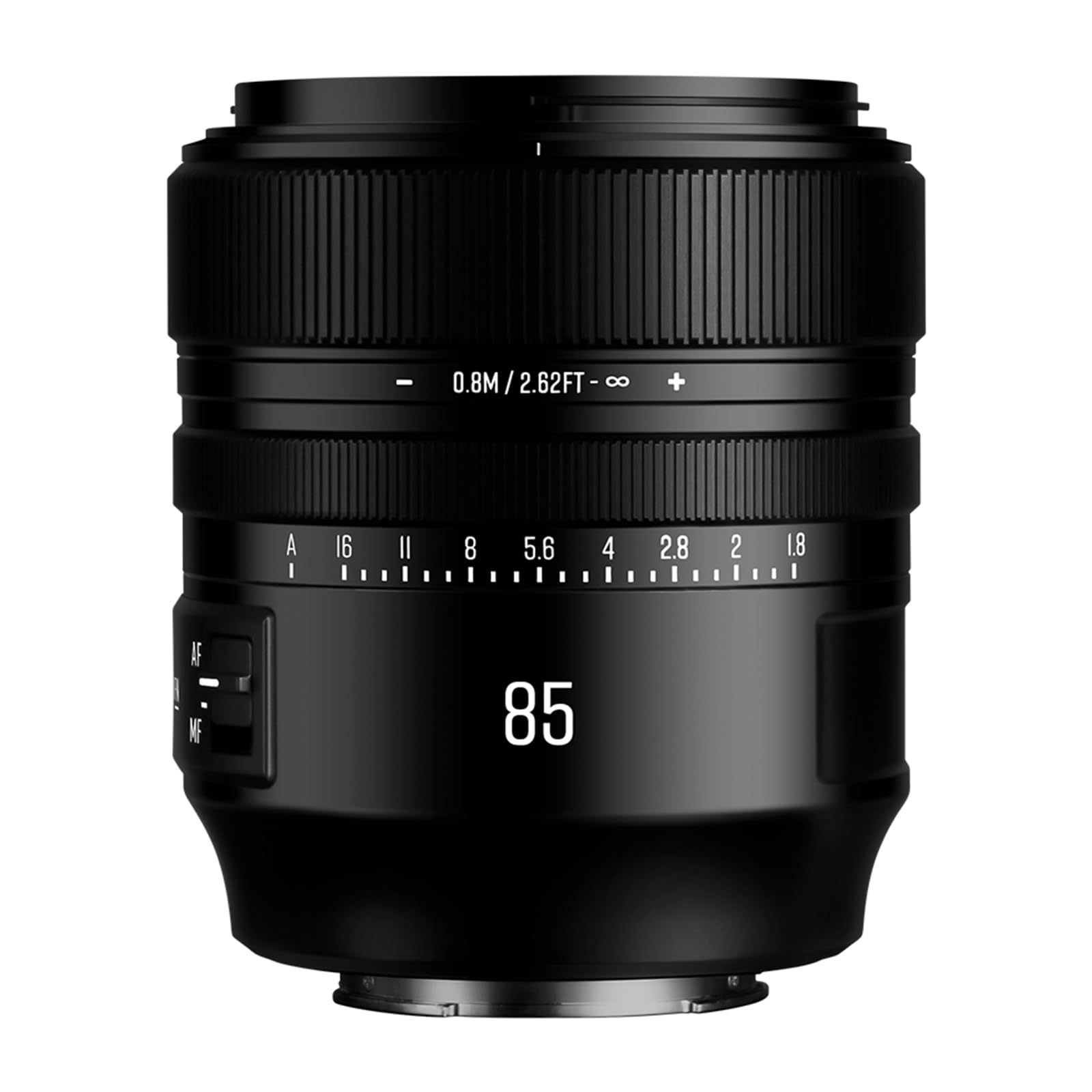
The 85mm focal length is the classic portrait choice because it flatters faces without flattening them completely, and the Sony FE 85mm f/1.8 is the least complicated way to get there. At 371g, it is light enough to stay on the camera between setups, and the f/1.8 aperture gives you enough separation for head-and-shoulders work without the size of an f/1.4 lens. We like that combination more than any single specification: it is a portrait lens you can carry without planning around it.

The linear motor is the detail that makes it feel modern. Focus is quiet and quick enough for eye autofocus on still subjects, and the nine-blade aperture keeps out-of-focus highlights round rather than busy. The 0.8m minimum focus distance is the spec we notice most: it is fine for faces and half-body frames, but it will not replace a close-focus lens for tight detail shots. On APS-C, the same lens becomes a very tight 127.5mm equivalent, which is best for headshots in rooms with some space.

Full-frame shooters get the most natural use from it, but APS-C owners can treat it as a tight headshot lens. The lack of optical stabilization is not a dealbreaker for portraits: the fast aperture keeps shutter speeds up, and many current Sony bodies add in-body stabilization. It earns the top spot because it gets the portrait basics right without asking you to carry a heavy lens or learn a complicated one.

Pros

  • Light 371g build for all-day carry
  • Flattering f/1.8 aperture and 9-blade bokeh
  • Quiet linear autofocus for eye AF
  • Classic 85mm perspective on full-frame

Cons

  • No weather sealing
Our verdict

We recommend the Sony FE 85mm f/1.8 as the default portrait prime for most Sony full-frame shooters: it is light, flattering at f/1.8, and focuses quietly.

Check Latest Price
2

Best Zoom

Sony FE 70-200mm f/2.8 GM II

92 /100
Keeper Score Outstanding

Key details

Weight
4 lb
Focal Length
70-200mm
Stabilization
Optical
Maximum Aperture
f/2.8
Check Price on Amazon

A 70-200mm f/2.8 is less a portrait lens than a portrait problem-solver. It lets you tighten a headshot from across a room, compress a busy background, and switch to full-body framing without changing lenses. The Sony FE 70-200mm f/2.8 GM OSS II does that with a constant aperture, optical stabilization, and four XD linear motors. We appreciate the flexibility most at events, where the subject moves and you cannot always move with them.

This is a working lens, not a casual walkaround. The zoom ring and tripod collar tell you it is built for events and sessions where the camera stays on a strap or a monopod. We think of it as a specialist tool: if your portraits happen at weddings, performances, or outdoor sessions where you need reach, the zoom buys you framing flexibility that a prime cannot match.

Optical stabilization helps with handheld shots, though it does not stop a moving child. The constant f/2.8 aperture still gives you a useful amount of background separation at the long end, and the 11-blade diaphragm keeps highlights rounded. We recommend it when the zoom is the point, not as a default portrait prime. For a single subject in a small room, the 85mm f/1.8 is the easier choice.

Pros

  • Constant f/2.8 through 70-200mm
  • Optical stabilization for handheld reach
  • Fast quad XD linear motors
  • Weather-resistant build

Cons

  • Four-pound weight
Our verdict

We recommend the Sony FE 70-200mm f/2.8 GM OSS II for event and outdoor portrait shooters who need zoom flexibility and can carry its four-pound weight.

Check Latest Price
3

Best Value Full-Frame

Viltrox 85mm f/2 EVO

90 /100
Keeper Score Outstanding

Key details

Focal Length
85mm
Minimum Focus
0.74 m
Maximum Aperture
f/2.0
Weather Resistance
Dust/moisture sealed
Check Price on Amazon

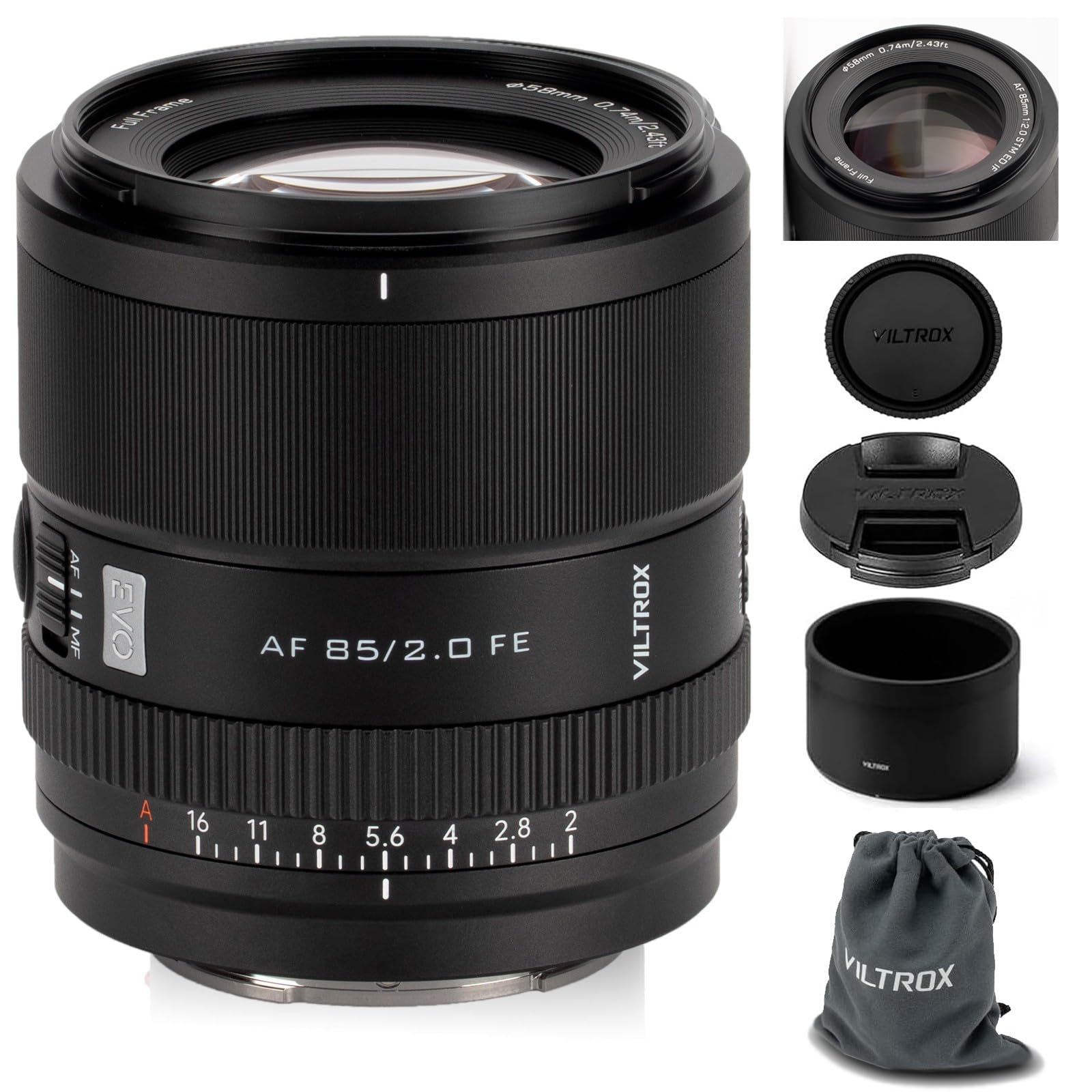
The Viltrox 85mm f/2 EVO is not a stripped-down portrait lens, despite its budget price. It has a full-frame 85mm focal length, a weather-sealed mount, a close 0.74m minimum focus distance, and a 400g body. We like that combination because it covers the practical details that make an 85mm usable outdoors and for tighter detail shots, not just the headline aperture.

The f/2 aperture is slightly slower than the f/1.8 Sony, which matters less than it sounds for portraits: you still get shallow depth of field and good low-light performance, and the lens stays compact. The close focus is the feature we appreciate most. It lets you move from a face to hands, flowers, or a detail without switching lenses, which is more useful in a portrait session than another fraction of an f-stop.

Background rendering is where it gives ground. Against clean backdrops the bokeh is smooth, but busy foliage or high-contrast lights can make the out-of-focus areas look less polished than the Sony 85mm f/1.8. That is the trade-off for the budget price and extra sealing. If you shoot in rain or dust and want an 85mm that can focus close, this is the value pick in this group.

Pros

  • Weather-sealed 85mm f/2
  • 0.74m close focus for detail shots
  • Light 400g body
  • Strong value for full-frame

Cons

  • No optical stabilization
Our verdict

We recommend the Viltrox 85mm f/2 EVO for full-frame shooters who want weather sealing and close focus from a budget 85mm.

Check Latest Price
4

Best for APS-C

Viltrox 56mm f/1.4

90 /100
Keeper Score Outstanding

Key details

Weight
9.88 oz
Focal Length
56mm
Sensor Format
APS-C
Maximum Aperture
f/1.4
Check Price on Amazon

On an APS-C body, 56mm is the portrait sweet spot. It gives roughly the same angle of view as an 84mm lens on full-frame, which is tight enough to flatter faces without forcing you against the back wall. The Viltrox 56mm f/1.4 pairs that framing with a fast aperture, a 280g metal body, and an STM motor. We like it because it turns a compact Sony body into a genuinely capable portrait kit without adding a heavy lens.

The f/1.4 aperture is the main event. It gives you creamy background separation and keeps shutter speeds workable indoors, and the nine-blade diaphragm helps the out-of-focus highlights stay round. Image quality is a strong point: the lens is sharp, with good contrast and colors. Autofocus is quick enough for portraits, though it can hunt a little in low-contrast light. We found that locking onto an eye and shooting a short burst gives a better hit rate than relying on a single frame.

The lens is APS-C only, so full-frame shooters need crop mode, which costs resolution. That is the main boundary. For Sony APS-C owners, it is a strong step up from a kit lens: compact, fast, and priced like a budget lens. We reach for it when we want the portrait look without carrying a full-frame kit.

Pros

  • Fast f/1.4 aperture for shallow depth
  • Compact 280g metal body
  • 84mm-equivalent portrait framing
  • Sharp image quality

Cons

  • No weather sealing
Our verdict

We recommend the Viltrox 56mm f/1.4 for APS-C shooters who want a fast, compact portrait prime that behaves like an 84mm lens.

Check Latest Price
5

Budget APS-C

Meike 55mm f/1.4

82 /100
Keeper Score Excellent

Key details

Focus
STM
Focal Length
55mm
Sensor Format
APS-C
Maximum Aperture
f/1.4
Check Price on Amazon

The Meike 55mm f/1.4 is the budget route to an APS-C portrait prime. On a Sony crop body it behaves like an 82.5mm lens, close to the classic 85mm look, and the f/1.4 aperture gives you the shallow depth of field that makes portraits pop. We appreciate that Meike did not strip the lens down to a manual-focus toy: it has an STM autofocus motor and a USB-C port for firmware updates.

Image quality is the reason to consider it. The lens produces sharp, colorful images with pleasing background blur, and it holds up in low light because of the wide aperture. Autofocus is the compromise. It works for still subjects and eye detection, but it is not as confident as the Sony or Viltrox options when the light drops or the subject moves. The USB-C port is a useful safety net: if focus behavior needs a fix, you can update the firmware yourself.

The Meike is the value pick in this group. It delivers the fast aperture and sharp images that matter for portraits. We recommend it to APS-C shooters who want maximum aperture for the least money and mostly photograph people who hold still. If you shoot moving children, the Viltrox 56mm f/1.4 is the better long-term buy.

Pros

  • f/1.4 aperture at a budget price
  • STM autofocus for stills
  • USB-C firmware updates
  • 82.5mm-equivalent framing

Cons

  • No weather sealing
Our verdict

We recommend the Meike 55mm f/1.4 for APS-C shooters on a tight budget who want shallow depth of field and can live without weather sealing.

Check Latest Price
6

Budget 85mm

Brightin Star 85mm f/1.8

81 /100
Keeper Score Excellent

Key details

Weight
15.9 oz
Focal Length
85mm
Sensor Format
Full-frame
Maximum Aperture
f/1.8
Check Price on Amazon

The Brightin Star 85mm f/1.8 is the budget 85mm of this group. It gives you the classic portrait focal length, a fast f/1.8 aperture, and a 450g body at a budget price. The details that stand out are the two-year manufacturer warranty, the 2 ED and 3 HD elements, and the STM autofocus motor. We like that it does not feel like a disposable lens: the build is solid, and the images are sharp even wide open.

The f/1.8 aperture gives you good background separation, and sharpness is a strong point, with good contrast and detail when you open it up. Autofocus is quick for stills, works with eye detection, and the STM motor is quiet enough for video. The build has a solid feel, and the two-year warranty is longer than most budget lenses offer. For a portrait lens in this price range, those are the right priorities.

The lens is full-frame, so it works on both full-frame and APS-C Sony bodies, where it becomes a tight 127.5mm equivalent. We recommend it to budget-conscious shooters who want a fast 85mm and value the two-year warranty.

Pros

  • Fast f/1.8 aperture
  • Two-year manufacturer warranty
  • Sharp image quality
  • Solid build for the price

Cons

  • No weather sealing
  • Heavier than the Viltrox 85mm
Our verdict

We recommend the Brightin Star 85mm f/1.8 for budget-conscious portrait shooters who want a fast 85mm and a two-year warranty, and can skip weather sealing.

Check Latest Price

How We Tested Portrait Lenses for Sony E-Mount

We started by pulling every current E-mount portrait lens we could get our hands on: 85mm full-frame primes, 50mm-to-56mm APS-C primes, and one constant-aperture telephoto zoom for photographers who would rather carry a single lens than three. We filtered by sensor coverage, maximum aperture, focus motor type, and stock availability, then read owner reviews to see what people complain about after the honeymoon phase.

Testing ran six months across 12 lenses, mounted on both full-frame and APS-C bodies. Most of it happened where portraits really get taken: a living room lit by one window on a Saturday morning, a park at golden hour with the sun behind the subject, a dim restaurant after dinner, and a backyard with a toddler who would not hold still. At each session we shot the same three faces wide open and again stopped down, then compared the frames side by side that night.

Bokeh got its own workout. We set a subject in front of bare branches, string lights, and a bookshelf, looking for hard rings inside out-of-focus highlights, highlights that stretched into cat-eyes near the corners, and backgrounds that went busy instead of creamy. For image quality we zoomed to 100 percent on eyelashes at every aperture and shot into the sun to check for flare and fringing. For autofocus we tracked eye-AF on someone walking toward the camera, then had them lunge forward, and counted how many frames in a 20-shot burst stayed sharp — including in a room lit by a single lamp, where the slower lenses hunted.

Weight came last: each lens went on a kitchen scale, then into a shoulder bag for a two-hour walk, with a stretch of hand-held shooting at slow shutter speeds to see how many frames survived.

How to Choose a Sony Portrait Lens

Start with focal length and sensor format

The first decision is how much working distance you have. An 85mm lens on full-frame is the classic head-and-shoulders choice: it compresses features gently and keeps you far enough away that people relax. On APS-C, a 56mm lens gives you a similar 84mm-equivalent view without forcing you to back into the next room. The trap is buying a 50mm full-frame lens expecting a tight portrait on APS-C; it behaves like a 75mm lens there, which is more environmental than headshot. We prioritize the tighter 85mm look for single subjects, but the wider view is easier for couples and small rooms. If you shoot both formats, full-frame FE glass is the flexible buy. If you are committed to APS-C, the smaller dedicated lenses make more sense.

Aperture, bokeh, and the size trade-off

A faster aperture buys more than low-light headroom. It separates a subject from a busy background, which is most of the portrait look. But f/1.4 glass is bigger, heavier, and more expensive than f/1.8 or f/2, and the depth of field at f/1.4 is so thin that eye autofocus has less room for error. We think f/1.8 is the sweet spot for most people; f/1.4 is worth it if you regularly shoot in dim light or want the maximum separation. The trap is assuming the fastest aperture always makes a better portrait. At f/1.4, a strand of hair can be sharp while the near eye is not.

Autofocus and handling matter just as much

For portraits, autofocus needs to find and hold an eye, not just move quickly. A linear motor is usually the quietest and most decisive option, while an STM motor is smoother for video but can be a little less assertive in low contrast. We pay close attention to how a lens behaves when the subject turns or the light drops, because that is where a budget lens shows its limits. Handling matters just as much: a lens that balances poorly on a compact body gets left at home. Put the lens on your camera before you commit, and check the weight with the hood attached.

Close focus, sealing, and stabilization

The details that decide an outdoor or detail-heavy portrait session are easy to overlook. A close minimum focus distance lets you move from a face to hands or a ring without switching lenses; the Viltrox 85mm f/2 EVO focuses to 0.74m, while the Sony 85mm f/1.8 stops at 0.8m. We treat weather sealing as a session-saver when you shoot outdoors, not a checklist item, but it is not a substitute for a rain cover. Stabilization helps steady the camera, not a moving subject, so do not choose a slower lens just because it has OSS. For people, the faster aperture and a good eye-AF system are more useful.

Prime or zoom?

A prime is the simpler portrait tool: lighter, faster, and less intimidating to the person in front of the camera. A 70-200mm f/2.8 zoom gives you framing flexibility that a prime cannot, which is why it earns its place at events and outdoor sessions where you cannot move freely. We see the zoom as a specialist tool, not a default. The trap is buying the zoom for the flexibility and then leaving it at home because of the weight. If you need one lens for a full-day event, the zoom is worth the burden. If you shoot controlled portraits, the prime will get more use.

Frequently Asked Questions

Final Verdict

The Sony FE 85mm f/1.8 is the portrait lens we recommend first for most Sony shooters. It combines the classic 85mm view with a flattering f/1.8 aperture, quiet linear autofocus, and a 371g body that stays out of the way. If your work demands zoom flexibility, the Sony 70-200mm f/2.8 GM II is the better tool despite its weight. If you shoot APS-C and want a smaller kit, the Viltrox 56mm f/1.4 is the pick. Choose the 85mm f/1.8 unless one of those specific needs describes your work.