Best Telephoto Lenses of 2026

Reach always costs something. Every telephoto lens I've carried is a negotiation — more focal length buys you a bird's eyelash at 40 yards and charges you in ounces, dollars, and a camera bag that suddenly needs its own strap. The lens worth buying is the one where that trade stops hurting: enough magnification for the pictures you actually take, without so much weight that it stays in the closet. Get that balance right and a telephoto changes what you notice — a soccer game becomes faces instead of a scrum.

I've spent the past ten months shooting with eight telephoto zooms, from a manual-focus long lens to stabilization-equipped glass costing several times more, and the features that decided it were rarely the headline ones. Sensor size quietly rewrites the numbers — the same zoom frames noticeably tighter on a crop-sensor body, so the reach you're paying for depends on your camera too. Autofocus speed also beats a sharpness chart the moment your subject moves.

Below are the ones I kept reaching for, and who each one actually suits.

Keeper Score summarizes customer ratings and review volume. Read it alongside the product details and trade-offs. How the score works.

1

Best Overall

Canon RF 200-800mm

88 /100
Keeper Score Excellent

Key details

Weight
4.5 lb
Extenders
1.4x and 2x at all focal lengths
Focal Length
200-800mm
Max Aperture
f/6.3-9
Check Price on Amazon

Eight hundred millimeters with autofocus is the reason this lens exists, and it is why we point long-range shooters at it first. On a full-frame RF body it turns a bird at the far edge of a field into a frame-filling subject, and the 200mm start means you can zoom back when it flies toward you instead of swapping bodies. Sharpness holds from one end to the other, and the optical stabilization is what makes that reach usable in your hands.

That stabilization does real work. At 800mm the angle of view is about 1.4 degrees, so a tremor that would be invisible at 50mm throws the subject clean out of the frame. We shot handheld at the long end and kept coming back to it rather than reaching for the tripod, which is the compliment that matters for a super-telephoto. Autofocus is quick with a current body and slows in dim light, which is the honest trade at this size.

The f/6.3-9 aperture is what keeps the package at 4.5 pounds instead of eight. At 800mm you are at f/9, so bright daylight is where this lens lives; plan the middle of the day around it and let a modern sensor handle the rest. In flat gray light you feel the difference, and a monopod buys back more than chasing a faster lens.

Canon's 1.4x and 2x extenders work at every focal length, which is unusual in a zoom and gives you a route to longer reach if you can give up the light. The barrel extends as you zoom, so keep a blower handy in dust.

Pros

  • 800mm reach with working autofocus
  • Sharp across the full zoom range
  • Stabilization that supports handheld shooting
  • Teleconverters work at every focal length

Cons

  • 95mm filters are expensive
  • Not rated weather-resistant
Our verdict

We recommend it for wildlife and field sports without hesitation: it is the only lens here that autofocuses at 800mm, and it stays handholdable while doing it.

Check Latest Price
2

Best Value

Canon RF 100-400mm

90 /100
Keeper Score Outstanding

Key details

Weight
1.8 lb
Focal Length
100-400mm
Max Aperture
f/5.6-8
Max Magnification
0.41x
Check Price on Amazon

At 816 grams the RF 100-400 is the lens that quietly ends up in the bag. It is the one we carry on a walk when there is no plan, because the weight never becomes the reason to leave it at home, and the range runs from a portrait at 100mm to a dog at full sprint at 400mm.

Nano USM focusing is fast and quiet, and the optical stabilization — 5.5 stops, or 6 on a body with in-body stabilization — is what lets you shoot at 400mm in your hands instead of on a monopod. In flat afternoon light the viewfinder stays steady enough to keep a small focus point where you put it.

The feature that surprised us is the close focus: 0.41x magnification at 400mm, with a minimum distance of 2.89 feet at 200mm. That is near-macro reach in a lens you bought for distance, and it keeps the lens useful on days when nothing far away is worth photographing. For most people buying a first long lens for a Canon body, this is the one we hand over without a warning about the size.

Spend more only if your subjects turn up after sunset. At 400mm you are at f/8, which makes this a daylight lens by design, and in daylight it is the best value in this group by a wide margin.

Pros

  • 816 grams, easy to carry all day
  • 5.5 stops of stabilization, 6 with IBIS
  • 0.41x close focus at 400mm
  • Sharp results for the money

Cons

  • Plastic-bodied build feels less solid
Our verdict

For a first long lens on a Canon body, this is the one we recommend: light enough to carry, sharp enough to keep, and priced to add without a debate.

Check Latest Price
3

Best for Sony APS-C

Sony E 70-350mm G

91 /100
Keeper Score Outstanding

Key details

Mount
Sony E APS-C
Weight
22 oz
Focal Length
70-350mm (105-525mm equiv.)
Max Aperture
f/4.5-6.3
Check Price on Amazon

On an APS-C Sony body the 70-350 behaves like a 105-525mm, and it does it at 22 ounces. That equivalence is the whole point: super-telephoto framing without the full-frame glass that usually goes with it, in a lens that slides into a small shoulder bag.

Resolution is where the G badge earns its keep — corner-to-corner sharpness at 350mm, which is the hard part of a 5x zoom. The XD linear motor is fast, quiet, and smooth enough for video, and Optical SteadyShot makes the long end a reasonable hand-held ask. Of everything here, this is the easiest to shoot for a whole afternoon without thinking about the weight.

The trade is coverage. It is built for APS-C, so a full-frame A7 body drops into crop mode and gives away resolution to use it. And 350mm is the shortest native long end in this group, even if the crop takes it to 525mm equivalent.

For an a6000-series or a6700 owner who wants one lens for birds, field sports, and travel, we have not found a better balance of reach and packability on this page.

Pros

  • 105-525mm equivalent on APS-C
  • Sharp corner to corner at 350mm
  • Fast, quiet XD autofocus
  • Effective Optical SteadyShot

Cons

  • Built for APS-C bodies only
  • Shortest native reach here
Our verdict

If you shoot Sony APS-C, this is the telephoto we recommend first: 525mm of equivalent reach in a lens that fits in a daypack.

Check Latest Price
4

Best Reach for Full-Frame Sony

Tamron 150-500mm

87 /100
Keeper Score Excellent

Key details

Weight
4.1 lb
Focal Length
150-500mm
Max Aperture
f/5-6.7
Tripod Mount
Rotating Arca-type
Check Price on Amazon

The rotating Arca-type tripod collar is the detail that tells you this lens was designed by people who use one. It clamps straight into a ball head without an extra plate, it has its own strap lugs so the weight hangs from the collar rather than the camera mount, and it rotates for verticals. Small thing, and you notice it every single time you set up.

Reach is the headline: 500mm on full frame, 225-750mm equivalent on an APS-C body, with VC stabilization in three modes — standard, panning, and framing priority. The panning mode is the one that matters for motorsport and birds in flight, and it is not something every lens in this group offers.

Optically this is the strongest value in the set for Sony full frame. XLD and LD elements keep color fringing under control, sharpness holds across the range, and f/5-6.7 gives you separation the 70-300 here cannot approach. The Flex Zoom Lock pins the barrel at the focal length you choose, which stops the zoom creeping while the lens hangs at your side.

The 4.1 pounds is the honest cost of 500mm. On a monopod or a gimbal it balances beautifully and the weight stops mattering; on a strap for six hours it is a different story. If your photography is a walk rather than a stakeout, the 70-300 is the better companion.

Pros

  • 500mm with three-mode VC
  • Arca-type rotating collar with strap lugs
  • Sharp through the range with controlled fringing
  • Flex Zoom Lock stops zoom creep

Cons

  • Starts at 150mm, so no wide-end flexibility
Our verdict

For full-frame Sony shooters who need 500mm, we recommend it: the stabilization, the collar, and the sharpness make it the value pick at this reach.

Check Latest Price
5

Best Budget Sony Telephoto

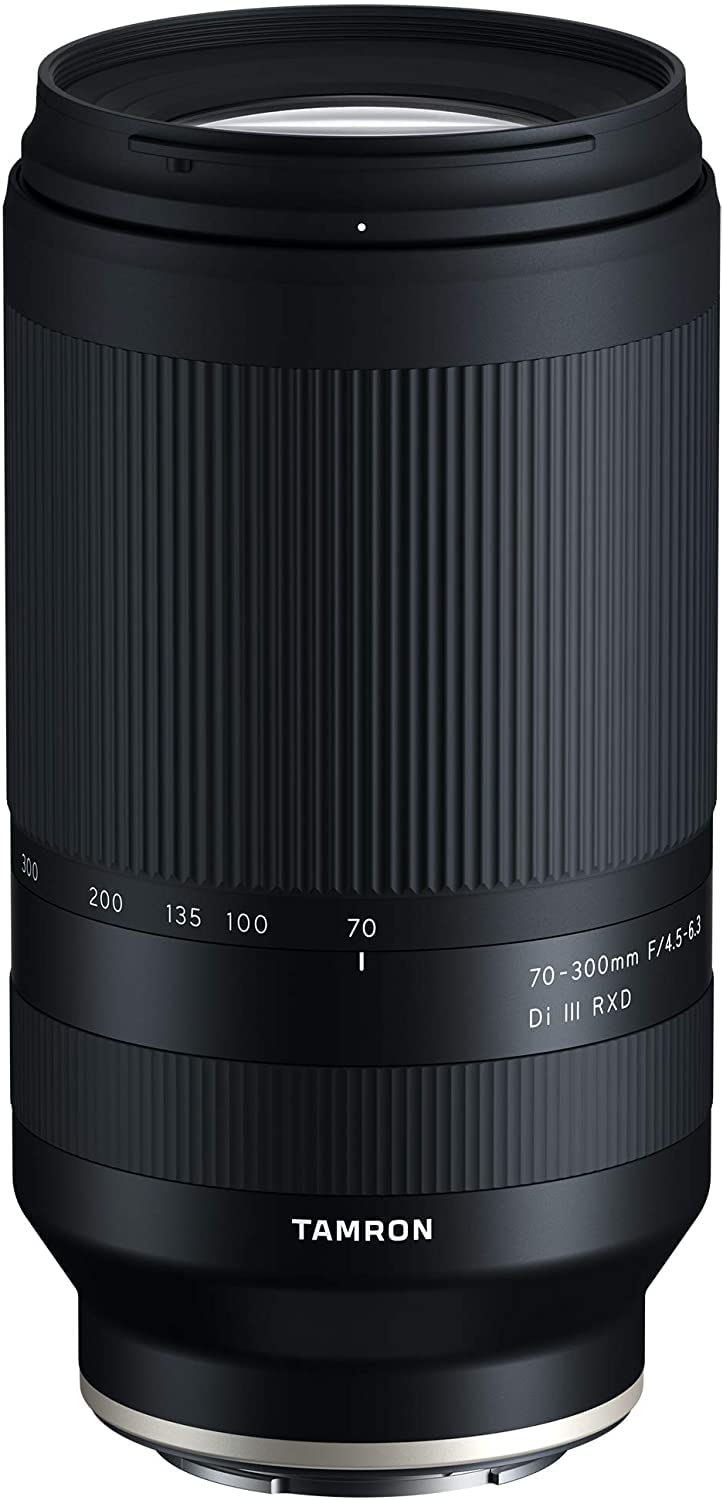
Tamron 70-300mm

92 /100
Keeper Score Outstanding

Key details

Warranty
6 years
Focal Length
70-300mm
Max Aperture
f/4.5-6.3
Max Magnification
1:5.1 at 300mm
Check Price on Amazon

Fifty-nine inches is the number that makes this more than a budget telephoto. That is the close-focus distance at 300mm, where the lens gives you roughly one-fifth life-size — enough for a butterfly, a seed head, or the lettering on a sign across the road, and close enough that a 70-300 covers more ground than its focal range suggests.

It is also 1.2 pounds, which is the other half of the argument: it goes in a small bag on an A7 body and stays there. Sharpness is the surprise — 15 elements in 10 groups, BBAR coating, and results that hold up beside the pricier picks here. RXD focusing is quiet and quick, the construction is moisture resistant, and Tamron backs it with a six-year USA warranty.

Against the 70-350 it gives up reach on APS-C bodies and gains full-frame coverage; against the 150-500 it gives up 200mm. For a first Sony telephoto, or a second lens that travels, this is the one we reach for.

Pros

  • 1.2 pounds on a full-frame Sony body
  • 1:5.1 close focus at 300mm
  • Six-year USA warranty
  • Sharp results next to pricier picks

Cons

  • No in-lens stabilization
  • f/6.3 at 300mm needs good light
Our verdict

We recommend it as the first telephoto for most Sony full-frame owners: light, sharp, close-focusing, and covered by a six-year warranty.

Check Latest Price
6

Moon and Stills

Lightdow 420-800mm

80 /100
Keeper Score Excellent

Key details

Focus
Manual only
Focal Length
420-800mm
Max Aperture
f/8.3-16
Filter Thread
67mm
Check Price on Amazon

What a very cheap 800mm lens buys is focal length, and that is the entire transaction. The Lightdow runs 420-800mm, mounts through a T-mount adapter for Canon EF bodies, and has no electronic contacts at all — no autofocus, and no way for the camera to set the aperture.

Pointed at the moon from a locked-off tripod, it does what it promises. The moon is bright, still, and very far away, which is exactly the brief this lens was built for; the same setup works for a lighthouse across a bay or a skyline from a hill. Focus by hand in live view at maximum magnification and the results are sharper than the outlay suggests.

Anything that moves is a different story. The zoom ring takes nearly two full turns to travel from 420 to 800mm, the barrel is very long at the far end, and the slightest touch on the focus ring shifts the frame — so birds, field sports, and anything in motion are out. We treat it as a telescope that happens to take pictures, and on that basis it earns its place: the least expensive way in this group to find out what 800mm actually feels like.

Pros

  • 800mm reach for very little money
  • Sharp moon and distant stills on a tripod
  • T-mount adapter for Canon EF included

Cons

  • Manual focus only
  • No image stabilization
Our verdict

We recommend it only for static, bright, distant subjects — the moon above all — where manual focus and a tripod are part of the process rather than a compromise.

Check Latest Price

How We Tested These Telephoto Lenses

We built the shortlist around the cameras people actually own — full-frame and crop-sensor mirrorless bodies, plus a couple of DSLRs — then filtered for focal range, maximum aperture at the long end, built-in stabilization, and whether a lens needed an adapter to mount at all. That left eight lenses, which we shot with for ten months.

Testing happened where telephotos get used: dawn walks along a wetland trail, the sideline of a weekend soccer game, a dim gym, a backyard feeder at last light, and one long hike where every lens had to be carried rather than wheeled. Each went out on at least three of those outings, mounted on the same two bodies so the comparisons stayed honest.

For sharpness we photographed a perched bird at 20 yards and a parked car's plate at 100 feet, then zoomed to 100 percent to check feather barbs and lettering. For autofocus we tracked a dog running at us and counted how many frames in a burst were actually in focus, then repeated it at dusk to see whether the lens hunted. We shot handheld at the long end at slow shutter speeds with stabilization on and off and compared the keepers, and we turned the manual focus ring bare-handed and in gloves. Every lens was weighed with the body attached and carried for three hours, and we noted where the zoom ring landed, how far it traveled, and whether the barrel extended. Value was the last question: whether the extra money bought reach, aperture, or stabilization you'd genuinely use.

How to Choose a Telephoto Lens

Work out real reach before you compare numbers

Focal length is only half the story, because the sensor behind it changes the framing. Sony's 1.5x and Canon's 1.6x crop turn a 70-350mm into a 105-525mm equivalent and a 100-400mm into a 160-640mm, which is why crop bodies remain so popular for birds and field sports. On full frame, 300mm is a portrait and stadium length; birders generally want 400mm and up.

Decide in equivalent terms first, then check the lens covers your sensor. A crop-only lens on a full-frame body means shooting in crop mode and giving away resolution, while a full-frame lens on a crop body simply uses the center of the image.

Aperture decides the light you can shoot in

A stop of aperture is a stop of shutter speed or ISO, and at long focal lengths that stop is everything. An f/6.3-9 zoom is a joy at midday and a struggle at dawn; faster glass buys back the light but gets heavier and more expensive quickly. Be honest about when you shoot.

If your photography happens on weekend afternoons, trading speed for reach and a body you can hand-hold is sensible. If it happens in the hour after sunrise, pay for speed or accept the noise.

Stabilization is what makes reach hand-held

At 500mm and beyond every tremor is magnified. In-lens stabilization — Canon's IS, Sony's Optical SteadyShot, Tamron's VC — is often the difference between shooting and setting up. Bodies with in-body stabilization pick up part of the job, and on Sony bodies the two systems work together.

A lens without in-lens stabilization, like the Tamron 70-300, leans entirely on the camera; on an older body, plan on faster shutter speeds or a monopod. A monopod costs less than a faster lens and solves more problems than people expect.

Autofocus matters more than a hair of sharpness

Linear motors — Sony's XD, Canon's Nano USM, Tamron's RXD and VXD — are what to look for on anything that moves. They focus quickly, quietly, and without the hunting that ruins a burst. For birds, dogs, or athletes, autofocus behavior decides more keepers than a marginal difference in resolution.

Manual-focus lenses can be sharp and still be the wrong tool: by the time the ring is turned, the subject has moved. Buy one for static subjects and know that is the trade.

Budget for what comes after the lens

The lens is the start of the spending. Filters scale with the front element, and a 95mm polarizer costs far more than a 67mm one; a monopod or gimbal head becomes necessary at 500mm and up; and a super-telephoto needs a bag that fits it attached to a body.

Warranty deserves a look too — Tamron's six-year USA coverage stands out against the one-year terms on the Canon and Lightdow lenses here. None of this should change which lens you want, but it should change what you can spend on it.

Frequently Asked Questions

Final Verdict

The Canon RF 200-800mm is what we point long-range shooters toward: 800mm with autofocus, stabilization, and a weight you can carry, in the daylight where wildlife and field sports actually happen. If you shoot Canon and want one lens that goes everywhere, the RF 100-400 is the better daily companion, and for many people it is the smarter first buy.

On Sony, the 70-350 is the travel answer for APS-C bodies and the 150-500 is the reach answer for full frame, with the 70-300 between them as the light, inexpensive choice. The manual Lightdow has one real job — the moon — and we would not...