Best Sony Macro Lenses of 2026

Macro lenses are sold on a ratio, and it's the one number worth learning: 1:1 puts your subject on the sensor at life size, 2:1 doubles it. The catch is that magnification and working distance pull against each other — the closer a lens focuses, the more likely your shadow reaches the flower before your focus does. A good macro lens resolves that tug, giving you either room to work or a usable last inch.

I spend most Saturday mornings kneeling in wet grass, and the lesson that stuck is that the lens matters less than whether you get the frame before the insect leaves. Over six months, our team ran eight of these on full-frame and crop-sensor bodies, at kitchen tables and in the yard.

Here's what nobody tells a first-time buyer: autofocus isn't a given. Two of the lenses we tried are manual-focus only — sensible on a tripod with a coin, maddening with anything that breathes. The list below splits along that line, and the cheapest options did not embarrass themselves.

Keeper Score summarizes customer ratings and review volume. Read it alongside the product details and trade-offs. How the score works.

1

Best Overall

Sony FE 90mm F2.8 Macro G OSS

90 /100
Keeper Score Outstanding

Key details

Weight
602 g (21.3 oz)
Focal Length
90mm
Maximum Magnification
1.0x
Minimum Focus Distance
0.92 ft (0.28 m)
Check Price on Amazon

The focus ring on Sony's 90mm slides back to swap between autofocus and manual, and that single gesture is why it's the lens we hand people first. At 1:1 the plane of focus is a sliver, so autofocus is guessing; dropping into manual without moving your hand off the barrel is the difference between catching a bee's eye and chasing it around the frame.

Optically it's the benchmark of this group. Ours was crisp edge to edge wide open, which is rare enough that we stopped checking for it and started shooting portraits instead — 90mm at f/2.8 with nine blades rounds out a background beautifully behind a headshot.

The 0.92 ft minimum focus distance is the quieter advantage. It keeps the front element far enough back that a small diffused flash fits above the subject without entering the frame, and it gives skittish subjects a little more standoff. Optical Steady Shot mostly steadies the finder at this range rather than buying you shutter speed, which is exactly what you want when you're crouched over a flower placing focus by hand.

Where it gives ground is acquisition in low light at close range, where it can hunt before it locks. The limiter and that sliding ring solve it faster than any menu dive. Add the dust and moisture resistance and it's the lens we take out on a dewy morning without thinking about it.

Pros

  • Sharp edge to edge wide open
  • 0.92 ft focus leaves room for a flash
  • Optical stabilization for handheld close-ups
  • Sliding ring swaps autofocus and manual instantly

Cons

  • Costs more than anything else in this group
Our verdict

For most people buying a first macro lens, this is the one: sharp wide open, sealed against weather, and equally at home on a portrait.

Check Latest Price
2

Best Value Full-Frame

Sigma 105mm F2.8 DG DN Macro Art

90 /100
Keeper Score Outstanding

Key details

Weight
1.58 lb
Focal Length
105mm
Aperture Ring
Clicked and de-clicked
Maximum Magnification
1:1
Check Price on Amazon

Fifteen millimetres doesn't sound like much until you're on your knees in wet grass. The Sigma's 105mm puts a little more air between the front element and whatever is about to fly away, and it does it at the same 1:1 magnification as our top pick.

We expected a visible step down in the files and didn't find one. It's sharp and contrasty, with the flat-field rendering that keeps copy work and product shots clean into the corners, and we happily shot portraits on it. Where the saving shows up is handling rather than optics — focus is quick enough for people and slow enough at 1:1 that you'll want the limiter set to its macro position.

The aperture ring is the detail we appreciated most: click-stopped for stills, de-clicked for video, with a lock so it can't drift off the A position. There's a proper three-setting focus limiter, and Sigma backs the lens with a four-year warranty. Two things to accept: at 715 g it's the heaviest here, and there's no weather sealing, a real gap if you shoot outdoors in bad weather.

Pros

  • Sharp, high-contrast optics at 1:1
  • Aperture ring clicks and de-clicks
  • Focus limiter has a dedicated macro setting
  • Four-year warranty

Cons

  • No weather sealing
  • Heaviest lens in this group at 715 g
Our verdict

If you want near-Sony image quality and a little more standoff, the Sigma is the closest thing here, with an aperture ring video shooters will appreciate.

Check Latest Price
3

Best for Extreme Close-Ups

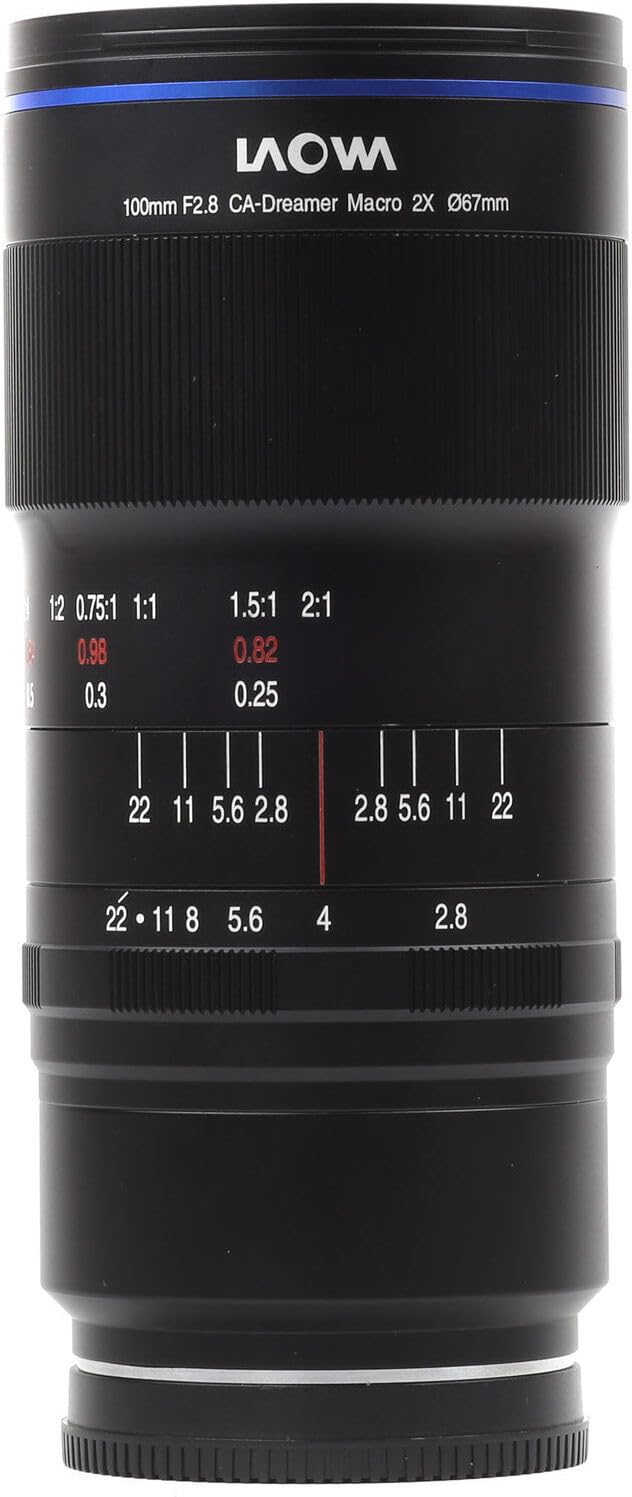
Laowa 100mm f/2.8 2X Ultra Macro APO

87 /100
Keeper Score Excellent

Key details

Focus
Manual
Weight
1.41 lb
Focal Length
100mm
Maximum Magnification
2x
Check Price on Amazon

Two-to-one is the number that separates this lens from everything else on the page. At 2:1 the frame covers a subject half the width of the sensor, which is the difference between photographing a butterfly and photographing the scales on its wing.

Everything about it is manual, and that's the point. The aperture ring sits on the barrel, the focusing ring has a long damped throw that makes tiny adjustments possible, and 13 blades keep defocused highlights round when you stop down. The APO glass is doing real work too — colour fringing on high-contrast edges is the usual complaint at this magnification, and these files came back clean.

Buy it if your macro is deliberate: on a tripod or a rail, stacking a mineral specimen or a dead hoverfly. Hand-holding at 2:1 is a losing game, because a breath moves the subject two frames sideways, and there's no stabilization or autofocus to fall back on. For static subjects at that magnification, nothing else here gets you this close for the money.

Pros

  • 2:1 magnification for tiny subjects
  • APO glass keeps edges clean at 2x
  • 13 aperture blades and a damped manual ring

Cons

  • Manual focus only
  • No image stabilization
Our verdict

Buy this if you want to fill the frame with something the size of a grain of rice; nothing else here magnifies this far with glass this clean.

Check Latest Price
4

Best for Traveling Light

Sony FE 50mm F2.8 Macro

86 /100
Keeper Score Excellent

Key details

Weight
12 oz
Focal Length
50mm
Maximum Magnification
1:1
Minimum Focus Distance
6.3 inches (0.16 m)
Check Price on Amazon

At 340 g and 2.78 inches long, this is the macro lens that actually travels. It's the one we leave in the bag on a trip where photography isn't the reason for the trip, and it's why a hand-held 1:1 shot of a museum label doesn't need a second lens along.

Six inches of minimum focus is both the trick and the catch. You get true 1:1 from something you can hold in one hand, but the front element ends up almost on top of the subject, which shadows your own light and rules out anything with legs. For flat things — stamps, documents, jewellery on a table — that trade disappears, and this is the tidiest lens here for it.

The 50mm also carries ED glass to knock down the axial chromatic aberration that shows up as fringing at high magnification, plus a focus limiter, a focus-hold button and a magnification scale on the barrel. Set the limiter to its close range and it's a lens you can work one-handed over a tabletop.

Pros

  • 340 g and short enough to live in the bag
  • True 1:1 at a 6.3 inch focus distance
  • ED glass targets axial chromatic aberration
  • Dust and moisture resistant body

Cons

  • Autofocus is slow and noisy at close range
Our verdict

The one to buy when the lens has to disappear into a small bag: 340 g, true 1:1, and a price below the other full-frame options.

Check Latest Price
5

Budget APS-C Macro

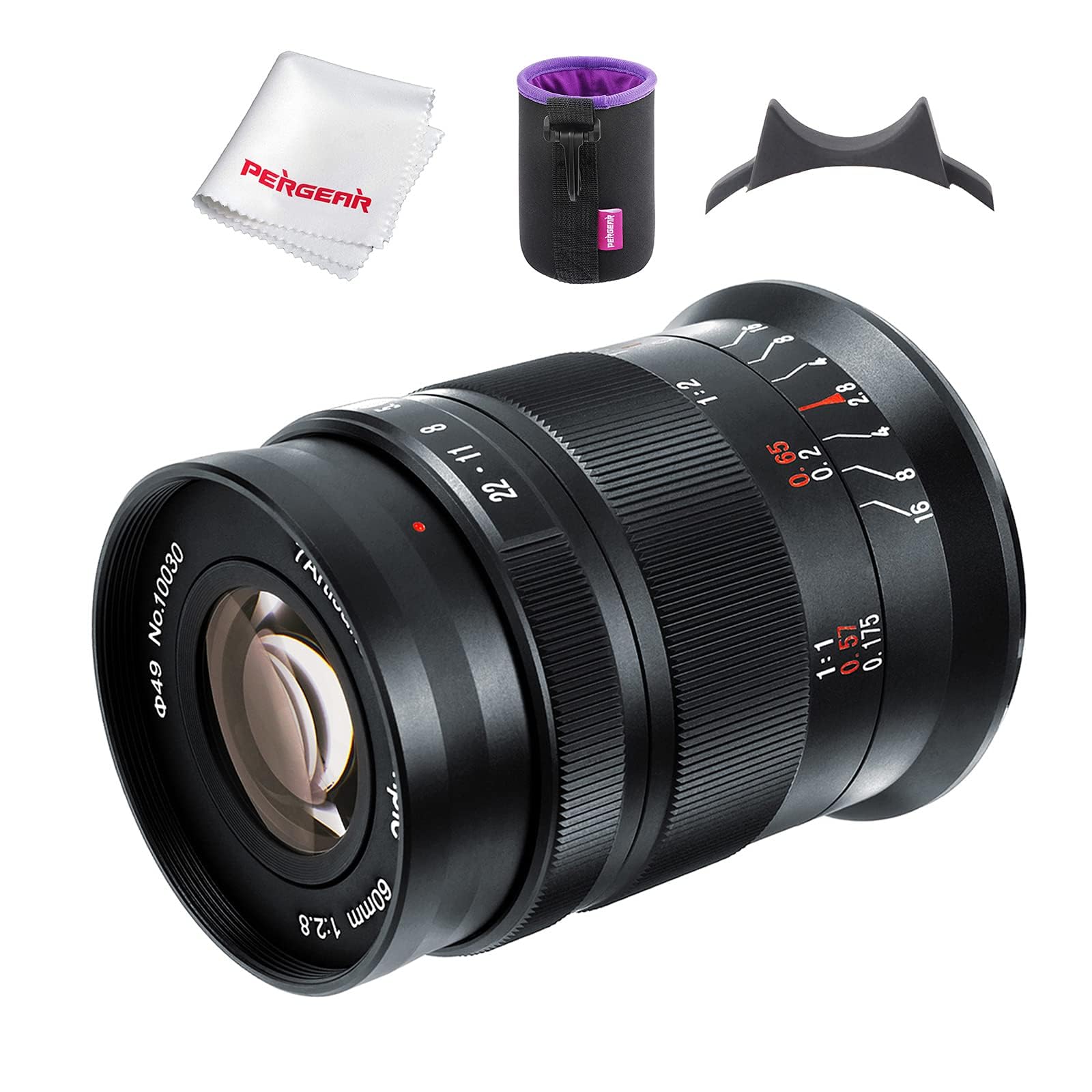
7artisans 60mm F2.8 II Macro

83 /100
Keeper Score Excellent

Key details

Weight
12.1 oz
Focal Length
60mm
Maximum Magnification
1:1
Minimum Focus Distance
0.175 m
Check Price on Amazon

The 7artisans is the cheapest lens here, and it's the one we point at anyone who wants to find out whether macro is a hobby or a phase. It's APS-C only and manual focus only, and it still puts a life-size image on the card.

What it gets right is the part that matters most at its price: the barrel doesn't extend. Internal focusing keeps it 80.5mm long with a 0.175 m minimum focus, so the front element doesn't creep toward a nervous insect as you turn the ring, and 342 g balances on a small body without a grip.

Eleven elements in eight groups with one ED element is more glass than the money suggests, and the nine-blade aperture keeps backgrounds soft behind a flower. Aperture on the ring, focus by hand: for coins, leaves, watch parts and still lifes, that isn't a compromise, it's the method. It's the one we hand to a teenager with an a6000 and a free weekend.

Pros

  • Least expensive lens in the group
  • Internal focusing keeps the barrel short
  • 342 g balances on a small body
  • One ED element at a budget price

Cons

  • Manual focus only
  • APS-C image circle only
Our verdict

A first macro lens for APS-C shooters who don't mind focusing by hand — small, internal-focusing, and cheap enough to experiment with.

Check Latest Price
6

APS-C High Magnification

Laowa 65mm f/2.8 2X Ultra Macro APO

81 /100
Keeper Score Excellent

Key details

Focus
Manual
Weight
11.2 oz
Focal Length
65mm (97.5mm equivalent)
Maximum Magnification
2:1
Check Price on Amazon

On an a6700 or an FX30, 65mm frames like 97.5mm, and that's the space this lens was built for: enough standoff to light a subject, little enough bulk to carry all day.

It reaches 2:1, which on APS-C means the frame covers something under half an inch wide. Three extra-low-dispersion elements hold colour clean at that magnification, the focus is internal so the lens stays the same length, and at 11.2 oz it's lighter than any full-frame option here. The manual ring is smooth and geared for small movements, which matters more than any figure on the box when you're nudging focus a fraction of a millimetre.

There's no autofocus and no full-frame coverage, so this is a lens you buy for one job: maximum magnification from a small kit. For insects with an APS-C body and a flash, it's the most capability per ounce in this group. If you want one lens to also shoot portraits and walkaround, the Sony 50mm is the friendlier companion.

Pros

  • 2:1 magnification on APS-C
  • Three extra-low-dispersion elements
  • Internal focus keeps length constant
  • Light at 11.2 ounces

Cons

  • Manual focus only
  • APS-C coverage only
Our verdict

For APS-C bodies this is the most magnification you can carry at 11 ounces, provided you're happy turning the ring yourself.

Check Latest Price

How We Tested These Macro Lenses for Sony E-Mount Cameras

We started with every E-mount macro lens sold new today, then narrowed by what actually changes how you shoot: maximum magnification, focal length, whether the lens covers a full-frame sensor or only APS-C, minimum working distance, and whether it autofocuses at all. We kept a deliberate spread from inexpensive manual glass to the heavy professional options, so the comparison would say something about what your money buys at each price.

Eight lenses then lived with us for six months. That meant early mornings in the garden chasing dew and beetles, handheld, with the subject gone in seconds. It meant a card table in the kitchen with coins, a watch movement, and a spool of thread, where the camera sat on a tripod and nothing moved. And it meant ordinary jobs — a ring photographed for a friend, a plant on a desk — because most of these get used for far more than macro.

Sharpness we checked the boring way: the same banknote and resolution target at 1:1, wide open and then stopped down, compared at 100% in the corners as well as the center. Autofocus was timed from half-press to lock at minimum distance and again at a meter, and we counted how often it hunted on a flat, low-contrast subject and whether the lock landed where we put the focus point or a hair behind it. We measured working distance with a ruler from the front element to the subject, since an inch or two is the difference between a lit frame and your own shadow. Build got judged by hand: how the focus ring felt and how far it turned, whether it crept while autofocusing, and how the lens balanced on a small body.

How to Choose a Sony Macro Lens

Magnification: 1:1 or 2:1

Check the magnification ratio, not the word macro on the box — plenty of zooms claim it for focusing at a third or a quarter of life size. True macro means 1:1, where the subject lands on the sensor at its actual size, and every lens here reaches at least that.

The two Laowa lenses go to 2:1, which puts twice life size on the sensor and turns a whole insect into a portrait of its eye. Extra magnification costs depth of field and light, so it earns its place only if very small subjects are the reason you're buying.

Focal length and working distance

Focal length is really a measure of elbow room. A 50mm or 60mm macro gets to 1:1 with the front element almost touching the subject, which is fine for flat work and hopeless for anything that moves or needs lighting. A 90mm to 105mm lens buys back space for a diffused flash and keeps you out of a bee's flight path.

If you shoot insects, go 90mm or longer. If you shoot stamps, coins or products on a table, a shorter lens is easier to handle and lighter to carry, and the closeness stops being a problem.

Autofocus, manual focus and the switches in between

At 1:1 the autofocus has very little contrast to work with and a sliver of depth to land in, so it hunts. That's the lens doing its job, not a fault. What separates the good options is how fast you can take over: a sliding collar, a limiter with a macro setting, or a well-damped manual ring.

Two lenses here are manual-focus only, which is no handicap on a tripod and a real one for anything that moves. Check that whatever you buy gives you a quick route into manual before you need it.

Full-frame versus APS-C coverage

Mount compatibility isn't coverage. The Laowa 65mm and the 7artisans 60mm are built for APS-C image circles, so on a full-frame body you're cropping or fighting heavy vignetting. Going the other way is always safe: any full-frame E-mount macro here works on an a6700 or an FX30, and the crop turns a 90mm into a 135mm-equivalent, which is a good insect and portrait length.

Decide from your camera body first, then narrow by focal length.

Weight, stabilization and the rest of the kit

At 1:1, stabilization steadies your framing far more than it rescues a slow shutter, because the subject keeps moving. Budget for a diffused flash before a heavier tripod, and add a small focusing rail if you want to stack focus on still subjects.

Weight is then the deciding comfort: 340 g and 602 g feel very different at the end of a two-hour walk, and the APS-C lenses are the lightest route to high magnification.

Frequently Asked Questions

Final Verdict

The Sony 90mm is the lens we recommend to almost everyone: sharp wide open, weather-sealed, stabilized, and quick to drop into manual the moment autofocus runs out of contrast. Nothing else here combines all four.

If the budget is tighter, the Sigma 105mm produces the same 1:1 files with a little more standoff and a better aperture ring. If your subjects are the size of a grain of rice and you work from a tripod, the Laowa 100mm's 2:1 magnification is worth giving up autofocus for.