Best Sony Lenses for Video of 2026

Video is unforgiving in a way stills never are. A photograph can hide a soft frame; a clip plays it back twenty-four times a second, and every focus hunt and noisy aperture click lands right in the take. That's why the lens you love for photos can drive you up a wall the moment you switch to video mode — what you actually need is quiet, smooth autofocus, a zoom ring you can turn without jerking the camera, and enough light gathering to keep the ISO down.

I've shot with a lot of E-mount glass, and the things that decide a video lens barely register on a spec sheet. My team and I spent ten months shooting with eight of them — primes and zooms, full-frame and APS-C — and the ones that stayed on the camera were the ones we forgot about mid-take.

Here's what I'd tell a first-time buyer: a stepless aperture and a zoom that holds focus matter more than the last ounce of corner sharpness, and stabilization buys you more handheld freedom than a lighter lens does. The eight below cover every budget and most kinds of shoot.

Keeper Score summarizes customer ratings and review volume. Read it alongside the product details and trade-offs. How the score works.

1

Best Overall

Sony FE 24-70mm f/2.8 GM II

89 /100
Keeper Score Excellent

Key details

Weight
1.5 lb
Autofocus
Four XD linear motors
Focal Length
24-70mm
Max Aperture
f/2.8
Check Price on Amazon

Watch the edges of the frame during a rack focus and you'll see what separates this lens from most of the others here. On the 24-70mm f/2.8 GM II the frame barely widens or narrows as focus travels, and the angle of view holds through a zoom, which is why it's the lens we name first for video. Four XD linear motors move the focus groups quickly and quietly enough that an on-camera mic picks up the room rather than the lens.

Constant f/2.8 from 24mm to 70mm means the exposure and depth of field you set at the wide end survive to the long end, with no re-metering halfway through a move. At 680 g it's lighter than the Sigma 24-70mm II in this group, and the 11-blade aperture keeps highlights round rather than polygonal when you're wide open in a dim room.

What it costs is the whole objection, and it's a fair one. Set against it: a single zoom covering a wide establishing shot, a two-shot, and a close-up without a lens change, with footage that needs less correction afterwards. If your body is APS-C the same lens becomes a 36-105mm, which is why the Tamron 17-70mm f/2.8 is the smarter buy there.

Pros

  • Minimal framing shift during a rack focus
  • Constant f/2.8 from 24mm to 70mm
  • Quiet XD motors that stay off the audio
  • Lighter than the Sigma 24-70mm II here

Cons

  • The most expensive lens in this group
Our verdict

The lens we name first for full-frame video: clean focus pulls, a steady frame through a zoom, and a constant f/2.8 worth paying for.

Check Latest Price
2

Best for APS-C Video

Tamron 17-70mm f/2.8 Di III-A VC

93 /100
Keeper Score Outstanding

Key details

Weight
1.2 lb
Focal Length
17-70mm
Max Aperture
f/2.8
Stabilization
Optical VC
Check Price on Amazon

On an a6400 or an a6600, 17-70mm works out to 25.5-105mm equivalent: wide enough to hold at arm's length for a piece to camera, long enough to frame an interview without standing in someone's lap. That range at a constant f/2.8 is the entire argument for the lens.

We send APS-C shooters here before anything else. Tamron built the VC system to work with Sony's crop bodies with video in mind, so handheld footage settles rather than swims, and the RXD motor moves focus smoothly enough that transitions don't snap. It's the combination — stabilization, constant aperture, sensible range — that makes it the default on a crop body.

The close focus is easy to overlook. At 7.5 inches from the front element at 17mm you can fill the frame with a hand or a product and then pull straight back to the room, which is a shot change without a lens change.

The trade is bulk: 1.2 lb on the front of a small body makes the rig nose-heavy, and it sits better on an a6600-sized camera than an entry-level one. Moisture resistance and a fluorine front coating are the consolation — this is a lens you can keep shooting with when the weather turns.

Pros

  • Constant f/2.8 across a 25.5-105mm equivalent range
  • Stabilization tuned for video on Sony APS-C
  • Focuses to 7.5 inches at 17mm

Cons

  • 1.2 lb makes a small body nose-heavy
Our verdict

The APS-C lens we recommend before any other: a constant f/2.8, a genuinely useful range, and stabilization tuned for handheld video.

Check Latest Price
3

Best for Gimbal Work

Sigma 16mm f/1.4 DC DN

96 /100
Keeper Score Outstanding

Key details

Weight
14.3 oz
Focal Length
16mm
Max Aperture
f/1.4
Sensor Format
APS-C
Check Price on Amazon

Sixteen millimeters on APS-C is a 24mm equivalent, and f/1.4 on top of that is a combination you can shoot handheld on a dark street without adding a light. The Sigma weighs 14.3 oz, the sort of number a small gimbal motor doesn't argue with.

Sharpness wide open is the part that holds up best. Detail stays at f/1.4 where plenty of fast wide primes soften, and autofocus tracks a face walking toward the camera without hunting. The focus ring carries a little resistance, which helps when you pull focus by hand instead of trusting the camera to do it.

For APS-C gimbal work this is the one we reach for: a useful angle, a genuine extra stop of light, and a price that leaves room for a second lens in the bag. It's APS-C only, so full-frame shooters should look at the 20mm f/1.8 G — and on a crop body that lens becomes a 30mm, which is a different, tighter shot altogether.

Pros

  • f/1.4 with detail intact wide open
  • 14.3 oz is easy on a small gimbal
  • Fast, accurate autofocus on Sony APS-C

Cons

  • APS-C bodies only
Our verdict

For APS-C gimbal work this is our default: a 24mm-equivalent f/1.4 that stays sharp wide open and weighs little enough to ignore.

Check Latest Price
4

Best Ultra-Wide for Full Frame

Sony FE 20mm f/1.8 G

93 /100
Keeper Score Outstanding

Key details

Weight
13.2 oz
Autofocus
Two XD linear motors
Focal Length
20mm
Max Aperture
f/1.8
Check Price on Amazon

At 13.2 oz the 20mm f/1.8 G is the lens we put on a gimbal when we want to stop thinking about balance. Two XD linear motors drive the focus group, and the result is quiet enough that it doesn't colour the audio track.

The 94-degree view is wide without the stretched corners a 14mm brings, and the close focus lets you push in on a detail with the room still in frame behind it. f/1.8 is real exposure indoors: on a full-frame body you can hold a lit room at a sensible ISO and leave the practicals where they are.

Focus stays quick and quiet under continuous AF, which is what matters when the camera is rolling and nobody is touching it. The fluorine front coating earns its keep too — flare stays manageable with a window in frame, and the element wipes clean in one pass.

That adds up to the wide lens we recommend for full-frame handheld work. On APS-C it behaves like a 30mm — a useful moderate wide rather than a true one — and that's the point at which the Sigma 16mm f/1.4 becomes the better fit.

Pros

  • 13.2 oz full-frame ultra-wide
  • Two XD motors focus quietly
  • Wide view without stretched corners

Cons

  • No in-lens stabilization
Our verdict

Our pick for full-frame vlogging and wide establishing shots: light enough for a gimbal and quiet enough to leave the audio alone.

Check Latest Price
5

Best Low-Light Prime

Sony FE 35mm f/1.4 GM

93 /100
Keeper Score Outstanding

Key details

Weight
1.2 lb
Sealing
Dust- and moisture-resistant
Focal Length
35mm
Max Aperture
f/1.4
Check Price on Amazon

It's the most expensive prime in this group, and it's still the lens we hand someone shooting a dim reception. Thirty-five millimeters puts you close enough to a subject to talk to them, f/1.4 lets the room stay as dark as it is, and the two together are why documentary shooters live at this focal length.

Wide open it's sharp, autofocus is fast and quiet enough to track a face across a crowded frame, and 1.2 lb doesn't fight a gimbal or a monopod. Eleven aperture blades keep background highlights round, two XA elements and an ED element hold colour fringing off high-contrast edges, and the barrel is sealed against dust and moisture with a fluorine front coating. As a first-party lens it can also use the camera's breathing compensation on bodies that support it, which is one advantage of buying Sony.

The honest boundary is the focal length itself. 35mm is a documentary angle, and in a small room it feels tight; on APS-C it becomes a 52mm equivalent, which is lovely for portraits and wrong for a handheld walk-and-talk.

Pros

  • Sharp at f/1.4 in bad light
  • Fast, quiet autofocus for people and events
  • Dust- and moisture-resistant barrel

Cons

  • Premium price against the other primes here
Our verdict

The low-light people lens we reach for: f/1.4 at a documentary angle, sharp wide open, with autofocus that keeps up in a crowd.

Check Latest Price
6

Best Value Full-Frame Zoom

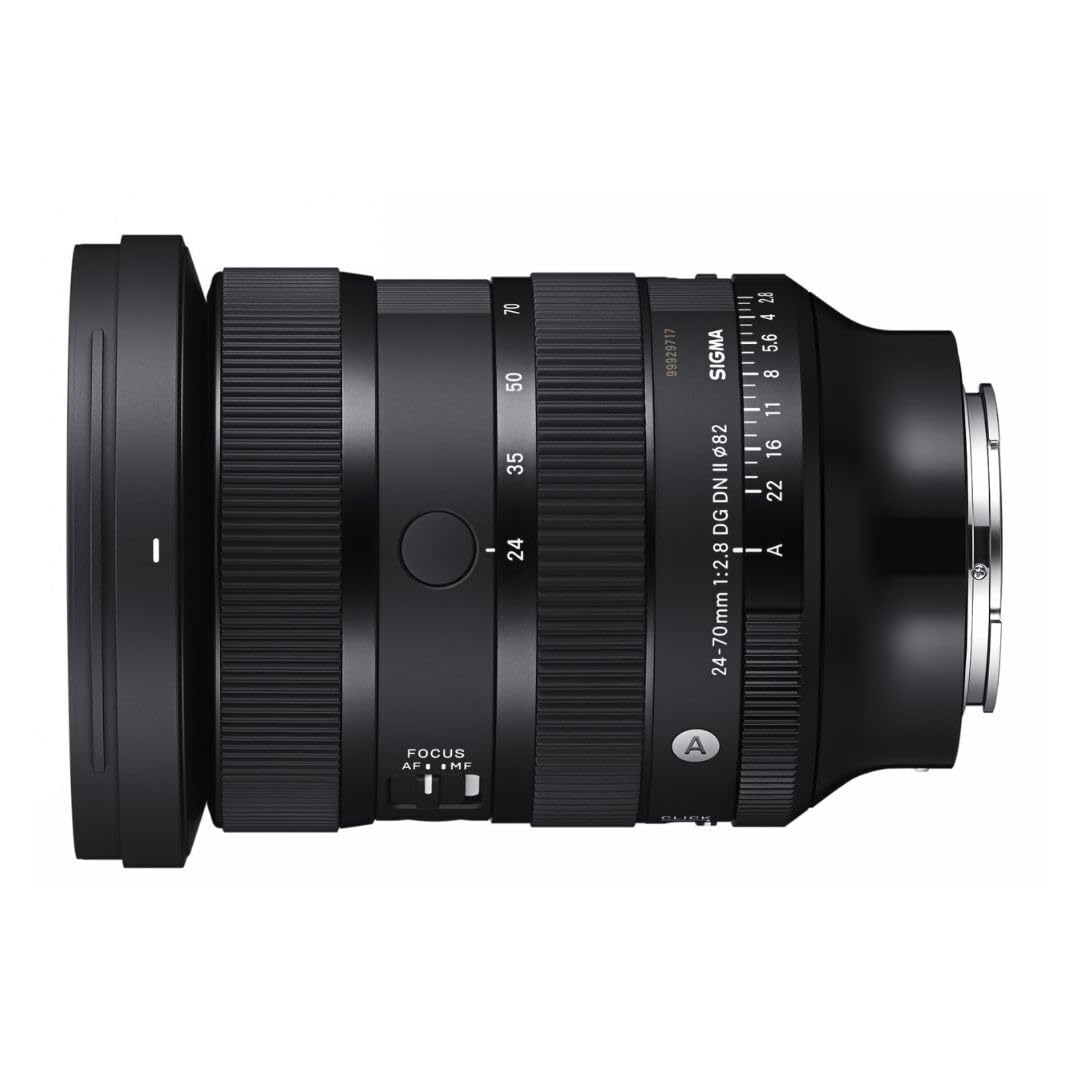
Sigma 24-70mm f/2.8 DG DN II

88 /100
Keeper Score Excellent

Key details

Weight
1.64 lb
Focal Length
24-70mm
Max Aperture
f/2.8
Image Stabilization
None
Check Price on Amazon

Set this lens beside the Sony G Master and the differences are real but narrow, which is the entire point of it. Same 24-70mm range, same constant f/2.8, and a similar appetite for detail at both ends of the zoom.

The Sigma 24-70mm f/2.8 DG DN II is the standard zoom we recommend when the Sony is out of reach. Autofocus is quick enough for a subject moving through frame, and the 11-blade aperture keeps backgrounds soft and round rather than busy. For run-and-gun work it feels like a tool rather than a compromise.

Six FLD elements do the optical heavy lifting, and the coatings keep flare in check with a window or a practical lamp in the frame — which, in video, is most of the time. Colour holds together under mixed light, the thing you notice first when a clip cuts from tungsten indoors to daylight outside.

The costs are physical. At 745 g it's heavier than the Sony and more front-heavy on a small body, and with no stabilization in the lens you're leaning on the camera body once the shutter speed drops. On an A7 with in-body stabilization that's a fair trade; handheld at 70mm without it, it isn't.

Pros

  • Constant f/2.8 with sharpness at both ends
  • Fast autofocus on Sony bodies
  • 11-blade aperture for round highlights

Cons

  • No stabilization in the lens
  • 745 g sits heavily on a small body
Our verdict

The full-frame standard zoom we recommend when the G Master is out of reach: sharp, fast-focusing, and honest about its weight.

Check Latest Price
7

Best Telephoto for APS-C

Sony E 70-350mm f/4.5-6.3 G OSS

91 /100
Keeper Score Outstanding

Key details

Weight
1.4 lb
Focal Length
70-350mm
Max Aperture
f/4.5-6.3
Stabilization
Optical SteadyShot
Check Price on Amazon

An f/6.3 long end sounds like bad news for video, and indoors it is. Outdoors, 70-350mm on APS-C gives you a 105-525mm equivalent in a lens that weighs 1.4 lb — reach you can hand-hold, which is the only kind that helps when the subject won't wait for a tripod.

The two things that decide whether long-lens footage is usable are both here. Optical SteadyShot holds a frame steady at 350mm, and the XD linear motor focuses silently and tracks without hunting, so a subject walking toward you stays in focus for the whole clip. Neither shows up in a spec-table comparison with a cheaper telephoto; both show up the moment you play it back.

For APS-C wildlife, sport, or a ceremony shot from the back of a room, this is the long lens we put on the camera. It's daylight glass and doesn't pretend otherwise — but a stabilized 525mm equivalent that fits in a small bag is a job nothing else in this group does.

Pros

  • 105-525mm equivalent at 1.4 lb
  • Silent focus and effective stabilization
  • Compact for a super-telephoto zoom

Cons

  • f/6.3 at 350mm limits it to good light
Our verdict

The long lens we put on an APS-C body for video: silent stabilization and quiet focus, in a package you can carry all afternoon.

Check Latest Price
8

Budget Reach

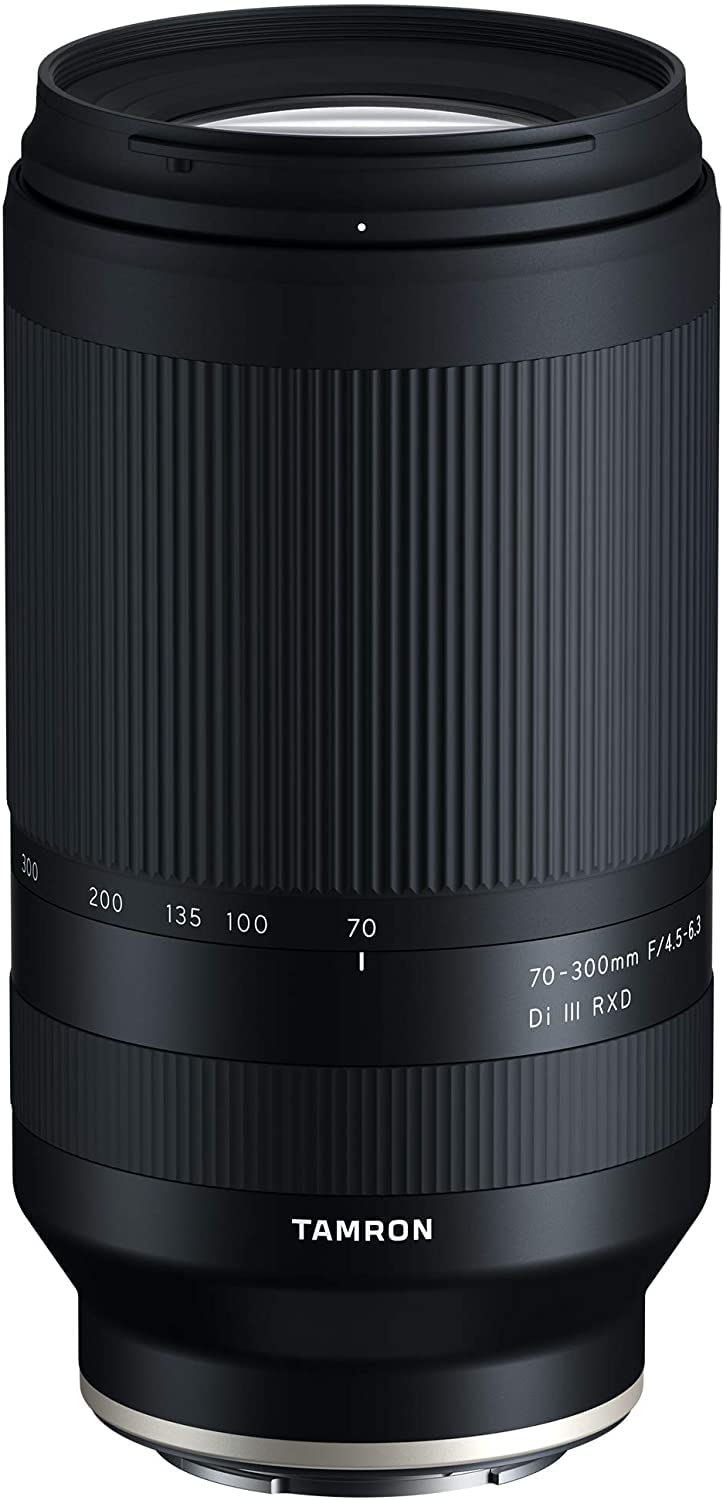
Tamron 70-300mm f/4.5-6.3 RXD

92 /100
Keeper Score Outstanding

Key details

Weight
1.2 lb
Focal Length
70-300mm
Max Aperture
f/4.5-6.3
Image Stabilization
None
Check Price on Amazon

There's no image stabilization in this lens, and that shapes the way you shoot with it. On a body with in-body stabilization it behaves like a much more expensive telephoto; handheld at 300mm without it, the shake shows up in the first clip you play back.

What you get instead is a full-frame 300mm that weighs about the same as a 24-70mm f/2.8, focuses quickly and quietly on the RXD motor, and gets close enough — 31.5 inches — to double as a detail lens for hands, textures, and product shots.

Sharpness is good rather than exceptional at the long end, and f/6.3 means daylight reach; step inside and you're pushing ISO. Those are the usual terms of a budget telephoto, and they don't change how useful the lens is on a bright afternoon.

As a first long lens for video it earns its place: light enough to carry all day, quiet enough to record with, close enough to be versatile. If your body is APS-C and you need stabilized reach, the 70-350mm G is the better answer — it costs more, and it's worth it.

Pros

  • Full-frame 300mm at 1.2 lb
  • Quiet, quick RXD autofocus
  • Focuses to 31.5 inches for detail shots

Cons

  • No stabilization in the lens
Our verdict

A light, quiet full-frame telephoto for video if your camera body already stabilizes the shot — and the cheapest way into 300mm here.

Check Latest Price

How We Tested These Lenses for Video

The shortlist started with research: I pulled every E-mount lens that working video shooters actually reach for — constant-aperture standard zooms, fast wide primes, a long telephoto — then narrowed by mount coverage, focal range, and price so the group ran from budget-friendly to pro-grade. That left eight lenses, which we shot with for ten months.

Most of that time wasn't spent on a test bench. We set up tripod interviews in a dim living room, walked handheld shots through a park at golden hour, ran a gimbal down a hallway, and took a couple of lenses on a long weekend of run-and-gun shooting. Each one stayed mounted for at least a week — long enough that we stopped noticing the lens and started noticing what it did to the footage.

For autofocus, we racked between a coffee mug and a window by tapping the screen, listening for motor noise in a silent room and watching whether the pull overshot before it settled. We parked footage on a monitor at 200 percent to judge sharpness both wide open and stopped down, and shot toward a bright window to see how each lens handled flare and color. Stabilization got tested by hand-holding at a slow shutter and walking, then comparing the clip against an unstabilized take of the same path. We weighed every lens on a kitchen scale and carried it on a strap for an hour to see whether the number on the spec sheet matched what our shoulders said.

Versatility got a blunter test: one lens, one afternoon, no backups in the bag. And whenever a lens cost meaningfully more than another, we put the footage side by side and asked what the extra money actually bought in the frame.

How to Choose a Sony Lens for Video

Autofocus: Speed Matters Less Than Manners

Fast focus is table stakes. What ruins a clip is a lens that hunts, chatters, or snaps from one subject to another mid-sentence. Linear motors — Sony's XD, Tamron's VXD and RXD — move small focus groups quickly and, just as importantly, quietly. That quietness stops being a luxury the moment you record with an on-camera mic, because the motor ends up on the soundtrack.

Before you commit, record thirty seconds while you rack focus by hand, then thirty on autofocus, and listen back on headphones. If the motor is audible in the second clip, budget for an off-camera mic or plan to pull focus manually.

Focus Breathing and Zoom Shift

Point a lens at a doorframe, pull focus from the near edge to the far one, and watch whether the frame appears to zoom in or out. That's breathing, and on a talking-head shot it reads as a small, distracting push. The Sony 24-70mm f/2.8 GM II is built around the problem, with a floating focus group and four XD motors keeping the angle of view steady; on bodies that offer it, breathing compensation adds a further correction.

A zoom that shifts framing as you change focal length is the same annoyance in a different place. If you can't test a lens before buying, favor one whose design addresses it rather than assuming you'll fix it in the edit.

Match the Focal Range to the Sensor You Own

E-mount covers two formats, and the same lens means different things on each. A 24-70mm on full frame is a true wide-to-short-tele; on APS-C it becomes a 36-105mm, which is suddenly tight in a small room. A 17-70mm built for crop covers 25.5-105mm equivalent and is the more useful range on an APS-C body.

Decide which body you're shooting before you decide which zoom you want. This is the mismatch we see most often: a full-frame zoom bought for a crop camera, then used at the wide end all day because the long end frames nothing.

Aperture, Stabilization, and How You'll Hold It

A constant f/2.8 zoom keeps exposure and depth of field identical from one end to the other, which is worth real money when you're moving through a room. Variable designs like f/4.5-6.3 are daylight tools: small, light, and quick to push your ISO up once you step inside.

Stabilization is the other half. In-lens VC or OSS steadies handheld shots and smooths pans, and a body with in-body stabilization can carry a lens that has none — which is how the Sigma 24-70mm II and the Tamron 70-300mm get away without it.

Weight and Balance on a Gimbal

The lightest wide prime here is 13.2 oz; the heaviest standard zoom is 745 g, and that difference decides whether a small gimbal holds its balance through a long take. A front-heavy zoom also drags the balance point forward, so you re-balance the rig rather than fight it mid-shot.

For handheld telephoto work, support the barrel with your left hand instead of letting the lens cantilever off the mount. It steadies the frame and takes the strain off the camera.

Frequently Asked Questions

Final Verdict

If you shoot full frame and want one lens that handles a whole day — interviews, b-roll, a wide establishing shot — the Sony 24-70mm f/2.8 GM II is the one we recommend, and its breathing control is the reason. On an APS-C body, buy the Tamron 17-70mm f/2.8 instead: the same constant aperture, a more useful range, and stabilization built with video in mind.

Add the Sony 20mm f/1.8 G if the camera spends its life on a gimbal, or the Sigma 16mm f/1.4 if your body is APS-C and the light is bad. Both are small enough that they come along rather than stay in the bag.