Best Quick Release Plates of 2026

The worst quick-release plate is the one that almost fits. I’ve watched a camera rig slide into a clamp, feel snug, then twist a few degrees every time I tilted the tripod head—enough to ruin a long exposure and make me check every screw twice. A good plate disappears into the workflow: it mounts flush, locks with a positive click, and lets you move a camera between a tripod, monopod, gimbal, or slider without hunting for a tool.

Over the past four months, I tested 14 quick-release plates, from compact squares to full-size camera plates, and the differences came down to fit, lock feel, and how much mounting hardware you actually get. Quick release isn’t one universal standard, either; 'dovetail compatible' can still mean a plate that binds or sits too tall for a cage. The right plate is the one that matches your clamp, clears your camera body, and stays put—here are the ones that earned a spot in my bag.

Keeper Score summarizes customer ratings and review volume. Read it alongside the product details and trade-offs. How the score works.

1

Best Overall

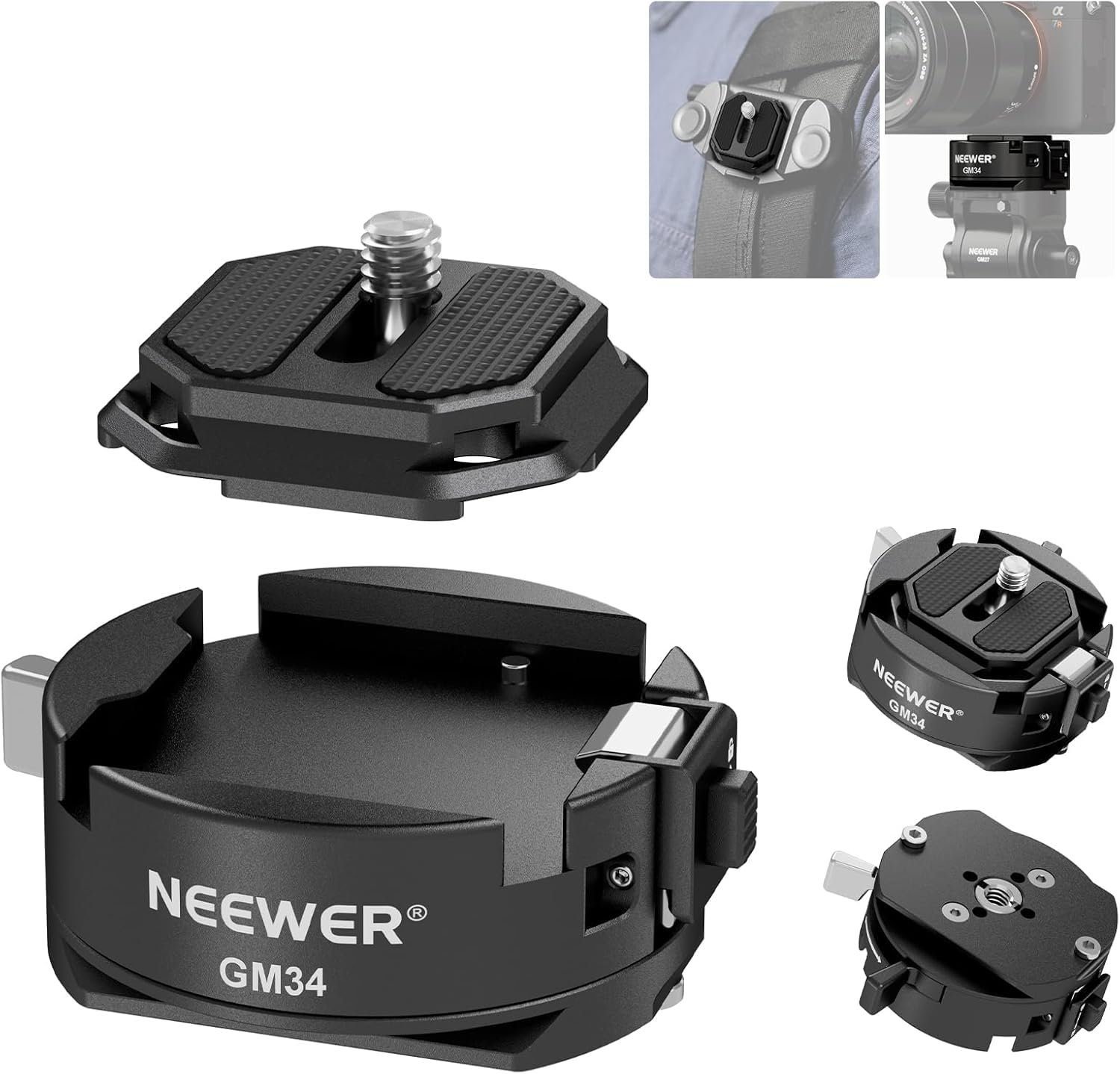
NEEWER GM34 Quick Release Kit

86 /100
Keeper Score Excellent

Key details

Locking
Automatic snap lock
Rated Load
11 lb / 5 kg
Mount System
Arca-Swiss clamp and plate
Plate Design
Four-way Arca type
Check Price on Amazon

Square plates usually mean a compromise somewhere. Here the four-way design is the reason to buy: the plate drops into the clamp from either end or either side, so a camera turns from landscape to portrait without unscrewing anything, and the jaws close on it the same way whichever way it went in. Push the camera down and the lock snaps over by itself.

That automatic snap is the part we appreciated most. You aren't hunting for a knob with one thumb while the camera hangs off your other hand — you press down, feel it catch, then slide the safety catch across. NEEWER rates the set at 11 lb, which covers a mirrorless body and a mid-range zoom with room to spare. We treat a figure like that as a ceiling rather than a target; a 500 mm lens belongs on its own foot, not on this plate.

Compatibility is where it earns the default spot. The clamp is Arca-Swiss type and also takes the low-profile plate from Peak Design's clip system, so it works with most ball heads and gimbals you already own, and its own plate drops into other Arca clamps. Gitzo ball heads are the one fit question worth raising before you order, since the jaw doesn't seat on every one of them.

Set against the ULANZI F38 below, this is the slower swap and the more flexible buy: the F38 clamp takes F38 plates and nothing else, while the NEEWER takes other makers' plates and hands its own back to them. For anyone who isn't already inside an ecosystem, that's the trade worth taking.

Pros

  • Four-way plate clamps from any direction
  • Lock snaps shut without a knob
  • Safety catch guards the release
  • Takes Peak Design clip plates too

Cons

  • Release needs a firm, deliberate push
Our verdict

The kit we point most photographers to: a four-way Arca plate and a clamp that locks itself, with a safety catch behind it.

Check Latest Price
2

Best for Fast Swaps

ULANZI F38 Quick Release Kit

90 /100
Keeper Score Outstanding

Key details

Weight
2.89 oz
Threads
1/4 in top, 1/4 and 3/8 in base
Rated Load
33.1 lb
Mount System
F38 clamp, 38 mm Arca base
Check Price on Amazon

The F38 is built for the photographer whose camera changes supports more often than settings — gimbal, tripod, monopod, slider, back again. The whole case for it is that the plate stays on the camera and the mount does the work, so nothing gets threaded or unthreaded in the field.

Flick the lever and the plate drops out; seat it and the lever clicks home, with a deadlock mode so a knock can't open it. ULANZI rates the mount to 15 kg and the kit weighs 82 g, and the lock-up is the part we trust: the plate sits flat and doesn't rock once the lever is home. Going from gimbal to tripod takes a second, one-handed, which is the entire point of paying for a system.

What you give up is compatibility in one direction. The base slots into an Arca-style clamp, but the F38 clamp itself takes F38 plates and nothing else, so this is a system you join rather than a plate you add to a mixed bag. The other thing to watch is the small plate on the camera, which is the piece that works loose over a few days of carrying; check it before a shoot rather than after a wobble.

The lever is small and sits close to the body, and gloves make it fussier than bare hands. If you shoot in mittens, the NEEWER's press-down lock is easier to work blind. If you don't, this is the faster mount of the two and the lock-in buys something real.

Pros

  • Lever release works one-handed
  • Deadlock mode blocks accidental release
  • Machined aluminum at 82 g, rated 15 kg

Cons

  • Small camera plate works loose over time
  • Lever is fiddly with gloves on
Our verdict

If you move between gimbal, tripod and monopod all day, this is the system that earns its keep: fast, rock steady, and locked into its own plates.

Check Latest Price
3

Best for Compact Rigs

SmallRig 3513C HawkLock Mini

90 /100
Keeper Score Outstanding

Key details

Weight
1.31 oz
Footprint
30 x 27.6 x 25.3 mm
Rated Load
11 lb
Mount System
HawkLock mini clamp and plate
Check Price on Amazon

Thirty-seven grams, and roughly 30 mm on a side. The 3513C is small enough to disappear on a monitor cage or the end of a magic arm, and small enough that it never fouls a port or a battery door — which is exactly what you want from a mount you're adding to a rig rather than to a camera.

The mechanism is a click-in plate with a lever release and a second lock inside the base, rated to 5 kg. We used it to get a 5-inch monitor on and off an arm without unscrewing anything, and the plate's 1/4-inch screw covers cages, lights and small cameras as well as monitors. Build is the strong point: aluminum, tight tolerances, no slop when new.

Where it gives ground is over time. The release latch can develop play and rattle against the plate; on a monitor that's irritating, and if you record sound on the camera it's worse than irritating. It's also the wrong shape for a camera body — the plate is tiny, and a camera with a zoom on it deserves more surface area. The same money buys the 2146B below if a camera is what you're mounting.

Pros

  • 37 g footprint that clears ports
  • Dual internal locking, 5 kg rated
  • Lever release works single-handed

Cons

  • Latch can develop play and rattle
Our verdict

Small enough to vanish on a monitor cage and light enough to forget: the mount we fit when the thing being mounted isn't a camera.

Check Latest Price
4

Best for Manfrotto Heads

Manfrotto 200PL Plate

96 /100
Keeper Score Outstanding

Key details

Weight
2.12 oz
Socket Fit
1/4 in or 3/8 in
Mount System
Manfrotto 200PL
Check Price on Amazon

This plate will not fit an Arca clamp, and if you're shopping for a universal system you can stop reading here. What it is, is the correct plate for the many Manfrotto heads that take the 200PL — ball heads, joystick heads and monopods that are still in daily use a long way from new.

It takes either a 1/4-inch or a 3/8-inch tripod socket, which is what makes it a genuine spare rather than a lookalike: it goes straight onto a camera base or a lens collar without an adapter. Fit is the whole job of a plate, and this one seats with no slop and releases cleanly once you find the lever — it's tucked in, and the first time takes a moment.

It's an old design, and that's the argument for it: Manfrotto hasn't needed to reinvent a plate that seats reliably. Our advice to anyone already on a 200PL head is to buy the genuine part rather than a clone, because the entire value here is that it fits without an adapter or a wobble.

Pros

  • Correct fit for Manfrotto 200PL heads
  • Takes 1/4-inch and 3/8-inch sockets
  • Seats with no play, releases cleanly

Cons

  • Runs smaller than some generic plates
Our verdict

For anyone already on Manfrotto heads, this is the plate to buy — the genuine part that seats properly and needs no adapter.

Check Latest Price
5

Best Low-Profile Plate

SmallRig 2146B Arca Plate

90 /100
Keeper Score Outstanding

Key details

Size
68 x 38 x 8 mm
Weight
1.76 oz
Threads
1/4-20 and 3/8-16
Mount System
Arca-Swiss
Check Price on Amazon

Long plates earn their keep on the things that aren't a bare camera body: a 70-200 collar, a cage with a top handle, an L-bracket you don't want to take off. At 68 mm this one spans enough of a lens foot to use both of its screws at once, which is the reason to choose it over a small square plate.

Running both threads is the trick. The plate carries a 1/4-20 and a 3/8-16, and using both on a lens foot stops the rotation a single screw allows. We noticed it most on a long lens on a ball head, where a one-screw plate creeps no matter how hard the clamp is closed. The 8 mm profile is low enough to leave a camera sitting flat on a table, and the sides are cut as Arca dovetails, so it drops into any Arca clamp without a lever or a lock to think about.

The one annoyance is the screw. The 1/4-20 isn't captive — unscrew it all the way and it comes free of the plate, which is how it goes missing in a bag. Keep a turn or two engaged when the plate is off the camera, and check it before you mount a lens foot you care about.

Pros

  • 68 mm length spans a lens foot
  • Two thread sizes resist rotation
  • Low 8 mm profile sits flat

Cons

  • 1/4-20 screw is not captive
Our verdict

The plate we leave on lens feet and cage bottoms: 68 mm long, two thread sizes, and low enough to keep a camera sitting flat.

Check Latest Price
6

Best Budget Kit

Beusoulover Quick Release Kit

87 /100
Keeper Score Excellent

Key details

Footprint
45 x 38 x 25 mm
Rated Load
110 lb
Mount System
Arca-Swiss dovetail receiver
Plate Thread
1/4 in
Check Price on Amazon

Most quick release kits cost more than a plate and a clamp really need to; this is the least expensive complete set on the page, plate and receiver together, and it gets the basic idea right.

The mechanism is a claw. Press the plate down onto the receiver and it locks itself, with an anti-slip pad on top to stop the camera rotating; release takes both buttons at once, which is the right kind of awkward — you won't drop a camera by brushing against it. The receiver's base is an Arca-Swiss dovetail, so it drops into a ball head, and the plate takes a standard 1/4-inch screw.

Two things to know before you buy. There's play in the connection — the plate can shift slightly under a heavier camera even when it's clamped — and despite the family resemblance it is not an ULANZI F38, so don't buy it expecting the two to interchange. On a phone rig, a small mirrorless or a second camera on a tight budget, it's a good mount for very little. Under a body with a zoom hanging off the front, the NEEWER's tighter lock is worth the step up.

Pros

  • Least expensive complete kit here
  • Locks on contact, two-button release
  • Arca-Swiss dovetail base

Cons

  • Not cross-compatible with ULANZI F38
Our verdict

The least expensive complete kit here, and a genuinely quick one: press the plate in, it locks itself, and two buttons release it.

Check Latest Price
7

Premium Arca Setups

PGYTECH Quick Release V2

87 /100
Keeper Score Excellent

Key details

Size
2.6 x 0.73 x 1.5 in
Weight
4.23 oz
Locking
Dual lock with anti-drop pins
Mount System
Arca-Swiss clamp and plate
Check Price on Amazon

The hammer-tone finish is the first thing you notice. The PGYTECH is a single piece of CNC-machined aluminum with a texture that hides scuffs, and at 120 g it feels like a small block of metal rather than a mechanism with parts inside it.

The action is a straight slide: the plate goes in one side, a press releases it, so mounting is one motion rather than a lift-and-seat. Behind that sits a dual-locking system with anti-drop stop pins, and the clamp's own sides are cut as Arca slots, so it can be clamped into another Arca mount. The bottom carries both 1/4-inch and 3/8-inch threads.

Two premiums come with it. It's the heaviest clamp in this group by a clear margin, which you feel on a small body, and it's the priciest of these picks.

Neither has bothered us in use, because the weight buys a clamp that feels solid and the one-motion release is the reason to own it. If your camera moves between a strap, a backpack mount and a tripod, this is the premium version of that idea. If you want a plate that vanishes under a body instead, the SmallRig 2146B does that job for less.

Pros

  • One-piece CNC aluminum body
  • Single-motion slide-in release
  • Dual locking with anti-drop pins
  • Side Arca slots let it stack

Cons

  • Heaviest clamp in this group
Our verdict

The best-finished clamp of the group: one-piece aluminum, a slide-in release that works in one motion, and dual locks behind it.

Check Latest Price
8

Spare Plates

Frienda PU50 Plate

87 /100
Keeper Score Excellent

Key details

Size
1.97 x 1.57 x 0.4 in
Screw
1/4-20
Weight
2.39 oz
Mount System
Arca-Swiss type
Check Price on Amazon

The plate that saves the most time is the one you never take off. At this price a plate can live on every body and every lens foot in the bag, which is the actual fix for slow support changes — nothing gets unscrewed, because nothing needs to be.

The plate itself is simple: machined aluminum, a rubber pad on top to grip the camera base, a 1/4-20 screw slotted so a coin will do, and Arca-style dovetails on the sides. At 1.97 by 1.57 inches it's a standard footprint, and at 2.39 ounces it adds nothing you'd notice to a body.

The screw runs long. In a shallow camera socket it can bottom out before the plate is snug, and the answer is a washer or a shorter screw, not more force on the wrench. Check it against the body you plan to leave it on before you tighten anything down hard.

None of that matters on a light camera. For a second body, a monitor or a compact on a tabletop tripod, this is exactly enough plate, and three of them in a bag are more useful than one expensive plate that has to be moved between cameras. That's the case for buying this one by the handful.

Pros

  • Low cost lets you fit one per body
  • Standard Arca-style footprint
  • Rubber pad grips the camera base

Cons

  • Dovetail fit varies between clamps
Our verdict

Buy several: a light, cheap Arca-style plate that lives on each body so you never unscrew one again.

Check Latest Price

How We Tested Quick Release Plates

My team and I started by pulling together plates that fit the clamps most shooters already own—common dovetail-style bases, plus a few square and mini plates with 1/4-inch and 3/8-inch threads. I filtered out listings with vague sizing or no clear mounting hardware, then compared clamp style, plate footprint, screw length, and included adapters. That left 14 plates, which I used for four months.

Each plate went onto a mirrorless body, a small camera cage, and a field monitor, then got swapped between a tripod, monopod, gimbal, slider, ball head, and magic arm during weekend landscape shoots, desk macro sessions, and a couple of video builds. I timed one-handed changes, noted whether the plate dropped in cleanly or caught on the clamp jaws, and checked for twist after tightening. I also carried a camera by the monopod to see if the plate stayed put under load. I compared plate footprints against compact bodies and cages, because a plate that overhangs can foul a tilt axis or block a battery door.

Screw hardware got the same scrutiny: I checked whether the 1/4-inch screw bottomed out in shallow tripod sockets, whether the 3/8-inch adapter stayed with the plate, and whether the included tool was usable in the field. To judge value, I weighed what came in the box against what each plate cost and whether it solved a real mounting problem without needing extra adapters. The best plates were not the biggest or the most complicated; they were the ones that fit the clamp, locked with a clean feel, and let me change support without thinking about the plate at all.

How to Choose a Quick Release Plate

Match the system before anything else

Arca-Swiss is the closest thing this category has to a standard, and it's what most ball heads, gimbals and video heads accept. Everything else — Manfrotto's 200PL, ULANZI's F38, SmallRig's HawkLock mini, NATO rails — is a closed system. Looking similar is not the same as fitting: the F38 clamp takes F38 plates only, even though its base will drop into an Arca slot, and F38-style lookalikes don't interchange with the real thing.

Find the clamp on the head you already own and read its model number before ordering anything. Starting from scratch, start with Arca-Swiss, which is where the widest spread of plates on this page sits, from the NEEWER kit down to the Frienda spares.

Judge the lock by how it releases

Three mechanisms behave differently under pressure. Drop-in plates seat and lock automatically, which is fastest and hardest to fumble. Lever clamps give a visible, one-handed release but get fussy in gloves. Screw knobs are slowest and least likely to be knocked open.

Whichever you pick, look for a second safety — a sliding catch, a deadlock mode, or two release buttons — and test it once with the camera an inch above a soft surface: seat it, listen for the click, then tug.

Load ratings are ceilings, not targets

The stated loads in this group run from 5 kg to a claimed 110 lb, and they aren't reached the same way. A plate rated for a hanging load says nothing about a long lens on a long foot, where leverage does as much work as weight. Put telephoto lenses on their own collar, use a plate long enough to run two screws, and treat the figure as a limit rather than a working load.

Profile, footprint and what it fouls

A 68 mm plate spreads load and gives you two screws; a 30 mm cube disappears under a monitor and keeps a battery door reachable. Look at the bottom of the camera before committing: does the plate cover the battery door, block a cage's ports, or sit under a strap lug?

Check socket depth too. A screw that runs long bottoms out before the plate is snug, and the fix is a washer rather than a firmer hand.

Frequently Asked Questions

Final Verdict

Start with the NEEWER GM34. It takes other makers' plates, locks itself when you press the camera down, and covers a mirrorless body with room to spare — the right default whether you're replacing a lost plate or building a system from nothing.

If your camera changes support a dozen times a session, the ULANZI F38 is faster, as long as you accept its own plates. And if the thing you're mounting is a monitor rather than a camera, the SmallRig 3513C is the one we reach for.