Best Pan and Tilt Tripod Heads of 2026

I swapped my ball head for a fluid head during a documentary shoot a few years back and never went back. A ball head is quicker for stills, but the second you pan, the frame lurches and settles. A fluid head puts drag on both axes, so a pan starts and stops like a door on a good hinge, and the tilt stays where you leave it.

We've spent the past six months with a dozen of them on tripods, monopods, and sliders — compact metal heads, heavy-duty models, one geared three-axis outlier — and the gaps come down to drag quality, plate fit, and how much room a head eats in a bag. Payload ratings are optimistic: a head rated to 11 pounds holds an 11-pound rig only when the camera is balanced over the center, and a long lens hanging off the front will make even a stout head creep. What follows is what we'd mount our own cameras on, whether the rig is a compact mirrorless or something heavier.

Keeper Score summarizes customer ratings and review volume. Read it alongside the product details and trade-offs. How the score works.

1

Best Overall

Neewer GM27 Fluid Head

86 /100
Keeper Score Excellent

Key details

Height
3.66 in / 93 mm
Max Load
8.8 lb / 4 kg
Tilt Range
-55° to +90°
Leveling Base
±10°
Check Price on Amazon

Leveling is the step that quietly ruins pan-and-tilt work. A head sitting a degree off square makes a slow pan drift off the horizon, and fixing it by nudging three tripod legs is the least enjoyable minute in photography. The Neewer GM27 builds a ±10° leveling bowl into its base, and that one feature is why it's our pick for most people shooting DSLR or mirrorless video.

The rest of the specification supports it. Payload is 8.8 lb/4 kg, the pan rotates a full 360°, tilt runs from -55° to +90°, and the two-section handle extends from 5.7 to 9.5 inches. Handle length is the detail we appreciated most in use: with the handle extended you can drive a slow pan with a couple of fingers instead of a closed grip, and that is the difference between a move that starts cleanly and one that jerks at the top.

At 93 mm tall and around 390 g it packs easily, and the aluminum body feels denser and more solid than its size suggests, with knobs that turn without wobble and a scaled pan base you can return to. The leveling bowl earns its keep on grass, sand, and anything that isn't a floor: a turn of the locking knob and the horizon squares up with the legs untouched.

The INNOREL F20 carries more weight and the SmallRig CH3 weighs less; neither levels itself, and on a slope that's the difference you notice first.

Pros

  • ±10° leveling base squares the horizon without moving legs
  • 8.8 lb/4 kg capacity covers a mirrorless or DSLR kit
  • Telescopic handle extends from 5.7 to 9.5 in
  • Aluminum body and knobs feel solid for the size

Cons

  • Fixed damping, so drag can't be tuned to a lens
  • Quick release clamp needs a firm, deliberate turn
Our verdict

Our pick for most shooters: the leveling base squares your horizon without touching the legs, and 8.8 lb of capacity covers a mirrorless or DSLR kit.

Check Latest Price
2

Best for Heavier Cameras

INNOREL F20 Fluid Head

87 /100
Keeper Score Excellent

Key details

Height
3.31 in / 84 mm
Weight
14.5 oz
Max Load
11 lb / 5 kg
Base Diameter
1.97 in / 50 mm
Check Price on Amazon

There's more in the INNOREL F20 box than a head: two Arca-Swiss quick release plates, a magic arm, and a phone clip. The second plate is the piece that changes how you work, because leaving one on a camera and one on a spotting scope turns a swap into a slide rather than a screw thread in the cold. All of that on a 411 g head rated to 5 kg/11 lb.

We rate it the best step up from the budget heads here. Its 50 mm base is the widest of the compact group, which sits more securely on a full-size tripod platform than the narrower bases on the SmallRig and Neewer compacts, and the movement has the damped, hydraulic feel we look for: start and stop a pan slowly and there's no jolt at either end. The taller 84 mm body also leaves your fingers room around the tilt knob, which matters when you're working in gloves.

It's mid-pack on height, so it isn't the head for a tripod that folds to nothing; the SmallRig CH3 is. But for a body and a 70-200 on a full set of legs, the extra capacity and the wide base do the quiet work that keeps a long lens from wagging between frames, and it's still light enough to carry uphill.

Pros

  • 11 lb/5 kg capacity in a 411 g head
  • Two Arca plates, magic arm, and phone clip included
  • 50 mm base, the widest among the compact heads here
  • Damped, hydraulic-feeling pan and tilt

Cons

  • Some telescope mounts need a separate adapter screw
Our verdict

We recommend it when the camera is heavy and the budget isn't: 11 lb of capacity, the widest base in the compact group, and a spare Arca plate in the box.

Check Latest Price
3

Best for Long Lenses

iFootage Komodo K5S

87 /100
Keeper Score Excellent

Key details

Weight
1.81 lb
Max Load
11 lb / 5 kg
Tilt Range
+90° / -83°
Rebound Force
5.29 lb
Check Price on Amazon

The iFootage Komodo K5S is the most expensive head here, and it spends that money where a video shooter feels it: a counterbalance spring rated at 5.29 lb of rebound force, individual locks for pan and tilt, and 5 kg/11 lb of payload in a 1.81 lb body.

The spring is the reason to look at it. Balanced properly, a camera with a long lens stays where you put it instead of nosing down the moment you release the handle, and the tilt range runs to -83°, so steep down-angles don't foul the handle or the legs. The plate also carries an anti-drop pin that catches the camera if the clamp isn't fully tight, which is the kind of insurance we're glad to see on a head this heavy for its size.

Where it earns its place is the combination: spring, pin, and separate axis locks in one compact head is a set nothing else on this page offers, and the pan holds a slow reveal without the stutter you get when a head is working near its limit. Mount it on the legs it lives on and it stops asking for attention, which is the highest compliment a head can get.

Pros

  • Counterbalance spring rated at 5.29 lb of rebound
  • Anti-drop pin guards an unlocked plate
  • Separate locks for pan and tilt
  • 11 lb payload with 360° pan and -83° tilt

Cons

  • Manfrotto-style plate rather than an Arca clamp
  • 1.81 lb, roughly twice the compact heads
Our verdict

Worth the premium if you shoot long glass: the counterbalance spring holds a heavy lens where you leave it, and the anti-drop pin backs it up.

Check Latest Price
4

Best for Cinema Rigs

SmallRig DH10 Fluid Head

84 /100
Keeper Score Excellent

Key details

Weight
1,200 g
Damping
Stepless
Max Load
22 lb / 10 kg
Quick Release
Compatible with DJI RS 2 / RS 3 plates
Check Price on Amazon

A 22 lb payload on a head that weighs about 2.6 lb tells you what the SmallRig DH10 is for: a built cinema camera, a long telephoto, or a body with a cage, monitor, and follow focus hanging off it. On a mirrorless camera it's more head than the job needs.

What you get for the weight is stepless damping, a real dial rather than fixed friction, and a snap-on quick release built around the same plates as DJI's RS 2 and RS 3 gimbals. That compatibility is the detail we appreciated most: move a camera from gimbal to tripod without taking the plate off, which is one less thing to fumble when a shot is waiting on you.

It's a case item, not a pack item. At 140 mm tall with a flat base, leveling comes from the legs rather than a bowl, and on a travel tripod the head is heavy enough to make the whole rig feel top-heavy. Used as intended, on solid legs with a rig that needs the capacity, none of that reaches you.

For a built rig the payload and the drag dial justify the space. For a mirrorless body, the Neewer GM27 covers the same ground with less to carry, and the iFootage K5S gives you a spring and separate axis locks instead of raw capacity. Buy this one when the camera is the heavy part of the equation.

Pros

  • 22 lb/10 kg payload
  • Stepless damping dial instead of fixed friction
  • Snap plate shares DJI RS 2 and RS 3 gimbal plates
  • Removable telescopic handle stores compact

Cons

  • Tilt tension and tilt lock share one knob
  • Plate release can jam under a heavy rig
Our verdict

For a built cinema rig, its 22 lb payload and stepless drag earn the space in the case; a mirrorless body doesn't need it.

Check Latest Price
5

Best Ultralight

SmallRig CH3 Video Head

89 /100
Keeper Score Excellent

Key details

Height
2.95 in / 75 mm
Weight
9.56 oz
Max Load
6.6 lb / 3 kg
Tilt Range
+90° / -70°
Check Price on Amazon

At 271 g the SmallRig CH3 is the lightest head here, and the weight is the argument: on a travel tripod or a monopod you stop noticing it's there, and it still carries 3 kg/6.6 lb, which is a mirrorless body with a standard zoom or a bridge camera with room to spare.

The details are better than the weight class suggests. The Arca-compatible plate mounts in either direction, which is the fix for the axis-offset problem you hit when a cage or an L-bracket sits at 90° to the clamp. Tilt runs +90° to -70°, enough to point down at a tabletop, and the telescopic handle unscrews and moves to the left, the right, or the front, so you pan with whichever hand is free.

There's a light spring that draws the camera back toward level when you release the handle, which makes a monopod behave itself between shots, and the 44 mm base is a touch wider than most heads this small. It's the one we keep mounted, because a head that travels beats a better head that stays home.

Pros

  • 271 g, the lightest head in this set
  • Plate mounts in either direction for cages
  • Handle moves left, right, or front
  • 6.6 lb/3 kg payload from a head this light

Cons

  • No leveling base; level with the tripod legs
Our verdict

If the head has to disappear into a daypack, this is the one: 271 g, a 6.6 lb payload, and a plate that flips for cages.

Check Latest Price
6

Compact Tripods

AVELLA V502 Fluid Head

84 /100
Keeper Score Excellent

Key details

Height
2.75 in / 70 mm
Weight
0.55 lb / 250 g
Max Load
6.6 lb / 3 kg
Tilt Range
-45° to +90°
Check Price on Amazon

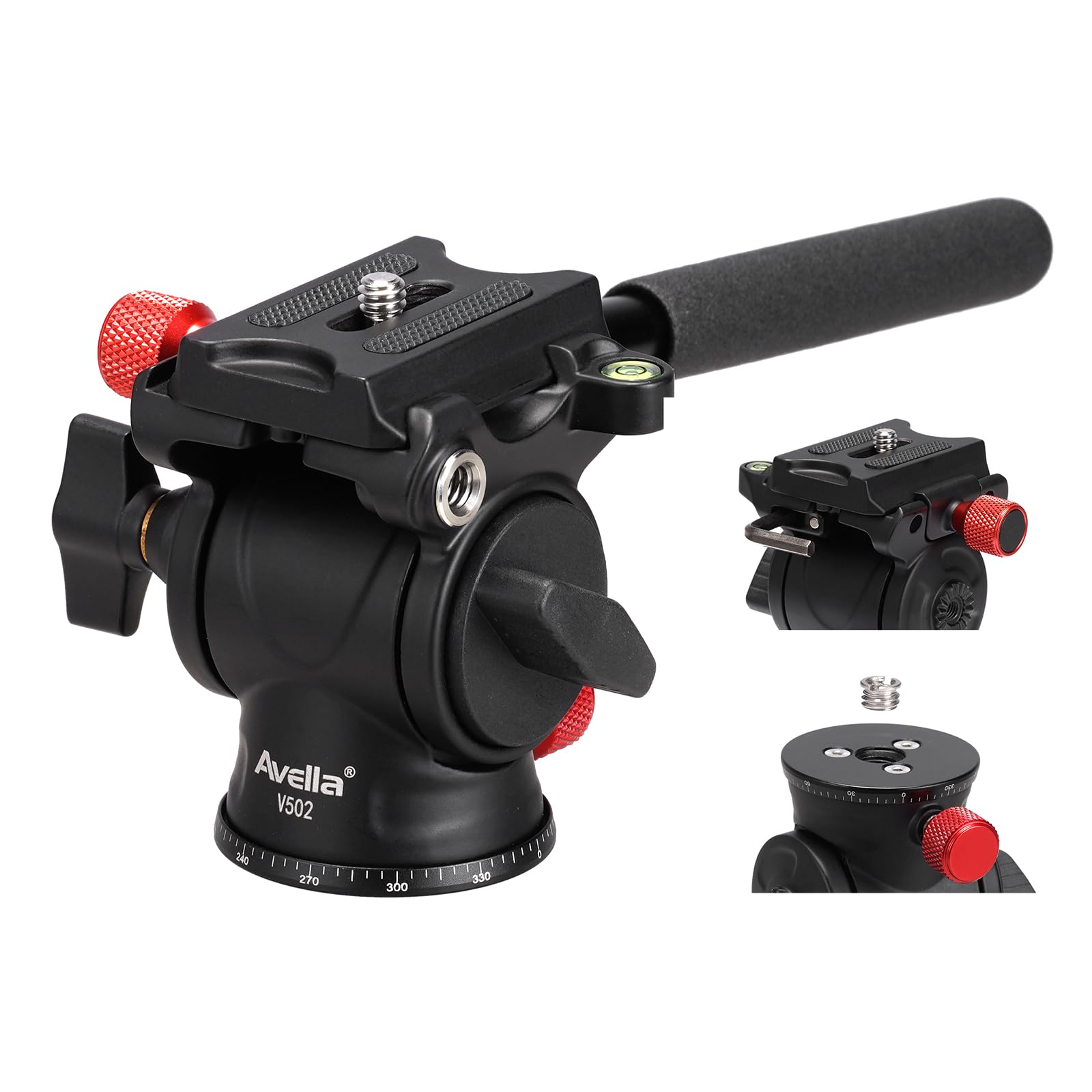
Seventy millimeters tall on a 45 mm base, the AVELLA V502 is sized for the compact tripods and tabletop legs that come with small cameras. It carries 3 kg/6.6 lb, pans a full 360°, tilts from -45° to +90°, and the whole head is 0.55 lb/250 g, which is light enough that it doesn't change how a small tripod handles.

For a small camera on a small tripod we think it's a smart first head. The pan is smooth for the size, the Arca-compatible plate locks down squarely, and the handle attaches magnetically, so moving it to the other side takes a second rather than a hex key, with the key stowed for full removal. The damping is fixed friction, which means one less knob to second-guess when you're learning to pan slowly.

Ours has stayed on the tabletop legs between shoots, which is the honest test of a head this small: it's already attached when you need it, and nothing about it is fussy enough to make you think twice about carrying it.

Pros

  • 70 mm tall on a 45 mm base for compact tripods
  • 360° pan with damped movement for its size
  • Magnetic handle repositions without tools
  • Arca-compatible plate locks down squarely

Cons

  • -45° tilt limits overhead and flat-lay angles
  • 3 kg ceiling suits compact cameras only
Our verdict

The sensible first head for a compact tripod: light, smooth enough for its size, and simple enough that there's nothing to learn.

Check Latest Price
7

Precise Framing

Neewer TH15 Geared Head

78 /100
Keeper Score Very Good

Key details

Axes
3-way geared
Weight
2 lb
Max Load
13.2 lb / 6 kg
Tilt Range
-45° to +90° front
Check Price on Amazon

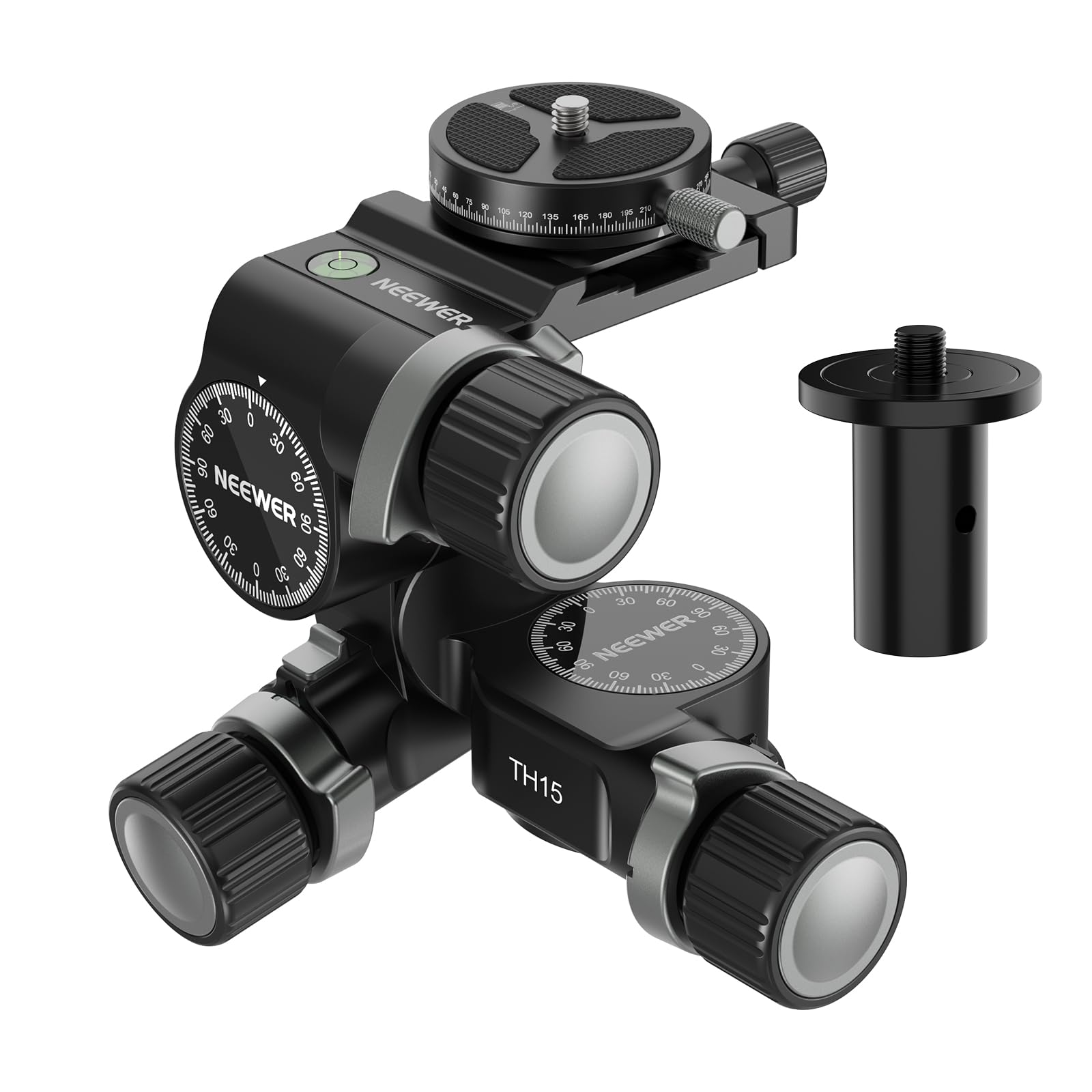
The Neewer TH15 isn't a fluid head at all. It's three geared axes driven by knurled knobs, each with a retractable switch that flips between coarse framing and millimeter adjustments. That's a different job from everything else here: you buy it when a frame has to land in an exact place and stay there.

For architecture, product work, and long-lens astronomy the geared approach earns its keep: 6 kg/13.2 lb of payload, -45° to +90° front tilt, ±90° lateral tilt, a 360° pan base, and an Arca-compatible round plate, all in a 2 lb head. The fine mode is where the design pays off, because a fraction of a turn moves the frame a hair, and that's what you need when you're squaring a roofline or stacking frames on a planet.

It isn't a head for motion. Following a moving subject needs continuous, even resistance, and a geared drive gives you steps instead, so video shooters should stay with the fluid heads here. For repeatable, locked framing it's the specialist in this group, and the retractable mode switches are the reason: one flick takes you from sloppy repositioning to something close to a micrometer stage.

Pros

  • Geared three-axis control with coarse and fine modes
  • 13.2 lb/6 kg payload
  • 360° pan base with Arca-compatible round plate

Cons

  • Knobs stiff enough to slow fine adjustment
  • Geared slack can develop with use
Our verdict

Not a motion head: choose it when a frame has to land in an exact place and stay there, and skip it if you're shooting video.

Check Latest Price

How We Tested Pan and Tilt Tripod Heads

We started by gathering every pan and tilt head we could find that was in stock, fit a standard tripod stud or flat base, and didn't cost more than the camera most people would put on it. Then we filtered on payload rating, plate type, base diameter, and weight, which cut the field to twelve. Those twelve have been in rotation for six months.

Each head spent a weekend on a carbon tripod in the backyard filming birds at the feeder, an afternoon on a monopod at a kids' soccer game, and a few hours on a slider during indoor walkthroughs. To judge pan quality we followed a car down the street at full zoom and watched for stutter, noting whether a pan started cleanly or snapped at the beginning. We locked the tilt with a loaded camera and checked it the next morning for droop, then mounted three different plates on every head to see which clamped clean and which needed a shove.

We timed how long it took to level a camera one-handed while the other hand held a lens, counted the turns from locked to free on each knob, and checked whether the handle could move to the other side. Then we stopped being gentle: heads rode loose in a daypack, sat in dust, and got used on a cold morning to see whether the drag stiffened up. We also weighed and measured each one with the handle off, because a head that won't fit in the bag you actually carry is a head that stays home. Value came down to whether a head gave usable drag and a trustworthy plate without charging extra for a logo — the bodies with plastic knobs showed play within weeks, while the machined aluminum ones didn't.

How to Choose a Pan and Tilt Tripod Head

Payload: rate the whole rig, then leave margin

Head ratings cover the camera, lens, cage, monitor, and batteries together, not the body alone. A head working near its maximum is where the drag goes inconsistent and slow pans start to stutter, so our rule of thumb is to leave a third of the rating unused. In this set, the 10 kg SmallRig DH10 is aimed at built cinema cameras, while the 3 kg SmallRig CH3 and AVELLA V502 suit a body and a standard zoom with room to spare.

Leveling: the feature that changes how you shoot

If you pan, a horizon that creeps is the first thing anyone watching will notice, and fixing it by nudging three legs mid-shot is miserable. A built-in leveling bowl, like the ±10° one on the Neewer GM27, squares the head to the horizon in a single turn whatever the ground is doing underneath. Shoot locked-off frames and it's a luxury; pan regularly and it's the difference between a shot that holds and one that drifts.

Judge the drag, not the word fluid

Most compact heads here use fixed friction damping set at the factory; the SmallRig DH10 is the one with a stepless drag dial. We test by panning as slowly as we can with two fingers and watching the start and stop: a good head moves without a jolt at either end, and a cheap one lurches as it takes up. Watch both axes, because pan and tilt don't always match, and a head can be silky horizontally while the tilt sticks.

Base, height, and handle reach

Check the base diameter against your tripod's platform. A compact 36–45 mm base on a full-size platform is fine, but a large head on a small travel platform crowds the clamp. Height matters as much, since the heads here run from 70 mm to 140 mm, and a tall head plus a plate can push a small tripod past its comfortable working height. Then look at the handle: a telescopic one, like the GM27's 5.7-to-9.5-inch, lets you steer with your fingertips rather than your wrist.

Frequently Asked Questions

Final Verdict

For most people the Neewer GM27 is the head to buy: 8.8 lb of capacity, a leveling bowl that squares the horizon in one turn, a telescopic handle that makes slow pans controllable, and a body light enough to leave on the tripod. It's the one we reach for when the shoot involves slow moves and uneven ground.

Step up to the INNOREL F20 if the rig is heavier or you swap between a camera and a scope, and to the SmallRig DH10 if you're flying a built cinema camera. If the head lives in a daypack, the 271 g SmallRig CH3 is the one that will actually be with you when the light turns.