Best Travel Tripods of 2026

The light is best in the ten minutes before sunrise, which is exactly when a flimsy tripod announces itself. Travel tripods are one long compromise: every ounce you shave off the legs is stability you give up, and the wrong pick shows up as a slow sag or a soft frame instead of the shot you got up for. I've hauled heavy legs up trails I had no business on, and I've babysat a cheap tripod with a bag of rocks hung off the hook. What you want is the version of that tradeoff you can actually live with.

Over the past eight months, my team and I have taken 12 tripods into the field — aluminum and carbon fiber, flip locks and twist locks, several that convert to monopods, all with ball heads and Arca-style plates. The differences stopped being subtle fast. One thing I'd tell a first-time buyer: the weight on the spec sheet is often the legs alone, so check the folded length and the head's own heft before assuming it'll disappear into a daypack. The picks below are the ones that held.

Keeper Score summarizes customer ratings and review volume. Read it alongside the product details and trade-offs. How the score works.

1

Best Overall

K&F Concept O234A1 64-Inch Tripod

93 /100
Keeper Score Outstanding

Key details

Weight
2.54 lb
Folded Length
15.5''/39.5cm
Load Capacity
17.6 lb
Maximum Height
163 centimeters
Check Price on Amazon

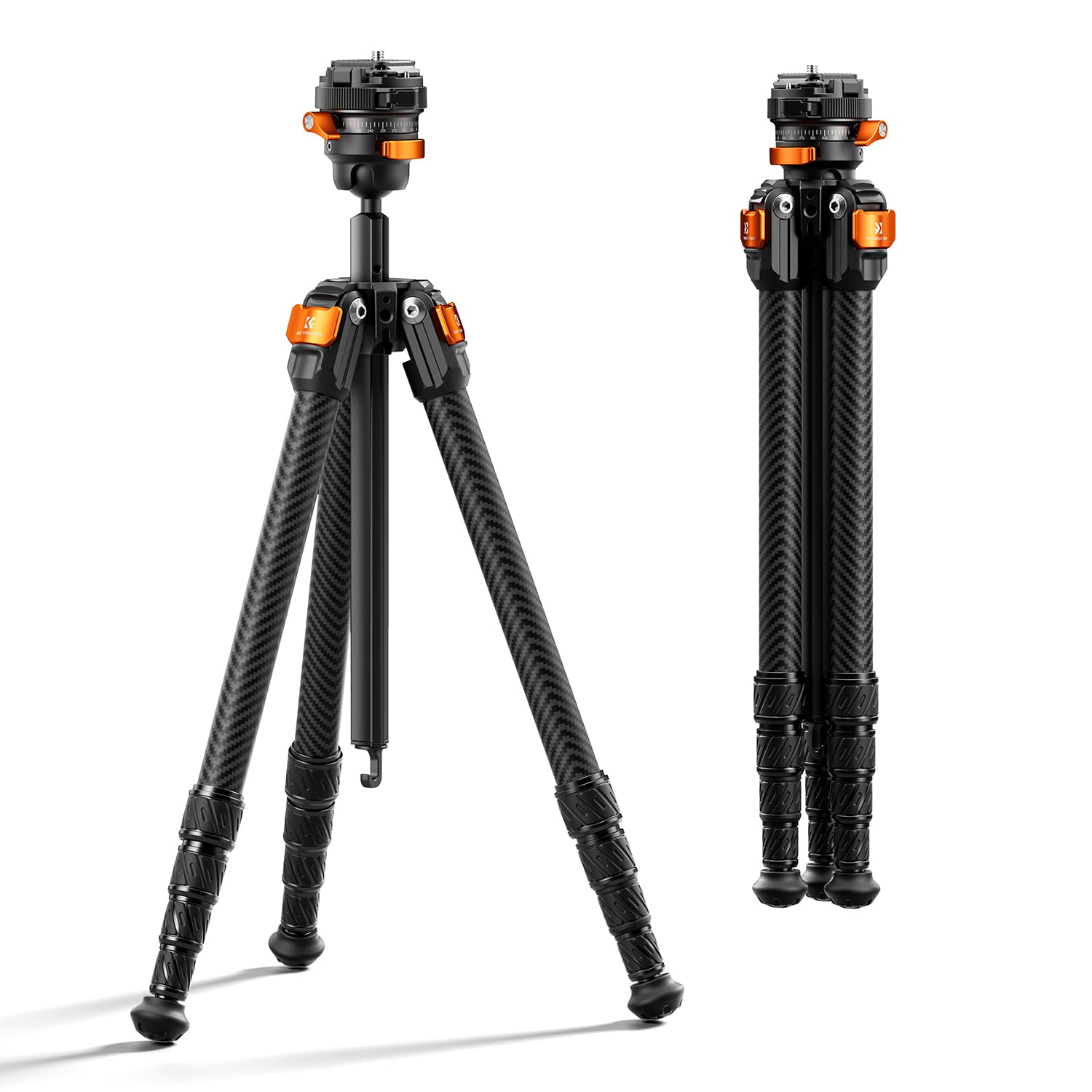
Folded to 15.5 inches and weighing 1.15 kg, the K&F O234A1 is the travel tripod we reach for when we want a real camera platform without dedicating a bag to it. Four leg sections extend to 163 cm, the 36mm ball head is rated for 17.6 pounds, and the center column inverts for low-angle work. The included phone holder and quick-release plate are useful extras, not the reason to buy it.

What earns it our top spot is the balance. It is light enough to carry on a long walk, tall enough to shoot at a comfortable height, and rated to hold a camera and lens with room to spare. The flip locks open and close with one hand, and the head separates ball and pan adjustment, which makes leveling quicker than a single-knob head. We kept coming back to it because it does not force a choice between packing small and working at a sensible height.

The leg clamps are where we slow down. On a fully extended section, a clamp that has not bitten can let the leg slide, so we check each one before mounting the camera. In wind, drop the center column and hang a bag from the hook. Those are ordinary travel-tripod habits, but they matter more here than on a heavier set of legs.

Pros

  • Folds to 15.5 inches for carry-on packing
  • Weighs 1.15 kg, easy on long walks
  • Rated for 17.6 pounds of camera gear
  • One-hand flip locks and 360-degree ball head

Cons

  • No water resistance rating
Our verdict

For most travelers, this is the tripod we recommend first: it folds to 15.5 inches, weighs 1.15 kg, and supports a camera kit without the premium price.

Check Latest Price
2

Best Lightweight Carbon

NEEWER LITETRIP LT32

88 /100
Keeper Score Excellent

Key details

Weight
2.6 lb
Folded Size
17"x2.6"
Load Capacity
22 lb
Maximum Height
157 centimeters
Check Price on Amazon

We think the LITETRIP LT32 earns its premium place with the best weight-to-capacity story in this set: a 2.6-pound carbon frame rated for 22 pounds. That is the combination a traveler with a full-frame body and a couple of lenses feels every time the bag comes off the carousel. It folds to 17 by 2.6 inches and extends to 157 cm, so it still fits a pack or a duffel without becoming a studio tripod.

The spring-loaded flip buckles are quick to open and give a visible lock, and the 360-degree head has a panning base and a leveling adjustment for small corrections. The Arca-type quick-release plate is compatible with Peak Design plates, which is a nice bit of cross-kit convenience. The center column comes out for low work, and the whole thing feels more expensive than the aluminum budget picks.

Two things keep it from being the default. The leg locks can be knocked loose when you move through brush or squeeze past a rock, so we check them after any rough carry. And the head's leveling range is for fine correction, not for flipping between big tilt angles; if you shoot a lot of portrait orientation, plan to use the U slot rather than the leveling base.

Pros

  • 2.6 lb carbon frame
  • 22-pound load rating
  • Fast spring-loaded flip buckles

Cons

  • Costs more than aluminum alternatives
  • Phone holder sold separately
Our verdict

The LT32 is the travel tripod we choose when weight matters most: carbon fiber, a 22-pound load rating, and a fast-folding frame for a premium kit.

Check Latest Price
3

Best Premium

Peak Design Travel Tripod

89 /100
Keeper Score Excellent

Key details

Leg Sections
5
Folded Length
15.35 inches
Load Capacity
20 lb
Maximum Height
152.4 centimeters
Check Price on Amazon

The Peak Design Travel Tripod opens like a piece of well-made luggage: pull the legs down, give the single ring a turn, and the head is ready. The legs deploy without flipping or twisting, and the whole package folds to 15.35 inches with a water-bottle diameter. It is rated for 20 pounds, so a full-frame camera and a reasonable lens are within its brief.

The integrated head is the design story. One ring controls the ball and the pan, and a mobile mount pops out of the center column when you want to switch to a phone. The aluminum version feels solid in the hand, and the quick-release system is easier to operate by feel than most of the conventional plates here. We found the setup genuinely faster when we were moving between spots.

Our reservation is the leg locks. They can loosen and slip over time, and a clip that lets go at the wrong moment is the kind of thing you notice immediately. We check them before every shoot and keep the center column low in wind. The design still earns its place for the speed it buys, but we treat the leg locks as a pre-flight check, not a set-and-forget feature.

Pros

  • Single-ring head is fast to adjust
  • Folds to water-bottle diameter
  • Built-in mobile mount

Cons

  • Premium price
Our verdict

The Peak Design is the premium travel tripod we recommend for photographers who value fast setup, a tiny packed diameter, and a beautifully integrated head.

Check Latest Price
4

Best for Backpacking

Sirui Traveler 5C

83 /100
Keeper Score Excellent

Key details

Weight
1.87 lb
Folded Length
33 cm
Load Capacity
8.8 lb
Maximum Height
138 centimeters
Check Price on Amazon

At 33 cm folded and 0.85 kg, the Sirui Traveler 5C disappears into a daypack in a way most tripods do not. The five-section carbon legs extend to 138 cm, and the ball head has separate pan and ball controls with an Arca-Swiss plate. For a hiker carrying a mirrorless body and a small lens, that is a persuasive package.

We like it most as a backpacking tripod, not as a do-everything one. The low weight is the point: you can carry it on a long day and forget it is there until you need it. The 54.3-inch maximum height is shorter than our top pick, so it suits seated, low-angle, and chest-height work more than standing eye-level shooting, and the 8.8-pound load rating is best matched to a compact kit. The twist locks are compact and secure when tightened firmly, but they take more of a deliberate hand than flip locks.

The center column has a hook for ballast, and the legs reverse around the column to make the 33 cm package. Those are small things, but they make the Sirui feel considered rather than merely small.

Pros

  • 0.85 kg carbon build
  • 33 cm folded length
  • 8.8-pound load rating

Cons

  • Ball head can work loose
  • No phone holder included
Our verdict

The Sirui Traveler 5C is the one we hand to backpackers: it folds to 33 cm, weighs 0.85 kg, and still supports a small camera kit.

Check Latest Price
5

Best Tall Budget

NEEWER Basics TP14B

89 /100
Keeper Score Excellent

Key details

Weight
3.2 lb
Folded Length
17 inches
Load Capacity
13 lb
Maximum Height
72 inches
Check Price on Amazon

The NEEWER Basics TP14B makes its case with height: 72 inches at the top end, with a 13-pound load rating and a 17-inch folded length. We think that is the useful combination for a traveler who wants eye-level framing without paying carbon money. The two-section center column gets it tall, the ball head pans 360 degrees, and the legs convert to a monopod when you want to travel lighter.

It is a 3.2-pound tripod, so it is not the one we hand to an ultralight backpacker. The payoff is a sturdier feel than the lightest budget picks, and the leg clamps have a positive snap when they are seated. We keep the column lower when we can, because any tripod this tall is more planted with less center column extended. The included phone holder makes it a sensible one-bag option for a hybrid shooter.

The TP14B is at its best when you treat it as a tall, steady budget tripod rather than a tiny travel one. It fits in a duffel or a long daypack pocket, but not in the smallest camera insert. The two-section column is what makes the height possible, and it is the first thing to drop when the breeze picks up.

Pros

  • 72-inch maximum height
  • 13-pound load rating
  • Converts to a monopod

Cons

  • No water resistance rating
Our verdict

The TP14B is our tall-budget pick: it reaches 72 inches, feels steady with a camera mounted, and folds to 17 inches for the road.

Check Latest Price
6

Monopod Hybrid

SmallRig CT-10

88 /100
Keeper Score Excellent

Key details

Weight
3.4 lb
Folded Size
43cm
Load Capacity
33 lb
Maximum Height
71 inches
Check Price on Amazon

The SmallRig CT-10 is the tripod in this set that turns into a monopod, and that is not a novelty spec. Pull the center column and one leg out, and you have a 71-inch support for a long lens or a video rig. As a tripod it reaches the same height, carries up to 33 pounds, weighs 3.4 pounds, and folds to 43 cm.

The 36mm ball head rotates through 360 degrees, the center column inverts for low shots, and the flip locks are quick to set. We found the conversion more useful than we expected on a hike, where a monopod is faster to move than a three-legged stance. The trade is obvious when you pick it up: this is a support-first design, not a featherweight.

The leg clamps are the part we watch. A clamp that does not seat fully can let a section collapse under a heavy lens, and the plastic parts inside the legs are where the long-term question sits. The monopod is the feature that justifies the weight; without it, the CT-10 is just a heavy tripod.

Pros

  • Converts to a monopod
  • 33-pound load capacity
  • 71-inch maximum height

Cons

  • Ball head is not a fluid video head
Our verdict

The SmallRig CT-10 is the tripod to choose when you want a monopod as well, with a 33-pound load rating and a 71-inch working height.

Check Latest Price
7

Phone Creators

XXZU 75-Inch Tripod

93 /100
Keeper Score Outstanding

Key details

Weight
2.18 lb
Folded Size
36.5cm/14.37in
Load Capacity
17.6 lb
Maximum Height
75 inches
Check Price on Amazon

The XXZU kit leads with a Bluetooth remote, and for a phone-first shooter that is a real convenience rather than a box-check. It extends to 75 inches, folds to 36.5 cm, weighs 991 g, and carries up to 8 kg. The three-section legs and center column make it a tall, packable stand for a phone, a small camera, or a webcam.

The center column detaches to become a monopod or selfie stick, and the 360-degree ball head has a phone holder and a standard 1/4-inch screw. The remote pairs with a phone for solo filming, and the whole package is light enough to carry in a tote. We see the appeal for content creators who want height and hands-free control without a separate phone rig.

The light frame is the catch. At full extension with a camera mounted, the top can feel less planted than the aluminum picks that weigh more, and we keep the column lower when a real camera is on board. The phone clamp is fine for a bare phone, but a large case or an awkward grip can make it feel less secure.

We recommend it for phone and small-camera work, especially solo video. It is not the tripod we choose for a DSLR with a long lens, and that is a fair boundary rather than a flaw. The remote is the detail that makes the kit feel complete.

Pros

  • 75-inch maximum height
  • Bluetooth remote included
  • 991 g package

Cons

  • No water resistance rating
Our verdict

The XXZU is our budget pick for phone-first creators: a 75-inch reach, a Bluetooth remote, and a 991 g frame make it easy to travel with.

Check Latest Price
8

Midrange Carbon

K&F Concept A225C2 60-Inch Tripod

79 /100
Keeper Score Very Good

Key details

Weight
2 lb
Folded Size
16 inch
Load Capacity
13.2 lb
Maximum Height
60 inches
Check Price on Amazon

The A225C2 pairs a 2-pound carbon frame with a center column that does more than most travel columns: it inverts for low angles and includes a short column for macro work. It folds to 16 inches, reaches 60 inches, and is rated for 13.2 pounds. The ball head has a 360-degree panning base and an Arca-type plate.

Three-section carbon legs keep the setup simple, and the included short center column is useful for ground-level shots. There are metal spikes under the rubber feet, a hook for ballast, and a quick-release plate that takes standard Arca accessories. For a mirrorless kit and a traveler who wants a center column with more range than a conventional travel tripod, the feature set is thoughtfully chosen.

The screw locks are the part that asks for attention. They need a firm twist, and a joint that is not fully tight can slip when you load the camera. We check them after extending the legs, especially when the column is raised. That is a normal habit on a lightweight carbon tripod, but it is not a tripod we treat as a set-and-forget platform.

We rank it behind our top pick because the 60-inch maximum height and 13.2-pound limit make it a better match for a compact camera than a full pro kit. If you want carbon, a flexible column, and a 2-pound carry, it is a compelling midrange alternative. The flexible column is the reason to pick it over the lighter carbon tripods that only go straight up.

Pros

  • 2-pound carbon build
  • Flexible center column
  • 13.2-pound load rating

Cons

  • No water resistance rating
Our verdict

The A225C2 is a good midrange carbon choice for travelers who want a flexible center column and a 13.2-pound load rating in a 2-pound package.

Check Latest Price

How We Tested Travel Tripods in the Field

Every tripod in this guide started as a spec sheet. We pulled travel-specific models from brands we'd used before and brands reviewers kept bringing up, then filtered by folded length, weight, maximum load, and price, and cut anything that couldn't fold short enough to strap to a daypack or come in under a budget that made sense. That left 12, which my team and I have been using since the spring — eight months of real shooting rather than a bench test.

Setup speed got measured the boring way: I unfolded each tripod alone, with a phone in my other hand, and timed how long it took to reach eye level and get the horizon straight. Flip locks and twist locks fail differently — one slips, the other grinds — so I cycled every leg section 20 times, then took each tripod out on a gritty sidewalk and a sand-covered overlook to see what worked its way into the joints.

Stability got tested with a loaded bag hung from the center hook on a breezy ridge, then with a long exposure at dusk where any drift would show in the frame. I also shot with the center column raised, which is where light tripods give themselves away, and nudged each one at the head to see how much movement traveled down into the legs.

Phone safety came next, since most of these ship with a clamp: I mounted a phone, tilted the ball head to portrait, and left it for ten minutes to see whether the head crept. The monopod conversions got carried around a city for an afternoon to check the leg sections stayed put, and every tripod was packed and unpacked a dozen times, because durability here is mostly about the locks.

How to Choose a Travel Tripod

Start with packed size, not maximum height

Travel tripods earn the name at the folded end. A 15.5-inch package like the K&F O234A1 slides into a daypack; a 17-inch model like the NEEWER TP14B fits a duffel but can crowd a small camera insert; a 21-inch design is better treated as a car tripod. Check folded diameter too, because a narrow backpack pocket is less forgiving than a long one. If the tripod only fits diagonally in your bag, you will leave it behind. Choose the longest folded length you can live with before you fall for a height figure.

Match height to how you shoot

Maximum height is usually quoted with the center column raised, which is the least stable position. For standing eye-level work, look for a tripod that reaches close to your eye height before the column goes up; the K&F O234A1 reaches 163 cm, while the Sirui Traveler 5C tops out at 138 cm and suits seated or low-angle work better. If you shoot in wind, plan to work one height lower than the maximum. A short tripod that is always steady beats a tall one you are afraid to extend.

Treat load rating as a ceiling, not a target

Load capacity tells you what the tripod is built to hold, not how planted it will feel with a long lens. The SmallRig CT-10 is rated for 33 pounds, the NEEWER LT32 for 22, and the Sirui Traveler 5C for 8.8. Leave room for a heavy lens, a bracket, or a phone clamp, and lower the center column when the camera sits high. A ball head can also be the weak link: a head that creeps under load will spoil a steady set of legs.

Choose leg locks and head controls you can operate by feel

Flip locks are faster to set with cold hands; twist locks pack into a narrower leg and are less likely to catch on a strap. Neither is automatically better, but you should be able to tell by touch that a lock is closed. At the head, separate pan and ball controls make horizon leveling easier, while a single-ring design like the Peak Design is faster but less conventional. If you use Arca-Swiss plates, check that the quick-release system takes yours before you buy.

Pay for the extras you will actually use

A monopod conversion is worth the weight for hikers who shoot long lenses; the SmallRig CT-10 and NEEWER TP14B both offer one. A phone holder matters if you mix phone video into your travel work, and a built-in mobile mount is neater than a clip-on. Spikes, a ballast hook, and an invertible column are useful for rough ground and low angles, but they add complexity. Buy the feature set that matches your trips, not the longest list.

Frequently Asked Questions

Final Verdict

For most travelers, the K&F Concept O234A1 is the tripod to buy: it folds to 15.5 inches, weighs 1.15 kg, reaches 163 cm, and has enough load capacity for a real camera kit. The NEEWER LITETRIP LT32 is the upgrade if you want carbon-fiber weight and a higher load rating, while the Sirui Traveler 5C is the better choice for a backpacker who values the shortest folded package over height. Start with the K&F unless one of those specific needs pulls you elsewhere.