Best Photography Reflectors of 2026

A reflector is the cheapest light you'll ever buy and the most annoying thing to hold. The bigger the surface, the softer the fill — which is why a big oval flatters a portrait and behaves like a sail the moment a breeze picks up. A good one solves both halves: enough surface to shape the light, plus hardware that keeps it aimed where you put it while your hands are on the camera.

We've spent six months with 12 of them, from 24-inch discs that fold into a tote bag to a five-foot panel that needs its own stand, shooting portraits indoors, products on a kitchen table, and headshots outside. They all work on the same trick — a taut fabric surface that bounces light back or softens it on the way through — and a reversible cover is what turns one frame into five tools. What nobody tells a first-timer is that white and translucent do most of the real work; gold is the surface people overuse.

The picks below run from handheld discs to stand-mounted panels, and each earned its spot on a different set of compromises.

Keeper Score summarizes customer ratings and review volume. Read it alongside the product details and trade-offs. How the score works.

1

Best Overall

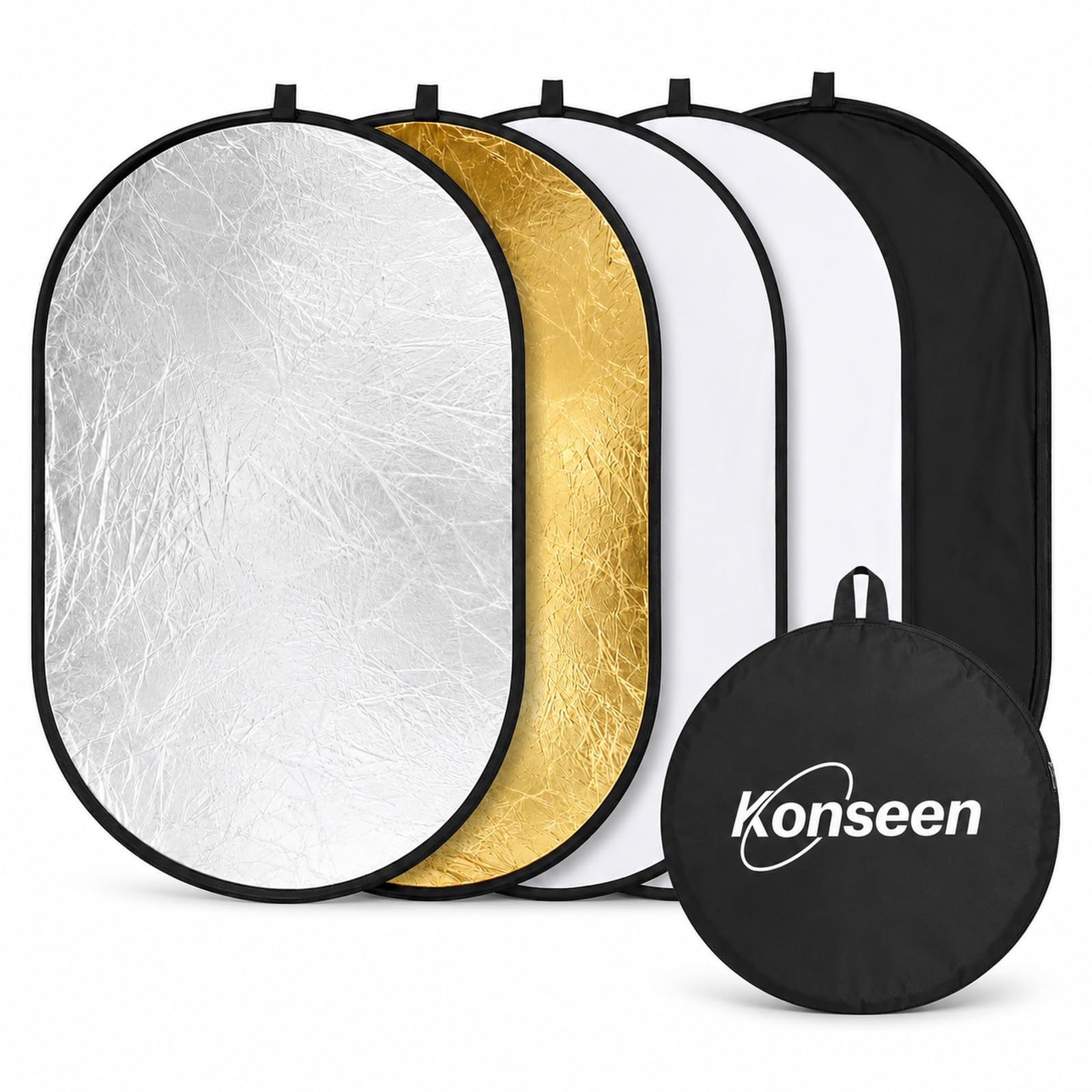
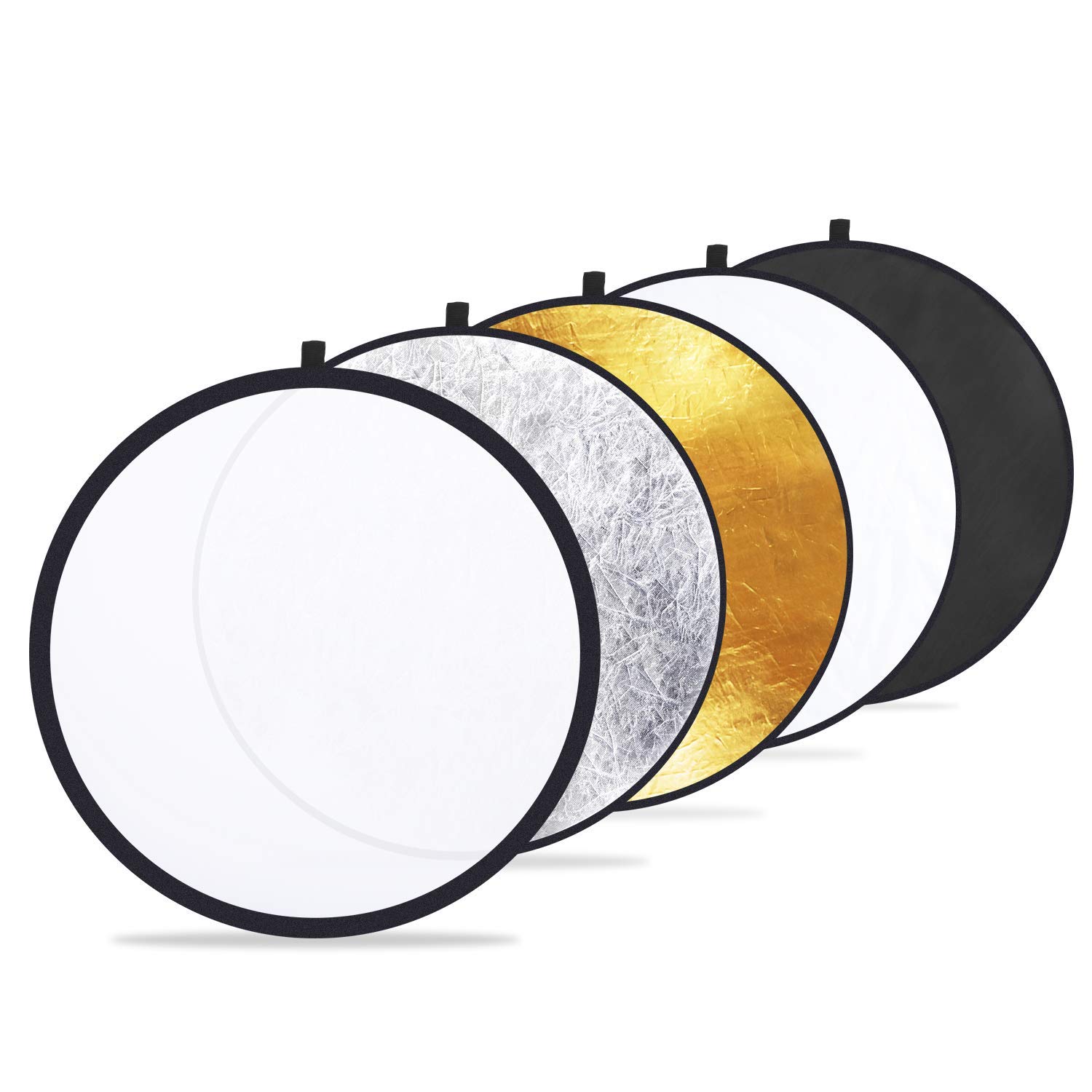
WELLMAKING 32" 5-in-1 Reflector

91 /100
Keeper Score Outstanding

Key details

Weight
1.6 lb
Mounting
1/4"-20 and 3/8"-16 threads
Open Size
32 in / 80 cm
Folded Size
12 in / 30 cm
Check Price on Amazon

The tilt adapter is the reason this WELLMAKING panel became our default. Most reflectors clamp to a stand and force you to move the whole rig to change the fill angle; here a swivel mount lets you tip the 32-inch disc without shifting the stand. That matters when you are shooting a portrait solo and the light is almost right but the shadow under the nose needs a nudge. The two built-in grips and the pair of thread sizes — 1/4-20 and 3/8-16 — give you more than one way to mount it, and the five surfaces cover the usual silver, white, gold, black, and translucent jobs. At 1.6 pounds and 12 inches folded, it goes into a kit without becoming a commitment.

We noticed the 32-inch size hits a useful middle ground. It is wide enough to throw soft fill across a head-and-shoulders portrait or a talking-head frame, but not so large that it turns into a sail the moment a breeze picks up. The translucent panel is the one we used most for softening hard window light; silver gave a cleaner, brighter bounce when we wanted contrast, and white stayed neutral.

The frame takes a few tries to collapse, which is the usual spring-steel learning curve rather than a defect. In a breeze, the panel needs a firm grip or a weighted stand. Neither changes the result. For fill you need to adjust mid-session, this is the panel we reach for.

Pros

  • Tilt adapter changes angle without moving the stand
  • Twin grips and two thread sizes
  • Five surfaces including a diffuser
  • Folds to 12 inches at 1.6 pounds

Cons

  • Light stand sold separately
Our verdict

Our default pick for portraits and streaming: the tilt adapter and twin grips let one person adjust fill without wrestling the stand.
Check Latest Price
2

Best Budget Compact

Etekcity 24" 5-in-1 Reflector

95 /100
Keeper Score Outstanding

Key details

Pouch
10 in zippered
Weight
8 oz
Surfaces
Five-in-one
Open Size
24 in / 60 cm
Check Price on Amazon

The Etekcity disc is the one that lives in a camera bag. It is 24 inches across, 8 ounces, and collapses into a 10-inch zippered pouch, so it takes up about as much room as a folded jacket. We found that the size is the point: a reflector you actually carry gets used more than a bigger one you leave in the car.

Against a 32-inch panel, this one is easier to hand-hold through a long run of headshots, and the smaller size is easier to angle into tight spaces. Five surfaces cover the basics: white for neutral fill, silver for more punch, gold for warmth, black for cutting spill, and translucent for softening a hard light source. That is the trade we accept for a disc that slips into a backpack.

The 10-inch pouch is a small but useful detail: it keeps the collapsed disc from snagging on straps and car keys. Folding is a skill, not a defect, and it becomes quick after a few sessions. The pouch and low weight earn it a permanent spot in the bag; the coverage limit is what keeps a larger panel in the kit too.

Pros

  • Folds into a 10-inch pouch
  • Weighs only 8 ounces
  • Five surfaces with translucent diffuser
  • Easy to hand-hold for headshots

Cons

  • Too small for full-body portraits
Our verdict

The one we reach for when the bag is already full: an 8-ounce 24-inch disc with five surfaces, a pouch, and a budget price that makes it an easy first reflector.

Check Latest Price
3

Best for Hands-Free Mounting

NEEWER RF-80II 32" Reflector

89 /100
Keeper Score Excellent

Key details

Weight
1.8 lb
Mounting
3/8" thread; 5/8" clamp
Surfaces
Five-in-one
Open Size
32 in / 80 cm
Check Price on Amazon

The RF-80II solves a different problem from a bare disc: it is built to stay put. The kit pairs a 32-inch five-in-one reflector with two hand grips and an adjustable metal clamp that fits a standard 5/8-inch light-stand stud. One grip has a 3/8-inch thread, so you can screw it onto a stand or bracket; the clamp gives you a second way to hold the panel without an assistant.

That extra hardware is what you pay for over a basic disc, and it shows in use. The clamp is the part we appreciated most: it holds the reflector at the angle you set, leaving both hands free to frame a shot or move a light. The 1.8-pound panel is still light enough to carry to a location, and the polyester surface is meant to resist tearing and fading. Five surfaces give you the same silver, gold, white, black, and translucent options as the rest of this group.

The clamp is only as useful as the support you put it on, and it assumes a stand with a 5/8-inch stud. For a solo shooter who wants repeatable, hands-free fill, the RF-80II is easier to trust than a panel balanced on a chair.

Pros

  • Clamp fits 5/8-inch light stands
  • Twin hand grips with 3/8-inch thread
  • 32-inch five-in-one panel
  • Polyester surface resists tearing and fading

Cons

  • Light stand not included
Our verdict

The best choice if you want to clamp a reflector to a stand and leave it there: twin grips and an adjustable clamp make hands-free fill easy for solo shoots.

Check Latest Price
4

Best Large All-Round

NEEWER 40" x 60" Reflector

95 /100
Keeper Score Outstanding

Key details

Shape
Oval
Weight
2.9 lb
Surfaces
Five-in-one
Open Size
40 x 60 in / 100 x 150 cm
Check Price on Amazon

A 40-by-60-inch reflector is where the light stops being a spot fix and starts wrapping a subject. We found the NEEWER oval covers a seated portrait or a two-person setup with one panel, and the 2.9-pound weight is light enough to carry to a location without treating it like studio furniture. That combination — big enough to matter, light enough to move — is why it earns a place for portraits and small productions.

The five surfaces work as expected: white for neutral fill, silver for brightness, gold for warmth, black for negative fill, and translucent for diffusion. The oval shape is more flattering than a rectangle when you are bouncing into a face because the falloff is less boxy. We also appreciated the carrying bag, which keeps the collapsed panel clean between shoots.

For a single headshot, a 32-inch panel is easier to manage; the extra inches here are for seated portraits, couples, and small groups. That is the point of stepping up. If your work stays tight, save the floor space and choose the smaller size.

Pros

  • 40 x 60 inches covers one or two people
  • 2.9 pounds for its size
  • Five surfaces including diffusion
  • Oval falloff is softer than rectangular

Cons

  • Needs a stand or a helper
  • Folding takes practice
Our verdict

Our large all-rounder: a 40-by-60-inch oval that covers one or two people, stays light enough to carry, and folds into its own bag.

Check Latest Price
5

Best for Full-Body and Groups

Godox 59" x 79" Reflector

93 /100
Keeper Score Outstanding

Key details

Hanging
Center hook
Surfaces
Five-in-one
Open Size
59 x 79 in / 150 x 200 cm
Folded Size
19 in
Check Price on Amazon

At 59 by 79 inches, the Godox is less a fill card than a movable wall of light. It is the pick for full-body portraits, group shots, and any setup where a 32- or 40-inch panel leaves the legs in shadow. The frame folds down to 19 inches, which is the detail that makes the size practical: it collapses into a circle you can carry in the included bag rather than a rigid panel you need a van for.

We were struck by how much coverage a single panel gives you. The middle hook lets you hang it from a stand, tripod, background holder, or wall, so you are not limited to a clamp at the edge. The five surfaces are the standard set, and the translucent side makes a useful overhead scrim when the sun is hard. This is the reflector we choose when the subject is moving across a wider frame.

The scale is the whole point: it covers a full body without feathering the edges, and it makes a useful overhead scrim for a couple. Folding it takes some learning, but the 19-inch collapsed circle is worth the practice. For studio work and controlled locations, that size is an advantage rather than a chore.

Pros

  • Covers full-body portraits and small groups
  • Folds to a 19-inch circle
  • Center hook for hanging
  • Five surfaces including translucent scrim

Cons

  • Needs a secure stand or helper in wind
Our verdict

For full-body portraits and group shots, the Godox's 59-by-79-inch panel gives you a wall of soft light, and it still folds into a 19-inch circle.

Check Latest Price
6

Best for Studio Portrait Catchlights

K&F Concept U-Shape Reflector

85 /100
Keeper Score Excellent

Key details

Tilt
180 degrees
Surfaces
Four-in-one
Open Size
180 x 60 cm
Stand Height
6.2 ft / 1.9 m
Check Price on Amazon

The U-shaped K&F Concept panel is built around one specific result: catchlights that wrap around the eye instead of sitting in it like a square window. The 180-by-60-centimeter curve follows the face, so the reflection has a softer edge and the fill falls off gradually toward the ears. If you shoot headshots and want more flattering light without adding a second strobe, this is the most distinctive tool in the group.

It is a kit rather than a bare panel. The frame assembles with bend rods and hand knobs, the 6.2-foot stand adjusts to working height, and the bracket tilts 180 degrees so you can aim the curve up or down. Four surfaces — silver, white, gold, and black — cover bright fill, neutral fill, warmth, and negative fill. The whole thing packs flat into the storage bag, though it is still a 3-kilogram studio item, not a camera-bag accessory.

The footprint is the bigger commitment. At 180 by 60 centimeters on a 6.2-foot stand, it needs a room where you can step back, and it is not the panel to pack for a hike. We do not see it as a travel reflector. For a home studio or a dedicated portrait space, the curved light is worth the setup.

Pros

  • Curved panel for wraparound catchlights
  • Included 6.2-foot stand
  • 180-degree tilt bracket
  • Packs flat in storage bag

Cons

  • Assembly can be fiddly
Our verdict

For studio headshots, the curved K&F Concept wraps catchlights around the face in a way flat panels can't, and the included stand makes it a complete portrait setup.

Check Latest Price
7

Best Rectangular for Products

Konseen 24" x 36" Reflector

91 /100
Keeper Score Outstanding

Key details

Shape
Rectangular
Weight
12.7 oz
Surfaces
Five-in-one
Open Size
24 x 36 in / 60 x 90 cm
Check Price on Amazon

The Konseen is the one we reach for when the subject is a product on a table rather than a person against a backdrop. The 24-by-36-inch rectangle gives you a broad, even sheet of fill that covers a place setting, a bottle, or a seated subject without the round hot spot a smaller disc can leave. At 360 grams, it is light enough to hold in one hand while you adjust with the other.

Five surfaces cover the usual work. The white side is the default for product shots, silver adds contrast, gold warms wood and skin, black flags down spill, and the translucent panel softens a hard key light. The rectangular shape is also easier to position along a table edge than a round panel because you can line up the long side with the surface you are lighting.

The frame is sturdy enough for regular use, and the included bag keeps the collapsed disc tidy. The rectangular shape packs down like any other spring-steel reflector, so it stores flat against a wall or in a gear bin. It is a practical shape for a small home setup.

What makes the Konseen useful is not a single headline feature but the combination of a bigger rectangle, low weight, and five surfaces at a budget price. If you mostly shoot headshots, a 24-inch round is easier to manage; for products and seated portraits, the extra width earns its place.

Pros

  • Rectangular panel spreads broad fill
  • Weighs 360 grams
  • Five surfaces with diffuser
  • Includes carrying bag

Cons

  • Folding takes a few tries
  • Zipper can be a weak point
Our verdict

For products, food, and seated portraits, the Konseen's 24-by-36-inch rectangle spreads fill more evenly than a small round disc, and it does it on a budget.

Check Latest Price
8

Starter Kit

UTEBIT 43" Reflector Kit

82 /100
Keeper Score Excellent

Key details

Included
Stand, clamp, bag
Surfaces
Five-in-one
Open Size
43 in
Folded Size
17 in
Check Price on Amazon

The UTEBIT kit is the one to choose when you want the support sorted in the same box. It bundles a 43-inch five-in-one reflector with a light stand, an adjustable metal clamp, and a zippered carrying case. For a first lighting setup, that removes the usual second order for a stand and a way to attach the panel.

The 43-inch surface is a useful step up from a 24-inch disc without becoming a full studio panel. It collapses to 17 inches, so it can live in a closet or a car trunk, and the five surfaces give you white, silver, gold, black, and translucent options. The clamp attaches the reflector to the stand, which leaves you free to move a light or check the frame.

The reflector itself is simple: five surfaces, a spring frame, and a 17-inch collapsed size. The listing claims 90% reflectivity; the practical point is that the silver and white surfaces give clean fill and the black side cuts spill. The translucent panel is the one for taking the edge off a hard key light.

What we like best is that the kit removes the usual scavenger hunt for a stand and clamp. For a beginner setting up a first portrait corner, the reflector is the star, but the support is what makes it usable on day one.

Pros

  • Complete kit with stand, clamp, and bag
  • 43-inch five-in-one panel
  • Collapses to 17 inches
  • Silver and white surfaces give clean fill

Cons

  • Stand adds bulk and setup time
Our verdict

The easiest first kit: a 43-inch five-in-one reflector, stand, clamp, and bag in one order, with enough coverage for portraits and small products.

Check Latest Price

How We Tested Photography Reflectors

We started by pulling every reflector we could find between roughly two and five feet across, then cut the list down to models with a reversible multi-surface cover, a real mounting point, and a bag that would survive a car trunk. Twelve made it through. Over six months we used each one the way a photographer actually does: fill light for studio portraits, a bounce card propped on a kitchen table for product shots, a scrim taped over a window, and handheld fill for outdoor headshots on afternoons when the wind had other ideas.

Setting up alone came first. We unfolded every one from its bag, timed how long it took, and noted whether the frame snapped open or fought back — the large ovals need a firm, confident twist, and a couple of them got the better of us on the first attempt. Then we swapped every cover in the set, because a five-in-one is only versatile if changing surfaces isn't a wrestling match on set.

In use, we watched the things reviews mention and photos never show: whether the rim stayed rigid after a hundred folds, whether the stitching held at the corners, whether a clamp or hand grip kept the panel angled where we set it instead of drooping halfway through a session. We weighed each reflector and measured its folded diameter against a standard tote, and we held the handheld models through full 20-minute sessions to see where arm fatigue set in.

Last, we judged value by what actually came in the box for the price — bag, clamp, stand, thread adapters — since a cheap reflector with no way to mount it stops being cheap fast. Panels that sagged, shed gold flakes, or lost their shape went straight back in the bag.

How to Choose a Photography Reflector

Match the panel to the subject

Size is the first decision because it sets both coverage and hassle. A 24-inch disc is a camera-bag tool for headshots, products, and close-up fill; 32 inches is the solo-portrait sweet spot and the size we recommend first for most people. A 40-by-60-inch oval covers a seated subject or a couple without much feathering, while a 59-by-79-inch panel is the one for full-body portraits and small groups. If you shoot both tight and wide, buy for the wider frame and use the panel farther back for headshots.

Decide how it will stay put

A reflector that needs a helper changes the pace of a shoot. Hand grips are fine for a quick headshot, but a stand, clamp, or tilt adapter lets you set the angle and step back. Check the mounting hardware before you buy: some panels have a 1/4-inch thread, some use 3/8-inch, and some clamps need a 5/8-inch light-stand stud. Our top pick's tilt adapter is useful because it adjusts the angle without moving the whole stand; if you already own a stand, a clamp-ready panel is the better buy.

Learn what the five surfaces do

Silver gives the brightest, most contrasty bounce; white is the neutral everyday fill; gold warms skin tones; black blocks light for negative fill; and the translucent panel goes between the light and subject as a diffuser. Start with white and translucent, then add silver when you need more punch. Gold is easy to overdo on skin, so use it sparingly or in late-afternoon light where the warmth looks natural.

Plan for folding, wind, and storage

Every large spring-steel reflector is a folding puzzle at first, and the bigger panels catch wind like a sail. Practice the fold at home before a shoot, and store the collapsed disc in its bag rather than loose in a gear bin. Outdoors, weigh the stand or use a sandbag; a 43-inch kit with a stand is not stable in a breeze just because the stand is included. If you shoot alone in open spaces, a smaller panel or a clamp with a solid stand will be less frustrating.

Frequently Asked Questions

Final Verdict

The WELLMAKING 32-inch is the reflector we recommend first for most people because the tilt adapter and twin grips make solo fill adjustments genuinely easier, not just more feature-rich. It is large enough for portraits and streaming, folds to 12 inches, and covers the five surfaces most shoots need.

If your portraits are full-body or group shots, step up to the Godox 59-by-79-inch panel; if you want the stand and clamp included, the UTEBIT 43-inch kit is the simpler first purchase.