Best Photography Light Boxes of 2026

You clear the kitchen table, stand a pair of earrings on white paper, and shoot forty frames. Every one comes back with a yellow cast, a hard shadow where your head blocked the ceiling light, and a background that reads as slightly grubby paper. A light box fixes both problems at once: it wraps the product in even, adjustable light against a clean sweep, so a phone snapshot starts to look like a catalog image.

I've shot small products for years, and the LED count shouted across a listing title is the least useful number on the page. Color rendering, even light, and a tent with breathing room around the product decide whether the shot actually works. My team and I have spent the last six months shooting in 14 light boxes, from 10-inch tabletop tents up to a 32-inch kit.

Size is where most people trip: measure your tallest, widest item, then leave a couple of inches of air on every side. Smooth dimming and warm-to-cool adjustability matter more than raw brightness. Below are the picks that earned a permanent spot on the desk.

Keeper Score summarizes customer ratings and review volume. Read it alongside the product details and trade-offs. How the score works.

1

Best Overall

PULUZ Mini Photo Studio Light Box

89 /100
Keeper Score Excellent

Key details

LEDs
104
Backdrops
Double-sided color mats
Interior Size
10" x 10" x 10"
Color Rendering
CRI>95, 5500K
Check Price on Amazon

A light box spends most of its life folded, and the PULUZ is the one we stopped avoiding putting away. It opens into a cube in about the three seconds the listing promises and collapses flat enough to slide behind a shelf, so it does not claim a corner of the desk the way a permanent setup does. The double-sided background mats follow the same logic: you flip a sheet for a second color instead of hunting for a loose insert.

The light is what decides whether the photos are usable. A 104-LED board behind a CRI>95 diffuser at 5500K gives daylight-balanced output that does not need rescuing in editing, and the brightness comes down far enough to keep a polished ring from turning into a white blob. We cared much less about the wattage than about that control, because glossy products are lost to hotspots long before they are lost to a lack of light.

Ten inches is the honest limit. A mug, a watch, a pair of earrings, a small ceramic, a card in a sleeve: all fine, with backdrop behind them. A shoe box, a folded sweater, or a handbag is not, and no amount of angling fixes it. If your catalog is bigger than a grapefruit, look at the 12-inch boxes below before you talk yourself into this one.

The three-month warranty is the shortest in this group, and it is the detail that gives us pause. Everything else about the PULUZ suggests it was designed by someone who has folded a light box in a hurry, from the front window that opens wide for a flat-lay to the top opening for shooting straight down, and that is why it is the first one we hand people.

Pros

  • Folds flat in about three seconds
  • CRI>95, 5500K light with adjustable brightness
  • Double-sided mats give two colors per sheet
  • Top and front openings for two shooting angles

Cons

  • Interior tops out at 10 inches
  • Three-month warranty is the shortest here
Our verdict

The box we recommend first: three-second setup, even CRI>95 light with real dimming, and the strongest record here on the light staying on.

Check Latest Price
2

Best Budget

Takerers 12-Inch Light Box

87 /100
Keeper Score Excellent

Key details

LEDs
120
Backdrops
6 PVC colors
Interior Size
12" x 12" x 12"
Color Temperature
3000K–5700K, three modes
Check Price on Amazon

The Takerers costs less than our top pick and gives you two more inches of interior in return. Inside a 12-inch cube you get 120 LEDs listed as adjustable from 3000K to 5700K across three modes, with dimming and six PVC backdrops. Setup is a ten-second unfold rather than an assembly job, and it packs down to roughly the footprint of a laptop sleeve.

Those three color temperatures are the reason to choose it over a single-daylight box. Warm light flatters wood, leather, and food; the neutral setting is what we reach for when a label or a swatch has to read true on a buyer's screen. Twelve inches takes a single shoe shot at an angle, a small handbag, or a stack of folded tees, and the whole thing still sits on a desk without taking it over.

Where the money comes out is the frame. The shell and the velcro tabs soften with repeated folding, and a box that arrives standing square may not stay that way through a season of setups and takedowns. Left open on a shelf that never becomes an issue; folded twice a day, expect it to loosen sooner than you would like.

Pros

  • 12-inch interior at a 10-inch price
  • 120 LEDs with three color temperatures
  • Six PVC backdrops and a quick fold

Cons

  • Frame and tabs loosen with constant folding
  • Brightness is modest at full power
Our verdict

Our budget pick: 12 inches of interior, 120 dimmable LEDs, and three color temperatures for less than the 10-inch competition. The frame will not love being folded every day.

Check Latest Price
3

Best Value for a Bigger Box

BENOISON 16-Inch Light Box

87 /100
Keeper Score Excellent

Key details

Backdrops
6 PVC colors
Interior Size
16" x 16" x 12"
Color Rendering
CRI 80
Color Temperature
5700K, three light modes
Check Price on Amazon

Sixteen by sixteen by twelve inches is the roomiest folding interior here short of the 32-inch studio, and the BENOISON sells it for about what the ten-inch boxes cost. A pair of sneakers, a stack of folded tees, a bottle and a glass together: all of it fits with backdrop behind it, which is the point where a light box stops being a jewelry accessory and becomes a small studio.

The light is where the corners were cut. The listing rates color rendering at 80 against the 95 the rest of these claim, and the box is at its best in a dim room rather than a bright one; the three modes are broad settings rather than precise ones. White and neutral products look clean. A scarf whose exact red a buyer will compare against a screen is a harder sell.

What it gets right is everything around the light. It folds flat, the six PVC backdrops are the wipe-clean kind, and the openings let you shoot from the front or straight down into a bowl. If your products outgrew a ten-inch cube and 32-inch money is not there, this is the sensible step.

Pros

  • 16-inch interior at a small-box price
  • Folds flat with six wipe-clean backdrops
  • Front and top openings for different angles

Cons

  • Color rendering listed at 80
  • Wants a dim room to look bright
Our verdict

A 16-inch interior for roughly ten-inch money, with six backdrops and a fold-flat shell. The right step up if your products outgrew a small cube; give it a dim room.

Check Latest Price
4

Best for Large Products

SYSCLOUD 32-Inch Light Box

87 /100
Keeper Score Excellent

Key details

LEDs
210
Dimming
Stepless, 0–100%
Backdrops
4 PVC colors
Interior Size
32" x 32"
Check Price on Amazon

If what you are photographing does not fit in your hands, a backpack, a stand mixer, a stack of sweaters, the tabletop cubes stop being an option, and the SYSCLOUD is the one here built for that job. Thirty-two inches square, 210 LEDs behind a CRI>95 diffuser, dimmable from nothing to full, and four PVC backdrops that include the white and black you will actually use.

That much interior changes the work. You can put three items in at once, light them evenly, and shoot a whole drop without rebuilding the set between pieces, and you can walk the brightness down for polished metal without the box going flat. It runs from its own power adapter rather than USB, so plan an outlet near wherever it lives rather than a power bank on the desk.

Folded, it stands behind a door, which is how a 32-inch box lives in a spare room instead of a studio. What it asks in return is floor or large-table space while it is up, four backdrops instead of six, and the highest price in this group by a wide margin. That is fair value if you have already hit the ceiling of a 16-inch box, and not before.

Pros

  • 32-inch interior swallows bags and appliances
  • 210 LEDs with stepless dimming and CRI>95
  • Folds flat for storage between shoots

Cons

  • Highest price in this set
  • Needs floor or big-table space and an outlet
Our verdict

The pick for products that will not fit a tabletop cube: 32 inches, 210 dimmable LEDs, and a fold-flat frame. Worth the premium only once a 16-inch box has run out of room.

Check Latest Price
5

Side-Angle Shooting

hellovetee 12-Inch Light Box

85 /100
Keeper Score Excellent

Key details

LEDs
120
Openings
Front, top, and side
Interior Size
12" x 12" x 12"
Color Temperature
3200K–5600K, three modes
Check Price on Amazon

Openings on the sides as well as the top and front are what separate the hellovetee from the other 12-inch box here, and they are the reason to choose it if you photograph tall, narrow things. A bottle lit only from above gets a hot shoulder; shoot it through the side window with one of the two diffusers clipped in and the light wraps around the label instead.

The rest is a competent 12-inch cube: 120 LEDs across three color temperatures, six PVC backdrops in a slightly different palette from its rival, and a fold that takes minutes rather than tools. Glare is the thing to manage. At full brightness the panels can show up on glossy surfaces, and dropping the brightness a notch with a diffuser over the opening sorts it out. The price sits above the cheapest 12-inch box, and what it buys is angles rather than capacity.

Pros

  • Side openings allow angles the others cannot reach
  • Two diffusers included for glossy products
  • Three color temperatures with dimming

Cons

  • Costs more than the other 12-inch box here
Our verdict

Side windows, two diffusers, and three color temperatures in a 12-inch cube. Choose it over the cheaper 12-inch box if you shoot tall items from the side.

Check Latest Price
6

Glossy, Reflective Items

Glendan 10-Inch Light Box

89 /100
Keeper Score Excellent

Key details

LEDs
88
Dimming
Stepless, 0–100%
Accessories
4 reflection boards, diffuser
Interior Size
10" x 10" x 10"
Check Price on Amazon

Four small reflection boards and a diffuser cloth come in the box with the Glendan, and for jewelry and watches those extras do more than another twenty LEDs would. Stand a board on each side of a ring and you get highlights where you want them instead of a white blob where the light hits. It is the difference between a photo that looks like a catalog page and one that looks like a phone snap on a table.

The rest is a capable ten-inch cube: 88 LEDs dimmable from 0 to 100 percent, CRI 95, six PVC backdrops, and a fold that takes seconds. Photographers shooting small, shiny, high-contrast things, jewelry, coins, watch faces, glass, get more from those accessories than from a brighter panel.

The risk is the light itself. Ours ran fine, but the failures that come up are all the same one: a unit that will not switch on after a few months. Buy it for the accessories and the price, run it for an hour when it arrives, and keep the receipt until you have used it on a real listing.

Pros

  • Four reflection boards and a diffuser included
  • 88 LEDs with stepless 0–100% dimming
  • Six PVC backdrops at the lowest price here

Cons

  • Some units stop switching on within months
Our verdict

The cheapest way to photograph jewelry and other glossy products well, thanks to four reflection boards and a diffuser. Go in knowing the light is the part that fails.

Check Latest Price
7

Color-Critical Work

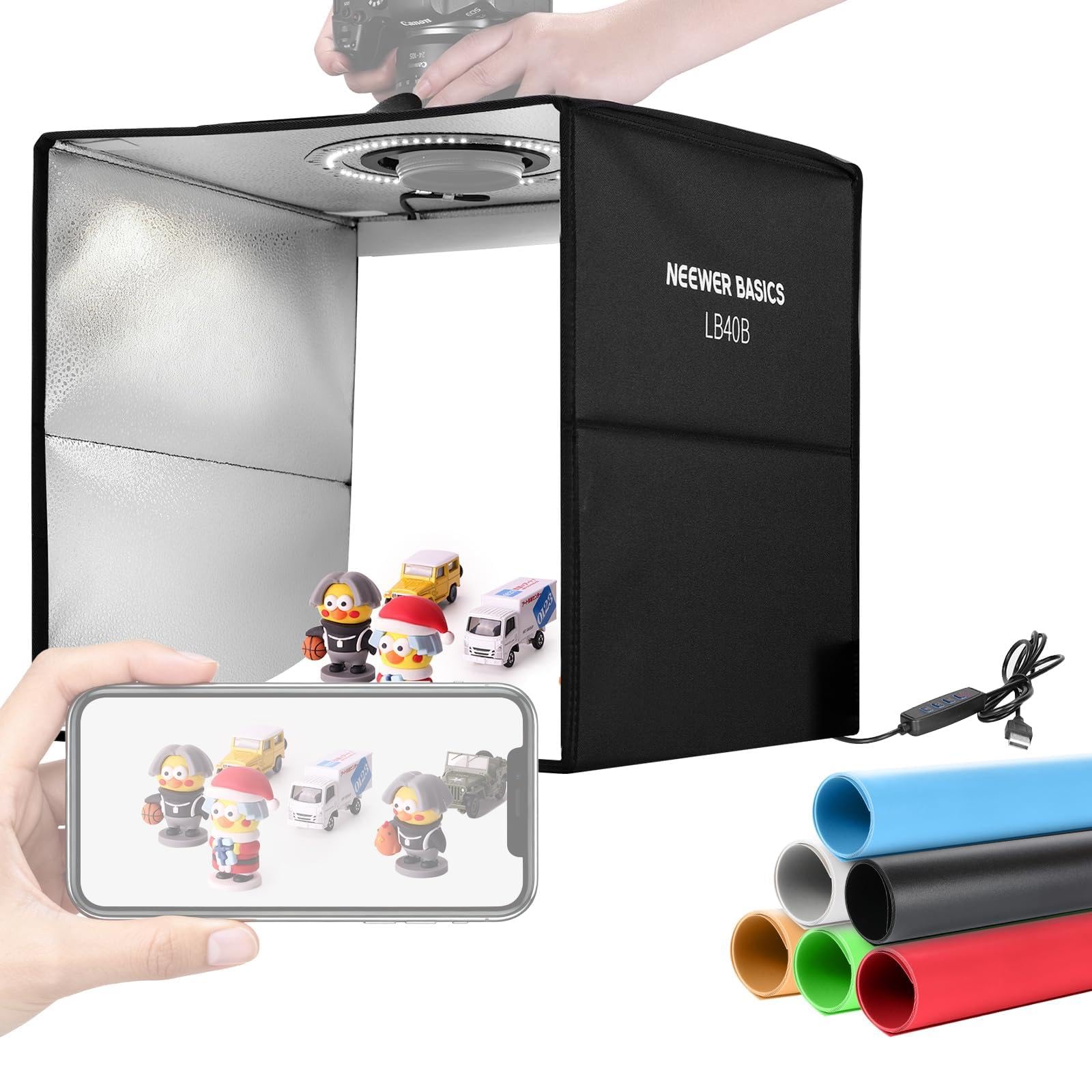
NEEWER Basics LB40B Light Box

84 /100
Keeper Score Excellent

Key details

LEDs
120 bi-color, CRI95+
Output
3900 lux/0.3m
Backdrops
6 colors
Interior Size
16" x 16" x 15"
Check Price on Amazon

The most expensive folding box here is also the only one that specifies its output: 120 bi-color LEDs at 3900 lux at 0.3 m, dimmable from 0 to 100 percent, with CRI95+ and a silver interior that bounces light back into the box rather than soaking it up. The enclosure is listed as metal rather than PVC over card, which is part of what the price buys and part of why it stays square on a table.

Bi-color earns its keep when your photos have to sit next to ones you already published. You can warm the light to match an older set instead of color-correcting every file afterward, and 16 inches by 15 inches clears a bottle, a vase, or a plated dish with backdrop behind it.

What we cannot tell you yet is how it holds up. This one has not been in rotation long enough for us to have a view on its LEDs or its folding joints, so the specification sheet is doing most of the recommending here. If controllable light in a tabletop box is what you need and the premium is affordable, it is the pick; if you want a box with a track record, the ones above have one.

Pros

  • Bi-color LEDs with 0–100% dimming
  • Stated 3900 lux output at 0.3 m
  • 16-inch interior with a metal enclosure

Cons

  • The priciest folding box in this set
  • Too new for a long-term reliability record
Our verdict

The most controllable light in a folding box: bi-color LEDs, full-range dimming, CRI95+, and a metal enclosure. A premium pick for color-critical work that is still earning its record.

Check Latest Price

How We Tested the Best Photography Light Boxes

We started by shortlisting boxes that published a color rendering index, a real color-temperature range, and honest interior dimensions, then filtered to the 10- to 32-inch span that covers jewelry, cosmetics, and food without swallowing a countertop. Fourteen made the cut, and they've been in rotation for six months.

Most of the shooting happened where these things actually live: a kitchen counter, a spare-room desk, and a folding table at a friend's bakery, photographing earrings, watches, soap, cookies, and a rotating pile of electronics headed for resale. We timed setup from closed bag to first frame, working alone with one hand on the product, and noted whether the frame popped open or fought back. We set real objects inside — a mug, a dinner plate, a boot — to check clearance, and watched whether backdrops clipped in flat or arrived creased.

With a box up, we shot the same white mug at every brightness step and compared the files side by side to find where dimming stopped changing the exposure and only added noise. Each unit ran its full warm-to-cool range while we photographed a white shirt and a navy one, watching for color casts, flicker on video, and any shift after twenty minutes on. Durability was the boring part: twenty-plus folds and unfolds, a few rides in a tote, then a look for sagging panels, loose LED strips, and seams pulling apart. We finished by tallying what actually came in each box against the price.

How to Choose a Photography Light Box

Measure the Product, Not the Box

Listings quote the outside of the frame, and the inside is smaller. The LED board and diffuser take an inch or two off the top, and the backdrop curves forward at the back, so a 10-inch cube gives you a shooting bay closer to nine inches across. A mug, a watch, a pair of earrings, or a cosmetics bottle all fit comfortably. A shoe box, a handbag, or a folded sweater does not, at any angle.

Put your largest product on a ruler and add two inches in each direction before you pick a size. If you shoot a mix of small and medium items, buy for the largest one and accept that the smallest ones will look a bit lonely inside.

Dimming and Color Temperature

Continuous dimming is the feature to protect above all others. Glossy metal and glass blow out long before the box runs out of brightness, and turning the light down is how you keep a highlight reading as a highlight instead of a white smear. Three color temperatures are also worth having: roughly 3000K warm, 4200K neutral, and 5500 to 5700K daylight let a new batch of photos sit next to ones you published last year.

Ignore lux figures quoted at a fraction of a meter unless you are comparing two boxes from the same maker. They are measured differently and do not travel between brands, so a big number on a cheap box means very little.

Color Rendering: What CRI 80 Costs You

CRI is a self-reported index of how faithfully a light shows color, and the gap between 80 and 95 shows up on saturated reds, deep blues, and skin. For hardware, books, and most packaged goods it barely registers. For textiles, art prints, cosmetics, and anything a buyer will hold next to a screen, pay for the higher figure and shoot against white.

Getting this wrong does not look like a bad photo. It looks like a product in the wrong color, which is worse, because the buyer thinks that is what you are selling.

The Light Is the Part That Fails

The shell is the cheap part of any of these boxes: coated fabric over card, velcro tabs, a PVC backdrop. What fails is the LED board or the connection where the cable meets the housing, which is why a one-year warranty is worth more here than an extra backdrop color. It is also why we run every box at full brightness for half an hour before trusting it with a listing deadline.

If it flickers, cuts out, or needs the plug wiggled to come on, return it inside the window rather than working around it. The workaround never gets better.

Backdrops and Reflections

PVC backdrops wipe clean and shrug off handling, but they reflect, and they crease if you store them folded. Matte paper kills glare on polished metal and marks if you look at it wrong. A white sweep handles most hero shots, black adds contrast for pale products, and the remaining colors are variety you will stop needing within a month.

If you photograph jewelry, watches, or glass, prioritize a kit with reflection boards or a spare diffuser. They shape highlights in a way that a brighter LED cannot, and they cost less than moving up a size.

Frequently Asked Questions

Final Verdict

The PULUZ is the box we point people to first because it gets the two things that decide whether you will actually use it: it folds flat in seconds, and its CRI>95 light is even and genuinely dimmable. Ten inches of interior covers jewelry, cards, cosmetics, and small ceramics, and on the one thing that matters most, the light staying on, it has the strongest record in this set.

If your products outgrow it, the decision splits on size. The Takerers 12-inch costs less and adds two inches of interior plus three color temperatures, while the SYSCLOUD 32-inch is the only box here that handles bags, appliances, and batch shots, and its premium only makes sense once the smaller boxes have genuinely run out of room.