Best Photography Light Stands of 2026

A light stand only gets interesting when it fails. When a softbox takes a nosedive mid-shoot, you stop thinking about output and start checking the base, the leg locks, and whether the column stays put. I’ve spent the past six months with 14 stands—packable aluminum tripods, heavy stainless C-stands, wheeled bases—using them in my spare-room studio and on location, and the good ones hold a strobe, softbox, ring light, or camera exactly where I aimed it.

Height is the number shoppers fixate on, but usable height matters more; a stand that reaches 9 or 10 feet can feel spooky with a big modifier up top if the legs are narrow. Air cushioning is easy to overlook until a heavy light drops when you loosen a knob. Weight and cost cut both ways: a sturdy C-stand is a burden to carry, while a light travel tripod is easier on your shoulder but demands more care with a softbox. Value is the stand you stop fighting, not the cheapest one in the cart.

Keeper Score summarizes customer ratings and review volume. Read it alongside the product details and trade-offs. How the score works.

1

Best Overall

K&F Concept TL06 Light Stand

89 /100
Keeper Score Excellent

Key details

Mount
1/4-inch-20 stud, 180-degree tilt
Stand Weight
3.8 lb
Folded Length
39.4 in
Maximum Height
9.2 ft
Check Price on Amazon

Nine feet of stand that packs down to 39 inches is the balance this one strikes. The TL06 runs from about 2.6 feet up to 9.2 on three sections, which is the range that puts a key light above a standing subject's eyeline and tilts a modifier down at them — the position portrait lighting wants and the one a six-foot stand can't reach. The top stud is a 1/4-inch-20 thread on a mount that tilts 180 degrees front to back, so a softbox or reflector aims where you point it without a separate bracket.

We treat it as the default in this group because nothing about it feels like the cheapest stand in the room. The legs splay wide and snap into position, the collars are buckle-style rather than twist, and the whole thing feels denser than the 3.8 pounds on the sheet. Set beside the budget two-pack we also recommend, it gives up a few inches of folded length and comes back with a stability margin that shows the first time you raise a softbox to the top section.

Where it runs out of headroom is at full extension with a big box. The top tube is slender, and a 47-inch modifier up there makes the stand top-heavy enough that a sandbag over a lower leg stops being optional. The mount is also only a 1/4-inch screw, so a monolight with a 5/8-inch receiver needs a spigot adapter, and there's no umbrella holder in the box — two small additions worth ordering alongside it.

Pros

  • Reaches a little over nine feet for standing portraits
  • 3.8-pound body folds to 39.4 inches
  • Wide splayed legs and buckle-style collars
  • Tilting 1/4-inch stud aims the fixture

Cons

  • Top section gets springy with a large modifier
  • 1/4-inch stud only; strobes need a spigot
Our verdict

We recommend the TL06 as the stand to buy first: a little over nine feet of reach, under four pounds to carry, and enough stiffness for a strobe and a medium softbox.

Check Latest Price
2

Best for Overhead Boom Work

Neewer Pro C Stand with Boom

95 /100
Keeper Score Outstanding

Key details

Boom Arm
4.2 ft
Stand Weight
20 lb
Load Capacity
44 lb
Maximum Height
10.5 ft
Check Price on Amazon

The reason to own a C-stand is the arm. This one's boom runs 4.2 feet and locks into two grip heads, so a strobe can hang out over a subject's head or reach across a table at an angle no tripod stand manages. The column runs from 4.7 to 10.5 feet, the whole thing is stainless steel on a folding three-leg base, and there's no paint on the risers to chip after a season of folding and unfolding.

Twenty pounds of stand sounds excessive until a strobe and a big modifier are hanging off a three-foot arm. The mass is the counterweight, and the legs slide independently, so you can straddle a table leg or a stand that's already in the way. With the arm extended, a sandbag on the base is part of the setup rather than an accessory: the stand will carry the weight, but the center of gravity moves out along the arm with it.

The grip heads are what make the geometry work. Two of them lock the arm at any angle and let you hang a flag or a reflector from the same stand, and the threaded ends take 1/4-inch and 3/8-inch fittings, which covers most monolights and LED panels without an adapter. The knobs are big and lock positively, which matters more than it sounds when you're reaching above your head in the dark.

What you give up is portability, and it's not a small give: 20 pounds plus an arm is a two-trip carry up a flight of stairs, and the base takes up more floor than a tripod stand. On a set where the lights stay put, though, this is the stand in this group we put under the biggest box and the longest arm.

Pros

  • 4.2-foot boom hangs a light overhead
  • 44-pound capacity on a stainless frame
  • Two grip heads plus 1/4- and 3/8-inch threads
  • Legs set independently around obstacles

Cons

  • 20 pounds, with a wide base for small rooms
Our verdict

We reach for this one whenever a light has to hang over someone's head — the boom, the 44-pound rating, and the stainless build are why it's the most capable stand here.

Check Latest Price
3

Best for Studio Mobility

Neewer SC305W Wheeled Stand

93 /100
Keeper Score Outstanding

Key details

Base
Tripod with 360-degree casters
Height Range
4.3 to 10 ft
Stand Weight
17 lb
Load Capacity
66 lb
Check Price on Amazon

Rolling a loaded stand instead of lifting it changes the rhythm of a studio day, and this is the only stand in the group built for it. Four 360-degree casters sit under a folding tripod base, the column runs from 4.3 to 10 feet in three sections, and the stainless steel carries a 66-pound rating — the highest here by a wide margin. The difference is obvious the first time you move a rim light mid-session: you roll it rather than unclip, carry, and re-aim.

Two details are worth more than their space on the spec sheet. The column has a spring buffer, which slows the drop when a collar is loosened with a light mounted, and the legs fold flat for storage in a corner. The wheels are quiet enough to reposition between takes without announcing it, and the whole thing takes less floor than we expected of a stand that reaches ten feet.

Pros

  • 360-degree casters roll a loaded stand
  • 66-pound capacity, the highest in this group
  • Spring buffer slows a loaded column's drop

Cons

  • Studio-bound at 17 pounds and 3.9 feet folded
Our verdict

If your lights stay in one room, this is the stand we point people to: casters that roll a loaded softbox, a 66-pound rating, and a buffer that slows the drop.

Check Latest Price
4

Best Budget Two-Pack

Amazon Basics Light Stand, 2-Pack

91 /100
Keeper Score Outstanding

Key details

In The Box
Two stands, two cases
Height Range
2.8 to 6.7 ft
Folded Length
28.5 in
Max Load, Base Section
7 lb
Check Price on Amazon

Two complete stands and two carry bags is a different proposition from one good stand, and for a first key-and-fill setup it's the more useful buy. Each stand runs from 2.8 to 6.7 feet, which puts a speedlight, a small LED panel, or a ring light at seated-portrait height, and the 1/4-inch screw tip takes the standard small-fixture thread. The top mount is fixed, so you aim by rotating the fixture rather than panning the stand.

The load rating is the part to read carefully: seven pounds at the base section, 5.5 at the second, and 1.1 at the top. Capacity falling as the column rises is how light stands work in general, but the drop is steep here, and the rating tells you what the top section is actually for. Small fixtures mounted low are what this pair is built for — a fill light, a background light, a second source on a product table.

What we appreciate most is that the set solves a lighting problem rather than a stand problem: one light on the subject, one on the background, both at seated height, and no reason to buy a third. The bags are the plainest kind, but they keep the legs off your car seats, and the screw tips take a phone clamp as readily as a speedlight.

Pros

  • Two stands and two cases in one purchase
  • Light enough to reposition one-handed
  • 1/4-inch screw fits ring lights and small panels

Cons

  • Load capacity falls to 1.1 pounds at the top section
  • Legs are stiff to splay and sway near full height
Our verdict

Two stands, two cases, and the lightest fixtures in the room — we recommend this set for a first key-and-fill pair, provided nothing heavy goes up top.

Check Latest Price
5

Best for Travel

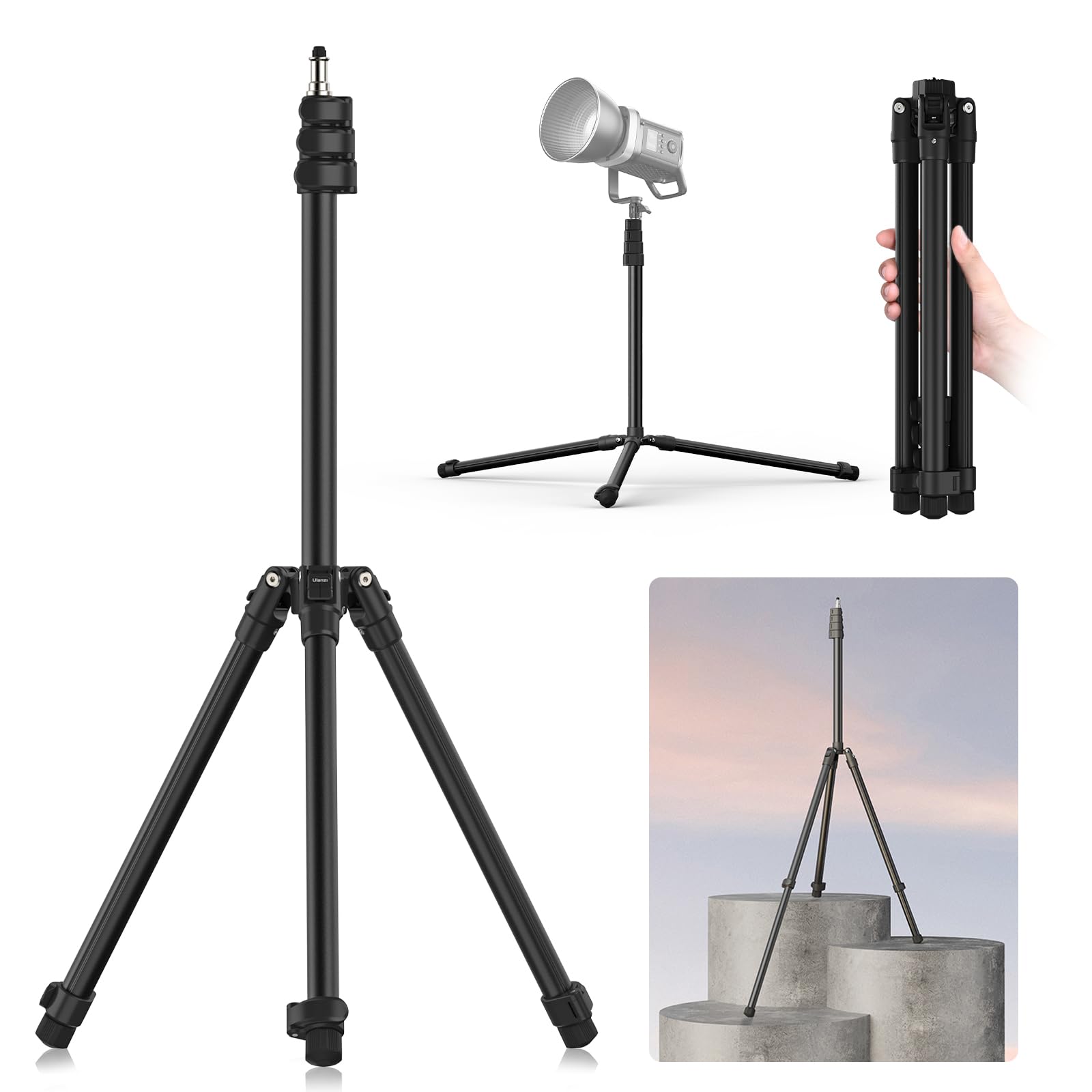
Ulanzi TT43 Light Stand

88 /100
Keeper Score Excellent

Key details

Stand Weight
1.9 lb
Folded Length
17 in
Load Capacity
6.6 lb
Maximum Height
6.2 ft
Check Price on Amazon

Seventeen inches folded and 840 grams is small enough that the TT43 disappears into a gear bag next to a lens instead of needing its own tripod sleeve. It opens to 6.2 feet on three sections, with two-stage legs that set at three spread angles by snapping a tab, and the 6.6-pound load rating describes its job: a speedlight, a small LED panel, a phone rig, or a compact diffuser.

The narrower footprint is what we came to value most — set beside a full tripod stand, it tucks into the corner of a small room and leaves a walkway where there wasn't one. The trade-off arrives with height and weight together: a heavier panel near the top makes the stand feel light, and the snap tabs that make setup quick are the parts that move if someone knocks a leg. With a small fixture at chest height on a location shoot, neither comes up.

Pros

  • Folds to 17 inches and weighs 1.9 pounds
  • Three leg-spread angles on snap tabs
  • Narrow footprint suits small rooms

Cons

  • 6.6-pound rating caps it at small fixtures
  • Feels light at the top of its height range
Our verdict

The TT43 is the one that goes in the bag: 17 inches folded, under two pounds, and steady enough for a speedlight or a small panel on location.

Check Latest Price
6

Best Air-Cushioned Stand

SmallRig RA-S280 Light Stand

87 /100
Keeper Score Excellent

Key details

Mount
1/4-inch stainless stud
Height Range
3.1 to 9.2 ft
Folded Length
37 in
Load Capacity
17.6 lb
Check Price on Amazon

Air cushioning is the feature we didn't value until a collar slipped on another stand and the column dropped with a strobe mounted. On the RA-S280 the sections are damped, so loosening a lock lets the column settle instead of fall, and that is the main reason we point people here rather than at a plain stand with the same reach. The flip locks work one-handed, the column runs from 94 to 280 centimeters, and the 1/4-inch stud is stainless steel rather than aluminum — a small thing that matters when you thread a fixture on and off every week.

Seventeen and a half pounds of rated capacity is more than our top pick carries, which is the number to think about if your modifier is bigger than a medium softbox. At 4.6 pounds with a 37-inch folded length, it's also a stand you can carry to a location in one hand along with a light bag, which is where a lot of heavier stands stop being useful.

The two-year warranty is the longest in this group, and it covers the flip clamps — the part that takes the wear on any stand. That's worth something when the stand is holding a light you'd rather not replace.

Pros

  • Air-damped sections protect fingers and gear
  • 17.6-pound capacity with one-hand flip locks
  • Two-year warranty, the longest here

Cons

  • No carry bag included
  • Column can creep at full height under a heavy modifier
Our verdict

Air cushioning plus a 17.6-pound rating make this the mid-price stand we suggest to anyone raising and lowering a loaded light all day.

Check Latest Price
7

Budget C-Stand

K&F Concept TL05 C Stand

90 /100
Keeper Score Outstanding

Key details

Included
Crossbar, two grip heads
Height Range
4.9 to 10.8 ft
Stand Weight
17.2 lb
Load Capacity
44 lb
Check Price on Amazon

Less money than the Neewer Pro C-stand buys a stainless C-stand with the same 44-pound rating, a column that reaches 10.8 feet, and a crossbar with two grip heads in the box. For a first C-stand, or a second one to hold a reflector or a flag, that trade is lopsided enough that we keep coming back to it.

The base is the part that decides whether you trust a C-stand. Three legs with non-slip pads fold into a flat C shape that stores in a corner, and the profile leaves room to drop a sandbag over each leg when the arm goes out. At 17 pounds it sits still under a strobe and is still a one-person carry between rooms, which is the balance a C-stand is supposed to strike.

What we mind is the hardware: the adapters grip a spigot by hole size rather than clamping it the way a grip head does, so there are more loose pieces to keep track of on a dark set. That's a small annoyance against a real saving, and it doesn't change how the stand holds a light.

Pros

  • 44-pound rating and a 10.8-foot column
  • Crossbar and two grip heads included
  • Cushion spring in the center column
  • 17 pounds with a folding C base

Cons

  • Four-hole adapters are fussier than grip heads
Our verdict

A C-stand we trust with a heavy strobe for a lot less than the Neewer — the TL05 is where a first overhead setup should start.

Check Latest Price

How We Tested Photography Light Stands

We built the shortlist from stands that keep turning up in rental kits and studio setups, then filtered by maximum height, collapsed length, material, load rating, and whether the base was a tripod, C-stand, or wheeled stand. That left us with 14 stands, which we tested over six months. I noted the hardware too—metal collars versus plastic, welded joints versus bolted—because quality shows up in the details long before a stand fails.

The stands lived in my spare-room studio and traveled in the back of my car to portrait sessions in clients’ living rooms and a few product shoots on dining tables. I set each one up alone and timed it, then loaded it with a strobe and softbox, a ring light, and a camera to see how much the column flexed at full height. On hardwood, low-pile carpet, and an uneven concrete porch, I adjusted each leg independently and checked whether the locks held under weight. I also gave the top a firm nudge with a heavy modifier attached to judge stability, and rolled the wheeled bases across a rug edge and a threshold to see if they tracked or caught.

Air cushioning got its own check: I loosened the collar with a light attached and watched whether the section eased down or dropped. C-stands with boom arms and grip heads were loaded off-center to see if the arm crept; portable stands were folded, bagged, carried up a flight of stairs, and packed into the car. I weighed each one after packing it back into its case. At the end, I compared how much fuss each stand caused from setup to teardown—that, more than any single spec, is where value and versatility showed up.

How to Choose a Photography Light Stand

Read the load rating at the height you'll use

A stand's capacity is usually quoted for its widest, lowest section, and it falls as the column rises — on some stands to a fraction of the headline number. Add up the fixture, the modifier, the bracket, and the umbrella, then keep the total well under the rating if the stand will be extended when it matters.

A softbox is a sail, and a stand at full height with one mounted is a lever. Weigh the modifier, not the light. When the numbers get close, the fix isn't a stronger stand so much as a lower height, a wider leg spread, and a sandbag over a lower leg.

Height is only useful if the base can stay under it

A nine-foot column doesn't help if the stand has to sit in a doorway. Tripod stands need floor area for splayed legs, C-stands slide a leg under furniture and let you drop weight on the base, and casters want a smooth, level floor. Decide where the stand will live before you decide how tall it should be.

Weight on the base is what separates a stable stand from a tipped one, and none of the stands here ships with sandbags. Plan for them: one bag over a lower leg covers a medium softbox at moderate height, and an extended boom wants more than that.

Tripod, C-stand, or wheels

The base type answers a question about the job. A tripod stand is the general-purpose choice — it folds, it carries, and it holds a light almost anywhere. A C-stand trades portability for an arm and a low, wide stance that gets a source over a subject or into a tight corner. Casters are for a studio where the lights move between setups without leaving the room.

Buy the base for the work you do most. If half your shooting happens on location, a wheeled base is the wrong first purchase, and if you never shoot overhead, a C-stand is a lot of stand to carry for the times you don't use the arm.

Folded length decides whether it leaves the house

Packed length matters more than weight for travel. A stand that folds to 17 inches drops into a gear bag, one at 39 inches needs a tripod sleeve in the car, and anything near four feet tends to stay in the studio. Measure the bag you already carry before you buy — a stand that doesn't fit it becomes a studio stand by default.

Weight shows up once you're carrying two stands plus lights and a tripod. Under two pounds per stand is a different trip from four or five, and the stands that fold smallest here are also the lightest ones.

Frequently Asked Questions

Final Verdict

Start with the K&F Concept TL06. It covers the most ground for the smallest commitment: a little over nine feet of reach, a body light enough to take to a location, and enough stiffness for a strobe with a medium softbox.

Move up to the Neewer Pro C Stand the moment a light has to hang on a boom over someone's head, and to the wheeled Neewer if the lights never leave the studio. Outfitting a first two-light setup? The Amazon Basics pair is the honest place to start.