Best Nikon Z DX Lenses of 2026

A DX lens is built for the smaller APS-C sensor inside Nikon's Z cameras, so the real decision isn't brand — there's only one — it's how wide or how long you want to go. A fast wide prime and a compact telephoto zoom are both Nikon Z DX glass, and they solve completely different problems.

I shoot a DX body on weekend walks and at family dinners, and I've learned the wrong focal length stays in the drawer no matter how good the glass is. Eight months with 10 of these lenses taught us that the keepers are the light ones covering more than one job — which is the real measure of value here.

Here's the math that trips up first-time buyers: a DX sensor crops by about 1.5x, so a 24mm wide prime frames more like a 35mm and a modest kit zoom starts at what feels like a normal lens. Autofocus matters as much as sharpness — the gap between a quick lock and a hunt shows up indoors, not on a spec sheet. What follows is what survived.

Keeper Score summarizes customer ratings and review volume. Read it alongside the product details and trade-offs. How the score works.

1

Best Overall

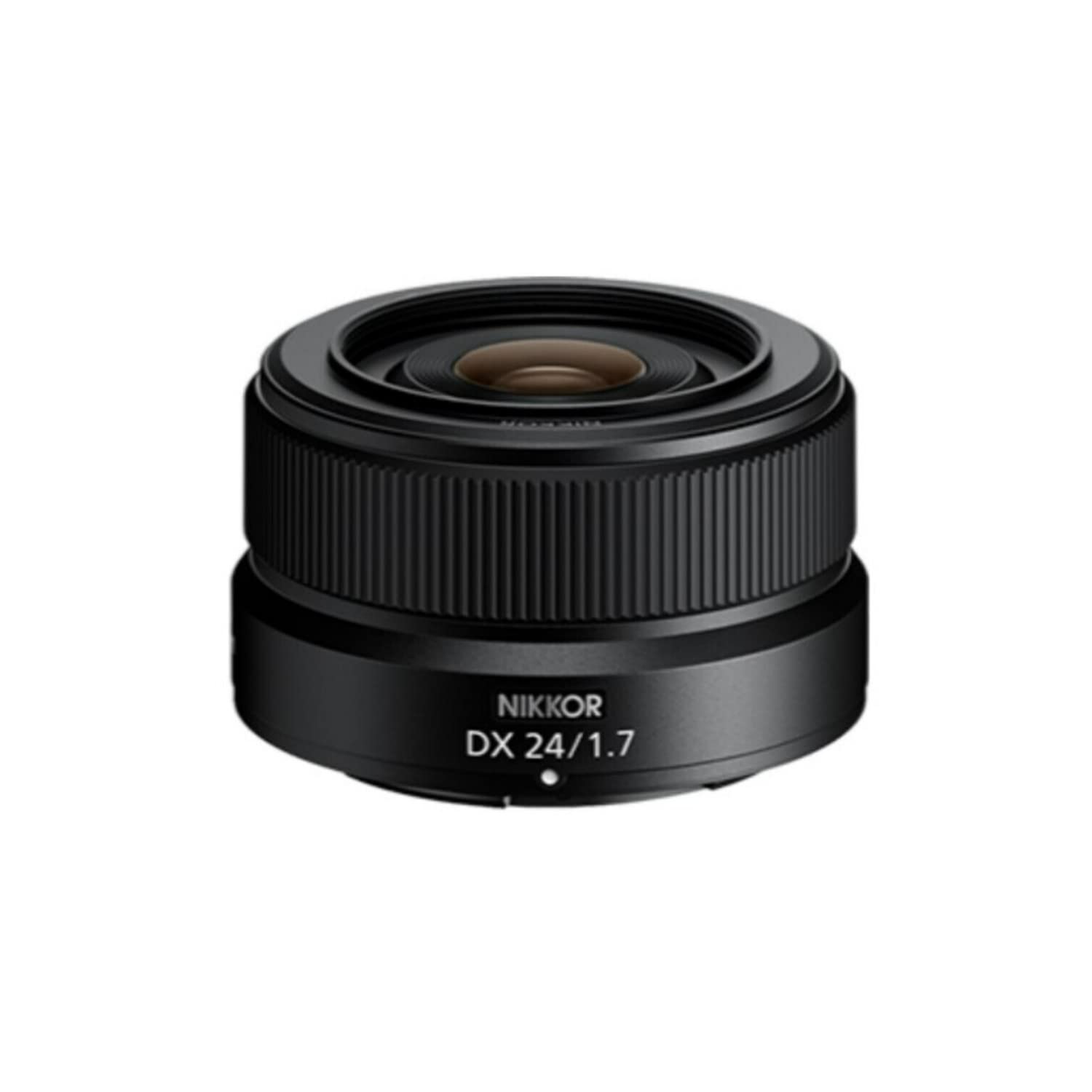
Nikon NIKKOR Z DX 24mm f/1.7

84 /100
Keeper Score Excellent

Key details

Weight
9.91 oz
Focal Length
24mm
Max Aperture
f/1.7
Minimum Focus
4.7 in
Check Price on Amazon

An f/1.7 maximum aperture is the whole reason this lens exists, and it's the reason we point anyone with a Z50 or Z fc toward it once the kit zoom stops feeling like enough. On a DX sensor, 24mm gives you roughly the view of a 35mm lens on full frame — the angle that fits a street corner, a table of people, or a small room without backing into a wall. That f/1.7 buys back the light the kit zoom gives away. In a dim kitchen or a restaurant after dark, the difference isn't subtle: you keep shooting at shutter speeds you can handhold instead of watching the ISO climb.

Sharpness held up better than we expected from something this small. The center is already crisp wide open, and the corners catch up by f/2.8, which is where we leave it for architecture and landscapes. At 281 grams it isn't much more than a body cap, so it stays mounted instead of migrating back to the bag. And focusing down to 4.7 inches from the front of the lens covers flowers, food, and small objects without a dedicated macro.

Two practical details we appreciated: the 46mm filter thread matches the 16-50mm kit zoom, so a polarizer you already own fits, and the barrel is sealed against dust and drips. That last part is unusual on a lens at this end of the range, and it's one we stop worrying about in a light drizzle.

Nikon tuned the autofocus for video and it shows: no mechanical whir when it tracks, and barely any focus breathing as it pulls. If you film yourself talking to camera, that's worth more than it sounds. What 24mm doesn't do is reach — from the back of a school hall you're cropping, not zooming — so treat this as the lens that lives on the camera day to day, not the one for everything.

Pros

  • Fast f/1.7 aperture for low light
  • Sharp wide open, crisper by f/2.8
  • 281 g with dust and drip sealing
  • Focuses to 4.7 inches

Cons

  • No optical stabilization built in
Our verdict

Buy this one first: the f/1.7 aperture turns a small DX body into a real low-light camera, and nothing else here changes what you can shoot as much.

Check Latest Price
2

Best All-Around Zoom

Nikon NIKKOR Z DX 18-140mm f/3.5-6.3 VR

87 /100
Keeper Score Excellent

Key details

Weight
11.1 oz
Focal Range
18-140mm
Max Aperture
f/3.5-6.3
Stabilization
VR, up to 5 stops
Check Price on Amazon

Three lenses in one barrel is the pitch, and for once it holds up. The 18-140mm covers the wide-to-normal view of the kit zoom and keeps going to roughly 210mm in full-frame terms — long enough for a head-and-shoulders portrait from across a courtyard, wide enough at 18mm for the courtyard itself. On a trip where changing lenses means missing the shot, that range counts for more than any single optical figure.

Of the five lenses here, this is the one we pack when we don't know what we'll be photographing. The 7.8x range is genuinely useful rather than decorative: 18mm for a street, 140mm for faces and details. Vibration reduction rated to five stops does the heavy lifting at the long end, where a slight tremor becomes visible in the frame. At 315 grams it's heavier than the pancake zooms but still light enough to carry all day, and it sits on a small body without feeling nose-heavy.

It also focuses to 0.2 m at the wide end — closer than most all-purpose zooms manage — which turns it into an impromptu close-up lens for flowers, menus, and textures. The compromise sits at the far end, where the aperture closes down and indoor reach shots want more light than the room has. Pair it with the 24mm f/1.7 for evenings, or accept a higher ISO.

Pros

  • One lens from 18mm to 140mm
  • Five-stop VR steadies the long end
  • 315 g and light enough to carry all day
  • Focuses to 0.2 m at the wide end

Cons

  • Drops to f/6.3 at 140mm
Our verdict

If you want a single lens for a whole trip, this is the one we pack — wide to telephoto without a second lens in the bag.

Check Latest Price
3

Best for Video and Vlogging

Nikon NIKKOR Z DX 12-28mm f/3.5-5.6 PZ VR

89 /100
Keeper Score Excellent

Key details

Weight
5.11 oz
Zoom Type
Motorized power zoom
Filter Size
67mm
Focal Range
12-28mm
Check Price on Amazon

The zoom on this lens is a small motorized lever, not a ring you twist, and that one choice explains who it's for. Push the lever and the framing glides; nothing jerks where your wrist catches up. For anyone filming themselves, talking to camera, or walking through a market with the camera pointed ahead, a smooth power zoom at arm's length is the difference between footage that looks deliberate and footage that looks handheld.

At 12mm it takes in a 90-degree view, the widest lens here by a clear margin and wide enough to hold a whole room or a face plus the scene behind it at arm's length. At 145 grams it's the lightest of these after the kit pancake, which matters when the camera is on a small grip or a compact gimbal. We think it's the most convincing video lens of the five, and the customizable control ring puts aperture or exposure compensation under a finger instead of in a menu.

For stills it's a wide-angle specialist: interiors, architecture, and landscapes where you want the foreground to lead. At 12mm the edges of the frame stretch, so keep people away from the corners and level the camera. Optical VR steadies handheld shots and clips, and the range up to 28mm — about 42mm in full-frame terms — is enough to tighten up without changing lenses.

Pros

  • Power zoom glides for video
  • 90-degree view at 12mm
  • 145 g with optical VR
  • Customizable control ring

Cons

  • Power zoom lever is imprecise for stills
  • 67mm filters match nothing else here
Our verdict

For anyone who films themselves, this power zoom is the most persuasive lens of the five: a 90-degree view that glides instead of jerks.

Check Latest Price
4

Best for Reach

Nikon NIKKOR Z DX 50-250mm f/4.5-6.3 VR

89 /100
Keeper Score Excellent

Key details

Focal Range
50-250mm
Minimum Focus
0.5 m
Stabilization
VR, up to 5 stops
Full-Frame View
75-375mm
Check Price on Amazon

The 50-250mm solves a particular problem: the thing you want is on the other side of something. A kid at the far end of a field, a bird on a fence post, a speaker at the front of a hall. At the long end you're looking at roughly 375mm in full-frame terms, enough compression to pull a subject out of its background instead of recording it as part of a scene.

Five stops of vibration reduction is what makes that reach usable by hand. At 250mm every small movement is magnified, and the stabilization is the difference between shooting and hunting for a tripod. It shares a 62mm filter thread with the 18-140mm, so one polarizer serves both, and the barrel retracts for storage — this is the lens that lives in a corner of a small bag until the moment you need it.

We treat it as the second lens, not the first. It starts at 50mm, so on its own there's no wide end at all; pair it with the 16-50mm or the 18-140mm and the set is complete. The other limit is light, since this is a daytime, outdoor lens in practice, and 0.5 m minimum focus means close-ups aren't its job. What it does, it does without fuss and without adding much to the bag.

Pros

  • Reaches roughly 375mm in full-frame terms
  • Five-stop VR makes handheld reach practical
  • Retracts small for the bag
  • Shares 62mm filters with the 18-140mm

Cons

  • Starts at 50mm, so it can't be your only lens
Our verdict

Buy it when your shorter zoom runs out and the subject is still across the field — 375mm equivalent with stabilization that makes handheld reach practical.

Check Latest Price
5

Pocketable Walkaround

Nikon NIKKOR Z DX 16-50mm f/3.5-6.3 VR

86 /100
Keeper Score Excellent

Key details

Weight
4.76 oz
Focal Range
16-50mm
Stabilization
VR, 4.5 stops
Full-Frame View
24-75mm
Check Price on Amazon

Start with the compromise: f/3.5 at 16mm dropping to f/6.3 at 50mm is the slowest glass in this group, and indoors in the evening it shows. Then pick the thing up. At 135 grams, collapsed into a pancake, it's the lens that lets a Z50 disappear into a jacket pocket, and that's most of why it earns a place here.

The range is the classic everyday one — 24-75mm in full-frame terms, wide enough for a room and long enough for a face across a table. In good light we found the results honest rather than exciting, which is exactly what a walkaround zoom should be. It focuses to 0.2 m, so close-ups of food and details are in reach, and 4.5 stops of stabilization helps both stills and clips when the light drops.

The 46mm filter thread matches the 24mm f/1.7, so one polarizer covers both, and the two together make a small, sensible kit: this one for daylight and range, the prime for everything after sunset. If you own it as a kit lens already, you know what it is. If you're choosing between it and a bigger zoom, the question is whether more range is worth more weight — and this is the one that makes the camera easy to bring.

Pros

  • 135 g and pancake-flat when retracted
  • 4.5-stop vibration reduction
  • Shares 46mm filters with the 24mm f/1.7
  • Focuses to 0.2 m

Cons

  • No weather sealing
Our verdict

The lens that keeps a Z50 pocketable: 135 grams, 4.5-stop stabilization, and a range that covers an ordinary day, as long as the light is decent.

Check Latest Price

What Eight Months With 10 DX Lenses Looked Like

We started with Nikon's full DX lineup for the Z mount and cut anything that duplicated another lens's reach, which narrowed things to the five jobs a DX shooter actually asks for: a compact everyday zoom, a wide zoom, a fast wide prime, a do-everything superzoom, and a telephoto. We tested 10 lenses over eight months, and for two of the zooms we ran a second copy, just to be sure a soft corner was the design and not a bad sample.

Autofocus got its own scenes, since that's where good glass and cheap glass part ways. We shot a kid running toward the camera at a park, tracked a cyclist across a parking lot, and worked a dim restaurant where the light is bad and nobody sits still. We noted whether each lens locked on immediately or hunted, and how loud the motor was in a quiet room. Portability we measured the boring way: every lens on a scale, then a full afternoon walking around with it on the body to see whether our shoulder noticed.

For image quality, we shot the same brick wall, backlit tree, and cluttered bookshelf at every aperture and compared the corners, not just the center. Stabilization we tested by hand-holding the long end at shutter speeds we'd never recommend, once with VR on and once with it off, and counting how many frames came out clean. Value we judged last, after living with each lens: whether it replaced a second lens in the bag, and whether we'd have paid for the reach we actually used.

How to Choose a Nikon Z Dx Lens

Start with the focal lengths you actually use

A DX sensor multiplies the number on the barrel by about 1.5, so the 16-50mm behaves like a 24-75mm and the 50-250mm behaves like a 75-375mm. Getting that straight matters, because a number that felt wide on a full-frame camera is not wide here, and a lens that seemed modest turns out to be a proper telephoto.

Before you buy anything, look at the focal lengths attached to your last few hundred pictures. If most sit between 18mm and 35mm, a long zoom is money spent on a range you don't use, and the 12-28mm or the 24mm prime will do more for you. If your pictures sprawl across a whole trip, the 18-140mm is the closest thing here to carrying everything at once.

Aperture, and the light you'll actually have

Every zoom here is variable aperture, and the wide figure is the one that gets advertised. f/3.5 applies at 16mm or 18mm and vanishes the moment you zoom in; by the long end you're at f/6.3, roughly two stops of light you no longer have. Two stops is the difference between a shutter speed that freezes a running child and one that smears them.

The 24mm f/1.7 is the only lens in this group that doesn't drift, and it's the one to choose if most of your pictures happen indoors or after dark. Otherwise, plan on good light, a higher ISO, or both.

Stabilization and autofocus for stills and video

Vibration reduction is rated between 4.5 and 5 stops on these zooms, and it earns its keep at the long end, where small movements get magnified. It won't stop a moving subject — only a faster shutter does that — so treat it as help for handheld stills and steadier footage, not a cure for a dim room.

For video, the 12-28mm's motorized power zoom glides where a twist ring jerks, and the 24mm f/1.7's autofocus is tuned to stay quiet and free of the breathing that makes a clip look like it's pulsing. If you film yourself, those details matter more than a sharpness chart.

Size, weight, and the retracting barrel

Between 135 and 315 grams, the difference decides whether the camera goes in a pocket or stays home. The 16-50mm collapses flat and effectively disappears on a small body; the 18-140mm is still comfortable on a neck strap, but you'll notice it by mid-afternoon.

Two of these zooms retract and need extending before they'll shoot — a ritual that costs a second and, in our experience, exactly one missed photo before it becomes automatic. Check that a retracted lens and a small body fit the bag you actually carry, not the one you mean to carry.

Sealing, conditions, and where you'll shoot

Only two lenses here make a weather claim: the 24mm f/1.7 is sealed against dust and drips, and the 18-140mm is listed as water resistant. The rest are not, which is fine for most people and a genuine consideration for anyone shooting from a boat, in dunes, or through a rainy season.

A rain cover and a dry bag cost little and protect more than sealing alone. If you shoot in rough conditions often, build a small kit around the sealed prime and leave the rest at home.

Frequently Asked Questions

Final Verdict

Our pick for most DX Nikon owners is the 24mm f/1.7. It's the only fast lens of the five, it's small enough to leave on the camera, and it turns indoor and evening shooting from a compromise into something you look forward to. Nothing else here changes the pictures you come home with as much.

The honest exception is travel. If a week away means wide streets, portraits, and something far off in the same afternoon, the 18-140mm covers all three without a lens change, and the 50-250mm is the piece to add once 140mm stops reaching.