Best Nikon F Lenses of 2026

The lens that came with your Nikon is a starting point, not a finish line. It handles a sunny afternoon fine and then hands you mush the moment the light drops or your kid starts running — usually the exact moment you wanted the picture. A second lens fixes that: a wider aperture buys back the dark, longer reach gets you close to things you can't walk toward, and better glass sharpens what the camera was already capable of.

I've shot Nikon bodies for years, and I still think glass matters more than the camera. Over the past eight months my team and I have worked through 10 F-mount lenses, from cheap fast primes to a long telephoto. Two things trip up first-timers: a full-frame lens on a crop body frames tighter than its number suggests, and some newer pulse-motor lenses won't autofocus on older bodies at all.

The picks below are the ones we kept reaching for, and they do very different jobs. A couple cost less than a decent dinner out; one is a genuine save-up purchase. Which one fits depends entirely on what you shoot.

Keeper Score summarizes customer ratings and review volume. Read it alongside the product details and trade-offs. How the score works.

1

Best Overall

Nikon AF-S DX 35mm f/1.8G

96 /100
Keeper Score Outstanding

Key details

Format
DX
Weight
7.04 oz
Focal Length
35mm
Max Aperture
f/1.8
Check Price on Amazon

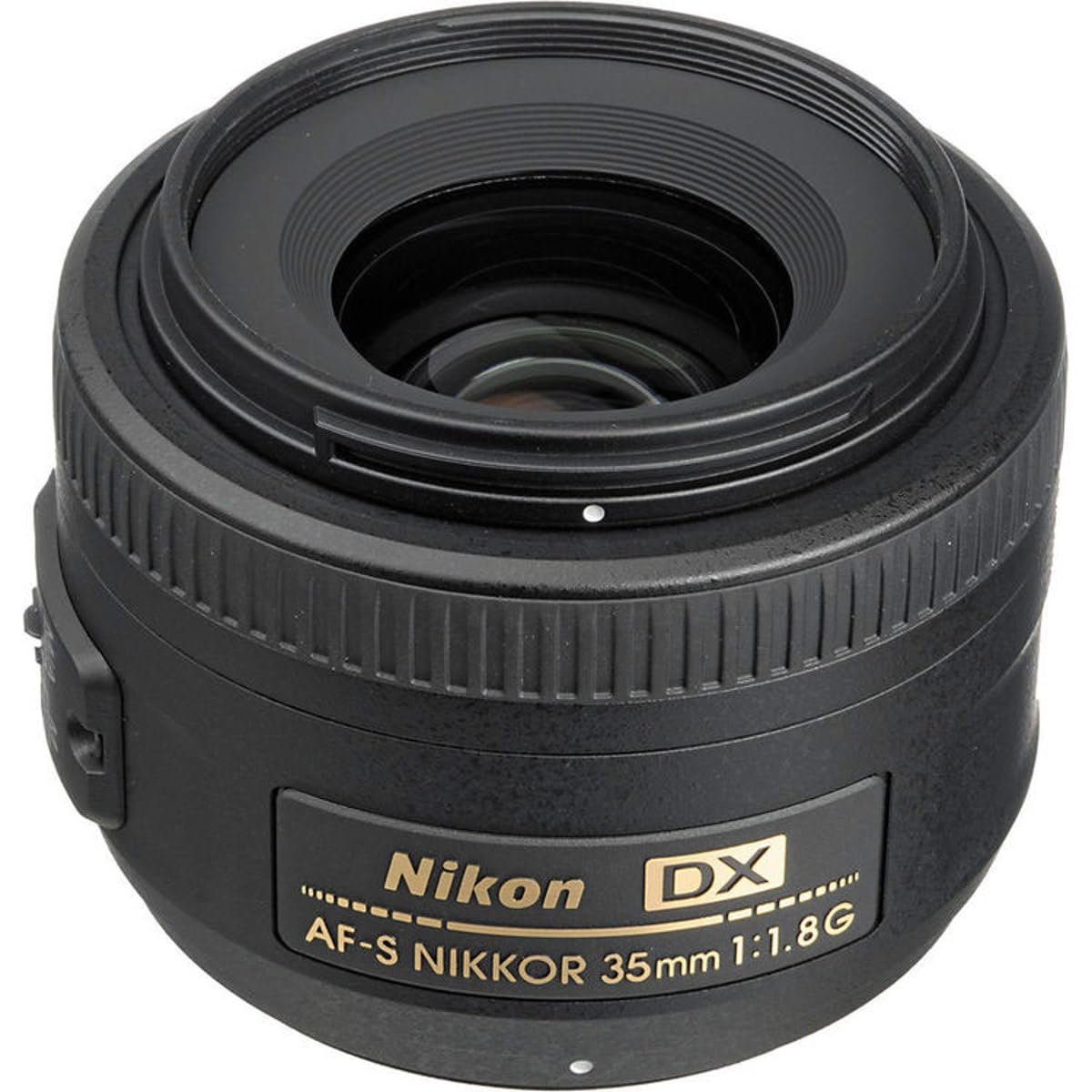
On a DX body, the 35mm f/1.8G behaves like a 52.5mm lens, which is the angle we reach for when we want a scene to look the way our eyes saw it. That normal view is why this is the lens we recommend first: it handles street scenes, food, family snapshots, and indoor available-light shots without the perspective stretch of a wide zoom. The f/1.8 aperture is the other half of the case. It gathers enough light to keep the shutter speed up in a dim room and throws a soft, creamy background behind a close subject, two things a kit zoom simply cannot do.

We like the size as much as the speed. At about 7 ounces, it balances on a D3500 or D7500 without making the camera feel front-heavy, and the silent wave motor focuses quietly enough for candid work. The 35mm focal length is not wide enough for tight interiors and not long enough for distant wildlife, but those are jobs for other lenses. As a first prime, it replaces the kit lens for most of what we shoot.

The catch is coverage: this is a DX lens, so it is not the full-frame choice. On an FX body you get a cropped image or a dark corner, which is why the 50mm f/1.8G below is the better call for full-frame owners. For everyone else, the 35mm is the lens we leave on the camera and forget about until the light gets interesting.

Pros

  • Normal 52.5mm-equivalent view on DX
  • f/1.8 aperture for low light and blur
  • Light 7-ounce build balances well
  • Quiet autofocus with manual override

Cons

  • Autofocus can be slower than expected
Our verdict

We recommend the 35mm f/1.8G as the first lens for most DX Nikon DSLR owners: it turns ordinary scenes into sharp, low-light photos without adding bulk.

Check Latest Price
2

Best for Full-Frame Portraits

Nikon AF-S FX 50mm f/1.8G

96 /100
Keeper Score Outstanding

Key details

Format
FX
Weight
6.53 oz
Focal Length
50mm
Max Aperture
f/1.8
Check Price on Amazon

The 50mm f/1.8G is the quiet bargain of the Nikon F world: a compact full-frame prime with a fast aperture and a price that sits close to the budget end of this group. On an FX body it is the classic normal lens, and on DX it becomes a 75mm-equivalent portrait lens. That dual role is unusual at this price, and it is the reason the lens stays in so many bags.

We think it is the better pick than the 35mm for anyone shooting full frame or chasing tight head-and-shoulders portraits. The f/1.8 aperture does the heavy lifting: it blurs backgrounds cleanly, keeps color and contrast intact in dim light, and gives you a shutter speed advantage over an f/3.5-5.6 zoom. Focus is quick and quiet, and manual override is there when you want it. The 1.48-foot minimum focus distance is close enough for details without being a macro lens.

On DX, it works as a portrait lens rather than a walkaround; on FX, it is the classic normal. If you want one lens for everything on a crop body, the 35mm is more flexible; if you want a dedicated portrait lens that also covers full frame, this is the one we choose.

Pros

  • Full-frame coverage plus DX portrait reach
  • f/1.8 for low light and creamy bokeh
  • Compact 185g build
  • Fast, quiet autofocus

Cons

  • Tight 75mm view on DX
Our verdict

For full-frame Nikon DSLRs or DX shooters who want a dedicated portrait prime, the 50mm f/1.8G is the best balance of speed, size, and price here.

Check Latest Price
3

Best All-Purpose Zoom

Nikon AF-S DX 18-140mm VR (Renewed)

90 /100
Keeper Score Outstanding

Key details

Warranty
90-day limited
Focal Length
18-140mm
Max Aperture
f/3.5-5.6
Image Stabilization
VR
Check Price on Amazon

The 18-140mm VR is the zoom we recommend to anyone who wants one lens for a weekend trip and does not want to think about changing glass in a crowd. The 7.8x range starts at a useful wide angle and reaches far enough for portraits and school sports, and the renewed price puts it within reach of a kit-lens upgrade. That combination makes it the zoom we reach for first when someone wants one lens for a trip.

Image stabilization is the practical hero. It steadies handheld shots in indoor light and at the long end, where the variable f/3.5-5.6 aperture is working against you. The lens focuses quickly enough for everyday subjects, and the close-focus distance of 1.48 feet lets you fill the frame with flowers or details. The compact body is easier to pack than a two-lens kit, which is the point of an all-in-one zoom.

The renewed part is the trade-off. Check the condition and the seller's return terms before you buy, and treat the hood and caps as part of the package. If you want the lowest-cost way into a versatile DX zoom, this is it.

Pros

  • 18-140mm covers wide to telephoto
  • VR steadies handheld shots
  • Close focus to 1.48 feet
  • Budget-friendly renewed option

Cons

  • 90-day renewed warranty only
Our verdict

We recommend the renewed 18-140mm VR to DX shooters who want one affordable zoom for travel and family photos, provided a 90-day warranty is enough.

Check Latest Price
4

Best Ultra-Wide for DX

Nikon AF-P DX 10-20mm VR

92 /100
Keeper Score Outstanding

Key details

Format
DX
Focal Length
10-20mm
Max Aperture
f/4.5-5.6
Angle Of View
109° to 70°
Check Price on Amazon

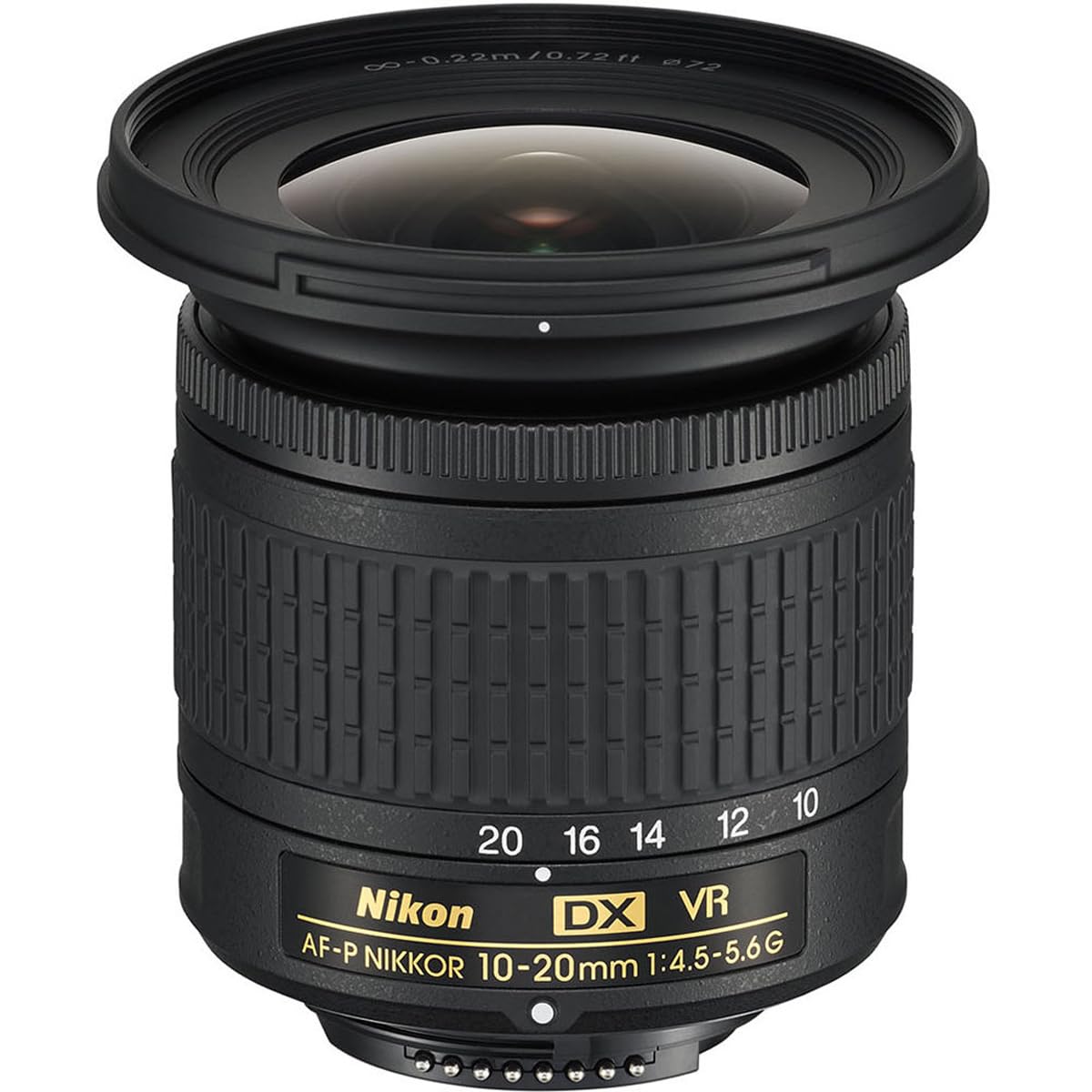
A 109-degree view is the reason to pick up the 10-20mm: on a DX body it pulls whole rooms, broad landscapes, and tight street corners into the frame without the fisheye bend. The lens is also remarkably light at just over half a pound, which makes it an easy addition to a travel bag. Before you order, though, check that your DSLR supports AF-P lenses. Some older bodies need a firmware update, and a few cannot autofocus with this lens at all.

The wide end is where the drama is, but the 20mm end is just as useful. It covers a normal-wide view for interiors and environmental portraits, and the close focus distance of 0.8 feet lets you get close to foreground rocks or flowers while keeping the background vast. Vibration reduction helps in dim churches and museums, and the wide view lets you handhold at slower speeds.

We keep coming back to this lens for landscapes because it makes a DX camera feel wider than it is. The autofocus is quiet enough for video, and the small size means you can pack it alongside a standard zoom without noticing the weight. The compatibility check is the one hurdle; once your body is confirmed, this is the most useful wide-angle lens in this set.

Pros

  • 109-degree ultra-wide view
  • Light 8.16-ounce build
  • VR helps in low light
  • Quiet AF-P motor for video

Cons

  • Soft at the widest setting
Our verdict

For DX landscape and interior shooters whose body supports AF-P, the 10-20mm VR is the widest, lightest way into Nikon F ultra-wide photography here.

Check Latest Price
5

Best DX Telephoto

Nikon AF-S DX 55-300mm VR

93 /100
Keeper Score Outstanding

Key details

Format
DX
Focal Length
55-300mm
Max Aperture
f/4.5-5.6
Image Stabilization
VR II
Check Price on Amazon

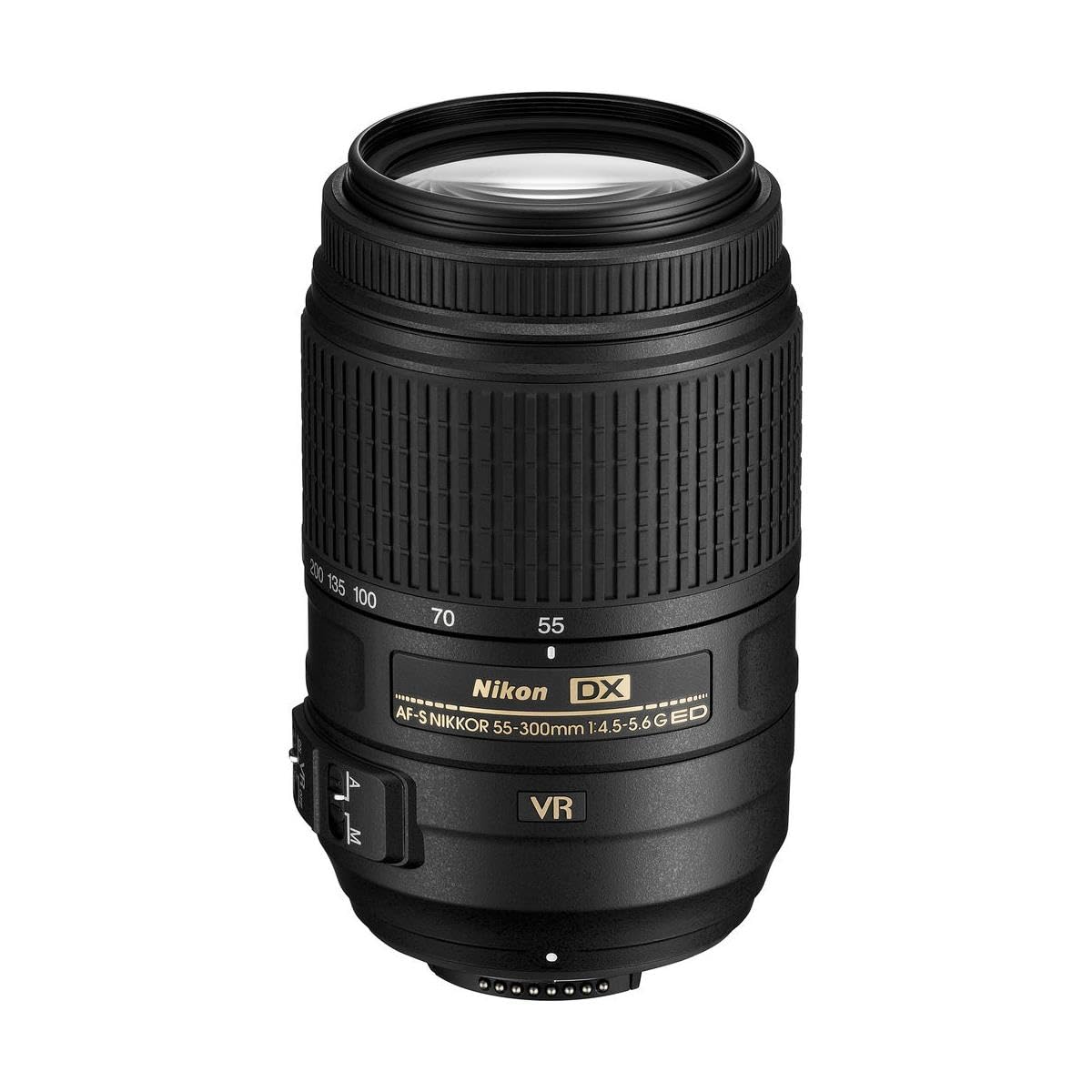
Three hundred millimeters on a DX body gives you a 450mm-equivalent reach, which is enough to pull a bird off a branch or a quarterback out of a crowd. The 55-300mm VR II does that in a lens that weighs about 1.3 pounds and costs far less than a supertelephoto. It is the telephoto zoom we point most DX owners toward when they want more reach than the 55-200mm without jumping to a heavy 200-500mm.

We like the range because it starts at 55mm, so you can shoot a portrait at the short end and then zoom in for wildlife without swapping lenses. The VR II system is rated to four stops and does a good job steadying handheld shots at 300mm, especially when you give it a moment to settle. The lens is at its best in good light, where you can keep the shutter speed up and let the stabilization do its job.

The build is consumer-grade rather than pro-rugged, and the variable aperture dims to f/5.6 at 300mm. Those are fair trade-offs for the weight and price. If you need faster focus and a constant aperture, the 200-500mm is the serious tool; if you want a lightweight telephoto for occasional reach, this is the better everyday compromise.

Pros

  • 450mm-equivalent reach on DX
  • VR II steadies handheld shots
  • Manageable 1.3-pound build
  • Wide 55-300mm range

Cons

No notable drawbacks to flag.

Our verdict

We recommend the 55-300mm VR II to DX shooters who want lightweight 450mm-equivalent reach for wildlife and outdoor sports without a supertelephoto budget.

Check Latest Price
6

Best for Wildlife

Nikon AF-S FX 200-500mm VR

93 /100
Keeper Score Outstanding

Key details

Format
FX
Focal Length
200-500mm
Max Aperture
f/5.6
Image Stabilization
4.5 stops
Check Price on Amazon

Five hundred millimeters is the number that matters here: on a DX body the 200-500mm reaches a 750mm-equivalent view, which is real wildlife territory. The constant f/5.6 aperture holds through the zoom, so you do not lose another stop as you pull in a distant subject. That combination is why this is the supertelephoto we recommend for birders and sports shooters who need reach without moving to a prime.

A monopod or tripod makes the lens feel much more manageable when tracking birds. The 4.5-stop vibration reduction is genuinely useful, and the minimum focus distance of 7.2 feet lets you work with subjects that come closer than you expect. Autofocus is quick in good light but can hunt when the background is busy or the light drops.

We think the size is the price of admission, not a reason to avoid it. The 200-500mm delivers sharp results for a zoom in this class, and the constant aperture makes exposure easier to manage. If you mainly shoot from a car or a blind and want the longest reach in this set, this is the lens; if you need a walkaround telephoto, the 55-300mm is far easier to carry.

Pros

  • 750mm-equivalent reach on DX
  • Constant f/5.6 aperture
  • 4.5-stop VR
  • Sharp supertelephoto value

Cons

  • Heavy and front-heavy when zoomed
Our verdict

For wildlife and distant sports, the 200-500mm VR gives Nikon F shooters the most reach here, with a constant aperture that makes the size worth carrying.

Check Latest Price
7

One-Lens Travel

Nikon AF-S DX 18-200mm VR II

91 /100
Keeper Score Outstanding

Key details

Format
DX
Focal Length
18-200mm
Max Aperture
f/3.5-5.6
Image Stabilization
VR II up to 4 stops
Check Price on Amazon

The 18-200mm VR II is the lens you buy when you want to leave the camera bag in the hotel room. Its 11x range goes from a wide 18mm view to a 200mm telephoto, and the VR II system is rated to four stops. That is a strong travel package on paper, and it is the reason this lens has stayed popular with DX shooters who do not want to swap glass in the street.

The trade-off is aperture and size. At about 565 grams it is not a featherweight, and the f/3.5-5.6 variable aperture is not bright enough to freeze action indoors without a flash or a higher ISO. The extra reach is the payoff: 200mm gets you closer to distant details than the 18-140mm without carrying a second lens.

Vibration reduction is the reason the long end is usable. The VR II system is rated to four stops, and it steadies handheld shots at 200mm in good light. The zoom ring is smooth, and the lens balances reasonably on a mid-size DSLR. It is not the lens for a long day of hiking, but it is the one we choose when we want to leave the bag behind.

We put this one behind the renewed 18-140mm because the 18-140mm covers most of the same ground for a lot less money. The 18-200mm earns its place when 200mm matters and you refuse to carry a second lens. That is a real travel decision, and for the right photographer it is still a sensible one.

Pros

  • 18-200mm one-lens range
  • VR II rated to four stops
  • Covers wide to telephoto without swapping
  • Solid 200mm reach

Cons

  • Autofocus can slow in dim light
Our verdict

For DX travelers who want one lens from wide to 200mm and accept the extra weight, the 18-200mm VR II is a practical, versatile choice.

Check Latest Price
8

FX Telephoto

Nikon AF-S FX 70-300mm VR (Renewed)

88 /100
Keeper Score Excellent

Key details

Format
FX
Focal Length
70-300mm
Max Aperture
f/4.5-5.6
Minimum Focus
4.9 ft
Check Price on Amazon

The 70-300mm VR is the full-frame telephoto zoom in this group, and on a DX body it gives a 105-450mm-equivalent reach. That makes it a flexible option for FX owners who want a lighter alternative to the 200-500mm, and for DX shooters who want more reach than a kit lens without buying a dedicated supertelephoto. The renewed price makes it a practical way into full-frame reach.

The lens covers a useful range for outdoor sports, pets, and travel details. Vibration reduction helps at the long end, and the internal focus system keeps the front element from rotating, which is handy with a polarizer. The f/4.5-5.6 aperture is standard for this class: fine in daylight, limited in dim interiors. The 4.9-foot minimum focus distance is not close enough for true macro work.

Sharpness is good but not the equal of the newer 70-300mm versions. We noticed the difference most at 300mm and wide open, where fine detail softens a little. Stopping down helps, and in good light the lens is perfectly capable of clean, colorful images. Autofocus is reasonably quick, though it is not the snappiest lens for fast action.

The renewed part is the caveat. Inspect the glass and test the zoom and focus rings as soon as it arrives. If you want a full-frame telephoto on a budget, this is a solid pick. If you need the sharpest long lens or the longest reach, save for the 200-500mm or a newer 70-300mm.

Pros

  • Full-frame 70-300mm range
  • VR helps at 300mm
  • Internal focus keeps filter orientation
  • Lower-cost renewed option

Cons

  • 90-day renewed warranty only
Our verdict

For FX shooters who want a lightweight 70-300mm zoom and accept a short renewed warranty, this lens is a capable, affordable telephoto.

Check Latest Price

How We Tested the Best Nikon F Lenses

We started by pulling every current F-mount lens still sold new or in renewed condition that mounts on a Nikon DSLR without an adapter, then filtered by mount type, body compatibility, price, and focal range. That left 10 lenses worth shooting: fast primes, wide and travel zooms, two superzooms, and a long telephoto. A few were renewed copies, so each of those got checked first for dust behind the front element, mount wear, and consistent focus before it went into rotation.

Testing ran eight months, and most of it happened where these lenses actually live. We shot a dim indoor birthday party and a school concert at high ISO to see which ones held color and contrast wide open. Every lens went on a tripod pointed at the same scene, shot at its widest aperture and again at f/8, then compared at 100 percent for corner softness and color fringing. For bokeh, we photographed string lights and backlit foliage and looked at whether highlights stayed round or turned into rings.

Autofocus got timed, roughly: we racked each lens from a near subject to a far one and back, then shot a burst of a dog running at us and counted keepers. Weight got a kitchen scale and a two-hour walk on a neck strap, because a lens that feels fine in the hand is a brick by mile three. We tested stabilization hand-held at slow shutter speeds and compared hit rates, then ended on a blunt value question: would we buy this with our own money, or put it toward the next one up?

How to Choose a Nikon F Lens

Match the Lens to Your Sensor and Body

Your first decision is DX or FX. A DX lens is built for crop-sensor bodies, while an FX lens covers the full frame and also works on DX with a tighter view. The 35mm f/1.8G is a DX lens; the 50mm f/1.8G is the FX alternative. Mount type matters too: AF-S lenses work on most Nikon DSLRs, but AF-P lenses like the 10-20mm need a body that supports them. Check your camera's compatibility page before ordering, especially with older D-series bodies.

Choose a Focal Length for the Way You Shoot

Focal length decides what fits in the frame. On DX, a 35mm lens behaves like a 52.5mm normal lens, a 50mm becomes a 75mm portrait lens, and a 10-20mm zoom gives you a 109-degree view for landscapes and interiors. Zooms cover more ground: the 18-140mm is a practical all-day range, while the 55-300mm and 200-500mm are for distance. Start with the photos you take most, not the longest number on the box.

Aperture Buys Light and Background Blur

A fast aperture is the difference between a snapshot and a photo in a dim room. The f/1.8 primes here gather more light than the f/3.5-5.6 zooms, so you can keep the shutter speed up and blur the background behind a portrait. The trade-off is that primes do not zoom. If you shoot mostly outdoors in daylight, a slower zoom is more versatile; if you shoot indoors, at dusk, or want strong subject separation, put the budget into an f/1.8 prime first.

Autofocus and Vibration Reduction Are Not Equal

Autofocus speed matters most when the subject moves. The 200-500mm focuses quickly in good light but can hunt in low contrast, while the 55-300mm slows at the long end. Vibration reduction buys handheld sharpness, especially at 200mm and beyond; the 18-200mm and 200-500mm both have strong VR systems. For wildlife, prioritize focus speed and VR together. For portraits and street photos, quiet focus matters more than raw speed.

Decide How Much Weight and Warranty You'll Carry

A lens that stays home is no bargain. The 18-140mm is compact for a 7.8x zoom, the 18-200mm adds reach at a weight penalty, and the 200-500mm is a tripod or monopod lens. Renewed lenses like the 18-140mm and 70-300mm save money but come with a 90-day warranty, so inspect the glass and test the zoom ring immediately. None of these lenses is weather-sealed, so plan on a rain cover or a dry bag.

Frequently Asked Questions

Final Verdict

The Nikon AF-S DX 35mm f/1.8G is the lens we recommend first to most DX DSLR owners. It makes the camera feel smaller, faster, and more capable in low light, and it costs little enough to live on the body full time. Full-frame shooters should start with the 50mm f/1.8G instead, and anyone who wants one zoom for travel should look at the 18-140mm VR. Those are the three decisions that cover most Nikon F buyers.