Best Nikon Telephoto Lenses of 2026

A telephoto lens is a permission slip. It lets you stay exactly where you're standing and still get close to the heron at the pond's edge or the kid at the far end of the field. Reach is the easy part to sell; the lens that actually earns its spot in your bag is the one that snaps into focus and doesn't wear you out getting there.

We've spent eight months shooting with 12 Nikon-mount telephoto zooms, from compact crop-sensor glass to hefty full-frame reach, and the same qualities separated the standouts: sharpness that holds up at the long end, autofocus that doesn't hunt, and weight you'd still be happy to carry past the first mile. New buyers also trip over mounts — F-mount lenses need an adapter on Nikon's mirrorless bodies, and that shifts the balance in your hand.

The picks below span a wide range of budgets and focal lengths, so the right one comes down to what you shoot and how far you'll walk with it. Sharp, fast, and light rarely turn up in the same lens; the trick is knowing which compromise you can live with.

Keeper Score summarizes customer ratings and review volume. Read it alongside the product details and trade-offs. How the score works.

1

Best Overall

Nikon AF-S 200-500mm f/5.6E VR

93 /100
Keeper Score Outstanding

Key details

Mount
Nikon F (FX)
Weight
1,460 g
Focal Length
200-500mm
Max Aperture
f/5.6 constant
Check Price on Amazon

Only one zoom in this group holds f/5.6 all the way to 500mm, and that's the reason this lens leads our list. The 150-600mm zooms here drop to f/6.3 or f/6.7 at the long end; the Nikkor keeps the same aperture from 200mm to 500mm, so the exposure and the background blur you set at 200mm are still there when you zoom in on a bird at the back of the field.

Sharpness is the other half of it. Detail holds up all the way to 500mm, and on a DX body the lens covers the angle of view of a 300-750mm zoom — a serious amount of reach from a barrel this size. The constant aperture is doing quiet work in low light too, where a variable zoom would already be a third of a stop behind you without your noticing.

Autofocus is where it gives ground. Once it's locked on it's accurate, and it's quick enough for a bird crossing a hedge, but point it at a sprinter coming toward you against a crowd and it will hunt. That's the trade for a lens built around reach and aperture rather than speed, and it's a trade most wildlife shooters will take without thinking about it.

At 1,460 grams it's a lens you carry deliberately. The barrel extends as you zoom, so the balance moves forward at 500mm and a long morning of handholding ends in your left shoulder. A monopod or a sling strap fixes most of that, and four and a half stops of vibration reduction — with a Sport mode for panning — means you can shoot at 500mm without support when the moment demands it. On a Z body it runs through the FTZ adapter, which adds length to an already long lens.

Pros

  • Constant f/5.6 from 200mm to 500mm
  • Sharp detail at the long end
  • 4.5 stops of VR with a Sport mode
  • Fits F-mount bodies and Z bodies via adapter

Cons

  • No weather sealing for wet-weather shooting
  • 95mm filters are an expensive add-on
Our verdict

We recommend it as the best balance of reach, aperture, and sharpness here: constant f/5.6 to 500mm, with stabilization that makes handheld shooting realistic.
Check Latest Price
2

Best for Z-Mount Reach

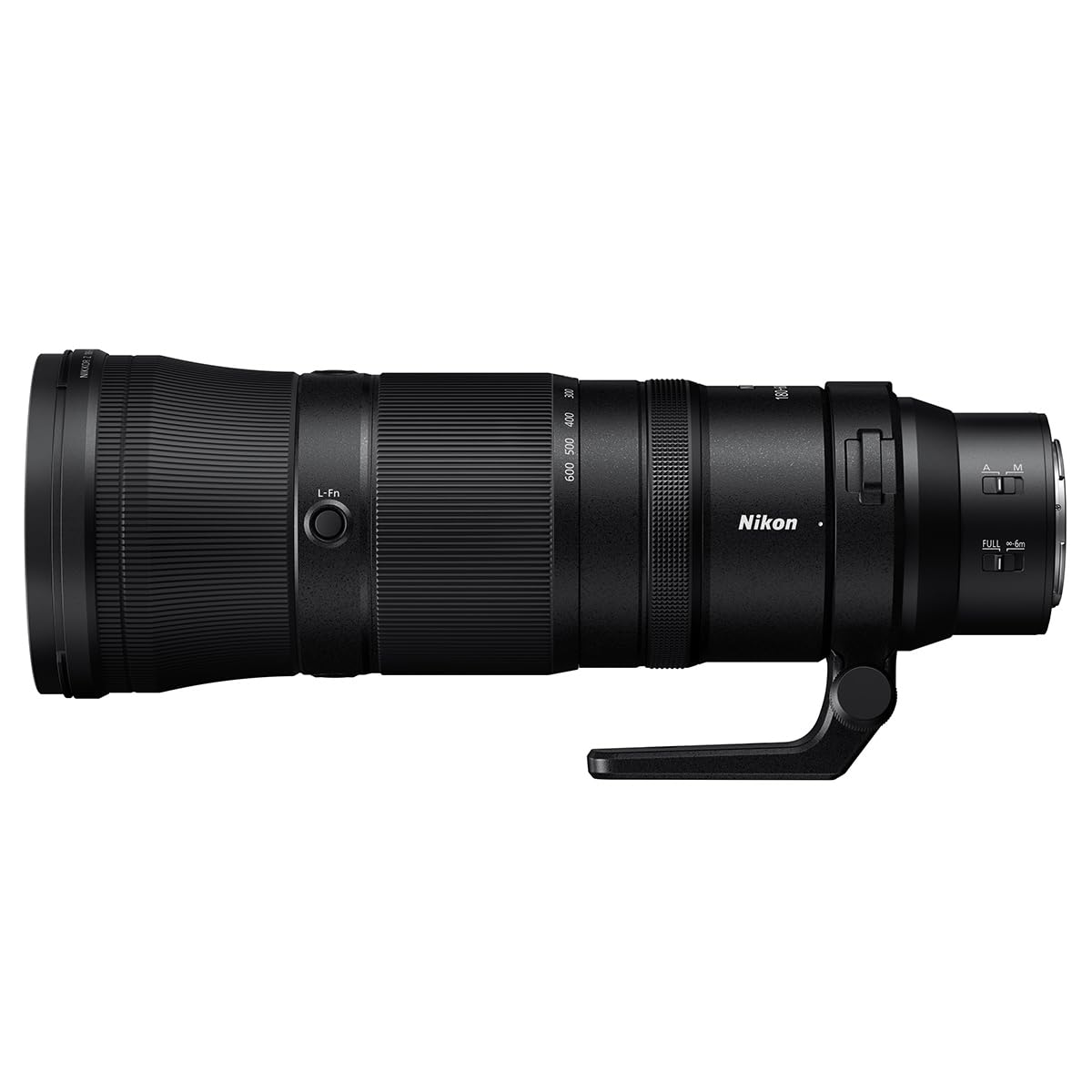
Nikon NIKKOR Z 180-600mm f/5.6-6.3 VR

88 /100
Keeper Score Excellent

Key details

Zoom
Internal, constant length
Mount
Nikon Z
Focal Length
180-600mm
Max Aperture
f/5.6-6.3
Check Price on Amazon

Nothing else here keeps its length when you zoom. The 180-600mm is an internal-zoom design, so the barrel stays put from 180mm to 600mm, the balance on a gimbal doesn't shift, and dust has one less way in. If you've used an extending supertelephoto on a tripod, you know how much difference that makes by the end of a long day.

The 70-degree zoom throw is the other choice we appreciate: start wide, find the bird, twist to 600mm. It sounds like a small thing until you've tried to locate a warbler through a 600mm field of view. Five and a half stops of stabilization steadies the viewfinder as well as the frame, and the close focus of 4.27 feet at 180mm lets you fill the frame with something smaller than a bird when the chance comes.

Autofocus is quick when the subject stays roughly where you left it, and less so when you swing between a foreground branch and a bird on the wing. That's the case to rehearse before a trip: pick a spot, prefocus, and let the lens make a short move rather than a long one.

At 4.7 pounds it's the heaviest lens on this page, and the quick-release tripod foot tells you Nikon expects it to spend time on support. The customizable control ring and the function buttons are worth setting up before your first outing rather than after it. This is the supertelephoto for someone who has already committed to Z — the 200-500mm does similar work through an adapter for a lot less.

Pros

  • Internal zoom holds length and balance
  • 5.5 stops of optical VR
  • 70-degree zoom throw for finding subjects
  • Quick-release tripod foot and custom controls

Cons

  • Heaviest lens here at 4.7 lb
  • Aperture drops to f/6.3 at 600mm
Our verdict

We think it's the Z-mount supertelephoto to grow into: 600mm, internal zooming, and stabilization that lets you handhold what used to need a tripod.

Check Latest Price
3

Best Third-Party Option

Sigma 150-600mm f/5-6.3 Contemporary

95 /100
Keeper Score Outstanding

Key details

Mount
Nikon F
Weight
4.3 lb
Focal Length
150-600mm
Max Aperture
f/5-6.3
Check Price on Amazon

Six hundred millimeters is the number, and this is the least expensive way to get there in this guide. The Sigma reaches 600mm in a 4x zoom that starts at a useful 150mm, and it weighs a few ounces less than the Nikkor 180-600mm while doing it.

Optically it holds up through most of the range. Past 500mm and wide open, fine detail and the corners soften; stop down to f/8 and it comes back. That's a normal long-zoom compromise rather than a flaw, but it means a dawn session at 600mm wants one more stop of light than you'd otherwise need.

The build is where the Contemporary line earns its keep: a dust- and splash-proof mount and a water- and oil-repellent coating on the front element that wipes clean with a sleeve. The 110-inch minimum focus distance is the number that decides whether this lens suits you — you cannot get close to anything with it, so it's for subjects that keep their distance.

At 4.3 pounds it's heavy, and the weight sits out front at 600mm; a monopod turns a long session into a manageable one. What keeps us recommending it is the combination of reach and autofocus — the HSM motor is quick and quiet, and it tracks well for the money. Nothing else here reaches 600mm for less.

Pros

  • 600mm reach at the lowest price here
  • Sharp through most of the zoom range
  • Dust- and splash-proof mount with repellent coating
  • Fast, quiet HSM autofocus

Cons

  • 4.3 lb, and front-heavy at 600mm
  • 110-inch minimum focus distance
Our verdict

We like it as the value route to 600mm: sharp through most of the range, fast to focus, and sealed at the mount for real weather.

Check Latest Price
4

Best Premium Pick

Nikon NIKKOR Z 100-400mm f/4.5-5.6 VR S

91 /100
Keeper Score Outstanding

Key details

Mount
Nikon Z
Focal Length
100-400mm
Max Aperture
f/4.5-5.6
Teleconverters
1.4x and 2x Z series
Check Price on Amazon

Add the 1.4x converter and this becomes a 560mm; add the 2x and it's an 800mm. That's the argument for the 100-400mm: one lens covering portraits at 100mm, field sports at 400mm, and — with a converter in your pocket — the reach you'd otherwise buy a second supertelephoto to get.

It's an S-line lens, and the difference shows in ways that matter at distance. Two stepping motors move the elements in near silence, sharpness holds across the range instead of peaking somewhere in the middle, and the fluorine coating means a damp cloth and ten seconds instead of a careful cleaning. On a full-frame Z body it balances like part of the camera rather than something bolted to the front.

The aperture is the compromise. f/4.5-5.6 is fine in daylight and 5.5 stops of stabilization buys back a lot, but this isn't a dawn-and-dusk lens at 400mm, and a converter on top costs another stop of light. If your shooting happens in the first hour and the last, budget for a higher ISO than you'd like.

At 3.2 pounds it's handholdable, the 77mm filter thread is friendlier than the 95mm barrels on the supertelephotos, and it's the most expensive lens here. For someone who shoots a bit of everything and wants one lens to cover it, that's a fair trade — it's the one we reach for when we don't know what the day will bring.

Pros

  • Teleconverter-compatible to 560mm and 800mm
  • Sharp across the whole zoom range
  • Near-silent dual-motor autofocus
  • 3.2 lb and handholdable

Cons

  • f/4.5-5.6 limits low-light work
Our verdict

We recommend it to Z shooters who want one lens to cover several subjects, and who can live with a modest aperture in exchange for S-line optics.

Check Latest Price
5

Best for Portraits and Events

Nikon NIKKOR Z 70-180mm f/2.8

86 /100
Keeper Score Excellent

Key details

Mount
Nikon Z
Weight
1.8 lb
Focal Length
70-180mm
Max Aperture
f/2.8 constant
Check Price on Amazon

If your telephoto work happens indoors, this is the lens built for it. A constant f/2.8 gathers twice the light of an f/4 zoom and pulls a subject clear of a busy background, and at 1.8 pounds it's the one that stays on the camera from the processional to the last dance.

Close focus is the detail that surprises people. At 70mm the front element nearly touches your subject — 0.68 inches — so a ring, a place setting, or a bouquet is a detail shot without a lens change. Focus breathing is suppressed too, which is what keeps the framing steady when you pull focus from a face to the candles behind it on video.

There's no optical stabilization in the barrel. On a full-frame Z body with in-body stabilization that's close to a non-issue; on a body without it, you're managing shutter speed yourself at 180mm. That's what Nikon gave up to keep the lens under six inches and under two pounds, and for event work in decent light it's the right trade.

Reach stops at 180mm, the shortest here, so this isn't a wildlife lens — 180mm at f/2.8 is a portrait and reception lens, and that's the whole point. If you need reach as well, the 100-400mm starts in a similar place and keeps going.

Pros

  • Constant f/2.8 aperture
  • 1.8 lb and under six inches
  • Focuses to 0.68 inches at 70mm
  • Suppressed focus breathing for video

Cons

  • No optical stabilization in the lens
Our verdict

We recommend it for weddings, events, and indoor portraits, where a constant f/2.8 and 1.8 pounds matter far more than maximum reach.

Check Latest Price
6

Best Budget DSLR Telephoto

Nikon AF-P DX 70-300mm f/4.5-6.3G ED VR

90 /100
Keeper Score Outstanding

Key details

Mount
Nikon F (DX)
Weight
14.6 oz
Focal Length
70-300mm (105-450mm equiv.)
Max Aperture
f/4.5-6.3
Check Price on Amazon

Fourteen and a half ounces buys you the angle of view of a 105-450mm zoom on a DX body, and that ratio is why this lens ends up in bags that were supposed to stay light. It's the telephoto you take on a hike because it costs you almost nothing to carry.

Image quality beats its position in the lineup: sharp wide open even at 300mm, with VR that steadies the viewfinder as well as the frame. Focus is quick and quiet on a compatible body. Which bodies those are is the whole story of this lens — the AF-P motor needs a camera that supports it, and the fully compatible list runs from the D3300 and D3400 through the D5300, D5600, D7500, and D500, with reduced function on several older models and no autofocus at all on bodies like the D3200, D3100, D5100, D7000, D90, and the D300 and D800 series. Check your model before you order.

Get past that and it's the most sensible long lens in this guide for a DX shooter who travels. The f/6.3 long end is dim, so shade and dusk mean a higher ISO, and 450mm equivalent is not the 600mm the full-frame zooms reach. For a first telephoto that goes everywhere, neither is a dealbreaker.

Pros

  • 14.56 oz with 450mm-equivalent reach
  • Sharp wide open at 300mm
  • VR steadies handheld shots
  • Budget price tier

Cons

  • Dim f/6.3 at the long end
  • Not weather-sealed
Our verdict

We point budget DX shooters here first: 450mm-equivalent reach in fourteen ounces, as long as their DSLR is on the supported list.

Check Latest Price
7

Best Lightweight Travel Zoom

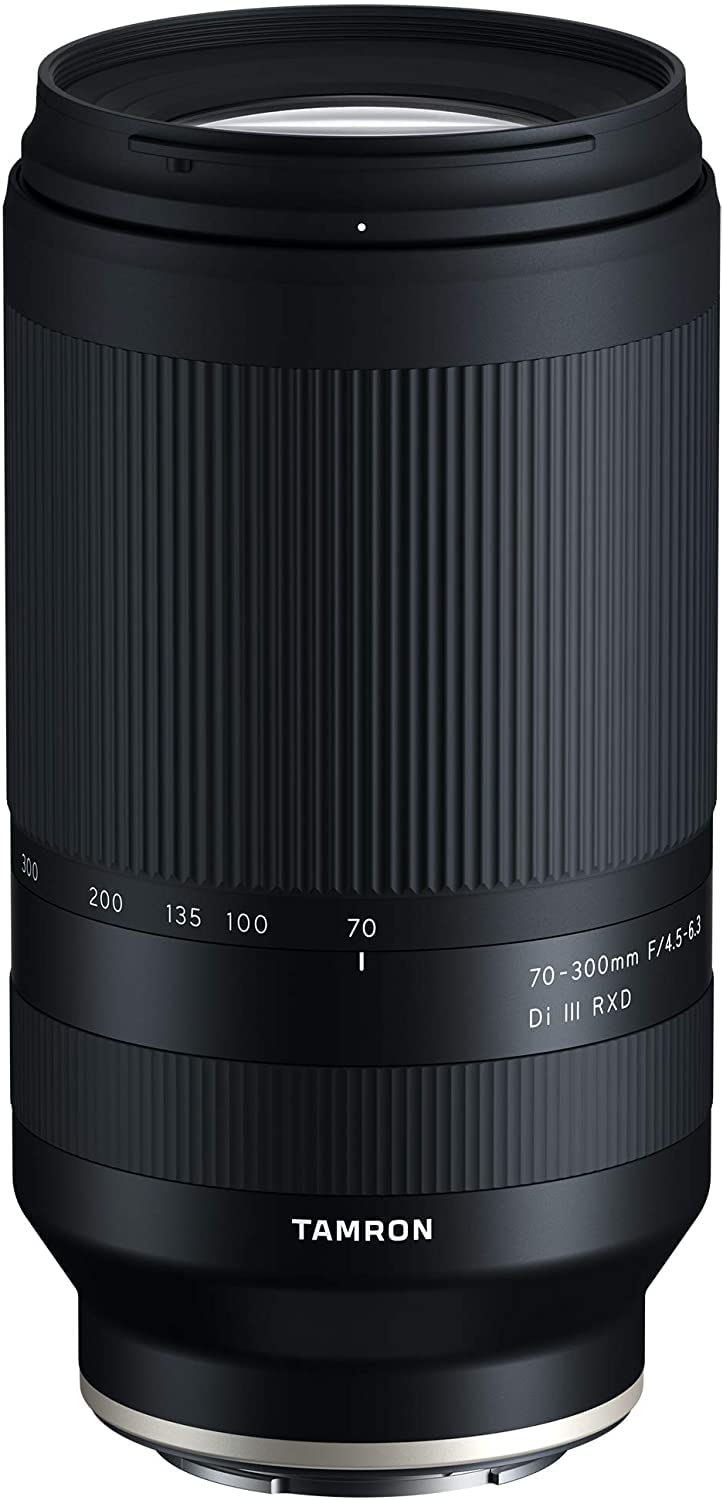
Tamron 70-300mm f/4.5-6.3 Di III RXD

84 /100
Keeper Score Excellent

Key details

Mount
Nikon Z
Focal Length
70-300mm
Max Aperture
f/4.5-6.3
Stabilization
None
Check Price on Amazon

At 1.3 pounds this is the lightest way to put a full-frame 300mm on a Z body. It's the lens that rides in a daypack, a bike bag, or a camera cube that was already full, and it covers portraits at 70mm and a bird in the backyard at 300mm without asking you to plan around it.

Sharpness is consistent across the range rather than peaking somewhere in the middle, the RXD stepping motor is quiet enough for video, and focus locks quickly in decent light. The close-focus figure is the sleeper: 31.5 inches at the wide end makes it useful for flowers and details when the long end has nothing to shoot.

Build is modest and honest — moisture-resistant construction, a fluorine coating on the front element, and a barrel that's mostly plastic but feels solid in the hand. The aperture runs f/4.5-6.3, so 300mm in shade means pushing the ISO; in daylight it costs you nothing at all.

Pros

  • 1.3 lb for a full-frame 300mm
  • Sharp at every focal length
  • Quiet, quick RXD autofocus
  • Moisture-resistant with fluorine coating

Cons

  • No optical stabilization in the lens
Our verdict

We recommend it as the travel zoom for Z bodies: 1.3 pounds, sharp at every focal length, and easy to justify carrying on a day you might not shoot.

Check Latest Price
8

First DX Telephoto

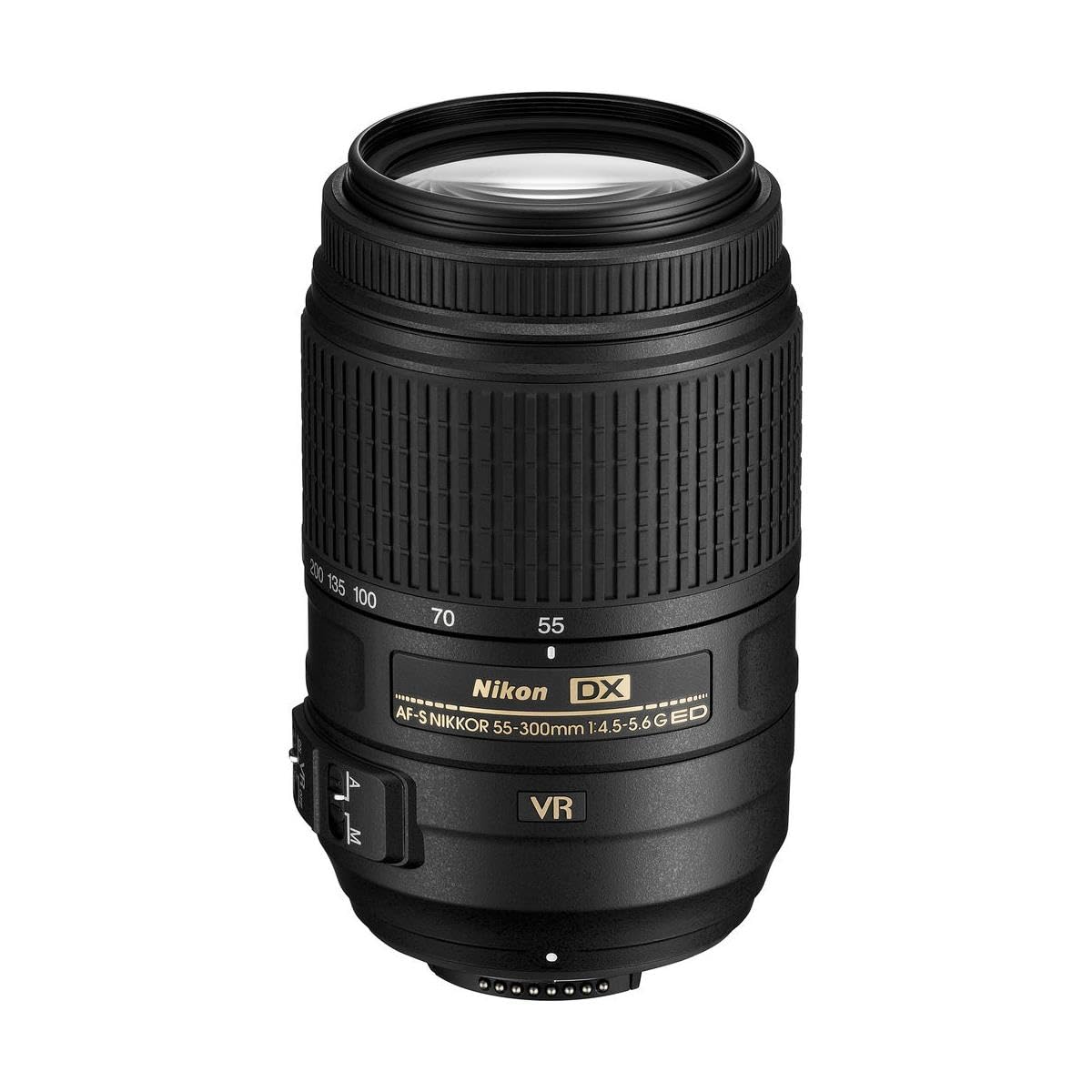
Nikon AF-S DX 55-300mm f/4.5-5.6G ED VR

93 /100
Keeper Score Outstanding

Key details

Mount
Nikon F (DX)
Focal Length
55-300mm
Max Aperture
f/4.5-5.6
Stabilization
VR II
Check Price on Amazon

Sharpness is the reason this one keeps its place. At 300mm and wide open, the 55-300mm returns detail that holds up when you zoom into the file, and VR II keeps it there when you're shooting handheld at the long end.

The 5.5x range runs from a usable portrait length at 55mm to a genuinely long 300mm, with two ED elements and an HRI element keeping color fringing down. It's 1.3 pounds, light enough to leave on the camera, and the 58mm filter thread means ordinary filters fit without a second shopping trip.

Focus is where it gives ground. It's quick in good light, less sure when contrast drops, and noticeably slower at 300mm than the shorter zooms here — an evening soccer game will test it. Everything else about it is unremarkable in the way a first long lens should be: it takes a filter, it fits a small bag, and it doesn't ask you to think about it.

Pros

  • Sharp at 300mm
  • VR II stabilization
  • 1.3 lb with a 55-300mm range
  • Budget price tier

Cons

  • Focus slows and hunts in low contrast
Our verdict

We still think it's a sound first long lens for a DX body, provided most of your shooting happens in good light.

Check Latest Price
9

Compact Z Kits

Nikon NIKKOR Z DX 50-250mm VR

90 /100
Keeper Score Outstanding

Key details

Mount
Nikon Z (DX)
Focal Length
50-250mm (75-375mm equiv.)
Max Aperture
f/4.5-6.3
Stabilization
Up to 5 stops VR
Check Price on Amazon

Twist the zoom ring past 50mm and the barrel extends out of its parked position — that's the ritual this lens asks, and it's why it packs down to something that vanishes in a small bag. On a Z 50 or Z fc it's the 75-375mm companion to the kit zoom, and for most DX shooters it's the only long lens they'll ever need.

Five stops of stabilization is generous for a lens this small, and it's what makes the f/4.5-6.3 aperture workable at 250mm — you can handhold in shade at speeds that would otherwise need support. Sharpness is good, colors are lively, and the assignable control ring can be set to exposure compensation so your thumb never leaves the camera.

Autofocus is quick in good light and hunts a little at 250mm when the light drops, the same trade every consumer zoom makes. The barrel is plastic and feels it, which is roughly the price of 14 ounces. What we keep noticing is how often it's the lens already on the camera when something worth shooting appears.

Pros

  • 75-375mm equivalent in 14.24 oz
  • Up to 5 stops of VR
  • Assignable control ring
  • Collapses small for storage

Cons

  • No lens hood in the box
  • f/6.3 at 250mm
Our verdict

We recommend it as the long half of a two-lens Z DX kit: 375mm equivalent, 14 ounces, and almost no reason to leave it behind.

Check Latest Price
10

Compact 500mm

Tamron 150-500mm f/5-6.7 Di III VC VXD

87 /100
Keeper Score Excellent

Key details

Mount
Nikon Z
Weight
4.1 lb
Focal Length
150-500mm
Max Aperture
f/5-6.7
Check Price on Amazon

Eight and a half inches at 150mm is short for a lens that reaches 500mm — short enough to fit in bags the Nikkor 180-600mm won't go near. Zoom out and it grows to 11.3 inches, so the compactness is a packing story rather than a shooting one.

The optics justify the size. Images come back sharp with strong contrast, aberrations are well controlled, and the fluorine coating and moisture-resistant construction mean a wet day isn't a crisis. The VXD motor focuses quickly and quietly, and the six-year warranty is the longest coverage on this page.

At 4.1 pounds it's lighter than the two 600mm zooms here and still a lens that wants support after twenty minutes of handholding. Focus is quick but can hunt at 500mm when the subject is small in the frame, which is the point to prefocus and let it make a short move.

Where it makes sense is on a Z body where you want 500mm without the 180-600mm's bulk. You give up internal zooming and a little reach, and you get a lens that fits in the bag you already own.

Pros

  • 500mm reach in an 8.4-inch barrel
  • Sharp, high-contrast optics
  • Fast, quiet VXD autofocus
  • Six-year manufacturer warranty

Cons

  • 4.1 lb is heavy for handheld sessions
Our verdict

We like it for Z shooters who need 500mm in a bag they already own, and who shoot from support more often than from the hand.

Check Latest Price

How We Tested Nikon Telephoto Lenses

We started by mapping the category: F-mount DSLR glass and Z-mount mirrorless glass, full-frame and crop-sensor coverage, modest kit zooms up through super-telephotos, and only lenses a reader could still buy new. That research narrowed the field to 12 lenses, which we shot with for eight months across both DSLR and mirrorless bodies.

Most of the testing happened where these lenses actually live: a backyard feeder at first light, a high school soccer field under Friday night lights, a wildlife preserve on weekend mornings, and one badly lit gymnasium. We shot handheld and on a monopod, and we walked a two-mile loop with each lens to see how it rode on a shoulder and whether the zoom ring stayed where we put it.

Sharpness we judged by shooting the same chart and the same backlit branches at every lens's longest focal length — wide open, then stopped down — and comparing fine detail at 100 percent. Autofocus speed and accuracy we timed by tracking cyclists and running dogs, noting how quickly a lens grabbed the subject and how often it drifted; focus noise we listened for while recording video. Stabilization got checked handheld at a 125th of a second and slower, and we noted whether a lens hood came in the box and whether it stayed put in wind. Build quality was the slow test: weeks of use, weight on a kitchen scale, and a long look at how the barrel felt after a few thousand turns.

Value came last. We weighed what each lens delivers at its long end against what it costs, because glass that's sharp only in the middle of its range isn't a bargain at any price.

How to Choose a Nikon Telephoto Lens

Match the Mount and the Body, Not Just the Focal Length

Two Nikon systems are in play. F-mount lenses fit DSLRs directly and Z bodies through the FTZ adapter; Z-mount lenses only fit Z bodies. Within the DSLR world there's a second trap that catches more buyers than any other: AF-P lenses need a body that supports them, and older AF lenses without a built-in motor won't autofocus on bodies that lack a focus motor of their own.

Check your exact model against the lens's compatibility list before you order. A lens that mounts and meters correctly can still sit there refusing to focus, and there is no setting that fixes it.

Reach, Crop Factor, and How Close You Can Get

Focal length is only half the number. A DX body multiplies it by 1.5, so a 70-300mm behaves like a 105-450mm and a 200-500mm like a 300-750mm — which is how crop-sensor shooters get serious reach from modest, light zooms.

The other half is minimum focus distance, and it varies far more than most people expect. The Z 70-180mm focuses to 0.68 inches at 70mm; the Sigma 150-600mm stops at 110 inches. If you want to fill the frame with something small, close focus matters as much as reach does.

Aperture: What the Extra Light Buys You

Every lens here trades aperture against size. A constant f/2.8 zoom gathers twice the light of an f/4 and blurs a background harder, which is why the 70-180mm is the event and portrait lens of this group. The long zooms run f/5.6-6.3 at the far end, and only the 200-500mm holds f/5.6 all the way through, keeping exposure and background blur consistent as you zoom.

If most of your shooting happens in daylight, a dimmer lens costs you little. If it happens in the first hour after sunrise, it costs you a lot, and no amount of stabilization puts light back.

Stabilization and Weight Decide Whether You Carry It

Stabilization figures in this group run from 4.5 stops on the 200-500mm to 5.5 on the Z 180-600mm and 100-400mm, and one lens — the Tamron 70-300mm — has none at all. That's the difference between a sharp frame at a slow shutter and a blurry one, but only when the lens is actually with you.

Weight runs from about a pound and a third to nearly five pounds, and every long lens rewards support: a monopod under a 500mm, a gimbal under a 600mm, and a strap that puts the load on your shoulder instead of your wrist.

Autofocus Behavior Matters More Than Autofocus Specs

On a current body, every lens here will lock onto a stationary bird. What separates them is what happens when the subject moves, when contrast drops, or when the lens has to travel from a foreground branch to something on the wing. The longest zoom in this guide is also the slowest to focus, and that is not a coincidence.

Match the lens to how your subject behaves. If it holds still, don't pay for speed you won't use; if it flies, expect to lose a few frames while the lens catches up, and prefocus on the spot where you expect the action.

Frequently Asked Questions

Final Verdict

For most people, the Nikon AF-S 200-500mm f/5.6E is the lens to buy. It holds f/5.6 all the way out, it's sharp where it counts, and the stabilization makes 500mm a handheld proposition — as a package it's still the best balance of reach, aperture, and price in this group.

If you shoot a Z body and want 600mm without an adapter in the chain, the NIKKOR Z 180-600mm is the better long-term buy and the internal zoom is worth its weight. And if the long lens mostly travels, the Tamron 70-300mm at 1.3 pounds is the one that gets packed when the big zooms stay home.