Best Monoculars of 2026

For years my birding bag held a pair of binoculars I loved and almost never carried. The day I swapped them for a monocular that slid into a jacket pocket, I stopped leaving optics at home. One tube instead of two did most of what I needed, and it was easy to pass to a kid or a friend for a quick look.

Since then I've put 12 monoculars through six months of real use: the feeders behind my house, a hawk-watch ridge during fall migration, two minor-league ballgames, and hikes where pack weight matters. The surprise was that magnification, the number everyone shops by, is the one most likely to disappoint — past a certain point you're only magnifying hand shake and heat haze. What separated the keepers was clear glass, a focus wheel that turns smoothly without slop, a body small enough to forget in a jacket pocket, and a price that matches how often you'll actually reach for it. The ones below are the ones I kept reaching for.

Keeper Score summarizes customer ratings and review volume. Read it alongside the product details and trade-offs. How the score works.

1

Best Overall

Vortex Solo 10x25

88 /100
Keeper Score Excellent

Key details

Weight
5.6 oz
Magnification
10x
Objective Lens
25 mm
Weather Sealing
Nitrogen purged, waterproof and fogproof
Check Price on Amazon

Five and a half ounces is the number that settles it. The Solo is 4.4 inches long, so it drops into a jacket pocket beside a phone and stops being something you have to plan around before a walk. The rubber armor gives you a grip when your hands are cold and wet, and the eyecup twists up if you are wearing glasses.

An unlimited, unconditional, transferable lifetime warranty is what tips it for us. Optics this small get knocked against fence posts and truck doors, and knowing Vortex will repair or replace the thing, loss and theft aside, takes the anxiety out of carrying it. Fully multi-coated glass, nitrogen purging, and O-ring seals mean rain and fog are not a reason to leave it home.

The 25 mm objective is the honest limit. Behind 10x it leaves a 2.5 mm exit pupil: crisp and bright at noon, grey by the time the light starts going, where the Bushnell below is still showing color. Focusing takes two hands at first, since the ring is stiff out of the box and eases with use, so plan to brace the tube and turn with the other hand until it does.

What it does better than anything else here is disappear. On a bird walk, a hike, or a ballgame we never thought about the weight, and the soft case clips to a belt so it is not loose in a bag. The eyecup has enough travel for sunglasses too, which most pocket optics this size do not manage.

Pros

  • 5.6-ounce body vanishes into a pocket
  • Transferable lifetime warranty, no questions asked
  • Nitrogen purged, waterproof and fogproof
  • Adjustable eyecup works with glasses

Cons

  • Dim view once the light fades
Our verdict

We point anyone who wants one optic they will actually carry, for birds, travel, and the trail, at the Solo: light, sealed, and covered for life.
Check Latest Price
2

Best for Low Light

Bushnell Legend 10x42

91 /100
Keeper Score Outstanding

Key details

Exit Pupil
4.2 millimeters
Field Of View
340 feet
Magnification
10x
Objective Lens
42 mm
Check Price on Amazon

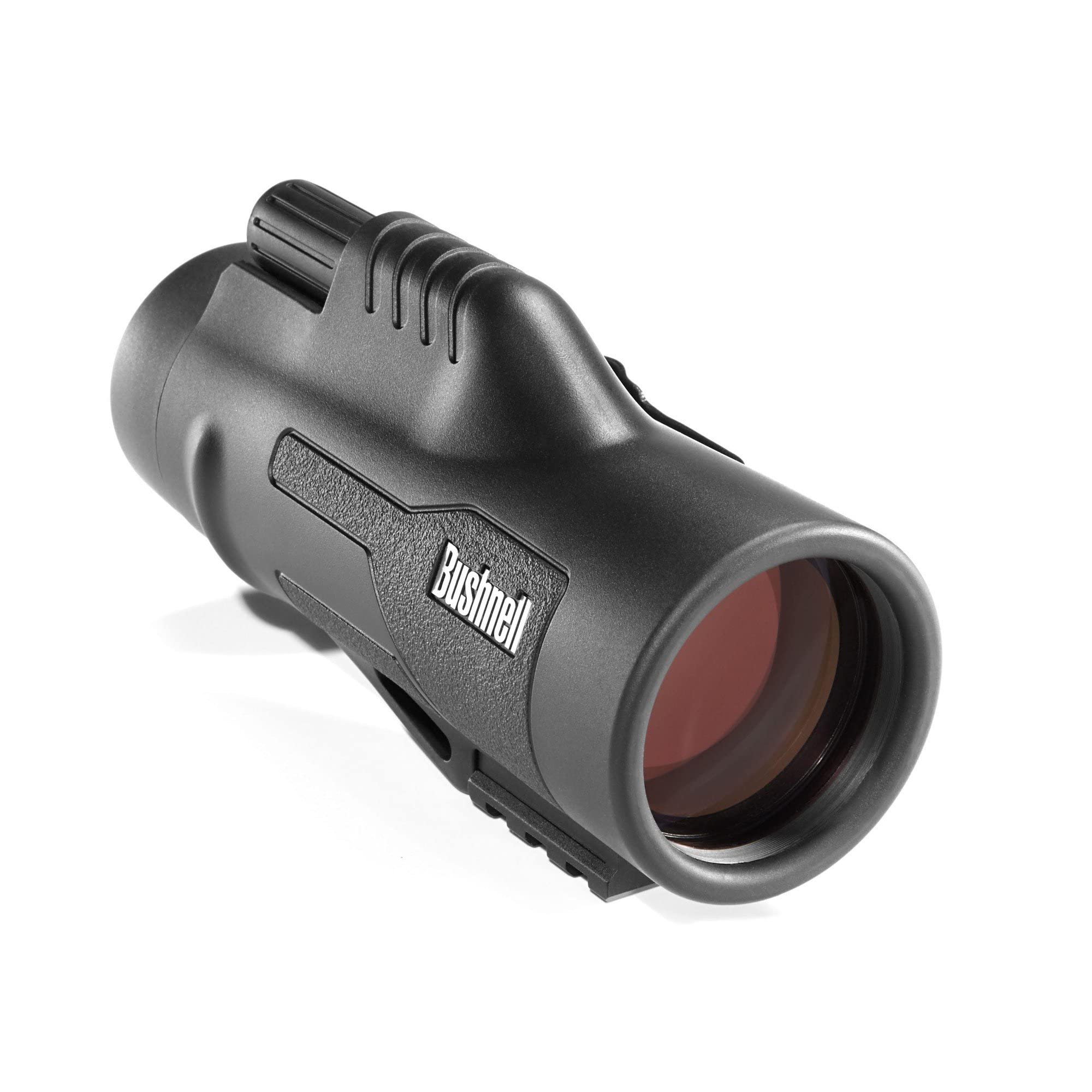
The gap between this and a pocket 10x25 shows up in the last twenty minutes of daylight. A 42 mm objective behind 10x leaves a 4.2 mm exit pupil, so the image keeps its color while smaller optics have gone muddy, which is why this is the one we hand someone heading out before sunrise or sitting under a treeline. ED Prime glass and ultra wide band coating keep the colors honest, and the resolution is the best in this group.

It is a full-size instrument at 374 g, rubber armored and O-ring sealed, with a tripod mount underneath and a focus knob smooth enough to turn with one hand while you keep watching. The 340 ft field of view is generous, and it makes picking a bird out of branches far less of a hunt than it is with the 12x and 16x picks here.

Weight and price are what you pay for the view. At 374 g it rides on a strap or in a pack pocket rather than a shirt pocket, and it sits in the top price tier here. Glass from a truck window, a blind, or a ridge, though, and neither of those registers as a hardship.

Pros

  • Bright 4.2 mm exit pupil for low light
  • One-hand focus knob stays smooth
  • Wide field of view for a 10x optic
  • Waterproof, armored, and tripod-mountable

Cons

  • Heaviest optic in this group
  • Sits in the top price tier
Our verdict

When the light is low or the distance is long, nothing else here matches the Legend's view, and the weight and price are the honest cost of it.

Check Latest Price
3

Best with a Phone Adapter

Pankoo 12x60

88 /100
Keeper Score Excellent

Key details

In The Box
Smartphone adapter and tripod
Field Of View
325 ft/1000 yards
Magnification
12x
Objective Lens
60 mm
Check Price on Amazon

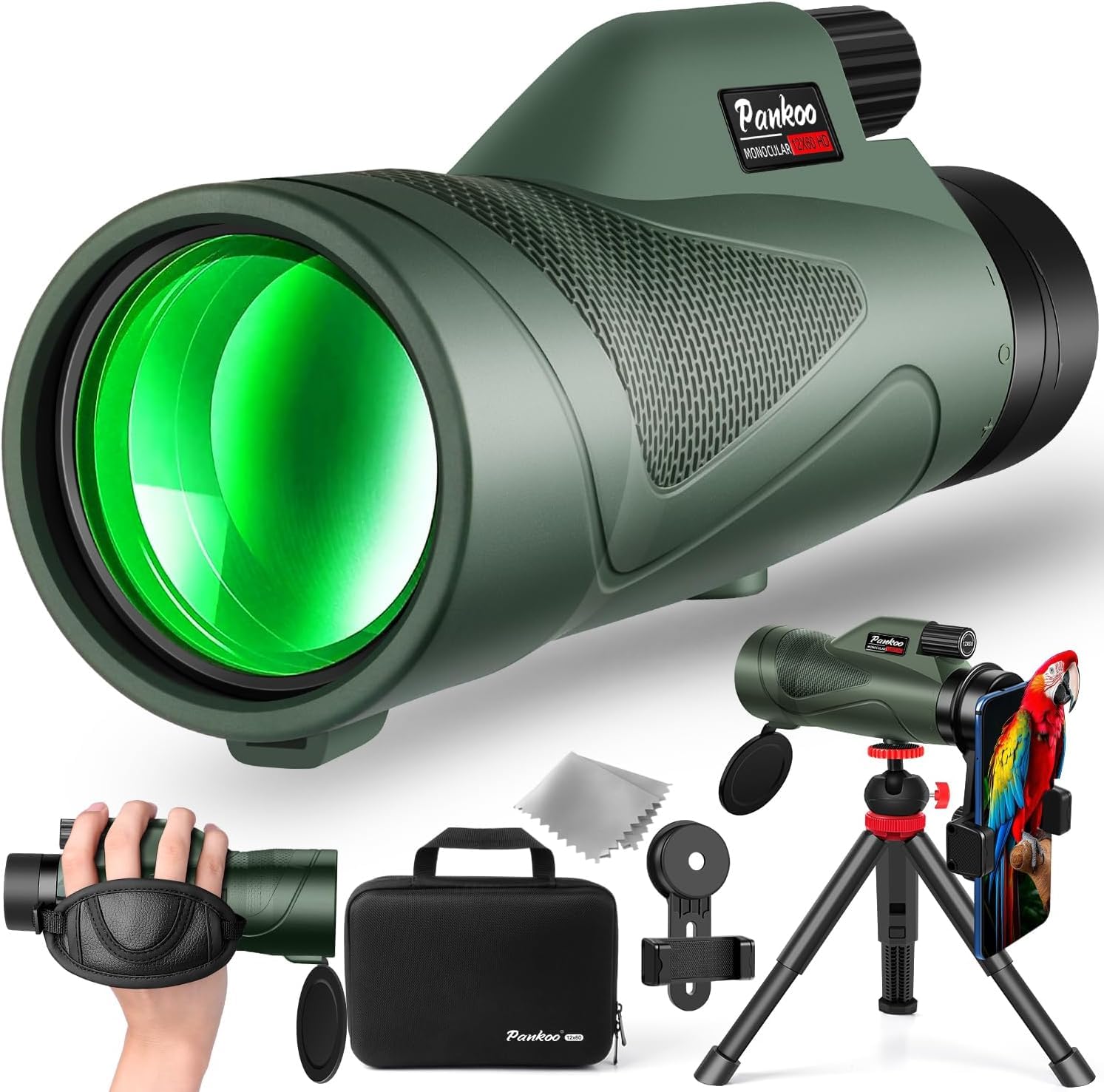
A phone holder and a small tripod come in the box, and that is the pitch: clamp your phone to the eyepiece and the screen becomes a 12x viewfinder. It is a much better way to show someone the deer at the far end of the field than passing the optic back and forth, and it is how we got the steadiest look out of this one.

The optics justify the tripod. A 60 mm objective behind 12x gives a 4.17 mm exit pupil, bright for this magnification, and the 325 ft field of view at 1,000 yards is generous enough to find a subject before you look closer at it. The body is nitrogen-filled and waterproof, and the BAK4 prism and fully multi-coated glass hold up in flat winter light.

Treat the bundled tripod as a starter piece. It is the flimsiest thing in the box, and a sturdier one turns this into a proper long-range viewer for a fence line or a feeder. At 14 ounces it is a pack item, not a pocket one. For backyard wildlife, range spotting, and beach watching, that is a fair trade.

Pros

  • Phone adapter and tripod included
  • Bright 4.17 mm exit pupil from a 60 mm lens
  • Wide 325 ft field of view at 12x
  • Waterproof, nitrogen-filled body

Cons

  • Fourteen ounces means a pack, not a pocket
Our verdict

If you want to look at things through your phone screen, the adapter and tripod make this the easiest start in digiscoping, and the 12x view is bright enough to be worth sharing.

Check Latest Price
4

Best Budget Pick

Feemic 8x42

89 /100
Keeper Score Excellent

Key details

Weight
10.1 oz
Exit Pupil
5.25 millimeters
Magnification
8x
Objective Lens
42 mm
Check Price on Amazon

This is the cheapest route here to a 42 mm objective, and the payoff is a 5.25 mm exit pupil, the brightest view in the budget half of this list. Eight power is also the steadiest thing you can hand someone: hand shake costs you more detail than a couple of extra power ever gains, especially on a trail with a daypack on.

The build is more than the price suggests. It is nitrogen-filled and sealed against water, fog, and dust, with BAK4 prisms, fully multi-coated glass, twist-up eyecups, and a 285 g body that fits a jacket pocket or a glovebox. One-handed viewing is genuinely comfortable, and we found that matters when the other hand is holding a leash.

Two things keep it from going higher up this list. Detail softens at long range next to the pricier picks, and the fabric pouch is a tight squeeze when you are packing up in a hurry. There is no warranty attached, either, which is part of how it reaches this price. As a first monocular, a spare for the car, or an optic for a kid old enough to be careful, none of that is disqualifying.

Pros

  • Bright 5.25 mm exit pupil at a low price
  • Waterproof, fogproof, and shockproof
  • 285 g and comfortable in one hand

Cons

  • Softer detail at long range
  • Fabric pouch is a tight fit
Our verdict

Our budget answer: a bright, steady 8x42 that is easy to hold and easy to afford, as long as you do not expect premium glass or a warranty behind it.

Check Latest Price
5

Best for Glasses Wearers

Nocs Zoom Tube 8x32

90 /100
Keeper Score Outstanding

Key details

Weight
9.5 oz
Magnification
8x
Objective Lens
32 mm
Water Resistance
IPX4
Check Price on Amazon

Three positions on the twist-up eyecup is one more than most, and it is the reason this is the one we suggest to anyone who keeps their glasses on outdoors. Set it right and you get the full field without pressing the tube into your lenses; set it down and the view is comfortable bare-eyed.

It is also the best-looking monocular here, and we do not think that is trivial. Gear that is pleasant to pick up gets carried more, and the Zoom Tube's chunky, modern shape is the sort of thing that ends up on a shelf by the door rather than in a drawer. Underneath are fully multi-coated optics, a central focus wheel, IPX4 sealing, and 9.5 ounces of body.

Same money as the Solo, and a different bargain. The 32 mm objective gives a 4 mm exit pupil, so the image is brighter and easier to look through for long stretches; the trade is 4 ounces and IPX4 sealing instead of a nitrogen purge. Rain and snow are fine. A dunking is not.

Where it lands against the Solo is close. You gain a brighter, more forgiving view and lose pocket weight and a lifetime no-fault warranty, and for glasses wearers who want one optic for walks and travel, that is the trade we take.

Pros

  • Three-position eyecup suits glasses
  • Bright 4 mm exit pupil from a 32 mm lens
  • 9.5 ounces with a central focus wheel

Cons

  • IPX4 only, so rain-resistant not submersible
Our verdict

The Zoom Tube is the pick for glasses wearers: three eyecup positions, a bright 32 mm view, and a body pleasant enough that you will actually carry it.

Check Latest Price
6

Wet Weather

Nocs Field Tube 10x32

86 /100
Keeper Score Excellent

Key details

Exit Pupil
3.28 millimeters
Magnification
10x
Waterproofing
IPX7
Objective Lens
32 mm
Check Price on Amazon

IPX7 is the number that separates this one from everything else here: it is rated to sit in three feet of water for half an hour. For kayakers, duck hunters, and anyone whose optic rides on the outside of a pack through a wet week, that is a different class of reassurance than the rain resistance on the Zoom Tube.

We reach for it for exactly that reason. Ten power behind a 32 mm objective gives a 3.28 mm exit pupil, bright enough for daytime work though not the glass you want at last light, and the three-position eyecup and center focus make it quick to get on a moving subject. At 8.09 ounces with a no-matter-what lifetime warranty, it is the most liveable rugged option on this list.

The money is what you notice. This sits in the top price tier here, and you are paying for sealing and coverage rather than for a view that beats a 42 mm objective. On a wet boat or in a salt marsh that is a sensible place to put your budget; on a dry hillside it is not.

Pros

  • IPX7, submersible to three feet
  • No-matter-what lifetime warranty
  • 8.09 ounces with a three-position eyecup

Cons

  • Premium price behind a small 32 mm lens
Our verdict

The one to buy if your optic gets wet: IPX7 sealing and a no-matter-what lifetime warranty make the Field Tube worth its premium.

Check Latest Price
7

Long-Range Scanning

Pankoo 16x52

87 /100
Keeper Score Excellent

Key details

Exit Pupil
3.25 millimeters
Field Of View
5.8 degrees
Magnification
16x
Objective Lens
52 mm
Check Price on Amazon

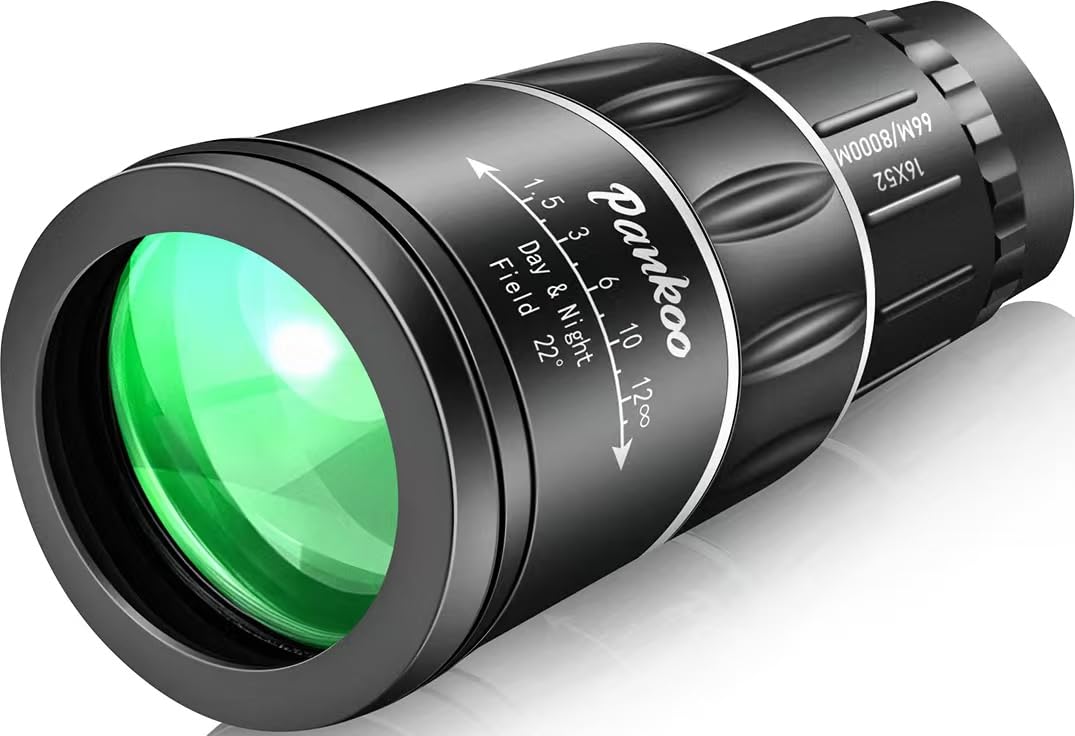
Sixteen power in a 52 mm tube gives you a lot of reach for very little money, and it is the pick for someone who wants to identify a fence line, a shed, or a bird on a far branch from a fixed spot. The catch is arithmetic: 16x behind a 52 mm lens leaves a 3.25 mm exit pupil, so your eye has to line up precisely and the image dims earlier than the view from an 8x or 10x.

The body runs 6.7 inches long and is sealed against water and fog with nitrogen, and the BAK4 prism and fully multi-coated glass are the same recipe the rest of the budget field uses. A hand strap and case come with it, and the 5.8 degree field of view is workable across open ground.

Where it struggles is the freehand look. We kept wanting a rest, a truck window, a fence post, a rolled-up jacket on a rock, and that tells you what kind of optic this is: every wobble is magnified along with the subject. The Feemic 8x42 is the friendlier all-rounder; this one is a distance tool that is easy to keep behind the seat.

Pros

  • 16x reach from a short tube
  • Waterproof and nitrogen-filled
  • Low price tier for the power

Cons

  • Hard to hold steady freehand
  • Small 3.25 mm exit pupil dims early
Our verdict

For long looks across open ground from a rest, the 16x52 gives you reach for very little money; just do not plan on using it freehand.

Check Latest Price
8

Tripod Viewing

PhysioPhyx 80x100

91 /100
Keeper Score Outstanding

Key details

Dimensions
6.9"D x 3.55"W x 3.99"H
In The Box
Monocular, tripod, smartphone adapter, carry bag, cleaning cloth
Magnification
80x
Objective Lens
100 mm
Check Price on Amazon

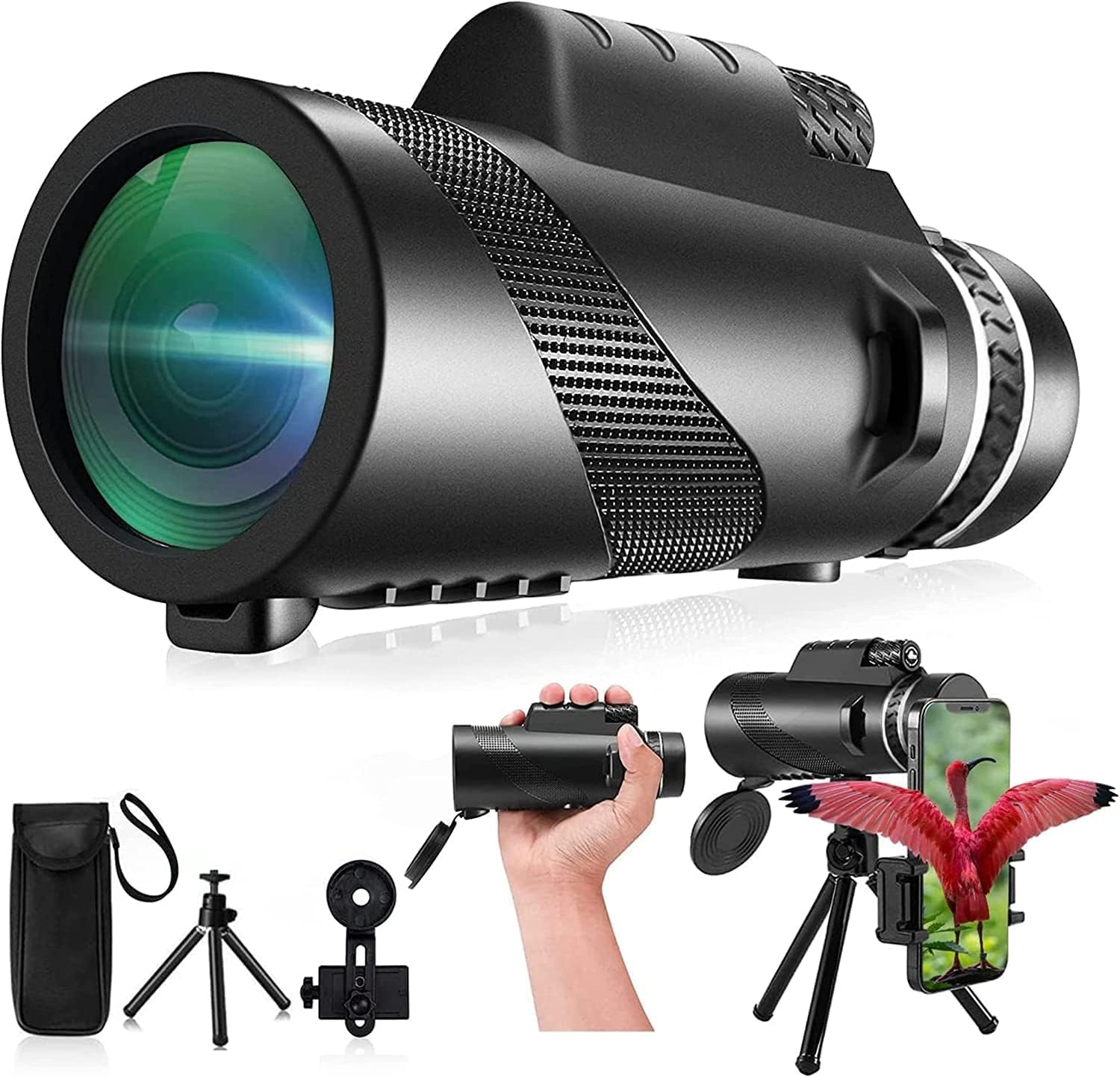
Eighty power is less a specification than a set of instructions: fixed position, tripod, and a subject that holds still. The 100 mm objective and the 6.9-inch body back that up. This is not an optic you pull out on a hike; it is a long-range spotter that happens to look like a monocular.

The kit is generous for the money. A tripod, a smartphone adapter, a bag, and a cleaning cloth come in the box, the body is sealed against moisture, and the eyecup is soft and adjustable. The phone adapter is what makes most sense of the magnification, because at this power you want a screen and you want the tripod holding it.

We are skeptical of what 80x buys in a body this size. Eighty power behind a 100 mm lens works out to about a 1.25 mm exit pupil, which is a dim, exacting view even at midday: your eye has to be perfectly centered, and any shake is magnified along with the subject.

So treat it as a specialty tool for spotting across a field from a fixed spot and for shooting phone photos of whatever you find. For that it is inexpensive and complete. For birding on the move, the small pocket picks here do more with less.

Pros

  • Enormous 80x reach for the money
  • Tripod and phone adapter included
  • Sealed body with adjustable eyecup

Cons

  • Unusable freehand at 80x
  • Dim, exacting 1.25 mm exit pupil
Our verdict

An inexpensive way to get enormous magnification and a phone mount, provided you use the tripod and accept a dim, exacting high-power image.

Check Latest Price

How We Tested 12 Monoculars Over Six Months

The shortlist started at roughly 40 monoculars from brands with service records we trust, and got cut to 12 by comparing magnification against field of view, prism glass, sealing, weight, and price. Anything whose claims looked inflated for the money — enormous magnification in a tiny, feather-light body — came off the list early.

Testing ran six months. Each unit went to the feeders behind the house at first light, up to a hawk-watch ridge during fall migration, to two minor-league ballgames, and into a daypack on weekend hikes; a few lived in a glove box for weeks at a time. We handed every one to someone who had never used a monocular before, and let a 10-year-old try them too, since smaller hands and unfamiliar eyes expose awkward controls fast.

Clarity we judged on feather barring and the lettering of a distant water tower at midday, then again at dusk, when cheap glass goes muddy. Focus got the closest attention: we tracked a moving bird one-handed, turned the wheel in thin gloves, and noted stiffness, backlash, and how close we could get to a butterfly on a coneflower. We timed how long each went from pocket to a sharp image, weighed it with the strap attached, and checked whether it truly disappeared into a jacket pocket. Fogproofing got a cold-car overnight followed by a walk into a warm kitchen; waterproof claims got a rinse under the tap. Phone adapters were clamped on and aimed at a feeder to see whether the image lined up and held. Then we asked the only question that matters: would we carry it again tomorrow?

How to Choose a Monocular

Read the Exit Pupil Before the Magnification

Divide the objective lens by the magnification and you get the exit pupil, the width of the light beam reaching your eye. A 42 mm lens at 8x gives 5.25 mm, which is forgiving: your eye does not have to be perfectly centered and the image stays usable as the light drops. A 25 mm lens at 10x gives 2.5 mm, sharp at noon and fussy by dusk, and an 80x100 works out to about 1.25 mm.

Anything under roughly 3 mm is a bright-daylight instrument. If most of your viewing happens early or late, buy the objective rather than the power; the difference at last light is bigger than the difference in reach.

Field of View Is What Makes Finding Things Easy

Field of view is how much of the world you see at a given distance, and it shrinks as magnification climbs. The Bushnell's 340 feet at 1,000 yards is generous for 10x. The 16x Pankoo lists 5.8 degrees instead, which is workable across open country and awkward in a wood, where you are trying to find a warbler in a canopy through a keyhole.

Wide beats powerful for birds, ballgames, and anything that moves. Power earns its keep when the subject is far, still, and out in the open.

Weight Decides Whether It Comes With You

A 5.6-ounce body 4.4 inches long disappears into a jacket pocket. Eight to 10 ounces is a strap or a small pack pocket. Thirteen or 14 ounces is a carry you plan around. Watch the word compact in a listing, too: it usually means a cargo pocket or a glovebox, and a 6.7-inch tube is not vanishing anywhere.

Measure the pocket you actually intend to use before you choose on size, and remember that the optic in the drawer is the one that never sees anything.

Sealing, Eyecups, and Glasses

Three levels of weather protection turn up here: IPX4, which shrugs off rain and snow; nitrogen purging with O-ring seals, which keeps fog out of the tube when you step from a cold car into a warm room; and IPX7, which survives a dunking. If you view from a boat or in wet weather, that ladder matters.

Glasses wearers should look for a twist-up eyecup with two or three positions and leave it partway up. That keeps your lenses off the glass and gives you the full field instead of a tunnel.

Focus, Warranty, and the Third Year

A center focus wheel is easier to work with one hand than a ring near the eyepiece, and a stiff ring out of the box usually loosens with use. Warranty is the part shoppers skip: the Vortex Solo carries an unlimited, transferable lifetime promise, the Nocs Field Tube a no-matter-what lifetime warranty, and several cheaper picks run 90 days or offer nothing at all.

On an optic that rides in a pack and gets knocked against things, that coverage is worth more than a marginally wider field of view.

Frequently Asked Questions

Final Verdict

The Vortex Solo is the monocular we tell most people to buy. At 5.6 ounces it goes where binoculars do not, the nitrogen-purged body handles weather, and an unlimited lifetime warranty covers the knocks a pocket optic takes. Its one real limitation is light: a 25 mm objective is a daytime tool.

If your viewing happens at dawn or dusk, the Bushnell Legend and its 42 mm objective are worth the extra money and the extra weight. If the budget is tight, the Feemic 8x42 gives you a bright, steady view for less than either.