Best Spotting Scopes of 2026

A spotting scope is a telescope that lives on a tripod, and the magnification printed on it tells you how far the zoom goes, not how good the view is. Push a mediocre one to its top setting and the image softens, color smears at the edges, and you're squinting at a gray blob where a bird should be.

I've carried scopes to hawk watches and shorelines for years, and over the past six months my team and I put eight through that same routine — light tabletop models and big 80mm glass alike. The pattern held: eyepiece and coatings matter more than zoom range, the tripod matters more than either, and a wide field of view at the low end keeps a moving bird in frame while you're still finding it.

Weight and setup count too — a scope you dread carrying stays in the car, and one that ships without a decent tripod costs you a second purchase. Here's where each of the eight landed, from the featherweight pack-along to the one worth leaving by the window.

Keeper Score summarizes customer ratings and review volume. Read it alongside the product details and trade-offs. How the score works.

1

Best Overall

Gosky 20-60x85 Spotting Scope

89 /100
Keeper Score Excellent

Key details

Field Of View
101-48 ft/1,000 yd
Magnification
20-60x
Tripod Height
13.3-63 in
Objective Lens
85mm
Check Price on Amazon

Sixty-three inches is the number that settled this one for us. That is how high the included tripod extends, which puts the eyepiece at standing eye level instead of somewhere near your knees — the difference between glassing for five minutes and glassing for an hour. Most kits in this bracket hand you a stubby tabletop model and let you hunt for a picnic table. We will take the taller tripod over a marginally sharper lens every time, because a scope you do not want to stand behind does not get used.

The 85mm objective is the other half of the argument. Light is what you have least of at dawn and dusk, and this front lens gathers more of it than the 60mm and 65mm scopes in this group. Fully multi-coated glass over a BAK4 prism keeps the image crisp well up the zoom range in daylight; at 60x it softens and dims, which is the trade every zoom eyepiece makes. Treat the top of the range as a way to confirm a detail you already found at 30x.

The kit is usable rather than a box of filler: a phone adapter that clamps over the eyepiece, a carrying bag, a cleaning kit, and that 101-foot field of view at 20x, which makes finding a bird in a hedge far easier than the 64-foot view on our budget pick. The adapter takes a minute to line up, and a large multi-lens phone can sit awkwardly in the clamp, so test the fit at home before you count on it in the field.

Sealed and nitrogen-purged, it shrugs off rain and dust without a second thought. Set against the compact scopes here, it is a big instrument — 17.7 inches of tube that wants a vehicle and a fixed position rather than a daypack. For a birder working a refuge from a levee, or a shooter who drives to the line, that is the right trade to make.

Pros

  • Tripod extends to 63 inches for standing use
  • Wide 101-foot field of view at 20x
  • 85mm objective holds brightness into low light
  • Complete kit: phone adapter, bag, cleaning kit

Cons

  • One-year warranty falls short of the lifetime picks
Our verdict

This is the one we tell most people to buy: a tripod that reaches standing height, an 85mm lens for dawn and dusk, and a wide 101-foot view at 20x that makes finding things easy.
Check Latest Price
2

Best for Beginners

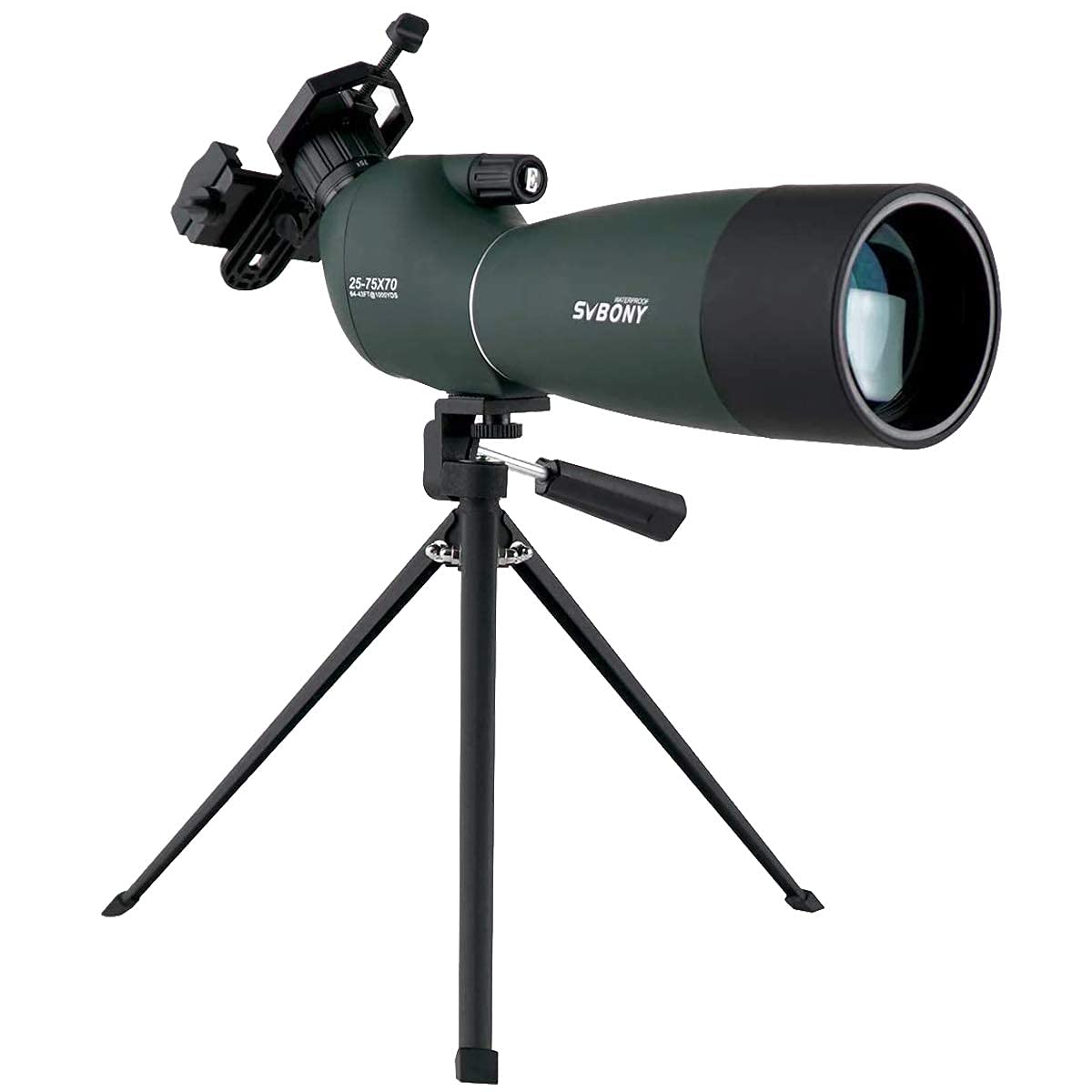
SVBONY SV28 25-75x70

89 /100
Keeper Score Excellent

Key details

Weight
2.01 lb
Eyepiece
45-degree angled
Magnification
25-75x
Objective Lens
70mm
Check Price on Amazon

The least expensive scope in this group, and the one we point a first-time buyer toward. For the outlay you get a 25-75x zoom on a 70mm objective, a 45-degree angled eyepiece, a phone adapter, a carry case, and a tabletop tripod. It is a complete first setup rather than a scope-shaped down payment.

We recommend it to beginners because the parts that matter work. The view is clear and bright from 25x to about 40x, the angled eyepiece lets you sit at a bench and look comfortably down into it rather than craning, and at 910 grams it is light enough to carry all day without thinking about it. Nothing about the body feels brittle in the hand.

What it will not do is compete at long distance: at 200 yards it shows you a bird, not the barring on its flank, and the gap between it and an 80mm scope opens fastest in flat evening light. The bundled tripod is a desktop piece — fine on a shooting bench, no use in a field — and the standard thread underneath means your own tripod takes over in seconds. That is where the money you saved should go.

Pros

  • Clear, bright view between 25x and 40x
  • Angled eyepiece is comfortable at a bench
  • Light enough to carry all day at 910 g

Cons

  • Dim, narrow view past about 50x
  • Phone holder and lens caps feel flimsy
Our verdict

Start here if you are new to glassing: a light, clear 70mm angled zoom that leaves room in the budget for a tripod worth owning.

Check Latest Price
3

Best for Travel

Emarth 20-60x60

89 /100
Keeper Score Excellent

Key details

Tripod
14 in tabletop
Eye Relief
17 mm
Magnification
20-60x
Objective Lens
60mm
Check Price on Amazon

A scope that lives in the truck is a scope you use twice a year. This one weighs about 1.3 pounds, comes with a shoulder-strap bag, and disappears into a daypack next to a water bottle — which is the entire argument for a 60mm body.

What you trade for that is light. Between 20x and 40x the view is clear and easy to point, and the angled eyepiece is comfortable when the scope is sitting on a rock or a fence rail. Push higher and the small objective runs out of brightness well before the magnification runs out, so an overcast afternoon at 60x is a dim, fiddly experience.

We keep it for the trips where binoculars are not quite enough: a hawk on a post across a field, a boat you want a better look at, a deer at the treeline. The 14-inch tabletop tripod it ships with is better on a rock than in open ground, and the 1/4-20 thread takes a full-size tripod when you have one with you. As a second scope, or the one that actually leaves the house, it earns the space in the bag.

Pros

  • About 1.3 pounds with a shoulder-strap bag
  • Clear, easy pointing from 20x to 40x
  • Standard 1/4-20 thread takes any tripod

Cons

  • Focus wheel gets fussy near the top of the zoom
  • Limited to a couple of hundred yards in practice
Our verdict

The scope that actually travels: about 1.3 pounds, a shoulder bag, and enough clarity to make a hawk across a field worth stopping for.

Check Latest Price
4

Best for the Range

Athlon Talos 20-60x80

90 /100
Keeper Score Outstanding

Key details

Weight
2.4 lb
Warranty
Lifetime, transferable
Magnification
20-60x
Objective Lens
80mm
Check Price on Amazon

Athlon lists a table-top mount, so a full-height tripod is on you if you want to stand at the eyepiece. What the money actually buys is glass and paperwork: an 80mm objective, fully multi-coated lenses, a nitrogen-purged waterproof body, and a transferable lifetime warranty, at a price below most of the 80mm scopes here. That warranty is the detail that decided it for us.

For punching paper it does the job cleanly. At 100 and 200 yards it resolves holes in white paper and holds focus while you pan between frames, and the 80mm lens carries it further on a good day. The image is crisp to roughly 40x and softens noticeably at 60x — on paper, 30x to 40x is where you will live anyway.

At 2.4 pounds it is light enough to walk to the line with a rifle and a range bag, and the porro-prism body is plain and workmanlike in a way that suits a tool. Porro prisms are cheaper to build well than roof prisms, which is part of how Athlon keeps the price down and the glass decent. Pair it with a tripod you trust and there is very little left to want at this price.

Pros

  • Transferable lifetime warranty on an 80mm scope
  • Resolves bullet holes at 100 and 200 yards
  • Light 2.4 lb body for the objective size

Cons

  • Focus gets touchy near 60x
Our verdict

For punching paper, this is the one: an 80mm lens that resolves holes at 200 yards, backed by a transferable lifetime warranty.

Check Latest Price
5

Best Step-Up

Vortex Crossfire HD 20-60x80

88 /100
Keeper Score Excellent

Key details

Weight
3.3 lb
Warranty
Unlimited lifetime
Magnification
20-60x
Objective Lens
80mm
Check Price on Amazon

Roughly twice the price of our top pick buys a different class of glass. The Crossfire HD is the least expensive way into Vortex's HD optical system: select glass elements, anti-reflective coatings on every air-to-glass surface, and a bright image that does not fall apart at the edges of the field.

The mechanical side is where it pulls away from the cheaper kits. Focus is helical — one ring that covers both fast and fine adjustment — so you can swing from a fence line to a bird and then creep into detail without changing your grip. The eyecups twist up for glasses, a sunshade pulls out to cut glare, and the foot is Arca-Swiss compatible, which means it clamps straight into a decent head instead of needing a plate.

For anyone who has already owned a budget scope, this is the one we point to. The step up shows in unglamorous places: the image stays flat to the edge, focus does not drift while you pan, and 3.3 pounds of rubber-armored body takes a truck bed without complaint. Behind an unconditional lifetime warranty, the extra outlay stops feeling like a gamble.

It wants a tripod with a real head — at 60x, a wobbly pan head is more visible through the eyepiece than any optical shortcoming. Give it one and it is a scope you keep for a decade.

Pros

  • Helical focus covers fast and fine adjustment
  • Arca-Swiss compatible foot, no plate needed
  • Unlimited, unconditional lifetime warranty
  • 3.3 lb with rubber armor and a sunshade

Cons

  • Color fringing on high-contrast edges at 60x
Our verdict

Worth the step up if you have outgrown a budget scope — HD glass, a helical focus ring, and a lifetime warranty that makes the extra outlay feel like insurance.

Check Latest Price
6

Best for Low Light

Vortex Viper HD 20-60x85

92 /100
Keeper Score Outstanding

Key details

Weight
4.85 lb
Warranty
Unlimited lifetime
Magnification
20-60x
Objective Lens
85mm
Check Price on Amazon

What the money buys here is the last twenty minutes of daylight. An 85mm objective with Vortex's XR Plus coatings holds color and contrast later into the evening than the cheaper scopes in this group, and that is the hour when animals move.

If your glassing happens at dawn and dusk rather than at noon, this is the pick that earns its price. Detail holds further up the zoom range than on the budget scopes here, and it holds in poor light, which is the rarer trick — plenty of glass is good in sunshine.

The details are the ones you notice after a season: a multi-position eyecup that stays where you set it, a pull-out sunshade for glare off water, a helical focus ring that keeps the body slim enough to pack, and an Arca-Swiss foot that goes straight onto a serious head. The VIP warranty is unlimited, unconditional, and fully transferable.

The eyepiece is fixed — no swapping in another Viper eyepiece — so what you buy is what you glass with. Set against that, the argon-purged magnesium body and the warranty make this the scope we hand to someone who is hard on gear and plans to keep one instrument for a long time.

Pros

  • Holds color and detail in low light
  • Smooth helical focus that packs slim
  • Unlimited, unconditional, transferable VIP warranty

Cons

  • Heaviest scope here at 2.2 kg
Our verdict

Buy it if your glassing happens in the last hour of light — nothing else here holds color and detail that late, and the warranty is unconditional.

Check Latest Price
7

Range Work

Celestron Ultima 80

87 /100
Keeper Score Excellent

Key details

Weight
3.6 lb
Eyepiece
45-degree angled
Magnification
20-60x
Objective Lens
80mm
Check Price on Amazon

Purple fringing is the first thing to know about the Ultima 80. Above about 20x, high-contrast edges pick up a blue-violet halo — a crow on a wire, a white target disc on black paper — and it is strong enough that anyone judging plumage color will find it distracting. Shooters reading holes in paper will not care at all, which tells you who this scope is for.

What it does well, it does without fuss: an 80mm objective that stays bright at 20x to 30x, a clean center image, and a large focus dial that is easy to find with cold hands. The tripod mount rotates, so you can swing the eyepiece to a comfortable angle on a bench or a window mount without moving the legs.

It is a 300-yard scope for most people and a 600-yard one on a good day, which covers a lot of paper and a lot of water. The soft case and the extended mounting plate come with it, and Celestron backs it with a limited lifetime warranty.

Where it lands: a first full-size scope for a target shooter who wants to read paper at 200 to 300 yards without paying premium prices. If you split your time between paper and birds, pay the difference for the Crossfire HD — the Ultima's halo will bother you every time a warbler moves.

Pros

  • Bright 80mm view at 20x to 30x
  • Rotating tripod mount for comfortable viewing
  • Limited lifetime warranty and soft case included

Cons

  • Focus gets coarse at high magnification
Our verdict

A bright, solid 80mm for reading paper at 200 to 300 yards; birders will notice the fringing before they notice anything else.

Check Latest Price
8

Truck Window Glassing

Bushnell Trophy Xtreme 20-60x65

88 /100
Keeper Score Excellent

Key details

Eyepiece
Straight
In The Box
Hard case, soft case, window mount
Magnification
20-60x
Objective Lens
65mm
Check Price on Amazon

A hard case, a soft case, a tabletop tripod and a window mount all come in the box, and that list tells you what this scope is for. It is the one you leave in the truck and clamp to the driver's window when something moves along the far fence line.

The 65mm objective is the smallest of our full-size picks, and it shows. Bright daylight is where it is happiest, and the 20-60x zoom does its best work in the lower half of its range. The straight eyepiece is the right call for a window mount — you look along the barrel rather than down into it — and it is easier to use there than the angled bodies here.

Build is the pleasant surprise. The body is sealed and waterproof, the optics are fully multi-coated, and at about a kilogram it is light enough to leave mounted and forget about. The padded soft case is genuinely good, which is not something we say often about a bundled case.

Where it fits: a hunter or a casual watcher who wants one box in the vehicle and does not want to baby it. Glass from a fixed position in good light and it will do the job for years; chase last light or fine detail past 300 yards and the 80mm scopes here are the better place to put your money.

Pros

  • Hard case, soft case and window mount included
  • Straight eyepiece suits a window mount
  • Light 1 kg body, sealed against weather

Cons

  • Tight eye relief makes glasses hard work
  • Image is a step behind the 80mm scopes here
Our verdict

The truck-window scope: hard case, soft case, window mount, and a 65mm zoom that does its best work in good light and does not mind the vehicle.

Check Latest Price

How We Tested These Spotting Scopes

We started by gathering every scope we could find with objective glass between 60mm and 85mm, in both angled and straight bodies, then narrowed by the things that show up again and again in owner reviews: fully multi-coated lenses and BAK4 prisms, a zoom eyepiece in the 20-60x or 25-75x range, a threaded tripod mount, and a case and phone adapter in the box. That left eight, and we spent six months with them.

Clarity was the main event. On a back deck at first light, at a ridge hawk watch, and looking down a 200-yard target lane, we read fine print on a distant sign, counted feather markings on perched birds, and stepped up through the zoom to see exactly where each image broke down — most held together to roughly 45x and softened past it. Field of view got its own pass: we followed gulls and geese in flight at the lowest setting and noted how quickly we could reacquire a bird after it slipped out of frame.

Focusing earned a stopwatch rather than an opinion. We timed the turns it took to move from a feeder 30 yards out to a treeline 300 yards away, and checked whether a fingertip adjustment would snap a bird's eye into sharp without skating past it. Tripod quality we tested by rapping the eyepiece with one knuckle and watching how long the image trembled, then repeating it on a breezy afternoon at full zoom. Each scope got weighed in its case and carried a mile, and we left them out in drizzle to see whether anything fogged when we brought them back inside.

Ease of use covered the unglamorous parts: setup from bag to glass in dim light, clipping a phone into the adapter, and handing the scope to a shorter friend to see whether the angled eyepiece actually helped. Value came last — what shipped in the box against what we still had to buy.

How to Choose a Spotting Scope

Pick a zoom range you will use

Every scope here zooms, and the numbers oversell. Divide the objective by the magnification and you get the exit pupil — the 80mm Athlon at 60x works out to roughly 1.3mm, bright enough to confirm a shape in full sun and not much use for watching a bird preen. Plan on living between 20x and 40x, with the top of the range reserved for quick checks.

That is why 20-60x and 25-75x behave differently in practice: the higher ratio does not add usable power, it just pushes the same glass further into dim, narrow territory. If you glass at dawn or dusk, choose the lower range and spend the difference on a bigger objective.

Objective size is a light decision

Objective diameter has one main job: gathering light. A 60mm body keeps weight down and is fine in sunshine; an 80mm or 85mm holds useful detail for another twenty minutes at each end of the day, which is exactly when wildlife moves. You pay for that in bulk, and bulk needs support.

The Emarth 60mm is the one that lives in a daypack; the Gosky 85mm and the Vortex 85mm are the ones you carry to a spot and set down. Decide which of those two people you are before you start comparing coatings.

The tripod matters as much as the glass

Most kits ship a tabletop tripod that tops out around 14 inches. That is fine on a shooting bench and hopeless in a field, because you end up crouched, and crouched glassing lasts about ten minutes. A full-height tripod puts the eyepiece at your eye while you stand, which is the specific reason the Gosky 20-60x85 leads this group — it extends to 63 inches.

Match the eyepiece angle to the height you will use. Angled bodies are easier on the neck when standing and easier to share with someone shorter; straight bodies suit a car window mount or a low hide. Either way, budget for a head that pans smoothly, because at 40x a sticky head is more visible through the eyepiece than a mediocre lens.

Focus and eye relief are what you will complain about

Focus draws more complaints than anything else in this category. Depth of field collapses as you zoom, so a single coarse wheel has a lot of ground to cover in a narrow range. Dual-speed or helical focus makes it far easier to land on a sharp image and hold it while you pan.

If you wear glasses, look for twist-up eyecups and generous eye relief — the Bushnell's tight eye relief is the main reason it is a truck scope rather than a glasses-friendly one. Get the scope outdoors before you commit. Indoors, everything looks sharp.

Warranty and accessories tell you the intended use

The box contents are a hint about what the maker expects you to do with it. A window mount and a hard case point to a vehicle-based range scope; a phone adapter and a soft bag point to travel. Warranties vary more than they should: Vortex and Athlon back their scopes for life, while Gosky gives you a year. On an instrument you plan to keep, the longer coverage is worth real money.

Frequently Asked Questions

Final Verdict

Buy the Gosky 20-60x85 if you want one box that handles birds, deer and paper targets without asking you to kneel in the mud. The tripod height is the deciding advantage — it is the affordable kit here that puts the eyepiece where a standing adult can actually use it — and the 85mm lens buys you the first and last hour of the day.

Two alternatives change that answer. If the scope has to go in a pack, the Emarth 20-60x60 is the one that travels, and the SVBONY SV28 is the cheapest sensible first scope. If you glass seriously and want glass you will not outgrow, the Vortex Crossfire HD is the step up worth paying for.