Best Memory Card Cases of 2026

Every SD card I own still lives in the flimsy plastic clamshell it was sold in — or it did, until I heard the crunch of one under a camera bag in a parking lot. Cards are the smallest, most expensive, easiest-to-lose thing anyone who shoots carries, and most of us keep them loose in a drawer or a bag pocket where the contacts collect lint and grit. A decent case fixes all of that: it holds each card where you can see it, keeps the contacts covered, and survives being sat on.

I've owned a few of these over the years, but we only recently gave the category a proper test: 16 cases, four months, loaded with cards I actually shoot on. Here's what I'd tell a first-time buyer — everyone shops by slot count, and it matters less than two other things: whether a card sits tight enough not to slide out when the lid opens, and whether the case closes with something you trust. The picks that survived all of that are below, sorted by how much you actually need to carry.

Keeper Score summarizes customer ratings and review volume. Read it alongside the product details and trade-offs. How the score works.

1

Best Overall

JJC 36-Slot Card Case

96 /100
Keeper Score Outstanding

Key details

Capacity
12 SD + 24 microSD
Interior
Molded foam slots
Dimensions
4.92 x 2.97 x 0.69 in
Water Resistance
Water-resistant silicone seal
Check Price on Amazon

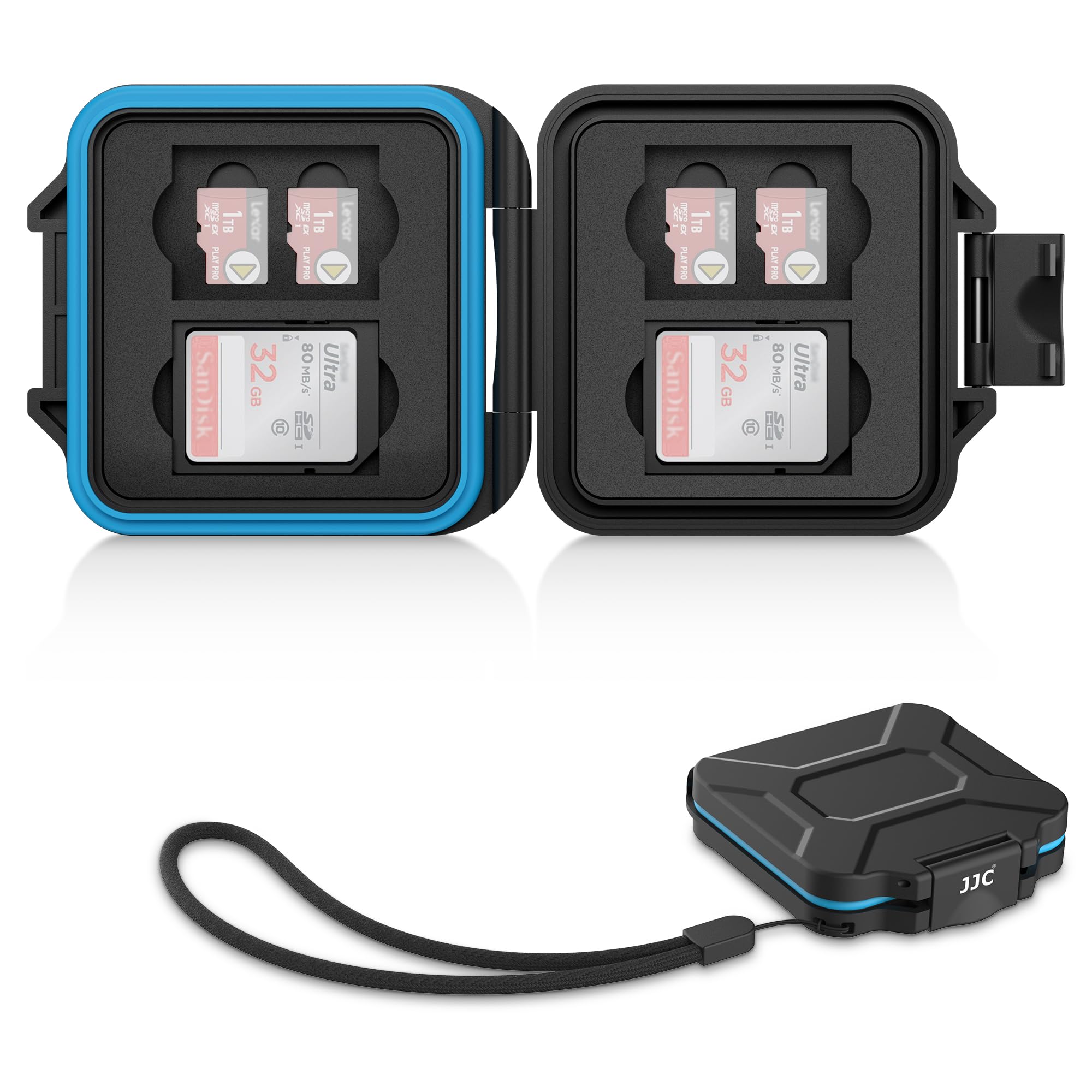
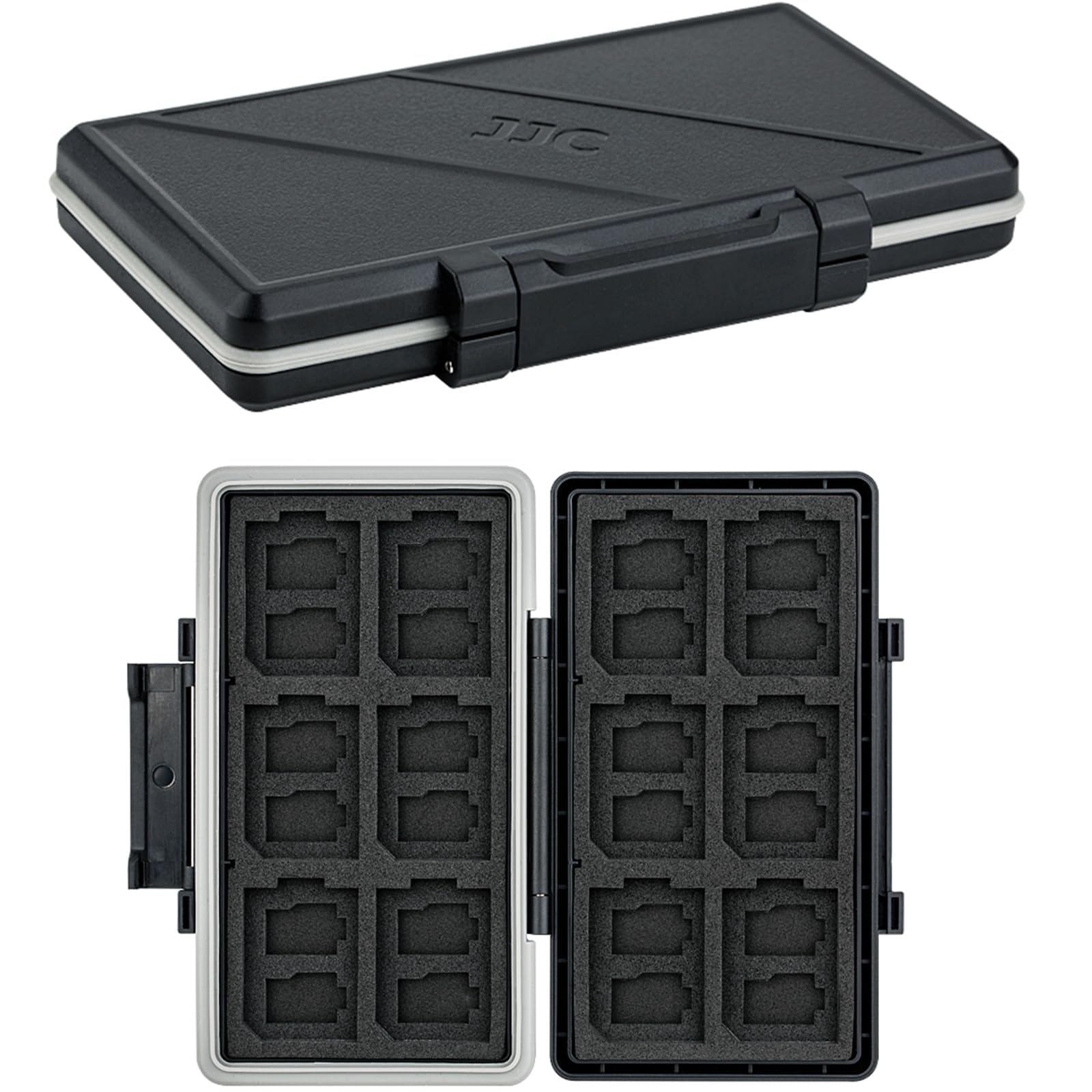
Twelve full-size SD slots and 24 microSD slots, all inside a case measuring 4.92 by 2.97 by 0.69 inches. That ratio is what makes this the default pick: it matches the way a mirrorless kit actually fills up, with big cards holding the day's footage and little ones living in adapters, action cams, and audio recorders.

Loading it is the part that kept us coming back. The foam is cut to the card rather than to a generic rectangle, so an SD card sits flush and a microSD sits in its own shallow well instead of sliding under a flap. We were also pleased to find the gray silicone gasket lifts out, which means sand and salt spray rinse away in seconds instead of working into the lining for the rest of the trip.

The latch closes firmly and opens with a thumb, which is the balance you want when you are swapping cards with one hand and holding a camera with the other. The shell has a matte finish that stays put in cold or damp hands, and the whole thing slides into a camera bag's front pocket without a fight.

The Kiorafoto 24-slot further down is the alternative when the case will ride on the outside of a pack: the same two-card-type layout, fewer slots, a rubber lining, and a harder shell. The HEIYING is the one to look at when 36 slots stop being enough for a season's worth of cards.

Pros

  • Holds 12 SD and 24 microSD cards together
  • Molded foam gives every card its own slot
  • Silicone seal keeps out dust and splashes
  • Slim enough for a bag's front pocket

Cons

  • No slots for CF or CFexpress cards
  • No labels included for tracking cards
Our verdict

For most people mixing SD and microSD cards, this is the case we hand over first: 36 slots, a sealed shell, and foam that keeps cards where you put them.

Check Latest Price
2

Best for Rough Handling

Kiorafoto 24-Slot Case

95 /100
Keeper Score Outstanding

Key details

Weight
4.9 oz
Capacity
12 SD + 12 microSD
Dimensions
5.63 x 3.23 x 1.10 in
Water Resistance
IPX5
Check Price on Amazon

Two things separate this case from the plastic boxes around it: a molded rubber lining and a weather seal around the rim. When the forecast is bad, this is the case we take. Cards sit in rubber instead of foam, and the lid closes down onto a gasket rather than a bare plastic lip, which is the difference between a case that shrugs off a wet backpack and one that just delays the inevitable.

The layout is 12 SD slots on one side and 12 microSD on the other, with a molded eyelet at the corner for the included carabiner. At 5.63 by 3.23 by 1.10 inches and about 139 grams it is a bag case, not a pocket one, and the carabiner is the reason to accept that — clipping it to the outside of a pack is how it earns its keep on a hike.

Rubber grips harder than foam, and the SD slots are cut close. Pulling a card takes a deliberate tug, which is reassuring at a desk and mildly irritating when you are changing cards in gloves. A hard drop can still shake a card loose, since nothing clamps over the top of each slot, so treat the seal as protection from water and dust rather than from gravity.

Pros

  • Rubber-lined shell with an IPX5 weather seal
  • Eyelet and carabiner for clipping to a pack
  • Even split of 12 SD and 12 microSD

Cons

  • SD slots grip tightly enough to slow swaps
  • Bulkier than the JJC 36-slot
Our verdict

If your cards travel in rain, dust, or the bottom of a pack, this is the one we trust: a hard polycarbonate shell, a rubber-lined interior, and a real gasket.

Check Latest Price
3

Best Wallet-Style

Eco-Fused 22-Slot Wallet

93 /100
Keeper Score Outstanding

Key details

Closure
Zipper
Capacity
22 slots (18 small, 4 large)
Material
Nylon mesh with microfiber
Card Types
SD, microSD, CF, MS Pro Duo
Check Price on Amazon

CompactFlash is the reason to start here. Four of this case's 22 slots are cut wide enough for a CF card, up to 43 millimeters, and the remaining 18 take SD, microSD, miniSD, Memory Stick Pro Duo, and MMC. No other case in this group covers that spread, which makes it the practical answer for anyone still running a DSLR alongside newer gear.

The rest is a zippered nylon wallet with clear-fronted pockets, so you can see what is where without opening every sleeve. It comes with labels for the cards, which matters more than it sounds once you have a dozen of them, and the whole thing lies flat enough to slip behind a tablet in a bag.

What it is not is armor. Nylon and mesh absorb a bump but will not stop a crush, and there is no gasket anywhere on it, so a soaked backpack is a genuine risk. Where it earns its place is a purse or a jacket pocket where a hard case feels like too much bulk — this is the one that rides along without complaint and still keeps every card contained.

Pros

  • Four wide pockets take CompactFlash cards
  • Zipper keeps every card contained
  • Flat wallet shape slips into a tote
  • Clear pockets show what is inside

Cons

  • Soft sides offer no crush protection
  • Only four pockets take CF cards
Our verdict

The case we point CompactFlash shooters to: four wide pockets for CF cards, a zipper that stays shut, and a flat shape that vanishes into a tote.

Check Latest Price
4

Best Pocket Case

JJC 12-Slot Slim Case

95 /100
Keeper Score Outstanding

Key details

Weight
1.3 oz
Capacity
4 SD + 8 microSD
Dimensions
3.1 x 2.7 x 0.6 in
Water Resistance
Water-resistant silicone seal
Check Price on Amazon

At 3.1 by 2.7 by 0.6 inches and 1.3 ounces, this is the smallest case here that still seals. The size is the first thing you notice and the last thing you stop appreciating, because it disappears into a shirt pocket. What matters more is that JJC kept the silicone gasket and hard ABS shell on the small version instead of trading protection for thinness.

The split is 4 SD and 8 microSD, which suits a compact mirrorless body, a drone, or an action cam — the kit where you carry two big cards and a handful of small ones. Each card gets its own molded EVA slot, the snap closure stays shut in a pocket, and at this size there is no excuse to leave the case at home, which is most of the battle.

Pros

  • Sealed hard shell at only 1.3 ounces
  • Small enough for a shirt pocket
  • Separate molded slots for every card

Cons

  • Only 12 slots in total
  • Wrist strap instead of a carabiner
Our verdict

For a jacket pocket or a small kit, this is the case we grab: 12 slots, a sealed hard shell, and barely more footprint than a card wallet.

Check Latest Price
5

Best for Large Card Libraries

HEIYING 40-Slot Case

94 /100
Keeper Score Outstanding

Key details

Closure
Magnetic
Capacity
20 SD + 20 microSD
Interior
Soft silicone lining
Dimensions
3.43 x 0.63 x 5.94 in
Check Price on Amazon

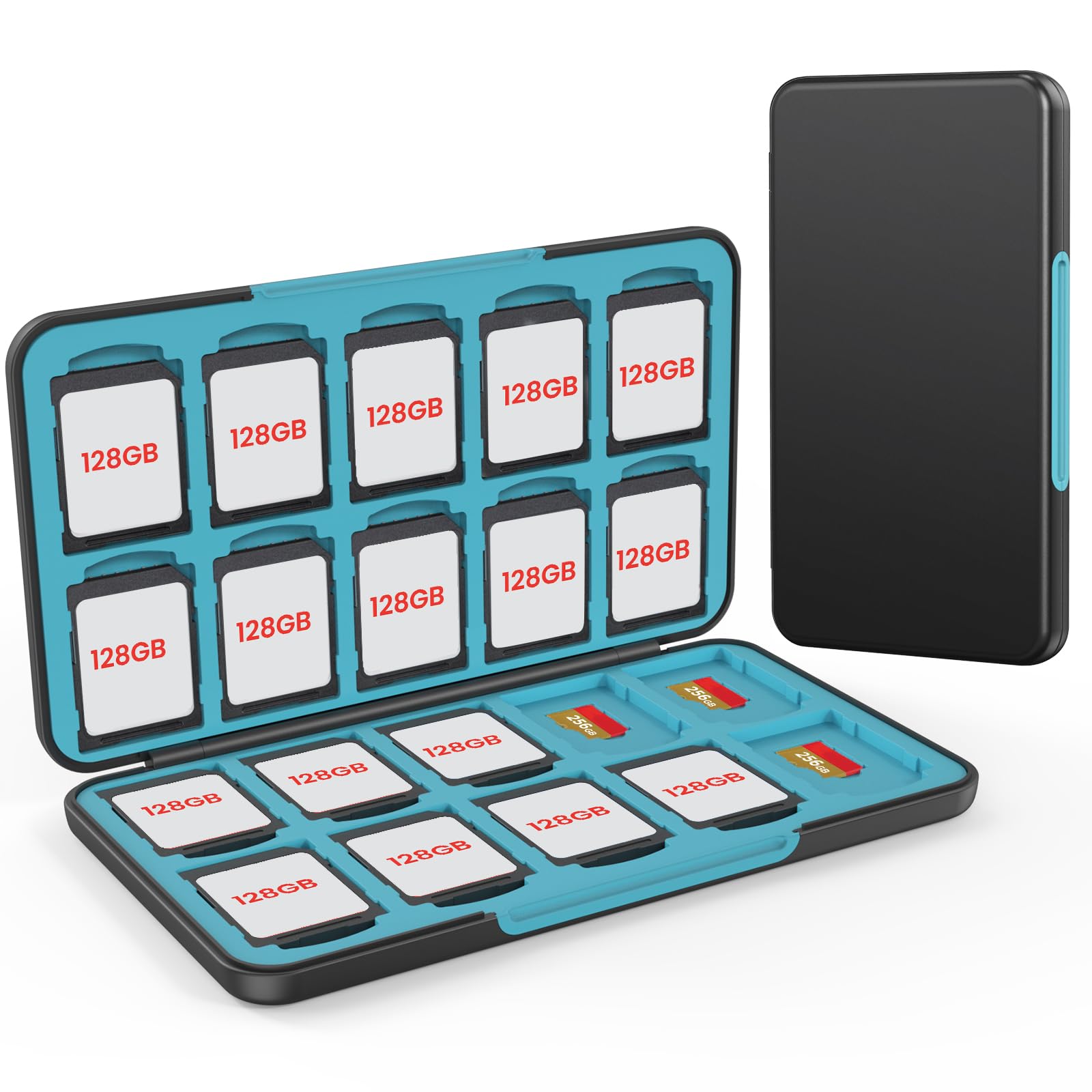
Twenty SD cards on top and 20 microSD underneath, in the same footprint. Stacking the slots in two layers is a genuinely clever bit of packing, and it puts 40 cards into something 3.43 by 0.63 by 5.94 inches — small enough that it slides into a backpack sleeve next to a tablet rather than demanding its own compartment.

The magnetic lid is what sold us. There is no latch to line up and no snap to press, so the case opens one-handed while the other hand holds a camera, and it shuts with a light push. For a card library you dip into several times a day, that small friction saving is the whole argument.

It also comes in prints, including a cow pattern, which is a silly thing to care about until you are digging through a dark camera bag for a black rectangle. The soft silicone lining is gentle on card shells, though it is a shallower grip than the molded foam on the JJC cases, so this one rewards a little care when you open it.

Pros

  • 20 SD and 20 microSD in one footprint
  • Magnetic lid opens one-handed
  • Print options make it easy to spot

Cons

  • Magnetic lid has no secondary catch
  • Shallow slots let cards lift out
Our verdict

The one we recommend when the drawer is overflowing: 40 slots in a case the size of a large phone, with a magnetic lid that opens one-handed.

Check Latest Price
6

Indexed Archiving

Kiorafoto 40-Slot Case

94 /100
Keeper Score Outstanding

Key details

Weight
6.88 oz
Capacity
40 SD-size slots
Card Types
SD, CFexpress Type A, game cards
Dimensions
8 x 4.2 x 1.65 in
Check Price on Amazon

The hard part of a large card library is not slot 1 or slot 12. It is slot 37, three months later, when you need the second camera's afternoon footage and every card looks identical. Kiorafoto solves that with an indexed, numbered layout plus two sheets of notepaper, so the case works as a logbook as much as a container.

The 40 slots are SD-sized, and they also take microSD-to-SD adapters, CFexpress Type A cards, and Switch or PS Vita game cards — the widest format support here after the Eco-Fused wallet. The shell is polycarbonate with sponge and silica gel inside, and it carries a water-resistant rating rather than a claim of waterproofing.

At 8 by 4.2 by 1.65 inches and 195 grams, we treat this as shelf-and-studio storage rather than something to clip on a belt. That is not a knock on the design; it is what 40 indexed slots cost in footprint, and the carabiner and lid straps mean it can still be lashed to the outside of a large backpack when the whole library travels.

The latch is the one part that asks for attention. It closes securely but takes a firm press to seat, and if the lid is not fully seated the index is the first thing to check. When a case is holding a season of work, we do not mind a closure that refuses to be accidental.

Pros

  • Numbered index and label sheets for tracking
  • Takes CFexpress Type A and game cards
  • Hard polycarbonate shell with water resistance

Cons

  • Large and heavy for bag carry
  • Lid needs a firm press to latch
Our verdict

If you need to know which of 40 cards holds which shoot, this is the case we reach for: a numbered index, label sheets, and room for CFexpress Type A.

Check Latest Price
7

Handing off Cards

Micscrew 36-Holder Case

89 /100
Keeper Score Excellent

Key details

Capacity
36 SD slots with holders
Included
40 writable labels and 4-card pouch
Dimensions
8.27 x 4.72 x 2.36 in
Holder Type
Individual transparent cases
Check Price on Amazon

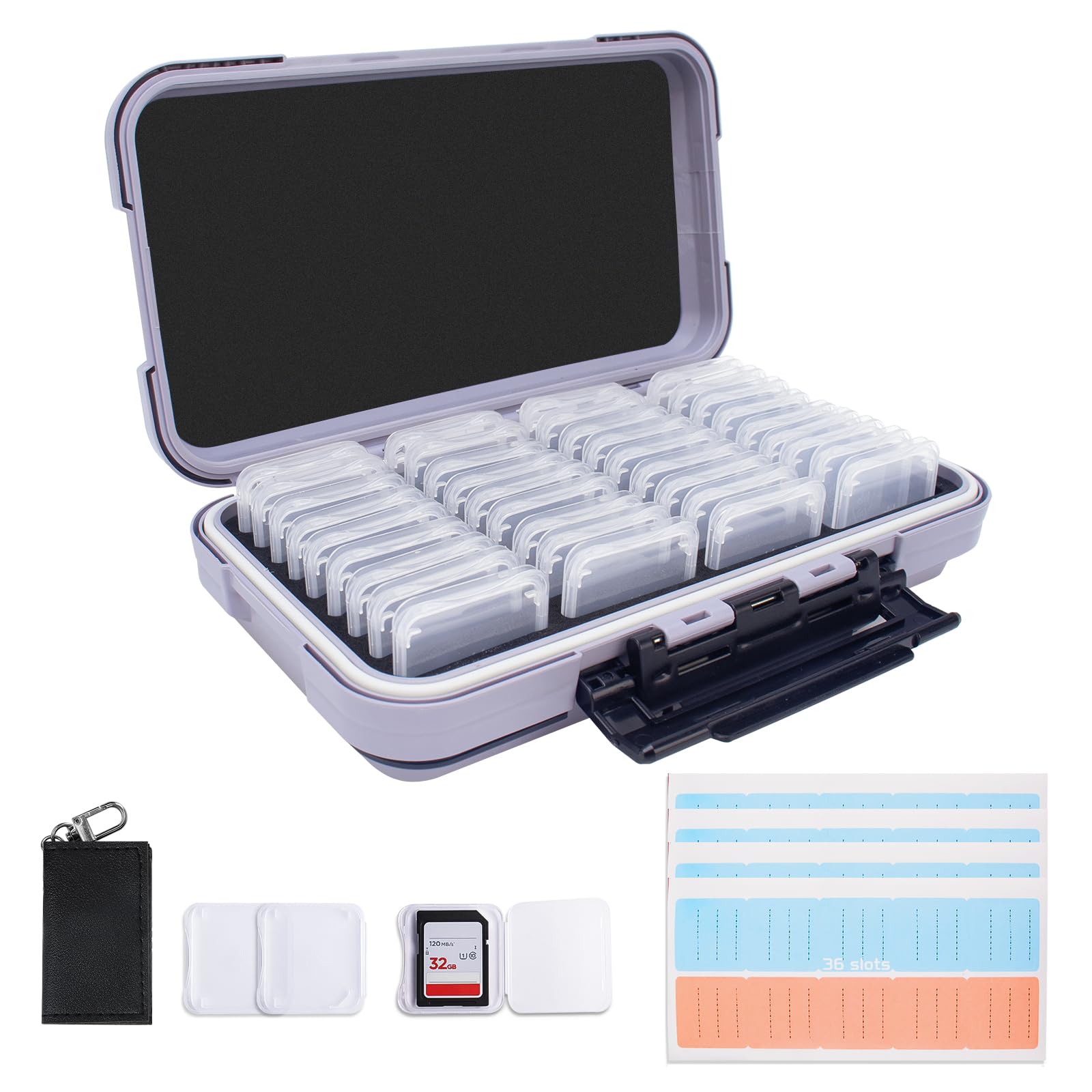
Thirty-six individual transparent holders sit in foam slots inside a hard case measuring 8.27 by 4.72 by 2.36 inches. Rather than pressing a bare card into foam, you snap each one into its own little box. That is the difference between a case that stores cards and a case that hands them out, because a card in its own holder can leave the case and come back without touching anything else.

Every holder takes a writable label, and the case ships with 40 of them, so a shoot can be numbered, dated, and filed in one motion. There is also a small magnetic pouch on a keychain that holds four cards, which is the piece that actually goes in a pocket while the big case stays in the car or the studio.

Protection is where it thins out. The case carries no water-resistance rating, and the lid's seal is a thin strip rather than a molded gasket, so keep it out of the rain and away from a spilled drink. Four anti-skid bars on the base stop it sliding across a desk, which is where a case this size tends to live anyway.

We rate it highest in this group for the handoff job. Label a card, box it, give it to a client, and neither of you has to worry about contacts or fingerprints. For everyday carrying, the JJC 36-slot is a third of the footprint and sealed, and that is the trade: this one organizes, that one travels.

Pros

  • 36 individual holders protect each card
  • 40 writable labels for shoot-by-shoot filing
  • Magnetic 4-card pouch for the day's cards
  • Anti-skid bars keep it steady on a desk

Cons

  • No water-resistance rating
  • Bulky for a camera bag
Our verdict

For photographers who hand cards to clients or file them shoot by shoot, this is the case we choose: 36 individual holders, 40 labels, and a small pouch for the day's cards.

Check Latest Price
8

Small Aluminum Kit

Qkenvo Aluminum Case

93 /100
Keeper Score Outstanding

Key details

Shell
Aluminum
Capacity
8 SD + 8 microSD
Dimensions
4.4 x 2.9 x 0.7 in
Water Resistance
Splash resistant, not submersible
Check Price on Amazon

Aluminum, not plastic. This is the only metal case in the group, and it is the one people pick up first when the cases are laid out on a table. At 4.4 by 2.9 by 0.7 inches it holds 8 SD cards and 8 microSD cards, and the finish makes it look like it belongs in a camera bag that cost more than the cards inside it.

The lid seals well enough for splashes, though the maker is clear that the case cannot be immersed, and the aluminum body shrugs off the bag-and-pocket life that cracks thin plastic hinges. It is light enough to forget in a jacket, which is exactly what you want from a case you carry every day.

The microSD row is the weak spot. Those cards sit shallower than the full-size ones and can lift out when the lid opens, so open it flat and over a table rather than in your lap. The SD slots below hold fine, and the release takes a firm push — closer to a two-hand operation than a flick, which is the price of a lid that never pops open by accident.

On looks and pocket size this is the case we point to first; on keeping microSD cards put, it sits behind the sealed cases above. If your kit is eight SD cards and you care how the thing feels in your hand, none of that will bother you.

Pros

  • Aluminum shell feels sturdier than plastic
  • 8 SD and 8 microSD in a pocket size
  • Splash-resistant sealed lid

Cons

  • Release takes a firm push to open
Our verdict

The only metal case here, and the one we hand anyone who wants eight SD cards protected in a jacket pocket without a plastic box.

Check Latest Price

How We Tested 16 Memory Card Cases Over Four Months

We started by gathering every case we could find that held at least eight cards and cost less than a spare SD card, then cut anything with no interior retention, no working closure, or a shell that flexed when squeezed. That left 16, which I then lived with for four months: hard-shell boxes with molded rubber slots, zippered pouches, slim EVA sleeves, and one aluminum box.

Each was loaded to its stated capacity with a mix of SD and microSD cards, then sent where cards actually live — a camera bag that gets tossed in a trunk, a jacket pocket on a rainy walk, a glovebox through a hot week, a desk drawer. I opened and closed each one 50 times, clipped the carabiners to a bag loop and a belt, and pocketed the slim ones to see whether they printed through fabric or snagged a seam.

Fit separated them fastest: I turned each case upside down, shook it, then opened it and counted what had moved. In the good ones every card stayed seated; in the bad ones they slid against the lid. We noted what held each one shut — latch, zip, or friction lid — and whether it stayed that way after a waist-height drop onto concrete steps, fully loaded. Water resistance got a one-minute faucet run with a dry tissue tucked inside. Retrieval got timed in dim light, hunting one specific card, which is where labels and clear sleeves earned their keep. Capacity claims were checked against real cards, since some high-slot cases hold mostly microSD, and after four months we looked at which ones still looked presentable and which had scuffed.

How to Choose a Memory Card Case

Match the Slots to Your Card Mix

Every case here is molded for a fixed combination, so count your cards by type before you compare totals. A mirrorless shooter with two action cams ends up needing far more microSD wells than SD slots, which is why the JJC 36-slot's 12-and-24 split suits that kit better than a 40-slot SD-only box. A microSD card only fits an SD slot with its adapter attached, and a case cut for full-size cards gives you nowhere to put a bare microSD.

If CompactFlash or CFexpress is still in your bag, check the compatibility line first. The Eco-Fused wallet's four wide pockets take CF, and the Kiorafoto 40-slot handles CFexpress Type A — most of the rest are SD and microSD only.

Hard Shell, Soft Wallet, or Something Between

A polycarbonate or ABS shell with a silicone gasket is what you want if the case rides loose in a pack or a jacket pocket; a nylon wallet is flatter and swallows odd card sizes, but a knock against a door frame goes straight through to the cards. The middle option, a hard case with a rubber lining, is where the Kiorafoto 24-slot sits, and it's the one we reach for when the weather looks uncertain.

The trap is the word waterproof. These cases are splash- and rain-resistant at best — one manufacturer states plainly that its aluminum case cannot be immersed — so a kayak trip still needs a dry bag around the case.

Check How the Case Holds the Cards

Retention is the design decision you feel every time you open the lid. Molded foam holds cards flat and lets them lift if the case is tipped; a rubber lining grips harder and makes swaps slower; individual plastic holders are the most secure and the slowest to load. None of these is wrong, but a photographer changing cards on a cold morning wants a different balance from someone filing a season of footage.

Open the case flat and over a table rather than in your lap. That habit covers most of the difference between designs.

Labels and Knowing What Is on Each Card

Storage is the easy part; recall is the hard part. A numbered index, a sheet of writable labels, or color-coded holders turns a box of identical cards into something you can audit. The Kiorafoto 40-slot and the Micscrew 36-holder both ship with labeling, and the small extra cost buys you a system rather than a container.

If you shoot for clients, label at the moment the card leaves the camera, not at the end of the week. It is the one habit that separates a working case from a drawer of mystery cards.

Size It to Where the Case Lives

A case that stays in a bag gets used; one that lives on a shelf does not. The pocket end of this group runs about 3.1 by 2.7 by 0.6 inches, while the 36- and 40-slot cases are closer to 8 inches across and need a compartment of their own. If you want the case clipped to a strap or a belt loop, look for a molded eyelet or a carabiner; a wrist strap is for carrying, not attaching.

Frequently Asked Questions

Final Verdict

For most photographers the JJC 36-slot is the case that solves the everyday problem: both card types in one place, a gasket against dust and splashes, and a shape slim enough to keep in the bag rather than in a drawer. It is the one we recommend without a caveat beyond the cards it does not take.

Spend your extra thought on the edges. If the case rides on the outside of a pack through weather, the Kiorafoto 24-slot's rubber lining and IPX5 seal justify the bulk. If CompactFlash is still in your kit, the Eco-Fused wallet is the only pick here that takes it.