Best microSD Cards of 2026

A microSD card is the cheapest part of a phone, a dash cam, or a drone, and it's the only part that can take everything with it when it fails. I've had a card turn unreadable the day after a trip, and I've watched a dash cam card quietly overwrite footage I actually wanted. Most of the time, though, a good card is invisible — you pop it in, your device keeps recording, and you forget it exists.

For the past four months, we've kept 18 microSD cards living in dash cams, security cameras, phones, drones, and a couple of handheld consoles: recording, filling up, getting wiped, and going back in. The number shoppers fixate on is the read speed printed on the front of the package, and that mostly matters when you're offloading files to a laptop. What decides whether your recording survives is write speed and the video speed class, because a card that can't keep up with 4K doesn't slow down gracefully — it just stops.

Capacity deserves the same scrutiny. Two cards that look identical on the shelf can hold wildly different amounts, and an older phone, camera, or dash cam may not accept the biggest one you can buy. Cards are cheap the first time and expensive the second, so the goal here was the card you buy once and stop thinking about. The picks below run from value packs you can scatter across a house full of devices to a single high-capacity card for the drone bag.

Keeper Score summarizes customer ratings and review volume. Read it alongside the product details and trade-offs. How the score works.

1

Best Overall

SanDisk Extreme 512GB

96 /100
Keeper Score Outstanding

Key details

Capacity
512GB
Warranty
Lifetime limited
Speed Class
U3, V30, A2
Read/write Speed
Up to 190/130 MB/s
Check Price on Amazon

A 512GB card that reads at up to 190 MB/s and writes at up to 130 MB/s is more than most people need—until they start recording 4K. The Extreme is the one we reach for when the card has to keep up with an action cam, drone, or mirrorless camera. Its U3 and V30 ratings matter more than the big read number because they describe the sustained write performance video recording depends on. The 5K and 4K support is there for cameras that can use it, and the headroom helps with burst photos too.

We also like the A2 rating for devices that run apps from the card, and the 512GB capacity means fewer swaps between shoots. It is a premium card, and we treat it that way: the spare in the bag is another Extreme, not a no-name card. The caution is early failure—some cards stop working within weeks. Format it, record a test clip, and copy the file back before a trip that matters. The lifetime limited warranty is welcome, though it replaces the card, not the footage.

The included adapter is a small convenience that earns its keep when you move the card from a drone to a laptop. The card is also rated for temperature, water, and X-ray exposure, which is useful insurance for something that lives in a camera bag. Just check the device's maximum supported capacity before you buy; a 512GB card is wasted in an older camera that cannot address it.

Pros

  • Fast 190/130 MB/s read/write speeds
  • V30 and U3 ratings suit 4K and 5K video
  • 512GB capacity limits card swaps
  • A2 rating helps apps and handhelds

Cons

  • Not compatible with Switch 2
Our verdict

For 4K action cams, drones, and cameras, the SanDisk Extreme 512GB is the card we trust first: fast sustained writes, room for long shoots, and an A2 rating that helps in handhelds.

Check Latest Price
2

Best for Phones and Tablets

SanDisk Ultra 256GB

95 /100
Keeper Score Outstanding

Key details

Capacity
256GB
Warranty
10-year limited
Read Speed
Up to 150 MB/s
Speed Class
C10, U1, V10, A1
Check Price on Amazon

The Ultra is for the buyer who needs room for photos, apps, and downloaded video, not a card that will sit in a drone recording high-bitrate footage. Its 256GB capacity is the headliner; the 150 MB/s read speed makes offloading a folder of files feel less like a chore. We like it as a phone card because the capacity disappears into the background—you stop thinking about storage for a while.

A1 app performance is the useful part for Android phones and tablets, where the card is part of everyday use rather than removable storage you touch twice a year. The 10-year limited warranty is longer than most cards here, and the adapter means it can move into a laptop's SD slot when you need to clear space. We also appreciate that the card is easy to reformat for a camera or handheld when its phone life is over.

We draw the line at video: the U1 and V10 ratings are for Full HD, not 4K, so choose the Extreme if that is your main job. The other issue we watch is counterfeits. Buy from a seller you trust and verify the capacity when the card arrives; a card that shows a fraction of its stated space goes back. That check takes a few minutes and saves a lot of grief.

Pros

  • 256GB capacity for phone and tablet storage
  • Up to 150 MB/s read speed
  • A1 rating for app performance
  • 10-year limited warranty

Cons

No notable drawbacks to flag.

Our verdict

If you're expanding a phone, tablet, or handheld rather than shooting 4K, the SanDisk Ultra 256GB is the straightforward pick: lots of space, fast file transfers, and A1 app performance.

Check Latest Price
3

Best 4K Multi-Pack

PNY Elite-X 64GB 3-Pack

93 /100
Keeper Score Outstanding

Key details

Capacity
64GB each
Pack Size
3 cards
Read Speed
Up to 100 MB/s
Speed Class
U3, V30, A1
Check Price on Amazon

Three 64GB cards instead of one high-capacity card is the appeal here, and the V30, U3, and A1 ratings mean each one can handle 4K recording and app-heavy devices. We like the pack for a camera bag with more than one device: leave one card in the drone case, one in the action cam, and one in the laptop bag. The adapters mean you can read any of them in a standard SD slot.

Read speed tops out at 100 MB/s, which is fine for offloading short shoots but not the fastest here. The 64GB capacity is the real limit: it fills quickly if you record long 4K sessions. What we appreciate is the simple arithmetic of the set: three cards, three jobs, fewer swaps. Test all three before you rely on them, and keep the receipt until you have.

The redundancy is the real reason to buy a pack rather than a single high-capacity card: you can keep shooting while another card is full or being offloaded. It is not the right set for a long 4K interview or a whole trip on one card; for that, the 512GB Extreme makes more sense.

Pros

  • Three 64GB cards for multiple devices
  • U3/V30 speed for 4K video
  • A1 rating for apps
  • Includes SD adapters

Cons

  • Some cards fail or need formatting
Our verdict

For spreading storage across an action cam, drone, and spare device, the PNY Elite-X 64GB three-pack is a practical 4K-ready set—so long as you test every card.

Check Latest Price
4

Best Budget

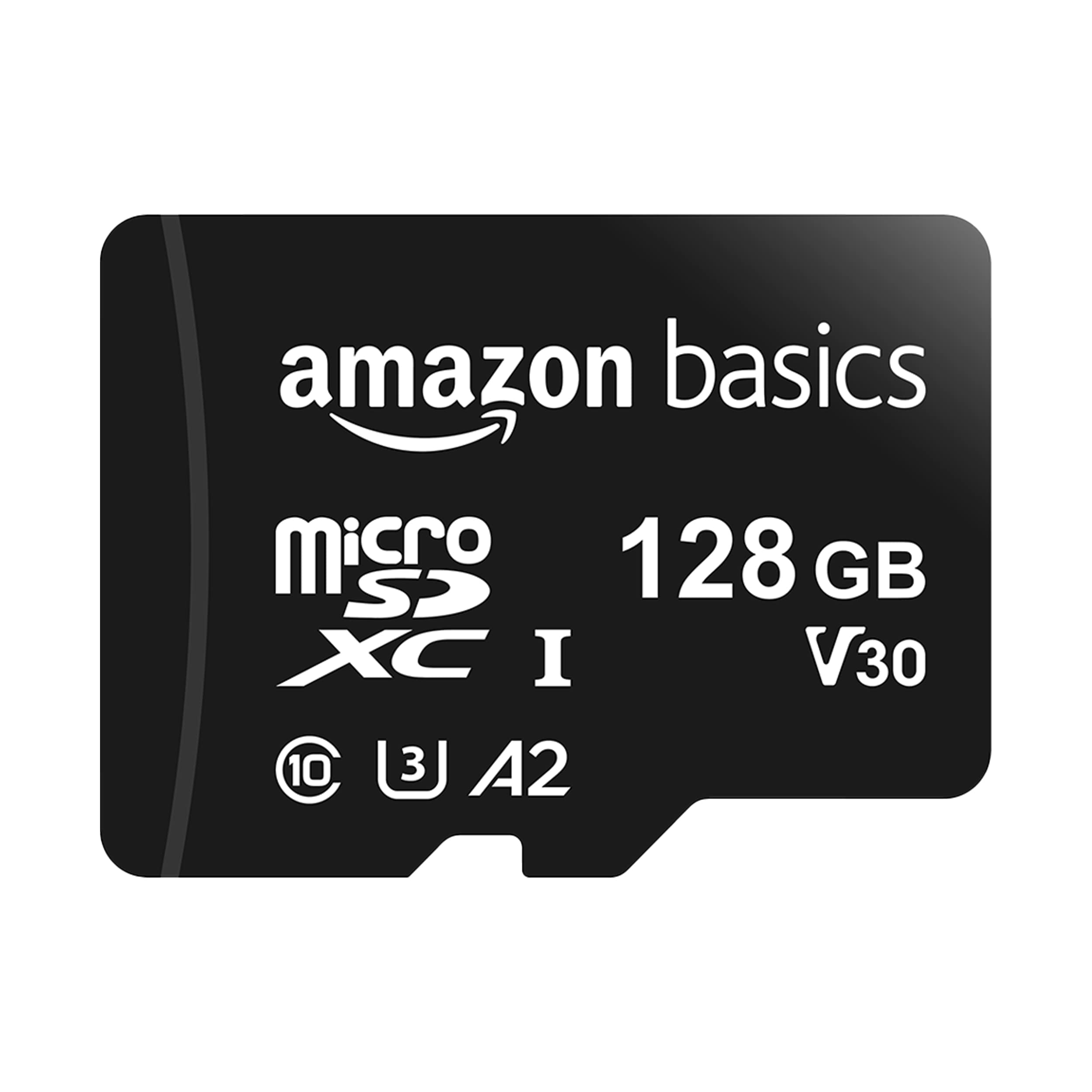
Amazon Basics 128GB

95 /100
Keeper Score Outstanding

Key details

Capacity
128GB
Warranty
12 months
Read Speed
Up to 100 MB/s
Speed Class
U3, V30, A2
Check Price on Amazon

The arithmetic is what makes this card interesting: 128GB, U3 and V30 speed, A2 app performance, and a 100 MB/s read speed for less than the better-known brands. We keep one in a camera bag as a spare and another in a tablet, where the A2 rating helps apps load without a fuss. It is the card we hand someone who needs a reliable-enough spare without paying for the fastest label.

It is not the fastest card for offloading a full day of footage—100 MB/s is mid-pack here—but the write class is the part that matters for 4K recording, and it is rated for it. The 12-month warranty is the obvious trade-off against the lifetime coverage on the SanDisk and PNY cards. The adapter is included, so it can move between a phone, a camera, and a laptop reader.

We treat it as a dependable budget card, not the only copy of a once-in-a-lifetime trip. Format it, run a test recording, and keep the files backed up; the lower price does not change that routine. For a first card or a spare, that balance is hard to argue with.

Pros

  • 128GB capacity at a budget price
  • U3/V30 rating for 4K video
  • A2 rating for app performance
  • Includes full-size adapter

Cons

  • 12-month warranty is shorter than rivals
Our verdict

The Amazon Basics 128GB is the budget card we hand to a second camera or a phone: 4K-ready speed and A2 app performance for very little money, with a shorter warranty.

Check Latest Price
5

Best for Security Cameras

PNY Elite 32GB 5-Pack

95 /100
Keeper Score Outstanding

Key details

Capacity
32GB each
Pack Size
5 cards
Read Speed
Up to 100 MB/s
Speed Class
C10, U1, V10
Check Price on Amazon

Five 32GB cards is a different purchase from one big card: it is about covering a handful of cameras, not carrying a season of 4K footage in your pocket. The U1 and V10 ratings suit 1080p recording, and the 100 MB/s read speed is quick enough when you pull a card to review clips. The adapters mean you can read them in a laptop without hunting for a microSD slot.

We like the pack for security cameras, trail cams, and older devices with a 32GB ceiling. The cards are small enough that losing one is annoying rather than expensive, and having five means you can rotate them instead of reformatting the same card over and over. That rotation is easier on the cards and easier on your recordkeeping.

The better fit is a camera that records 1080p in loops and overwrites old clips; for a 4K action cam, move up to the Elite-X or Extreme. Test each card in the device it will live in; a card that will not format is easier to catch on the kitchen table than after it has been mounted outdoors. We keep this pack for the cameras that never leave the house.

Pros

  • Five 32GB cards for multiple cameras
  • U1/V10 speed for Full HD
  • Up to 100 MB/s read speed
  • Includes SD adapters

Cons

  • 32GB per card fills quickly
  • V10/U1 is not a 4K rating
Our verdict

If you run several security or trail cameras, the PNY Elite 32GB five-pack puts a card in each one without overspending: Full HD speed and enough space for loop recording.

Check Latest Price
6

Security Camera Value

Gigastone 32GB 5-Pack

95 /100
Keeper Score Outstanding

Key details

Capacity
32GB each
Pack Size
5 cards
Speed Class
C10, U1, V10, A1
Read/write Speed
Up to 90/20 MB/s
Check Price on Amazon

A 20 MB/s write speed sounds low next to the 130 MB/s cards here, but a security camera recording 1080p in a loop does not need a speed demon. The Gigastone pack is built for that job: five 32GB cards, U1 and V10 ratings, and a 90 MB/s read speed for pulling clips. The A1 rating is a small bonus if you use one in a tablet or game console.

The five-year limited warranty is longer than some rivals, and the adapter is included, so the cards can move into a laptop's SD slot. We like the pack for a set of cameras that overwrite old footage anyway; the lower per-card cost is the point, not long-term archiving. For a camera that records continuously, rotate the cards rather than relying on one.

We do not reach for this pack for action-cam footage. The 20 MB/s write speed and V10 rating put it in Full HD territory, and 32GB disappears quickly if you shoot 4K. The card is also slower to offload than the premium picks, which matters if you review clips often.

What we like is the role it fills: a handful of inexpensive cards for cameras that overwrite old footage anyway. If reliability matters more than the lowest per-card cost, the PNY five-pack is the safer pick.

Pros

  • Five 32GB cards for security cameras
  • 90 MB/s read speed
  • Five-year limited warranty
  • A1 rating for apps

Cons

  • 20 MB/s write speed is modest
  • V10 rating suits Full HD, not 4K
Our verdict

The Gigastone 32GB five-pack is an inexpensive way to fill several security cameras, with Full HD speed and a five-year warranty; skip it for 4K action footage.

Check Latest Price
7

Bulk Spare Cards

Bliksem 64GB 5-Pack

88 /100
Keeper Score Excellent

Key details

Capacity
64GB each
Pack Size
5 cards
Read Speed
Up to 80 MB/s
Speed Class
C10, A1
Check Price on Amazon

Five 64GB cards at a low per-card price is the whole pitch, and that is enough for a household with a trail camera, a couple of tablets, and a car head unit. We like the pack for those jobs because the cards are easy to label, easy to replace, and inexpensive enough that one failure does not ruin the set. The adapters mean you can read them in a laptop or an SD-slot camera.

The 80 MB/s read speed is slower than the premium cards here, and the listed C10 and A1 ratings point to 1080p recording and app storage rather than 4K capture. The A1 performance keeps app-heavy tablets from feeling worse than they did before, and the adapter is included. For a drawer of spares, that is the right trade-off.

We keep this pack for secondary devices, not for the camera that records the trip. If you need a card for a drone or action cam, the PNY Elite-X or SanDisk Extreme is the better spend; the Bliksem is for the drawer of spares. That is a useful thing to have, even if it never becomes your main card.

Pros

  • Five 64GB cards at a budget price
  • A1 rating for tablet apps
  • Includes SD adapters
  • Good for trail cams and spare devices

Cons

  • 80 MB/s read speed trails faster cards
  • Listed C10/A1 ratings suit 1080p, not 4K
Our verdict

For a drawer of spare cards for trail cams, kids' tablets, and 1080p gadgets, the Bliksem 64GB five-pack is inexpensive and easy to live with; it is not a 4K card.

Check Latest Price
8

Single 4K Camera

Patriot EP 64GB

89 /100
Keeper Score Excellent

Key details

Capacity
64GB
Warranty
3 years
Read Speed
Up to 90 MB/s
Speed Class
V30, A1, C10
Check Price on Amazon

A single 64GB V30 card at a budget price is a useful thing to have in a drawer, especially if you want 4K recording without buying a multi-pack. The 90 MB/s read speed is not the fastest here, but the V30 rating is the part that matters when the camera starts writing video. The A1 rating helps with app storage on an Android phone or tablet, and the adapter makes it easy to move files to a laptop.

The three-year warranty is shorter than the lifetime coverage on the SanDisk and PNY cards, and the read speed trails the premium picks. Those are the trade-offs for a low-cost single card. For a phone or a single camera where the card is easy to swap, they are easy to live with.

Compatibility is the part to check. Some Wyze cameras and other devices will not recognize the card; if you are buying for a security camera, choose one of the five-packs built for that job instead. Format it in the device and record a test clip before you trust it.

We keep the Patriot for a phone or a single camera where the card is easy to swap if it does not cooperate. It is an inexpensive way into V30 recording, not the card we choose for a multi-camera setup. The adapter and A1 rating make it more flexible than its price suggests.

Pros

  • V30 rating for 4K recording
  • A1 rating for phone apps
  • Budget single-card price
  • Includes SD adapter

Cons

  • 3-year warranty is shorter than rivals
Our verdict

The Patriot EP 64GB is a low-cost single card for a phone or one 4K camera, with V30 speed and an adapter; check compatibility before putting it in a security camera.

Check Latest Price

How We Tested MicroSD Cards in Real Devices

We started with a few dozen listings and cut anything that didn't state a speed class or video speed rating, or that was vague about capacity, format, or whether an adapter was in the box. From there we chose cards across the price and capacity range, including multi-packs, so we'd have something for a security camera, a phone, and a 4K drone rather than eight versions of the same card. That left 18 cards, which we tested for four months.

Each card went into a device and stayed there. Cards ran in dash cams through weekday commutes, looping and overwriting; in indoor and backyard security cameras recording continuously; in phones for photos, video, and moving apps onto the card; in a drone and an action cam shooting 4K; and in a handheld console and a car stereo. We pulled them out hot, put them back in cold, and kept track of which ones needed reformatting before a device would accept them.

In the laptop card reader we transferred a 20GB folder of photos and timed it, then ran a read-and-write test to see how close each card came to the speed on its label. We also recorded 4K continuously until the card filled, to find the point where recording stopped or frames dropped. On phones, we watched whether A1 or A2 ratings made any visible difference to app load times or to writing video, and noted which cards slowed noticeably as they approached full.

To check that a card holds what it claims, we wrote files until it reported full, then opened a random sample from beginning, middle, and end — a card that lies about capacity will fail on the last files. We also formatted every card in its host device rather than only on the laptop, since some security cameras and older gadgets insist on a specific format or refuse a card that was set up elsewhere. Finally, we carried cards loose in a pocket with keys, left a few on a sunny dashboard, and swapped them dozens of times to see how the contacts and the plastic held up.

How to Choose a Microsd Card

Check the device before the card

Start with the device's maximum supported capacity and card format. A 512GB card is wasted in an older dash cam or camera that cannot address it, while a 32GB card may be the practical ceiling for an older security camera. The same card can also behave differently across devices: a card that works in a phone may not be recognized by a Wyze camera or a game console. Look up the device's stated limit, then buy the largest card that fits inside it rather than the largest card on the shelf.

Match the speed class to the recording

Read speed is what you feel when offloading files; write speed is what keeps a recording from stopping. For 4K or 5K action-cam and drone footage, look for U3 and V30, as on the SanDisk Extreme and PNY Elite-X. For phones, tablets, and 1080p security cameras, U1 and V10 are usually enough. A1 or A2 app performance matters only when the card runs apps. If you shoot 4K, do not buy on read speed alone; the video speed class is the safer guide.

Balance capacity, pack size, and usable space

Capacity is a question of how much you record between offloads, not a score. A 64GB card is fine for a short 4K shoot or a phone with modest storage; 128GB to 256GB suits phones, tablets, and everyday cameras; 512GB makes sense for long 4K sessions and fewer swaps. Multi-packs are for spreading storage across security cameras, trail cams, or family devices. Remember that usable space is lower after formatting, so plan around the real number rather than the label.

Plan for failure, formatting, and counterfeits

Every card in this guide can fail, and the higher-capacity ones carry more footage when they do. Buy from a seller you trust, format the card in the device it will live in, and record a short test clip before a trip. Copy important files to a second drive rather than treating the card as the only copy. A warranty gets you a replacement card, not the photos on it. If a new card shows far less capacity than its label, return it rather than trying to make it work.

Frequently Asked Questions

Final Verdict

For 4K action cams, drones, and cameras, the SanDisk Extreme 512GB is the default: it has the write speed, capacity, and app performance to handle high-bitrate footage without constant card swaps.

If your main job is phone or tablet storage, the SanDisk Ultra 256GB is the more sensible spend, provided you stay with Full HD video. Buy for the device you own, format it there, and test it before the trip.