Best Macro Focusing Rails of 2026

The hardest part of macro photography isn't getting close. It's moving the camera a few millimeters without losing the framing you just set. A focusing rail turns that tiny adjustment into a repeatable slide, so you can nudge focus through a stack or fine-tune a close-up without wrestling a ball head. I've watched a tripod head creep at the worst possible moment, and that little drift is exactly what a good rail is supposed to eliminate.

Over eight months, my team and I tested ten rails, from simple screw-drive models to dovetail-style clamps with rotating heads and detachable feet. We looked at build quality, stability, adjustability, precision, ease of use, and whether the price matched the performance. One thing I'd tell any first-time buyer: travel length gets the attention, but lock-up matters more. A long rail that flexes or slips after you tighten it is worse than a short one that stays put. The picks below are the ones that felt solid, moved in small enough increments for real macro work, and didn't make setup a chore.

Keeper Score summarizes customer ratings and review volume. Read it alongside the product details and trade-offs. How the score works.

1

Best Overall

NEEWER 4-Way Macro Rail

88 /100
Keeper Score Excellent

Key details

Weight
1.26 lb
Movement
4-way, knob-driven with scales
Camera Mount
Quick release plate with 1/4-20 screw
Load Capacity
5.51 lb
Check Price on Amazon

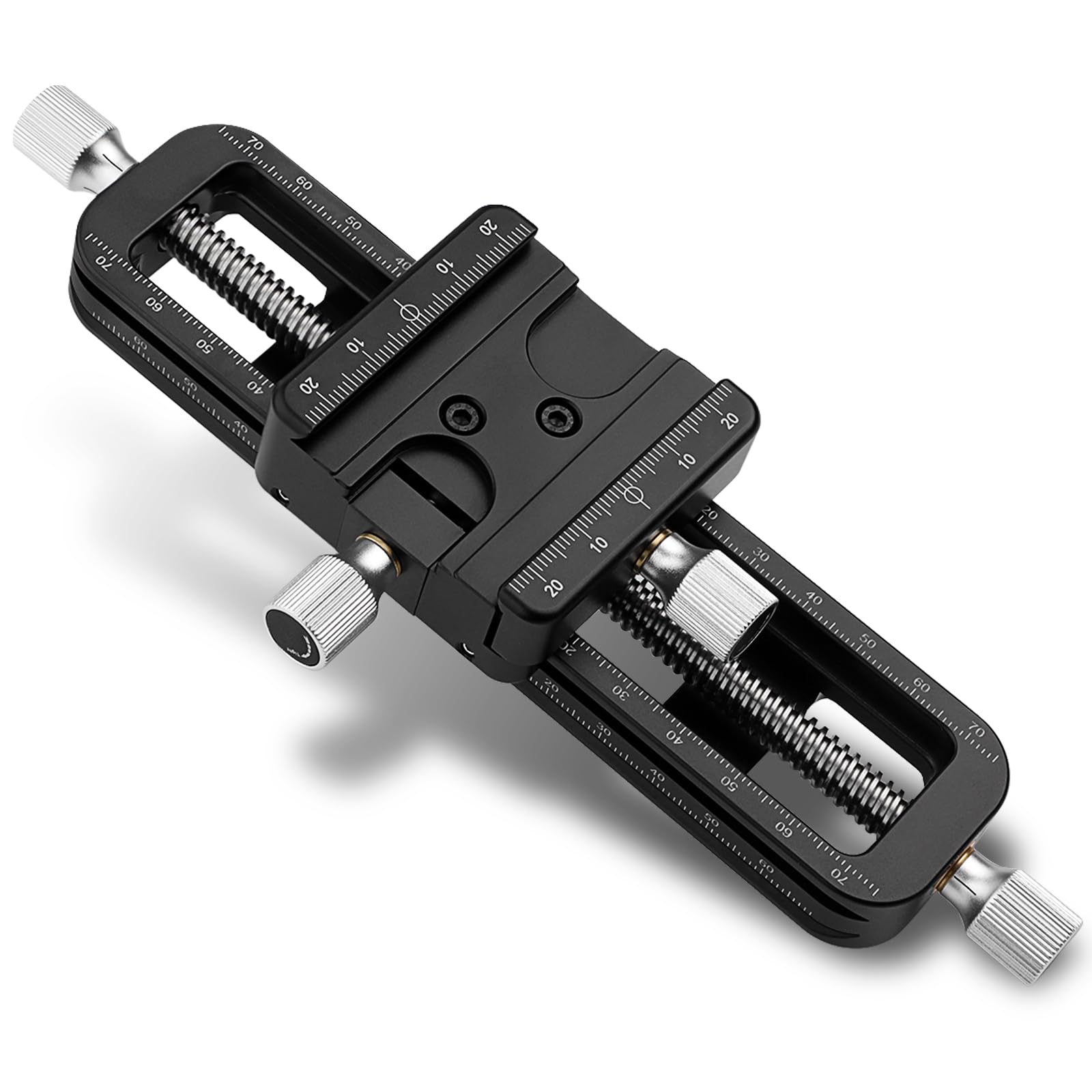
Four directions of travel is what earns this rail its place at the top of our list. Once the tripod is levelled for a 1:1 shot, moving a leg to reframe is the last thing you want to do; the second carriage slides the camera sideways so we could recentre on a subject without touching the legs, then the forward-back carriage brings it back to the plane of focus. That reads like a small convenience until you have spent an evening chasing a subject that keeps drifting.

The knob feel is what we kept coming back to. Reversing direction is where an inexpensive rail gives itself away, with a slack zone before the carriage responds; here the thread picks up almost immediately, so we could walk a stack forward and back without hunting for engagement. Numbered scales on both carriages let us note a position, change a subject, and come back to the same starting point.

Mounting is genuinely quick. The release plate screws to the camera and drops onto the rail, so a body comes off between setups without unscrewing anything, and the 2.5 kg capacity covers a full-frame body with a 100 mm macro and leaves room to spare. The base carries both a 1/4-20 socket and a dovetail, which means it goes onto a ball head, a video head, or an Arca-style clamp without an adapter. Going back to a single-axis rail after this one means giving up the sideways carriage, and we minded that more than we expected.

Pros

  • Two carriages let you reframe without moving the tripod
  • Knobs pick up almost immediately when you reverse direction
  • Quick-release plate speeds up camera changes
  • 2.5 kg capacity with socket and dovetail mounting

Cons

  • At 570 g, the heaviest rail in this group
  • Two stacked axes add height under the camera
Our verdict

We make this the default macro rail: two carriages for reframing, dependable knob feel, a quick-release plate, and enough capacity for a full-frame body with a macro lens.
Check Latest Price
2

Best Fine Control for the Money

Haoge FM-160 Macro Rail

80 /100
Keeper Score Excellent

Key details

Travel
115 mm (4.53 in)
Camera Mount
Arca-type clamp and dovetail base
Fine Adjustment
4 mm per rotation
Check Price on Amazon

If you want worm-drive precision without spending much, this is the rail to get. A worm screw takes the slack out of the carriage, so it moves the instant the knob turns and stays exactly where you leave it — no creeping between frames of a stack. Four millimetres of travel per full rotation is a genuinely fine increment, and the 1 mm scales are laser-etched on both sides, so a stack can be repeated from the numbers rather than by eye.

The cost of that gearing is speed. Crossing the full 115 mm is a lot of turning, so we set the tripod with the carriage near the middle of its travel and worked outward instead of winding from end to end. For stacking, where the camera may move a few millimetres across an entire sequence, that is the right trade; for a session that jumps between subjects at different distances, it is a slow way to work.

Above the bed sits an Arca-type clamp, which we much prefer to a screw-on thumbwheel when swapping bodies, and the base is an Arca dovetail that drops straight into most ball heads. Fit and finish are better than the money suggests — clean machining, no play we could find in the carriage — and at 12.3 ounces it adds almost nothing to a bag.

Pros

  • Worm drive holds position with no creep
  • 4 mm of travel per turn for fine, repeatable steps
  • Laser-etched 1 mm scales on both sides
  • Arca clamp on top, Arca dovetail underneath

Cons

  • 115 mm of travel is the shortest here
Our verdict

This is the rail we hand anyone who wants worm-drive precision that holds its position, and who can work within a shorter bed.

Check Latest Price
3

Best for Long Reach

NiSi NM-180S Macro Rail

85 /100
Keeper Score Excellent

Key details

Clamp
360-degree rotating Arca-Swiss
Travel
160 mm
Load Capacity
11 lb
Fine Adjustment
1.25 mm per rotation
Check Price on Amazon

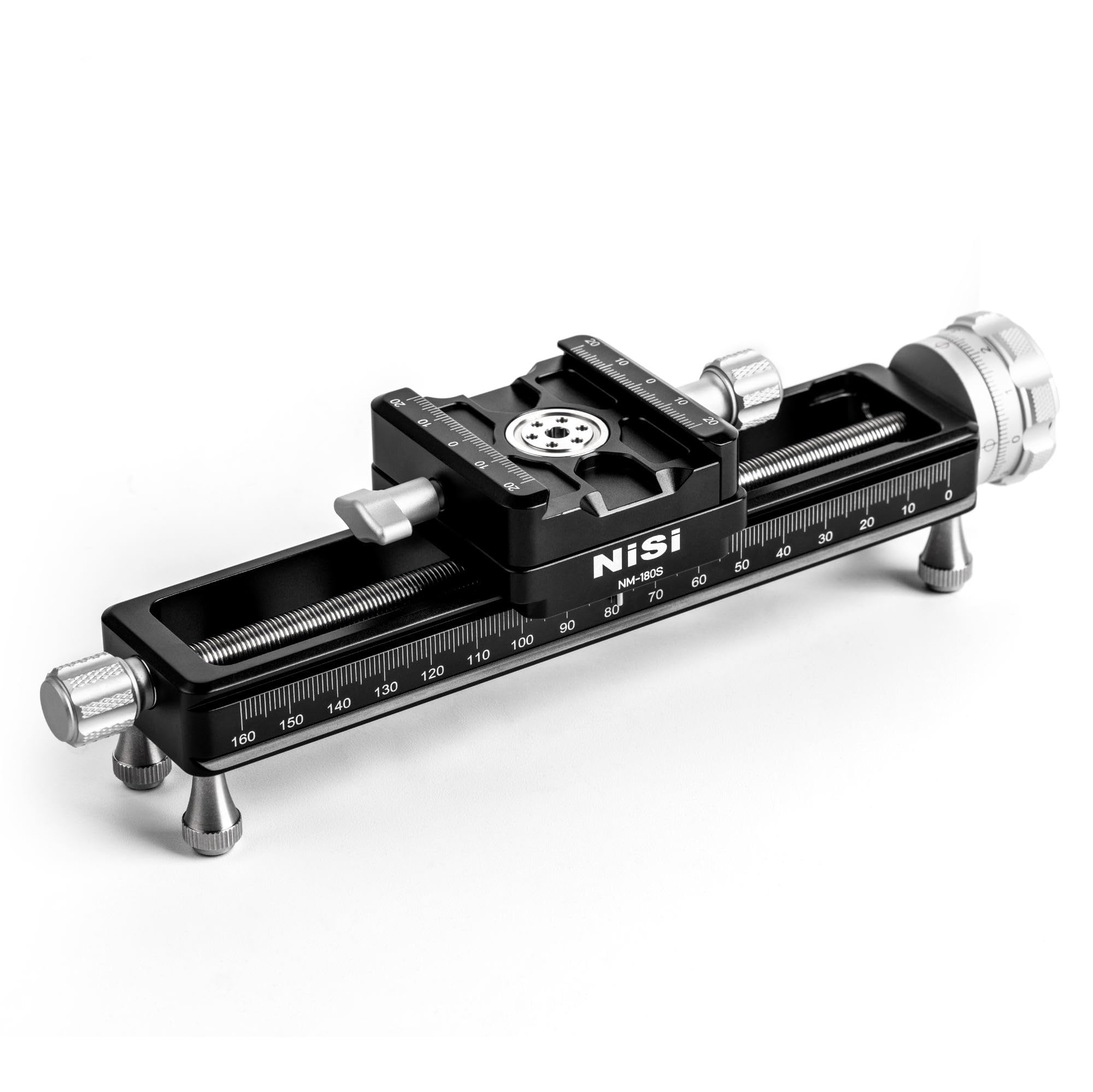
A quarter turn of the clamp put the camera on its side without lifting it off the rail, and that is the moment the NM-180S made its case for us. The clamp rotates a full 360 degrees around an Arca plate, so going from a top-down frame to a side-on one costs a twist instead of a remount — worth a lot when the subject is a flower that is closing or a splash that will not repeat.

The rest is a clean single-axis rail with 160 mm of travel, the longest here, geared to move the carriage 1.25 mm for a full turn of the knob. That is fine enough to advance a stack in tiny, controlled steps, and the movement stays smooth along the whole bed. Machining is CNC aluminium with a scratch-resistant finish, and at 440 g the rail is light for how much of it you get.

The detachable feet are more than a novelty: they let the rail sit directly on a table for copy work, and the double-dovetail base slides into Arca clamps from either direction. We rate it the most versatile rail here for a working session, and it asks one thing in return — a tripod with some mass under it. With a heavy body pushed to the far end of the travel we could provoke a flex that the shorter Haoge does not show, and keeping the camera close to the clamp and the column down settles it.

Pros

  • Rotating clamp switches orientation without remounting
  • 160 mm of travel, the longest in this group
  • 1.25 mm per turn for very fine steps
  • Detachable feet for tabletop work

Cons

  • 160 mm takes many knob turns to cross
Our verdict

Choose this one when you need reach and a clamp that rotates in place — the most versatile rail here, provided your tripod has some mass.

Check Latest Price
4

Best Budget

Koolehaoda 115mm Macro Rail

78 /100
Keeper Score Very Good

Key details

Base
38 mm Arca-type plate
Travel
115 mm
Weight
10.6 oz
Load Capacity
22 lb
Check Price on Amazon

There is no clamp on top of this one. The camera threads straight onto a 48 mm thumbwheel with a 1/4-20 stud, so a body change means unscrewing one camera and winding on another rather than popping a plate. Shoot one body all day and you will never notice; swap between two setups and it is the main reason to look at the NiSi or the Haoge instead.

What the money buys is a properly geared 115 mm rail. The carriage runs on a knob-driven worm gear with millimetre scales down both sides, the movement is smooth, and it holds position when you let go — the whole job, done without drama. The base is a 38 mm Arca-type plate with a 3/8-inch socket, so it drops into an Arca clamp or onto a tripod stud, and at 300 g it is the lightest rail here.

Rigidity is the surprise. A rail this light has no business feeling as solid as it does under a mirrorless body and a macro lens, and the 10 kg rating is far more than a close-up kit will ask of it. Set it once, note the scale reading, and the whole thing behaves like a much more expensive block of metal — it is the rail we stop worrying about.

Pros

  • Smooth worm-gear movement that holds position
  • 38 mm Arca-type base with a 3/8-inch socket
  • Lightest rail here at 300 g

Cons

  • Printed index scales rather than engraved
Our verdict

For a first rail or a spare that lives in the bag, this does the job with a worm gear, marked scales, and no clamp to fiddle with.

Check Latest Price
5

Best Premium

Novoflex Castel-Q Focusing Rack

91 /100
Keeper Score Outstanding

Key details

Mount
Arca-type clamp and dovetail base
Travel
5.5 in
Weight
0.9 lb
Fine Adjustment
15 mm (0.6 in) per rotation
Check Price on Amazon

This is a rail for someone who has decided to buy once. The Castel-Q is a single machined rack rather than a modular system — Arca-type clamp on top, Arca dovetail underneath, drive wheel on the side — and there is nothing to assemble, align, or lose in a bag.

Five and a half inches of travel beats the 115 mm rails comfortably, and the wheel covers 15 mm per full rotation, so long moves are quick. That gearing cuts both ways. Fifteen millimetres a turn is the coarsest in this group — the Haoge covers 4 mm and the NiSi 1.25 mm — so a one-millimetre step is a small fraction of a revolution, and fine focus comes from a light hand rather than from gearing that does the work for you.

Build is why it costs what it does. The movement is smooth over the full length, the clamp locks without shifting framing, and at 0.9 lb it is lighter than the NEEWER despite travelling further. The base doubles up as well: an Arca dovetail for the clamp on your head, plus 1/4-20 and 3/8-16 threads for tripods that do not have one.

Pros

  • Arca clamp and dovetail in one machined rack
  • 5.5 inches of travel with quick wheel movement
  • Dovetail plus 1/4-20 and 3/8-16 threaded mounting

Cons

  • Listed 16-ounce load recommendation rules out heavier rigs
Our verdict

Worth the money for a photographer who wants one Arca-native rack to keep, and who prefers a drive wheel to a knob.

Check Latest Price
6

Quick Repositioning

SIRUI MS18 Macro Rail

83 /100
Keeper Score Excellent

Key details

Weight
15.5 oz
Movement
Single axis; stack two for 4-way
Quick Slide
One-key release
Load Capacity
22 lb
Check Price on Amazon

A release button on the side frees the carriage for hand sliding, and it changes the rhythm of a session — release, slide, lock, instead of winding from one end of the rail to the other between subjects. The button is stiffest once a camera is hanging on the rail, so we set the carriage position first and hung the body on afterwards.

Everything else is built for flexibility rather than sheer precision. The head rotates a full 360 degrees, the feet come off for tabletop work, and the body accepts a second rail in its Arca-style slider, which is how you get four-way movement from this design rather than buying a different one. There is a 10 kg load rating behind all of it, far more than a macro kit will ask, and at 440 g the rail is light enough to live in a bag.

Put the pieces together and the MS18 suits a working session more than a single careful stack: slide to the next subject, spin the head for a different angle, and drop the feet on a table when the tripod is in the way. The trade for that articulation is time at the start, where there is more to square and lock than on a fixed rail.

Pros

  • One-key release for sliding the carriage by hand
  • 360-degree rotating head and detachable feet
  • Stackable for four-way movement
  • 10 kg load rating covers a heavy rig

Cons

  • More to align and lock at setup than a fixed rail
Our verdict

We point quick-working shooters to the MS18 for its slide release, rotating head, and stackable body, accepting single-axis travel on its own.

Check Latest Price

How We Tested Macro Focusing Rails

We started by gathering rails that kept showing up in macro forums and retailer listings, then filtered out anything with vague load ratings, plastic clamp bodies, or no clear compatibility with standard tripod plates. That left us with ten rails to test over eight months. We mounted each on the same tripod and ball head and used the same camera and lens, plus a couple of heavier setups, to see how they handled real close-up work.

Testing happened where macro actually happens: a kitchen table with coins, leaves, and watch parts; a backyard garden in morning light; and a cluttered desk for focus-stacking sessions. We set up low to the ground with the detachable feet, switched to a quick-release clamp when we needed to move the camera, and rotated the head to check whether the framing stayed square.

At each step we pushed the rail by the smallest increment we could manage and watched the live view for any jump or backlash, then locked it and pressed gently on the camera to see if the position held. We counted how many turns it took to move a set distance, checked whether the markings were readable, and noted whether the clamp grabbed the plate without wobble. We also checked the clamp bodies and knobs for flex, carried each rail in a camera bag, and set it up repeatedly to judge ease of use, then compared what each one cost against how smooth and secure it felt.

How to Choose a Macro Focusing Rail

One Axis or Two

One carriage covers most macro work. You set the framing with the tripod head, then use the rail to walk the camera through focus. A second carriage, as on the NEEWER, lets you slide the camera sideways to reframe without touching the legs, which saves a full reset when a subject drifts or when you are working along a row of them.

The cost is height and weight sitting under the camera. If your subjects hold still and the framing is settled before you start stacking, a single-axis rail is simpler and stiffer for the same money.

How Far One Turn of the Knob Takes You

Gearing sets the character of the whole tool. The NiSi advances 1.25 mm per turn, the Haoge 4 mm, and the Novoflex 15 mm, and those figures decide how a session feels: fine gearing gives small repeatable steps but takes many turns to cross the bed, while coarse gearing moves fast and asks for a light hand at the fine end.

Worm-drive rails such as the Haoge hold their position when you let go of the knob, which matters more than outright smoothness when you are stacking. Choose the gearing that matches whether you mostly creep or mostly reposition.

Match the Mount to the Gear You Already Own

Up top you either get an Arca-type clamp, which takes a plate you probably already have, or a threaded stud with a thumbwheel, as on the Koolehaoda — secure, but slower to change a camera. Underneath, most rails offer a dovetail that drops into an Arca clamp, and some add a threaded socket for older heads.

The trap is reading Arca-style as universal. Lever clamps and some plate profiles do not always play nicely together, so check the clamp on your ball head against the plate on your camera before you order rather than after.

Stability Is a Tripod Problem Too

Any rail pushes the camera forward of the head's centre, and a macro lens at 1:1 puts that weight a long way out. Add a light tripod and a raised centre column and you get movement that no amount of machining will fix.

Keep the column down, hang a bag from the hook, and keep the camera close to the clamp rather than parked at the end of the travel. If the tripod under the rail is marginal now, that is where the next upgrade belongs.

Frequently Asked Questions

Final Verdict

We recommend the NEEWER for most macro shooters. Two carriages mean you can reframe without moving the tripod, the knobs engage without a slack zone, and the quick-release plate makes camera changes fast — that combination covers stacking, close-ups, and product work without asking you to buy a second rail.

If your work is pure stacking at high magnification and you want worm-drive precision for less, look at the Haoge FM-160. If you constantly switch between horizontal and vertical framing, the NiSi's rotating clamp pays for itself in saved remounts.