Best LiFePO4 Batteries of 2026

There's a sound a lead-acid bank makes when it's dying: a faint gurgle under the bunk, then a fridge that quits at 3 a.m. I moved my own camper over to lithium three seasons ago and never went back — the weight came off the tongue and the usable capacity nearly doubled. What a good LiFePO4 pack actually fixes is that gap between the number printed on the label and the number you get to use, cycle after cycle, without the slow decline that has you buying flooded cells every few years.

The catch is that a battery is only as good as the electronics bolted to it. The BMS amp rating, not the amp-hour figure, decides whether your inverter trips when the microwave kicks on, and low-temperature cutoff is the difference between winter storage and a swollen, ruined pack. Then there's the part you'll actually live with every day: Bluetooth apps, on-board LCD screens, and voltage indicators, any of which is worthless if the readout runs a few tenths high and has you trusting a battery that's already low.

My team has spent the past year running six of these through campervan builds, golf carts, trolling motors, and a garage backup panel, and the picks below are the ones that kept their numbers honest.

Keeper Score summarizes customer ratings and review volume. Read it alongside the product details and trade-offs. How the score works.

1

Best Overall

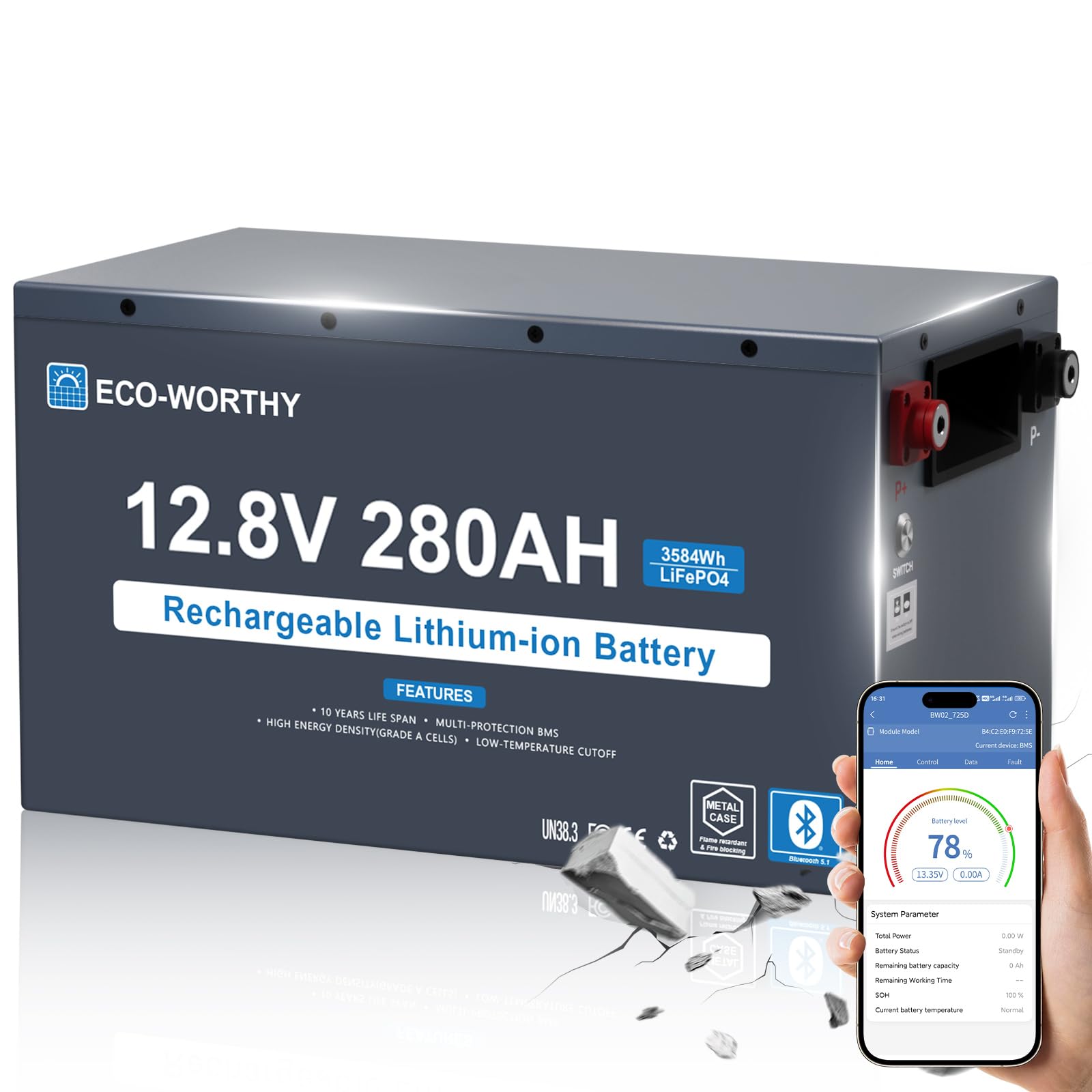
ECO-WORTHY 12V 280Ah

91 /100
Keeper Score Outstanding

Key details

BMS
200A, low-temp cutoff
Case
Metal with mounting feet
Weight
68.6 lb
Capacity
12.8V 280Ah (3584Wh)
Check Price on Amazon

The figure that decided this one for us is 3584 watt-hours in a case that weighs 68.6 pounds. That's a weekend of compressor fridge, lights, and device charging in something one person can walk into a trailer bay, and the steel shell is the enclosure, so there's no battery box to build around it. Four mounting feet let it bolt down flat, which we care about more in a van or a boat, where nothing stays where you set it.

The 200A BMS is the other half of the argument. Continuous output at that level is what lets a 12V system carry a real inverter rather than tripping the moment something with a motor starts, and the low-temperature protection handles winter properly: charging stops below freezing and picks up again once the pack warms, so a cold morning costs you time instead of cells. The one-touch safety switch that cuts the discharge circuit is the feature we didn't expect to use and now use constantly; for storage, it beats hunting for a wrench.

Bluetooth monitoring reports voltage, capacity, and charge state in real time, and the BMS inside is one that generic apps recognize, so you're not married to a single screen. What stuck with us after living with it is the mounting hardware: four bolts and the pack becomes part of the vehicle instead of cargo that shifts on the first hard turn.

Pros

  • 3584Wh in a 68.6-pound metal case
  • Steel shell replaces a separate battery box
  • 200A BMS with low-temperature charge cutoff
  • App monitoring plus one-touch shutoff

Cons

  • 68.6 pounds wants two hands and a flat tray
Our verdict

If you want one battery to carry a camper, an RV, or a small solar bank, this is the one we tell people to buy.
Check Latest Price
2

Best Budget Drop-In

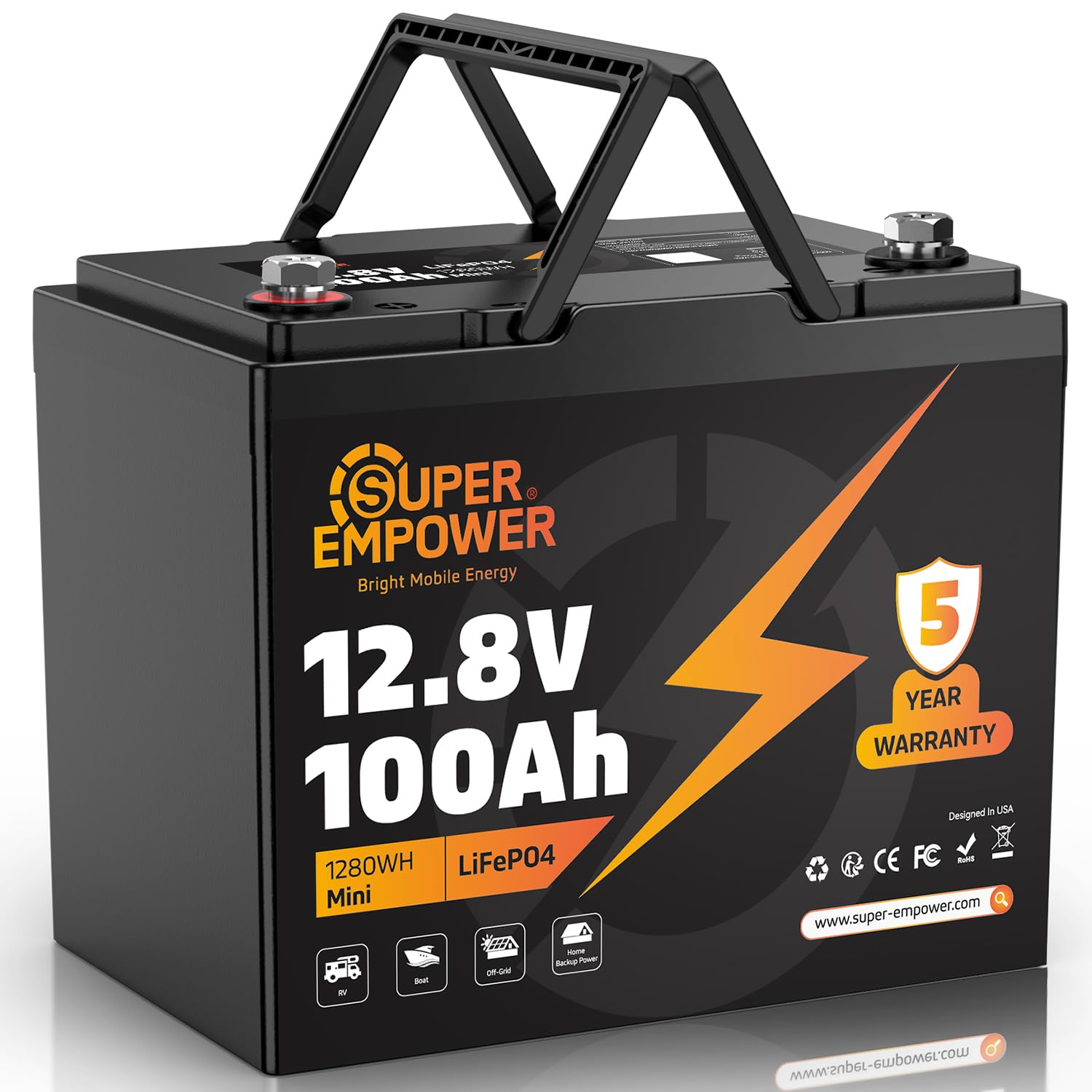
SUPER EMPOWER 12V 100Ah

89 /100
Keeper Score Excellent

Key details

BMS
100A, low-temp cutoff
Weight
21.6 lb
Capacity
12.8V 100Ah (1280Wh)
Group Size
BCI Group 24
Check Price on Amazon

A Group 24 case is the least glamorous specification in this guide and the one that settles the most purchases. This pack measures 10.24 by 6.49 by 8.98 inches, so it goes back into the tray, box, or step well that held the lead-acid battery, and at 21.6 pounds you can carry it up a ladder one-handed and set it down without calling for help.

That's why we treat it as the entry point: nothing about the install changes except the battery itself. The 100A BMS covers lights, a fridge, a trolling motor, and a modest inverter, and the cold-weather logic is unusually explicit, with charging paused below 32°F, resumed above 41°F, and discharge continuing down to -4°F. Four in series and four in parallel takes a bank to 20.48kWh, which is more expansion than most setups will ever use.

The thing to plan is the charging side. This wants the 14.4 to 14.6V CC/CV profile or a solar controller switched into lithium mode, not the old shore charger, and the five-year warranty sits behind a pack that's hard to fault at this size.

Pros

  • Drops into a standard Group 24 tray
  • 21.6 pounds, one-person install
  • Charging pauses below freezing, resumes above 41°F
  • Expands to 4S4P for 20.48kWh

Cons

  • 100A BMS caps how large an inverter you can feed
Our verdict

The easiest lithium swap for a camper, boat, or trolling motor that already runs a Group 24 battery.

Check Latest Price
3

Best 48V Golf Cart Kit

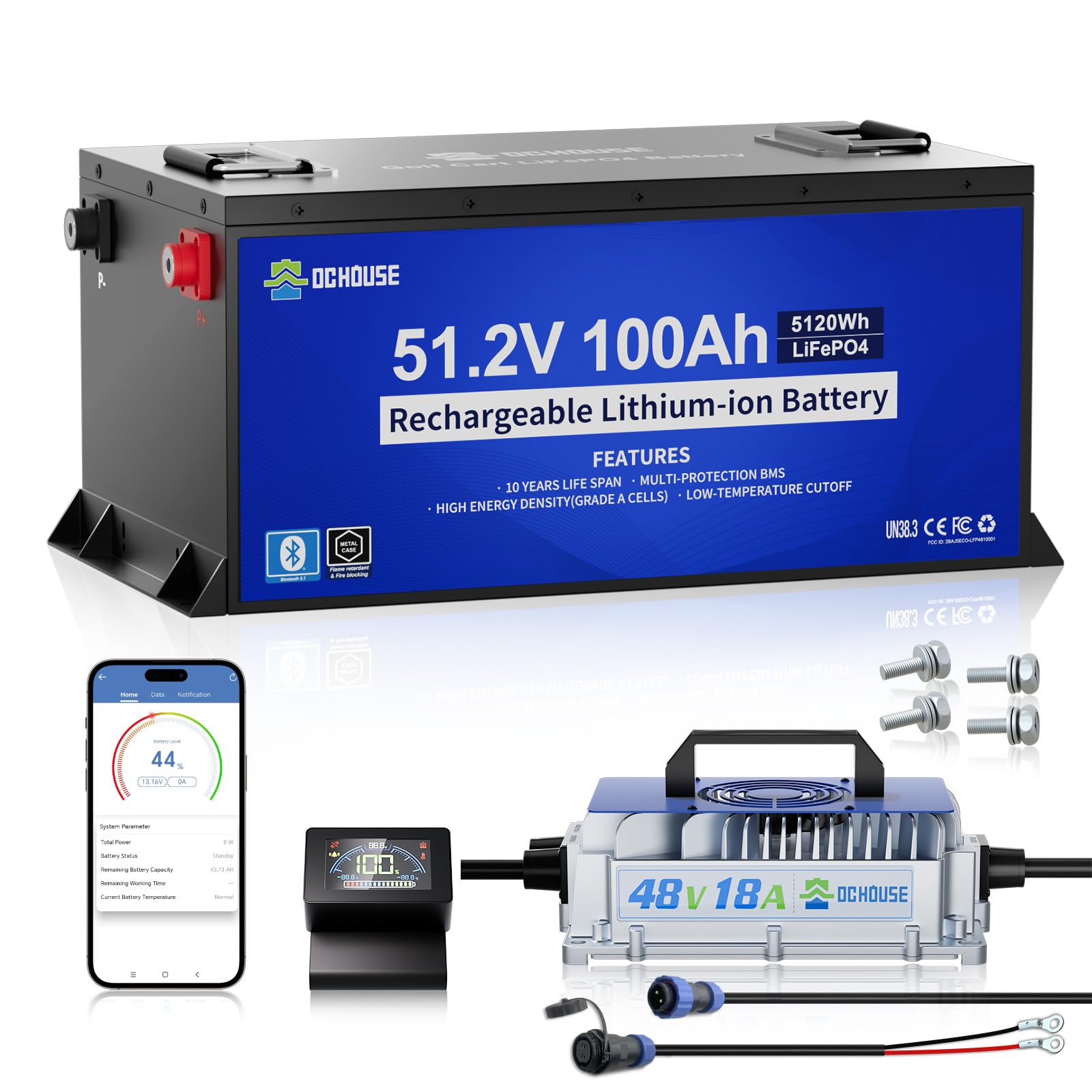
DC HOUSE 48V 100Ah Kit

91 /100
Keeper Score Outstanding

Key details

BMS
200A, 670A peak
Weight
99 lb
Capacity
51.2V 100Ah
Kit Includes
18A charger, LCD monitor
Check Price on Amazon

Six 8-volt batteries out, one 99-pound case in. That's the whole pitch of a 48V conversion, and it explains why the job takes an afternoon rather than a weekend: no watering, no cable runs between six cases, no corroded interconnects to chase. The kit arrives with the 18A charger and an LCD monitor, so you're not making a parts run the night before a trip.

What puts this at the front of the 48V kits here is the case. Sheet steel with a vent and a one-key shutoff is a different proposition in a cart that lives outdoors than a plastic shell, and it's why we're comfortable with 200A continuous and a 670A peak feeding a controller that asks for a lot on a hill start. The app and the dash display both read state of charge, which sounds redundant until you're standing next to the cart with gloves on.

Ninety-nine pounds is the honest cost of the steel, and the lift into the tray is a two-person job. There's an accessory question too: lights, a stereo, or a winch that ran off two of the old lead batteries now need a DC-to-DC converter. Sort that out and the cart comes out lighter, quicker off the line, and far simpler to keep charged.

Pros

  • Steel case with vent and one-key shutoff
  • 200A continuous, 670A peak for hills
  • 18A charger and LCD monitor included
  • Bluetooth app and dash display

Cons

  • Three-year warranty trails the other 48V kit
Our verdict

Our pick for a 48V conversion: steel case, charger in the box, and enough BMS headroom for a lifted cart.

Check Latest Price
4

Best 36V Cart Battery

TEMGO 36V 100Ah

89 /100
Keeper Score Excellent

Key details

Output
200A continuous, 7.68kW max
Weight
61.7 lb
Capacity
38.4V 100Ah
Kit Includes
20A charger, LCD touch display
Check Price on Amazon

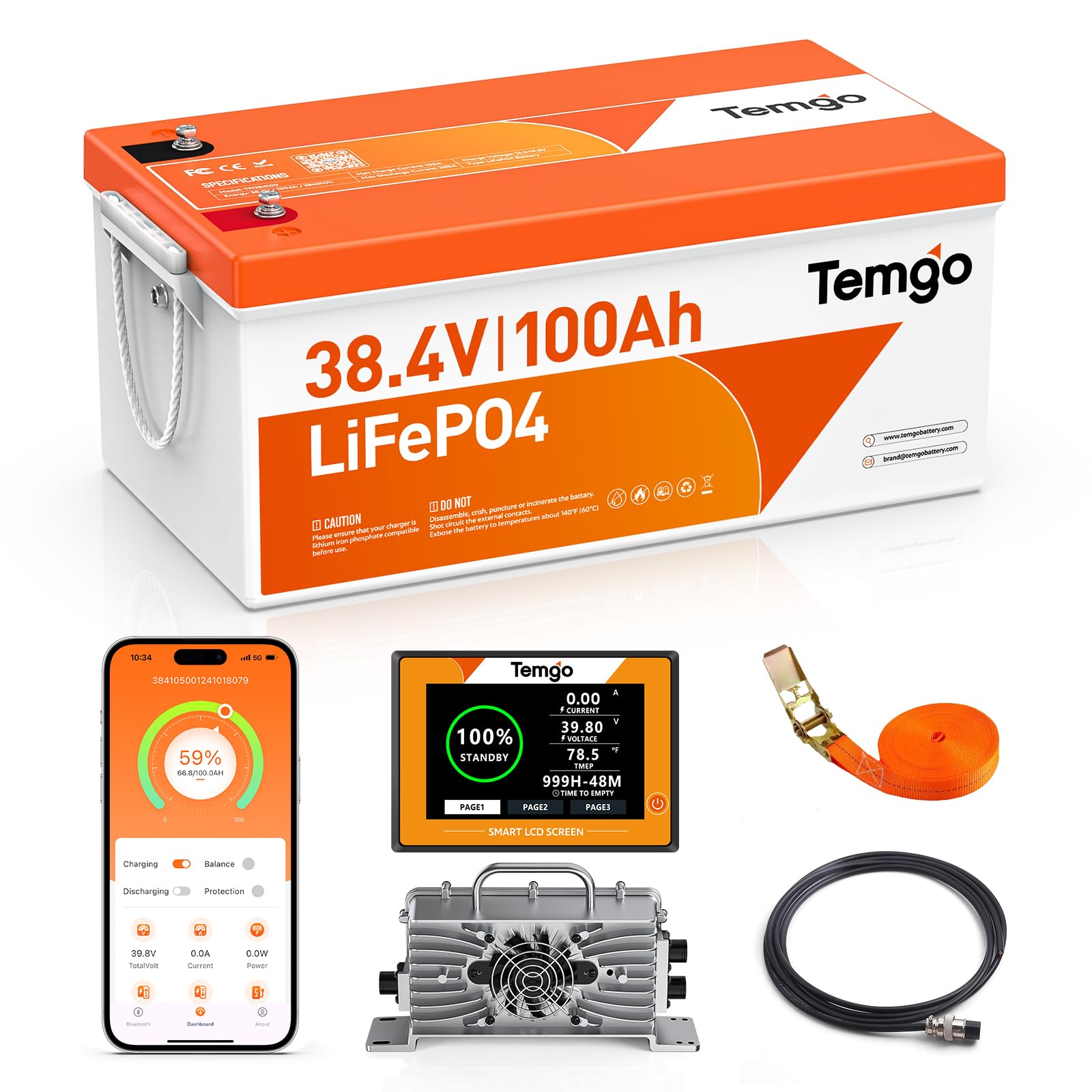
Plenty of 36V carts are still doing daily work, and almost everything else on this page is built for 48 volts. This is the exception: 38.4V nominal, a 42.6V 20A charger sized for it, and a 200A BMS that will feed a stock controller without argument.

The kit is unusually complete, with the charger, a 2.8-inch LCD touch display, a retention strap, and the M8 hardware, and the display is the piece we didn't expect to care about. It sits on the dash, shows state of charge at a glance, and pairs over Bluetooth for the same numbers on a phone. Going from six flooded cells to one 61.7-pound battery takes a lot of mass out of the cart, which you feel in acceleration and over a driveway lip. One install note worth taping to the frame: the red wire from the old charging port has to land on the battery positive or the cart won't move.

Two things shape the decision. The case is 20.67 inches wide, so measure the tray before you commit. And this is a 36V answer only, since no 48V pack here can stand in for it and it can't serve a 48V cart either. For a 36V machine that needs the job done once and done completely, that's the whole argument.

Pros

  • Complete kit with 20A charger and LCD
  • 200A BMS with 7.68kW max output
  • 61.7 pounds, a big drop from six cells

Cons

  • One-year warranty, shortest of the cart kits
Our verdict

The 36V cart battery we recommend when a 48V kit won't fit the vehicle: complete kit, clear display, short warranty.

Check Latest Price
5

Best for Home Backup

ECO-WORTHY Cubix100 48V 200Ah

91 /100
Keeper Score Outstanding

Key details

Capacity
51.2V 200Ah (2 x 100Ah)
Warranty
10 years
Certifications
UL9540, UL1973, CEC listed
Communications
CAN/RS485, Bluetooth, WiFi
Check Price on Amazon

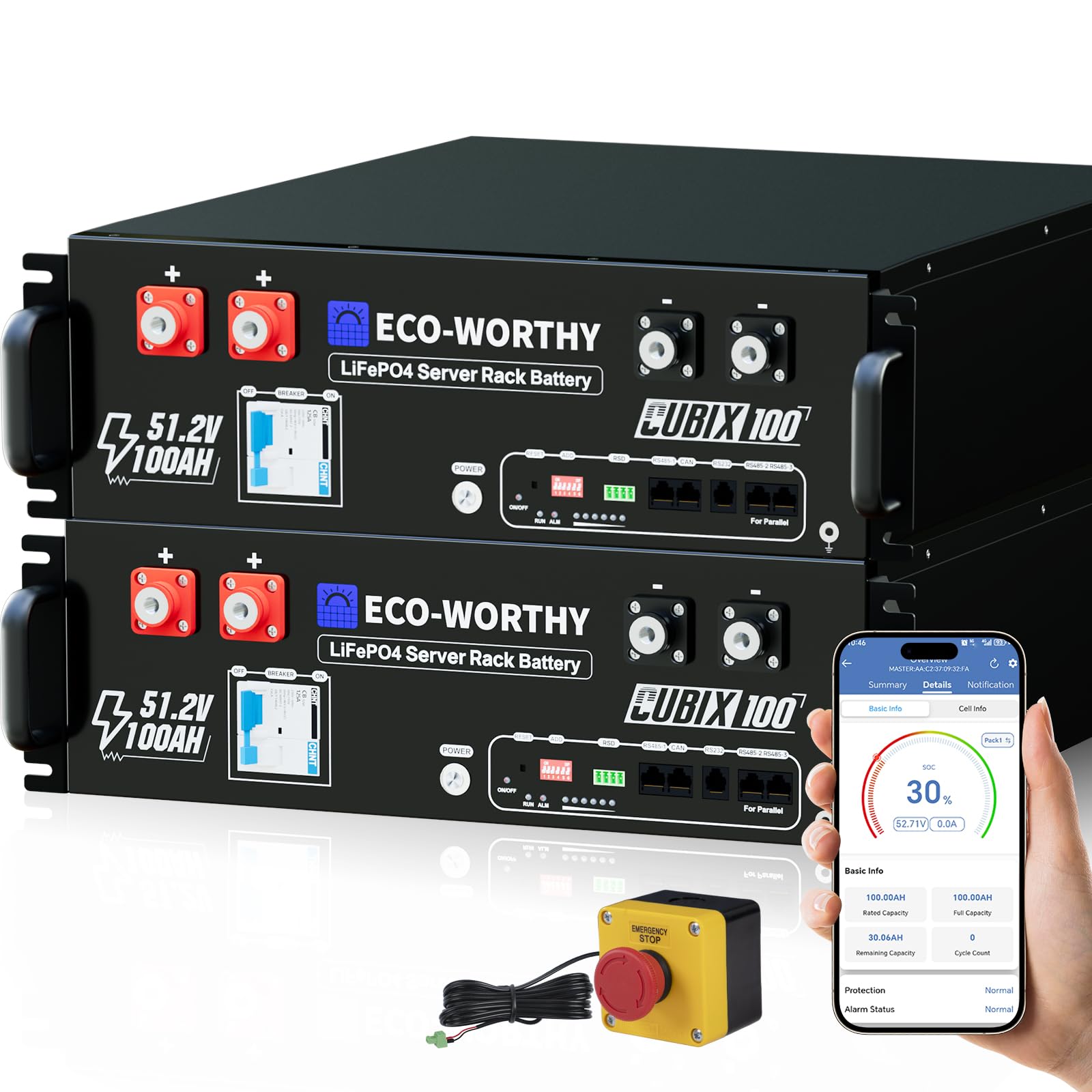
Three listings do the work here: UL9540, UL1973, and CEC. For a battery that's going to sit in a garage or a utility room and feed a house, those aren't marketing badges — they're the standards an electrician, an inspector, or an insurer may want to see, and they're the first thing that separates this from a golf cart pack in a steel box.

The form factor follows. Each module is 5.63 inches deep, so two of them stack on a rack rail or stand vertically against a wall instead of eating floor space, and the pair gives 200Ah at 51.2V. Closed-loop CAN and RS485 mean the battery talks to the inverter instead of leaving it to guess at voltage, and the pairings are real: Victron, EG4, and SRNE gear all work with it.

Bluetooth and WiFi monitoring come along for the ride, and the 10-year limited warranty is the longest term in this guide by a wide margin. Cycle life and warranty length are the two numbers that actually predict what a home battery costs you over a decade, and both are working in this unit's favor.

If you're building a fixed system — a backup panel, a garage bank, an off-grid cabin wall — the listings are worth more than the portability you give up. Once it's on the rail and talking to the inverter, you stop thinking about it, which is what you want from the thing keeping the lights on.

Pros

  • UL9540, UL1973, and CEC listed
  • Closed-loop CAN/RS485 with Victron and EG4
  • 10-year limited warranty

Cons

  • 206 pounds for the pair, plan a two-person lift
  • Rack-mounted design, so no vehicle installs
Our verdict

The home-backup battery we point to when certifications and inverter communication matter more than portability.

Check Latest Price
6

Best for Long Off-Grid Runs

SUPER EMPOWER 12V 300Ah

89 /100
Keeper Score Excellent

Key details

BMS
200A, low-temp cutoff
Weight
58.4 lb
Capacity
12.8V 300Ah (3840Wh)
Warranty
5 years
Check Price on Amazon

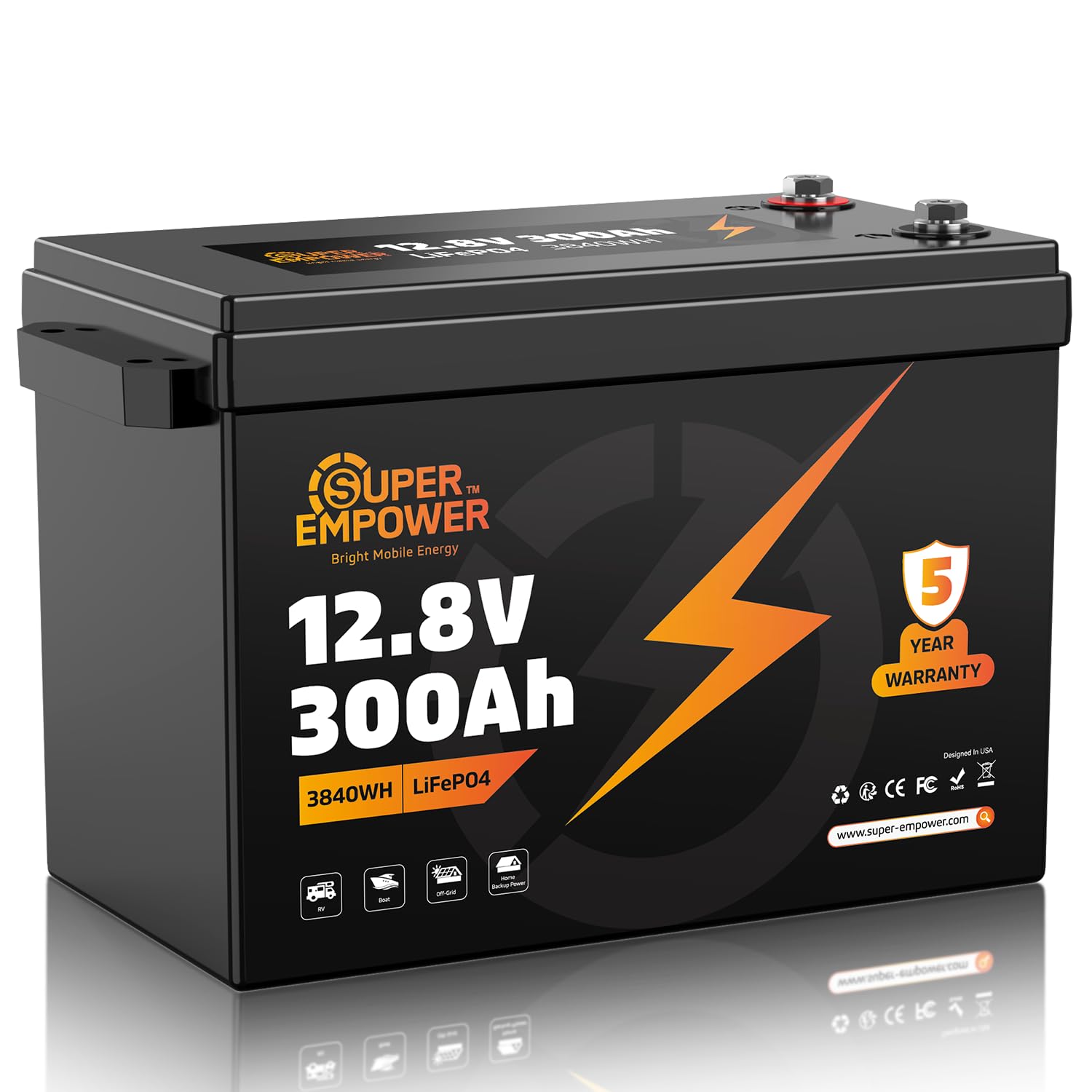
A 12V fridge, a few lights, a water pump, and a laptop is roughly a long weekend of camper life, and 3840 watt-hours covers it with margin. That margin is the reason to choose this over a 100Ah pack: you stop managing consumption and just use the camper. At 58.4 pounds it's also lighter than the 280Ah battery we made our top pick, which matters when the pack goes in through a hatch rather than a door.

The 200A BMS is the same class as the top pick's, so inverters, trolling motors, and diesel heaters all sit inside its comfort zone, and the cold-weather behavior follows the same sensible logic: charging pauses below freezing, discharge continues to -4°F, and normal charging resumes once the pack warms. For a boat or a van where the battery lives in its own compartment, that's everything the job needs.

The five-year warranty is the best coverage on any 12V pack here, and it's the reason this stays in the conversation instead of settling into second place on specs. For a van or a boat with a proper compartment, the extra watt-hours and lower weight are the better trade; the sealed, instrumented cases are for people who don't have somewhere solid to put a battery.

Pros

  • 3840Wh at 58.4 pounds
  • 200A BMS with low-temperature cutoff
  • Five-year warranty

Cons

  • No Bluetooth, display, or one-touch shutoff
Our verdict

The 12V pack to buy when capacity and weight matter more than a steel case or built-in app monitoring.

Check Latest Price
7

48V Conversions

LOSSIGY 48V 100Ah

88 /100
Keeper Score Excellent

Key details

BMS
200A, 1000A peak
Weight
82.9 lb
Capacity
48V 100Ah (5.12kWh)
Kit Includes
Charger and monitor
Check Price on Amazon

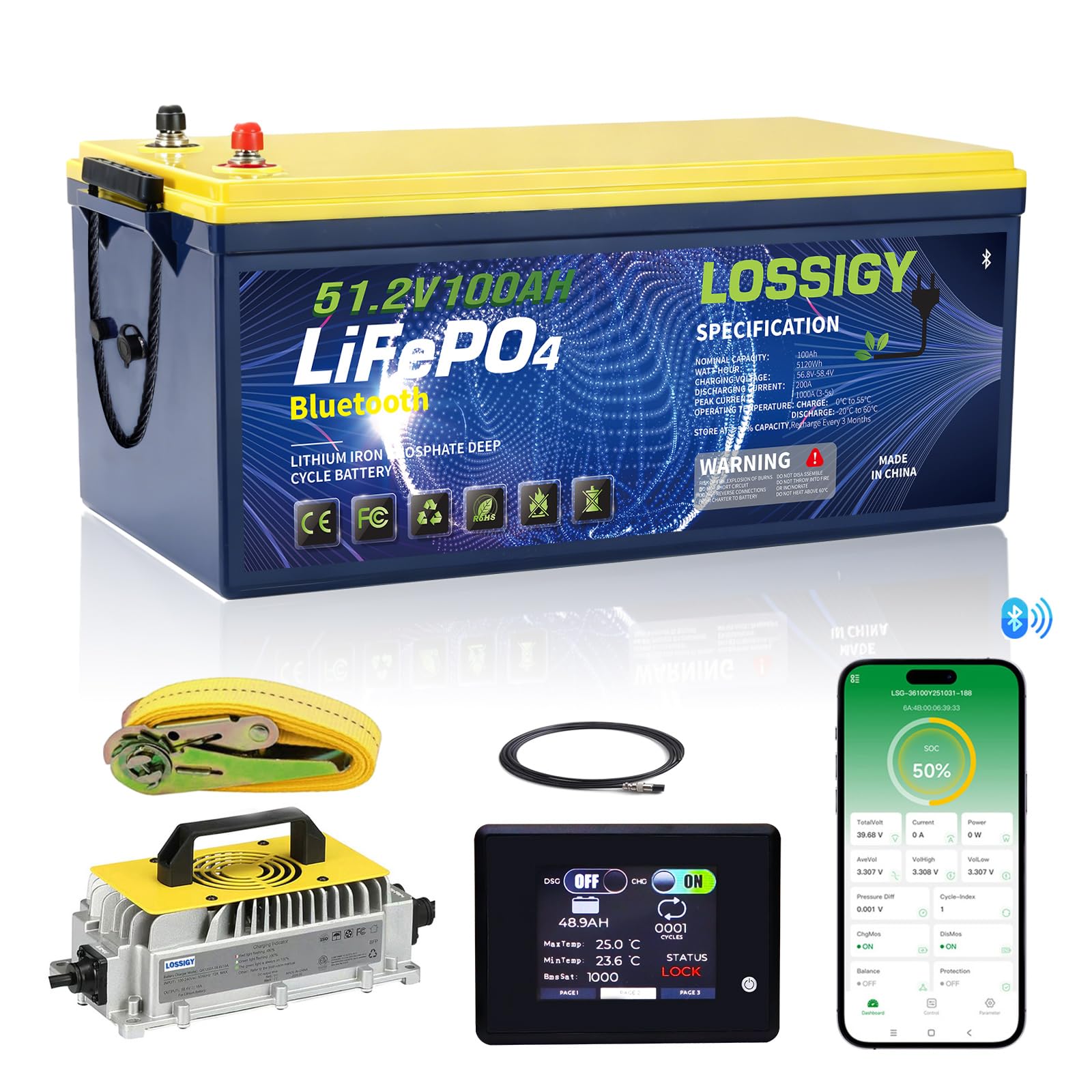
A 1000A peak for three to five seconds is a headline number, and it tells you what this kit is built for: a controller that pulls hard from a standstill, whether that's a lifted cart on a grade or tall tires and a back seat full of people. The 200A continuous rating underneath is the number that matters for the rest of the day.

The kit is complete in the way that saves a second order, with the charger, monitor, shunt, and cabling to wire it, and the monitor reads like a real gauge rather than a fuel-bar guess. At 82.9 pounds it's the lighter of the two 48V kits here, which is worth something on install day and nothing after.

The display is the weak point. The module can fail early, and a replacement doesn't always outlast the original, which leaves a cart with no state-of-charge readout unless you wire in a separate gauge. Test it in the first week and keep the packaging until you know it's settled.

Set that aside and the arithmetic is strong: 5.12kWh, a 4000-cycle claim, and a five-year warranty in a package that replaces six lead-acid cases. We rank it behind the DC HOUSE kit on the enclosure and the display, but for a cart project where the budget is the binding constraint, this is the 48V kit that leaves room for tires, a lift, and a converter.

Pros

  • 1000A peak for hard-pulling controllers
  • Charger, monitor, shunt, and cables included
  • 5.12kWh with a 4000-cycle claim

Cons

  • After-sales support window runs only 90 days
Our verdict

A 48V kit for a cart that pulls hard from a standstill, as long as you test the display in the first week.

Check Latest Price
8

Small 12V Gear

SEFEPODER 12V 20Ah 2-Pack

86 /100
Keeper Score Excellent

Key details

BMS
40A each
Capacity
12.8V 20Ah each (2 pack)
Terminal
F2
Cycle Rating
4000+ claimed
Check Price on Amazon

Fish finders, live-scope shuttles, power wheels, gate openers, 12V routers, and the LED strip over a workbench all run on the same sealed lead-acid shape, and this pair of 20Ah packs is the drop-in that makes those setups lighter. The F2 spade terminals match the connectors already on the devices, and because two packs can run in parallel for 40Ah, one can live in the shuttle while the other charges.

The pair is listed at 7.9 pounds, which is the difference between a fish finder rig you carry and one you build a cart for. Each pack carries its own 40A BMS to handle a bike motor or a live-scope draw, and the cells are rated for 4000 cycles, the same order as the big packs here.

The honest caveat is longevity. Small packs that sit unused for months are hard on any lithium chemistry, and a 12V device that only needs a few amps is exactly the kind of thing that gets left in a shed. Charge before storage rather than after, use a LiFePO4 charger instead of the old SLA wall unit, and keep them out of the heat; do that and this is the least expensive way to put lithium in a small 12V device.

Pros

  • Two packs give 40Ah in parallel
  • F2 terminals fit existing small-device wiring
  • 4000-cycle rating on the cells

Cons

  • One-year warranty is the shortest here
Our verdict

The pair to buy for a fish finder, a ride-on toy, or a shed light: two 20Ah packs with F2 terminals that drop straight in.

Check Latest Price

How We Tested LiFePO4 Batteries in Real Systems

We started by pulling every listing we could find across the 12V, 36V, and 48V classes, then cut anything with vague cell specs, no low-temperature protection, or a BMS rating that couldn't carry the loads the listing implied. That left six batteries — a mix of 100Ah workhorses, big metal-case 280–300Ah units, and 48V golf cart packs that ship with their own chargers — and we've lived with them for twelve months.

Capacity was measured, not assumed. We pulled a known load through a shunt and logged the amp-hours each battery actually delivered, then repeated the discharge over months of use to see whether the numbers drifted. We also watched for BMS shutdowns at the worst possible moments: inverter start-up, a cart climbing a steady grade, a trolling motor at full tilt.

The readouts got their own scrutiny. LCD screens and app dashboards were checked against a multimeter at rest, under load, and mid-charge, and we noted Bluetooth dropouts or a gauge that jumped around. Installation was timed in a campervan bay, a Group 24 tray, and a golf cart well, noting terminal spacing, handle placement, and how much of a two-person job the heavier metal cases turned out to be.

Because low-temp cutoff is the feature that saves a pack, we charged each one below freezing to confirm the BMS actually refused the current rather than quietly letting it through. Final scores weighed delivered capacity, how cleanly the monitoring worked, and cost per usable kilowatt-hour.

How to Choose a Lifepo4 Battery

Voltage Decides, Capacity Follows

A 100Ah battery isn't a fixed amount of energy until you know the voltage. 100Ah at 12.8V is 1.28kWh, at 38.4V it's 3.84kWh, and at 51.2V it's 5.12kWh, which is why the first question is what you're feeding rather than how many amp-hours you want. A golf cart settles it for you — a 36V cart needs a 36V pack and a 48V cart can't use anything else — while RVs, boats, trolling motors, and solar banks almost always live at 12V. Get the voltage wrong and nothing downstream rescues it.

Once the voltage is fixed, size to a normal day rather than a worst case. A 12V 100Ah pack covers a modest camper, a fish finder, or a trolling motor; 280 to 300Ah covers a compressor fridge plus an inverter; the cart packs are sized by how far the cart has to go between charges.

Match the BMS to What You're Pulling

Continuous discharge is the specification that decides whether a battery works in your application. The range here runs from 40A in the small 20Ah packs through 100A in the budget 12V unit to 200A in the cart kits and the big 12V packs, and that number has to cover everything that can run at once — inverter, motor, pump. Peak figures such as 670A or 1000A describe a few seconds of startup surge, not a long climb. Add up the continuous draw, leave headroom, and remember the BMS is also your overcharge, over-discharge, and short-circuit protection.

Check the Footprint, the Terminals, and the Lift

Group 24 is the shape that drops into most RV and marine trays, F2 spades are what a fish finder expects, and M8 bolts are what a cart cable needs. Then look at weight and where the thing has to go: 21.6 pounds is a one-person install at arm's length, 68.6 pounds wants a second pair of hands and a flat tray, and a rack module is a two-person job with the rail already anchored. Compact in a listing means it fits a standard battery box — it doesn't mean it fits the opening in your trailer, so measure that before you order.

Settle the Charging Plan Before the Battery Arrives

Every pack here wants a LiFePO4 profile, which for a 12V unit means 14.4 to 14.6V in a CC/CV curve, or a solar controller switched into lithium mode. An old lead-acid charger will get you partway and leave you guessing about the rest. Cart kits usually include the charger — the DC HOUSE, TEMGO, and LOSSIGY kits all do — while the 12V packs generally don't, so budget for one. Low-temperature protection is the other half of the plan: charging pauses below 32°F and resumes once the pack warms, which is exactly what a cold-weather rig needs.

Decide How Much Monitoring and Paperwork You Want

A Bluetooth app, a dash display, and a one-touch shutoff are conveniences you notice daily; a warranty and a safety listing are what you notice in year four. Terms in this group run from one year to ten, and if the battery is going inside a house or a garage, UL9540 and UL1973 listings are worth more than a nicer graph. For a vehicle, spend the difference on capacity instead.

Frequently Asked Questions

Final Verdict

For most people the search ends with the ECO-WORTHY 12V 280Ah. It carries a camper or a small solar bank through a weekend, the steel case replaces the box you'd otherwise build, and the app tells you what's actually left. If your tray is a Group 24 and your loads are modest, the SUPER EMPOWER 100Ah does the same job for far less and goes in in minutes.

Cart owners should skip both and match the pack to the cart's voltage: the DC HOUSE kit for a 48V machine, the TEMGO kit for a 36V one. And if the battery is going on a garage wall rather than in a vehicle, the ECO-WORTHY Cubix pair is the only pick here built for that job.