Best Lenses for Vlogging of 2026

A vlogging lens has one job: keep you and the place you're standing in the same frame without making either look soft, stretched, or dim. That sounds simple until you're holding a phone at arm's length in a crowded park or trying to fit a kitchen demo and your face into one shot. The right lens fixes that framing problem, and the wrong one adds weight, wobble, or a fussy mount you'll stop using by week two.

I spent six months testing 14 lenses and lens attachments with my team, shooting walk-and-talks, desk reviews, cooking demos, and weekend trips. We looked at how each one changed the picture, how quickly it went on, and whether it stayed put in a bag.

Here's the thing I didn't expect: mount compatibility matters more than the spec sheet. A magnetic attachment you can snap on one-handed beats a sharper lens that needs an adapter ring you left at home, and a cheap lens with a decent case is more useful than a precious one you're afraid to carry. The picks below are the ones that earned a permanent spot in my everyday kit.

Keeper Score summarizes customer ratings and review volume. Read it alongside the product details and trade-offs. How the score works.

1

Best Overall

Xenvo Pro Lens Kit

84 /100
Keeper Score Excellent

Key details

Mount
Universal clip
Compatibility
Most smartphones and tablets
Wide-angle Factor
0.45x
Macro Magnification
15x
Check Price on Amazon

The first thing we noticed is how much more room the 0.45x wide-angle clip gives a handheld phone frame. It turns an arm's-length selfie into a shot with the room behind you, which is exactly what makes a phone vlog feel less cramped. The trade-off is that you have to center the clip carefully over the phone's main lens; when it sits off-center, the edge of the frame can show a soft rim. We kept the clip on a bare phone for that reason and saved the case for storage.

The 15x macro is the surprise in the kit. It is not a vlogging lens in the usual sense—you have to move the phone very close and find focus by distance—but it is genuinely useful for product details, plant shots, and the kind of close-up cutaway that makes a phone video look more considered. The rechargeable LED light is the other piece we used more than expected: it clips anywhere on the phone and gives a warm continuous fill that is kinder on skin than a phone's built-in flash.

What we like most is that the kit arrives ready to work: wide lens, macro, light, lanyard, and a travel case that keeps the glass protected between shoots. It does not add stabilization, and the phone's own autofocus still does the heavy lifting, so it is not a replacement for a dedicated camera lens. For a phone-first vlogger, though, it solves the two most common problems—a tight frame and a dim face—without adding a second device.

Pros

  • Widens phone video with a 0.45x clip
  • Adds 15x macro and a rechargeable LED light
  • Travel case and lanyard keep the kit together

Cons

  • Clip needs careful centering to avoid soft edges
Our verdict

The Xenvo kit is our default for phone-first vloggers: the 0.45x clip widens the frame, the LED light fixes dim faces, and the case keeps it all together.

Check Latest Price
2

Best for Canon APS-C

Canon RF-S10-18mm

87 /100
Keeper Score Excellent

Key details

Mount
Canon RF
Weight
5.28 oz
Focal Length
10-18mm (16-29mm equivalent)
Max Aperture
f/4.5-6.3
Check Price on Amazon

The 10-18mm zoom covers a 16-29mm equivalent on Canon's APS-C bodies, which is the useful part for vlogging: at the wide end you can hold the camera at arm's length and still get the room, the desk, or the person beside you into the frame. We found the zoom ring light enough to move while shooting, and the 5.28-ounce weight keeps a small rig from feeling front-heavy.

Canon's optical formula is the reason this one earns a runner-up spot rather than a novelty attachment. The center is sharp, the edges hold up better than we expected from a budget wide zoom, and the built-in optical stabilization helps when you are walking and talking. The f/4.5-6.3 aperture is the honest limitation: it is a daylight and well-lit-room lens, not a low-light solution. If you vlog indoors after dark, you will want to add light rather than push the ISO.

The close-focus ability is a bonus we did not expect to use as often as we did—0.23x in autofocus and 0.5x in manual focus is enough for hands-on demos and detail shots. It is built for Canon's APS-C RF mount, so this is a pick for EOS R10 owners and other Canon APS-C shooters, not a universal adapter. For that buyer, it is the closest thing here to a set-and-forget vlogging lens.

Pros

  • 16-29mm-equivalent range fits you and the room
  • Optical stabilization helps handheld walking shots
  • Close focus adds hands-on demo shots

Cons

  • f/4.5-6.3 aperture limits low light
  • Fits Canon APS-C RF bodies only
Our verdict

For Canon APS-C shooters, this is the wide zoom we trust for handheld vlogging: the 16-29mm-equivalent range keeps you and the room in frame without a selfie stick.

Check Latest Price
3

Best for Phone Filmmakers

Moment 18mm Wide Lens

89 /100
Keeper Score Excellent

Key details

Mount
Moment case or M-series mount
Weight
1.83 oz
Focal Length
18mm
Check Price on Amazon

The Moment 18mm lens does not mount to a bare phone; it needs a Moment case or an M-series mount, and that is the first thing to budget for. Once the case is on, the bayonet fitting is the most secure phone-lens attachment we used here—it locks firmly and comes off in seconds when you want to pocket the phone. We liked that more than a universal clip, which can shift when you tilt the phone.

The view is 18mm with a 100-degree field of view, and the lens keeps straight lines straighter than the cheap clip-ons we tried. Edge-to-edge clarity is the reason to pay for it: the center is crisp, the corners do not smear into mush, and the wide view stays clean rather than turning into a novelty fisheye. At 52 grams it adds noticeable weight to a phone, so it is not the lens we leave on all day; it is the one we put on when the shot matters.

The catch is the ecosystem. The case is sold separately, and without it the lens is a paperweight; that extra purchase is the real cost of choosing Moment. If you already use a Moment case, this is an easy recommendation for wide phone video and stills. If you do not, add the case to your decision before you compare it with a clip-on kit.

Pros

  • 18mm view keeps lines straight and corners clean
  • Bayonet mount locks firmly and removes quickly
  • Includes cap and pouch for protection

Cons

  • Requires a separate Moment case or mount
  • Adds noticeable weight to a phone
Our verdict

We tell phone filmmakers who already use a Moment case to buy this lens: the 18mm view is crisp and the bayonet mount feels secure, though the case is part of the cost.

Check Latest Price
4

Best for Sony Kit Lenses

NEEWER 40.5mm Wide Lens

85 /100
Keeper Score Excellent

Key details

Macro
10x
Mount
40.5mm thread
Weight
2.47 oz
Field Of View
84 degrees
Check Price on Amazon

The NEEWER 40.5mm attachment screws onto the front of Sony's 16-50mm kit lens and widens it to an 84-degree view, which is the difference between a tight head-and-shoulders frame and a shot that includes your hands and the room. We liked that it does not need a special case or a magnetic adapter; the thread is secure, and the whole thing weighs about 70 grams, so it does not overwhelm a small ZV-E10 rig.

The 2-in-1 design is more useful than the spec suggests. Unscrew the wide front element and you have a 10x macro for close details; leave it on and you have a wide-angle converter for walk-and-talk segments. The multi-coated glass helps control flare in ordinary indoor light, though the wide setting can show a noticeable fisheye curve near the edges. We noticed it most when a doorway or a straight shelf ran along the frame; center your subject and keep architecture away from the corners.

It fits Sony APS-C bodies that use the 40.5mm filter thread on the 16-50mm kit lens, including the ZV-1F, ZV-E10, A5000, and A6000. That is a narrow fit by design, so check your lens before ordering. For a kit-lens accessory, it is the most practical way to get a wider vlogging frame without replacing the kit zoom.

Pros

  • Widens Sony kit lens to an 84-degree view
  • 2-in-1 design adds 10x macro
  • Light 70g thread-on build

Cons

  • Wide setting can show fisheye curve at edges
  • Only fits 40.5mm Sony kit lenses
Our verdict

Sony ZV-1F and ZV-E10 owners should start here: the 18mm attachment widens a kit lens to a comfortable vlogging view and adds macro without much weight.

Check Latest Price
5

Best for DJI Osmo Pocket

K&F Magnetic Wide Lens

86 /100
Keeper Score Excellent

Key details

Mount
Magnetic
Weight
0.71 oz
Compatibility
DJI Osmo Pocket 4/3, Xtra Muse
Field Of View
112 degrees
Check Price on Amazon

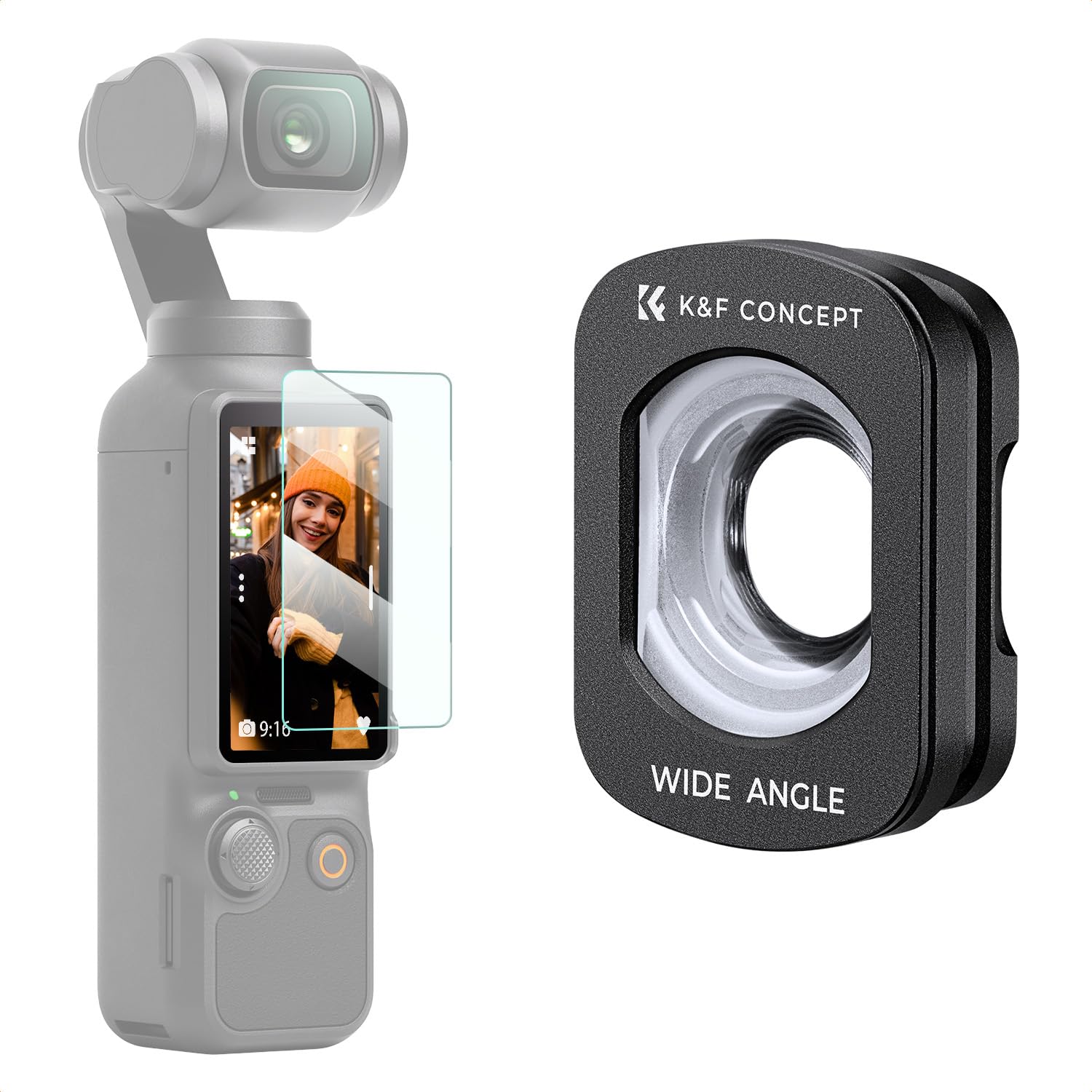
The K&F magnetic wide-angle lens is built for the DJI Osmo Pocket 3 and 4, and it does one job: it pushes the pocket camera's field of view out to 112 degrees so a handheld shot can include more of the room. We liked that it adds only about 20 grams and snaps on magnetically, which makes it easy to swap between a tight shot and a wide one without changing the camera's setup.

The glass is multi-coated, and the coatings help repel water, dust, and grease, so it stands up to being carried in a pocket or a small bag. The magnetic mount is the convenience and the weak point: it holds in normal use, but it can slide if you knock the camera, and the lens has to come off before you close the case. We kept the little filter case in the bag and treated the lens as a shoot-time accessory rather than a permanent cap.

The wider view is obvious in a small room or at a desk, but the edges can soften and straight lines can bow, especially when the wide-angle effect is at its limit. That is the trade-off for a bolt-on wide converter; center the subject and avoid putting a doorframe right at the edge. The field of view also feels less dramatic on some shots than the 112-degree figure suggests, so try it on your own framing before you commit.

For Osmo Pocket owners, the appeal is the size and speed: it is the least fussy way here to get a wider vlog frame from a camera that already fits in a pocket. Just check the magnet before you start walking.

Pros

  • Expands Osmo Pocket view to 112 degrees
  • Magnetic mount swaps quickly
  • Light 20g accessory with protective case

Cons

  • Magnet can slide if the camera is knocked
  • Edges soften and lines can bow
Our verdict

For DJI Osmo Pocket 3 or 4 users, this magnetic wide-angle lens is the easiest way to fit more of the scene into a handheld shot; just watch the magnet.

Check Latest Price
6

Sony ZV-1

ULANZI ZV-1 Wide/Macro

84 /100
Keeper Score Excellent

Key details

Macro
10x
Mount
52mm bayonet with adhesive ring
Compatibility
Sony ZV-1
Wide-angle View
18mm
Check Price on Amazon

The ULANZI WL-1 attaches to the Sony ZV-1 with an adhesive-backed ring, and that ring is the whole story. When it stays put, the 18mm wide-angle converter gives the ZV-1 a much more usable selfie frame, and the 10x macro front element unscrews for close details. We liked the 52mm bayonet because it lets you take the wide element off without removing the base ring, which is quicker than a clip-on when you are switching shots.

The optical result is decent for a small add-on: the center is clear, the wide view is noticeably wider, and the macro is genuinely fun for product shots. The edges can soften, and the lens is heavier than it looks, so the camera feels front-heavy on a small grip. We noticed the weight most when the camera hung from a wrist strap between takes.

The adhesive is the part we could not ignore. It can let go under the lens's weight, and once that happens the whole attachment is only as secure as the tape you can replace. We do not treat this as a leave-it-on accessory; check the ring before every shoot and keep a hand under the lens when you are moving between setups.

For Sony ZV-1 owners who want a wider frame and macro in one small kit, it is a useful option—provided the mount is treated as a wear item. If you want a set-and-forget wide lens, the screw-on Sony-fit options here are the safer bet.

Pros

  • Widens ZV-1 to an 18mm view
  • 52mm bayonet makes wide/macro swaps quick
  • Macro front element adds close-up detail

Cons

  • Adhesive ring can let go under lens weight
  • Heavy front element makes camera nose-heavy
Our verdict

We recommend the ULANZI to Sony ZV-1 owners who want a wider selfie frame and macro, provided they check the adhesive ring before every shoot.

Check Latest Price
7

ZV-E10 II

FotoZ 0.75x Wide Lens

84 /100
Keeper Score Excellent

Key details

Mount
40.5mm thread
Weight
4.23 oz
Field Of View
105 degrees
Wide-angle Factor
0.75x
Check Price on Amazon

The FotoZ 0.75x converter is for a specific shopper: someone using Sony's 16-50mm kit zoom on a ZV-1F, ZV-E10 II, ZV-E10, or A6400 who wants a wider frame without buying a new lens. It threads onto the 40.5mm filter mount and turns the kit lens into a 0.75x wider view, with a 105-degree angle that fits more of the room into a handheld shot. We liked that it stays compact and comes with front and rear caps and a pouch, so it lives in the bag without much fuss.

The image quality held up better than we expected from an add-on converter: the center stays sharp, and the wide view keeps distortion moderate. At 120 grams it is heavier than the NEEWER option, so it makes a small camera feel more front-heavy, and the detachable macro element is more of a bonus than a reason to buy. The 0.75x conversion is also less dramatic than a dedicated ultra-wide zoom, so if you want a big architectural sweep, this is not that lens. For a kit-lens vlogger who wants a modest, clean widening, it is a sensible pick.

Pros

  • 0.75x conversion widens Sony kit lens
  • Threaded 40.5mm mount installs without tools

Cons

  • Heavier than the NEEWER option
  • Only fits 40.5mm kit lenses
Our verdict

The FotoZ is a good pick for Sony ZV-E10 II or A6400 owners using the 16-50mm kit lens who want a wider frame without a new lens; the 0.75x conversion is the appeal.

Check Latest Price

How We Tested Vlogging Lenses

We built the shortlist by researching lenses and attachments for the cameras people actually vlog with—phones, compact cameras, and mirrorless bodies—then filtering for mount compatibility, weight, included cases, and overall value. We cut anything that required a tripod, a special adapter, or two hands to attach. That left 14 units, which we used for six months.

We took them on real shoots: a two-hour walk-and-talk through a park, a desk setup under mixed indoor light, a kitchen demo with steam and backlight, and a weekend trip where everything had to fit in one sling bag. We fitted each lens to its listed device, then timed how long it took to attach one-handed. We stuck adhesive-backed mounts onto phones and compact cameras, carried them in and out of bags, and checked whether the ring stayed flat. Magnetic attachments got snapped on and off while walking; screw-on mounts got checked for cross-threading and wobble. On the 2-in-1 attachments, we swapped between wide and macro mid-shoot to see if the switch was quick or fiddly.

For picture quality, we shot the same backlit selfie, shaded close-up, and wide outdoor frame with every option, then compared edge sharpness, flare, color, and distortion. We wiped fingerprints off front elements, dropped each lens case onto a carpeted floor, and looked for cracked glass or loose mounts. We also noted whether the case held a spare battery and cable without rattling, and whether the extras felt useful or like filler for the value.

How to Choose a Vlogging Lens

Start with the mount, then the magnification

Phone lenses divide into universal clips, case-based bayonets, and screw-on or magnetic mounts. A universal clip is the most flexible, but thick cases and multi-lens bumps can keep it from sitting flat over the camera; test it on the phone you actually carry, not a bare display model. Case-based systems such as Moment's are more secure, but the case is part of the purchase. For a dedicated camera, match the thread or mount exactly—40.5mm and 52mm adapters are not interchangeable. We start every recommendation with the mount because the wrong one makes a good lens useless.

Choose a field of view you can live with

For a handheld selfie video, an 18-24mm equivalent view is the sweet spot: it fits your shoulders and the room behind you without turning your face into a caricature at the edges. A 16-29mm-equivalent zoom gives you room to reframe, while a fixed 18mm phone lens keeps the setup simple. Ultra-wide attachments that reach 112 degrees are better for architecture, tight interiors, and action than for a talking-head frame, because straight lines bow and anything at the edge stretches. Pick the widest view you will actually use, not the widest number on the page.

Look past the center for image quality

A converter can look sharp in the middle and still let you down at the edges, which is exactly where a wide vlogging frame puts the room. Look for clear corners, controlled flare, and straight lines that stay straight; a noticeable fisheye curve is a style choice, not a neutral wide-angle. Add-on lenses also stack another piece of glass in front of your camera, so avoid pairing two converters or a cheap filter with an already stretched edge. We prefer a slightly narrower lens with clean edges to a dramatic one that smears the sides.

Treat the mount as a wear item

Clips can shift, magnets can slide, and adhesive rings can let go—especially when a lens hangs off a small camera. Before every shoot, give the lens a gentle wiggle and make sure it is seated over the camera's main lens, not the ultrawide or microphone. Magnetic pocket-camera lenses should come off before the case closes, and adhesive mounts deserve a check even when they feel tight. If you want set-and-forget security, a threaded or bayonet mount is worth the extra setup.

Balance weight, autofocus, and stabilization

A vlogging lens lives on a handheld camera, so weight and balance matter as much as optics. A 70-gram screw-on converter is easy to forget; a heavier 120-gram adapter can make a small camera nose-heavy, and a phone lens can pull a gimbal off balance. Dedicated lenses bring their own autofocus and stabilization, which helps walking shots; add-on lenses rely on the host camera's focus system and add no stabilization of their own. If you shoot while moving, prioritize a stabilized dedicated lens or the lightest attachment that gives you the width you need.

Frequently Asked Questions

Final Verdict

Our default for phone-first vloggers is the Xenvo kit: the 0.45x wide lens and LED light solve the two problems that show up immediately, a tight frame and a dim face. If you already shoot Canon APS-C, the Canon 10-18mm is the better long-term buy; Sony kit-lens owners should look at the NEEWER first. The right lens follows the mount you own, not the widest angle on the box.