Best Lavalier Microphones of 2026

Viewers will forgive a shaky frame. They will not forgive bad sound. A lavalier mic fixes that by clipping a tiny microphone to your collar, inches from your mouth, instead of recording whatever the camera's built-in mic picks up from across the room. The catch is that the category splits in two: wireless kits that pair a transmitter with a receiver and a charging case, and wired lavs that plug straight into a 3.5mm jack.

That fork is where most people get stuck. Wireless sets are convenient, but you have to match the receiver to your phone's port — Lightning, USB-C, or a camera's 3.5mm — and the cheap ones start hissing the moment you step back. Wired lavs are quieter and simpler but tether you to the camera. Over the past six months, my team and I clipped 12 of them onto shirts, helmet liners, and jacket collars to see which ones stayed clean.

Two things surprised me. Build quality matters more than people expect — a lav gets yanked, sat on, and jammed into a pocket, and the clip usually fails before the capsule does. Battery claims also run optimistic in the cold. The ones below are what survived.

Keeper Score summarizes customer ratings and review volume. Read it alongside the product details and trade-offs. How the score works.

1

Best Overall

Hollyland Lark M2

95 /100
Keeper Score Outstanding

Key details

Battery
10 hrs per transmitter, 40 hrs with case
Audio Format
48 kHz/24-bit, 70 dB SNR
Receivers Included
Camera (3.5 mm), USB-C, Lightning
Transmitter Weight
0.32 oz
Check Price on Amazon

Three receivers live in the Lark M2's charging case: a 3.5 mm one for a camera, a USB-C one and a Lightning one. That single fact is why it ended up as our top pick. Most kits here give you the receiver that matches one device and leave you buying an adapter for the second, and the arithmetic gets worse the moment a phone joins a camera setup. The transmitters weigh 9 g, and Hollyland includes both a magnet clip and a silicone necklace mount, so you can hang one on a lanyard instead of clamping it to a collar.

Audio is 48 kHz/24-bit with a 70 dB signal-to-noise ratio, which is the working standard for this class rather than a headline. What impressed us is how little there is to get wrong. The transmitters arrive paired, a yellow button switches noise cancelling on and off in a single press, and the camera receiver has a mono/stereo switch for two-person shoots. There's no app in the chain and no menu to learn before your first take.

Battery is the other quiet advantage. The case takes the kit to roughly 40 hours, which is enough for a multi-day trip without hunting for a cable, and the 300 m rating is more than most shoots need. 2.4 GHz is still 2.4 GHz, though, and a crowded venue is where any wireless kit gets tested.

What it doesn't give you is control. Noise cancelling is one press rather than a set of levels, and nothing here records a backup file inside the transmitter the way the DJI Mic 2 does. Neither has stopped us reaching for this case first.

Pros

  • Camera, USB-C and Lightning receivers in one case
  • 9 g transmitters with magnet and necklace mounts
  • 48 kHz/24-bit audio at 70 dB signal-to-noise
  • Charging case takes the kit to about 40 hours

Cons

  • Noise cancelling has no level adjustment
  • About 10 hours per transmitter before a recharge
Our verdict

We recommend it to almost everyone: three receivers cover a camera and both phone types, and the 9 g transmitters vanish on a collar.

Check Latest Price
2

Best Ultralight

DJI Mic Mini

93 /100
Keeper Score Outstanding

Key details

Battery
Up to 48 hrs with charging case
Noise Cancelling
2 levels (Basic, Strong)
Transmission Range
Up to 400 m
Transmitter Weight
0.35 oz
Check Price on Amazon

Ten grams is the number DJI leads with, and it's the right one. The transmitter sits on a T-shirt without dragging the neckline, which is the difference between a subject who forgets the mic and one who keeps touching it. The set is two transmitters, one receiver and a case rated for 48 hours of charging, and the whole thing is small enough to live in a jacket pocket.

Two noise-cancelling levels are the practical part — Basic for a quiet room, Strong for a street — and automatic limiting catches the sudden laugh that would otherwise clip. If you already shoot on DJI hardware, the transmitter can talk to OsmoAudio devices such as the Pocket and Action cameras with no receiver in the chain at all, at 48 kHz/24-bit. That's the feature we point a DJI owner to first.

Phone recording is the part to check. With a phone you need the receiver in the chain, and some iPhone setups end up routing through a third-party camera app rather than the native one. The rest is straightforward: 400 m of rated range, two transmitters for two people, and a case that keeps both topped up. If your bag is DJI, this is the least fuss of anything here; if it isn't, the receiver-based kits do the same job with fewer conditions.

Pros

  • 10 g transmitter disappears on a shirt
  • 48 hours of charge with the case
  • Receiver-free link to DJI OsmoAudio cameras

Cons

  • Receiver-free direct link works only with DJI devices
Our verdict

Our pick for DJI shooters: the transmitter links straight to Osmo cameras, and the case holds 48 hours of charge.

Check Latest Price
3

Best for Backup Recording

DJI Mic 2

93 /100
Keeper Score Outstanding

Key details

Receiver
OLED display with headphone out
Internal Recording
32-bit float, up to 14 hrs per transmitter
Transmission Range
250 m (FCC)
Signal-to-noise Ratio
85 dB
Check Price on Amazon

Every transmitter in the Mic 2 set is also a recorder. It writes 32-bit float audio internally, up to 14 hours per transmitter, which means a dropped wireless link or a badly set camera gain no longer costs you the take — you go back to the file and pull the audio out. For interviews and one-shot pieces, that's a different kind of insurance from a longer range figure.

The rest of the kit is built for the same buyer: 250 m of rated range, transmitters and receiver pre-linked, both USB-C and Lightning adapters in the box, and a receiver with an OLED display and a headphone jack so someone can actually listen while it records. We think the display and the monitoring jack matter more than they sound, because checking level on a small screen beats discovering the problem in the edit.

It is the most expensive kit on this page, and what you're paying for is the safety net plus that receiver, not a bigger capsule. If you shoot scripted, repeatable content on a phone, put the difference toward a second transmitter instead; if you shoot once and can't go again, this is where it goes.

Pros

  • 32-bit float backup inside each transmitter
  • Up to 14 hours of internal recording per transmitter
  • OLED receiver with headphone monitoring
  • USB-C and Lightning adapters both included

Cons

  • Premium price against every other pick here
Our verdict

The kit we hand people who can't afford a lost take: every transmitter records its own 32-bit float backup.

Check Latest Price
4

Best Value Wireless Kit

Hollyland Lark A1 Combo

92 /100
Keeper Score Outstanding

Key details

Battery
Up to 42 hrs with charging case
Audio Format
48 kHz/24-bit, 120 dB SPL
Receivers Included
Lightning and USB-C
Transmitter Weight
0.28 oz
Check Price on Amazon

Two transmitters, two receivers and a case — the receivers are Lightning and USB-C, so an iPhone and an Android phone can both be fed from the same kit with no adapter in sight. That's an unusual thing for a lower-priced system to get right and a very ordinary thing for a household with two phones to need.

The transmitters are 8 g and 9 mm thick, magnetic, and small enough to sit under a collar rather than on it. Audio is 48 kHz/24-bit with 120 dB SPL handling, and there are three noise-cancelling levels, six gain steps, three EQ voicings and three reverb sizes on board. Reverb on a lavalier sounds like a gimmick until you're recording a voiceover in a carpeted bedroom and want it to sound like it isn't.

The thing to do on delivery is test both transmitters and both receivers the same day: a unit can arrive dead, and the Lightning receiver is the one most likely to be the problem. Hollyland covers that with a warranty, so the remedy is a return rather than a repair, but it's an evening you don't get back. Buy this for two-phone coverage at the bottom of the price range, not for a camera receiver — there isn't one in this version.

Pros

  • Lightning and USB-C receivers in the same case
  • 8 g magnetic transmitters hide under a collar
  • Three noise-cancelling levels plus EQ and reverb

Cons

  • No 3.5 mm camera receiver in the box
Our verdict

What we like here is the arithmetic: two transmitters plus Lightning and USB-C receivers, so two phones record from one case.

Check Latest Price
5

Best Wired

Rode Lavalier GO

93 /100
Keeper Score Outstanding

Key details

Capsule
4.0 mm omnidirectional
Connector
3.5 mm TRS
Frequency Range
20 Hz – 20 kHz
Signal-to-noise Ratio
67 dB
Check Price on Amazon

The Lavalier GO asks nothing of you. There's no battery, no pairing, no receiver and no app — just a 4 mm capsule on a 3.5 mm TRS plug that goes straight into a camera, a recorder or a wireless transmitter you already own. After a week of charging cases and pairing buttons, that simplicity is worth more than it sounds.

The sound is the omnidirectional, forgiving kind: place it slightly off-centre and it still picks up a natural voice, which is what you want from a lavalier clipped on by someone who has never clipped one on before. The foam pop shield handles plosives, the clip has built-in cable management to keep a loop of slack at the collar, and the 20 Hz–20 kHz range and 67 dB signal-to-noise ratio are honest numbers for the money.

Two things to know. It needs an adapter to reach a phone that has no headphone jack, and it isn't universally happy on the end of somebody else's wireless transmitter — plugged into a DJI transmitter, for instance, it can bring a wash of interference. Test that combination before a paid shoot rather than during one.

So the buyer is specific: someone who already has a camera with a mic input, an audio recorder, or a transmitter they trust, and wants a second, better capsule without adding another set of batteries to the bag. At a price that sits close to the wireless kits here, it only makes sense if the rest of your chain already exists.

Pros

  • No battery, no pairing and no app
  • Sub-miniature 4 mm capsule sits discreetly
  • Clip has built-in cable management

Cons

  • Interference possible on some third-party transmitters
  • Costs nearly as much as a wireless kit here
Our verdict

Charging and pairing are somebody else's problem: we like it for anyone whose camera or recorder already has a mic input.

Check Latest Price
6

Motovlogging

Purple Panda Lavalier

89 /100
Keeper Score Excellent

Key details

Cable
4.9 ft, plus 9.8 ft extension
Connector
TRS / TRRS
Polar Pattern
Omnidirectional
Frequency Range
40 Hz – 16 kHz
Check Price on Amazon

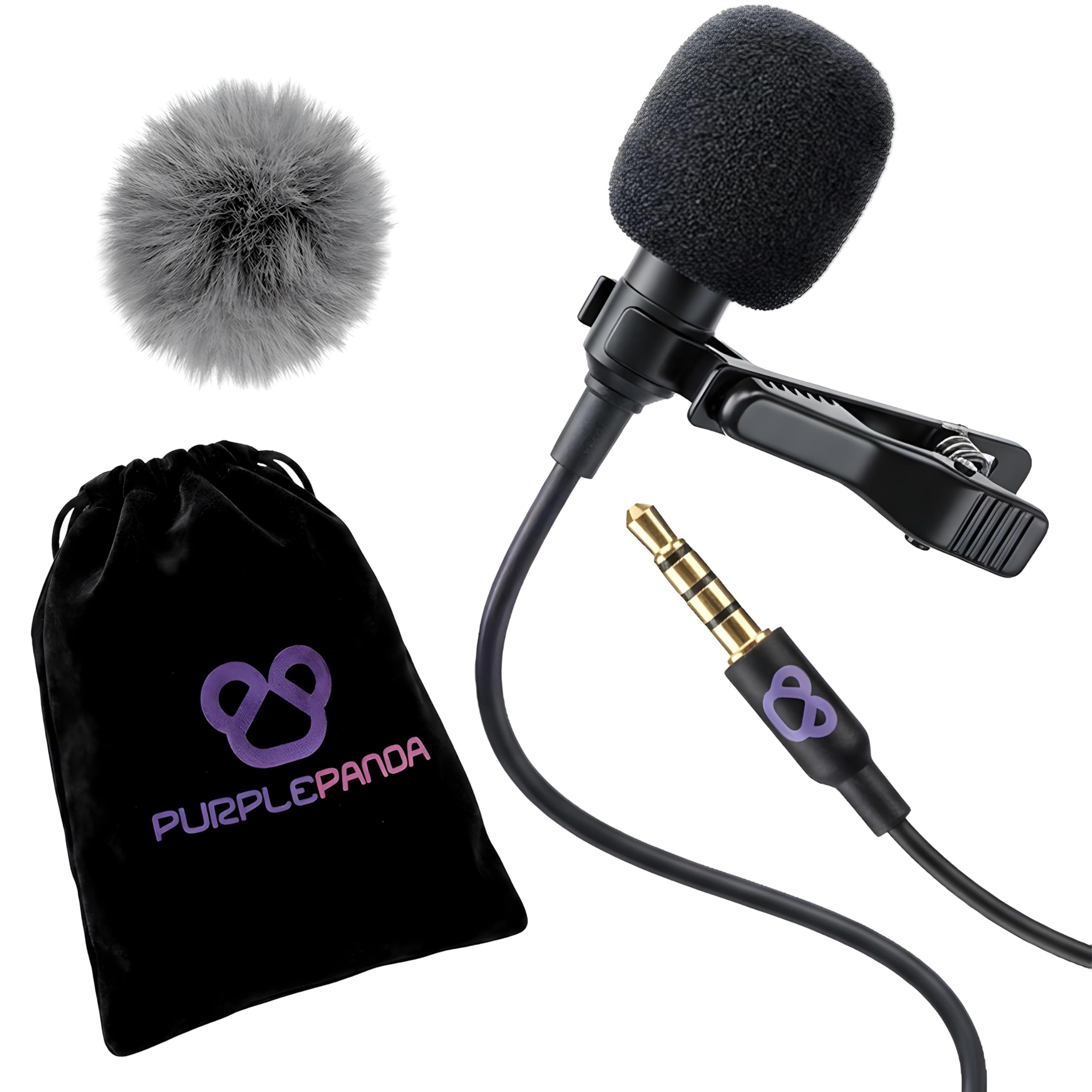
Two cable lengths are the reason to look at this one. The mic itself has a 4.9 ft cord; Purple Panda also puts a 9.8 ft extension in the bag, which is the difference between clipping a mic inside a helmet and having nowhere to put the camera. For motovlogging, karting, or any mount where the camera sits well away from the person, that reach is the feature.

It's a wired omnidirectional lav with a TRS/TRRS setup — both plugs are covered — and the box includes fuzzy and foam windscreens, two clips, a pouch and a TRS adapter. The specification is modest next to the wireless systems here: 40 Hz–16 kHz and a 55 dB signal-to-noise ratio. The catch sits upstream of the microphone. Action cameras need their maker's own 3.5 mm adapter, sold separately, and choosing the wrong one is where this setup usually goes wrong.

Used within that limit, it's the least expensive way to get a decent voice onto an action-cam track, and a furry windscreen at speed does more for intelligibility than any processing. The risk is hiss: some camera and phone combinations produce a steady high-pitched noise that no amount of gain-staging removes. Buy it for a supported adapter and a helmet, and check the noise floor before you trust it with a whole ride.

Pros

  • 4.9 ft cord plus a 9.8 ft extension
  • Fuzzy windscreen included for open-air riding
  • No battery to charge or pair

Cons

  • Can pick up steady hiss on some setups
Our verdict

The one we point at helmet and motovlog setups, provided you already own the camera maker's 3.5 mm adapter.

Check Latest Price
7

Budget Phone Shoots

Amazpro Wireless Mic

94 /100
Keeper Score Outstanding

Key details

Battery
Up to 30 hrs with charging case
Connectors
Lightning and USB Type-C
Transmitter Weight
0.18 oz
Pass-through Charging
Yes
Check Price on Amazon

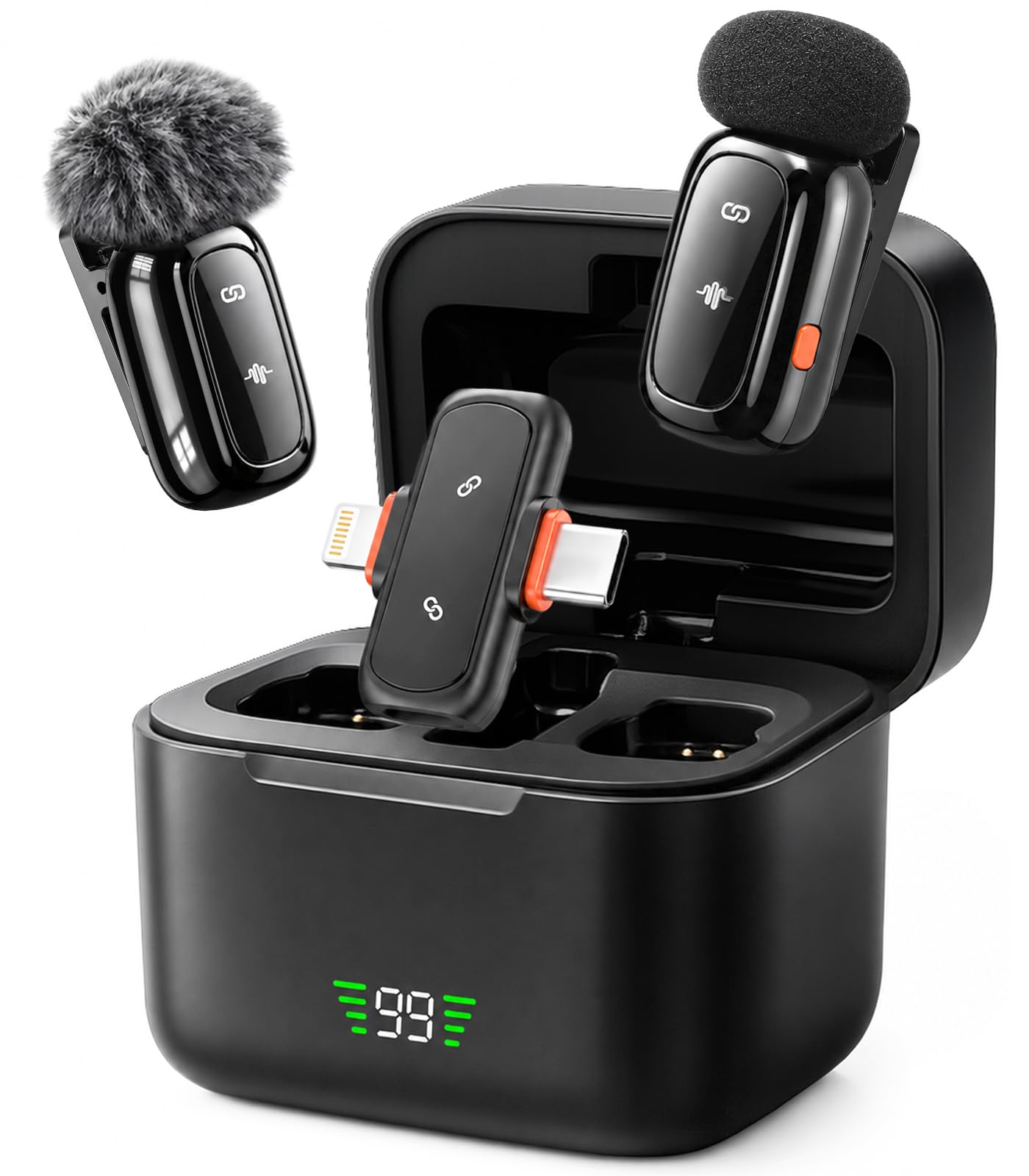
Pass-through charging is the small feature that makes this kit make sense. The receiver has its own charging port, so a phone running a long livestream keeps taking power while the microphone is plugged in — the difference between a two-hour stream and a phone that dies halfway through it.

The rest is phone-first: 5 g transmitters that clip to a collar without pulling at it, Lightning and USB-C connectors covering both phone camps, a one-button noise-cancelling mode, no app and no Bluetooth pairing to fight with, and a case carrying about 30 hours of total power with a battery readout on the front. For a first microphone bought for TikTok or a family vlog, that covers most of what you need.

What it isn't is a camera system. There's no 3.5 mm receiver in the box, so it's phones and tablets only, and the transmitters have no display of their own. At the bottom of the price range here, it's the kit for when the phone is the whole studio — and the moment a camera joins the setup, the Lark A1 Combo is the step up.

Pros

  • Pass-through charging keeps the phone powered
  • 5 g transmitters, the lightest in this group
  • No app or Bluetooth pairing step

Cons

  • No 3.5 mm receiver, so phones and tablets only
Our verdict

We see it as the first mic for a phone-only creator, with pass-through charging that keeps a long stream alive.

Check Latest Price

How We Tested the Best Lavalier Microphones

We started with the lavs that come up repeatedly in reviews and creator forums, then filtered by the thing that eliminates the most options: how each one connects. Some ship a receiver for a Lightning phone, some for USB-C, some for a camera's 3.5mm jack, and a few need a separate adapter for each. Anything that couldn't connect out of the box to at least one common device was cut. Twelve mics made it through, and we used them for six months.

Testing happened where these actually live: clipped to a T-shirt collar in the backyard with a breeze blowing, tucked inside a motorcycle helmet, and pinned to a jacket on a walk through a busy block to see how much street traffic bled in. We recorded the same spoken paragraph and the same guitar riff on every mic, then listened back through cheap earbuds, studio headphones, and a phone speaker — the three ways an audience will really hear it.

The rest only showed up over weeks. For range, we walked away from the receiver until the signal broke, once in a straight line and once around a corner. For noise, we ran an extractor fan and a hair dryer nearby and noted how much of it the noise cancelling removed versus how much it flattened the voice. For build, we unclipped and reclipped daily, coiled and uncoiled the cables, and flagged the clips that loosened, the plugs that crackled when wiggled, and the cases that stopped holding a charge.

Value settled the close calls. A mic that sounds excellent but needs three adapters and quits after two hours is a worse buy than a cheaper one that just works with the phone already in your pocket.

How to Choose a Lavalier Microphone

Wireless Freedom or a Wired Sure Thing

If you need to move, wireless is the only answer — nobody walks a stage trailing a 3.5 mm cable. Wired earns its place in the opposite situation: a fixed interview, a desk voiceover, or a helmet mount where the camera rides along with the person. A wired lav has no battery to find dead and no pairing step, which is why the Rode Lavalier GO still travels in a lot of bags.

The trade is a physical tether and a mic input on the recording device. If your camera has no 3.5 mm jack, price the adapter before you price the microphone.

Count Your Devices, Not Your Microphones

Every wireless kit is really a receiver purchase. Lightning, USB-C and 3.5 mm TRS are three different sockets, and a USB-C receiver does nothing for a camera with a mic jack. Write down each device you'll record on, then count the matching receivers in the box. Kits here range from two receivers (the Lark A1 Combo, Lightning and USB-C) to three (the Lark M2, which adds the camera version).

The trap is the phrase works with iPhone and Android. It often means one receiver plus adapters you supply, and an adapter that handles audio is a different part from the charging cable in your bag.

What the Audio Specs Actually Buy You

48 kHz/24-bit has become the working standard in this class, so treat it as a floor rather than a selling point. The specification that changes a recording is clipping protection. Fixed-gain 24-bit audio has to be set correctly before you roll; auto-limiting on the Lark A1 Combo rides the gain down on a sudden laugh, and the DJI Mic 2's 32-bit float internal recording lets you rescue a take in the edit that a fixed file would have lost.

Signal-to-noise ratios in this group run from 55 dB to 85 dB. The higher figure is the quieter floor around the voice, and it matters most in a small, hard room.

Hours Per Transmitter, Not Hours in the Case

Charging cases make the headline numbers, and a 40- or 48-hour figure describes the case, not the microphone. What limits a shoot day is per-transmitter runtime — roughly 7 to 10 hours across these kits — so the case has to come with you, and it has to be charged itself the night before.

If you stream from a phone, check whether the receiver passes charging through. The Amazpro does, and on a long live session that's worth more than another five hours of case capacity.

Weight, Mounting and What Noise Cancelling Can't Do

Five to ten grams stays comfortable on a collar; heavier transmitters pull at a neckline and end up clipped to a pocket instead. Magnetic mounts are quicker on a shirt with no placket, clips are more secure on a jacket, and a necklace keeps the capsule off fabric altogether — which is the real fix for rustle.

Noise cancelling handles steady room hum. It does not remove wind, and no setting will: that's a furry windscreen's job, plus a little thought about which way the person is facing.

Frequently Asked Questions

Final Verdict

Our pick for most people is the Hollyland Lark M2. Three receivers in one case mean it works with the camera you own and the phone you upgrade to, the 9 g transmitters are easy to hide on a collar, and nothing in the setup needs an app first. If a take can't be repeated, the DJI Mic 2's 32-bit float backup recording is worth the jump in price.

And if you record at a desk into a camera or a recorder that already has a mic input, the wired Rode Lavalier GO takes batteries out of the equation entirely.