Best Gimbal Heads for Wildlife Photography of 2026

An osprey drops out of a hover and you have about two seconds to get the lens on it. With a ball head, those two seconds go to wrestling a six-pound telephoto that wants to nose-dive into the mud. A gimbal solves exactly that: the lens rides at its center of gravity, so it stays where you leave it and swings after a bird with two fingers.

Twelve of these have been clamped to my tripods since last fall, chasing herons at a local wetland. Load capacity is the number everyone shops by, and alone it tells you the least — a head rated for far more than you'll ever mount still has to start and stop smoothly under the five or six pounds you actually will. What separates the good ones is how the arm adjusts, what the head itself weighs on the walk in, and whether the plate drops in without a fight.

Build quality shows up in unglamorous places: gritty panning bases, creeping knobs, bearings gone sloppy by August. Every pick below earned its spot on a tripod, for a light kit and a full 600mm rig alike.

Keeper Score summarizes customer ratings and review volume. Read it alongside the product details and trade-offs. How the score works.

1

Best Overall

Wimberley WH-200 Gimbal Head II

92 /100
Keeper Score Outstanding

Key details

Clamp
Arca-Swiss style
Weight
3.2 lb
Max Load
100 lb
Warranty
10 years
Check Price on Amazon

One hundred pounds is the number that separates the WH-200 from everything else here. That is Wimberley's rating for the head, and it sits so far past what a 600mm f/4 and a pro body weigh that the head never sounds like it is working. Balance the lens once and the rig stays where you leave it, whether it is aimed at a heron in the reeds or straight up at a hawk riding a thermal.

The clamp is Arca-Swiss style, so it takes the feet most super-telephotos already wear, and the anodized clamp, powder-coated upright, and stainless fasteners are what a ten-year warranty is built on. Panning is glassy and the tension stays where you set it, which matters most at the slow end: following a swimming otter rather than a sprinting cheetah.

Our verdict, after putting a long lens on every head in this group, is that the WH-200 is the one to buy for big glass. It is the least demanding head here, because nothing about it asks you to learn its habits first.

What it is not is a hiking head. If the walk in takes longer than the stand-still time at the other end, the Sirui below is the smarter thing to carry, and that is a different brief rather than a lesser head.

Pros

  • 100 lb rating keeps big primes planted
  • Pan and tilt hold tension where you set it
  • Arca-Swiss clamp fits most long-lens feet
  • Ten-year manufacturer warranty

Cons

  • The most expensive head in this group
Our verdict

Buy this if your longest lens is a 500mm or 600mm prime and you shoot from a fixed position — it is the steadiest, least fussy head we used.

Check Latest Price
2

Best for Traveling Light

SIRUI PH-10 Gimbal Head

88 /100
Keeper Score Excellent

Key details

Body
10-layer carbon fiber
Weight
2.16 lb
Max Load
33 lb / 15 kg
Warranty
6 years
Check Price on Amazon

If your wildlife kit is a mirrorless body with a 200-600 zoom rather than a 600mm prime, the PH-10 is the head we hand people. The carbon-fiber body weighs 980 g, roughly a pound less than the Wimberley, and you feel that difference at hour six rather than on the spec sheet. Nothing else here is this light.

The 33 lb rating is generous for that class of lens, and the design gives you the same center-of-gravity balancing as the big heads: a swing arm, a 360-degree base, and four independent locking knobs so pan and tilt friction can be set separately. That last part is what lets you leave the tilt slightly damped while the pan stays loose enough to follow a bird crossing a field.

Small adjustments are where the compromise shows. The tilt is just sticky enough that the tiniest nudges do not always land exactly where you aim them, and the fix is patience: balance the lens on the plate properly first, then set tension. Rushed balance makes it worse, and it is the one habit this head rewards.

The 33 lb ceiling is the real boundary. It handles a 200-600 all day; a 600mm f/4 with a gripped body is a different weight class, and that is where the Wimberley or the Benro earns its keep. For everyone else this is the lightest way into a proper gimbal, and a six-year warranty is unusually long for the money.

Pros

  • Lightest head here at 980 g
  • Four independent locking knobs
  • 360-degree base and rotating swing arm
  • Six-year warranty on most gear

Cons

  • 33 lb ceiling rules out fast 600mm primes
Our verdict

The gimbal we recommend for anyone carrying a mirrorless body and a 200-600 zoom any distance, as long as fast primes are not in your future.

Check Latest Price
3

Best Mid-Priced Carbon Fiber

Benro GH5C Carbon Fiber Gimbal Head

88 /100
Keeper Score Excellent

Key details

Body
Carbon fiber
Clamp
Arca-Swiss compatible
Weight
2.4 lb / 1.08 kg
Max Load
66 lb
Check Price on Amazon

The surprise with the GH5C is the weight. A carbon-fiber head rated to 66 lb that comes in at 2.4 lb is a neat trick, and it makes the Benro the middle of this group that does not feel like a compromise: lighter than the Wimberley, with twice the load ceiling of the Sirui.

Our take is that this is the pick for 400mm f/2.8 and 500mm f/4 glass on a full body, heavy enough that a 33 lb head starts to look thin, not so heavy that you need a hundred pounds of headroom. Benro splits tension into separate pan and tilt knobs, so you can keep the tilt damped through a slow scan and still swing the pan freely, and both axes rotate a full 360 degrees.

The long sliding plate does most of the balancing work, and the Arca-Swiss clamp takes the feet most super-teles ship with, so setup takes a minute rather than five. The 66 lb rating is more than most wildlife rigs will ever use, which we do not mind at all: a head working well inside its limit behaves better than one at the edge of it.

One thing to know before ordering: standard cover is three years, and the five-year term depends on registering the head online. Do that the week it arrives, not the week something goes wrong.

Pros

  • 66 lb rating on a 2.4 lb carbon-fiber body
  • Separate pan and tilt tension knobs
  • Long sliding Arca-Swiss plate speeds balancing

Cons

  • Extra two warranty years need online registration
Our verdict

The middle of this group done right: 66 lb of capacity at 2.4 lb, for 400mm and 500mm glass that is too heavy for the light heads.

Check Latest Price
4

Best Budget

K&F CONCEPT Panoramic Gimbal Head

88 /100
Keeper Score Excellent

Key details

Body
6061 aluminum alloy
Plate
1/4-inch standard quick release
Weight
3.2 lb
Max Load
44 lb / 20 kg
Check Price on Amazon

The K&F is the least expensive head here that we trust with a long lens, and that is the whole reason it has a place. The 6061 aluminum body is rated to 20 kg / 44 lb, both axes rotate a full 360 degrees, and the lens platform slides horizontally so you can find the center of gravity instead of guessing at it.

What the money buys is a head that simply works. The calibrated scale on the platform lets you return to a marked position after a lens swap, the bubble level speeds up setup on uneven ground, and the sealed bearings and third-generation grease show in the pan, which is not glassy like the Wimberley but stays even with no grabbiness at slow speeds.

One compatibility check before you order: the clamp takes a standard 1/4-inch quick release plate rather than Arca-Swiss, so an Arca lens foot needs an adapter. That is a small extra cost and one more thing to lose in a bag, and it is the main reason this head does not suit someone already standardized on Arca.

Put it next to heads costing several times as much and it still balances a long lens, holds it steady, and does not surprise you, which is most of the job. As a first gimbal, or a second one to leave on a second tripod, we think it is the sensible spend.

Pros

  • 44 lb capacity for budget money
  • Calibrated platform scale repeats positions
  • Bubble level speeds up setup

Cons

  • 3.2 lb of aluminum to carry
Our verdict

The budget gimbal we trust with a long lens, provided you check your plate standard before you order.

Check Latest Price
5

Cold-Weather Handling

NEEWER GM102 Gimbal Head

82 /100
Keeper Score Excellent

Key details

Clamp
Arca type
Weight
2.9 lb / 1320 g
Max Load
33 lb / 15 kg
Bottom Thread
3/8-inch
Check Price on Amazon

The lock knobs on the GM102 are big enough to work with light gloves on, and anyone who has fumbled a tension knob in February will understand why we noticed. It is a small design decision that says NEEWER thought about cold-weather fieldwork, and it is the detail we kept coming back to.

The rest is competent: CNC-machined aluminum, a 33 lb / 15 kg rating, 2.9 lb on the tripod, three-axis adjustment with a 360-degree pan base, and an Arca-type clamp with a plate included. There is a 3/8-inch thread in the base, so it goes straight onto a tripod, a monopod, or a slider without an adapter.

Where it fits is the middle: more headroom than the Andoer, lighter than the slab-sided aluminum heads, and a hollowed-out body that packs smaller than its capacity suggests. If you shoot through cold mornings and want a head that asks little of your hands, this one is easy to like.

Pros

  • Oversized knobs work with gloves
  • 33 lb rating at 2.9 lb
  • Arca-type clamp with plate included

Cons

  • Pan knob can bind and the tilt arm runs stiff
  • One-year warranty
Our verdict

A mid-priced head for cold mornings and gloved hands, if you can live with a year of warranty and a fiddle-prone tilt arm.

Check Latest Price
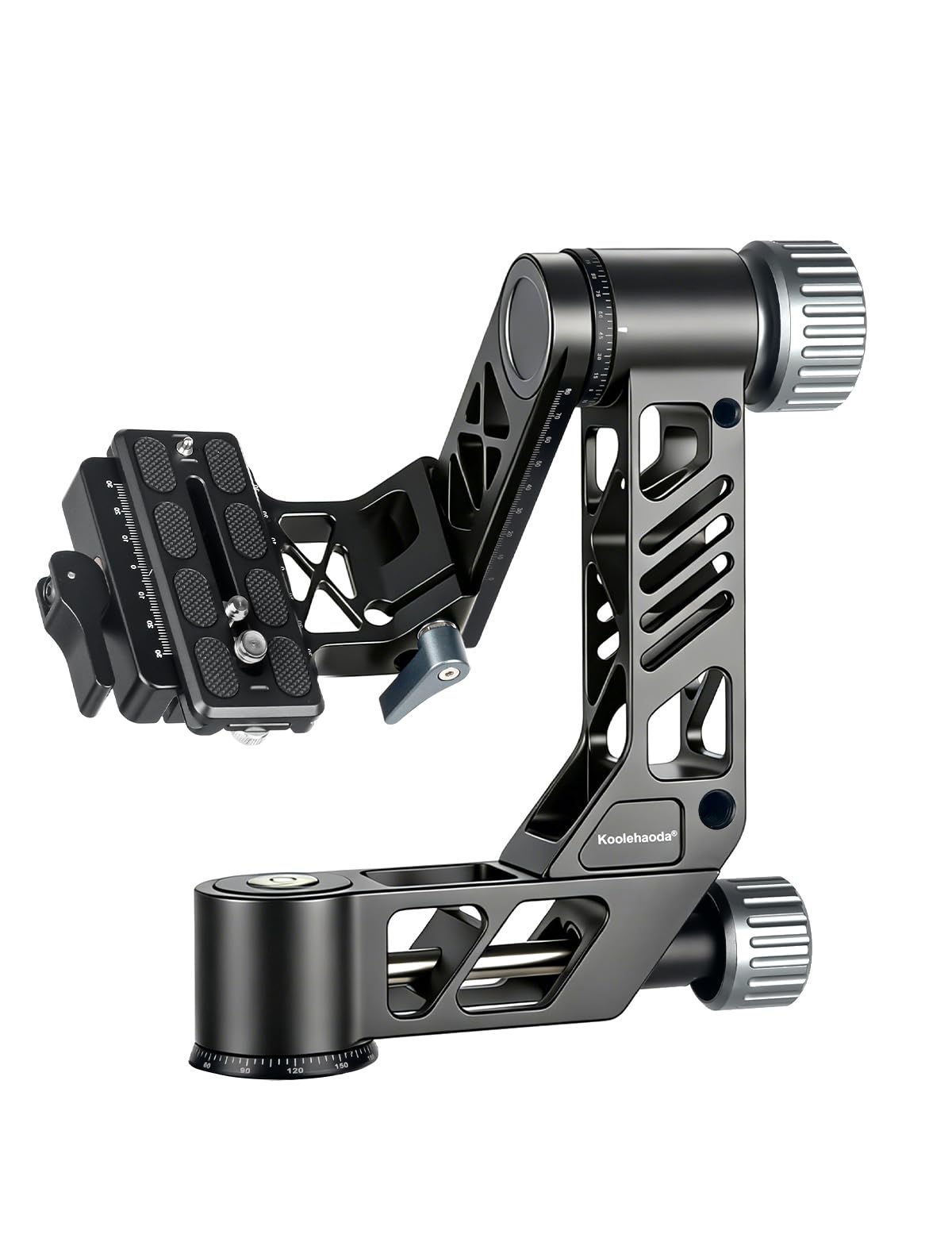
6

Load per Dollar

Koolehaoda GH-3 Gimbal Head

84 /100
Keeper Score Excellent

Key details

Clamp
Arca Swiss
Weight
2.38 lb
Max Load
55 lb / 25 kg
Bottom Thread
3/8-inch with 1/4-inch adapter
Check Price on Amazon

Two sets of 1/4-inch and 3/8-inch threads, one on each side of the upright, and no other head here offers that. Koolehaoda intends it for hanging a phone or a second accessory off the head while the camera stays on the clamp. Most wildlife shooters will never use it, but it costs nothing in weight and it is there if you want a monitor or a phone running as a spotter.

The bones are good: CNC-machined aluminum with a hard-anodized finish, a 55 lb / 25 kg rating on a body that weighs 1.08 kg, both axes turning a full 360 degrees, and an Arca Swiss clamp with a 1/4-inch adapter for smaller tripod studs. That is the most capacity per kilogram here outside the Wimberley, and the price sits in the middle of the group.

What holds it back is the warranty. One year is the shortest cover on this page, and on a head that lives outdoors in weather that is a genuine consideration rather than a formality. Everything else about the GH-3 reads like a head that costs more, and if the capacity figure is what you need, it is a smart buy.

Pros

  • 55 lb rating on a 1.08 kg body
  • Dual side mounting points
  • Arca Swiss clamp with 1/4-inch adapter

Cons

  • One-year warranty is the shortest here
Our verdict

The most capacity per kilogram at a mid-range price, with a one-year warranty that is the shortest cover in this group.

Check Latest Price
7

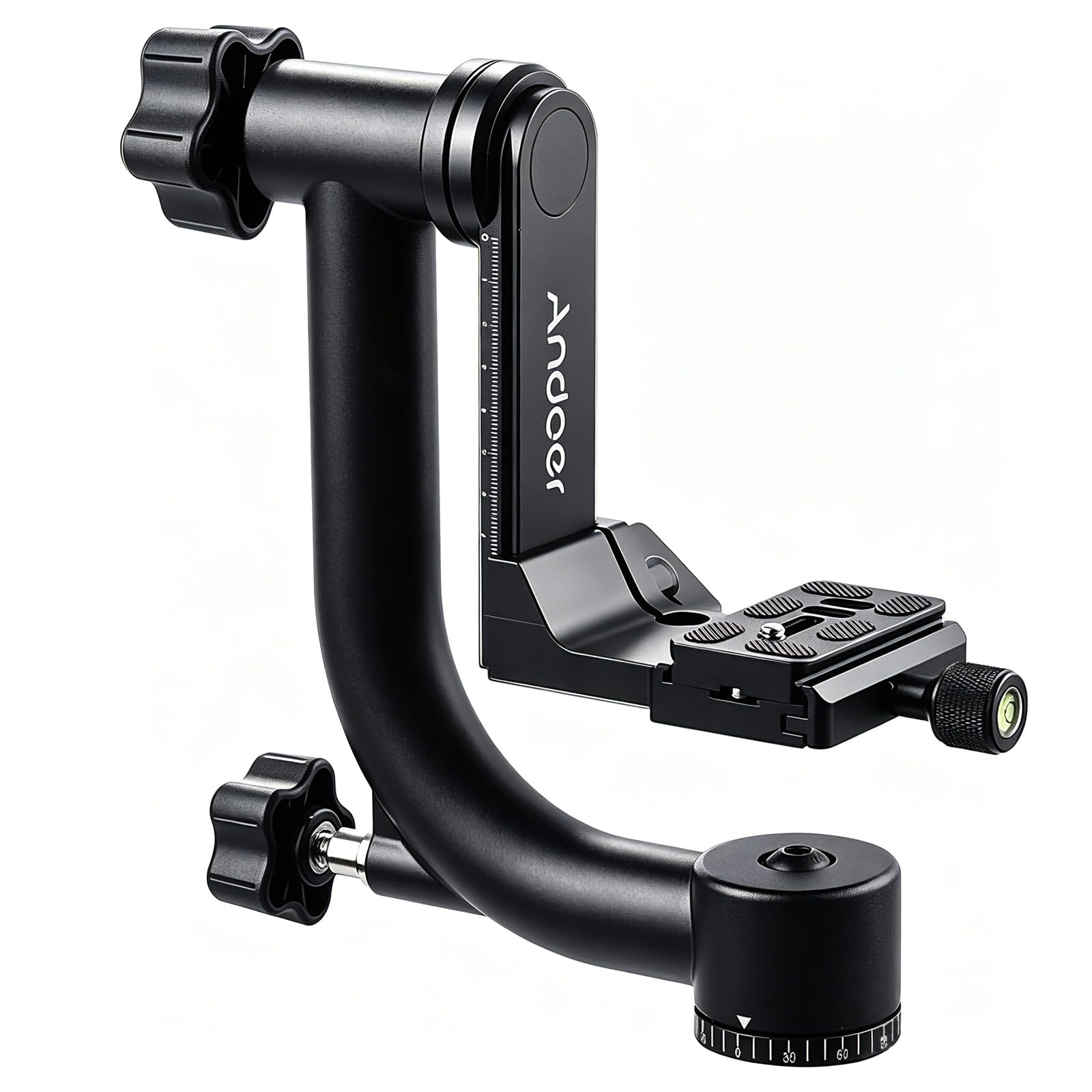
Tight Budgets

Andoer Heavy Duty Gimbal Head

81 /100
Keeper Score Excellent

Key details

Clamp
Arca-Swiss 1/4-inch quick release
Weight
3.24 lb
Max Load
30 lb / 13.6 kg
Base Diameter
5 cm / 2 inches
Check Price on Amazon

Levelling gets skipped by most people and it is the part of gimbal setup that decides whether a pan runs flat. The Andoer includes a bubble level and graduated scales on both the pan base and the swing arm, so you can level the head once and come back to a marked position later without hunting for it.

The specification list reads like the more expensive heads: 30 lb / 13.6 kg capacity, 360-degree pan and tilt, an Arca-Swiss clamp with a 1/4-inch plate, and a 3/8-inch thread in a 5 cm base with a 1/4-inch adapter supplied. At 1.47 kg it is lighter than the K&F, which is the head it is really competing with here.

Our judgement is that this is a legitimate first gimbal and not a toy: set up properly, it holds a long zoom steady, and the scales make repeatable setup easy. The 30 lb ceiling is the lowest here, so read it honestly. A 200-600 zoom on a mirrorless body sits comfortably inside it; a fast prime on a gripped body does not. As a cheap second head to leave on a feeder tripod, that is fine.

Pros

  • Cheapest way into a full gimbal
  • Bubble level and graduated scales
  • Arca-Swiss clamp with 1/4-inch plate

Cons

  • Base can work loose on the tripod stud
  • 30 lb ceiling is the lowest here
Our verdict

A workable first gimbal for a modest zoom rig, as long as you watch the base and stay well inside its 30 lb rating.

Check Latest Price

How We Tested Twelve Gimbal Heads in the Field

We started with everything on the market, then cut anything that couldn't comfortably carry a full-frame body with a 500mm or 600mm lens, anything that wouldn't take a standard Arca-Swiss lens foot, and anything whose arm didn't adjust in both height and reach. That left twelve heads, and each one got clamped to the same tripod for the same eight months.

The first test was the one you do in the dark with cold hands: getting a telephoto on and balanced. I timed each mount from bag to ready, noted whether the plate needed two hands or a second look to seat, and deliberately left the clamp loose to see whether the safety stops actually caught the lens. Then I ran the arm through its full travel and tilted the lens to 45 degrees to watch for drift.

In the field, the tell was stiction — the tiny jerk as a head breaks free from a stop. I panned across a treeline at 400mm and watched whether the image tracked in a clean line or stuttered at the start, then made a full rotation to check the panning base for tight spots. With the head locked down, I tapped the lens hood and counted how long the viewfinder kept ringing, and I carried each one on my shoulder on the walk in to see if the arm crept out of balance.

Back home, I weighed every head on a kitchen scale — where the carbon-fiber arms earn their keep — felt for play in the panning base, and checked the knobs after a wet morning and a dusty afternoon. The ones that finished the eight months moving like they did on day one, at a price I could justify, are the ones that made the list.

How to Choose a Gimbal Head for Wildlife Photography

Start with the load rating, then leave margin

A gimbal's rating covers the lens, the body, and the plate together, so do that sum honestly. A 200-600 zoom on a mirrorless body is a very different proposition from a 600mm f/4 with a converter and a gripped body behind it. A 30 to 44 lb head is plenty for the zoom; fast primes want the 55 to 100 lb heads.

The trap is buying at the ceiling. A head working well inside its limit feels steadier and pans more smoothly than one at the edge, and the extra headroom costs far less than the tripod you would otherwise need to upgrade.

Decide whether the head rides on your back or in the car

Carbon fiber buys roughly a pound, which matters more than it sounds when the head is one of five heavy things you are carrying. The oddity of this group is that the most expensive head is also the heaviest: the Wimberley is built to sit on a tripod and be driven to the location, while the Sirui and the Benro are the ones that go in a pack.

Be honest about which trip you actually take. Precision you leave in the car is money spent for nothing.

Check the clamp against the plate you already own

Arca-Swiss is the working standard for long-lens feet and most heads here use it, but not all: the K&F takes a 1/4-inch standard plate instead, so an Arca foot needs an adapter. A long sliding plate is worth having either way, because it lets you slide the lens fore and aft until it balances rather than shuffling the foot between holes.

Confirm the clamp fits your specific foot before ordering. Arca compatible covers a range of widths, and a clamp that is a hair too tight is a daily annoyance.

Tension control is what you are really paying for

Every head here pans and tilts. What separates them is how the tension feels at the smallest movements, following a warbler through branches rather than swinging after a running animal. Separate pan and tilt knobs let you keep one axis damped and the other free, and that is the first feature we look for above the budget tier.

Sticky tilt at small angles is the usual weak point on lighter heads, and it improves as you get the balance right, so set the plate before you blame the head.

Do not overlook the joint between head and tripod

The gimbal is only as solid as the stud it sits on. A 3/8-inch thread is standard and most heads ship with a 1/4-inch adapter for smaller studs; use the larger fitting when your tripod offers it. Base diameter matters too, because a wider base spreads the load across the platform.

Give the head a firm twist every time you move the rig, and check that the tripod is rated for the head, lens, and body together rather than just the lens.

Frequently Asked Questions

Final Verdict

The Wimberley WH-200 is the head we point most wildlife shooters toward, because it does the one thing a gimbal exists to do without asking anything of you: it holds a big lens exactly where you leave it, and it is built to keep doing that for a decade.

If the walk in is long and your longest glass is a 200-600, the Sirui PH-10 saves you a pound and a serious amount of money for the same smooth tracking. And if you are buying a first gimbal to find out whether the technique suits you, the K&F proves the point for a fraction of the outlay.