Best Tripods for Macro Photography of 2026

Macro photography rewards patience and punishes wobble. At 1:1 magnification, a breeze through an open window or a floorboard flexing under your heel can blur a compound eye into mush, so the tripod carries more weight here than anywhere else in photography. What you actually need isn't just a rigid set of legs — it's a rig you can nudge two millimeters without losing the frame, then trust to hold that position through a focus stack.

I've chased dew-covered insects at sunrise and shot coins and watch faces on my kitchen counter, and the weak link is almost never the legs. It's the head, the center-column joint, and whatever plastic knob you're being asked to lock down. Over the past seven months, my team and I tested 12 tripods built for close work — from palm-sized tabletop stands to full-height models with horizontal arms — and the spread in sturdiness, adjustability, and overall quality against price was wider than I expected.

Weight matters here in a way it doesn't in a studio: a macro tripod gets carried into the garden, folded into a tote, and set low in the dirt one-handed while you hold a flashlight. Versatility earns its keep too, since a column that swings horizontal for overhead shots or a leg that unscrews into a monopod is the difference between one tripod and three. Below, the picks are sorted by what they're genuinely good at.

Keeper Score summarizes customer ratings and review volume. Read it alongside the product details and trade-offs. How the score works.

1

Best Overall

SIRUI AM-203 Mini Tripod

90 /100
Keeper Score Outstanding

Key details

Folded Length
11.4 in
Load Capacity
10 kg / 22 lb
Maximum Height
42 cm / 16.5 in
Minimum Height
5.5 cm / 2.2 in
Check Price on Amazon

Five and a half centimeters is the number that matters here. That's how low the AM-203 sits with its three legs splayed — lower than any other tripod with a head in this group — and it changes what you can shoot. There's no center column either, since the ball head mounts straight to the leg spider, so there's one fewer joint between the camera and the subject, and at 1:1 that joint is usually the thing that moves.

Those two facts are why we recommend it as the default for macro work. Low and rigid covers most of what a macro tripod is for: fungi, insects, moss, anything sitting on the ground or a low wall. The B-00K ball head is the part that impressed us — it holds position when you tighten it down, and the panning collar sits under the ball, so you can swing to a new angle without losing the tilt you just set.

Three leg angles, rubber feet, and a set of steel spikes come in the box, and the head takes standard ARCA plates, so a focus rail or a spare body swaps over without an adapter. Folded it's 11.4 inches and 0.76 kg — small enough to live in a camera bag permanently, which is how a macro tripod actually gets used. The mounting stud converts between 3/8-inch and 1/4-inch if you ever want a bigger head on it, and the working range runs from 5.5 cm to 42 cm, which is the band close-up work lives in.

Pros

  • 5.5 cm minimum height, the lowest here
  • No center column to flex or drift
  • Three leg angles plus steel spikes
  • 10 kg head capacity with an ARCA plate

Cons

  • Tabletop height only: 42 cm maximum
Our verdict

Our default for macro: it gets lower than any other complete tripod here, holds still once it's set, and stays small enough to live in a bag.
Check Latest Price
2

Best Budget

NEEWER Tabletop Tripod

90 /100
Keeper Score Outstanding

Key details

Weight
1.7 lb
Height Range
6.7 to 19.7 in
Leg Sections
5
Load Capacity
11 lb / 5 kg
Check Price on Amazon

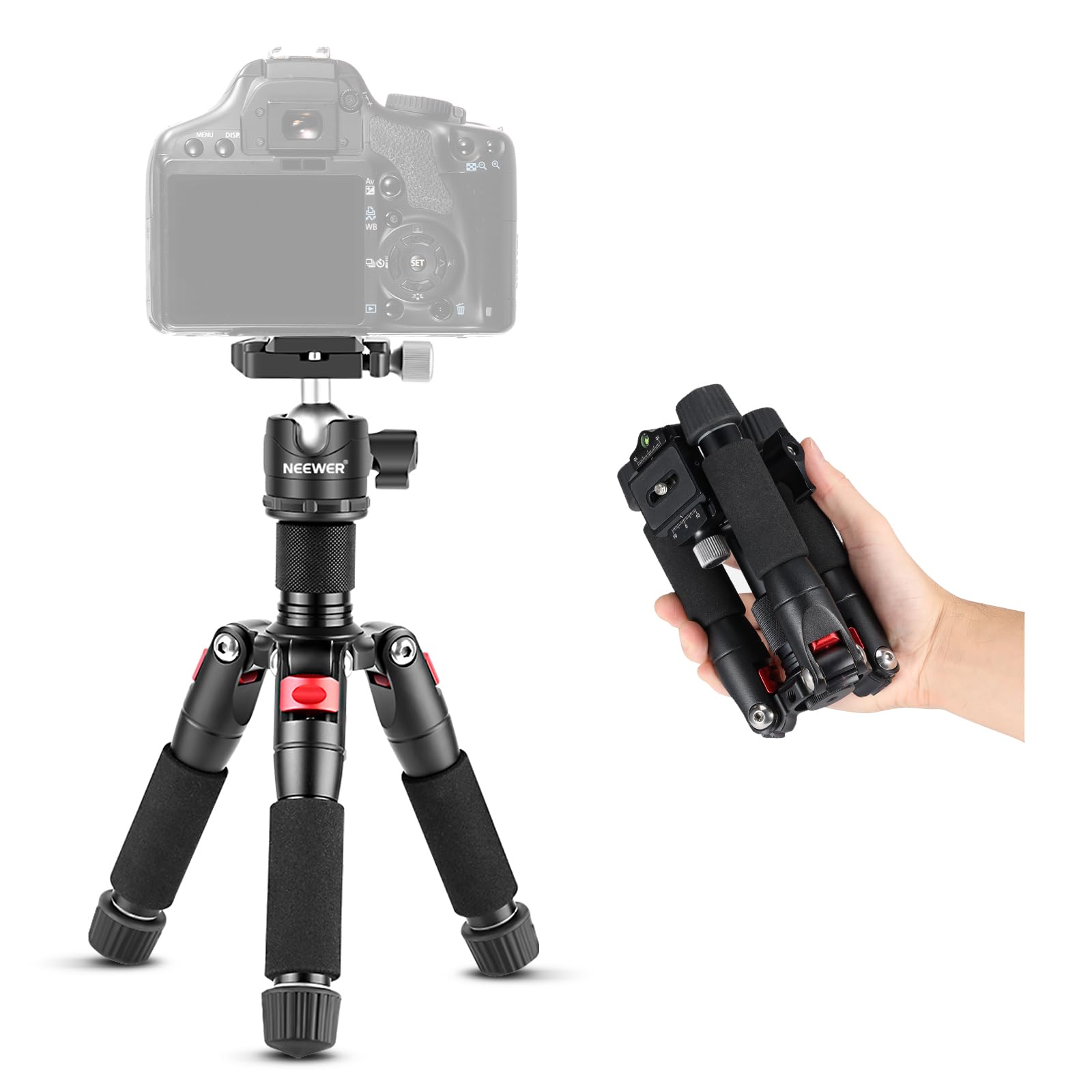
Budget is the whole argument for this one, and it's a decent argument: it's the least expensive tripod here that arrives complete, with a ball head, a quick-release plate, and five leg sections that drop it to 6.7 inches. If you're finding out whether macro is a hobby you want, that's enough tripod to answer the question.

Five sections is also where the compromises live. Every extra collar is another joint that can flex or slip, and the head is where you feel it first — the plate can work loose after a few lens changes, so check the screw each time you mount up and use the bubble level to confirm you haven't introduced a tilt. The three leg-angle positions let you splay it wide for low work, and the wider you splay it, the less those extra sections matter.

What we appreciate most is the range for the size. From 6.7 to 19.7 inches it covers ground-level work and a tabletop, and at 1.7 pounds with non-slip feet it goes into a bag without a second thought. It won't be the last macro tripod you buy, but it stays useful as a second support once you have a better one.

Pros

  • Cheapest here with a ball head and plate
  • Drops to 6.7 inches for low work
  • 360-degree head with a bubble level

Cons

  • Five leg sections flex more than three
Our verdict

A complete, capable tabletop tripod for the least money here — the easiest way to find out whether macro work suits you.

Check Latest Price
3

Best Tabletop Height

SIRUI AM-TT50 Desktop Tripod

92 /100
Keeper Score Outstanding

Key details

Height Range
17.7 to 52 cm
Leg Sections
5
Folded Length
18 cm
Load Capacity
17.6 lb
Check Price on Amazon

The AM-203 goes lower; this one goes higher, and for a lot of tabletop work that's the more useful direction. The AM-TT50 runs from 17.7 cm to 52 cm on five sections, so the camera can sit 20 inches above a table — the right position for flat-lay food shots, leaves and coins, or anything standing up that you want side-on.

The detail we didn't expect to use so much is a 1/4-inch threaded hole at the base of the head, which takes a magic arm. That means a small LED or a diffuser can ride on the tripod instead of needing its own stand, and in tabletop macro, where the light sits within a foot of the subject, that's a real convenience. Three leg stops — 10, 36, and 68 degrees — cover the splay you want, and the ball head pans a full circle with a U-notch for shooting straight down.

This is the pick when the macro work happens on a desk rather than on the forest floor. It's not light for its size at 0.8 kg, and we don't mind that: the heft is part of why a 17.6-pound-rated frame stays put when you nudge the head. Above desk height we keep the legs at the widest stop, where the five-section design is at its most rigid.

Pros

  • 20 inches of height for tabletop work
  • 1/4-inch accessory hole takes a magic arm
  • Three leg angles and a 360-degree head

Cons

  • Five sections take longer to extend than three
Our verdict

Buy it if your subjects sit on a table: 20 inches of height, three leg angles, and a threaded hole that takes a light.

Check Latest Price
4

Best for Overhead Shots

K&F Concept Overhead Tripod

92 /100
Keeper Score Outstanding

Key details

Folded Length
21.3 in
Load Capacity
22 lb / 10 kg
Maximum Height
90 in / 2.3 m
Minimum Height
21.4 in
Check Price on Amazon

Straight-down macro is a different problem from ground-level macro, and this K&F answers it with a center column that swings from vertical to horizontal and pans a full circle. Set the camera over a subject on a table, then raise and lower it with the column instead of moving the whole tripod.

The column is 28 mm in diameter, which matters more than the headline height: a skinny column flexes when it's horizontal with a camera hanging off the end, and this one holds. Locking the column down firmly before you let go of the camera is the whole trick — we make that the last thing we do before a top-down frame.

The rest is a full-size aluminum tripod: four sections to 90 inches, a 10 kg ball head, a detachable monopod, and 4.5 pounds to carry. Folded it's 21.3 inches, so it straps to the outside of a pack rather than going inside one.

For overhead work — copy-stand duty, top-down shots of flat subjects, anything where the camera has to hover — this is the one we reach for, and the horizontal column is the reason. It's also the least flexible tripod here for macro overall, since the minimum height is 21.4 inches and ground-level work is out. Buy it as the overhead half of a two-tripod kit, or as the tripod for a studio table where the camera always points down.

Pros

  • Horizontal column with 360-degree pan
  • 28 mm column resists flex when extended
  • 10 kg ball head on a 22 lb frame

Cons

  • 21.4-inch minimum rules out ground-level work
  • 4.5 lb with a 21-inch folded length
Our verdict

The overhead specialist: a 28 mm column that swings horizontal and stays rigid, for top-down macro a mini tripod can't reach.

Check Latest Price
5

Best Full-Size All-Rounder

K&F Concept 64-Inch Tripod

93 /100
Keeper Score Outstanding

Key details

Weight
2.54 lb
Height Range
20.4 to 64.1 in
Folded Length
15.5 in
Load Capacity
17.6 lb / 8 kg
Check Price on Amazon

This is the tripod we pack when macro isn't the only thing on the trip. It folds to 15.5 inches and weighs 1.15 kg, so it fits a carry-on, and it covers everything from a 64-inch standing shot down to a low angle, because the center column comes out and goes back in upside down — with a short column in the box for the same job.

The inverted column is the macro part. It hangs the camera between the legs a few inches off the ground, which is the least expensive way to get a full-size tripod down to subject height. It's also fiddly: the head ends up upside down, every control is reversed, and framing happens through a flipped preview. We use it for a handful of frames per outing, not for a whole session.

The rest is a competent travel tripod — 8 kg capacity, a 36 mm ball head, flip locks, and a 20.4-inch minimum without inverting anything. The flip locks are the part to watch: a leg that isn't fully clamped can slide, so we close them deliberately rather than flicking them. Treat it as one tripod that does macro reasonably, not a macro tripod that travels.

Pros

  • Folds to 15.5 inches for carry-on travel
  • Inverting column for low-angle work
  • 8 kg capacity with a 36 mm ball head

Cons

  • Upside-down column reverses every control
Our verdict

One tripod for the whole trip: 15.5 inches folded, 8 kg of capacity, and an inverted column that gets the camera low when you need it.

Check Latest Price
6

Outdoor Overhead Work

CAMBOFOTO 68-Inch Tripod

84 /100
Keeper Score Excellent

Key details

Leg Sections
3
Load Capacity
33 lb
Maximum Height
68 in
Minimum Height
20.87 in
Check Price on Amazon

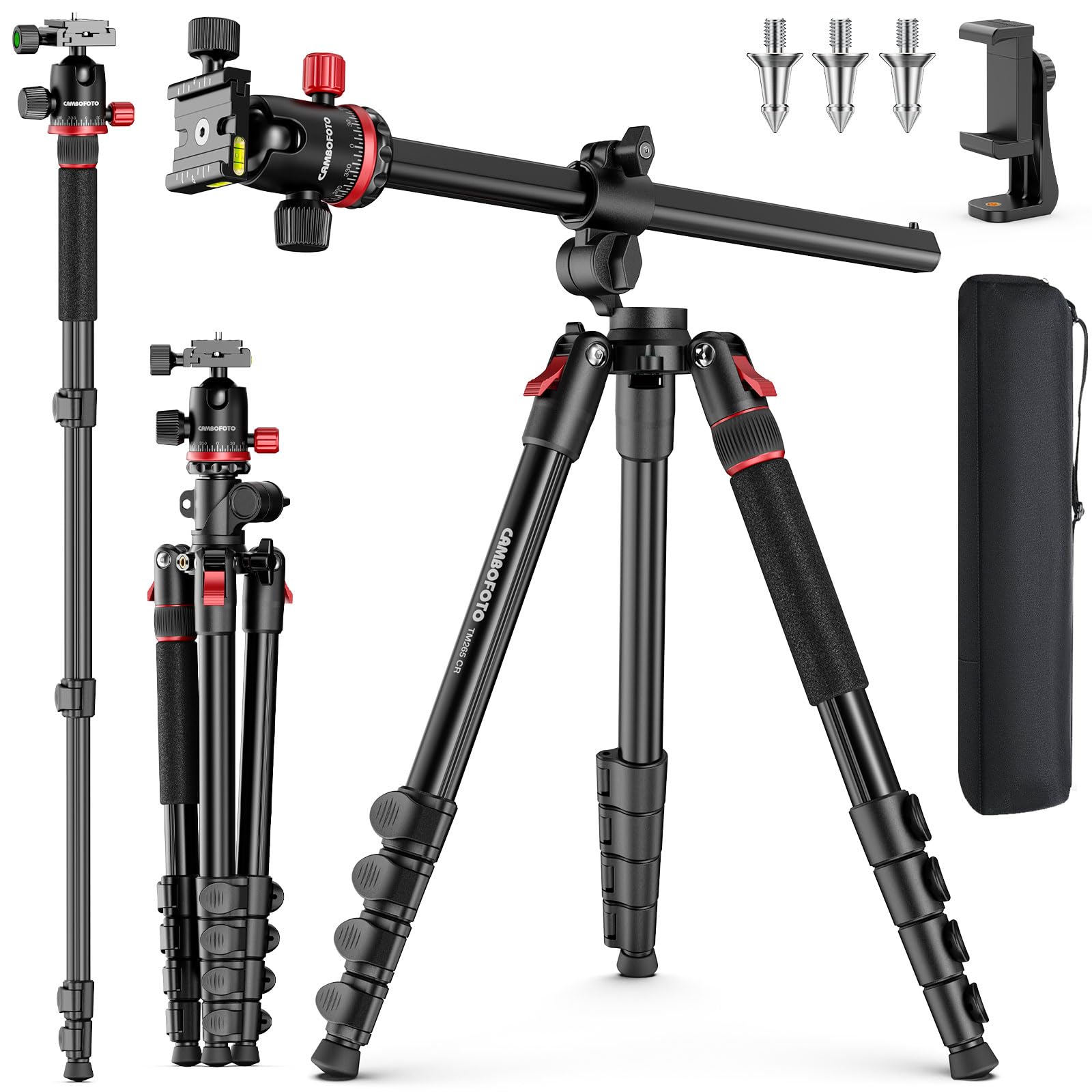
Three leg sections instead of four is the quiet advantage here. Fewer collars means fewer places for the frame to flex, and it's part of why this tripod feels stiffer than its folded length suggests. The design is overhead-first: the center column swings horizontal, tilts through 90 degrees each way, and pans a full turn.

We rate it as the outdoor option of the overhead pair. Three steel spikes come in the box for soft ground, the column has a counterweight hook, and a detachable leg becomes a 53-inch monopod. The ball head carries four bubble levels, which sounds like overkill until you're trying to get a sensor parallel to a mushroom cap.

It's a newer design than the K&F, and the finish is more workmanlike — there's plastic in the leg collars where the others use metal. What you get in exchange is a 33-pound load rating and a two-year warranty, the sort of spec that matters if the tripod is going to sit in wet grass with a camera on it.

Pros

  • Three-section legs make a stiffer frame
  • Horizontal column with a counterweight hook
  • Steel spikes for outdoor setups
  • 33 lb load capacity

Cons

  • Plastic in the leg collars
Our verdict

The outdoor overhead pick: three-section legs, steel spikes, and a horizontal column rated to 33 pounds.

Check Latest Price
7

Lowest Camera Positions

Zeadio Tabletop Tripod

90 /100
Keeper Score Outstanding

Key details

Weight
5.64 oz
Mounting
1/4"-20 with ARRI pins
Height Range
24 to 107 mm
Load Capacity
40 kg / 88 lb
Check Price on Amazon

Four inches is the top of its range, and there's no head in the box. Take both facts seriously and this makes sense: it isn't a tripod you stand behind, it's a palm-sized aluminum base that puts a camera two to four inches off the ground and refuses to budge.

At 160 g, with three leg positions and rubberized feet, it's what we drop in a pocket when the subjects are mushrooms, insects, or anything else at ankle height. The top plate takes a 1/4-inch screw with ARRI locating pins plus a couple of auxiliary holes, so a small ball head goes on and the camera ends up just above the ground with a footprint the size of your hand.

We recommend it as a supplement rather than a first tripod. The 40 kg rating is absurd for something this small, and the all-metal build is why it feels like a tool rather than a toy — but without a head it can't aim anything, and above four inches it has nothing to offer. Buy it to solve ground-level macro and keep a ball head on it.

Pros

  • All-metal build at 160 g
  • Three leg positions with rubberized feet
  • 1/4-inch screw with ARRI locating pins

Cons

  • Sold as a base only; you supply the head
Our verdict

A pocket-sized metal base for ground-level macro: add your own ball head and it puts a camera four inches off the floor.

Check Latest Price

How We Tested Macro Tripods

We started with every tripod sold for close-up and overhead work, then narrowed by the specs that decide a macro shoot: minimum height, how flat the legs splay, folded length, load rating, and whether the head takes a standard quick-release plate. We kept a wide spread of prices and formats rather than sorting by budget, because the same question — does it hold still? — applies to a desktop stand and a full overhead rig. That left 12 tripods, which we used for seven months.

Testing happened where macro actually happens: the kitchen counter, where we shot coins and flower petals from directly above; the garden at dawn, on our knees in wet grass beside mushrooms and beetles; and a dim corner of the living room, where we set up by flashlight. At each spot we timed a solo setup from bag to level, then fired a burst at a quarter second and examined the frames at 100 percent.

Stability was the entire point, so we tested it rudely. We rapped a knuckle against an extended leg and watched live view at 10x to see how long the shake took to settle, hung a loaded camera bag from the hook, and left overhead arms extended for an hour to check for sag. For adjustability, we turned each ball head by the smallest amount we could manage and noted how far the frame jumped, then tried the same micro-move on models with friction or geared columns.

We weighed every tripod with its head attached and carried it in a shoulder bag on a 20-minute walk to see how it sat. Finally, we compared leg locks, knobs, and head bodies side by side to judge what the extra money bought — on several it bought metal where the cheaper option had plastic, and on a few it bought nothing at all.

How to Choose a Tripod for Macro Photography

Match the Minimum Height to Your Subjects

The specification that separates macro tripods is the lowest height they reach, not the highest. Anything living on the ground — fungi, insects, moss, a coin on a wall — needs the camera within a few inches of it, and a tripod that bottoms out at 21 inches can't get there however good its head is. A mini that splays to near ground, like the AM-203 at 5.5 cm, is the right tool. If your work is all on a table the calculation flips: you want 15 to 20 inches of height so the camera sits above the subject, which is what the AM-TT50 gives you.

Watch how a full-size tripod claims its lowest height. On most of them that figure only comes with the center column inverted — the camera hangs upside down between the legs, the controls are reversed, and you frame through a flipped preview. It works for a few frames, not for a working session.

Count the Joints

Every leg section and every center column is a place where the camera can move after you've locked everything down. That's why a three-section mini with no column holds a macro frame better than a five-section desktop tripod of similar size, and why the tall tripods here feel most solid with their columns down. If macro is the main job, choose the fewest sections you can live with and a short or absent column.

Overhead work is the exception, because there the column is the point rather than the compromise. It still has to be stiff: a fat tube — the K&F overhead's is 28 mm — plus a firm lock is what keeps a camera from drooping at the end of a horizontal arm, and a counterweight hook, where the tripod has one, gives you somewhere to hang a bag.

Buy the Head, Not Just the Legs

Fine adjustment happens at the head, and the failure that ruins macro frames is a ball head that creeps when you let go. Look for a separate panning collar under the ball so you can swing to a new angle without losing the tilt you set, and a plate that takes standard ARCA accessories so a rail or a second body swaps on without an adapter. The head's own capacity is often lower than the tripod's, so check both numbers.

Before you load a camera, set the head, tighten it, and press gently on the plate. If it shifts under a fingertip, it will shift under a lens.

Weigh Your Rig, Then Add the Extras

A full-frame body with a 100 mm macro lens runs around three pounds; add a flash bracket, a diffuser arm, or a focusing rail and you're at four or five. Anything rated 11 pounds or more covers a normal macro setup with margin, and the extra capacity mostly buys stiffness rather than necessity. What it costs is weight in the bag — the difference between a two-pound desktop tripod and a four-and-a-half-pound full-size one is the difference between carrying it and leaving it at home.

Frequently Asked Questions

Final Verdict

Buy the SIRUI AM-203 if macro is the reason you're shopping. It's the only complete tripod here that gets a camera within a couple of inches of the ground without inverting a column, and its head holds position once it's tightened — at macro distances, that's most of the battle.

If your subjects sit on a desk, the SIRUI AM-TT50 trades that low range for 20 inches of height and a threaded hole for a light. And if the shot you want is straight down, no mini gets there: the K&F overhead's 28 mm horizontal column is the answer, as long as you don't also need to work below 21 inches.