Best Fujifilm Wide-Angle Lenses of 2026

A wide-angle lens is the one you buy for the room rather than the subject — the tighter the space, the more it earns its keep. Mount one and the first thing you notice is the corners, where inexpensive wide glass tends to go soft or turn point lights into comets.

I've had seven of them in rotation over the past eight months, from a pocketable f/2.8 prime to a fast f/1.4 and a zoom, and I've shot them the way most people do: handheld at dusk, indoors at a party, on a hike with the lens left on the camera all day. One thing worth knowing — stabilization matters less on a wide lens than on a telephoto, since you're already steady at slow speeds; autofocus speed and how the focus ring feels in the cold tell you more about a lens than the spec sheet does.

Some of these are built to disappear into a camera bag; others are built to survive a working day outdoors. What they share is that none of them gave up the corners to get there.

Keeper Score summarizes customer ratings and review volume. Read it alongside the product details and trade-offs. How the score works.

1

Best Overall

Fujinon XF16mmF2.8 R WR

91 /100
Keeper Score Outstanding

Key details

Weight
5.47 oz (155 g)
Focal Length
16mm (24mm equiv)
Max Aperture
f/2.8
Weather Sealing
Yes (nine-point seals)
Check Price on Amazon

Twenty-four millimeters in full-frame terms is where wide angle stops being an effect and starts being useful: room enough for the near bank and the far ridge in one frame, not so much that the corners of a building lean away from you. The XF16mmF2.8 gets there at 155 grams and 45 mm long, and that is the reason it's our default. On a small X-body it barely changes how the camera hangs at your side, so the lens is still mounted at the end of a long walk instead of back in the bag.

The sealing is what separates it from the rest of this group. Nine seals around the barrel and a rated working temperature down to 14°F mean a wet ridge or a cold morning isn't the moment you stop shooting, which always seems to be the moment worth shooting. Four of the lenses here carry no sealing at all. If you shoot coastlines or snow, this is the one that matches a sealed body.

Optically it does the job a wide prime has to do. Ten elements in eight groups hold sharpness out to the corners, and distortion is controlled tightly enough that building verticals stay put without a correction pass. Nine diaphragm blades are worth knowing about if you like shooting into the sun, where stopped-down point lights turn into defined sunstars rather than a smear.

The 49mm filter thread is the unglamorous advantage: polarizers and ND filters in that size are the least expensive to buy and the easiest to stack flat in a bag. The real measure of a wide lens this small is how often it's already the one mounted, and in our bag that's most days.

Pros

  • 24mm-equivalent view without edge stretching
  • 155 g and 45 mm long on the camera
  • Sealed at nine points down to 14°F
  • Takes inexpensive 49mm screw-in filters

Cons

  • f/2.8 gives up two stops to the Viltrox 13mm
Our verdict

Our pick for most Fujifilm owners: a 24mm-equivalent prime light enough to live on the camera, sealed for bad weather, and sharp to the corners.

Check Latest Price
2

Best for Low Light and Astro

Viltrox 13mm f/1.4 XF

88 /100
Keeper Score Excellent

Key details

Focal Length
13mm (19.5mm equiv)
Max Aperture
f/1.4
Filter Thread
67mm
Minimum Focus
8.6 in (22 cm)
Check Price on Amazon

Nineteen and a half millimeters equivalent at f/1.4 is a combination nothing else here offers. Against the f/2.8 primes in this group that's two full stops — the difference between a handheld interior at a usable shutter speed and one you don't get, and the difference between a clean night-sky file and a noisy one.

We reach for it when the light is the problem. A 94-degree view holds a whole room without fisheye curl, the STM motor focuses quietly enough to leave running while you film, and eye detection picks up the people who wander into the edge of the frame. The 8.6-inch minimum focus is the spec we didn't expect to lean on: at 13mm, getting that close puts a foreground object large in the frame while the space behind it stays legible.

Both rings feel right in the hand — a clicked aperture ring the body reads, and a damped focus ring for manual pulls. Firmware arrives over USB rather than through a dock, which matters more on a third-party lens than a first-party one, since you'll be the one tracking updates. At 67mm the filters cost more than the small sizes, so budget for the set as well as the lens.

Pros

  • f/1.4
  • Sharp across the frame with strong color
  • 8.6-inch close focus for foreground drama
  • Quiet STM autofocus with eye detection

Cons

  • No weather sealing anywhere on the barrel
Our verdict

For dim interiors, events, and night skies, the f/1.4 aperture makes this the most capable wide lens in this group.

Check Latest Price
3

Best Zoom

Fujinon XF10-24mm f/4 R OIS

88 /100
Keeper Score Excellent

Key details

Weight
14.5 oz
Focal Length
10-24mm (15-36mm equiv)
Max Aperture
f/4
Stabilization
Optical (OIS)
Check Price on Amazon

The argument for this lens is a bag with fewer lenses in it. Ten to 24mm is 15-36mm equivalent, running from a dramatic interior corner to normal street framing without a swap — which is exactly what you want when the camera is on a tripod in a doorway and the light is changing while you decide.

What impressed us is how little the zoom gives away at the wide end. Four aspherical and three extra-low-dispersion elements in a 14-element design keep the frame sharp across, and distortion at 10mm is low enough that an interior stays rectangular. The constant aperture means exposure doesn't shift as you zoom, which matters more for video than stills but is welcome either way.

Optical stabilization is what makes it a real interior tool: at 10mm the IS buys handheld frames that would otherwise want a tripod, and it works alongside whatever stabilization the body already has. The zoom ring has some resistance to it, which at least keeps the focal length from creeping while the camera hangs at your side.

Pros

  • 15-36mm equivalent in a single lens
  • Optical stabilization for handheld interiors
  • Low distortion even at the 10mm end

Cons

  • Constant f/4 is the slowest aperture here
  • 410 g, more than twice the XF16mm
Our verdict

One lens covering 15-36mm equivalent with stabilization: the most efficient way to shoot architecture and interiors, provided f/4 is enough light for you.

Check Latest Price
4

Widest Field of View

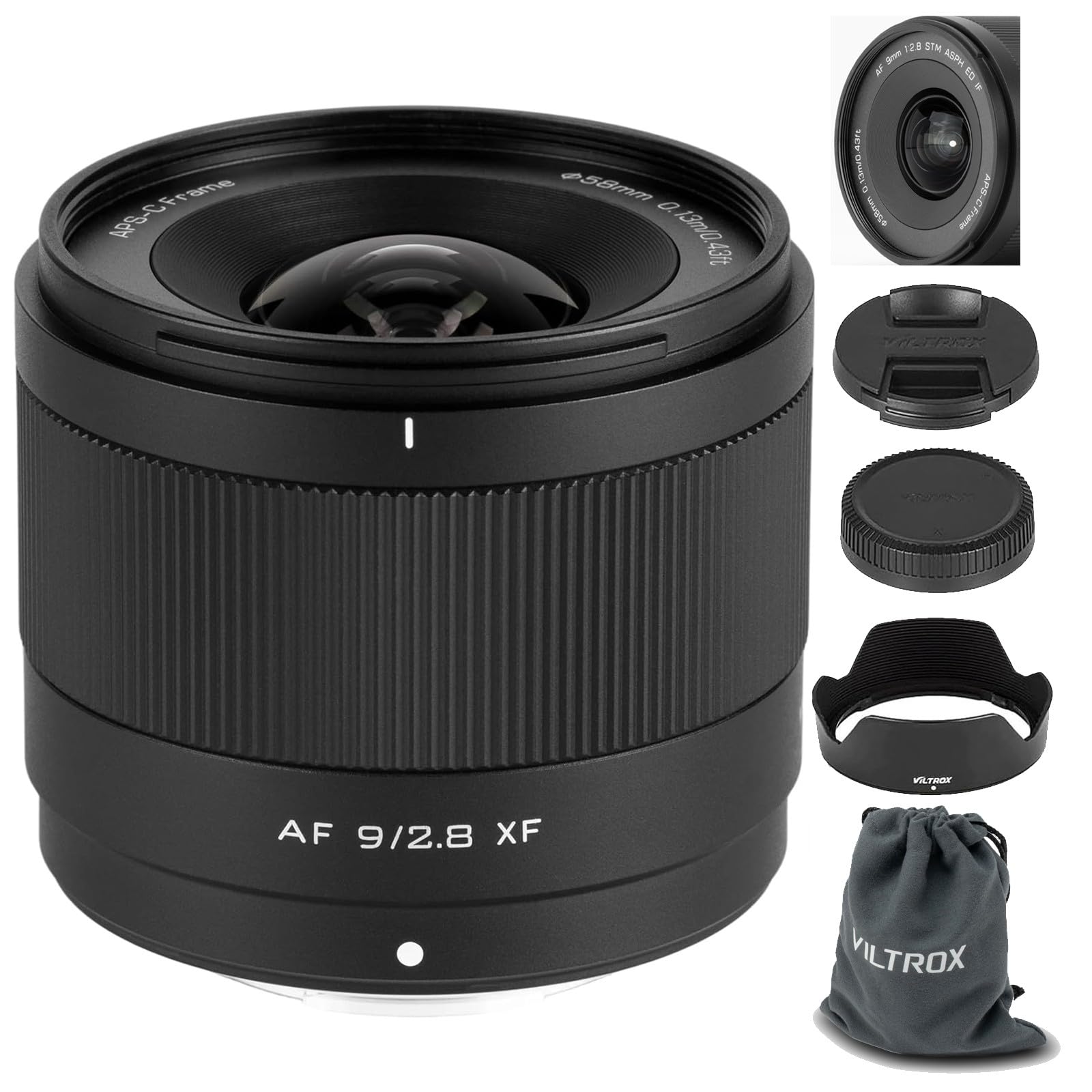
Viltrox 9mm f/2.8 XF

85 /100
Keeper Score Excellent

Key details

Weight
13.4 oz
Focal Length
9mm (13.5mm equiv)
Max Aperture
f/2.8
Minimum Focus
0.13 m (5.1 in)
Check Price on Amazon

A 113.8-degree view is a different way of seeing. Point it at a hotel room and the far wall arrives with the ceiling and both side walls attached; point it at a tree and the trunk comes at you. At 13.5mm equivalent this is the widest lens in the group, and the one that makes a small space look like a space rather than a corner.

What we ended up using most was the close focus. Five inches is close enough to put a coffee cup or a doorstep large in the frame while everything behind it stays visible, and that foreground-to-background relationship is what separates a composition from a snapshot at this focal length. The optics — two aspherical, three extra-low-dispersion, and three high-refractive-index elements — hold up better than the price suggests, with sharpness that survives out to the corners.

It autofocuses, which the two manual lenses here don't, and eye detection is there for the people you put in the frame. At 380 g it feels like glass without weighing like a zoom, and screw-in filters work at a normal 58mm. Use the hood that comes in the box; with a front element this wide, stray light has a lot of surface to work with.

Pros

  • 113.8 degrees
  • Autofocus and eye detection at this width
  • 5.1-inch close focus for exaggerated foregrounds
  • Sharpness that holds up to the corners

Cons

  • No weather sealing
Our verdict

The widest lens here and the one that autofocuses: our pick for tight rooms, dramatic foregrounds, and interiors where you can't back up.

Check Latest Price
5

Best Value for Night Skies

Rokinon 12mm f/2.0 NCS CS

88 /100
Keeper Score Excellent

Key details

Focus
Manual
Weight
9.59 oz
Focal Length
12mm (18mm equiv)
Max Aperture
f/2.0
Check Price on Amazon

This is the lens for the person who sets up a tripod, focuses once, and shoots a hundred frames of the same valley or the same star field. At 18mm equivalent with f/2 it gathers enough light to keep the shutter short under a night sky, and the 98.9-degree view takes in a whole ridge without turning the horizon into a bowl.

Twelve elements in ten groups, and a barrel that feels denser than the price implies. The focus ring turns with enough damping that small adjustments are possible rather than a guess, and focus peaking on a modern X-body makes the whole business quick: set the ring near infinity at f/8 and nearly everything from a few feet out is sharp. Aperture is set on the lens ring, so the camera isn't doing that part for you.

For night work this is where the value sits in this set: f/2 at 18mm equivalent, with stars that stay round and colors that hold up. Six aperture blades also give you defined, clean sunstars when you stop down for a daylight landscape — a small thing you notice the first time you shoot into a sunrise.

Pros

  • f/2 at 18mm equivalent for night skies
  • Dense, solid-feeling build for the money
  • Smooth damped focus ring for zone focusing

Cons

  • Manual focus only
  • No weather sealing
Our verdict

A dense, fast 18mm-equivalent prime for tripod landscapes and night skies, with the money saved going toward patience rather than glass.

Check Latest Price
6

Cheap Ultra-Wide

TTArtisan 10mm f/2

81 /100
Keeper Score Excellent

Key details

Focal Length
10mm (15mm equiv)
Max Aperture
f/2
Angle Of View
105 degrees
Filter Thread
72mm
Check Price on Amazon

Fifteen millimeters equivalent for the least money in this group. The TTArtisan 10mm f/2 sits in the same territory as the Viltrox 9mm and asks a little less for it, in exchange for a manual focus ring and about a millimeter and a half less width. Whether that trade is worth making depends entirely on whether anything in your frame moves.

Everything is on the barrel: focus on one ring, aperture on another, no communication with the body past the mount. For landscape and night work that costs almost nothing — at 10mm and f/8, focused near infinity, everything past a couple of feet is sharp and you can leave it there all evening. For handheld interiors with people in them, it costs you a lot.

The glass is better than the price suggests. Barrel distortion stays close to invisible, which at 105 degrees is the hard part, and f/2 is genuinely useful under a night sky where every stop buys a lower ISO. The 72mm filter thread is the practical catch: a polarizer or ND set in that size will cost more than the small-diameter filters the Fujinon primes take.

Pros

  • 15mm-equivalent view for the least money
  • Barrel distortion close to invisible at 105 degrees
  • f/2 useful for night sky work

Cons

  • Manual focus only
  • 72mm filters mean buying a new set
Our verdict

The least expensive way into a 15mm-equivalent view, and a sensible one if your wide work happens on a tripod.

Check Latest Price

How We Tested Wide-Angle Lenses for Fujifilm Cameras

We started by listing every wide-angle lens we could find in the X mount, then cut the field to the ones that differ in ways a buyer would actually notice: focal length, maximum aperture, autofocus versus manual focus, and whether it works on older bodies as well as new ones. Seven made the final cut, and every one was mounted and shot rather than compared on paper.

Testing ran eight months, mostly handheld and mostly in the situations that send people shopping for a wide lens: cramped interiors, evening streets, hikes with the lens left on the camera all day, and close work in dim rooms. For focus, we racked each lens from near to far, timed how quickly it locked in low light, and repeated it on a moving subject in continuous mode; with the manual options we focused by ring and noted how easy it was to hit a precise point. For stability, we shot handheld at 1/15 second and slower, then re-shot with stabilization on and off where it was available.

Image quality was judged on the same scenes for every lens: a brick wall for corner sharpness at each aperture, bare branches against a bright sky for fringing, doorframes for distortion, direct sun for flare. We carried each lens for a full day to judge weight and balance, and mounted and unmounted them dozens of times to see how the rings and mount held up, including a damp morning and a dusty trail.

Value and versatility came last, once we knew the lens: which focal length we kept reaching for, whether a faster aperture earned its extra bulk, and how close each one focused when the shot got tight. More than one of the least expensive lenses beat pricier ones on corner sharpness alone.

How to Choose a Fujifilm Wide-Angle Lens

Work Out How Wide You Actually Need

Everything on a Fujifilm body is multiplied by 1.5, so the number on the barrel is never the number you see: 16mm behaves like 24mm, 13mm like 19.5mm, 10mm like 15mm, and 9mm like 13.5mm. The useful question is how much foreground you want in the shot. At 24mm equivalent the near bank, the midground, and the ridge all sit at believable sizes. Below about 16mm equivalent, whatever is closest to the lens starts to dominate — which is either the effect you're after or a mess, and you generally know which before you buy.

Primes also force a decision that zooms postpone. Carrying a single 16mm means you learn one framing, and the ones you miss are the ones you crop or walk toward. That's a feature for most landscape shooters and an irritation for anyone photographing rooms to a deadline.

Aperture Is About Light, Not Sharpness

The spread from f/1.4 to f/4 separates these lenses more than any other figure. A fast wide lens lets you handhold a dim church interior and shoot a night sky at a lower ISO; it also means more glass, more money, and usually more bulk. Our position is simple: if your wide work comes off a tripod in daylight, spend the budget on range and sealing instead, because a slow wide lens at a sensible aperture does everything a landscape asks.

If you shoot after dark, buy the aperture and accept the rest. Two stops is the difference between a usable file and a deleted one far more often than a difference in corner sharpness.

Autofocus or Manual Focus

Manual wides are cheaper and, for tripod work, no handicap at all: focus peaking at f/8 on a 12mm puts almost everything past a couple of feet in focus, and you can leave the ring there all afternoon. Two things undo that. Wide open, a manual lens at f/2 has a very thin slice of focus when you're close, so scale focusing needs care rather than habit. And there's no continuous autofocus for someone walking through your frame.

If you photograph rooms, events, or people, autofocus earns its premium. If you photograph mountains, it mostly buys convenience.

Sealing and the Weight You'll Actually Carry

The best wide lens is the one that's with you when the light turns. A 155 g prime goes in the bag without a thought; a 410 g zoom is a decision you make at the door every time. Be honest about which one you'll still be carrying at hour six.

Sealing is the other half of that calculation, and it only counts when the body is sealed too. A sealed lens on an unsealed camera buys you nothing but confidence. Match the two, and then stop worrying about the forecast.

Filters and Front Elements

Landscape shooters live behind a polarizer and a couple of ND filters, and the thread size on the lens decides what those cost. Small-diameter primes take inexpensive filters that stack flat in a bag; a 72mm thread usually means a new set. Ultra-wide front elements add a second problem — a thick filter ring on a very wide lens is where corners darken and holder shadows creep in.

Buy the filter system with the lens rather than after it. That single decision is why a slightly more expensive lens with a common thread can end up the cheaper purchase.

Frequently Asked Questions

Final Verdict

For most Fujifilm shooters the XF16mmF2.8 is the wide lens that earns its place: small enough to live in the bag, sealed well enough to keep shooting in bad weather, and wide enough at 24mm equivalent for most landscapes and most rooms. It is the one we recommend without asking what you shoot.

Two requirements change that answer. If you need the 15-36mm range in a single body and shoot interiors methodically, the XF10-24mm f/4 replaces three primes and adds stabilization. If most of your wide work happens after dark, the Viltrox 13mm's f/1.4 is worth the extra glass in your bag.