Best Fujifilm Telephoto Lenses of 2026

Reach is the easy part of buying a telephoto lens; carrying it is the hard part. The longest zoom in the case always looks tempting, right up until you've hauled it around a wetland for three hours and started leaving it in the car. The lens worth owning is the one that gets you close to the subject without making you dread the walk back.

One thing to know before you shop: Fujifilm X bodies are APS-C, so the number printed on the barrel is really 1.5 times that in full-frame terms — a 300mm behaves like a 450mm, which is why a fairly compact zoom can cover a kid's soccer game from the far sideline. My team and I have spent nine months shooting with eight Fujifilm telephoto zooms, and the differences show up fast.

The good ones are sharp wide open and feel like they'd survive a knock; the frustrating ones hunt for focus, whir, and feel hollow in the hand. Stabilization matters more in this focal range than almost anywhere else in photography, and the price gaps don't reliably track the image-quality gaps. Below are the lenses that earned a spot in my bag.

Keeper Score summarizes customer ratings and review volume. Read it alongside the product details and trade-offs. How the score works.

1

Best Overall

Fujinon XF70-300mm F4-5.6

91 /100
Keeper Score Outstanding

Key details

Weight
1.28 lb
Focal Length
70-300mm
Max Aperture
F4-5.6
Weather Sealing
Dust, splash and low-temp resistant
Check Price on Amazon

Half a kilogram with 450mm on the end of it is the trade this lens makes, and it's why it's our top pick. The XF70-300mm weighs 580 g and reaches 450mm in full-frame terms, so it drops into the same bag as a standard zoom without a second thought. On a small X-mount body it sits forward of your hand rather than dragging it down — a different experience from the long lenses further down this list.

Fujifilm builds it from 17 elements in 12 groups, including one aspherical and two ED elements, and seals the barrel at 10 points against dust, splash and cold. The sealing is the specification we kept coming back to. A long lens is the one you carry when the forecast turns, and this is the least expensive sealed lens in this group, which makes the value argument a short one. Stabilization is on board as well, and it's what lets you keep shooting handheld at the long end instead of hunting for a fence post to lean on.

Where it stops is at the far end. If your subjects are reliably small and far away — waders on a mudflat, a receiver at the back of the end zone — the 100-400mm and the 150-600mm buy you real distance, and no amount of cropping closes that gap cleanly. For everything short of that, we think the smaller lens is the one that actually leaves the house, and that's worth more than the last 150mm.

Pros

  • 450mm equivalent reach at 580 g
  • Sealed against dust, splash and low temperatures
  • The least expensive sealed lens in this set

Cons

  • f/4-5.6 aperture is slow in dim light
Our verdict

Our default pick: 450mm of full-frame-equivalent reach in a weather-sealed 580 g barrel, for less than any other sealed lens here.
Check Latest Price
2

Best for Wildlife

Fujinon XF100-400mm F4.5-5.6

88 /100
Keeper Score Excellent

Key details

Weight
4.2 lb
Max Aperture
F4.5-5.6
Stabilization
5 stops
Focal Length (35mm Equiv)
152-609mm
Check Price on Amazon

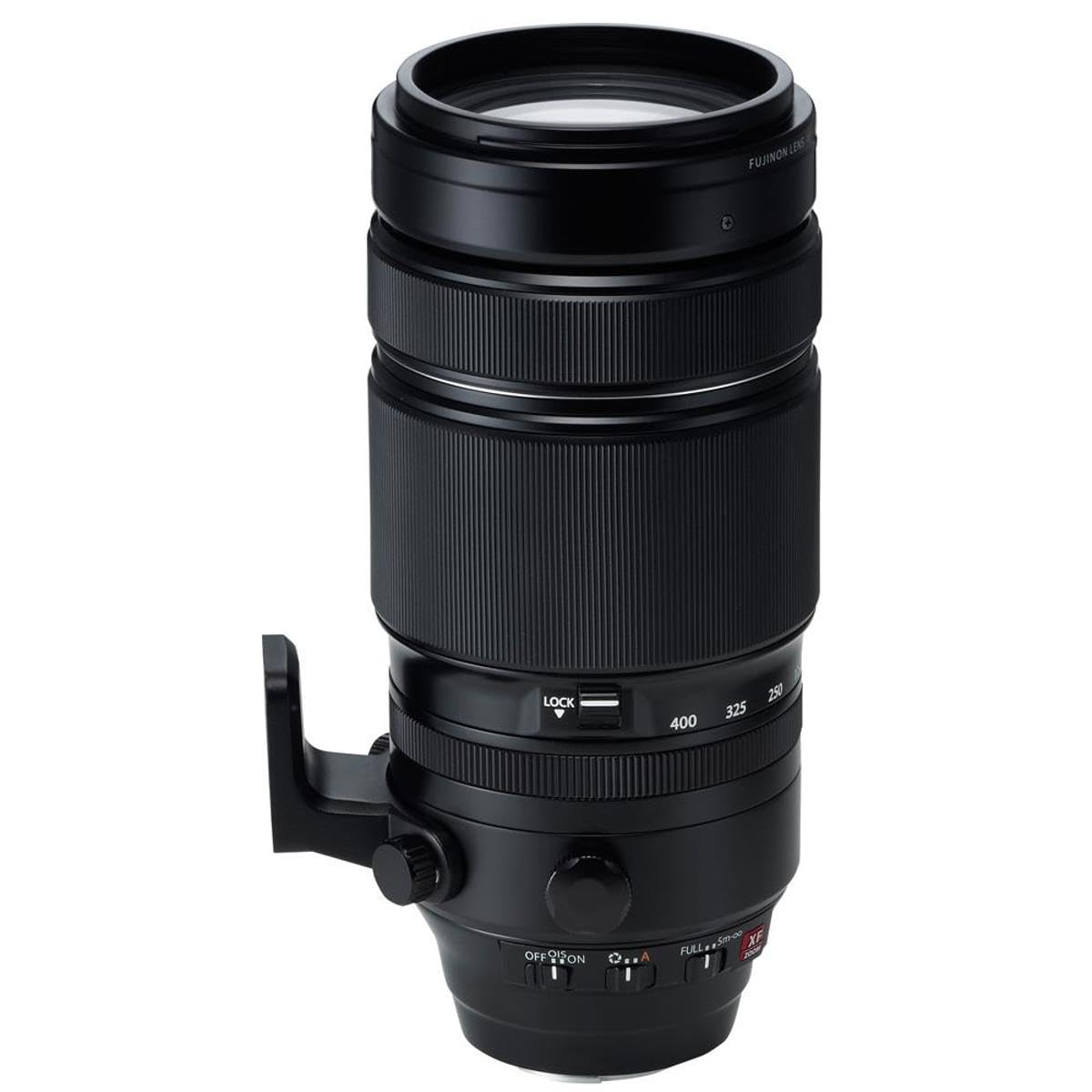
The XF100-400mm adds 150mm of equivalent reach over our top pick and brings a removable tripod collar with it, and that pairing is what makes it the wildlife lens of this group. In full-frame terms it runs 152-609mm, with 21 elements in 14 groups — five ED and one Super ED among them — handling the color correction.

Five stops of stabilization is the number that decides how often this lens comes off the tripod. At 609mm equivalent, handheld shooting is the difference between getting the frame and packing up, and the quoted system holds up well enough that we were comfortable standing unsupported in good light. Autofocus is quick and tracks a moving subject across the frame, and the files carry the kind of detail you can print large; on image quality this is the strongest of the long lenses here.

Here's the detail that surprised us: the 150-600mm is the lighter of the two, at 1,605 g against 4.2 lb here. What the extra heft buys is light — f/5.6 at the long end instead of f/8 — and that's the whole case for this lens over the longer one when the good hours are dawn and dusk. The collar takes the weight when you're set up and comes off when you're not. Minimum focus is 1.75 m, so plan on a different lens for anything close.

Pros

  • 609mm equivalent with five-stop stabilization
  • A full stop more light at the long end than the 150-600mm
  • Removable tripod collar balances a heavy barrel

Cons

  • Minimum focus distance of 1.75 m
Our verdict

The long lens we point at birds and sport: 609mm equivalent, five stops of stabilization, and a full stop more light at the long end than the 150-600mm.

Check Latest Price
3

Best for Maximum Reach

Fujinon XF150-600mm F5.6-8

85 /100
Keeper Score Excellent

Key details

Weight
1,605 g
Max Aperture
F5.6-8
Filter Thread
82mm
Focal Length (35mm Equiv)
229-914mm
Check Price on Amazon

Nothing telescopes as you zoom. The XF150-600mm holds the same barrel length from 229mm to 914mm equivalent, which sounds like a small thing until you've tracked something across a sky with a lens that grows as you turn the ring — the balance shifts, the hood moves, and the whole rig feels different at each end of the zoom. Here it doesn't.

Reach is the entire proposition: 914mm at the long end, and Fujifilm quotes 1,280mm with the 1.4x teleconverter and 1,824mm with the 2x. Autofocus keeps up with that, which is what turns the reach into pictures rather than frustration — a long lens that won't lock on is a spotting scope.

At 1,605 g it's lighter than the 100-400mm here, and that was the thing that surprised us most in this group: the longest lens isn't the heaviest. It's still a big barrel with an 82mm front thread, and the included tripod foot is there because you'll want a gimbal for a long session. If your subjects come to you, save the money and the bulk; if they never do, nothing else here reaches this far.

Pros

  • 229-914mm equivalent, out to 1,824mm with converters
  • Internal zoom holds the barrel length constant
  • Lighter than the 100-400mm here
  • Quick, quiet autofocus

Cons

  • f/5.6-8 confines it to good light
Our verdict

For subjects you can't get near: 914mm equivalent in a barrel that keeps its length, with autofocus quick enough to stay with them.

Check Latest Price
4

Best for Low Light

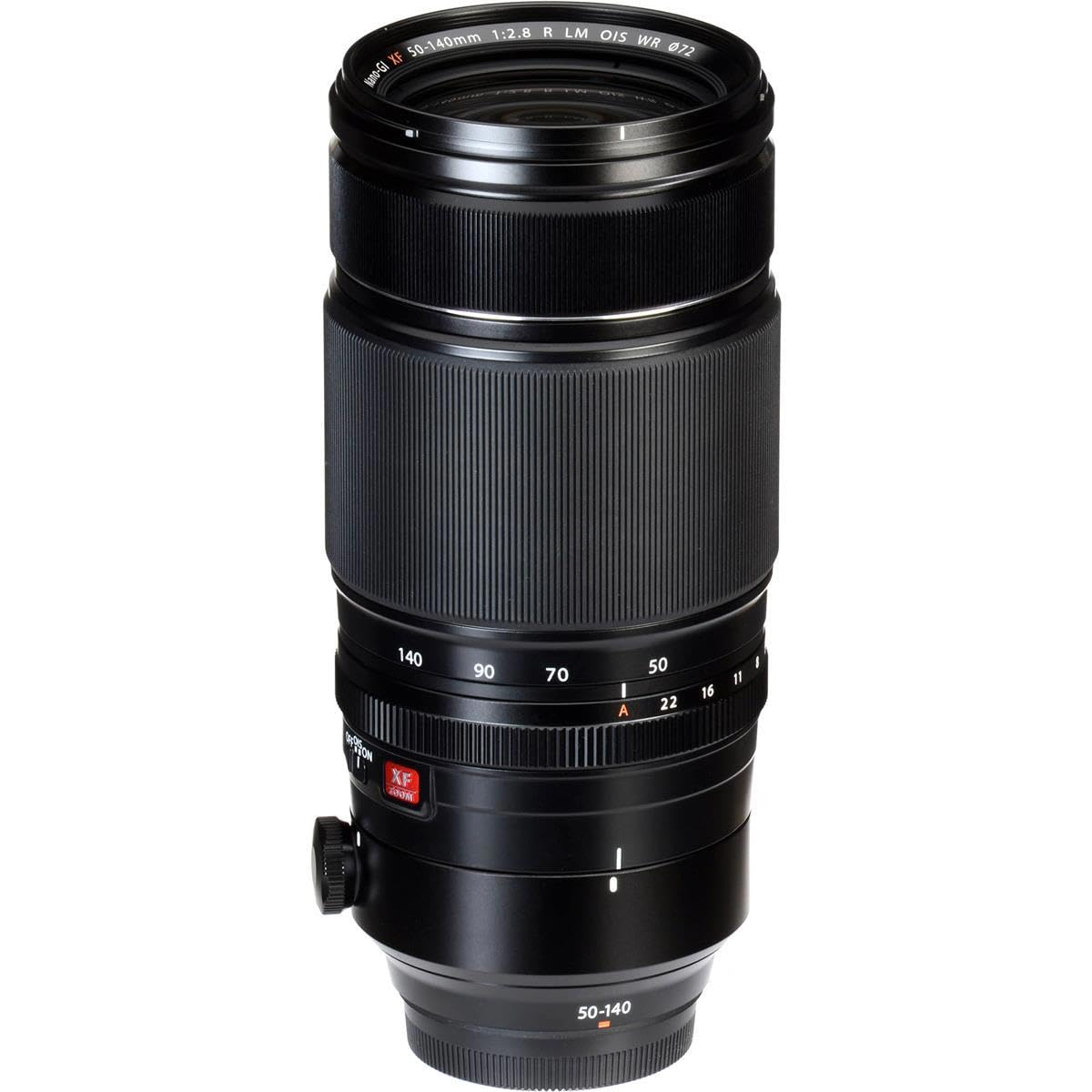
Fujinon XF50-140mm F2.8

89 /100
Keeper Score Excellent

Key details

Weight
2.2 lb
Max Aperture
F2.8
Weather Resistance
Dust, water and low-temp resistant
Focal Length (35mm Equiv)
76-214mm
Check Price on Amazon

A constant f/2.8 across a 76-214mm equivalent zoom makes this a different animal from everything else here. This is the gym, the reception, the stage and the press pit — anywhere the light is poor and you can't move closer — and for that job we think it's the strongest lens in this group.

The payoff is light and separation. At f/2.8 you get shutter speeds in a dim room that the f/4-5.6 zooms here can't reach without pushing ISO, and backgrounds fall away for portraits in a way the slower lenses can't imitate. Sharpness is what struck us most: this is the lens here whose files look expensive straight out of the camera. The build matches — dust, water and low-temperature resistance, internal focus, and a barrel that feels like it will outlast a couple of camera bodies.

214mm is where it ends, and that's the trade you're accepting. If your subject is a person, a pet, or a player you can walk around, that's plenty and the aperture is worth more than reach. If it's a bird you can't approach, it isn't, and the 100-400mm is the answer instead. One more thing to know before you buy: the stabilization whirrs audibly, which matters if you record sound along with the shot.

Pros

  • Constant f/2.8 through the whole zoom
  • Sharp, high-contrast rendering
  • Sealed against dust, water and cold
  • Fast, accurate linear-motor autofocus

Cons

  • Carries 1 kg, heavy next to the small zooms here
Our verdict

A constant f/2.8 telephoto for dim rooms and shallow backgrounds — the one we reach for when light is the problem rather than distance.

Check Latest Price
5

Best Budget

Fujinon XC50-230mm F4.5-6.7

85 /100
Keeper Score Excellent

Key details

Max Aperture
F4.5-6.7
Filter Thread
58mm
Stabilization
3.5 stops
Focal Length (35mm Equiv)
76-350mm
Check Price on Amazon

At the bottom of the price range sits the only lens here that counts as an easy add-on. The XC50-230mm covers 76-350mm in full-frame terms, which is genuine reach — a rooftop, a bird table, a kid on a far touchline — and it does it in a barrel that doesn't ask for its own bag.

The optics are the pleasant surprise. Thirteen elements in 10 groups, one aspherical and one ED among them, and detail holds together at the long end better than the price suggests, which we didn't expect at this end of the range. Stabilization is rated at 3.5 stops, enough to steady the 350mm end in reasonable light, and the 76mm wide end is useful for finding a subject before you zoom in on it. The f/4.5-6.7 aperture is the number to watch: it closes down quickly as you zoom, so a grey afternoon pushes the ISO up, and that's the real cost of the saving.

Pros

  • 76-350mm equivalent for the lowest outlay here
  • 3.5-stop optical stabilization
  • One aspherical and one ED element

Cons

  • No dust or moisture sealing
  • Slow to lock focus in dim light
Our verdict

The cheapest way into real reach on an X-mount body, as long as you shoot in decent light and don't need sealing.

Check Latest Price
6

People and Travel

Fujinon XF55-200mm F3.5-4.8

90 /100
Keeper Score Outstanding

Key details

Weight
1.28 lb
Max Aperture
F3.5-4.8
Stabilization
4.5 stops
Focal Length (35mm Equiv)
83-300mm
Check Price on Amazon

83-300mm in full-frame terms is the range that covers most of what people photograph at a distance — a face across a garden, a dog in a field, a band from the back of a room — and this lens covers it in a 580 g barrel with a 4.5-stop stabilizer.

The glass is what keeps it in the conversation. Sharpness and contrast are the consistent strengths, the all-metal barrel feels better than the price implies, and it's the mid-range zoom here that gives you the most at the wide end. Focus is the weak spot we kept running into: it's quick with good light and contrast, and hesitant without, hunting in dim conditions where the 70-300mm doesn't.

So why isn't it higher on this list? Because the 70-300mm costs about the same, adds 150mm of reach, and seals the barrel — for most buyers we think that's the end of the argument. The 55-200mm still makes sense if you photograph people more than wildlife: 55mm instead of 70mm at the wide end is a real difference indoors, and the shorter reach is the part you'll miss least.

Pros

  • Sharp, high-contrast optics
  • Solid all-metal construction
  • 4.5-stop stabilization

Cons

  • Not weather-sealed
Our verdict

An older zoom that still earns a place: sharp, well built, and the one to pick if 55mm at the wide end matters more than weather sealing.

Check Latest Price

How We Tested Fujifilm's Telephoto Zooms

We started with the full Fujifilm X-mount telephoto lineup and narrowed it by focal range, maximum aperture, whether the lens was stabilized and weather-sealed, and price — then bought eight of them outright so nothing was judged on a loaner. Testing ran nine months, and each lens went out on the same kinds of trips: Saturday-morning youth soccer from the far sideline, dawn at a local wetland, an indoor swim meet, and a lot of standing at the kitchen window waiting on the bird feeder.

For sharpness, I shot each lens wide open at its longest focal length, then again stopped down a full stop, and blew the files up to 100 percent on a branch, a jersey number, and a face in a crowd to see where detail held and where the corners smeared. Every lens also shot the same stationary target on a tripod at dawn, so I was comparing optics rather than my own luck. At the end of each session I asked whether the more expensive glass had bought anything I could actually see.

Autofocus was judged on moving subjects — a dog sprinting at the camera, kids warming up, gulls over water — by counting how many frames in a ten-shot burst were genuinely in focus, and by listening for the motor in a quiet room. Stabilization meant shooting handheld at slow shutter speeds and counting keepers, then repeating it while panning. Each lens was weighed on a kitchen scale, carried on a two-hour hike, and used in light drizzle to see how the barrel, mount, and finish handled weather and knocks; the plasticky ones announced themselves quickly.

How to Choose a Fujifilm Telephoto Lens

Compare the equivalent reach, not the number on the barrel

Every lens here is marked in native focal length, but an X-mount body multiplies that by 1.5. The 70-300mm finishes at 450mm in full-frame terms, the 100-400mm at 609mm, and the 150-600mm at 914mm. That conversion is the only fair way to compare these against the long glass you may be coming from, and it's the figure to keep in your head while you shop.

Then be honest about the subject. If you photograph birds, aircraft, or field sports from the touchline, 400mm equivalent is a floor rather than a target, and the two long zooms are the only serious answers here. If your subject is a person, a pet, or a performer you can position yourself around, 200mm equivalent with a fast aperture produces more keepers than 600mm at f/8.

Aperture decides when you can shoot

Reach and aperture fight each other in every one of these lenses. The 50-140mm holds f/2.8 right through its zoom; the 70-300mm and 100-400mm start around f/4 and finish at f/5.6; the 150-600mm is at f/8 by the time it reaches 600mm. Those are roughly three stops apart at the long end, which is the difference between a workable shutter speed at a dusk kickoff and a card full of noise.

We think the decision comes down to when you shoot rather than where. Indoor and evening work at moderate distance — events, courts, stages, portraits — makes a constant f/2.8 worth more than another few hundred millimeters. Daylight field work swings it the other way. Teleconverters blur the line, but they cost aperture, so check the converter's compatibility list and subtract the light before you count the extra reach.

Weight is the specification you feel every time

The lightest lenses here are 580 g and the heaviest is listed at 4.2 lb, with the 150-600mm in between at 1,605 g. That spread barely matters on a gimbal and matters enormously on a four-hour walk. If you can, handle a body-and-lens pairing before you commit — a 1 kg zoom on a compact X body is a different camera to carry than a 580 g one.

Two practical notes. The 100-400mm and the 150-600mm come with tripod collars, which move the pivot to the lens so a heavy rig balances properly on a head and gives you something to carry it by. And the reach you leave at home counts for nothing, which is the argument we keep making for the 70-300mm.

Sealing, stabilization and autofocus

Weather resistance isn't universal here: the 70-300mm, 100-400mm, 150-600mm and 50-140mm are sealed, while the XC50-230mm and the XF55-200mm make no such claim. A sealed body with an unsealed lens is still a fair-weather kit, so if you shoot in rain, spray, or sea air, budget for sealing rather than working around it.

Stabilization ratings run from 3.5 stops on the budget zoom to 5 stops on the 100-400mm. Read those as a guide to how low you can drop the shutter, not as a fix for a moving subject. Autofocus is the quality the numbers don't capture: the linear-motor lenses lock on faster and hunt less in low light, and that's where a lot of the price difference between an XC and an XF lens actually shows up.

Filters and accessories don't transfer

The filter threads run 58mm on the XC50-230mm, 62mm on the XF55-200mm, 67mm on the XF70-300mm, 72mm on the XF50-140mm, 77mm on the XF100-400mm and 82mm on the XF150-600mm. A polarizer or ND filter bought for one lens won't screw onto the next. If you use filters regularly, buy for the largest thread you own and add step-up rings instead of duplicating a set.

Frequently Asked Questions

Final Verdict

Of the six lenses here, the XF70-300mm is the one we point most people toward. It puts 450mm equivalent on the end of a 580 g barrel, seals it against the weather, and undercuts every other sealed lens in this group — which is why it's our top pick rather than the longest or the fastest lens on the page.

The alternatives are specific rather than general. If light matters more than distance, for indoor and evening work, the XF50-140mm's constant f/2.8 is the answer. If your subjects won't come closer, step up to the 100-400mm for a stop more light at the long end, or the 150-600mm when 914mm is the whole reason you're buying.