Best Front and Rear Dash Cams of 2026

The footage from a dash cam only helps if it's already recording when something goes wrong. A front-only camera misses the rear-end hit, a too-short cable turns the rear camera into a wiring project, and a clip that takes minutes to pull off the app is one you'll stop checking. I want a setup that disappears onto the glass, starts every time, and gives you a readable plate at night.

Over seven months, my team and I installed and lived with 12 front-and-rear dash cams in daily drivers and weekend road-trip cars. We paid attention to video quality and recording performance first, then the quieter stuff: whether Wi-Fi actually moved files, whether the cable reached the rear glass cleanly, and how night footage held up against headlights and streetlamps. Reliability and value matter more here than in almost any other gadget—a camera that reboots in the heat is just a suction cup.

The picks below earned a permanent spot on our windshields—start there for a clean install and usable night footage.

Keeper Score summarizes customer ratings and review volume. Read it alongside the product details and trade-offs. How the score works.

1

Best Overall

ROVE R2-4K Dual Dash Cam

89 /100
Keeper Score Excellent

Key details

Mounts
Suction and 3M adhesive
Included Card
128 GB
Rear Resolution
1080p
Front Resolution
1440p native, 4K upscaled
Check Price on Amazon

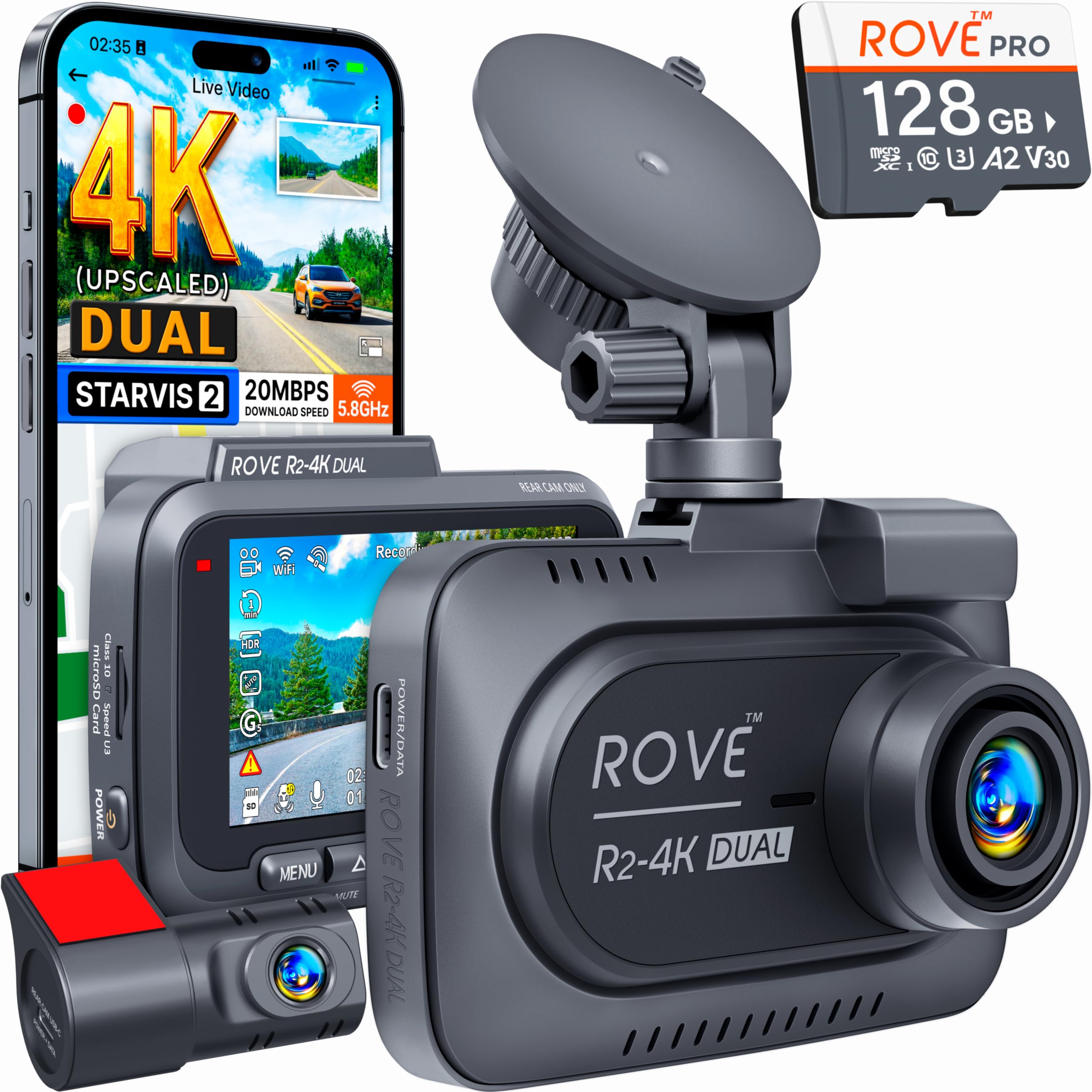
The headline says 4K; the fine print says something more useful. The front camera records natively at 1440p and upscales to 4K, and the rear records 1080p — and we prefer a spec sheet that admits it to a badge that does not. What the money actually buys is a complete dual-camera kit: a Sony STARVIS 2 sensor behind an f/1.5 lens, GPS, a three-inch screen and a 128GB card. It is the camera we point most people toward when they set up front and rear coverage for the first time.

The box is unusually complete. Alongside the camera and the rear unit there is a 128GB ROVE card, a suction mount, a 3M sticky mount, a trim tool, five cable clips, a 3.5m power lead and a 6m rear cable. Two mount types matter more than they sound: the suction cup lets you move the camera between cars, and the tape mount is the one that holds through a hot summer. Apply the electrostatic film before the adhesive — it is what makes the mount removable without leaving glue on the glass.

Continuity is the thing to watch. This camera can stop recording without telling you, so check the screen when you pull away and format the card every few weeks. That habit is the difference between owning a dash cam and owning a decoration. Otherwise the hardware does what you ask: the GPS stamps speed and position into every file, and the rear unit is powered and recorded from the front camera, so there is one card to manage rather than two.

Against the Affver, this one costs more and records less resolution at the front. The extra buys the wider record behind it, GPS in every file, both mount types and a bigger card in the box — the parts that decide whether the camera is still doing its job in year two. The three-inch screen is the other quiet advantage: big enough to aim the lens and confirm a recording without reaching for the phone.

Pros

  • Complete kit: card, both mounts, trim tool
  • Native 1440p front with GPS built in
  • Suction and adhesive mounts for two cars
  • Three-inch screen for on-camera playback

Cons

  • App pairing is inconsistent, especially with CarPlay
  • 140-degree rear lens covers less than the wide picks
Our verdict

The dual dash cam we recommend to most drivers: native 1440p front, 1080p rear, GPS, a 128GB card and both mounts in the box, with the most consistent record in this group.
Check Latest Price
2

Best Value

Affver A4 Dual Dash Cam

88 /100
Keeper Score Excellent

Key details

Screen
3.59 in
Included Card
64 GB
Rear Resolution
2.5K at 25 fps
Front Resolution
4K at 30 fps
Check Price on Amazon

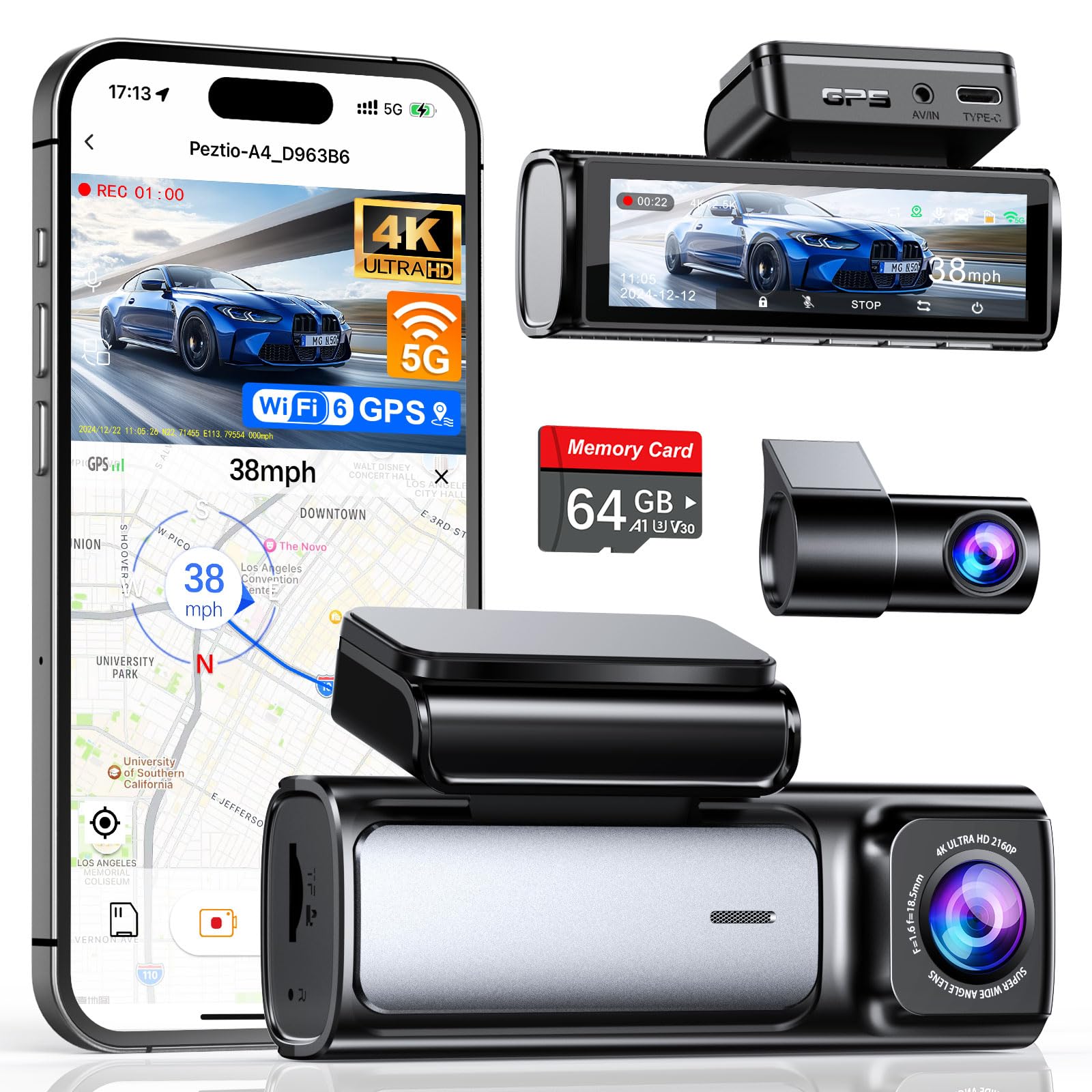
For less money than our top pick, the A4 hands you more resolution: a 4K front at 30fps and, since a June 2026 update, a 2.5K rear at 25fps, plus WiFi 6, GPS, a 64GB card and the largest screen in this group at 3.59 inches. On paper it is the better camera. In the car it is close enough that the price becomes the argument.

What settled it for us is how little the install asks of you. The rear cable and a trim tool come in the box, the menus are legible on that big screen, and the body is small enough to sit under the mirror without cutting into your view of the road. That combination — easy to fit, easy to read, out of the way — is why it is our value pick rather than just the cheapest 4K badge here.

Two numbers to know. The card ceiling is 256GB, the lowest in this group alongside the Botslab and the E-YEEGER, so at 4K front and 2.5K rear you will be overwriting sooner than the VIOFO's 512GB ceiling allows. And the rear runs at 25fps, which is fine for a plate at a standstill and slightly softer on one moving away from you.

Pros

  • Native 4K front, 2.5K rear
  • 3.59-inch screen, the largest here
  • Rear cable and 64GB card included
  • Small body that leaves the view clear

Cons

  • 256GB ceiling is the lowest here
  • Rear records at 25fps
Our verdict

The value pick: native 4K up front, a 2.5K rear, WiFi 6, GPS and a 64GB card for less than our top pick, on the largest screen here.

Check Latest Price
3

Best for Night Driving

VIOFO A229 Plus

86 /100
Keeper Score Excellent

Key details

Sensors
Dual STARVIS 2 IMX675
Rear Resolution
1440p
Storage Ceiling
512 GB
Front Resolution
1440p at 60 fps
Check Price on Amazon

Two Sony STARVIS 2 IMX675 sensors — the same one at each end — with HDR applied to both channels. That is the A229 Plus's argument, and it is the right one if a lot of your driving happens before sunrise or after dark. Most dual cameras here give the rear the cheaper sensor; this one does not.

The compromise is resolution. Where the ROVE and the Affver push 4K at the front, VIOFO stays at 1440p front and rear, with 60fps up front for smoother plate reads at speed. In daylight that is a smaller number on the box. After dark it is the difference between a plate and a smear, because the work is being done by the sensor and the HDR rather than by interpolation. The 140-degree lenses are tighter than the 150-to-170-degree units here, and the trade is less A-pillar and less edge distortion in the shot.

This is the camera we fit when the driving is mostly at night, and the one we trust most on the footage that ends up mattering. The record behind it is not as clean as the ROVE's, though: the front or rear camera can stop working after a few months. Buy it where returns are simple and confirm both channels are recording in the first week.

Budget for a card, because there is not one in the box, and take the 512GB ceiling seriously — a 256GB high-endurance card suits it. Install is the tidiest of the group: a 6m rear cable, static stickers, a trim tool, and a GPS puck on its own adhesive pad rather than built into the mount, which means you can place it where it can actually see sky. The 18-month warranty is the longest in this group.

Pros

  • STARVIS 2 with HDR front and rear
  • Supercapacitor instead of a battery
  • 512GB ceiling, the highest here
  • 18-month warranty, longest in this group

Cons

  • No memory card in the box
  • Front or rear camera can stop working
Our verdict

The night-driving pick: the same STARVIS 2 sensor and HDR front and rear, 1440p at both ends, voice control and a supercapacitor, in the tidiest install kit here.

Check Latest Price
4

Best Connected Features

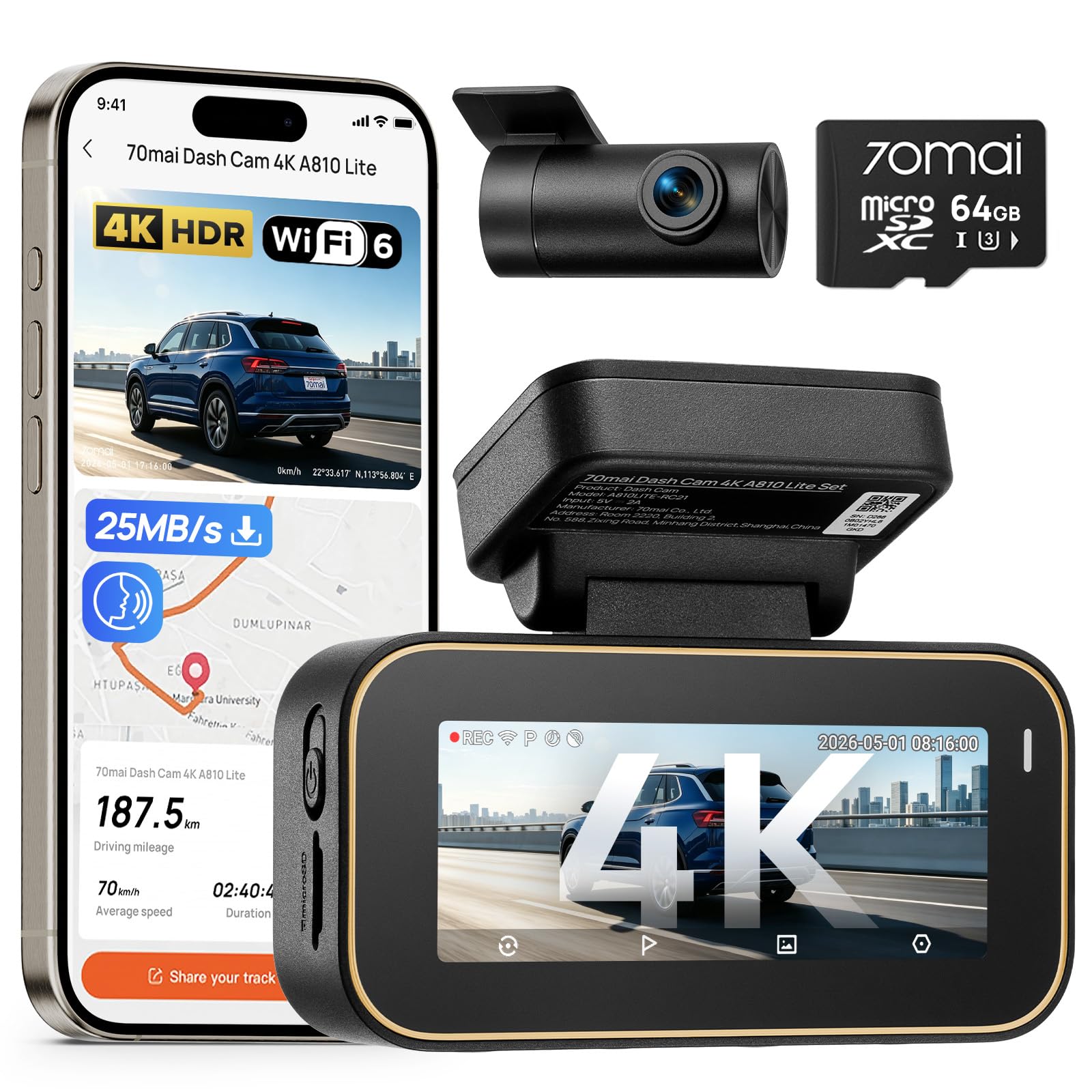
70mai A810 Lite

85 /100
Keeper Score Excellent

Key details

Transfer
WiFi 6, up to 25MB/s
Included Card
64 GB
Rear Resolution
1080p
Front Resolution
4K (3840 x 2160)
Check Price on Amazon

The A810 Lite is the only camera in this group that lists 4G LTE remote access — a live look at the car, a notification when it is disturbed, a clip on your phone from another state. We think that is the most genuinely different feature on this page, with one caveat: the box holds a 64GB card, a charger, the rear camera and its cable, but no LTE module. Treat remote access as something you add rather than something you unbox.

The rest is well judged. A true 4K front at 3840x2160 and a 1080p rear, a WiFi 6 link that moves files at up to 25MB/s, three-mode GPS stamped into the footage, voice control for the basics, a supercapacitor instead of a battery, and a 64GB card included. Clips come off quickly enough that pulling one at the roadside is not a project.

Where it sits against the Affver is the useful comparison: similar money, more front resolution on the Affver, faster transfers and the remote option here. If the rear footage is mainly for lane position and the front is what you will show an insurer, the trade works. The rear camera is 1080p, which is where the money went elsewhere, and that is the honest limit of this one.

Pros

  • WiFi 6 transfers up to 25MB/s
  • Supercapacitor and 64GB card included
  • Three-mode GPS and voice control
  • Lists 4G LTE remote access

Cons

  • Cable run is tight in long-wheelbase vehicles
  • Rear camera is only 1080p
Our verdict

The connected pick: 4K front and a 1080p rear with WiFi 6, three-mode GPS, voice control and a supercapacitor, plus 4G remote access if you add the hardware.

Check Latest Price
5

Best Premium

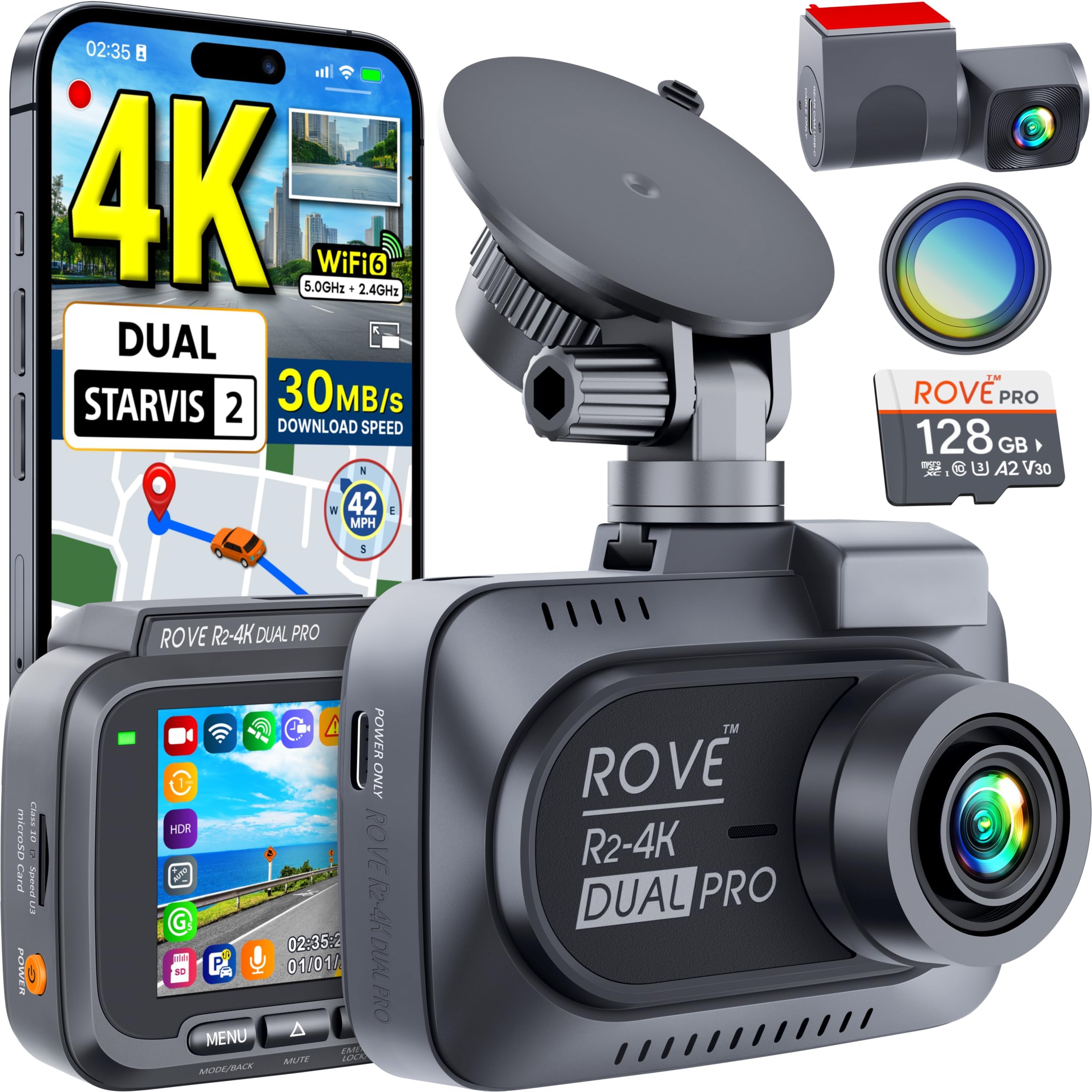
ROVE R2-4K Dual PRO

85 /100
Keeper Score Excellent

Key details

Sensors
IMX678 front, IMX675 rear
Included Card
128 GB
Rear Resolution
2K at 30 fps
Front Resolution
4K at 30 fps
Check Price on Amazon

This is the most expensive camera here, and it exists to answer one question: how much detail does your footage actually need? A native 4K front on Sony's 8MP IMX678, a 2K rear on the IMX675, WiFi 6 moving files at up to 30MB/s — the fastest transfer in this group — quad-mode GPS, a 128GB card, a 1TB ceiling and a CPL filter in the box.

The CPL is the part we care about. Polarizing the front lens cuts the dashboard reflection that washes across the glass on a bright day, and that reflection is a common reason a plate turns into a white smear on a sunny afternoon. Add the native 4K front and the 2K rear and you have the clearest daylight footage in this group; that pair is what the premium buys over the standard R2-4K.

One reservation matters more than the rest: the front camera can freeze or black out. Buy where returns are straightforward, and check the front channel after the first hot week rather than the first day. Otherwise this is the R2-4K with better glass in front of it, a tighter 140-degree rear lens and a filter on the nose.

Pros

  • Native 4K front on an 8MP sensor
  • CPL filter included for dashboard glare
  • WiFi 6 at up to 30MB/s, fastest here
  • 1TB ceiling and a 128GB card

Cons

  • WiFi pairing is no easier than the cheaper ROVE
  • Rear night footage trails the front camera
Our verdict

The premium choice: native 4K front, 2K rear, the fastest transfer here and a CPL filter in the box, for drivers who need plate-level detail from a moving car.

Check Latest Price
6

Best for Rear Detail

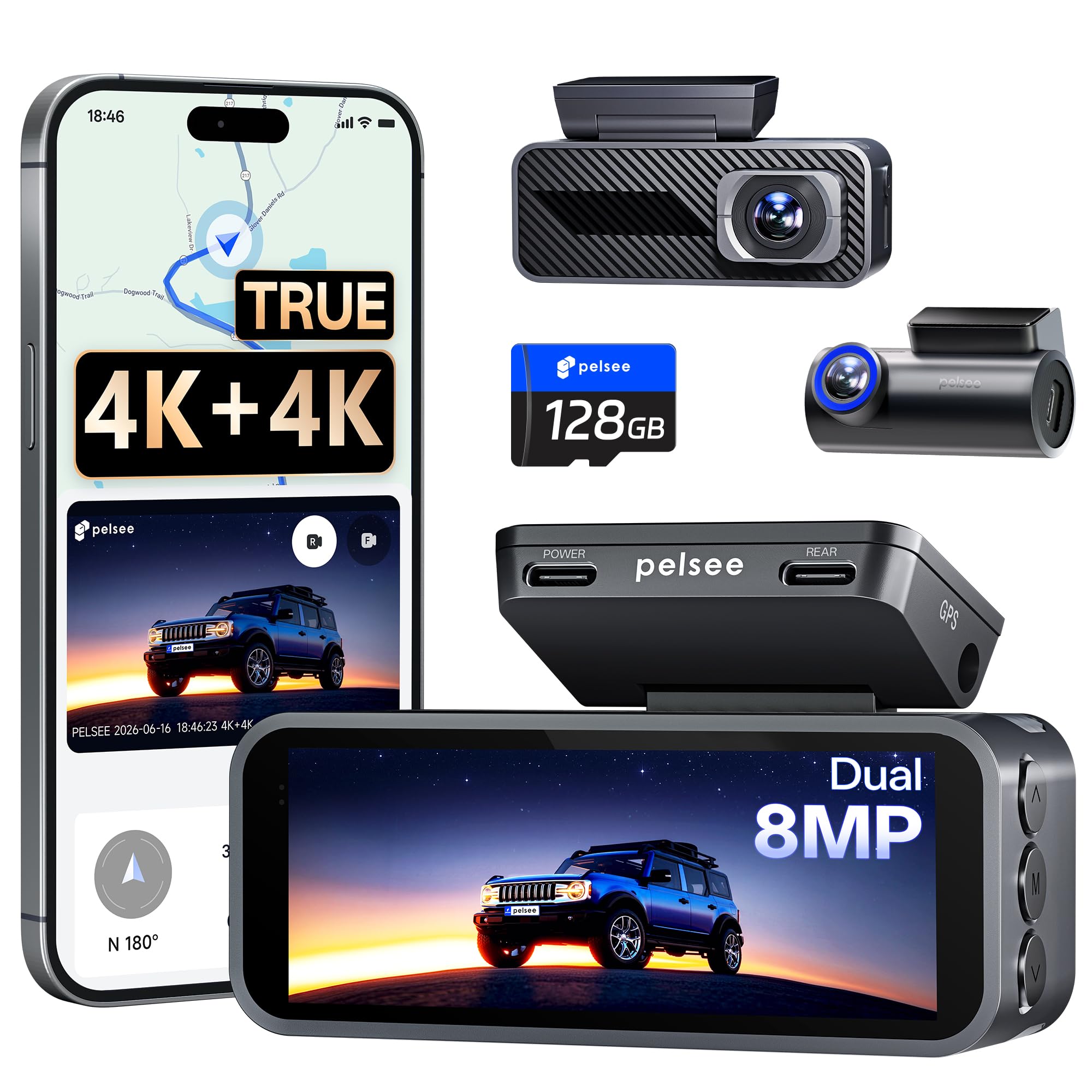
Pelsee S1 Pro

86 /100
Keeper Score Excellent

Key details

Included Card
128 GB
Rear Resolution
4K native (8MP)
Storage Ceiling
1 TB
Front Resolution
4K native (8MP)
Check Price on Amazon

Every camera here sells the front lens. The S1 Pro's pitch is the other end: 8MP sensors front and rear, native 4K at each, which is the highest rear resolution in this group by a clear margin. If what you keep missing is the car behind you, that is the number that matters.

The rest is well specified. An f/1.4 aperture at the front — the widest here — full-color night footage, WiFi 6, GPS, voice control, a 3.39-inch screen, a 128GB card and a 1TB ceiling. The 170-degree front lens is as wide as anything in this group, and the rear covers 150 degrees.

The cost of all that resolution shows up on the card. 4K at both ends writes bigger files than any other camera here, so the 128GB card in the box will loop sooner than you expect; a 256GB high-endurance card and a monthly format is the sensible setup. That is the trade for the clearest rear footage in the group, and we think it is an easy one for anyone who has been rear-ended once.

Pros

  • Native 4K front and rear
  • f/1.4 aperture, widest here
  • 128GB card and 1TB ceiling
  • WiFi 6, GPS and voice control

Cons

  • Dual 4K fills a 128GB card fastest here
Our verdict

The rear-coverage specialist: native 4K at both ends, the widest aperture here and a 128GB card, for drivers who need the clearest view of what is behind them.

Check Latest Price
7

Minimal Spend

E-YEEGER S50

84 /100
Keeper Score Excellent

Key details

Included Card
None
Rear Resolution
1080p
Storage Ceiling
256 GB
Front Resolution
2.5K (2560 x 1440)
Check Price on Amazon

No WiFi. No app. No card in the box. The S50 records 2.5K at the front and 1080p at the rear onto a card you supply, and that is the entire proposition. If you have ever stood in a parking lot waiting for a phone to negotiate with a dash cam, the appeal is obvious.

It is also generous where the money does not show. A 2-inch IPS screen, a 23ft rear cable — the longest in this group — and an adhesive mount with a pry tool and spare pads in the box. The 170-degree front and 160-degree rear lenses cover more of the road at both ends than the ROVE does.

Two things cost extra. Parking mode needs a specific three-core hardwire kit sold separately, so the 24-hour feature is not really in the box. And with no app, getting a clip means walking the card to a computer — fine at home, useless at the roadside when you need to show someone what just happened.

Where it earns a place is as a second camera: a work van, a teenager's first car, the vehicle that does the school run and not much else. You are giving up the app, the card and the GPS, and if none of those were going to change what you do with the footage, this is the cheapest way to have both directions covered. Buy a high-endurance card with it and set the loop to three minutes.

Pros

  • Lowest price in this group
  • 23ft rear cable, longest here
  • 170-degree front lens
  • Simple push-button controls

Cons

  • No WiFi or app; card must be removed
  • Card and hardwire kit sold separately
Our verdict

The cheapest way into dual-channel recording: 2.5K front, 1080p rear and a 23ft rear cable, with no app, no card and no GPS to pay for.

Check Latest Price
8

Discreet Installs

BOTSLAB G300H Plus

86 /100
Keeper Score Excellent

Key details

Night Sensor
STARVIS 2 with HDR
Included Card
64 GB
Rear Resolution
1080p
Front Resolution
4K
Check Price on Amazon

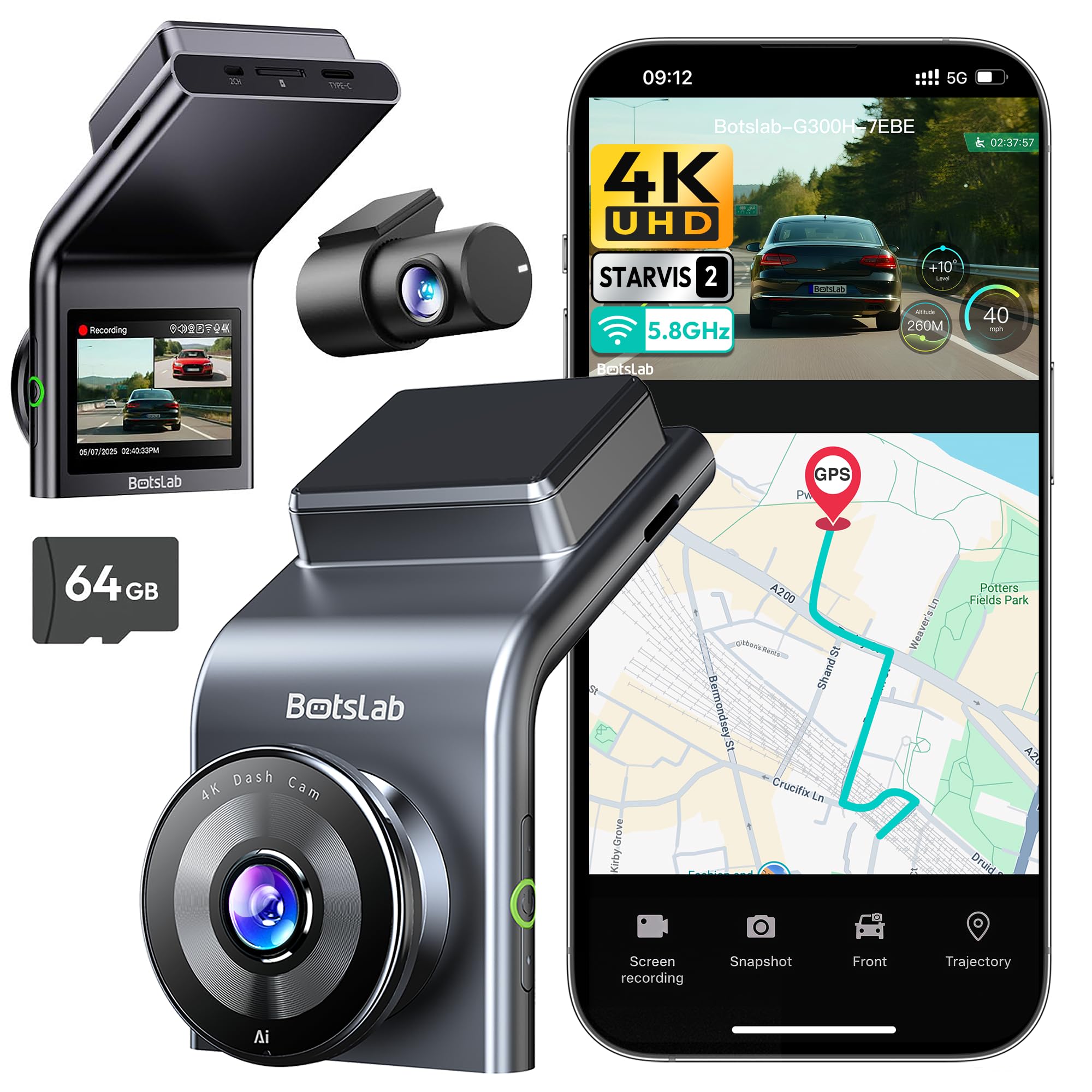
A 2-inch screen and a silver-finished body, where most of this group gives you three inches of black plastic. It is a small distinction and it is the reason this camera made the list at all: some windshields, and some drivers, are happier with a camera that does not announce itself in the corner of the view.

The hardware is more serious than the size suggests. A STARVIS 2 sensor with HDR at the front, 4K recording, 1080p at the rear, 5.8GHz WiFi up to 20MB/s, GPS, voice control and a supercapacitor — the heat-tolerant component we look for in anything that lives on a windshield through summer.

Installation is generous: a 6.5m rear cable, one of the two longest here, electrostatic film, 3M tape, a pry bar and a 3.5m USB-C power lead. The 64GB card in the box gets you started, but 256GB is the ceiling, so if you plan to leave parking mode running you will want a bigger high-endurance card from day one.

What it gives up is speed and frame rate. Transfers top out below the WiFi 6 units, and 25fps is a step behind the 30fps cameras here, which you notice on a plate at a closing distance rather than on a parked car. Against the 70mai it trades the remote-access option for a smaller footprint and a longer rear cable; choose it if living discreetly on the glass matters more than what the app can do from another city.

Pros

  • STARVIS 2 sensor with HDR
  • Supercapacitor for heat tolerance
  • 6.5m rear cable, one of the longest
  • Voice control and 5.8GHz WiFi

Cons

  • 256GB ceiling is at the low end here
  • 25fps recording trails the 30fps units
Our verdict

The discreet option: STARVIS 2 with HDR, 4K front and 1080p rear, voice control and a supercapacitor in one of the smallest bodies in this group.

Check Latest Price

How We Tested 12 Front-and-Rear Dash Cams

We started by gathering the front-and-rear dash cams shoppers actually compare, then filtering by whether both cameras recorded at useful resolutions, whether the mount and cable kit suited a normal car, and whether the app and Wi-Fi were part of the package rather than an afterthought. That left 12 units, which we installed in our own vehicles for seven months—commuting, errands, weekend trips, and overnight parking.

Installation was the first real test: I routed each rear cable from the windshield to the rear glass, noted whether the length was generous enough to follow trim without stretching, and used the app for everyday clip retrieval. I timed how long each unit took to connect over Wi-Fi and download a one-minute clip, then repeated it at night in a parking lot—the moment when ease of use stops being abstract.

On the road, we watched recording performance over loops, looking for gaps, missed files, and the way each camera handled sudden bumps or locked events. We reviewed daytime and nighttime footage on the same routes, comparing how well plates, signs, and lane markings survived headlight glare, rain, and streetlamp color. We also left each unit in parking mode overnight and watched for reboots, dead batteries, or mounts that sagged in the heat—camera reliability shows up in the boring weeks, not the first drive.

At the end, we weighed what came in the box—cards, mounts, hardware—against the price and asked which one we'd hand to a family member without a caveat. The ones that stayed on our windshields made recording, retrieving, and trusting the footage feel routine.

How to Choose a Front and Rear Dash Cam

Native resolution beats a 4K badge

A 4K file upscaled from a 1440p sensor has more pixels than it has detail, and it costs you card space to store the difference. The ROVE R2-4K is honest about this in its own specifications; plenty of listings are not. Look for the native number, then look at what each end records. A 1080p rear is enough to show lane position and who was behind you, but not enough to read a plate at distance — 2.5K or 4K at the back is a real upgrade, not a marketing one.

You can see the whole spread in this group: 1080p behind on the ROVE and the 70mai, 2.5K on the Affver, native 4K on the Pelsee. Decide what the rear footage is for before you start comparing front numbers.

Night footage is a sensor question

After dark, aperture and sensor do the work, not the resolution figure. An f/1.4 to f/1.6 lens pulls in more light than the f/1.8 units, and HDR matters most where headlights blow out the frame. The detail worth checking is whether HDR applies to both channels — the VIOFO A229 Plus applies it front and rear, which is the main reason it is our pick for a dark commute.

Expect the rear channel to be the weaker end whatever you buy, because the sensor is smaller and the view often goes through tinted glass. Test the rear footage after dark in the first week, on the road you drive most, so you know what you have before you need it.

Heat, mounts and parking power

A dash cam lives in the worst place in the car: a closed cabin in direct sun, all day. A supercapacitor handles that better than a lithium battery, which is the first thing we check on a spec sheet. The mount matters just as much. Tape on an electrostatic film holds where a suction cup lets go in heat, though the suction cup is the one you can move between cars.

Parking mode needs constant power, which in almost every case means a hardwire kit — the E-YEEGER even names the specific one it takes. Use a kit with a low-voltage cutoff so a week of airport parking does not leave you looking for a jump start.

Getting clips off the camera

The app is where these cameras most often disappoint. WiFi 6 and 5.8GHz transfers, 20 to 30MB/s on the faster units here, beat the older 2.4GHz link, and CarPlay or Android Auto running can interfere with pairing on several of these cameras. The fallback is a card reader, so make sure you can physically remove the card without dismantling the mount.

Use a high-endurance card rather than the cheapest one on the shelf, and format it in the camera every few weeks. Loop recording overwrites the oldest files, so a card that quietly corrupts is a camera that quietly stops being useful.

Read the box list before you buy

What comes in the box decides how long install day takes. The rear cable has to run from the back window to the front camera: 6m suits most cars, while the 23ft cable on the E-YEEGER gives you slack in a van. A trim tool and clips save you improvising with a credit card. Cards split the group too — several ship with 128GB, the 70mai and the Affver with 64GB, and the VIOFO and the E-YEEGER with none.

Add up what is missing before you compare prices. A high-endurance card and a hardwire kit can close the gap between a camera that looked cheap and one that was simply complete.

Frequently Asked Questions

Final Verdict

The ROVE R2-4K Dual is the one we point most people toward: native 1440p in front, 1080p behind, GPS, a 128GB card and both mounts in the box, and the most consistent record of the group behind it.

Spend more only for a reason. The VIOFO A229 Plus earns it if most of your driving is after dark, and the Pelsee S1 Pro earns it if rear detail is what you are missing. Spend less and the Affver A4 still gives you native 4K at the front for a smaller outlay.