Best Filament Dryers of 2026

You hear it before you see it: a faint ticking from the nozzle, then a print that lifts off the bed with stringers where a smooth wall should be. That's moisture boiling off at the hot end, and it happens to spools that sat in a room that felt perfectly dry. A dryer holds a spool at a steady low heat until the water's gone, then keeps it that way while it feeds the printer.

Desiccant packs slow the problem; they don't dry anything. My team and I put 12 dryers through real print jobs over seven months, and the spec sheet rarely predicted the winner. What did: spool capacity, whether you can print straight out of the unit, whether dual chambers let you dry two materials at once, how high the heat goes for nylon and PC, and whether the controls make sense without the manual at 11 p.m.

A dryer is only as good as its seal; a warm open box in a humid room is just a spa for your filament. The picks below held temperature, sealed properly, and earned a permanent place beside the printer.

Keeper Score summarizes customer ratings and review volume. Read it alongside the product details and trade-offs. How the score works.

1

Best Overall

Comgrow SH02 Filament Dryer

87 /100
Keeper Score Excellent

Key details

Heater
150W PTC
Spool Capacity
2 spools
Max Temperature
70°C
Filament Presets
9 types
Check Price on Amazon

Two spools, 70°C, and a sealed lid are the three things we look for in a first serious dryer, and the SH02 hits all three without the four-spool footprint. The 150W PTC heater is stronger than the basic 50°C boxes, so PETG and ABS are within reach, and the one-key presets cover nine materials including PLA, TPU, PETG, ABS, ASA, PVA, PC, PA, and PP. The lid and outlet use sealing rings, so the box can keep working as storage after the heat cuts off.

The feature that sold us is the twin-spool layout: you can dry a spool of PLA while keeping a backup of PETG ready, and the two filament holes let you feed either one straight to the printer. The feed path is the part to watch—thin or badly wound filament can drag at the exit, and the fan is audible enough that we noticed it across the room. Neither spoiled the drying for us, but they make this a dryer for a dedicated shelf rather than a desk-side appliance.

For most home printers, the combination of two spools, 70°C, and sealed storage is the best balance in this group. It is not the box we count on for years of unattended service; reliability is the weak spot, so buy it where returns are simple. What we keep coming back to is the everyday convenience: load two spools, set the material, and leave them sealed until the next print.

Pros

  • Two spools dry at once
  • 70°C ceiling covers PETG and ABS
  • Sealed lid and outlet keep spools dry
  • Presets for nine filament types

Cons

  • Fan noise is noticeable
  • Reliability is the weak spot
Our verdict

For most home printers, the SH02 is the two-spool dryer we recommend: 70°C, sealed storage, and a footprint that still fits a shelf.
Check Latest Price
2

Best for Engineering Filaments

Sovol SH03 Filament Dryer

82 /100
Keeper Score Excellent

Key details

Heaters
2 × 200W PTC
Chambers
2 independent
Spool Capacity
4 spools
Max Temperature
85°C
Check Price on Amazon

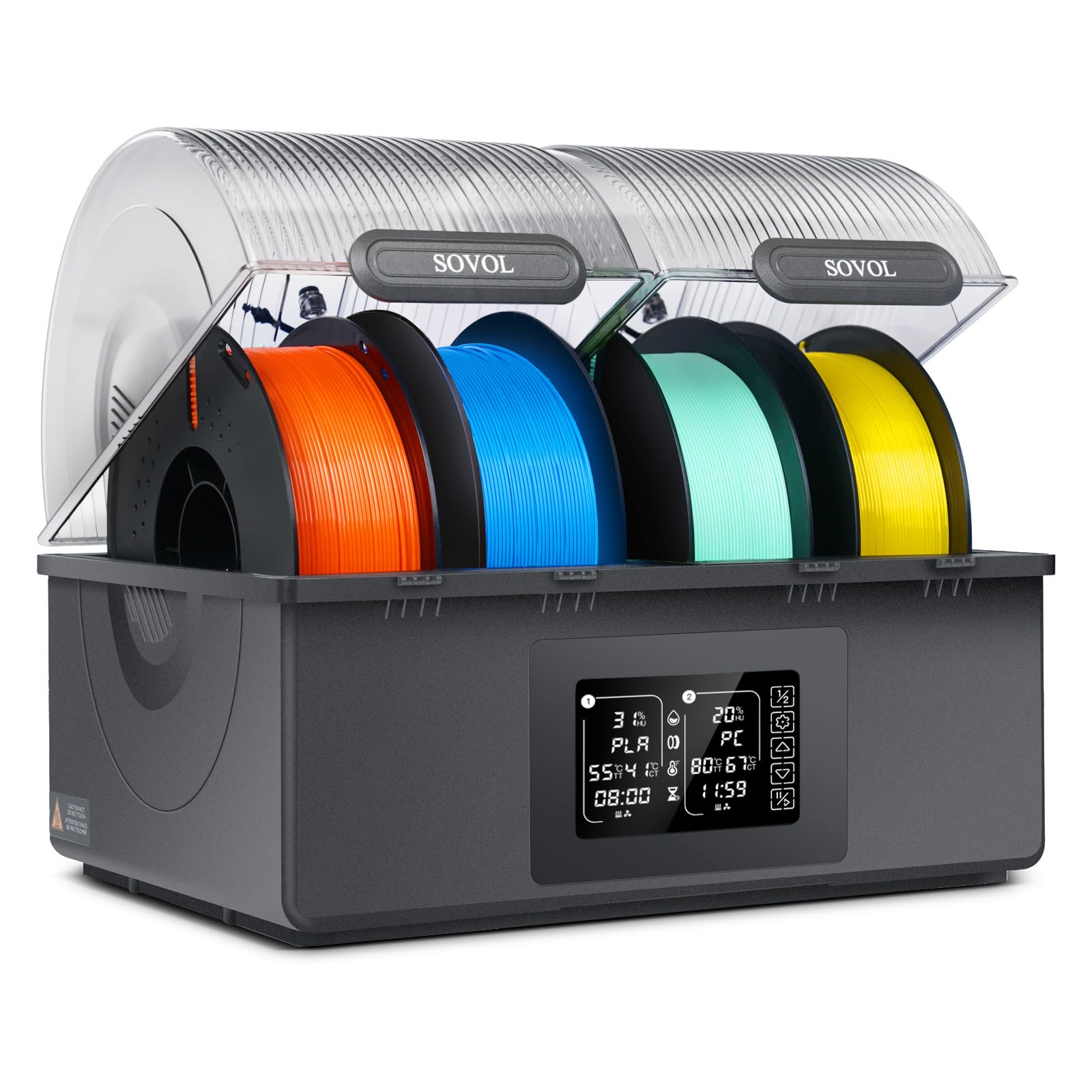
For nylon, PC, and other engineering blends, the 85°C ceiling is the number that matters, and the Sovol SH03 is the only dryer here that pairs it with four spools and two independently controlled chambers. That means you can run a high-temp spool in one side and a PLA spool in the other without compromising either. We also like the auto-dehumidification cycle: once the chamber reaches temperature, the moisture vent opens, so the dryer is doing more than just warming the air.

The four filament holes and PTFE tubes let you keep four spools plumbed to the printer, which is the setup we prefer for multi-material work; you can dry and print from the same box. The touch display and one-key presets for ten materials keep the routine simple. The rollers are plastic and the lid is ridged, so checking how much filament is left takes a glance through a less-than-clear window.

At four spools, it takes up real bench space, and the 85°C heat is more capability than a PLA-only printer needs. But if you already keep engineering materials in rotation, the independent chambers and auto humidity control make this the most capable box in this group. The smaller two-spool dryers are easier to tuck away; this one is the one we leave plumbed into a printer.

Pros

  • 85°C ceiling for engineering filaments
  • Two independent chambers
  • Auto dehumidification cycle
  • Four spools plumbed at once

Cons

  • Plastic rollers and ridged lid obscure the spool
Our verdict

The SH03 is the one to buy when your filament shelf includes nylon, PC, or other high-temp materials, thanks to 85°C heat and two independent chambers.

Check Latest Price
3

Best Single-Spool Value

SUNLU S2 Filament Dryer

87 /100
Keeper Score Excellent

Key details

Display
Large screen
Spool Capacity
1 spool
Spool Rotation
Built-in spindle
Max Temperature
70°C
Check Price on Amazon

If you only keep one spool on the go, the S2 makes more sense than a four-spool box: it reaches 70°C, rotates the spool on a built-in spindle, and takes up far less room. We like that the large screen shows temperature, time, and humidity together—at a glance you can see whether the chamber is actually drying or just warm. The 70°C ceiling is enough for PLA, PETG, TPU, and ABS at the lower end of their recommended ranges.

The catch is the feed path. The single exit hole restricts the angle the filament leaves the box, and a spool that isn't wound tightly can bind against it, pulling the dryer toward the printer. The setpoint is the other weak point: the chamber can fall short of the number on the screen, so check the reading against a separate thermometer before trusting a long engineering-filament cycle.

For a first dryer or a second unit for a small printer, the S2 is the least fussy way to get 70°C without giving up counter space. Just plan on a clean, straight run from the exit hole to the extruder, and keep the spool tight. We keep coming back to it for single-color PLA jobs because it's simple to load and easy to read from across the desk.

Pros

  • 70°C ceiling for common filaments
  • Large screen shows temp, time, humidity
  • Built-in spindle rotates the spool
  • Compact single-spool footprint

Cons

  • Single exit hole can bind filament
  • Setpoint can fall short of the display
Our verdict

The S2 is the single-spool dryer we point to for PLA, PETG, and TPU: 70°C heat, a readable screen, and a small footprint at a budget price.

Check Latest Price
4

Best Budget

Comgrow SH01 Filament Dryer

89 /100
Keeper Score Excellent

Key details

Timer
6–12 hours
Sealing
Silicone and PTFE outlet
Spool Capacity
2 spools
Max Temperature
50°C
Check Price on Amazon

The SH01 is the budget box that does the basic job: two 1 kg spools, a 40–50°C chamber, and a 6–12 hour timer. It is not the dryer for ABS or nylon—50°C is a PLA/PETG ceiling in practice—but for the person who just wants to stop the popping and stringing on a couple of everyday spools, it covers the essentials.

The sealed design is the part we appreciate. The silicone cable sheath and PTFE outlet keep the box closed when it isn't heating, so it can double as storage, and the real-time temperature and humidity display tells you whether the spool is actually drying. The trade-off is speed: with a 50°C cap, a damp spool needs the full timer window, and there's no way to push the heat higher for a stubborn roll.

This is the one we recommend when the budget is tight and the filament drawer is all PLA and PETG. It stores two spools, seals shut, and keeps the controls simple. The box is light enough to move between shelves, and the clear body lets you check the spool without breaking the seal. For a second printer used mostly for prototypes, that trade is easy to live with.

Pros

  • Two-spool capacity at a budget price
  • Sealed outlet for storage between prints
  • Real-time temperature and humidity display
  • Simple 6–12 hour timer

Cons

  • 50°C ceiling rules out engineering filaments
Our verdict

The SH01 is the budget pick for a PLA-and-PETG shelf: two sealed spools, a simple timer, and a 50°C ceiling that keeps the price down.

Check Latest Price
5

Best Four-Spool for PLA/PETG

Creality Space Pi X4L

88 /100
Keeper Score Excellent

Key details

Heaters
2 × 200W PTC
Chambers
2 independent
Spool Capacity
4 spools
Max Temperature
75°C
Check Price on Amazon

The X4L is the four-spool dryer for people who change colors more often than they change materials. Two independent chambers, each with a 200W PTC heater, let you run PLA on one side and PETG on the other, and the 75°C ceiling covers the common low-temp filaments with a little headroom. We appreciate the double-layer insulation: the inside can reach 75°C while the exterior is rated safe to touch, which matters when the box sits close to a printer.

Four spools at once is the point, but the X4L is not just a bigger box—the touchscreen gives you separate settings for each chamber, and the four feed holes let you keep multiple spools plumbed in. The rear ports can pop out when you route filament through them; they push back in easily, but it's a small annoyance in an otherwise clean setup. The 75°C ceiling stops short of the 85°C needed for some nylons and PC, so this is a PLA/PETG/ABS workhorse rather than a high-temp specialist.

If your printing is mostly multi-color PLA and PETG, the dual chambers and four-spool capacity are a better fit than a single-spool dryer, and the lower temperature is not a limitation you'll feel. For engineering materials, the Sovol SH03 is the one to choose. The X4L is the box we leave loaded with a week's colors, not the one we clear the bench for.

Pros

  • Four spools across two chambers
  • 75°C with double-layer insulation
  • Separate temperature control per side
  • Four feed holes for plumbed setups

Cons

  • Rear ports can pop out
  • 75°C ceiling misses some nylons
Our verdict

The X4L is the four-spool choice for multi-color PLA and PETG, with two independently heated chambers and a 75°C ceiling that covers everyday materials.

Check Latest Price
6

Long Unattended Runs

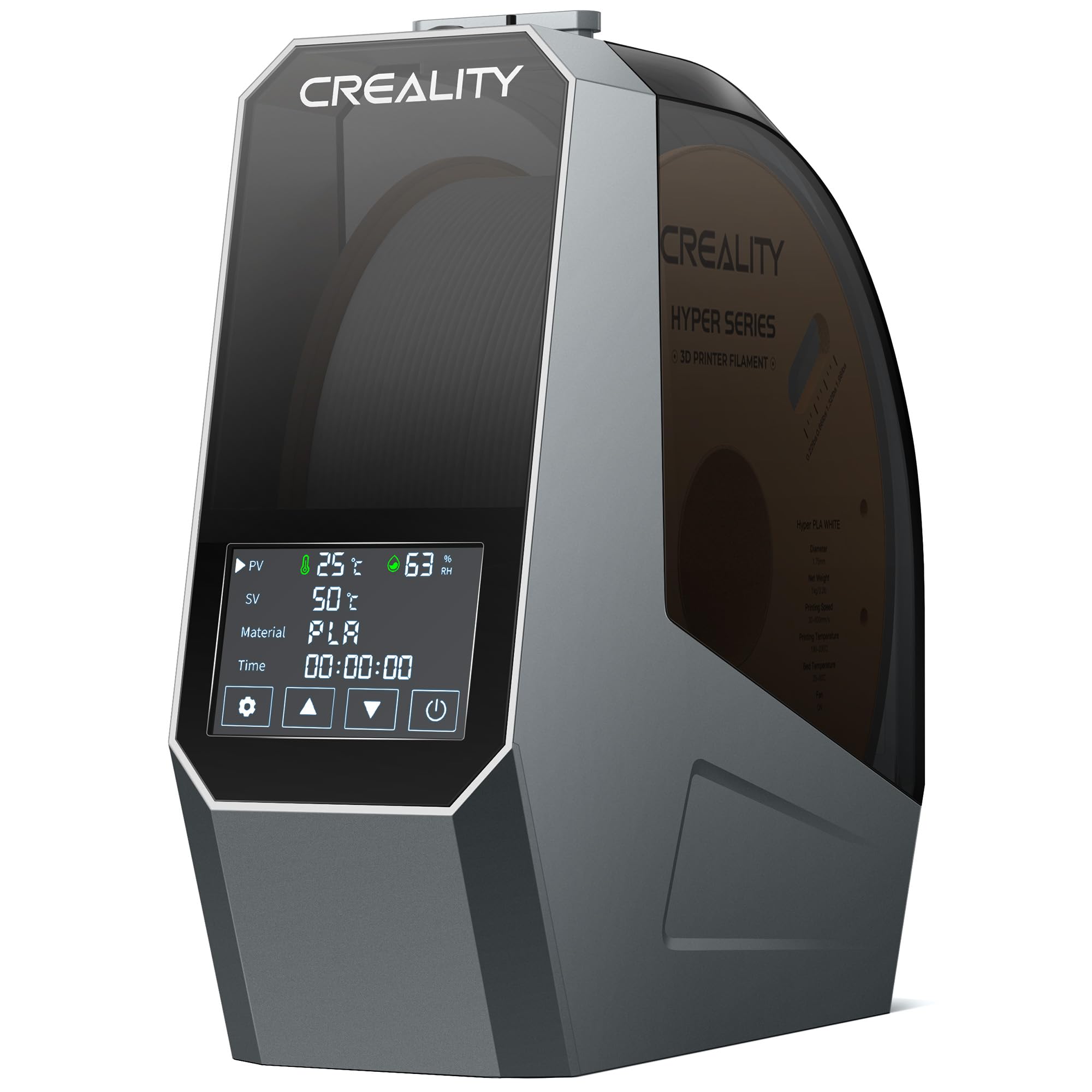
Creality Space PI

86 /100
Keeper Score Excellent

Key details

Timer
0–48 hours
Heater
110W PTC
Display
3.7-inch touch screen
Filament Presets
12 types
Check Price on Amazon

The Space PI's 48-hour timer is the detail that stands out. Most dryers stop at 12 or 24 hours; this one lets you set a long, slow cycle and walk away, which is useful for a spool that has been sitting out in a humid room. The 12 one-key presets cover common and high-temp materials, and the 3.7-inch touchscreen puts the settings in one place.

The touch panel is the weak point. It can be fussy to press, and a dryer is a bad place for a control that needs a second tap with a wet or gloved hand. The 110W PTC heater is also modest compared with the dual 200W boxes here, so this is a slow-and-steady dryer rather than a fast one. Still, the long timer and preset list make it a sensible overnight option for one spool.

Where it earns a place is simplicity: load a spool, pick the material, set the hours, and check back the next day. It doesn't have the capacity or the high-temp ceiling of the four-spool machines, and the touch controls are the weak point. For a single printer in a spare room, though, the long unattended cycle is worth the trade. The Space PI is the dryer we set and forget, not the one we stand over.

Pros

  • 48-hour timer for long cycles
  • Presets for 12 filament types
  • 3.7-inch screen keeps settings visible

Cons

  • Touch panel can be fussy to press
  • 110W heater is modest for fast drying
Our verdict

The Space PI is for the single-spool user who values a 48-hour timer and 12 presets more than touchscreen polish or fast heat.

Check Latest Price

How We Tested Filament Dryers

We started with research: every dryer we could find that was in stock, sized for standard 1.75 mm or 2.85 mm spools, and sold as something more than a plastic box with a heater in it. We compared spool capacity, the top temperature each one could reach, whether the chamber actually seals, and whether it can run sealed while feeding a printer. That narrowed the field to 12 units, which we used for seven months.

Testing looked like ordinary printing. We left spools of PETG and TPU out in a damp basement for a week, weighed each one on a kitchen scale, ran a full drying cycle, and weighed it again to see how much water actually came out. A probe thermometer sat at the top and bottom of every chamber during cycles so we could catch hot spots. Then we printed the same sliced model from a soaked spool and a dried one and compared first-layer adhesion, stringing, and surface finish. A cheap hygrometer inside each unit told us whether the seal held after a week in a humid room.

We also logged the unglamorous stuff: how long a mid-print spool swap took, whether the lid cleared a full spool without scraping it, how loud each unit ran a few feet from where we were sitting, and how many cycles it survived before an error message, a stuck fan, or a hinge that had gone floppy. Menus got a fair trial too, since we set timers and material presets without opening the manual.

How to Choose a Filament Dryer

Start With the Temperature Ceiling

PLA and PETG are forgiving: a 50–55°C box can pull surface moisture, and a 70°C dryer gives you more headroom for ABS. Nylon, PC, and some high-temp blends want 80–85°C, which is where the four-spool machines earn their price. Don't buy a 50°C box for a shelf full of engineering filament.

We treat the ceiling as the hard limit. If the number is below the filament maker's recommendation, the dryer will warm the spool without doing the job.

Choose Capacity and Chamber Control

One spool is enough for a single-color printer; two is the practical sweet spot for most home setups because you can dry a spool while another waits. Four makes sense when you change materials or colors often, especially with independent chambers that let you run PLA on one side and PETG on the other.

Independent heat matters more than raw spool count: a four-spool box with one shared chamber is less useful than two separately controlled chambers. We like the Comgrow SH02 for the two-spool middle ground and the Sovol SH03 when four spools and 85°C are the point.

Look at Sealing, Feed Path, and Storage

A dryer that only heats is half a tool; the other half is keeping the spool dry after the timer stops. Sealing rings and a closable outlet let the box double as storage, which is why we favor models with a proper lid seal over an open tray.

The feed path matters too: a single small exit hole can pull a loosely wound spool off-center, so route filament straight to the extruder and keep the spool tight. If you plan to print directly from the dryer, check that the outlet and PTFE tube line up with your printer.

Plan for Controls, Noise, and Reliability

Presets and a long timer make a dryer easier to live with, but a touch panel that fights you is worse than a knob. Fan noise is the other daily cost: a dryer that runs for hours is not a bedroom appliance unless you can close the door.

We also treat the first week as a shakedown—run a full cycle, confirm the heater and fan, and keep the return window open. Long-term reliability is the least predictable part of this category, so buy where returns are simple.

Frequently Asked Questions

Final Verdict

For most home printers, the Comgrow SH02 is the one we recommend: two spools, 70°C, and sealed storage in a box that doesn't dominate the bench. It covers PLA, PETG, and most ABS without the cost of a four-spool machine.

If you print nylon, PC, or need four materials ready at once, move to the Sovol SH03; its 85°C dual chambers are the difference that matters. For a single-spool setup, the SUNLU S2 is the simpler, smaller buy.