Best Carbon Fiber Filament of 2026

Carbon fiber filament is sold on the promise of stiffness, and the first spool I tried delivered that—along with a snapped part that had looked perfectly printed. The fibers add strength and heat resistance, but they can also make a filament brittle, abrasive on your nozzle, and fussier about bed and layer adhesion than ordinary PLA. And carbon fiber isn't a magic ingredient: the base plastic—PLA, PETG, nylon, or ASA—does as much to decide where a part belongs as the fiber load does.

Over six months, my team and I printed 14 spools of carbon fiber filament, mostly workshop brackets, jigs, replacement knobs, and outdoor clips. We cared whether each roll printed reliably, whether parts held up to flexing and heat, and whether a cheaper spool's savings disappeared into failed prints. Most of these filaments are black, so finish and consistency matter more than color—but black also makes layer lines and surface flaws easy to spot. The picks below are the ones that earned a permanent spot beside the printer.

Keeper Score summarizes customer ratings and review volume. Read it alongside the product details and trade-offs. How the score works.

1

Best Overall

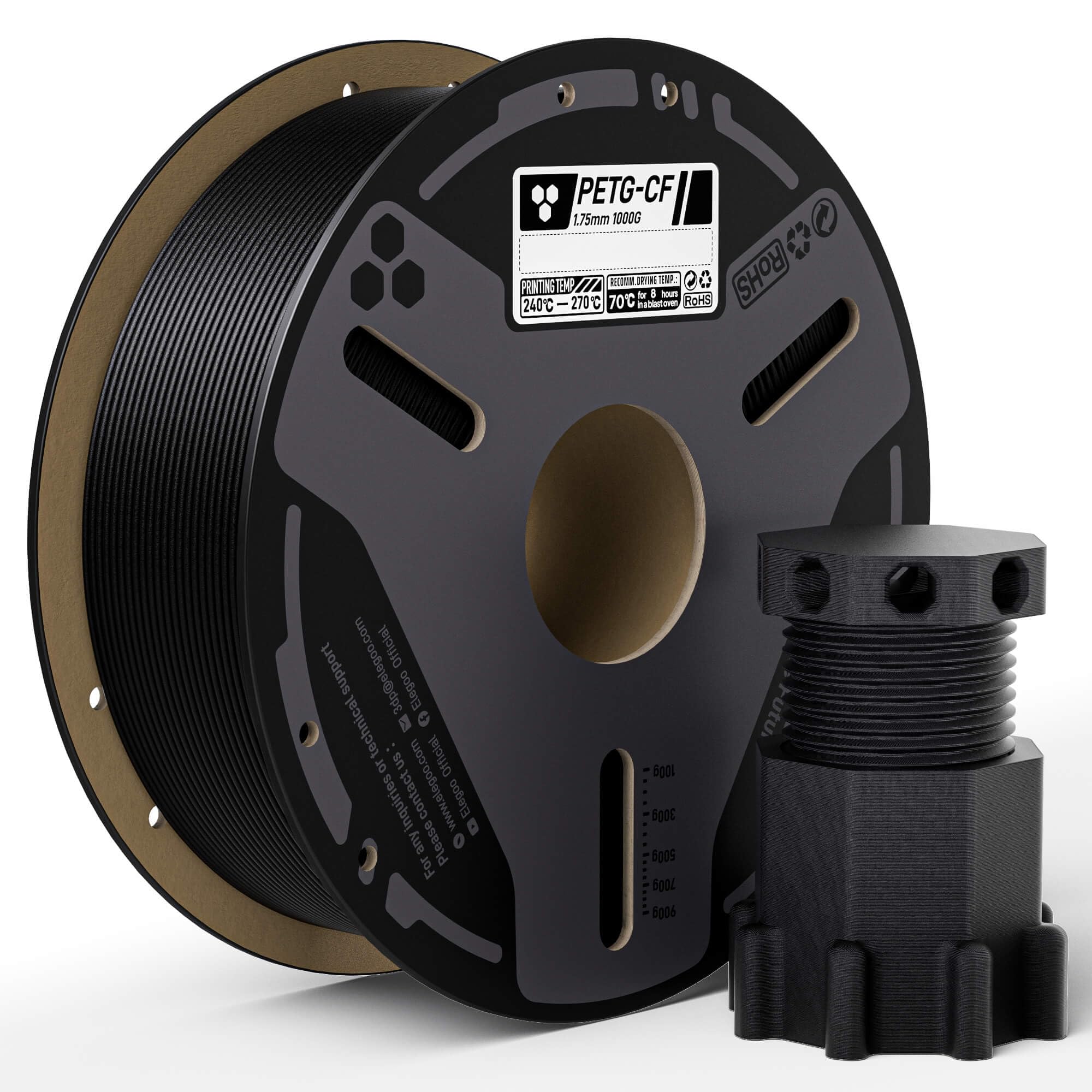
ELEGOO PETG-CF

93 /100
Keeper Score Outstanding

Key details

Material
PETG + carbon fiber
Spool Weight
2.2 lb
Nozzle Requirement
Hardened steel, 0.4 mm or larger
Check Price on Amazon

The first thing we check on a carbon fiber spool is what it demands of the printer, and this one asks for remarkably little: a hardened steel nozzle of 0.4 mm or larger, and otherwise the machine you already own. ELEGOO claims compatibility with most common 1.75 mm FDM printers, and nothing in our prints argued with that. That easy fit is the main reason it is our top pick — carbon fiber stops being a project and becomes a material you can use on a Tuesday night.

The payoff shows up on the part. Chopped fiber leaves a fine matte texture that swallows layer lines, and the black prints dark and even rather than washed out. Brackets and clips come off noticeably stiffer than the same shapes in plain PETG, dense enough that a functional part reads as molded rather than printed. The spool itself has fed cleanly for us, with an even wind that has not snagged mid-print.

Where it gives ground is heat and absolute stiffness. A part that sits near a motor or a hot pipe is a job for the nylons further down this list; for the much longer list of everyday brackets, jigs, and housings, this is the spool we pick up first. It also happens to be the least expensive carbon fiber here, which makes the experiment cheap if you are still deciding whether CF earns a permanent slot in your lineup.

Pros

  • Stiff, dense parts with a matte, layer-hiding finish
  • Needs only a hardened nozzle on most printers
  • Least expensive carbon fiber spool here
  • Winds evenly and feeds without tangling

Cons

  • First layer depends on the build plate
Our verdict

Our default carbon fiber pick: it asks one nozzle swap of your printer and gives back stiff, matte parts that look molded.
Check Latest Price
2

Best for High Heat and Load

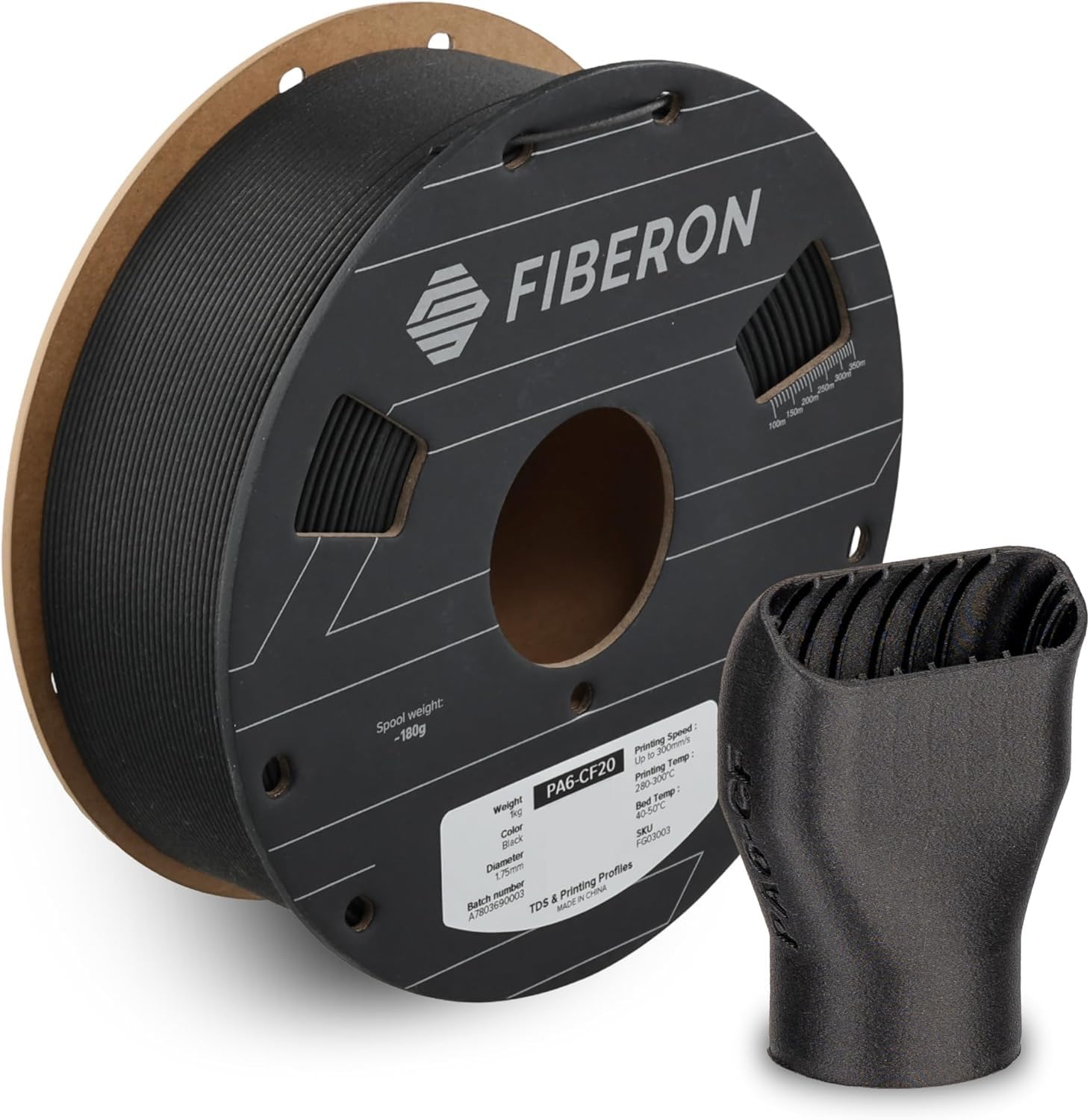
Polymaker Fiberon PA6-CF20

91 /100
Keeper Score Outstanding

Key details

Spool Weight
2.2 lb
Heat Deflection
215 °C (annealed)
Tensile Strength
109.3 MPa (dry)
Carbon Fiber Content
20%
Check Price on Amazon

Put the numbers side by side and the gap is plain: Polymaker rates this PA6-CF20 at 109.3 MPa tensile strength and a heat deflection temperature of 215 °C once annealed, while the PETG-CF picks at the top of this list soften at a fraction of that heat. That is not a step up in finish quality, it is a different class of part — under-hood brackets, jigs that sit beside something hot, anything that has to stay stiff and stay straight while warm.

Getting there takes a printer with some headroom. The listed setup is a 280–300 °C nozzle, an all-metal hotend, a 40–50 °C bed, a hardened steel or ruby nozzle, and the part cooling fan off, which rules out a stock entry-level machine. The line we care about most is the one saying a heated chamber is not required — that is what keeps this on a well-specced desktop printer instead of behind an industrial purchase order, and it is why we think the upgrade pays for itself on functional parts.

Nylon also brings homework. Dry the spool at 100 °C for ten hours before the first print, then keep it under 20% relative humidity, ideally printing straight from a dry box. Shortcuts show up as popping, rough walls, and layers that let go. Do it properly and you get dense parts with strong layer adhesion and the kind of stiffness that makes a printed jig feel like a machined one.

Pros

  • 109.3 MPa tensile strength and 8.64 GPa stiffness
  • Holds shape to 215 °C once annealed
  • No heated chamber required
  • Strong layer adhesion for load-bearing parts

Cons

  • Costliest spool in this guide
Our verdict

If your printer reaches 280 °C and you own a dryer, this is the strongest, most heat-tolerant spool in the guide.

Check Latest Price
3

Best Low-Moisture Nylon

Polymaker Fiberon PA612-CF15

89 /100
Keeper Score Excellent

Key details

Spool Weight
1.1 lb
Heat Deflection
175 °C (annealed)
Tensile Strength
91.9 MPa (dry)
Carbon Fiber Content
15%
Check Price on Amazon

Half a kilogram is the detail that decides this one. Polymaker ships the PA612-CF15 on a 0.5 kg spool, which is the right size for finding out whether nylon belongs in your workflow before a full roll of the expensive stuff commits you to it, and enough to build a few real parts if it does.

The material is the least moisture-sensitive nylon here. PA612 is a long-chain nylon, and the point of the longer chain is that you keep most of PA6's strength and heat performance without chasing water quite so hard. The stated figures carry it: 91.9 MPa dry X-Y tensile strength, 83.1 MPa after the specified anneal and moisture conditioning, and a heat deflection temperature of 175 °C after sixteen hours at 100 °C.

We still treat it as nylon, because that is what it is. Dry it, store it sealed below 20% relative humidity, and feed it from a dry box if your shop runs damp. The payoff is visible: parts come off dense and stiff with almost no discernible layer lines, and the surface has that fine, slightly rough carbon texture that reads as engineered rather than decorative.

Annealing is the other thing to plan around. If you want the heat numbers, the part goes in the oven, and annealing moves dimensions. Prints that were dialed in can come back slightly off, so leave stock on anything that has to fit, or anneal a test piece first. Small-footprint parts also want a wide brim to keep the corners down.

Pros

  • Least moisture-sensitive nylon in this guide
  • 91.9 MPa dry strength, 83.1 MPa after conditioning
  • 175 °C heat deflection after a sixteen-hour anneal
  • Prints with barely visible layer lines

Cons

  • Requires an all-metal hotend and hardened nozzle
Our verdict

The nylon we recommend for a damp shop: nearly PA6 strength with a shorter drying leash, in a spool size that lets you try it.

Check Latest Price
4

Best for Outdoor Parts

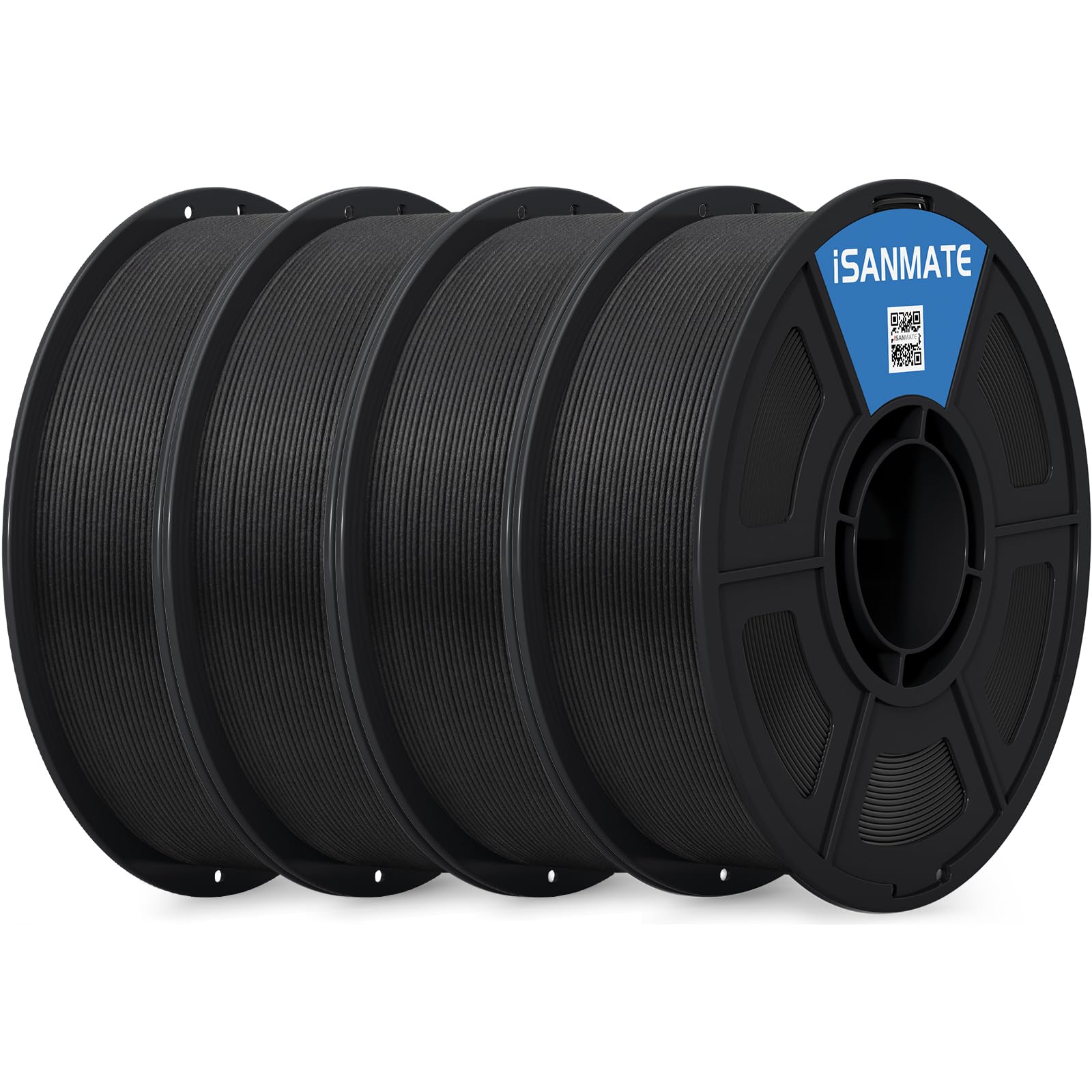
iSANMATE ASA-CF

87 /100
Keeper Score Excellent

Key details

Material
ASA + carbon fiber
Pack Size
4 × 1 kg spools
Nozzle Temperature
240–270 °C
Weather Resistance
UV, rain and heat
Check Price on Amazon

A PLA-CF bracket left on a sunny dashboard will teach you what ultraviolet light does to a print. ASA is the material that shrugs it off, and this is the only ASA-CF in the guide: four one-kilo spools of matte black, aimed at housings, brackets, and trim that live outdoors.

The pitch is simple. ASA brings UV, weather, and heat resistance, the carbon fiber brings stiffness, and the combination prints in the 240–270 °C window at 30 to 100 mm/s. ASA is also an enclosure material by nature — still air and a warm chamber are what keep tall parts from lifting at the corners — so an open-frame printer in a cool room is the setup that will fight you.

For a material with a warping reputation, this one behaves more like PLA than the reputation suggests. It loads cleanly, lays down a matte finish with very little shine, and hides layer lines well enough that an outdoor bracket looks like a bought part. The vacuum-sealed packaging with desiccant is a small thing we noticed and appreciated, because ASA that has been sitting open is ASA you have to dry before you can use it.

What holds it back is consistency. Layer adhesion is the variable: some prints bond hard, others need the nozzle pushed toward the top of the range before the layers fuse, and the black can land closer to dark gray than deep black. Buy it for the UV stability, run a test part before you commit a large print, and the other three spools will earn their shelf space.

Pros

  • UV, weather, and heat resistance for outdoor parts
  • Prints cleanly for an ASA, closer to PLA in behavior
  • Matte finish hides layer lines
  • Vacuum sealed with desiccant

Cons

  • Sold only as a four-spool pack
Our verdict

For anything that lives outside, this is the pick: ASA's UV stability with carbon fiber stiffness, in four spools that will last.

Check Latest Price
5

Best First Carbon Fiber Spool

ELEGOO PLA-CF

93 /100
Keeper Score Outstanding

Key details

Material
PLA + carbon fiber
Spool Weight
2.2 lb
Diameter Tolerance
±0.02 mm
Nozzle Requirement
Hardened steel
Check Price on Amazon

This is the least heat-resistant spool on the page, and it is still the one we point a first-time carbon fiber buyer toward. PLA-CF is the gentlest version of the material: it prints on the machine you already own with nothing more than a hardened steel nozzle, it does not need an enclosure or a dry-box habit, and it delivers the stiffness and matte look that made you curious about carbon fiber in the first place.

The specs are tidy in the way that matters for a first spool. The diameter is held to ±0.02 mm, the spool is dried and vacuum-sealed before it ships, and the wind is machine-controlled to keep it from tangling. On our prints that translated into steady feeding and clean walls — no drama, no profile archaeology, just results that look like the pictures on the box.

Understand what you are buying, though: this is PLA at heart. Parts are stiffer than plain PLA and they look better, but impact resistance and heat performance are still PLA numbers. That is the trade against the PETG-CF at the top of this list, which is tougher and takes more heat for roughly similar money, and against the nylons, which are in a different league. Choose this one when ease is the point.

Pros

  • Easiest carbon fiber to print: a hardened nozzle and nothing else
  • ±0.02 mm diameter, dried and vacuum sealed
  • Stiffer than plain PLA with a matte, layer-hiding finish
  • Machine-wound to resist tangling

Cons

  • PLA base limits it to indoor, room-temperature parts
Our verdict

The easiest way into carbon fiber: prints on a stock machine with a hardened nozzle, and gives up heat and toughness to do it.

Check Latest Price
6

Worry-Free Printing

FLASHFORGE PETG-CF

92 /100
Keeper Score Outstanding

Key details

Material
Carbon fiber PETG
Spool Weight
2.2 lb
Moisture Prep
Dried 24 hours, vacuum sealed
Diameter Tolerance
±0.02 mm
Check Price on Amazon

Tidiness is the pitch: ±0.02 mm diameter tolerance, twenty-four hours of drying before the spool is vacuum-sealed, machine winding with a manual check on top of it, and a clog-resistant build. If your last spool failed because the diameter wandered or the wind snagged halfway up a print, those are exactly the four things that fix it.

We rate it as the low-risk PETG-CF of the group. There is nothing exotic here and nothing that needs a custom profile — you load it, print it, and it behaves. What we cannot say is that it does anything the ELEGOO above does not do just as well, so the case for it is the dimensional guarantee rather than the parts it produces. If a tolerance that tight is what lets you stop watching a twelve-hour print, that is worth paying something for.

One quirk worth knowing before you order: FLASHFORGE's own product copy slips and calls it a PLA in the clog-free bullet. It is not — it is PETG-CF, and it wants PETG-CF settings and a dry box in a humid shop. Carbon fiber PETG picks up water like any PETG, and a damp spool shows up as popping and rough walls long before it fails outright.

Pros

  • ±0.02 mm tolerance with 24-hour pre-drying
  • Machine-wound spool that resists snagging
  • Clog-resistant build for long unattended prints

Cons

  • Costs more than our top PETG-CF pick
Our verdict

The safe, conventional PETG-CF: tight diameter, dry out of the bag, and none of the tuning games.

Check Latest Price
7

Stiff, Visible Parts

IEMAI PETG-CF

87 /100
Keeper Score Excellent

Key details

Spool Weight
2.2 lb
Surface Finish
Matte black
Diameter Tolerance
±0.03 mm
Carbon Fiber Content
20%
Check Price on Amazon

Twenty percent chopped carbon fiber is the headline, and it is the only PETG-CF in this guide that puts a number on its loading. More fiber means more stiffness and a heavier matte grain in the finished surface — this is a print you can feel the texture on, closer to a molded composite panel than to ordinary PETG.

That surface is the best thing about it. Prints come out matte and close to line-free, and the black hides layer stepping better than most. The diameter is held to ±0.03 mm, a touch looser than the ±0.02 mm spools further up this list, and it still fed without complaint on our machine.

Our reservation is what that fiber load does to the melt. A heavy fill is harder to push through a small nozzle, so a hardened nozzle and a dry spool are not optional here, and long prints may want a little more retraction tuning than plain PETG to keep the walls clean. We think the fiddling is worth it for stiff, static parts: brackets, mounts, jigs, anything that gets clamped rather than flexed.

Where it sits against the top pick is straightforward. The ELEGOO is the more forgiving spool and the easier one to run all day; this one is stiffer and clearly better looking. If your parts are visible — a bracket on a desk, a housing in a display — the finish justifies the extra attention.

Pros

  • 20% carbon fiber, the only stated loading among the PETG-CF picks
  • Matte, near-line-free surface
  • ±0.03 mm tolerance and smooth feeding
  • Firm, stiff parts with a high-tech look

Cons

  • Cracks under impact instead of flexing
Our verdict

The best-looking PETG-CF here: 20% fiber, a matte near-line-free surface, and stiffness that suits brackets rather than clips.

Check Latest Price
8

Lower-Cost Nylon

SUNLU PA6-CF20

84 /100
Keeper Score Excellent

Key details

Spool Weight
2.2 lb
Heat Resistance
Up to 209 °C
AMS Compatibility
Not compatible
Carbon Fiber Content
20%
Check Price on Amazon

Nylon is the material that makes carbon fiber worth the trouble, and this is the cheapest way into it here: 20% fiber in a PA6 base, a stated heat resistance of 209 °C, and a recommended anneal that pushes the part further. It also asks more of you than any PETG-CF on the page.

Start with what the spool spells out. The nozzle window is 270–290 °C, the bed runs 50–70 °C, and SUNLU recommends annealing between 80 °C and 130 °C for five to twelve hours if you want the heat numbers to hold. That means an all-metal hotend, a hardened nozzle, and a dryer that can run a genuine cycle — this is not a spool you unwrap and print.

Results track the prep. Dried properly and printed hot, it lays down strong layers and a matte, low-shine surface with real stiffness. Dried badly, it does what nylon does: pops at the nozzle, bonds weakly, and hands you a part that separates along a layer. The margin between those two outcomes is narrower here than with the Polymaker nylons, which is the trade for the lower cost per kilogram.

Our read is that this is a spool for someone who already runs nylon and wants to keep doing it for less. If you are learning the material, the PA612 above is the more forgiving teacher with a smaller commitment. If your drying routine is second nature and your parts are large, this is the one that makes nylon affordable enough to use on everyday jobs.

Pros

  • 20% carbon fiber in a PA6 base
  • Heat resistance stated to 209 °C
  • Annealing instructions included for full heat performance
  • Cheaper per kilogram than the Polymaker nylons

Cons

  • Not compatible with AMS or multi-material systems
Our verdict

Nylon performance at the lowest price per kilo here, provided you dry it properly and feed it from an external spool.

Check Latest Price

How We Tested Carbon Fiber Filament

We built the shortlist by sorting carbon fiber filaments by base material—PLA-CF, PETG-CF, PA6-CF, PA612-CF, and ASA-CF—then checking for a stated fiber load, diameter tolerance, spool size, and clear print temperature range. From that pool we tested 14 spools over six months on the same hardened-nozzle FDM printer, printing workshop brackets, jigs, replacement knobs, and outdoor clips. Each spool got a first-layer patch and a small stacked block before the real parts, so we could see whether corners lifted, whether layers fused, and whether the filament stringed or jammed when a print moved from a small detail to a large flat area.

Print quality and reliability came down to repeatability: we printed the same bracket twice from each spool, then compared surface finish, dimensional fit, and whether the second print failed where the first succeeded. For strength, we flexed and dropped finished parts, clamped brackets in a vise, and hung weight from hooks until something bent or snapped; some filaments were stiff but brittle, while others gave a little before failing. We also left outdoor clips on a sunny windowsill and kept a few parts near a heater to see how they handled heat and UV exposure over weeks, not minutes.

Bed adhesion and layer adhesion were checked by hand—prying the first layer off the build plate and breaking test blocks along their layer lines. We tracked failed starts, wasted filament, and how much tuning each roll needed, because value isn't just the spool cost; it's how many usable parts you get from it. Color was a narrower question since most options are black, but we noted whether the finish was consistent from spool to spool and whether it hid layer lines or magnified them.

How to Choose Carbon Fiber Filament

Match the Material to the Job

Every carbon fiber filament is a base plastic with chopped fiber stirred in, and the base is what decides where the part can go. PLA-CF is the easiest to print and the least heat-tolerant, which suits jigs, models, and indoor fixtures. PETG-CF adds toughness and enough heat resistance for brackets and housings in a normal room. Nylons take load and heat. ASA-CF is the outdoor choice because it holds up to UV, rain, and sun.

Pick the family first; the brand argument gets much easier afterward. Our rule of thumb: if you cannot name the temperature the part will see and whether it will see sunlight, you are not ready to choose a spool yet.

Read Heat Numbers With the Anneal Attached

A heat deflection temperature means nothing without the treatment that produced it. Polymaker lists 215 °C for its PA6-CF20 and 175 °C for the PA612-CF15, but both figures arrive after a specific anneal — sixteen hours at 100 °C in the PA612's case. Printed and left raw, the same filament is a softer, less heat-stable part.

That is the trap: a bare HDT figure flatters a spool you have not annealed. If the application sits anywhere near a heat source, budget oven time as part of the process rather than as an optional extra, and anneal a test piece before you anneal something that has to fit.

Check Your Hotend Before You Choose

The most common mismatch is a nylon spool on a printer that cannot reach the temperature. PA6-CF wants 280–300 °C through an all-metal hotend; below that you get partial melting and weak parts, not a slightly worse print. Carbon fiber is abrasive too, so a hardened steel or ruby nozzle is a requirement rather than an upgrade, with 0.4 mm as the sensible floor for a filled filament.

Our checklist runs in this order: maximum nozzle temperature, hotend type, nozzle material, and whether the printer is enclosed. ASA wants still, warm air. Answer those four honestly and you will avoid most of the disappointing spools on the market.

Dry It, Then Dry It Again

Nylon is hygroscopic enough that a sealed bag is a starting point, not a guarantee. Polymaker's instruction for PA6-CF is 100 °C for ten hours before printing plus storage below 20% relative humidity, and a dry box that feeds the printer directly is the difference between a reliable spool and an occasional one. PETG-CF is more forgiving but still picks up water.

The symptoms are consistent across materials: popping at the nozzle, rough walls, and layers that let go. If you do not own a dryer, put one in the budget before your first nylon spool — it will matter more to your results than the next twenty degrees of nozzle temperature.

Spool Size, Winding, and Real Cost Per Part

Filament is sold by weight, so compare cost per kilogram rather than the sticker on the spool — a half-kilo roll at a modest price is often the dearest material here per gram. Half-kilo spools are still the right way to audition nylon, since most people do not finish a kilo of it before it needs drying again.

Winding matters as much as chemistry. We check the spool's wind before the first long print, not after it fails, and we check whether the spool is cardboard or plastic if a multi-material feeder is in the plan.

Frequently Asked Questions

Final Verdict

ELEGOO's PETG-CF is the spool we point most people to, and the reason is fit rather than hype: it asks one hardened nozzle of the printer you already own and gives back stiff, matte parts that hide their layer lines. That combination covers more real printing than any other spool here.

Move up only when the part demands it. Polymaker's PA6-CF20 is the answer when a bracket has to stay straight while hot, and the iSANMATE ASA-CF is the answer when it has to live outdoors. Those three cover the jobs almost everyone actually has; the rest of the list is how you refine one of them.