Best Canon RF Lenses of 2026

Camera bodies get the headlines, but the lens decides whether you can shoot a dim reception hall, a running back at 200 yards, or a flower at six inches. Every RF lens is a trade: speed costs weight, reach costs light, and a zoom that covers everything rarely opens wide. Work out which of those you can live with and the shopping gets much simpler.

I've spent the past seven months shooting with eight RF lenses, from a pocket-size prime to a super-telephoto zoom, and the deciding factors turned out to be less spec-sheet-ish than I expected. A lens half a pound lighter is the one that actually leaves the house. Stabilization buys handheld shots, but it won't rescue glass that hunts for focus in a dark room, and the gap between focus motors shows up the first time you film a school play from the back row. The lenses below are the ones that earned a permanent spot in the bag — some for image quality, some for value, all for being the right tool on a day I needed one.

Keeper Score summarizes customer ratings and review volume. Read it alongside the product details and trade-offs. How the score works.

1

Best Overall

Canon RF28-70mm f/2.8 IS STM

90 /100
Keeper Score Outstanding

Key details

Weight
1.6 lb
Focal Length
28-70mm
Max Aperture
f/2.8
Weather Resistance
Weather-resistant
Check Price on Amazon

The RF28-70mm f/2.8 IS STM is the lens we leave on the camera when we do not know what the day will bring. The constant f/2.8 aperture is the headline: it keeps shutter speeds up indoors and gives portraits a soft background without a prime swap. The 28-70mm range covers group shots, food, and tighter portraits, and the lens is light enough to stay on the body.

What makes it a better default than the 24-70mm L for many people is the size. It is lighter and less front-heavy on an R-series body, so it comes along instead of staying in the bag. We paid attention to how it handled on a long walk: the zoom ring moves smoothly, the STM focus is quiet enough for video, and the optical stabilization helps at the long end. Canon builds in weather resistance it calls L-series equivalent, and we still wipe it down after a wet shoot.

The two UD and two aspheric elements do their job: images stay crisp across the range, and the f/2.8 aperture holds color and contrast together in low light. For a small room or a tight group shot, the 24-70mm L is the better tool; its wider start gets the whole scene in. For everyday people, travel, and events, this lens is wide enough. If you want one lens that covers most of what you shoot and does not cost L money, this is the one we recommend.

Pros

  • Constant f/2.8 through the zoom range
  • Lighter than the 24-70mm f/2.8 L
  • Weather-resistant build
  • Quiet STM focus for video

Cons

  • Wide end stops at 28mm
Our verdict

We recommend the RF28-70mm f/2.8 as the default RF lens for most photographers because it pairs a fast constant aperture with a size and cost that make it easy to carry every day.

Check Latest Price
2

Best Pro Standard Zoom

Canon RF24-70mm f/2.8 L IS USM

94 /100
Keeper Score Outstanding

Key details

Weight
1.98 lb
Focal Length
24-70mm
Max Aperture
f/2.8
Image Stabilization
Up to 5 stops
Check Price on Amazon

The extra 4mm at the wide end is why the RF24-70mm f/2.8 L IS USM still earns a place next to the newer 28-70mm. In a tight living room or a crowded event, 24mm lets you keep the whole scene in frame without stepping back through a doorway. The L-series optics are sharp edge to edge, and the constant f/2.8 aperture gives you the same low-light and background-blur flexibility as the top pick.

We found the autofocus quick and quiet. Nano USM is smooth enough for video, and the 5 stops of optical stabilization helped handheld in dim interiors. The 9-blade aperture keeps out-of-focus highlights round, and the control ring is easy to assign. Build is weather-resistant and feels like a working lens.

The trade-off is weight. At 898 grams, it is the lens you notice on a long walk, and the cost is premium. But if you shoot interiors, architecture, or events where 24mm matters, the extra width and L-series confidence are worth the carry. It is also the safer choice if you want the Canon professional standard zoom and do not mind the bulk.

Pros

  • 24mm wide end for tight scenes
  • 5 stops of optical stabilization
  • Fast, quiet Nano USM focus

Cons

  • Heavy at 898 g
  • Premium cost
Our verdict

If your work depends on edge-to-edge sharpness and L-series build, we think the RF24-70mm f/2.8 earns its keep despite the bulk.

Check Latest Price
3

Best Travel All-Rounder

Canon RF24-105mm f/4 L IS USM

92 /100
Keeper Score Outstanding

Key details

Autofocus
Nano USM
Focal Length
24-105mm
Max Aperture
f/4
Image Stabilization
Up to 5 stops
Check Price on Amazon

A day of travel is the test that matters for a zoom, and the RF24-105mm f/4 L IS USM is built for it. The range starts at 24mm for buildings and landscapes and reaches 105mm for portraits and details, so you can leave the bag in the hotel. The constant f/4 aperture keeps the lens smaller than an f/2.8 standard zoom, but it will not freeze indoor action the way the 24-70mm f/2.8 will.

We like the handling. The zoom ring is broad and easy to find, the Nano USM focus is quick and quiet, and the 5 stops of optical stabilization make handheld shots at the long end more forgiving. The L-series build feels solid, and the control ring is there for quick exposure changes.

If you shoot people indoors or need the shallowest depth of field, the 24-70mm f/2.8 is the better tool. For landscapes, travel, and daylight events, the 24-105mm is the more useful single lens. We pack it as the one-lens travel choice because the extra reach saves more shots than the extra stop of light.

Pros

  • 24-105mm range covers wide to portrait
  • Constant f/4 aperture
  • 5 stops of image stabilization

Cons

  • f/4 aperture limits low light
Our verdict

For one lens that covers a day of travel, we reach for the RF24-105mm f/4: the extra reach matters more than the slower aperture.

Check Latest Price
4

Best Lightweight Telephoto

Canon RF70-200mm f/4 L IS USM

93 /100
Keeper Score Outstanding

Key details

Autofocus
Dual Nano USM
Focal Length
70-200mm
Max Aperture
f/4
Image Stabilization
Up to 5 stops; 7.5 with IBIS
Check Price on Amazon

Telephoto zooms have a way of staying home because of their weight. The RF70-200mm f/4 L IS USM is the one we pack when we want compression and reach without a separate camera bag. Canon calls it the shortest and lightest 70-200mm f/4 it has made, and the handling backs that up: the lens feels balanced on an R body rather than nose-heavy.

The f/4 aperture is the trade-off. In bright outdoor light it is a great sports and portrait lens, and the 5 stops of optical stabilization, or 7.5 stops with a coordinated IBIS body, let you handhold in shade. Indoors, you want the f/2.8 version or a faster prime. Dual Nano USM focus is fast and quiet, which matters for video and for tracking kids or animals.

We appreciate that the lens does not try to be a do-everything zoom. It is a dedicated telephoto that fits in a small bag, and the constant aperture keeps exposures consistent as you zoom. If you shoot mostly daylight and want the lighter kit, this is the smart choice. If you shoot dim venues, spend for the f/2.8.

Pros

  • Shortest and lightest 70-200mm f/4
  • 5 stops IS, 7.5 with IBIS
  • Dual Nano USM focus

Cons

  • f/4 needs good light indoors
Our verdict

We choose the RF70-200mm f/4 when we want telephoto compression without a bag that feels like a toolbox.

Check Latest Price
5

Best Budget Wildlife Lens

Canon RF100-400mm f/5.6-8 IS USM

90 /100
Keeper Score Outstanding

Key details

Weight
1.8 lb
Focal Length
100-400mm
Max Aperture
f/5.6-8
Max Magnification
0.41x
Check Price on Amazon

The RF100-400mm f/5.6-8 IS USM is the lens that makes long reach feel ordinary. At 816 grams, it is light enough to carry on a hike, and the 100-400mm range covers everything from backyard birds to kids' soccer. The maximum aperture is the catch: f/5.6 at 100mm and f/8 at 400mm means you need daylight, especially at the long end.

We were surprised by the close-focusing. At 400mm, 0.41x magnification lets you fill the frame with a flower or a butterfly from a respectful distance. The 5.5 stops of optical stabilization, or 6 stops with an IBIS body, help handheld shots, and Nano USM focus is quick and quiet. It is not weather-sealed, so a dry bag is worth the space.

For the money, the image quality holds up in good light, and the lens is a genuine budget wildlife option rather than a placeholder. If you shoot dawn and dusk, the f/8 aperture will frustrate you; the 200-800mm or a faster telephoto is the answer. For everyone else, this is the telephoto zoom we recommend first.

Pros

  • 100-400mm reach at 816 g
  • 0.41x close focus at 400mm
  • 5.5 stops IS, 6 with IBIS

Cons

  • f/5.6-8 needs daylight
  • Not weather-sealed
Our verdict

We keep the RF100-400mm in the conversation for daylight wildlife because it delivers useful reach at a weight that will not end the hike early.

Check Latest Price
6

Best Everyday Prime

Canon RF35mm f/1.8 Macro IS STM

93 /100
Keeper Score Outstanding

Key details

Weight
10.9 oz
Focal Length
35mm
Max Aperture
f/1.8
Max Magnification
0.5x
Check Price on Amazon

A 35mm prime is the lens we reach for when we want the camera to feel small again. The RF35mm f/1.8 IS STM Macro does that and adds a 0.5x close-focus capability that turns a walk around the block into a detail shoot. At 10.88 ounces, it balances nicely on an R8 or RP, and the f/1.8 aperture keeps hand-held evening shots possible.

The macro side is more useful than the name suggests. You can get within 0.17 meters and fill the frame with a flower or a plate of food without switching lenses. Optical stabilization is rated at 5 stops, and the control ring is there for quick ISO or exposure changes. We found the center sharp wide open, with pleasing background blur.

Autofocus is the place to set expectations. It is accurate for stills, but it can be slow and audible when it hunts, especially in low contrast. For video, the STM motor is quieter than older primes but not silent. If you need the fastest focus for action, a dedicated L prime is the better tool. For street, travel, and close-ups, the size and focal length win.

Pros

  • 35mm f/1.8 everyday focal length
  • 0.5x macro close focus
  • Light at 10.88 oz

Cons

  • Autofocus can hunt and be audible
Our verdict

The RF35mm f/1.8 is the prime we suggest for everyday carry: wide enough for scenes, close enough for details, and small enough to forget.

Check Latest Price
7

Best Budget Prime

Canon RF50mm f/1.8 STM

94 /100
Keeper Score Outstanding

Key details

Weight
5.6 oz
Autofocus
STM
Focal Length
50mm
Max Aperture
f/1.8
Check Price on Amazon

The RF50mm f/1.8 STM is the least expensive way into an RF prime, and it does not feel like a compromise in the hand. At 5.6 ounces, it disappears on the camera, and the f/1.8 aperture gives you low-light headroom and a soft background that a kit zoom cannot match. For portraits, details, and available-light snapshots, it is the lens we hand to someone building a first kit.

Sharpness is good wide open and better stopped down, and the 50mm focal length is a natural match for people and street scenes. The STM focus is smooth enough for video and quiet enough for most rooms, though it can hunt in very dim light. There is no optical stabilization, so you are relying on the camera body or a faster shutter speed.

The build is plastic and the focus motor is audible if you listen for it, but those are the right compromises at the budget end. It is also small enough to keep in a jacket pocket, which is why it comes along even when a zoom is in the bag. If you want one prime to learn on, this is the one.

Pros

  • 50mm f/1.8 for low light and blur
  • Very light at 5.6 oz
  • Low-cost entry to RF primes

Cons

  • No optical stabilization
  • Focus can hunt in dim light
Our verdict

We call the RF50mm f/1.8 the easiest first RF prime, because it turns low light and background blur into something a beginner can afford.

Check Latest Price
8

Ultra-Wide Travel

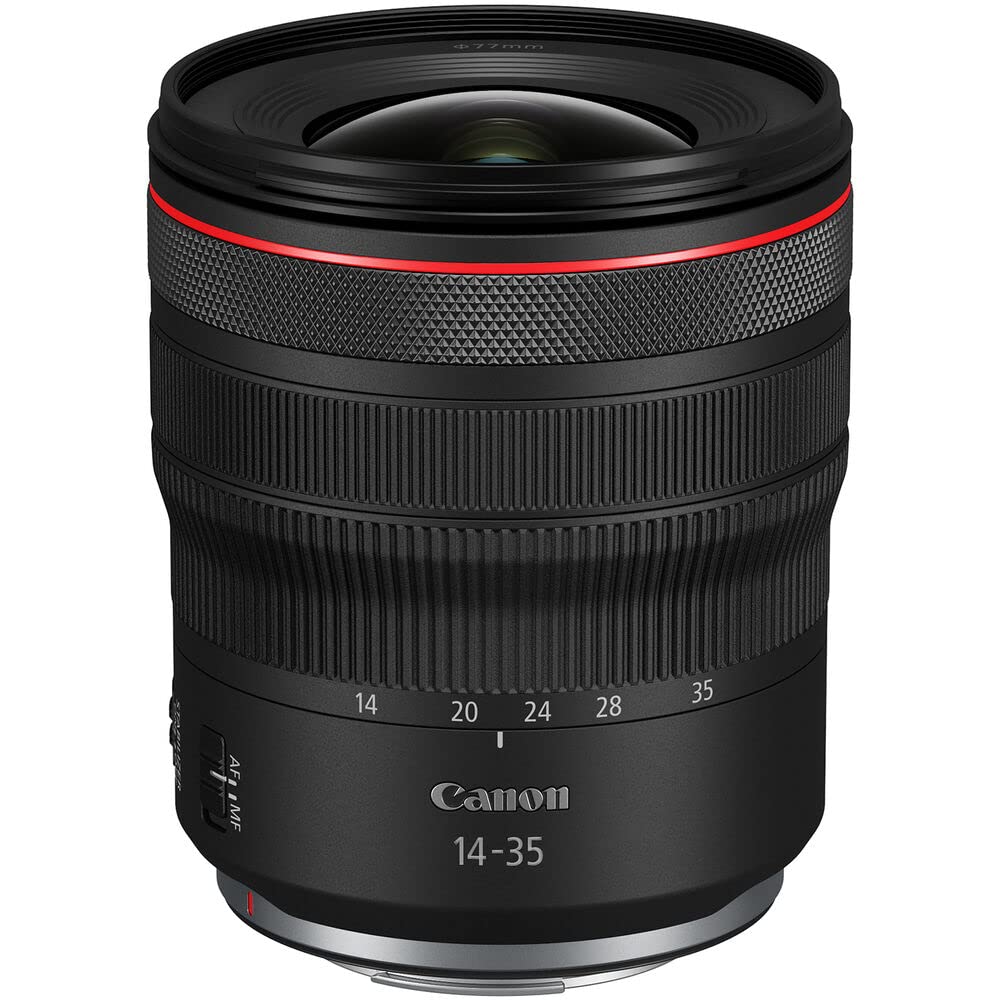
Canon RF14-35mm f/4 L IS USM

88 /100
Keeper Score Excellent

Key details

Weight
1.2 lb
Close Focus
7.9 in
Focal Length
14-35mm
Max Aperture
f/4
Check Price on Amazon

Fourteen millimeters is the number that makes the RF14-35mm f/4 L IS USM worth packing. In a small room or a tight street, that extra width is the difference between showing the space and showing a wall. The zoom reaches 35mm for a normal view, so it covers landscapes, interiors, and travel without a second lens.

We like the close-focusing. At 7.9 inches at every focal length and 0.38x at 35mm, you can get detail shots without switching to a macro. At 544 grams, it is light enough for a gimbal or a full day of walking. The L-series optics are sharp, and the fast autofocus is reassuring for video.

The f/4 aperture is the trade-off for the compact build. It is fine for landscapes and interiors on a tripod, but it will not blur a background like the f/2.8 wide zoom. We also saw edge softness and vignetting at 14mm in some shots; stopping down and correcting in post helps. If you need the widest view in a light package, this is the one. If you shoot dark interiors or astro, the 15-35mm f/2.8 is the better tool.

Pros

  • 14mm ultra-wide start
  • Light at 544 g
  • 0.38x close focus at 35mm

Cons

  • f/4 aperture limits low light
  • Edge softness at 14mm
Our verdict

For landscape and interior shooters who want a wide view without a heavy ultrawide, the RF14-35mm f/4 is our pick.

Check Latest Price
9

Fast Wide Zoom

Canon RF15-35mm f/2.8 L IS USM

93 /100
Keeper Score Outstanding

Key details

Weight
1.85 lb
Focal Length
15-35mm
Max Aperture
f/2.8
Image Stabilization
Up to 5 stops
Check Price on Amazon

The RF15-35mm f/2.8 L IS USM is the wide zoom for people who cannot choose between a landscape lens and a low-light reportage lens. The constant f/2.8 aperture is the reason: it keeps shutter speeds up in dim interiors and gives you a cleaner separation at 35mm than the f/4 wide zoom. The 15mm start is wide enough for architecture and tight event spaces.

We found the image quality crisp edge to edge, with the kind of contrast that makes the L cost easier to justify. Nano USM focus is fast and quiet, the 5 stops of stabilization help handheld, and the weather-resistant build is reassuring outdoors. The 82mm filter thread is worth noting if you already own filters.

At 840 grams it is a substantial lens, and it costs more than the f/4 version. The weight is the price of the faster aperture, and it balances well on an R5 but makes a long day longer. For astro, events, and dim interiors, that is a fair trade. For travel and landscapes in good light, the 14-35mm f/4 is lighter and wider.

Pros

  • Constant f/2.8 wide zoom
  • 5 stops IS and fast Nano USM
  • Weather-resistant L build

Cons

  • Heavy at 840 g
  • Premium cost
Our verdict

The RF15-35mm f/2.8 is our wide zoom for dim rooms and night skies, provided you accept the weight and the premium cost.

Check Latest Price
10

Super-Telephoto Wildlife

Canon RF200-800mm f/6.3-9 IS USM

88 /100
Keeper Score Excellent

Key details

Weight
4.5 lb
Focal Length
200-800mm
Max Aperture
f/6.3-9
Extender Compatibility
RF1.4x and RF2x
Check Price on Amazon

Eight hundred millimeters is a speciality, and the RF200-800mm f/6.3-9 IS USM is the lens that makes it feel reachable. The 200-800mm range covers everything from a nearby deer to a distant bird, and the 4x zoom means you can adjust framing without swapping extenders. It is compatible with the RF1.4x and RF2x extenders at all focal lengths, which stretches the reach further.

We were impressed by the sharpness at the long end in good light, and the optical stabilization helps keep the view steady. At 4.5 pounds, it is light for an 800mm lens but still a deliberate carry; a monopod or a good strap makes a long session easier. The f/6.3-9 aperture is the real limit: at 800mm and f/9, you need bright conditions or high ISO.

Autofocus is quick enough for birds in flight in good light, but it is not a dim-venue lens. It is also not weather-sealed, so plan for rain. For wildlife and outdoor sports, the reach is the story. For low-light action, a faster 400mm or 600mm prime is the better tool.

Pros

  • 200-800mm reach
  • Extender compatible with RF1.4x and RF2x
  • 4.5 lb is light for 800mm

Cons

  • Slow f/6.3-9 aperture
  • Not weather-sealed
Our verdict

We point wildlife and sports shooters toward the RF200-800mm when 800mm reach matters more than a fast aperture.

Check Latest Price
11

Low-Light Telephoto

Canon RF70-200mm f/2.8 L IS USM

93 /100
Keeper Score Outstanding

Key details

Weight
2.6 lb
Focal Length
70-200mm
Max Aperture
f/2.8
Image Stabilization
Up to 5 stops
Check Price on Amazon

The RF70-200mm f/2.8 L IS USM is the lens we choose over the f/4 version when the light is going to be bad. The extra stop buys faster shutter speeds indoors and a softer background at 200mm, and the lens is still surprisingly compact for an f/2.8 telephoto. It is the classic event and portrait zoom for a reason.

We found the focus fast and accurate, with dual Nano USM keeping up with moving subjects, and the 5 stops of stabilization steadying handheld shots. The 9-blade aperture keeps highlights round, and the minimum focus distance of 2.3 feet lets you get closer than you might expect. Build is weather-resistant and feels solid.

At 2.6 pounds, it is not a lens you forget about, and the cost is premium. But for weddings, indoor sports, and portraits where f/4 pushes ISO too high, it earns the weight. If you shoot mostly daylight, the f/4 version is the smarter carry. If you shoot dim rooms, this is the one.

Pros

  • Constant f/2.8 telephoto zoom
  • Dual Nano USM focus
  • 5 stops IS, 9-blade aperture

Cons

  • Heavy at 2.6 lb
  • Premium cost
Our verdict

When f/4 is not enough for indoor events, the RF70-200mm f/2.8 is the telephoto we reach for, heavy lens and all.

Check Latest Price

How We Chose and Tested These RF Lenses

We started with the entire RF lineup rather than whatever was on sale, sorting every current lens by focal range, maximum aperture, stabilization, focus motor, and size, then cutting any that duplicated a slot another lens covered better. That left eight lenses — compact primes, standard zooms, a macro, and telephotos all the way out to super-telephoto reach — which I shot with for seven months on the same two mirrorless bodies.

Most of that time was spent where I actually shoot: a dim reception hall and a night market for low light, the sideline of a Friday night football game and a wetland at dawn for reach and tracking, my kitchen counter for macro, and a foggy hike where weight stops being a spec and starts being the reason a lens stays home.

At each outing I shot the same scenes at the same settings so the files could be compared side by side afterward, then reviewed them at 100 percent for corner sharpness, color, and how busy the out-of-focus areas got. Autofocus was scored by keepers — bursts of a dog running straight at me, and a speaker at a podium in near dark — plus a listen for motor noise while recording video. Stabilization got its own pass: handheld frames at shutter speeds I'd normally never attempt, once with it on and once with it off.

I weighed every lens on a kitchen scale and carried it on a sling for a full day, because a lens that stays in the bag is worth less than its review scores. Value and versatility came last: I counted how many frames from an outing I actually kept, and noted which lens I reached for without thinking on a trip where I could bring only one.

How to Choose a Canon Rf Lens

Match the focal range to your subjects

A standard zoom is the safest first RF lens because it covers the everyday range. The 28-70mm f/2.8 is the one we recommend for most people, but if you shoot interiors or tight group shots, the 24-70mm f/2.8 L's extra width matters. For travel, the 24-105mm f/4 trades aperture for reach. Beyond that, add a telephoto only when you know you need distance: 100-400mm for daylight wildlife, 70-200mm for events and portraits, 200-800mm for serious reach.

Decide how much aperture you need

Maximum aperture is about light and separation, not just blur. An f/2.8 zoom lets you shoot indoors at lower ISO and gives portraits a cleaner background; an f/4 zoom is smaller and less expensive, and it is the better travel companion if most of your shooting is outdoors. Variable apertures like f/5.6-8 on the 100-400mm demand daylight at the long end. Buy the fastest lens you will actually carry, not the fastest one on the spec sheet.

Weigh the lens, not just the camera

Lens weight changes how often the camera leaves the house. The RF70-200mm f/4 L is the telephoto we pack for a full day; the f/2.8 version earns its 2.6 pounds when the light is poor. The RF28-70mm f/2.8 is lighter than the 24-70mm L, which is why it becomes a default. Hold the combination if you can, or compare the lens weight with your body and ask whether you will carry it for an hour or a day.

Look at autofocus and stabilization together

Canon's RF bodies pair lens IS with in-body IS, and the result can be more than either alone: the 70-200mm f/4 L claims up to 7.5 stops with a coordinated body, and the 100-400mm reaches 6 stops with IBIS. Autofocus matters just as much for video. STM motors are quiet and smooth; Nano USM and dual Nano USM are faster. If you shoot moving subjects, prioritise focus speed; if you shoot handheld landscapes, prioritise stabilization.

Know what L-series and weather sealing buy you

An L lens is not automatically the right lens, but it usually brings tighter build, better coatings, and weather resistance. The 24-70mm f/2.8 L and 15-35mm f/2.8 L are the heavy-duty options; the 28-70mm f/2.8 is not an L but Canon rates its weather resistance as L-series equivalent. The 100-400mm and 200-800mm are not weather-sealed, so plan for rain. If you shoot outdoors in bad weather, pay for sealing; if not, put the money into focal range.

Frequently Asked Questions

Final Verdict

For most RF shooters, the Canon RF28-70mm f/2.8 IS STM is the lens to build a kit around. It covers the useful everyday range, keeps a fast f/2.8 aperture across the zoom, and stays light enough to carry without thinking about it. If you regularly shoot tight interiors or need the last word in edge-to-edge sharpness, the RF24-70mm f/2.8 L is the upgrade. If you want one travel lens with more reach, choose the RF24-105mm f/4 L instead.