Best Canon EF Lenses of 2026

The day I swapped the kit zoom for a cheap 50mm prime, I stopped moving my feet out of laziness and started doing it because the pictures got better. That's the thing about EF-mount glass: the camera body gets the credit, but the lens decides what the photo actually looks like. Fast glass buys you light and soft background blur; a good zoom buys you the frame you'd otherwise miss while swapping lenses in a parking lot.

My team and I spent the past nine months shooting with a dozen EF lenses, from a featherweight prime to a white-barrel telephoto you feel by hour four. Two things surprised us. Image stabilization is worth more than its spec sheet suggests at the long end, and it does nothing for a subject that won't sit still. Autofocus speed and motor noise matter just as much, especially on video where the mic picks up every micro-adjustment. The picks below are the ones that earned a permanent spot in the bag — for portraits, for reach, for the days you only carry one lens.

Keeper Score summarizes customer ratings and review volume. Read it alongside the product details and trade-offs. How the score works.

1

Best Overall

Canon EF 50mm f/1.8 STM

96 /100
Keeper Score Outstanding

Key details

Weight
5.6 oz
Filter Size
49mm
Focus Motor
Stepping motor (STM)
Focal Length & Aperture
50mm f/1.8
Check Price on Amazon

The lens we point a new EOS owner toward is almost always this one. Fifty millimeters is a comfortable place to learn: wide enough for a table of friends, long enough to flatter a face, and with an f/1.8 aperture that makes a dim living room shootable. At 5.6 ounces with a 49mm filter thread, it disappears into a bag and stays there.

What keeps us coming back is how much the aperture changes the photographs rather than the specification sheet. Backgrounds fall away at f/1.8, and the seven-blade diaphragm keeps the out-of-focus areas tidy instead of busy. The detail that surprises people is the close focus: 1.15 feet with 0.21x magnification, close enough to fill the frame with a plate of food or a flower without changing lenses.

Autofocus is the one place the price shows. The stepping motor is quiet and smooth, which is exactly why it works for video, and in good light it locks fast. In a dim room against a low-contrast subject it hunts, and it is not the lens for tracking a dog running at you.

It is one focal length, it isn't sealed against weather, and a wet shoot is not its day. What it does better than anything else here is teach: you move your feet to frame instead of zooming, and you learn what a stop of light is worth. On a crop body it frames like an 80mm, which is a fine starting point for portraits.

Pros

  • f/1.8 aperture for low light and blurred backgrounds
  • Light 5.6-ounce body that stays in the bag
  • Quiet STM focus that suits video
  • Closes to 1.15 feet for near-macro detail

Cons

  • Hunts in dim, low-contrast light
  • No weather sealing
Our verdict

This is the lens we tell every new EOS owner to buy first: a fast f/1.8 aperture in a body small enough to leave on the camera.

Check Latest Price
2

Best Everyday Zoom

Canon EF 24-105mm f/4L IS USM

87 /100
Keeper Score Excellent

Key details

Filter Size
77mm
Weather Sealing
Dust and moisture resistant
Image Stabilization
Up to 3 stops
Focal Length & Aperture
24-105mm f/4
Check Price on Amazon

One body, one lens, a full day of walking: that's the case for the 24-105mm f/4L, and it holds up. Twenty-four millimeters takes in a street or a hotel lobby, 105mm pulls a face out of a crowd, and the range between means you stop swapping glass in the wind. The value isn't in any one focal length; it's in the shots you get because the right lens was already mounted.

The f/4 maximum aperture holds steady as you zoom, the image stabilizer is rated to about three stops, and the barrel is sealed against dust and moisture, three things that matter more on a walk-around lens than on one that lives in a studio. Two things to know before ordering: f/4 is not fast, so indoor work leans on the stabilizer and a higher ISO, and this listing is white-box bulk packaging rather than a retail carton, which is worth factoring in if the lens is a gift or you care about resale.

Against the 24-70mm f/2.8 you give up a stop of light and gain 35mm of reach plus stabilization. For travel and events in decent light that is the right trade, and it's the zoom that spends the most time on our camera when we only take one.

Pros

  • Covers wide to short telephoto in one lens
  • Stabilizer rated to about three stops
  • Sealed against dust and moisture

Cons

  • f/4 limits indoor and dusk shooting
  • Ships in bulk packaging, not a retail box
Our verdict

For one lens that covers a whole day out, this is the zoom we reach for, as long as f/4 is fast enough for the light you shoot in.

Check Latest Price
3

Best for Portraits

Canon EF 85mm f/1.8 USM

91 /100
Keeper Score Outstanding

Key details

Weight
15 oz
Filter Size
58mm
Focus Motor
Ring-type USM
Focal Length & Aperture
85mm f/1.8
Check Price on Amazon

If the 50mm is the lens you learn on, the 85mm is the one you graduate to when the pictures are mostly people. The extra focal length compresses features so noses recede and backgrounds tighten, and that is the difference you notice long before any sharpness chart matters.

The f/1.8 aperture does the heavy lifting. Nine diaphragm blades keep out-of-focus highlights rounder than the 50mm's seven, and the ring-type USM motor snaps into focus fast enough for a child who won't sit still. At 15 ounces it balances nicely on a full-frame body, and because the front group doesn't rotate during focusing, a polarizer stays where you set it.

Where it stops suiting people is small rooms. On a crop body the framing tightens to roughly 136mm, and you'll be backing into furniture to fit a half-body shot. There's no stabilization either, which costs you nothing at portrait shutter speeds and does cost you in dim interiors. We keep it for the work it's built for, faces at a distance that flatters them, and reach for the 50mm when the room is tight.

Pros

  • Compressed perspective that flatters faces
  • Nine-blade aperture for smooth background blur
  • Fast ring-type USM autofocus

Cons

  • Too tight for small rooms on a crop body
  • No image stabilization
Our verdict

For portraits this is the lens we hand people once the 50mm stops being enough: fast, sharp, and easy to hold for an hour.

Check Latest Price
4

Best Telephoto Value

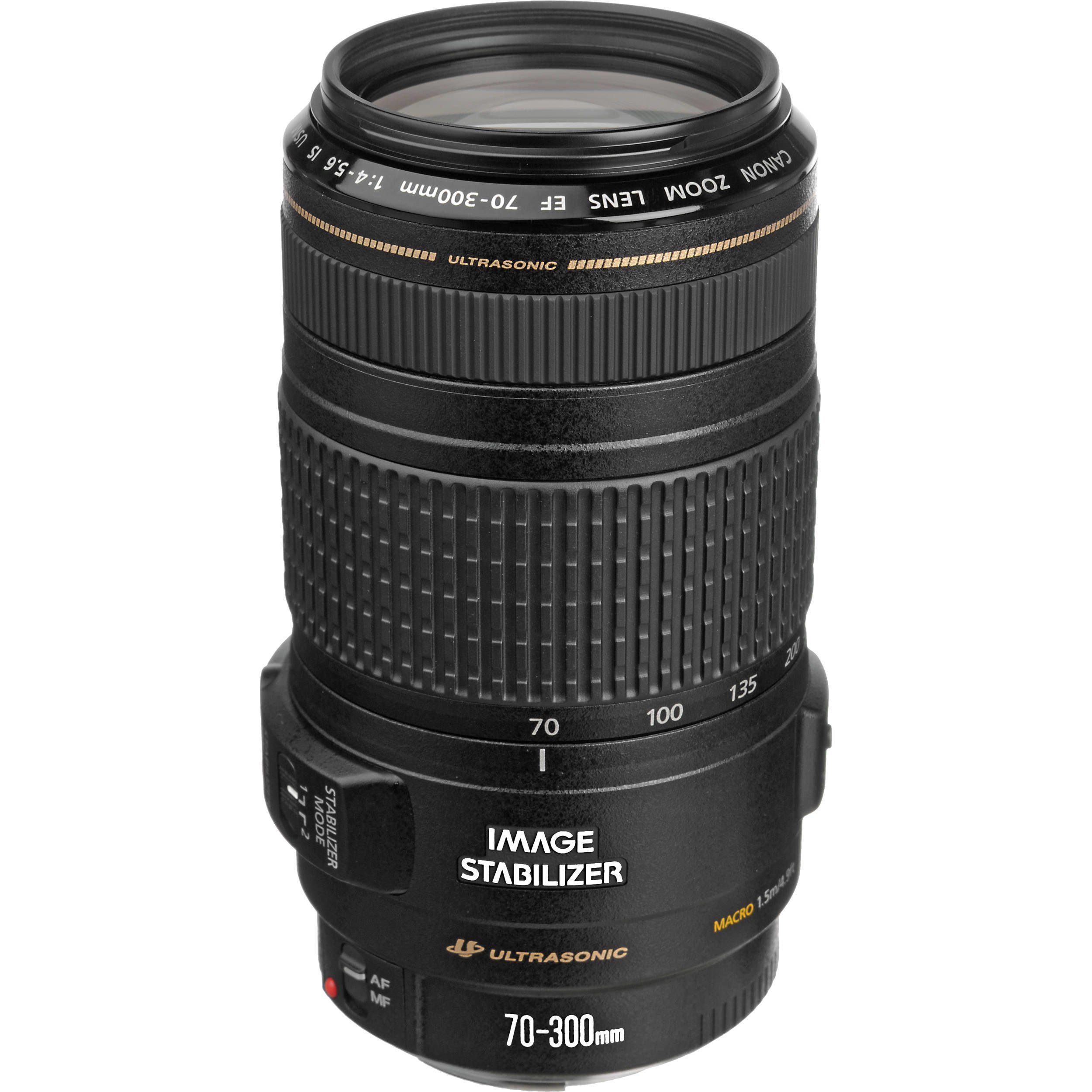
Canon EF 70-300mm f/4-5.6 IS USM

89 /100
Keeper Score Excellent

Key details

Weight
1.4 lb
Focus Motor
Micro-type USM
Image Stabilization
3 stops, two modes
Focal Length & Aperture
70-300mm f/4-5.6
Check Price on Amazon

A 300mm lens without stabilization is a tripod lens. That's the whole argument for this one: Canon rates the stabilizer at three stops and gives it a second mode for panning, which is the difference between shooting a soccer game handheld and packing a monopod for it.

Reach runs 70-300mm, framing like 112-480mm on a crop body, enough for field sports, zoo enclosures, and birds that let you get reasonably close. The eight-blade diaphragm and electromagnetic aperture help backgrounds stay soft at the long end. Set against the 75-300mm, the extra outlay buys one thing, the stabilizer, and that is not small: the cheaper lens needs bright sun or a support to stay sharp at full zoom, and handheld at 300mm in shade that shows.

What you accept is f/5.6 at the long end, which asks for daylight or a high ISO, and a micro-type ultrasonic motor that focuses quickly in good light and less decisively when the light drops and the subject is small in the frame. For daylight travel and kids' sport without stepping up to L-series weight, this is where we point.

Pros

  • Three-stop stabilizer with a panning mode
  • 70-300mm reach in a 1.4-pound lens
  • Soft backgrounds at the long end

Cons

  • f/5.6 at 300mm limits low-light use
  • Autofocus slows on small, dim subjects
Our verdict

Three stops of stabilization are what make 300mm usable in your hands, and that's why this is the telephoto we recommend for most people.

Check Latest Price
5

Best Pro Standard Zoom

Canon EF 24-70mm f/2.8L II USM

92 /100
Keeper Score Outstanding

Key details

Weight
1.77 lb
Filter Size
82mm
Focal Length & Aperture
24-70mm f/2.8
Check Price on Amazon

A constant f/2.8 across 24-70mm is why working photographers keep this lens mounted. The exposure you set at the wide end is the exposure you get at the long end, and you can keep shooting when the light falls off instead of reaching for a flash. The sharpness is what convinced us: at the apertures you actually use, files hold detail we associate with primes, and the ring-type USM focus is fast and quiet enough to disappear.

There is no image stabilization, and that reads as deliberate rather than an oversight. At f/2.8 you buy shutter speed with aperture, and a stabilizer would add size and cost to a lens that already weighs 805 grams.

Size is the honest trade. On a small body it is front-heavy, and it takes 82mm filters, the most expensive thread in this group. If you already own 77mm filters for the 24-105mm or the 100-400mm, none of them will screw onto this lens.

It earns its place indoors, at events, in bad light, with no second chance at the shot. If your photography is travel and daylight, the 24-105mm covers more ground for less and stabilizes; this one is for the person who already knows they shoot in the dark.

Pros

  • Constant f/2.8 through the zoom range
  • Sharpness that rivals prime lenses
  • Fast, quiet ring-type USM focusing

Cons

  • No image stabilization
  • Takes costly 82mm filters
Our verdict

For paid event and wedding work, this is the standard zoom we trust: f/2.8 across the range and sharpness that holds up beside a prime.

Check Latest Price
6

Best for Wildlife

Canon EF 100-400mm f/4.5-5.6L IS II USM

91 /100
Keeper Score Outstanding

Key details

Weight
3.46 lb
Weather Sealing
Dust and water resistant
Image Stabilization
4 stops
Focal Length & Aperture
100-400mm f/4.5-5.6
Check Price on Amazon

The first thing to notice is the zoom ring. The version this replaced pushed and pulled; this one rotates, with a torque ring you can tighten so the barrel doesn't creep while you carry it. It's a small mechanical change that answers the most common complaint about the original, and after a few minutes it stops being something you think about.

Optically it is the strongest telephoto in this group. Four stops of stabilization with modes for static subjects and for panning, Air Sphere Coating to hold contrast when the sun sits in front of you, and a minimum focus of 3.2 feet, close enough to fill the frame with a bird feeder from across a yard and much closer than the 5.9 feet of the lens it replaced.

It weighs 1570 grams, and that weight is the price of the reach. Handheld it balances over your left hand nicely; after an hour it doesn't. Plan on a monopod for long sessions and treat the camera-and-lens combination as a two-hand carry.

The autofocus is quick enough for birds in flight and for a receiver running a route, which is more than we can say for the cheaper telephoto here, and the weather sealing means a drizzle isn't the end of the day. It is a great deal of lens to buy, and it's the one we pick when the subject won't wait.

Pros

  • Four-stop stabilization with multiple modes
  • Fast, accurate autofocus for action
  • Rotation zoom with an adjustable tension ring
  • Sealed against dust and water

Cons

  • 1570 grams demands support on long days
Our verdict

For wildlife and field sports, this is the lens we take: quick focus, four stops of stabilization, and a zoom ring that beats the old push-pull.

Check Latest Price
7

Wide Landscapes

Canon EF 17-40mm f/4L (Renewed)

85 /100
Keeper Score Excellent

Key details

Weight
1.1 lb
Condition
Renewed, 90-day warranty
Filter Size
77mm
Focal Length & Aperture
17-40mm f/4
Check Price on Amazon

Here's a detail that never makes the marketing copy: this lens takes 77mm filters, the same thread as the 100-400mm and the 24-105mm. If you already own a 77mm polarizer or a set of ND filters, this is the wide-angle that lets you keep using them instead of buying a second set.

Seventeen to forty millimeters on a full-frame body is a genuine ultra-wide, enough to exaggerate the foreground of a beach or fit a whole interior into one frame. It weighs 1.1 pounds and focuses down to 0.9 feet, and there's no stabilization, which matters less at wide angles than anywhere else on this page. On a crop body it behaves like a standard zoom instead, so be sure which body it's going on.

This copy is renewed, which means a 90-day warranty rather than Canon's year, and that is why it undercuts the rest of the L-series glass here. For landscape and architecture, where you stop down anyway, that trade is easy to accept. Night skies are the exception: f/4 is the wrong tool for them, and no amount of technique fixes that.

Pros

  • Ultra-wide 17-40mm L-series zoom
  • Shares 77mm filters with two other picks
  • Light at 1.1 pounds

Cons

  • Renewed copy carries only a 90-day warranty
  • f/4 rules out night-sky work
Our verdict

The least expensive way into a Canon L ultra-wide, and the one we suggest for landscapes, provided you're comfortable buying renewed.

Check Latest Price
8

Daylight Reach

Canon EF 75-300mm f/4-5.6 III

95 /100
Keeper Score Outstanding

Key details

Weight
1.1 lb
Closest Focus
4.9 feet
Image Stabilization
None
Focal Length & Aperture
75-300mm f/4-5.6
Check Price on Amazon

There is no image stabilization here, and that single absence defines the lens. At 300mm small movements in your hands show up in the picture, so unless the light is good and the shutter speed high, you'll see the softness before you see the subject.

What you get is real reach in a light package. It weighs 1.1 pounds, measures 4.8 inches long, and focuses as close as 4.9 feet, not near enough to fill the frame with a flower but fine for a birdbath or a fence line. The 58mm filter thread is shared with the 85mm and the 70-300mm, so a polarizer crosses over.

Optically it sits below the 70-300mm, most visibly at the long end in flat light. Birds and stadium seats still come back recognizable and well framed; feather detail and jersey numbers are where the extra money goes.

We recommend it for one specific buyer: someone who wants to try wildlife or a kid's soccer game without committing to a heavy, stabilized telephoto. Shoot it in daylight, brace your elbows on something solid, keep the shutter speed up, and it does the job it was built for.

Pros

  • 300mm reach for the least money here
  • Light at 1.1 pounds
  • Shares 58mm filters with two other picks

Cons

  • No image stabilization at all
  • Softer at 300mm than the 70-300mm
Our verdict

If reach is all you can afford right now, this gets you to 300mm in daylight; just don't expect it to carry you into low light.

Check Latest Price

How We Tested These EF Lenses

We started from the focal lengths people actually shoot rather than from a spec sheet: a fast fifty, a portrait prime, a standard zoom, an ultrawide, and a couple of telephoto zooms. From there we filtered by mount compatibility, constant versus variable aperture, whether the lens drives focus with USM or the older gear motor, and price, then bought and borrowed 12 lenses spanning a plastic-mount prime to a white-barrel supertelephoto. Every one of them was shot on the same two bodies over nine months.

The shooting happened where lenses really get used: a Saturday portrait session in open shade, a dim indoor hall wide open at high ISO, a windy soccer sideline, a weekend hike with the whole kit in one shoulder bag, and a lot of handheld work at shutter speeds nobody would recommend.

Wide open, we compared center and corner sharpness on the same brick wall at every aperture and noted where each lens cleaned up. We looked at how out-of-focus highlights rendered — round and smooth versus ringed and busy — instead of just calling the bokeh nice. For autofocus we timed acquisition from a fully defocused start and tracked a jogger running toward the camera; for noise we recorded clips on the camera's own mic and listened for the motor. Stabilization got a blunt test: 1/15 second handheld, ten frames, count the keepers. Weight went on a kitchen scale and then into our shoulders after six hours.

Over the months we also watched the unglamorous stuff: zoom creep on the long lenses, dust behind the front element, play in the focus ring, how tight the mount still felt in month eight. Value got settled last — what each lens delivered against what it cost, not against its own spec sheet.

How to Choose a Canon Ef Lens

Start with the subject, then the focal length

The first decision isn't a badge or a maximum aperture, it's what you point the camera at. People at close range want something between 50mm and 85mm, interiors and landscapes want 17mm to 40mm, and anything moving away from you wants 70mm and up. Primes buy aperture, and an f/1.8 lens gathers several times the light of an f/4 zoom; zooms buy coverage and the shots you don't miss while changing lenses.

Write down the three subjects you photograph most and pick the lens that covers two of them. A lens that is perfect for the one thing you shoot twice a year is a lens that stays in the cupboard.

What stabilization and focus motors actually do

Stabilization steadies the camera, not the subject. It rescues a still church interior at a slow shutter and does nothing for a running dog, which is why it matters most on long lenses used handheld. At 200mm and beyond it is the single most useful feature you can pay for, and it's the clearest line between the two telephoto zooms here.

Focus motors matter just as much if you shoot video. A stepping motor moves quietly and smoothly, which is why the 50mm f/1.8 doubles as a video lens; a ring-type USM motor prioritizes speed and near-silent snap for stills.

Crop body or full frame

Every lens here is an EF lens, so it mounts on a full-frame body and on an APS-C body like a Rebel. What changes is framing: the 1.6x crop turns the 50mm into an 80mm and the 85mm into roughly a 136mm, which is why a portrait lens can suddenly feel too long in a small room.

EF-S lenses are the ones that won't mount on a full-frame body, so if an upgrade is on your horizon at all, buying EF now is the safer path. On a crop body you are also using only the middle of the image circle, which is usually the strongest part of the frame.

Weight is a feature, not a footnote

A 1570-gram telephoto and a 5.6-ounce prime are different commitments. Weight is the specification that decides whether a lens travels, and the heavy options usually want a monopod or a sturdier tripod, which is more to carry and more to spend.

Before committing to a long zoom, handle one for an afternoon if you can. Reach on paper is poor consolation for a lens that stays in the hotel room.

New, white box, and renewed

Some listings are new retail stock, some are white-box bulk packaging without the retail carton, and some are renewed copies carrying a 90-day warranty instead of a year. None of that changes what the lens does; it changes what happens if something goes wrong.

A renewed L-series zoom is a reasonable way to save on glass, as long as the difference in price is large enough to cover a repair you might otherwise have had covered for free.

Frequently Asked Questions

Final Verdict

The EF 50mm f/1.8 STM is the lens we tell people to buy first, because it changes more pictures for less commitment than anything else here: a fast aperture, a body small enough to leave mounted, and a close-focus distance that makes everyday details worth photographing.

If you want one lens for a whole trip, the 24-105mm f/4L is the better traveling companion. If your subjects are far away and moving, the 70-300mm is where the stabilization earns its keep, and the 100-400mm is the version to buy once the reach becomes the point.