Best Canon Mirrorless Cameras of 2026

A Canon mirrorless camera is really a decision about the sensor, and it's the one thing you can't change later. Full-frame gets you cleaner files in dim rooms and that soft background blur; APS-C gets you more reach from the same lens, a lighter bag, and money left over for glass. Neither is the wrong answer — it comes down to whether you shoot indoors at night or chase a kid across a sunny field.

I've shot Canon bodies for years, and over the past eight months my team and I have carried eight of them — full-frame and crop, body-only and bundled with a zoom — through birthday parties, muddy games, and a few genuinely dark rooms. Autofocus reliability separated them far more than the number on the box did; a burst rate you never touch isn't a feature so much as a distraction.

The spec sheets bury the cheaper truths, too: most of these bodies outrun a single battery before they fill a card, and the lens in the kit matters more than the dial layout ever will. These are the ones we kept reaching for.

Keeper Score summarizes customer ratings and review volume. Read it alongside the product details and trade-offs. How the score works.

1

Best Overall

Canon EOS R6 Mark II

92 /100
Keeper Score Outstanding

Key details

Autofocus
Dual Pixel CMOS AF II
Photo Sensor
24.2MP full-frame CMOS
Stabilization
5-axis sensor-shift
Continuous Shooting
Up to 40 fps electronic
Check Price on Amazon

The R6 Mark II is the camera we reach for when the brief is everything: a family trip, a dim reception, a kid running across a field. Its 24.2MP full-frame sensor has enough latitude for indoor light, and the 1.3-pound body does not turn a day of walking into a chore. We like that it feels like a working camera rather than a spec sheet with a lens mount.

Autofocus is the reason it earns the top spot. Dual Pixel CMOS AF II recognizes people, animals, and vehicles, and it adds horses, trains, and aircraft. We paid close attention to eye detection during portraits and found it sticky enough to forget about the AF point and concentrate on expression. That is the kind of invisible assistance that makes a camera more enjoyable.

The 40 fps electronic burst at 20MP is more speed than most people need, but it changes how you shoot moving subjects: you can hold the shutter through a short burst and pick the frame later. The mechanical shutter reaches 1/8000 second, and five-axis sensor-shift stabilization helps handheld stills and video. We used it with slower lenses and appreciated the extra steadiness.

The 3-inch articulating touchscreen and 0.76x EVF make it easy to switch between waist-level video framing and eye-level stills. The body is comfortable without being bulky, and the controls are laid out for people who change settings often. Video is a genuine part of the package rather than an afterthought.

For a working hybrid, the R6 Mark II is the most balanced camera here. It gets the everyday things right, from focus to handling to video, and it leaves the exotic features to the specialists. That is why it is our default, and why we are comfortable recommending it before the more expensive bodies.

Pros

  • Full-frame files with low-light headroom
  • Subject detection for people, animals, and vehicles
  • 40 fps electronic burst for action
  • Five-axis stabilization steadies handheld shots

Cons

  • 24MP leaves less cropping room than higher-res bodies
Our verdict

For most people buying into Canon mirrorless, the R6 Mark II is the camera we recommend: fast, sure-footed with people and animals, and comfortable for both stills and video.

Check Latest Price
2

Best Value Full-Frame

Canon EOS R8

91 /100
Keeper Score Outstanding

Key details

Video
4K up to 60 fps, 6K oversampled
Body Weight
Canon's lightest full-frame RF body
Photo Sensor
24.2MP full-frame CMOS
Continuous Shooting
Up to 40 fps electronic
Check Price on Amazon

The R8 is the full-frame camera for the photographer who has already decided the bag is not getting bigger. Canon puts a 24.2MP full-frame sensor, 40 fps electronic shooting, and 4K 60p video oversampled from 6K into its lightest full-frame RF body. On paper, it reads like a scaled-down R6 II; in the hand, the weight saving is the point.

We came away thinking it is the right first full-frame for most Canon upgraders. The 1,053-zone Dual Pixel CMOS AF II tracks people, animals, and vehicles, and the 2.36M-dot OLED EVF and vari-angle screen are not the cut-down parts. It is quick enough for kids and pets, and the full-frame sensor gives you more room in low light than an APS-C body of the same generation.

The R8 makes most sense with a compact RF lens, where the whole package feels balanced. We also appreciate that Canon kept the controls familiar, so moving up from an R50 or an older DSLR does not mean relearning the brand. It is a full-frame camera that fits into the same bag as an APS-C kit, and that is the trick.

Pros

  • Full-frame sensor in Canon's lightest RF body
  • 40 fps electronic shooting
  • 4K 60p oversampled from 6K

Cons

  • Short battery life for a full day
Our verdict

We recommend the R8 to anyone who wants full-frame images and 4K video without carrying a full-frame-sized kit, as long as a spare battery comes along.

Check Latest Price
3

Best for Beginners

Canon EOS R50

90 /100
Keeper Score Outstanding

Key details

Video
4K up to 30 fps, 6K oversampled
Autofocus
651-zone Dual Pixel CMOS AF II
Photo Sensor
24.2MP APS-C CMOS
Continuous Shooting
Up to 15 fps electronic
Check Price on Amazon

The R50 is the camera we hand to the person who has been shooting everything on a phone and wants to learn why a real lens matters. It uses a 24.2MP APS-C sensor, weighs 16 ounces, and shoots 4K video at up to 30 fps. The small body and 18-45mm kit lens make a package you can carry without planning around it.

We found the controls friendly without being childish. The 3-inch articulating screen flips forward for vlogging, the electronic viewfinder is there when sunlight washes out the screen, and the menu is not a wall of abbreviations. The 651-zone Dual Pixel CMOS AF II recognizes people, animals, and vehicles, which means a beginner can concentrate on composition instead of chasing a focus box.

What makes it our beginner pick is the combination of that autofocus with 15 fps electronic shooting and oversampled 4K. We think it is the right camera for a household that wants stills and video from one body, and for a new shooter who wants room to grow. The kit lens covers wide to short telephoto, so it handles travel, portraits, and school events before you buy anything else.

The R50 is not the camera we point at someone who already knows they want a big grip or a shelf of fast primes; it is the camera we point at someone buying a first lens. We like that it leaves the expensive decisions for later. Start with the kit, learn what you shoot, and add glass only when you know why.

Pros

  • Beginner-friendly controls and menu
  • Reliable subject-detection autofocus
  • 4K video oversampled from 6K

Cons

  • Small body can feel cramped for larger hands
  • Kit lens is slow in dim light
Our verdict

The R50 is the Canon mirrorless camera we hand to beginners: its autofocus, size, and straightforward controls make learning photography feel less like homework.

Check Latest Price
4

Best APS-C for Action

Canon EOS R7

91 /100
Keeper Score Outstanding

Key details

Autofocus
651-zone Dual Pixel CMOS AF II
Photo Sensor
32.5MP APS-C CMOS
Stabilization
5-axis in-body
Continuous Shooting
15 fps mechanical; 30 fps electronic
Check Price on Amazon

Reach is the reason to look at the R7. Its 32.5MP APS-C sensor puts more pixels on a distant subject than a 24MP full-frame body, and it gives you the angle of view of a longer lens without buying one. For wildlife, field sports, and airshows, that matters more than the last bit of low-light performance.

The speed backs it up. The R7 shoots 15 fps with the mechanical shutter and 30 fps with the electronic shutter, and the 5-axis in-body stabilization helps when you are handholding a long lens. The 651-zone Dual Pixel CMOS AF II covers the frame, and the dual UHS-II SD slots give you a backup card without reaching for a different format.

We found the autofocus quick and decisive, with subject detection that makes tracking a moving animal much less fiddly. The tilting screen and 1.1-pound body make it easy to carry, though the grip is still big enough for a long lens. It is a camera that feels purpose-built for the long end of the zoom.

The R7 is the camera we choose when the subject is likely to be far away and moving. It is not the smallest or cheapest way into the RF mount, but it is the one that makes a telephoto zoom go further in your hands. That is a specific kind of value, and it is why the R7 stays in this guide.

Pros

  • 32.5MP APS-C sensor gives extra reach
  • 15 fps mechanical and 30 fps electronic bursts
  • Five-axis in-body stabilization

Cons

  • Autofocus can hesitate in low light or with some adapted lenses
Our verdict

Choose the R7 when reach and speed matter more than full-frame depth of field; its 32.5MP APS-C sensor and 30 fps electronic burst are built for wildlife and sports.

Check Latest Price
5

Best High-Resolution Hybrid

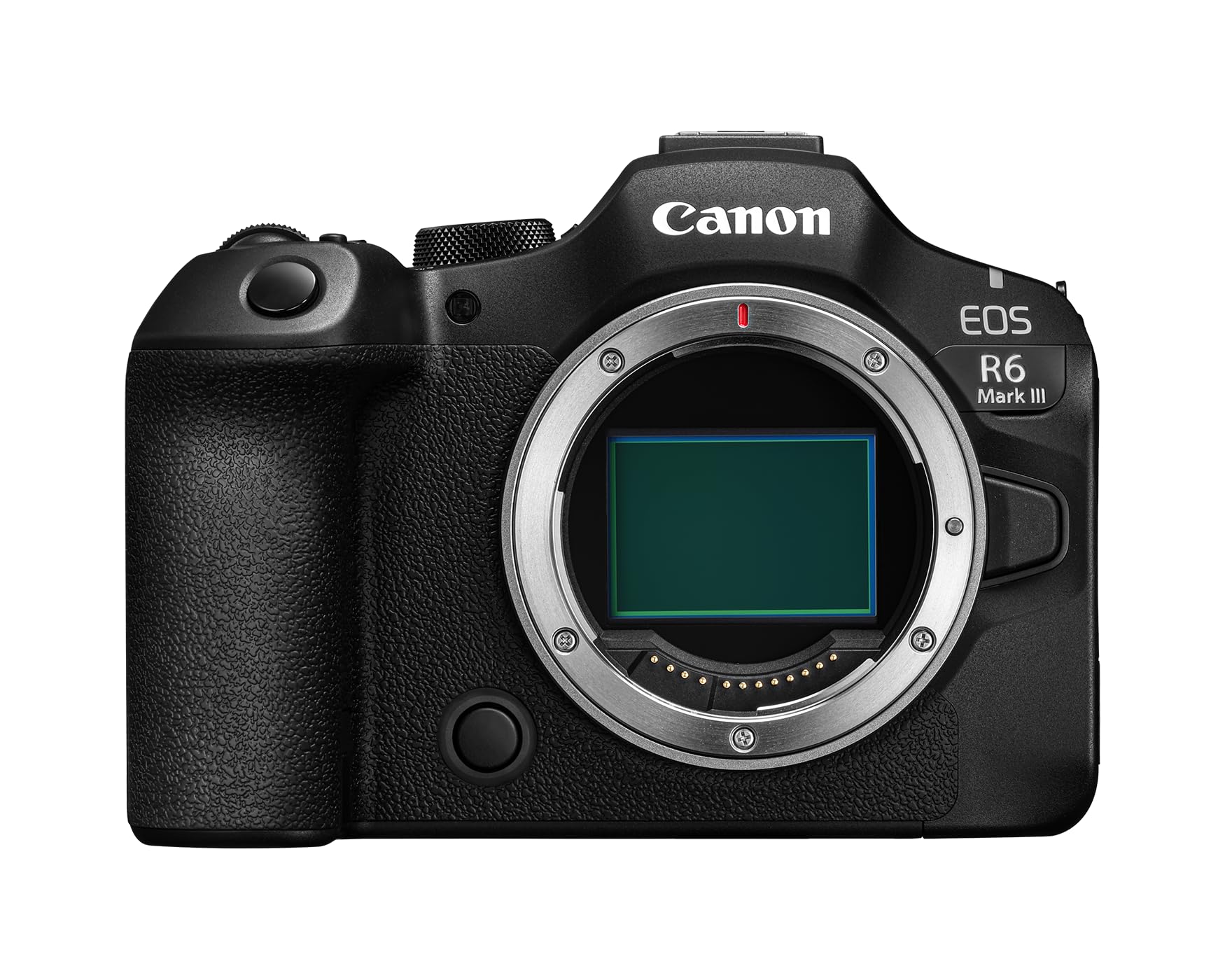
Canon EOS R6 Mark III

89 /100
Keeper Score Excellent

Key details

Media
CFexpress Type B + SD UHS-II
Photo Sensor
32.5MP full-frame CMOS
Stabilization
Up to 8.5 stops
Continuous Shooting
Up to 40 fps
Check Price on Amazon

The R6 Mark III answers the one question the R6 II leaves open: what if 24MP is not enough? It pairs a 32.5MP full-frame sensor with 40 fps shooting, up to 8.5 stops of stabilization, and Dual Pixel CMOS AF II. We think it is the better high-resolution hybrid for someone who crops portraits, landscapes, or wildlife files and still wants a fast camera.

The extra resolution is not just a number on a page. It gives you more room to straighten a horizon, pull in a distant subject, or print large without leaning on software. The dual CFexpress Type B and SD slots, 20-frame pre-continuous capture, and 1.5-pound body make it a serious working tool. The R6 II remains the smarter buy for most people, but the Mark III earns its premium when resolution is part of the job.

Pros

  • 32.5MP full-frame sensor adds cropping room
  • 40 fps shooting with pre-continuous capture
  • Up to 8.5 stops of stabilization

Cons

  • Premium price over the R6 Mark II
  • CFexpress Type B cards add cost
Our verdict

The R6 Mark III is the high-resolution hybrid we choose when 24MP feels tight, pairing 32.5MP files with 40fps shooting and strong stabilization.

Check Latest Price
6

Best for Professionals

Canon EOS R5 Mark II

90 /100
Keeper Score Outstanding

Key details

Video
8K 60 RAW; 4K 120
Autofocus
Dual Pixel Intelligent AF with Eye Control
Photo Sensor
45MP full-frame stacked CMOS
Continuous Shooting
Up to 30 fps electronic
Check Price on Amazon

The R5 Mark II is not the camera we suggest to a first-time buyer, and it is not trying to be. It is a 45MP full-frame body with a stacked sensor, 30 fps electronic shooting, 8K 60 RAW and 4K 120 video, and Eye Control autofocus. The spec sheet is aimed at someone who already knows which frame they need and wants the camera to keep up.

What earns it a place is how much of that speed is usable. Eye Control lets you pick a focus point by looking through the viewfinder, Action Priority reads the scene to guess the main subject, and pre-continuous capture buffers frames before you press the shutter. We were struck by how much of the R5 II is built around not missing the moment, rather than adding another menu page.

The 45MP files and 8K video are the other side of the deal. They give you room to crop and detail for large prints, and they make the camera feel like a professional instrument. The body is 1.5 pounds, which is reasonable for what it holds, and the 3-inch articulating screen works for both stills and video.

For a working photographer, the R5 II is the most capable camera here. It is also the one that demands the most from the rest of the kit: storage and a clear reason to shoot at 45MP. If your work does not need that, the R6 Mark II is the more comfortable recommendation.

Pros

  • 45MP stacked sensor with 30 fps electronic
  • 8K 60 RAW and 4K 120 video
  • Eye Control and Action Priority autofocus

Cons

  • Premium price and large file workflow
  • CFexpress Type B cards add cost
Our verdict

The R5 Mark II is a professional tool for photographers who need 45MP, 30fps, and 8K video in one body, and its price and file sizes reflect that.

Check Latest Price
7

One-Lens Travel

Canon EOS R10

89 /100
Keeper Score Excellent

Key details

Kit Lens
RF-S18-150mm F3.5-6.3 IS STM
Autofocus
651-zone Dual Pixel CMOS AF II
Photo Sensor
24.2MP APS-C CMOS
Continuous Shooting
15 fps mechanical; 23 fps electronic
Check Price on Amazon

The 18-150mm kit lens is the reason the R10 earns a place here. It covers wide-angle to telephoto in one barrel, so you can go from a group shot to a school concert without changing lenses. The R10 body adds a 24.2MP APS-C sensor, 15 fps mechanical and 23 fps electronic shooting, and 651-zone Dual Pixel CMOS AF II.

We like the handling for travel: the tilting screen, electronic viewfinder, and 1.6-pound package are easy to carry, and the autofocus tracks people, animals, and vehicles. The 18-150mm lens is the practical center of the kit, and it is the reason to choose this over a body-only camera if you do not want to build a lens collection.

Our judgement is that the R10 is the one-lens answer for family trips and everyday shooting. The 18-150mm range covers the shots that usually get missed while you swap lenses, and the body is quick enough for kids and pets. If changing lenses is the thing that stops you from carrying a camera, the R10 kit removes that excuse.

Pros

  • 18-150mm kit covers wide to telephoto
  • 15 fps mechanical and 23 fps electronic
  • 651-zone subject-detection autofocus

Cons

  • Kit lens is slow at the long end
Our verdict

The R10 earns a look when you want one lens to cover travel and family shooting, thanks to its 18-150mm kit and fast 15fps mechanical burst.

Check Latest Price
8

Budget Full-Frame

Canon EOS RP

90 /100
Keeper Score Outstanding

Key details

Kit Lens
RF24-105mm F4-7.1 IS STM
Autofocus
Dual Pixel CMOS AF, 4,779 points
Photo Sensor
26.2MP full-frame CMOS
Continuous Shooting
5 fps
Check Price on Amazon

The RP kit is the least expensive way into full-frame Canon here. You get a 26.2MP full-frame sensor, a 24-105mm lens with optical stabilization, and a compact 16-ounce body. The pitch is simple: full-frame images and a useful zoom range without a pro-body budget.

We like the lens range for travel and everyday shooting. The 24-105mm covers wide scenes and tighter portraits, and the optical stabilization helps in lower light. The articulating screen and electronic viewfinder make the camera easy to use at eye level or from a low angle, and the body feels small enough to carry all day.

The RP is at its best with still subjects and good light. It shoots 5 fps, and its autofocus is a generation behind the faster bodies here. That is not a problem for landscapes, architecture, or portraits, but it is the reason we do not send it to a soccer field. The full-frame sensor still gives you the look and low-light benefit that make the format appealing.

Our verdict is that the RP is the full-frame starter for someone who wants to slow down. It rewards composition and lens choice more than speed. If you need to track a running child indoors, the R8 is the better spend; if you want the full-frame look on a travel budget, the RP kit is still the cheapest way in.

Pros

  • Lowest-priced full-frame kit here
  • 24-105mm lens with optical stabilization
  • Compact body for travel

Cons

  • Battery life is short
Our verdict

The RP kit is our pick for the lowest-cost route into full-frame Canon, provided you shoot mostly still subjects and pack spare batteries.

Check Latest Price
9

Video-First Creators

Canon EOS R50 V

85 /100
Keeper Score Excellent

Key details

Video
4K 60 fps crop; 4K 30 fps full-width
Kit Lens
RF-S14-30mm F4-6.3 IS STM PZ
Photo Sensor
24.2MP APS-C CMOS
Continuous Shooting
Up to 15 fps
Check Price on Amazon

The R50 V is built around video in a way the R50 is not: a front record button, a vertical tripod mount, and a 14-30mm power zoom lens. It uses a 24.2MP APS-C sensor, records 4K at up to 60 fps in crop mode or 30 fps full-width, and shoots 15 fps stills. We think it is the right video-first Canon for a creator who works from a screen and wants a compact walkaround rig.

The wide 14-30mm range is the unsung part of the kit. It gives you room for handheld framing and tight interior shots, and the power zoom makes smooth framing easier than twisting a ring. The front record button and vertical mount sound like small details until you have to reach around a tripod plate or reframe a vertical clip. For vlogging and streaming, that is the kind of thinking we want to see.

Pros

  • Front record button and vertical tripod mount
  • 4K 60p crop and 4K 30p full-width video
  • Compact 14-30mm power zoom lens

Cons

  • No eyepiece finder
  • Slow kit lens limits low light
Our verdict

The R50 V is the video-first Canon we recommend to creators who shoot to a screen, want a compact power zoom, and do not need a stills-first body.

Check Latest Price

How We Tested the Canon Mirrorless Lineup

We started with Canon's current lineup and filtered by sensor size, price band, and the way each body is actually sold — bare body or paired with a zoom — so the shortlist covered full-frame and APS-C and both ends of the budget. That left eight cameras, which we shot with for eight months, passing them among three of us so no one person's habits decided the verdict.

Every camera went to the same three places: a Saturday morning soccer game, an indoor birthday party under bad lighting, and a weekend hike where it had to live on a sling strap for hours. We fired bursts at a dog sprinting toward us and a kid on a swing, then counted how many frames held focus when we zoomed to 100 percent. In the dim rooms we pushed the ISO and compared noise in the shadows against detail in hair and fabric, which is where the cheaper bodies gave themselves away.

Battery life we measured the blunt way — one charged pack, an empty card, and a count of frames plus minutes of 4K until the camera shut itself off. We also set up each menu from scratch without the manual, timed how long it took to change ISO and focus mode one-handed, and noted whether a body ever froze, dropped a write, or hunted for focus after we'd locked on. Value came last: what the bundled lens actually is, what the next lens up would cost, and whether anything in the box needed replacing on day one.

How to Choose a Canon Mirrorless Camera

Start With Sensor Size, Then Resolution

Full-frame gives you more low-light headroom and a narrower depth of field; APS-C gives you more reach from the same lens and usually a smaller body. In this group, the 24.2MP R6 Mark II and R8 are the full-frame all-rounders, the 32.5MP R6 Mark III adds cropping room, and the 45MP R5 Mark II is for heavy crops and large prints. On the APS-C side, the R7's 32.5MP sensor is the reach specialist, while the R50 and R10 use 24.2MP sensors. We pick format first and resolution second: 24MP is plenty for most prints, and the extra pixels matter most when you crop often.

Treat Autofocus and Burst Speed as Separate Choices

Subject detection is now the dividing line between a camera that helps and one that fights you. Dual Pixel CMOS AF II appears across the R6 Mark II, R8, R50, R7, R10, and R6 Mark III, with people, animal, and vehicle detection; the R5 Mark II adds Eye Control and Action Priority. Burst speed is a different question. The R6 Mark II and R8 reach 40 fps electronically, the R7 does 30 fps, and the RP stops at 5 fps. If you photograph children, pets, or sport, pay for autofocus and a useful burst; for landscapes and portraits, spend elsewhere.

Match the Finder and Screen to How You Shoot

A hybrid shooter benefits from an electronic viewfinder and an articulating screen; the R6 Mark II, R8, and R6 Mark III give you both. The video-first R50 V is built around a front record button, a vertical tripod mount, and a screen-led workflow, which is liberating for vlogging and limiting for stills in bright sun. Stabilization belongs in the same decision: the R7, R6 Mark II, R6 Mark III, and R5 Mark II list in-body stabilization, which helps handheld video and slow-shutter stills. We do not buy a body for one headline frame rate if the finder and handling make you leave it at home.

Budget for the Lens and the Battery, Not Just the Body

The kit lens is part of the camera's character. The R10's 18-150mm is a true travel zoom but slow at the long end; the R50's 18-45mm is compact and modest; the RP's 24-105mm covers a lot of ground with stabilization. RF-S lenses fit full-frame bodies in crop mode, but they do not turn a full-frame camera into a full-frame system, so plan your lens path. Smaller bodies also trade battery capacity for size, and a spare is sensible for a full day. We favor one good lens over stretching for a body that leaves nothing for glass.

Frequently Asked Questions

Final Verdict

The Canon EOS R6 Mark II is our default because it balances the things most photographers actually use: a clean 24.2MP full-frame file, autofocus that holds onto people and animals, and enough speed for action without a huge body. It is the camera we choose when we do not know what the day will bring.

If full-frame is the goal but the budget is tighter, the R8 gets you the same sensor generation in a smaller body. If your subject is usually far away and moving, the R7's APS-C reach and 30 fps burst make more sense than another full-frame body.