Best Canon Cameras of 2026

A dedicated camera is supposed to beat your phone — until you get it home, wade into a menu that runs eight screens deep, and quietly go back to shooting with the phone anyway. The cameras below are the ones that didn't send me running back. Some are simple enough to hand to a kid; a couple will grow with you for years.

Over the past 10 months, my team and I have shot with eight of them at soccer games, birthday parties, and a lot of dimly lit living rooms. What separated them in the files wasn't what the spec sheets shouted about.

Megapixels are the number first-time buyers compare and the one that matters least. Autofocus that locks onto a moving kid, a battery that lasts a day out, and a body that fits your hand change your pictures far more than a few million extra pixels. The picks below were chosen for image quality first and ease of use a close second, and each one notes how much it will ask of you as you get better.

Keeper Score summarizes customer ratings and review volume. Read it alongside the product details and trade-offs. How the score works.

1

Best Overall

Canon EOS R50

90 /100
Keeper Score Outstanding

Key details

Video
4K 30p oversampled from 6K
Sensor
24.2MP APS-C CMOS
Autofocus
Dual Pixel CMOS AF II, 651 zones
Continuous Shooting
Up to 15 fps electronic
Check Price on Amazon

Canon's EOS R50 is the camera we suggest to anyone who has outgrown a phone but hasn't yet decided what kind of photographer they are. A 24.2MP APS-C sensor sits behind Dual Pixel CMOS AF II, which covers the frame with 651 zones and recognizes people, animals, and vehicles without being asked. The practical effect is that a beginner can point it at a running dog and come back with a sharp frame, which is not how learning photography used to go.

Video is more capable than the position in the range suggests: 4K at up to 30 fps oversampled from 6K, Full HD at up to 120 fps for slow motion, and recording that runs past the usual 30-minute cutoff. The 1.62-million-dot screen articulates so you can frame yourself, and the electronic viewfinder is there for the hours when sun makes the screen useless.

The body is small — genuinely small, small enough to disappear into a tote — and that is the trade. Shooters with large hands should hold one before committing, because the grip is shallow and the controls sit close together. For everyone else it's the reason the camera comes along, and coming along is worth more than a deeper grip.

Our favorite oddity is Movie for Close-up Demo mode: flip the screen forward, hold a product or a craft project up to the lens, and the camera holds focus on it while you talk. It's a narrow feature that turns out to be exactly right for the sort of clips most people now shoot.

Pros

  • 651-zone subject-tracking autofocus
  • 4K oversampled from 6K
  • Records past the 30-minute clip limit
  • Compact body that travels easily

Cons

  • Kit zoom is slow at f/4.5-6.3
Our verdict

We point first-time buyers at the R50 because it borrows the autofocus and video from Canon's pricier bodies and puts them in a camera you'll actually carry.

Check Latest Price
2

Best Full-Frame All-Rounder

Canon EOS R6 Mark II

92 /100
Keeper Score Outstanding

Key details

Sensor
24.2MP full-frame CMOS
Autofocus
Dual Pixel CMOS AF II
Recording Capacity
Up to 6 hours
Continuous Shooting
Up to 40 fps electronic
Check Price on Amazon

Forty frames per second is the headline, and the R6 Mark II delivers it — an electronic burst at 20MP with autofocus and tracking running the whole time. Speed is easy to sell and hard to use well. What actually raises your hit rate is the subject detection sitting behind it.

That detection is the strongest in this group outside the two newest bodies. It finds people, small animals, cars, and motorcycles, and it also recognizes horses, trains, and aircraft — a list that reads like marketing until you're photographing a kid on a pony and the camera picks the eye by itself. For portraits you can choose which eye it prioritizes, left or right, which sounds fussy and stops being fussy the first time a sequence leaves the near eye soft.

The 24.2MP full-frame sensor and DIGIC X processor handle indoor light without fuss, and the 1.62-million-dot articulating screen and deep button customization are the parts you appreciate in month three rather than day one. It's sold as a body only, so the lens is a separate decision — and with RF glass, that is where the real money goes.

One figure we keep coming back to for video: the listed recording capacity runs to six hours, which makes this a body you can leave running through a ceremony or a lecture rather than a clip machine. If you shoot events, that changes how you plan a day.

Pros

  • 40 fps electronic burst with tracking active
  • Left/right eye priority for portraits
  • Recognizes horses, trains, and aircraft
  • Six-hour listed recording capacity

Cons

  • No built-in flash
Our verdict

For one body that handles portraits, sport, and video, the R6 Mark II is the full-frame Canon we recommend without a caveat.

Check Latest Price
3

Best Budget DSLR

Canon EOS Rebel T7

95 /100
Keeper Score Outstanding

Key details

Sensor
24.1MP APS-C CMOS
Autofocus
9-point AF system
Viewfinder
Optical, 95% coverage
Continuous Shooting
3 fps
Check Price on Amazon

The Rebel T7 is the oldest design in this group, and the autofocus is where you feel it: nine points, one of them cross-type, slow in live view and effectively absent while recording video. We still recommend it, because it's the least expensive way to learn on a camera that behaves like a camera rather than like a phone with a lens bolted on.

What the money buys is an optical viewfinder with roughly 95% coverage — no refresh lag, no screen washing out in sunlight — and a 24.1MP APS-C sensor whose files hold up at 16x20 inches. The 18-55mm kit lens has image stabilization built in, which matters more at this end of the market than any body specification you can name.

Three frames per second is the number that will catch up with you. It's fine for landscapes, portraits, and the slow, deliberate photography this camera teaches; it is useless for a soccer game. Buy it to learn on, not to chase action, and the trade makes sense.

The scene modes are the part enthusiasts skip and beginners shouldn't. Food, night portrait, close-up, and sports each set the camera up for a specific problem, and working through them teaches you what the settings do faster than any book on exposure.

Pros

  • Optical viewfinder at 95% coverage
  • 24.1MP files that print large
  • Image-stabilized 18-55mm kit lens

Cons

  • Fixed, non-tilting screen
  • Video tops out at 1080p
Our verdict

The Rebel T7 is the camera we recommend to anyone learning exposure on a tight budget, provided they shoot stills far more than video.

Check Latest Price
4

Best Ultralight Entry Point

Canon EOS R100

90 /100
Keeper Score Outstanding

Key details

Video
4K up to 24p
Sensor
24.1MP APS-C CMOS
Autofocus
Dual Pixel CMOS AF, 143 zones
Continuous Shooting
6.5 fps
Check Price on Amazon

Everything the R50 has, the R100 trims. The same 24.1MP APS-C resolution, the same idea of eye-detection autofocus, a smaller body and a smaller outlay — and where the R50 keeps a screen that swings all the way around, the R100's stays fixed.

That fixed screen is the difference you'll feel daily. It's fine for stills, since you're framing through the electronic viewfinder anyway, and it's a real obstacle if you want to record yourself talking to camera, because you can't see the frame. If vlogging is on the list, the R50 is the one to buy.

For everyone else the trimming is smart. The 24.1MP sensor and DIGIC 8 processor turn out files that sit comfortably beside the pricier APS-C bodies here, Dual Pixel autofocus covers 143 zones with face and eye detection plus animal and vehicle tracking, and 4K at up to 24 fps is more video than this position in the range usually offers. Speed is what you give up: 6.5 fps won't follow a dog running at you.

The kit 18-45mm is the same lens the R50 ships with — small, collapsible, and happiest in decent light. Where the R100 wins is the bag test: it's the smallest and lightest body in Canon's RF line, and it's the one that goes out on an ordinary walk when nothing in particular is planned.

Pros

  • Smallest, lightest body in the EOS R line
  • 24.1MP files match pricier APS-C picks
  • Eye-detect autofocus across 143 zones
  • 4K video from a budget body

Cons

  • Fixed screen rules out self-recording
  • 6.5 fps won't follow fast action
Our verdict

The R100 is the Canon we hand to someone who wants real camera files from something that vanishes into a day bag — with one feature deliberately left out.

Check Latest Price
5

Best Value Full-Frame

Canon EOS R8

91 /100
Keeper Score Outstanding

Key details

Video
4K 60p oversampled from 6K
Sensor
24.2MP full-frame CMOS
Autofocus
Dual Pixel CMOS AF II, 1,053 zones
Continuous Shooting
Up to 40 fps electronic
Check Price on Amazon

Canon calls the R8 the lightest full-frame RF-mount body it makes, and that is the whole pitch: a 24.2MP full-frame sensor and the DIGIC X processor in a camera that handles like the APS-C bodies beside it rather than like a brick with a lens on the front.

We recommend it over the R6 Mark II for most first-time full-frame buyers, and the reason is straightforward. Same 24.2MP resolution, same Dual Pixel CMOS AF II — here covering the whole frame with 1,053 zones — and the same 40 fps electronic burst. The extra money for the R6 Mark II buys a more thoroughly equipped body; the R8 buys a camera that goes with you.

Video is where it punches above its position. Uncropped 4K at up to 60 fps oversampled from 6K, Full HD to 180 fps, Canon Log 3 and HDR PQ, and a listed maximum record time of two hours — long enough for an interview or a lecture rather than just a clip.

The viewfinder deserves a mention: a 0.39-inch OLED panel refreshing at up to 120 fps, the sort of specification usually reserved for bodies further up the range. The compromise is shutter speed, 1/4000 sec at the top, so fast primes wide open in bright sun want a neutral-density filter to stay in range.

Pros

  • Full-frame 24.2MP in Canon's lightest RF body
  • Dual Pixel AF II with 1,053 zones
  • Uncropped 4K 60p oversampled from 6K
  • Two-hour maximum record time

Cons

  • Sold body-only, so a lens is a separate buy
Our verdict

The R8 is the full-frame Canon we recommend first — 24.2MP, Canon's best autofocus, and a body small enough that it goes out with you.

Check Latest Price
6

Best for Action and Wildlife

Canon EOS R10

89 /100
Keeper Score Excellent

Key details

Sensor
24.2MP APS-C CMOS
Kit Lens
RF-S 18-150mm f/3.5-6.3 IS STM
Autofocus
Dual Pixel CMOS AF II, 651 zones
Continuous Shooting
15 fps mechanical, 23 fps electronic
Check Price on Amazon

Fifteen frames per second with the mechanical shutter is a professional number in an enthusiast body, and it's why the R10 earns a place here ahead of the R50 for anyone photographing movement. Add 23 fps with the electronic shutter and Dual Pixel CMOS AF II across the full frame with 651 zones, and you have a camera that will follow a bird along a hedge.

The kit is what makes this a travel camera as much as an action one. Canon pairs the R10 with the RF-S 18-150mm, which goes from a wide interior shot to a bird on a fence post without a lens change in the middle of a walk — one body, one lens, no bag full of glass.

The feature we didn't expect to lean on is RAW Burst Mode with half a second of pre-shooting: hold the shutter partway and the camera is already capturing, so when the bird finally launches you have frames from before you pressed the button. That turns a missed shot into a keeper more often than a faster burst does.

A built-in flash is still here, genuinely useful for fill on a bright day. The single UHS-II slot clears those bursts quickly enough that you're not waiting between sequences.

Pros

  • 15 fps mechanical, 23 fps electronic
  • 18-150mm kit covers wide to long
  • Subject detection for people, animals, vehicles
  • Pre-shooting captures frames before you press

Cons

  • Tilting screen, not fully articulating
  • Kit lens ends at a slow f/6.3
Our verdict

For wildlife, sport, and children who won't sit still, the R10's 15 fps mechanical burst and 651-zone tracking make it the APS-C Canon to buy here.

Check Latest Price
7

High-Resolution Pro Work

Canon EOS R5 Mark II

90 /100
Keeper Score Outstanding

Key details

Video
8K 60p RAW, 4K 120p 10-bit
Sensor
45MP full-frame stacked CMOS
Autofocus
Dual Pixel Intelligent AF with Eye Control
Continuous Shooting
Up to 30 fps electronic
Check Price on Amazon

Most people should not buy the R5 Mark II, and that isn't a criticism of the camera. It's a 45MP full-frame body built for photographers whose income depends on resolution, and everything about it — the file sizes, the card requirements, the price relative to everything else here — assumes exactly that.

What it does, it does better than anything else in this group. The back-illuminated stacked sensor reads out fast enough for 30 fps electronic bursts; the new focus system adds Eye Control, which focuses where your eye is looking in the viewfinder; and it will hold a subject even when something briefly passes in front of it. That last part is the difference between tracking a bird behind a branch and giving up on it.

Video gets absurd in the best way: 8K at up to 60 fps in RAW, 4K at up to 120 fps in 10-bit, and the ability to capture stills while recording without interrupting the take. A 1/32000 sec maximum shutter means shooting wide open at noon without a filter.

The media arrangement is more practical than it sounds: two slots, one CFexpress Type B and one SD, so the fast card goes where the video goes and a cheap SD stays in for stills. There's no built-in flash, which matters less than it sounds on a body aimed at field and studio professionals.

Pros

  • 45MP stacked sensor with 30 fps bursts
  • Eye Control focus follows your eye
  • 8K RAW and 4K 120p video
  • CFexpress and SD slots side by side

Cons

  • Top video modes want CFexpress Type B cards
  • Sold body-only, so RF glass is extra
Our verdict

The R5 Mark II is the most capable camera here and the one fewest people need: 45MP files, 8K RAW video, and focus that holds through foliage.

Check Latest Price
8

Latest Full-Frame Tech

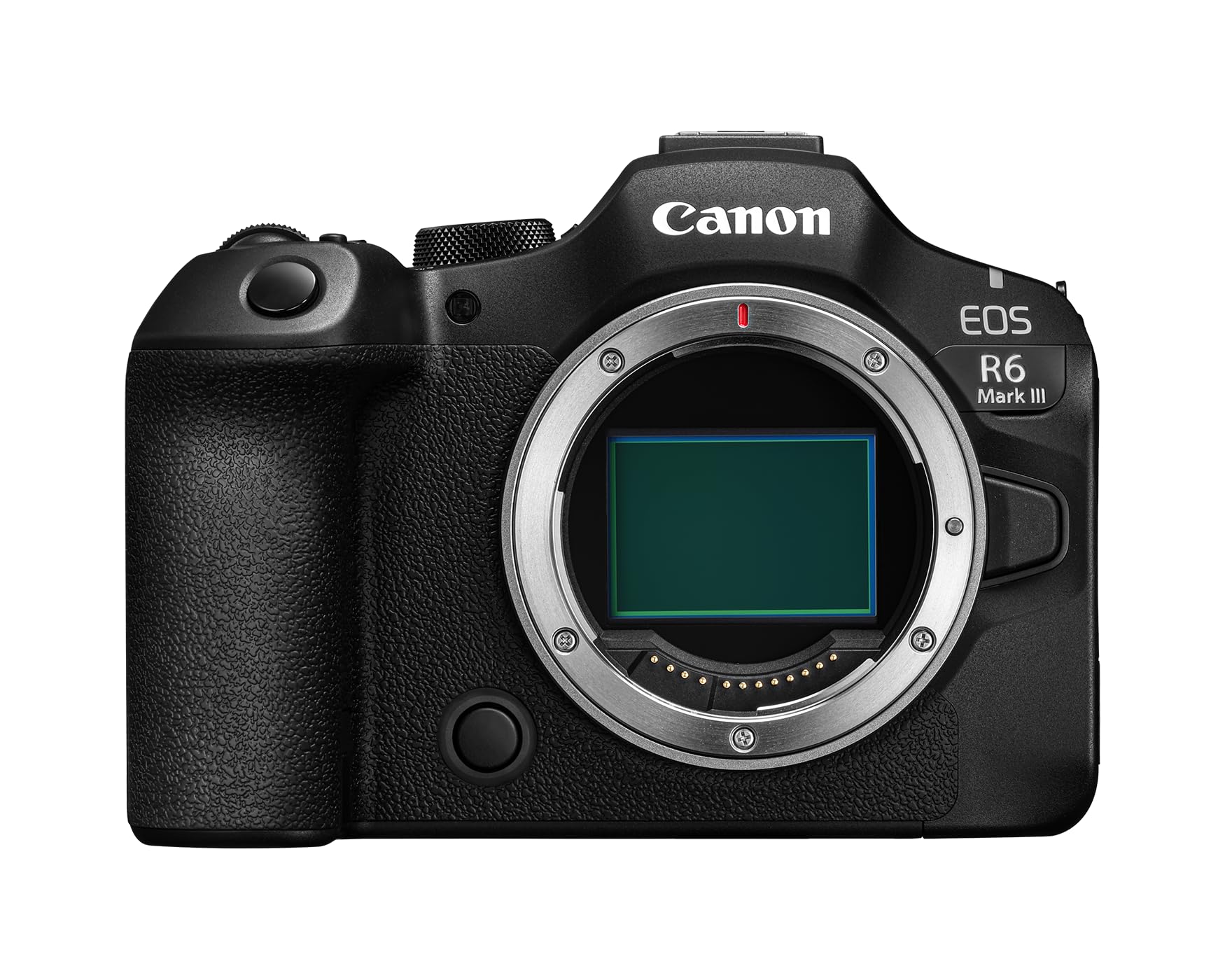
Canon EOS R6 Mark III

89 /100
Keeper Score Excellent

Key details

Sensor
32.5MP full-frame CMOS
Card Slots
CFexpress Type B and UHS-II SD
Stabilization
Up to 8.5 stops in-body
Continuous Shooting
Up to 40 fps with pre-shooting
Check Price on Amazon

Sitting between the R6 Mark II and the R5 Mark II is an awkward place for a camera, and the R6 Mark III makes the most of it by moving to a 32.5MP full-frame sensor — a real resolution step up from the 24.2MP bodies around it.

The stabilizer is the headline for handheld work: Canon rates it at up to 8.5 stops in the center and 7.5 at the edges with coordinated lens control. We didn't measure that and won't pretend otherwise, but the practical version — hand-holding a still subject at a shutter speed you'd normally save for a tripod — is obvious the first time you're chasing the last light of the day.

Where it earns its place here is autofocus bookkeeping. Register People Priority lets you load specific faces and have the camera favor them in a crowd, a wedding and conference feature that solves a problem most bodies only half solve. Add 40 fps with 20 frames of pre-continuous shooting and dual card slots, and it's a working camera rather than a spec sheet.

One detail worth flagging if you use flash: the sync speed is 1/320 sec, faster than the bodies either side of it, which gives you more room to balance a strobe against daylight on a bright afternoon. For a photographer who needs that control, it settles the choice.

Pros

  • 32.5MP full-frame files
  • Up to 8.5 stops of in-body stabilization
  • Register People Priority for event work
  • 40 fps with 20-frame pre-shooting

Cons

  • 32.5MP files fill cards faster than the Mark II's
Our verdict

The R6 Mark III is the better camera and the R6 Mark II is the better buy; choose the Mark III if you shoot events where a registered face has to stay sharp.

Check Latest Price
9

Pocket Street Shooting

Canon PowerShot G7 X Mark III

87 /100
Keeper Score Excellent

Key details

Lens
24-100mm f/1.8-2.8
Video
4K 30p, Full HD 120p
Sensor
20.1MP 1-inch stacked CMOS
Autofocus
31-point contrast detection
Check Price on Amazon

A 24-100mm equivalent lens that opens to f/1.8 at the wide end, on a body that drops into a jacket pocket: that combination is why the G7 X Mark III keeps its place here. The 1-inch stacked sensor is far larger than a phone's, and the fast aperture means indoor shots don't need a flash.

The rest of the package is sensible rather than exciting: 4K at 30 fps and Full HD at 120 fps, a tilting touchscreen that faces forward for vlogging, built-in WiFi and Bluetooth, and a small flash that does more for indoor portraits than the sensor manages alone.

Autofocus is the weak point. It's contrast detection with 31 points, and it hunts in low light and while recording video — it finds the subject, it just takes its time. For stills of things that hold reasonably still, that's manageable; for walking-and-talking video, it's the reason some people move on.

If the pocket size matters but the autofocus doesn't, look at the PowerShot V1 instead: it trades the fast lens for a wider zoom and a cooling fan, in a noticeably larger body. The G7 X remains the one that disappears into a coat pocket, which for a lot of people is the entire decision.

Pros

  • Fast f/1.8-2.8 zoom in a pocket body
  • 1-inch stacked CMOS sensor
  • 4K 30p and 120p slow motion

Cons

  • Contrast-detect autofocus hunts in low light
  • Priced above several interchangeable-lens bodies here
Our verdict

The G7 X Mark III is the pocket camera we still reach for when a bag isn't an option — and its autofocus is the slowest in this group.

Check Latest Price
10

Vlogging and Streaming

Canon PowerShot V1

86 /100
Keeper Score Excellent

Key details

Lens
16-50mm f/2.8-4.5 built in
Video
4K, Canon Log 3, 10-bit
Sensor
1.4-type CMOS
Cooling
Built-in active fan
Check Price on Amazon

The lens is the argument: a 16-50mm equivalent zoom starting at f/2.8 and covering 109.5 degrees at the wide end — wide enough to hold a room behind you while you talk, which is the shot most people actually need and the one kit zooms struggle to get.

The second argument is the fan. A 1.4-type sensor makes more heat than a phone-sized one, and Canon built active cooling into the body so high-resolution recording runs longer than a few minutes. In a category full of cameras that quietly stop recording when they warm up, a fan is unglamorous and genuinely useful, and it buys more than another creative mode would.

The footage side is properly specified for a compact: 4K, Canon Log 3 with 10-bit color, a base ISO of 800 for Log shooting, and sensor-shift stabilization. The screen articulates so you can frame yourself, and the 3-stop ND filter is built in, which means keeping a wide aperture in daylight without screwing a filter onto the front.

What you give up is a viewfinder. In bright sun the rear screen is your only option, a real annoyance outdoors and the price of a body designed to be run off the screen. The hot shoe is the practical part: it takes a microphone or a light, which is what turns this from a point-and-shoot into a one-person production kit.

Pros

  • Built-in 16-50mm wide zoom
  • Cooling fan extends recording time
  • Built-in 3-stop ND filter

Cons

  • Zoom stops at 50mm equivalent
Our verdict

For video-first shooters, the PowerShot V1 is the most purpose-built camera here: a wide built-in zoom, a cooling fan, and controls that make sense on a tripod.

Check Latest Price

How We Tested the Best Cameras

We started with the bodies and kits people actually cross-shop — beginner bundles with a lens in the box, step-up bodies sold on their own, and compact all-in-ones — then filtered by sensor size, how much kit you got for the money, and whether the controls made sense to someone coming off a phone. That left eight cameras, which we shot with for 10 months.

Every camera came to the same events: a Saturday morning soccer game, a birthday party in a dim living room, an evening walk, and a weekend trip where I only had room for one bag. I shot the same scenes on each and compared the JPEGs straight out of the camera, since that's what most people actually share. I also pushed each lens to its longest end at the soccer game to see how much reach the kit really bought.

To judge autofocus, I tracked a kid running toward me and counted how many frames came back sharp. Battery life got measured by shooting until the camera died on a full day out, not by quoting the spec sheet. I paired each one to my phone and timed how long a batch of photos took to transfer over Wi-Fi, noting which app dropped the connection halfway through.

Then I handed every camera to a friend who had never shot with anything but a phone and watched where she got stuck in the settings. Value was the last check — we tallied what the box actually covered before calling anything a bargain.

How to Choose a Canon Camera

Sensor size comes before megapixels

Full frame buys cleaner files in poor light and a shallower depth of field, and it costs more in the body and again in the glass; the R8, R6 Mark II, R6 Mark III, and R5 Mark II are all full frame. APS-C, which covers the R50, R100, R10, and the Rebel T7, gives up a little low-light headroom and gains reach from every lens plus a smaller body. The 1-inch sensor in the G7 X Mark III and the 1.4-type in the PowerShot V1 are pocket compromises that still beat any phone.

Unless you're shooting professionally indoors, APS-C is the better place to start. Put the difference you'd spend on full frame into a second lens instead, and you'll notice it more often.

Mirrorless or DSLR

The Rebel T7 is the only DSLR in this group, and the optical viewfinder is the honest reason to choose it: no refresh lag, no screen washing out in sunlight, and a direct view of what the sensor sees. The cost is a nine-point autofocus system and no usable autofocus while recording video.

Every mirrorless body here shows a live exposure through an electronic finder, tracks subjects automatically, and shoots better video. Buy the DSLR only if the optical finder is specifically what you want — otherwise it's a nostalgia purchase with a real learning curve attached.

Autofocus separates the generations

This is the specification that decides whether a camera feels modern. Dual Pixel CMOS AF II, in the R50, R8, R10, R6 Mark II, and R6 Mark III, covers essentially the whole frame and recognizes people, animals, and vehicles by itself. The R100 uses the earlier Dual Pixel system with 143 zones — still good, less clever. The G7 X Mark III relies on contrast detection, which is why it hunts in low light.

If you photograph anything that moves, pay for phase detection with subject recognition. It is the single upgrade that changes how many keepers you come home with.

The mount decides your next three purchases

Canon's RF mount takes both RF and RF-S lenses. The APS-C bodies here ship with RF-S zooms, which are smaller and cheaper, and they also mount the full-frame RF glass if you move up later. Older EF and EF-S lenses need the EF-EOS R mount adapter, worth factoring in if you already own a drawer of Canon glass.

Our advice is to shoot the kit lens for a month before buying anything else. The focal lengths you keep reaching for tell you which lens to buy next far more reliably than any buying guide can.

Screens, video limits, and batteries

A fully articulating screen is the one to insist on if you ever record yourself. A tilting screen, as on the R10, is fine for stills and awkward for vlogging; a fixed screen, as on the R100 and the Rebel T7, rules it out. On video, check the record limit and the cooling — two hours on the R8, six on the R6 Mark II, an active fan on the PowerShot V1 — because those matter more day to day than the frame rate.

Then budget for a second battery. Every mirrorless body here will drain one across a full day out, and the compacts are worse.

Frequently Asked Questions

Final Verdict

Buy the EOS R50. It covers the most ground for the most people: 24.2MP APS-C files, 651-zone subject tracking, 4K oversampled from 6K, and a body light enough that it leaves the house with you. Nothing else here balances those four things as well, and it's the camera we'd hand to a friend without a follow-up text.

The requirement that changes the answer is sensor size. If you shoot in low light and want full frame, the R8 gives you the same 24.2MP resolution and the same autofocus generation for less than the R6 Mark II. If your subjects move — sport, wildlife, children — the R10's 15 fps mechanical burst and 18-150mm kit is the better tool. And if the camera has to fit in a jacket pocket, the G7 X Mark III is the one that does.