Best Compact Mirrorless Cameras of 2026

The real risk with a camera isn't buying a bad one — it's buying a good one and never taking it anywhere. I've watched friends talk themselves into a big DSLR, use it for a month, then leave it in a closet because it didn't fit the bag they actually carry. A compact mirrorless body fixes that: an APS-C sensor and a real lens in something you can sling over a shoulder, so the shots a phone keeps fumbling — birthday candles, a kid running at dusk — come out closer to the way the moment felt.

We've spent the past six months shooting with seven of these cameras, and the differences show up quickly once you put the spec sheets down. Megapixels sell bodies; what actually decides whether you keep shooting is whether the autofocus holds a moving face, whether the battery survives a day out, and whether the kit lens is good enough that you don't need to buy another one right away.

The picks below are the ones we kept reaching for — small enough to bring along, easy enough to hand to a friend, and priced so the money goes into the pictures rather than the badge.

Keeper Score summarizes customer ratings and review volume. Read it alongside the product details and trade-offs. How the score works.

1

Best Overall

Canon EOS R50 (18-45mm Kit)

90 /100
Keeper Score Outstanding

Key details

Video
4K 30p oversampled from 6K, uncropped
Screen
3.0-inch articulating touchscreen
Sensor
24.2MP APS-C CMOS
Autofocus
651-zone Dual Pixel AF II
Check Price on Amazon

Sixteen ounces is what the R50 body and its 18-45mm kit lens add to a bag, and that number is the reason it comes with us more often than anything else we tested. Small only helps if the camera still handles like a camera, and this one does: a viewfinder, a screen that swings out to face you, and controls that don't require a menu dive. That pairing, more than the 24.2MP sensor, is why it's the one we recommend first.

The autofocus is what we kept coming back to. Dual Pixel AF II covers essentially the full frame with 651 zones and picks out people, animals, and vehicles on its own, so eye detection follows a head turn instead of dropping to the background the moment someone moves. Point counts are abstract on a page; what you notice in use is that you stop re-focusing and start composing.

Video is unusually complete for a body this size: 4K at 30p oversampled from 6K with no crop, Full HD up to 120p for slow motion, and up to 15 fps with the electronic shutter. The kit lens is the compromise. It's tiny and stabilised, but it dims to f/6.3 at 45mm, which pushes the ISO up indoors after dark. A fast RF prime fixes that, and the R50 grows into it.

Two details earned their keep that we didn't expect to care about. The 18-45mm focuses down to 0.20m at the wide end, close enough for flowers, food, and the kind of detail shot a phone flattens. And the camera works as a plug-and-play webcam over USB with no extra software, which quietly made it the most-used camera in the house on a video-call day.

Pros

  • Viewfinder plus a fully articulating screen
  • 651-zone autofocus with subject detection
  • 4K 30p oversampled from 6K, uncropped
  • Up to 15 fps with the electronic shutter

Cons

  • Compact grip feels small in large hands
Our verdict

We recommend the R50 to most people buying a first compact mirrorless: a viewfinder, a screen that faces you, and subject-tracking autofocus that holds, all in a bag-friendly body.

Check Latest Price
2

Best for Stills

Sony a6400 (16-50mm Kit)

91 /100
Keeper Score Outstanding

Key details

Video
4K up to 30p
Screen
3.0-inch tilting touchscreen
Sensor
20.1MP APS-C CMOS
Autofocus
425 phase-detect points
Check Price on Amazon

By the calendar, the a6400 is the oldest camera in this group, and it's still one we recommend without hesitation. What keeps it relevant is autofocus: 425 phase-detection points spread across most of the frame, paired with real-time eye tracking that grabs a subject and refuses to let go.

The viewfinder is the other half of the argument. Putting the camera to your eye in bright sun is a different activity from shading a screen with your hand, and it steadies a longer lens. With the 16-50mm power zoom collapsed, the whole kit slides into a jacket pocket, and there's enough of a grip and enough dials that it doesn't feel like a toy.

So why keep an older body on a page like this? Because stills are what it does best, and it does them without drama — exposure, colour, and focus land where you expect, and 11 fps with tracking is plenty for a school football game or a dog at the park. If you mainly photograph rather than film, this is the one we hand you.

Video is 4K at up to 30p and holds detail well; the newer Sonys here add video conveniences rather than a fundamentally different picture. What you're really buying is the mount. E-mount lenses are everywhere, so a fast 35mm-equivalent prime or a cheap long zoom is a short search away, and a lens bought now still fits the next Sony body.

Pros

  • Real-time eye autofocus that holds
  • 425 phase-detect points over most of the frame
  • Viewfinder in a body that fits a pocket
  • Deep E-mount lens choice to grow into

Cons

  • Screen tilts but doesn't swing out to the side
Our verdict

We keep the a6400 on this list for stills shooters: eye autofocus that holds, a viewfinder you can use in daylight, and a lens mount with room to grow.

Check Latest Price
3

Best for Video

Sony ZV-E10 (16-50mm Kit)

85 /100
Keeper Score Excellent

Key details

Video
4K 30p oversampled from 6K
Screen
3.0-inch side flip-out touchscreen
Sensor
24.2MP APS-C CMOS
Autofocus
425-point hybrid AF
Check Price on Amazon

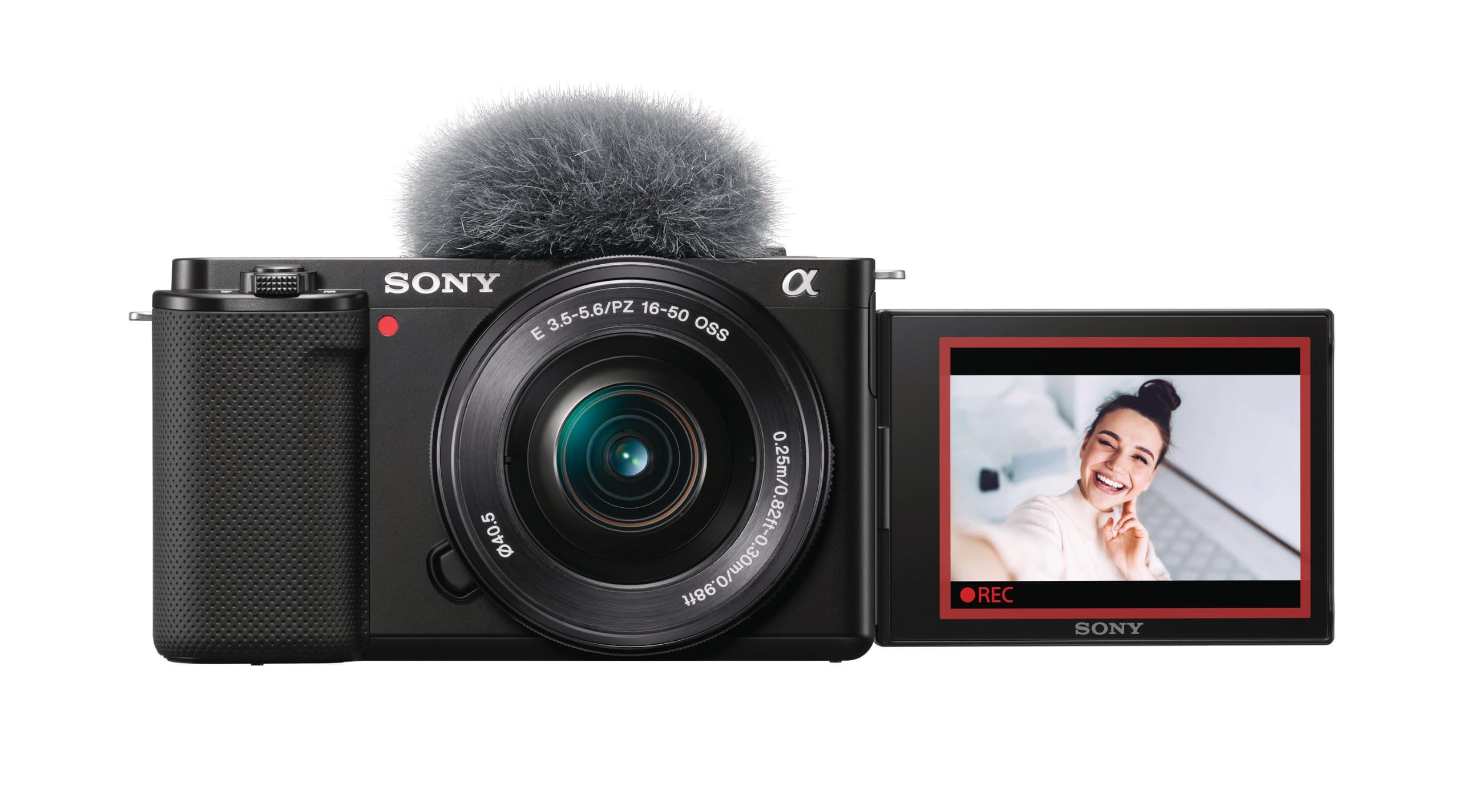
No viewfinder is the whole idea. The ZV-E10 is built for the person who's in front of the camera as often as behind it, so the money went on a screen that flips out to the side and a body that stays out of the way. We found that trade easy to live with while filming and instantly irritating while framing a landscape in the sun.

The video side earns it. 4K at 30p is oversampled from 6K with full pixel readout, so fine detail survives, and two top-plate buttons handle fixes you'd otherwise take to an editing app: Background Defocus softens the background with one press, and Product Showcase slides focus from your face to whatever you hold up to the lens.

Audio is better than the size suggests — a directional three-capsule mic plus a windscreen in the box, which is more than most bodies this small offer. One USB cable turns it into a webcam with no extra software, and the 16-50mm power zoom has a rocker for slow, smooth zooms mid-shot.

Autofocus is the 425-point hybrid system with real-time eye tracking, and for talking-head work it's the right tool; 11 fps is fine for stills, if unremarkable. A photographer should look elsewhere, because the missing viewfinder and the video-first controls are the wrong trade for someone who shoots through a lens.

Pros

  • Side flip-out screen for framing yourself
  • 4K 30p oversampled from 6K
  • One-press background defocus and showcase modes
  • Three-capsule mic with windscreen included

Cons

  • 4K stops at 30p, with no 60p option
Our verdict

We steer video-first buyers to the ZV-E10: the side-flipping screen, clean oversampled 4K, and one-press background blur make recording yourself genuinely easy.

Check Latest Price
4

Best Two-Lens Kit

Nikon Z50 II (Two-Lens Kit)

87 /100
Keeper Score Excellent

Key details

Video
4K UHD up to 60p
Sensor
20.9MP APS-C CMOS
Autofocus
231 points, nine subject types
Kit Lenses
16-50mm and 50-250mm VR
Check Price on Amazon

Two lenses, one bag, and a working range from 16mm to 250mm — that's the argument for this kit, and it's a strong one. The 16-50mm covers the everyday and the 50-250mm reaches far enough for wildlife, school sports, and the far side of a street, both stabilised, both small enough to travel together.

The body underneath is the most capable APS-C Nikon here: 20.9MP, 4K at up to 60p, and an EVF with 1.02x magnification. Subject detection recognises nine kinds of subject, with dedicated bird and airplane modes, and this is the newest autofocus Nikon brings to these picks — the one we point at anyone who wants a single purchase to cover a whole year of shooting.

Picture Controls are the feature we didn't expect to use: a dedicated button cycles 31 presets, and you can save your own, which means a usable look straight out of the camera on a grey afternoon. There's also a built-in flash, which neither Sony here lists.

What it costs you is lens changes. Two lenses mean a decision every time the light or the subject shifts, and an open body while you make it; if you mostly shoot one subject at a time, that's a small price. Both lenses are stabilised, which matters more at 250mm than any figure in the body's spec sheet.

Pros

  • Two stabilised lenses covering 16–250mm
  • 4K UHD recording up to 60p
  • Nine subject types including bird and airplane
  • Built-in flash for indoors and evening

Cons

  • Screen tilts but never faces forward
Our verdict

We point anyone who wants one purchase to cover a year of shooting at the Z50 II kit: two stabilised lenses, 4K 60p, and the newest autofocus Nikon offers here.

Check Latest Price
5

Best Budget

Canon EOS R100 (18-45mm Kit)

90 /100
Keeper Score Outstanding

Key details

Video
4K up to 24p
Screen
3.0-inch fixed LCD
Sensor
24.1MP APS-C CMOS
Autofocus
143-zone Dual Pixel AF
Check Price on Amazon

The screen on the R100 is fixed, and that one omission tells you most of what you need to know. Everything else is a real mirrorless camera: the RF mount, a 24.1MP APS-C sensor, an electronic viewfinder, and Canon's Dual Pixel autofocus with face and eye detection.

That points at one buyer: someone who wants a proper camera with a viewfinder and has no plans to film themselves. For that person it's the least expensive way into the RF system here, and the files don't read as a compromise — 24.1MP with Canon's colour, from a body Canon lists as the smallest and lightest in the EOS R line.

The rest is straightforward in a way we liked. 6.5 fps is enough for a slow-moving subject, the menus are short, and there's headroom in the files to crop. For landscapes, portraits, and birthday shots taken at standing height, the R100 gives away very little to cameras costing more.

Two practical notes. There's no wall charger in the box, so budget for one alongside a spare battery. And the mount is the same RF fitting as Canon's full-frame bodies, so a lens bought for this camera still fits the day you move up.

Pros

  • 24.1MP APS-C files with an electronic viewfinder
  • Dual Pixel AF with face and eye detection
  • Canon's smallest, lightest EOS R body
  • Shares the RF mount with full-frame Canons

Cons

  • Fixed screen can't be angled or turned
  • 4K video tops out at 24p
Our verdict

For a first camera on a tight budget, we recommend the R100: an EVF, 24.1MP files, and the RF mount, as long as a fixed screen doesn't bother you.

Check Latest Price
6

Everyday Carry

Nikon Z fc (16-50mm Kit)

88 /100
Keeper Score Excellent

Key details

Video
4K UHD
Sensor
20.9MP APS-C CMOS
Controls
Analog shutter, ISO, exposure dials
Autofocus
209-point phase-detect AF
Check Price on Amazon

Shutter speed, ISO, and exposure compensation each get their own marked dial on the top plate, and that changes how you shoot: you glance down and read your settings instead of hunting through a menu. It's the only camera here making that tactile case for itself, and it's the one we grab on the way out.

Underneath the retro body it's a 20.9MP APS-C camera with a vari-angle screen, an EVF at 1.02x, 4K video, and 11 fps. It's quick and accurate in use, and eye detection held on portraits without fuss. The 16-50mm kit lens collapses flat, so the whole thing hangs off a strap all day without complaint.

Here's the part that surprised us: the silver finish earns its keep. People relax in front of a camera that looks like a camera rather than a piece of equipment, and a body you enjoy carrying is a body you take out on days with no brief. That's the Z fc's real argument over the R50 — not a specification, a reason to bring it.

Pros

  • Analog dials for shutter, ISO, and exposure
  • Vari-angle screen plus an EVF
  • 20.9MP stills at up to 11 fps
  • Photos transfer to a phone via SnapBridge

Cons

  • No built-in flash, hot shoe only
  • 209-point autofocus trails the newer picks
Our verdict

The Z fc is the compact mirrorless we reach for on a day off: dials you can read at a glance, a flip-out screen, and a body people respond to.

Check Latest Price

How We Tested These Compact Mirrorless Cameras

We started by gathering the compact mirrorless bodies that come up again and again for anyone stepping up from a phone: an APS-C sensor, a zoom lens in the box, a screen that flips forward, wireless transfer to a phone, and a body small enough to actually carry — all in the same rough price band. From that shortlist we brought in seven cameras and shot with them for six months, rotating each one through the same situations so the comparisons stayed apples to apples.

Every camera came to a Saturday farmers market, a dimly lit restaurant, a kid's soccer game, and at least one weekend trip where it lived in a tote bag. For picture quality, we shot the same low-light kitchen scene on every body, then opened the files side by side to see where noise crept into the shadows and whether skin tones stayed believable straight out of the camera. We also cropped into distant foliage and zoomed to 100 percent to see how much detail survived.

Autofocus got tested on the move: a colleague walked toward the lens at dusk while we fired bursts, then we pointed each camera at a dog sprinting across a field and counted how many frames were genuinely sharp — and whether it locked onto the eye or drifted back to an ear. Battery life was tracked the boring way, as a running tally of shots per charge across a full day with no spare in the bag, plus whether the camera would top up from a car charger between stops.

For ease of use, we handed each camera to someone who had never touched it and timed how long it took them to change ISO and find exposure compensation, then scrolled every menu to see which ones made sense and which ones buried things. Size was judged with the camera in a jacket pocket and in a small crossbody bag with the lens attached. And because so many of these are bought to shoot video, we rolled handheld 4K clips while panning, checked whether the screen flips around to face you, and timed how long it took to send a JPEG to a phone in a parking lot.

How to Choose a Compact Mirrorless Camera

Start With the Bag, Not the Body Weight

A body-only weight flatters every camera here, because the lens decides whether the whole thing goes in a pocket or a shoulder bag. Collapsing kit zooms — Canon's 18-45mm, the Nikon and Sony 16-50mms — are what keep these kits genuinely small. Add a fast prime or a 50-250mm telephoto and you're carrying a camera bag, not a pocket camera.

Put your own bag on the table and wrap your hand around the grip before you compare numbers. The R50 and a6400 have shaped grips that make a small body feel secure; the smallest options here ask more of your fingers.

Whether the Screen Faces You Matters More Than You Think

A viewfinder is the first question and articulation is the second. An EVF lets you frame at eye level in bright sun and steadies a long lens; a screen-only body like the ZV-E10 is smaller and simpler but asks you to shade the panel outdoors.

Then check which way the screen moves: the R50 and Z fc swing out to face you, the a6400 and Z50 II tilt, and the R100's is fixed. 'Flip screen' in a listing doesn't always mean it can face you, and a tilting panel can be blocked by a tripod or a mic sitting in the hot shoe.

Autofocus: Read the Coverage, Not Just the Count

Point counts mean little without coverage. Hundreds of zones spread across the whole frame and 209 points in a smaller area are not the same offer, and neither number tells you whether the camera will find an eye and keep it.

What you notice in use is subject detection — the camera naming a face, a dog, or a vehicle and holding it while you recompose. Decide what you photograph most, then pick the body that recognises it. For video, tracking that survives movement matters more than any headline figure.

The Video Specs That Change the Footage

Three things decide whether video is pleasant or fiddly. Frame rate: 4K at 30p covers most travel and talking-head work, while 60p — the Z50 II has it — buys smoother motion and half-speed slow motion. Crop: check that 4K uses the full sensor width, because a cropped mode quietly turns your wide lens into a normal one.

Sound is the third. Clean on-board audio and a windscreen matter more than resolution once you're outdoors, and the ZV-E10 ships with both. If you film yourself, screen articulation outranks every other video spec on the page.

Batteries and the Cost of Going Small

Small bodies carry small batteries, and a mirrorless camera runs a sensor and a screen the entire time it's switched on, so a second pack belongs in the original purchase rather than in next month's order.

Check how it charges, too. Not every kit here includes a wall charger, and in-body USB charging is convenient but slow. Two spare batteries and a decent SD card cost less than the day they save you, and they're the difference between a camera you use and one that waits by the outlet.

Frequently Asked Questions

Final Verdict

The Canon EOS R50 is the compact mirrorless camera we hand to most people, because it gets the two things first-time buyers never think to ask for right: a viewfinder you can see through outdoors and a screen that faces you when you film yourself, backed by autofocus that holds on a moving subject.

If video is the point rather than the bonus, the Sony ZV-E10 makes recording yourself easier at the cost of that viewfinder. If the budget is tight and you shoot at eye level, the R100 delivers the same mount and 24.1MP files without the moving screen.