Best Camera Dollies of 2026

Every camera dolly promises a smooth move, and on a clean floor most of them deliver. The trouble shows up later — on carpet, over a tile threshold, or on the second flight of stairs you have to carry it up. Heft and soft wheels keep a move steady, and they're the same things that make a dolly a nuisance to transport.

My team and I have spent four months rolling 12 dollies through real shoots, from a garage with a seam down the middle to spare-room carpet that eats cheap wheels. What separates them usually isn't price — it's whether the leg mounts adjust wide enough for the tripod you own, whether it folds into its bag without a fight, and whether the wheels stay round after a few weekends.

One piece of advice: ignore the payload number and look at wheel diameter and how the feet lock down. A dolly on small hard wheels will chatter, and a tripod creeping half an inch mid-take ruins more shots than a lower weight limit will. The picks below rolled clean and packed up without drama.

Keeper Score summarizes customer ratings and review volume. Read it alongside the product details and trade-offs. How the score works.

1

Best Overall

SmallRig Quick-Lock Tripod Dolly

91 /100
Keeper Score Outstanding

Key details

Payload
33 lb
Wheel Size
3 in
Clamp Range
Up to 2.12 in
Leg Extension
11.7 to 17.1 in
Check Price on Amazon

Quick-lock clamps and 3-inch rubber wheels are the two details that make the SmallRig the first dolly we reach for when a tripod has to move. The clamps open and lock with a twist, so you seat each foot instead of balancing the tripod on a tray. With a 33-pound payload, it carries a camera, fluid head, and a reasonable accessory load without feeling fragile.

The legs extend from 11.7 to 17.1 inches, which covers a wide spread of tripod footprints, and the whole frame folds to 16.9 by 5.9 inches into a carry bag. We appreciate that the folded package is small enough to keep in the car without treating it as a separate tripod case. The 3-inch wheels are the other reason it feels composed: they roll over small transitions in a hard floor rather than chattering over every seam.

The COMAN adds individual wheel brakes; the SmallRig's advantage is the quicker clamp setup and tidier fold. We pick it first for studio work and location shoots where the floor is predictable and the tripod is coming along anyway. It is the least fussy way here to turn a stationary tripod into a moving camera.

Pros

  • Quick-lock clamps fit most tripods
  • 3-inch wheels roll smoothly
  • 33 lb payload handles a full rig
  • Folds compact with a carry bag

Cons

  • Clamp range tops out at 2.12 inches
Our verdict

For tripod-based shoots, this is the dolly we recommend first: its quick-lock clamps hold a full rig securely and the 3-inch wheels keep moves smooth.

Check Latest Price
2

Best Budget

NEEWER NW-600 Tripod Dolly

94 /100
Keeper Score Outstanding

Key details

Payload
33 lb
Wheel Size
2 in
Folded Size
22.5 in
Leg Extension
10.8 to 15.7 in
Check Price on Amazon

The NW-600 is the dolly we point to when the budget is the first constraint. It is the least expensive tripod dolly in this group, and the three legs fold together into a bundle that slips into the included carry bag. For a first dolly or a backup that lives in the car, that combination is hard to argue with.

We found the 33-pound capacity and adjustable leg mounts do the basic job without drama: the tripod feet seat in the clamps, the legs extend from 10.8 to 15.7 inches, and the dolly rolls smoothly on the flat hard floors where we use it most. The folding frame is easy to bundle into the included bag, and the handle makes it simple to carry from the car.

The SmallRig is the more refined dolly, with quicker clamps; the NW-600 is the one we lend out without worrying about the case. For occasional wedding-hallway moves, warehouse walk-throughs, or a first tripod dolly, it covers the job at the lowest cost here.

Pros

  • Lowest-cost tripod dolly here
  • 33 lb capacity for a tripod rig
  • Folds into a bundle with carry bag
  • Rolls smoothly on flat hard floors

Cons

  • 2-inch wheels feel bumpy on uneven floors
Our verdict

If you want a dependable tripod dolly for occasional moving shots and don't need the smallest folded package, the NW-600 is the value pick we recommend.

Check Latest Price
3

Best with Wheel Brakes

COMAN DF1 Tripod Dolly

91 /100
Keeper Score Outstanding

Key details

Payload
33.1 lb
Wheel Size
3 in
Wheel Brakes
Individual locks
Leg Extension
11.8 to 17.3 in
Check Price on Amazon

The feature that won us over is the individual wheel brakes. On a tripod dolly, being able to park the rig while you frame a shot is a small thing that changes how quickly you can work, and the COMAN's pull-buckle locks are easy to set with a foot. The 3-inch wheels and 33.1-pound capacity put it in the same working class as our top pick.

The legs extend from 11.8 to 17.3 inches and the clamps are adjustable, so it fits a range of tripod feet. We prefer the COMAN's wheel size to the 2-inch wheels on the budget NEEWER: on hardwood, tile, and short-pile carpet, the larger wheels keep the rig rolling with less chatter. The folded frame is 43 centimeters long and the carry bag makes it easy to move between rooms.

The COMAN is the tripod dolly we choose when a shoot moves between a studio and a less predictable floor, and the brakes are the reason we notice their absence on other dollies. For straight and broad curved moves, it is a confident, practical pick.

Pros

  • Individual wheel brakes lock the dolly
  • 3-inch wheels handle varied surfaces
  • 33.1 lb payload with adjustable legs
  • Carry bag and folding frame

Cons

  • Direction changes can feel jerky
Our verdict

We recommend the COMAN when you want a tripod dolly with wheel locks; its 3-inch wheels and adjustable clamps make studio and location setups easier to park.

Check Latest Price
4

Best Motorized

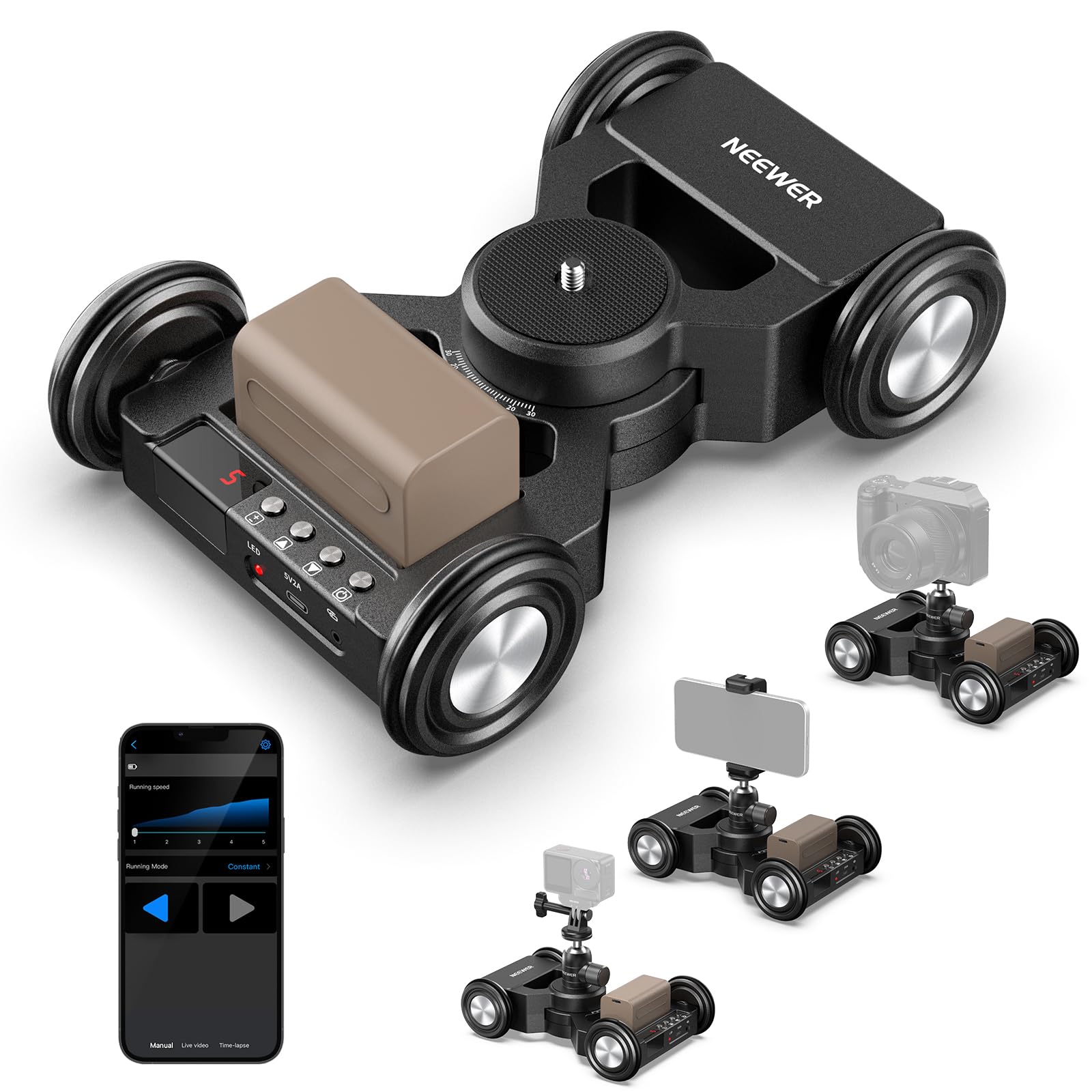
NEEWER DL400 Motorized Dolly

87 /100
Keeper Score Excellent

Key details

Speeds
60 s/m, 50 s/m, 35 s/m, 25 s/m, 15 s/m
Weight
3.75 lb
Control
NEEWER app
Runtime
Up to 5 hours
Check Price on Amazon

The DL400 is the dolly we take when the move needs to repeat without a hand on the camera. The NEEWER app handles manual, live-video, and time-lapse shooting, and the five speed settings let you set a pace and run it again without rebuilding the shot. The ball head adds 360-degree rotation and 90-degree tilt, and the 30-degree manual side-to-side adjustment gives you a way to fine-tune framing without opening the app.

We like the battery choice: the NP-F750 is rated for up to five hours and charges over USB-C, which is easier to manage on location than a proprietary brick. The dual motor is rated below 30 dB, and that claim matters if you record dialogue nearby. The dolly weighs 3.75 pounds, so it is still a one-hand carry alongside a tripod.

The DL400 earns its place when you need repeatable motorized moves and app control, not when you just want to roll a tripod across a room. For solo shoots and time-lapse, the trade is easy to justify. It is the most automated dolly here, and the one we hand to a solo operator who needs to set a move and step away.

Pros

  • App control for manual, live, and time-lapse
  • Five speed settings
  • Up to 5 hours on NP-F750 battery
  • Dual motor rated below 30 dB

Cons

  • Priciest dolly in this group
Our verdict

The DL400 is the one we choose when a move needs to repeat without a hand on the camera: app control, five speeds, and a quiet dual motor make it the motorized pick here.

Check Latest Price
5

Low-Angle Skater Shots

Vidpro SK-22 Skater Dolly

82 /100
Keeper Score Excellent

Key details

Weight
2 lb
Payload
25 lb
Wheel Setup
Adjustable axles
Mounting Points
Seven 1/4-20 threads
Check Price on Amazon

The SK-22 is for the shot a tripod dolly cannot make: camera inches off the floor, moving through a doorway, along a table edge, or past a product on a desk. The CNC-machined aluminum chassis, 25-pound capacity, and seven 1/4-20 mounting points let you build a low rig around the camera rather than around the dolly. The adjustable axles set straight, curved, or full-circle paths, with position markers for repeatability.

The handle extends, but it is still short for standing pushes, so low moves often mean kneeling beside the dolly; a short extension rod helps if you already own one. The seven mounting points are the part we keep coming back to: they give you room for a ball joint, an arm, or a second accessory without clamping everything to one spot.

We treat it as a problem-solver for low angles, not as the default tripod dolly. When the shot is close to the floor, it earns its place; when it is not, the tripod dollies are easier to trust. The low-angle frame is the reason it stays in the kit, even when the tripod dollies handle the rest of the day.

Pros

  • Low-angle skater design
  • Seven 1/4-20 mounting points
  • Adjustable axles for curved paths
  • 25 lb capacity

Cons

  • Wheels can bind and wobble with heavier rigs
Our verdict

The Vidpro SK-22 is the specialist we reach for when the camera has to skim the floor; it is not the dolly for every full-height tripod move.

Check Latest Price

How We Tested Camera Dollies

We started with a long list of dollies that let you change the leg spread, since a dolly that only fits one tripod is a dolly you'll outgrow. From there we cut anything with hard plastic wheels, no carry solution, or a stated payload that looked generous for its hardware, and landed on 12 to test over four months.

Each one went through the same set of moves: a six-foot push on hardwood, a slow pan across low-pile carpet, a run over a tile threshold and a loose cable, and a lap of a concrete garage floor with a seam in the middle. We taped start and end marks, loaded a tripod and camera, pushed at a steady walking pace, then watched the footage back at full size looking for vibration, hunting, and drift off the line. The low-slung models got run along a tabletop for low-angle passes. Wheels were checked for flat spots and hair wound around the axles, which is what quietly kills a smooth move after a few shoots.

Setup got timed, solo, out of the bag: how many turns each leg clamp took, whether the feet stayed put when we nudged the tripod, and whether the whole thing folded flat enough for a closet shelf. We carried every dolly up and down a flight of stairs by its handle or bag and noted which ones felt like hauling a toolbox. Then we weighed what each one asked for against how it rolled, because a cheap dolly that tracks straight is a better buy than an expensive one that doesn't.

How to Choose a Camera Dolly

Start With the Support You Already Own

A tripod dolly is a wheeled base that carries a tripod; a tabletop or skater dolly carries the camera directly, often inches off the floor; a motorized dolly adds a motor, battery, and app or remote. If you already have a solid tripod and want room-scale moves, start with a tripod dolly like the SmallRig or the budget NEEWER. If the shot is low and close, a skater dolly such as the Vidpro makes more sense. Motorized control is a separate step up for repeatable solo moves, not a requirement for a first dolly.

Match the Wheels to the Floor

Wheel size and hardness decide how much of the floor you feel in the footage. Three-inch rubber wheels, as on the SmallRig and COMAN, roll over small seams and short-pile carpet with less chatter; two-inch wheels can be fine on a smooth studio floor but transmit more bump. The trap is expecting a dolly to smooth out a soft or uneven carpet. If you shoot in different rooms, choose larger wheels and bring a hard board for the worst spots.

Check Payload, Fit, and Mounting

Payload is the combined weight of camera, lens, head, and accessories, so leave headroom rather than loading to the limit. For tripod dollies, measure your tripod leg diameter and confirm the clamps open wide enough; the SmallRig tops out at 2.12 inches. For tabletop and motorized dollies, check the mounting thread and whether you need a ball head or phone clamp. A 33-pound dolly and a 25-pound skater look similar in photos but suit very different rigs.

Decide Whether Motorized Control Earns Its Place

A motorized dolly is worth it when you need a repeatable move, a time-lapse, or a solo operator who cannot push the camera and watch the frame at the same time. Look at speed range, battery runtime, and noise if you record live audio. The NEEWER DL400 offers five speeds, app control, and a rated five-hour battery; a manual tripod dolly is simpler, cheaper, and easier to pack when you only need a few smooth pushes.

Frequently Asked Questions

Final Verdict

The SmallRig Quick-Lock is the dolly we recommend first for most tripod shooters. Its quick-lock clamps, 3-inch wheels, and compact fold make it the most secure, least fussy way here to put a tripod in motion. If you need to park the rig constantly, choose the COMAN for its individual wheel brakes; if you need repeatable motorized moves, the NEEWER DL400 is the better buy. The Vidpro SK-22 is the low-angle specialist, not the default.