Best Motorized Camera Sliders of 2026

The last time I tried to hand-crank a slow push-in across a rooftop at sunset, I lost the light and half the take. A motorized slider does that for you: set your start and end points, pick a speed, and it repeats the same travel take after take. The catch is that the motor, the rail, and the app all have to be good at once — one weak link and you get judder, flex, or a whine that lands right in the audio track.

We've spent eight months running eight of these sliders through real shoots rather than a test bench: an interview setup in a living room, tabletop product shots on a kitchen counter, and a few freezing dawn time-lapses. Two things surprised me. Track length is a portability decision as much as a creative one — a long rail buys a longer move, but also a heavier case and a second trip from the car. And app control lives or dies on easing; if the motor lurches at the start of a move, you'll see it on screen no matter how good the rail is. The picks below range from long carbon-fiber rails built for slow cinematic moves to short ones that fit in a backpack, and each one earned its spot on set.

Keeper Score summarizes customer ratings and review volume. Read it alongside the product details and trade-offs. How the score works.

1

Best Overall

NEEWER ER1 Motorized Slider

87 /100
Keeper Score Excellent

Key details

Weight
5.51 lb
Battery
4400mAh NP-F750; charger not included
Control
App; 2.4G remote not included
Rail Length
47.2 in / 120 cm
Check Price on Amazon

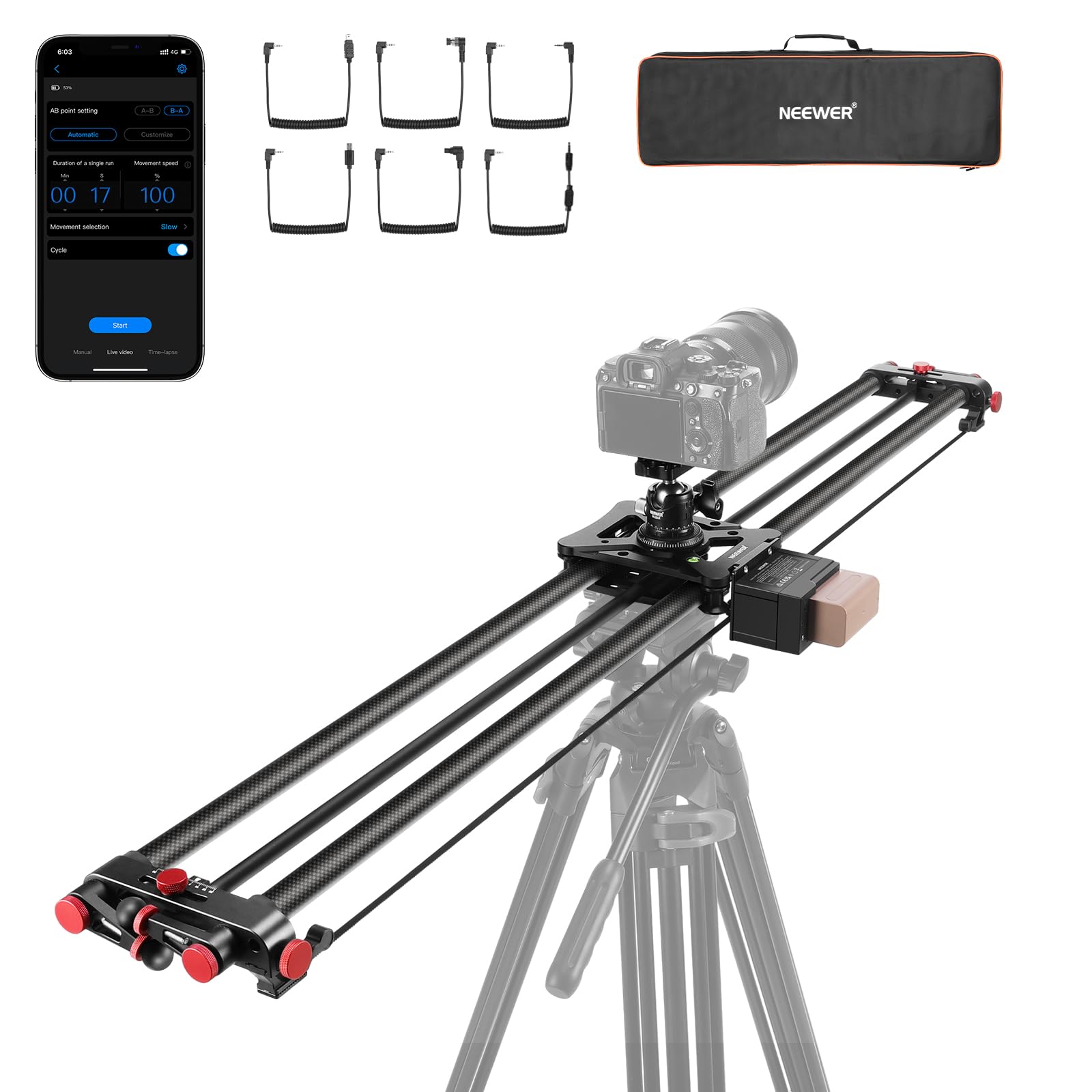
A 47.2-inch rail is a useful middle ground for a motorized slider: long enough for a slow reveal or a full pass across a subject, short enough to fit across a back seat. The ER1 is built around that rail in carbon fiber, with a motorized carriage that runs in manual, video, and time-lapse modes. The 4400mAh NP-F750 battery is included, so you can power the rail without adding a separate power bank.

We like the app-first control because it keeps the move on the phone instead of a separate controller you have to dig out of a bag. You can set speed, interval, and start and end points, and the side knobs let you switch from a straight horizontal slide to a tracking move or a 120-degree panorama. That flexibility makes the ER1 feel like a small production tool rather than a one-trick rail.

The 2.5 kg rail is light enough to carry in a soft case, but the 47-inch length still needs a clear path and a stable support. We treat it as a rail to set up once and leave for the shot, not something to reposition every few minutes. That makes it a better fit for planned scenes than for run-and-gun coverage.

Pros

  • 47.2-inch rail covers full-size moves
  • App control for manual, video, and time-lapse
  • Included 4400mAh NP-F750 battery

Cons

  • 2.4G remote not included
  • Battery charger not included
Our verdict

We recommend the ER1 as the default motorized slider for most shooters because its 47.2-inch rail, app control, and included battery cover full-size moves without the bulk of a multi-axis rig.

Check Latest Price
2

Best Value

GVM 48" Carbon Slider

82 /100
Keeper Score Excellent

Key details

Control
iOS/Android app
Payload
20 lb
Rail Length
48 in / 120 cm
Battery Life
2 hours
Check Price on Amazon

The GVM 48-inch makes its case with a number: a 20-pound payload on a 48-inch carbon rail. That is enough capacity for a mirrorless body, a substantial lens, and a head, and it is why this one earns its place as the value full-size pick. The rail is 120 cm long, and the carriage is controlled through an iOS or Android app rather than a separate control box.

The app is the part we were pleasantly surprised by. It covers tracking, time-lapse, and panoramic shooting, and you can dial in speed, interval, and travel rather than accepting a single auto move. The carbon rail weighs 4 kg, which is light for its length, and the carriage feels solid under a larger camera. Six shutter-release cables and an extension cable come in the box, so there is a decent chance one matches your camera.

The battery is rated at two hours, which is the number we plan around. For a long interview day or a sunset time-lapse, pack a spare or have a power plan, because the rail's useful capacity does not help once the motor stops. We also like that the app keeps the move repeatable: set it once, then concentrate on the camera rather than the carriage.

Pros

  • 48-inch carbon rail for long moves
  • 20-pound payload handles larger rigs
  • App control with tracking and time-lapse
  • Six shutter cables and extension included

Cons

  • App-only control depends on a charged phone
Our verdict

We see the GVM 48-inch as the value choice: it pairs a 20-pound payload with app control on a full-length carbon rail.

Check Latest Price
3

Best for Gimbal Setups

IFOOTAGE Shark Nano II 660

85 /100
Keeper Score Excellent

Key details

Control
Touchscreen and app
Payload
15.4 lb / 7 kg
Rail Length
26 in
Sliding Range
17 in
Check Price on Amazon

The Shark Nano II 660 is not trying to be the longest rail here. Its 26-inch body gives 17 inches of travel, but the carriage pans a full 360 degrees, so the move can curve and orbit instead of only sliding left to right. Pair it with a DJI RS gimbal and the slider becomes a small motion-control rig, with the gimbal handling tilt while the rail handles the travel.

We kept coming back to the touchscreen. It is faster than opening an app when you are setting eight waypoints in the field, and the phone app is there when you want a larger view. The 15.4-pound payload is generous for a 26-inch rail, and the brushless motor is rated below 20 dB, which is the kind of quiet you notice when the camera is close to the subject.

The catch is travel. A 48-inch rail gives a longer straight move, and the Nano's 17 inches can feel short for a full walk-through. For gimbal-led beauty shots and tabletop orbits, though, the shorter rail is easier to place and quicker to balance, and the multi-axis move is the reason to choose it over a longer straight slider. That trade is the whole product: less rail, more axes.

Pros

  • 360-degree pan with dual-axis control
  • 15.4-pound payload with 17-inch travel
  • Touchscreen and app with eight waypoints

Cons

  • Premium price tier limits casual buyers
Our verdict

We reach for the Nano II 660 when a DJI gimbal is part of the shot; its 360-degree movement and 15.4-pound payload turn a simple slide into a multi-axis move.

Check Latest Price
4

Compact Rigs

GVM 27" Aluminum Slider

81 /100
Keeper Score Excellent

Key details

Weight
5.2 lb
Control
Wired controller
Payload
5.51 lb
Rail Length
27 in
Check Price on Amazon

The GVM 27-inch is the short rail in this group, and that is its whole appeal. The body measures 26.8 inches across and weighs 2.36 kg, so it fits in tight rooms, on a table, or in a small travel kit. The aluminum rail has adjustable non-slip feet and a bubble level, and you can mount it on the ground or on a tripod.

Set it up for a product close-up, a slow pass across a desk, or a quick interview intro, and the compact length stops feeling like a compromise. The rail adjusts for horizontal, vertical, and 45-degree shooting, and the wired controller covers time-lapse, video, and round-trip moves. It is a tool you can leave assembled and move in one hand, and the included carrying bag makes the travel-kit role more complete.

We liked it most for small-camera work where a 48-inch rail is overkill. The short rail encourages a different kind of shot: instead of a long reveal, you get a compact move that fits the room. That is a fair trade for a kit that lives in a small bag.

Pros

  • Compact 26.8-inch body for tight spaces
  • Light 2.36 kg aluminum build
  • Vertical, horizontal, and 45-degree shooting

Cons

  • 2.5 kg payload limits larger rigs
Our verdict

The GVM 27-inch is our compact pick for small cameras and tight rooms; its short aluminum rail is easy to place, and the wired controller keeps setup simple.

Check Latest Price

How We Tested Motorized Camera Sliders

We started by pulling spec sheets for roughly two dozen sliders and narrowing them by track length, payload rating, motor type, and control options — app, remote, or on-body only — then cross-checked owner reviews for the complaints that tend to surface after a few months of ownership. That left eight units, from short aluminum rails to long carbon-fiber ones, which we used for eight months across interview shoots, tabletop product work, and dawn time-lapses.

Smoothness got the most scrutiny. We set each slider to its slowest usable speed, ran the same two-point move ten times, and compared the footage side by side, watching for a lurch at the start and stop and for the end point drifting between takes. We pressed down mid-rail with a loaded camera mounted to see how far the carriage dipped, and checked the rail joints for play after months of setup and teardown. For noise, we ran each motor a foot from a microphone and listened back to hear which ones ended up on the recording.

Controls were tested by handing the app or remote to someone who'd never touched that slider and timing how long it took them to program a move — and by walking the remote around a corner to find where the signal quit. We let time-lapses run until the battery died, noting whether the carriage finished its travel or stopped mid-move and whether it remembered its endpoints after a power cycle. Every unit was weighed in its case, set up solo on a stopwatch, and loaded into a car trunk to judge how much of a second trip it costs. Then we set all of that against price to see what the extra money actually bought.

How to Choose a Motorized Camera Slider

Rail Length and Usable Travel

Rail length is not the same as carriage travel. A 26-inch slider may give only 17 inches of movement once the carriage and end stops are counted, while a 47- or 48-inch rail gives a visibly longer move. Match the rail to the location: a 48-inch rail needs support at both ends with a heavy camera, and a 27-inch model is easier to place in tight rooms. The compact GVM 27-inch is the one we reach for when space is the constraint; the NEEWER ER1 and GVM 48-inch cover full-size moves.

Payload: Count the Head and Lens

Count the camera, lens, head, and any monitor or phone clamp before comparing payload ratings. The GVM 27-inch tops out at 2.5 kg, which is plenty for a small mirrorless body but easy to exceed with a zoom lens and a sturdy head; the GVM 48-inch is rated at 20 pounds, and the IFOOTAGE Nano II 660 lists 15.4 pounds. Pick a rating with some margin, and support a long rail at both ends. The saved weight of a smaller rail is not worth a camera fall.

Control: App, Remote, or On-Body

App control is convenient, but not always fastest. The NEEWER ER1 and GVM 48-inch use phone apps; the IFOOTAGE adds a touchscreen with eight waypoints; the GVM 27-inch uses a wired controller. If you work alone, an app that saves start and end points is worth more than a bigger screen on the rail. Check the box: the ER1's 2.4G remote is not included.

Manual start and end point setting is normal. Build a routine: level the rail, set the two ends, test at the speed you plan to shoot, then save the move before the light changes.

Smoothness, Noise, and Power

Slow moves expose vibration: a carriage that stutters at a crawl shows it, and a slipping belt can ruin a take. Look for a stepper or brushless motor and a carriage that stays level under your camera; the IFOOTAGE is rated below 20 dB, the NEEWER uses a silent stepper motor, and the GVM 48-inch is quiet in use. Any motor noise can still reach a camera microphone, so record audio separately in quiet scenes. Battery life matters too—the GVM 48-inch is rated at two hours, while the NEEWER includes a 4400mAh NP-F750 and the IFOOTAGE supports USB-C PD 60W. Carry a spare or a tested power path.

Frequently Asked Questions

Final Verdict

The NEEWER ER1 is the motorized slider we recommend first because it covers the widest range of solo work: a 47.2-inch carbon rail, app control for manual, video, and time-lapse moves, and an included battery. The missing remote and charger are accessories to add, not reasons to walk away.

If your shots are built around a DJI gimbal, the IFOOTAGE Shark Nano II 660 is worth stretching for: its 360-degree movement and 15.4-pound payload do things a straight slider cannot. Buy the ER1 for a straightforward full-size move; choose the IFOOTAGE when the move itself needs to curve.