Best Action Cameras for Scuba Diving of 2026

Salt water finds every weak point. A camera that fogs, floods, or shuts down at 40 feet doesn't just ruin one dive — it takes the whole day's footage with it, and often a chunk of your budget too. What a good action camera actually fixes is quieter than the spec sheet suggests: it holds color as the light drains away, steadies the frame while you're still kicking, and seals well enough that you stop thinking about it halfway through the dive.

My team and I have spent the past eight months diving, snorkeling, and generally abusing 12 cameras to see which of those promises hold up. The thing I'd tell a first-time buyer is that stabilization matters more underwater than it does on a bike, because water magnifies every wobble, and the highest frame rate on the box is worthless if the battery quits on the second dive of the day.

Water resistance, picture and video quality, and how the mounts and accessories behave when your hands are cold and gloved separated the field far more than resolution did. Below are the ones worth strapping to your rig.

Keeper Score summarizes customer ratings and review volume. Read it alongside the product details and trade-offs. How the score works.

1

Best Overall

DJI Osmo Action 5 Pro

92 /100
Keeper Score Outstanding

Key details

Sensor
1/1.3-inch
Battery
240 minutes
Max Video
4K/120fps
Built-in Storage
47GB
Check Price on Amazon

Two hundred and forty minutes is the number that settled this one for us. That's the battery life DJI lists for the Osmo Action 5 Pro, and on a dive trip it changes the arithmetic: a two-tank morning fits inside a single charge, so you're not unsealing a housing on a moving boat to swap cells between sites. We also appreciate the 47GB built in — the small panic of a full card at the second site is one nobody needs.

The second half of the argument is the 1/1.3-inch sensor. Water eats red light first, which is why so much dive footage comes home flat and blue. Bigger pixels give a cleaner starting point in that light, and 10-bit color with D-Log M leaves more to work with when you're grading the green out on the laptop that evening. We won't pretend a compact replaces a proper rig with a strobe, but this is the closest anything here gets.

Handling is where DJI has thought hardest. Both OLED screens are bright enough to frame on, the magnetic quick-release flips between horizontal and vertical in seconds, and at 146g the camera won't drag a wrist mount off course while you're busy with your buoyancy. The front screen earned its keep more than we expected — on a short pole it makes the camera something you aim rather than guess at.

One thing to settle before you buy: DJI calls this waterproof but doesn't quote a depth in the specifications, so match the rating to the sites you actually dive and plan on a housing if you go deeper. And if you only ever snorkel the shallows, you're paying for log profiles and frame rates you'll never touch.

Pros

  • Four-hour battery covers a two-dive morning
  • 1/1.3-inch sensor for low-light reef footage
  • 47GB built in as a card-full safety net
  • Dual OLED screens and magnetic quick-release

Cons

  • Depth rating not published; confirm before diving
Our verdict

The dive camera we reach for first: four hours of battery, a big sensor for murky water and 47GB on board, provided you confirm the depth rating first.

Check Latest Price
2

Best for GoPro Owners

GoPro HERO13 Black

89 /100
Keeper Score Excellent

Key details

Photo
27MP
Battery
79 minutes
Max Video
5.3K60
Native Waterproof
33ft (10m)
Check Price on Amazon

Waterproof to 33ft — that's the fine print on the HERO13 Black, and it's the first thing a diver needs to get straight. Ten meters is a snorkel or a shallow reef, not a scuba dive. The camera can go in the water without a case, but on a real dive it goes into a housing, and no amount of clever marketing changes that.

Five-point-three-K at 60fps and 27MP stills are the headline numbers, but the HB-Series lens system is what we keep coming back to. The camera detects the lens and reconfigures itself, so you're not menu-diving with wet hands while the boat drifts off the mooring. For our money that's a more useful upgrade than the resolution, and it's the strongest reason to pick this over the HERO12.

It's also the most expensive camera here, and what you're paying for is the lens system and the ecosystem more than dive performance. If you already own GoPro mounts, a tray and a housing, that premium buys continuity as much as capability. Starting from nothing, the cheaper GoPro does most of this job.

Pros

  • 5.3K60 video and 27MP photos
  • Auto-detecting HB-Series lenses
  • Enduro battery covers a single dive

Cons

  • 79 minutes is one dive, not two
Our verdict

The GoPro for a diver already inside the ecosystem: swappable lenses, 5.3K footage and a 79-minute battery, once you add the housing scuba requires.

Check Latest Price
3

Best Budget Dive Kit

AKASO Brave 4

89 /100
Keeper Score Excellent

Key details

Photo
20MP
Batteries
2 x 1050mAh
Max Video
4K/30fps
Waterproof Case
131ft
Check Price on Amazon

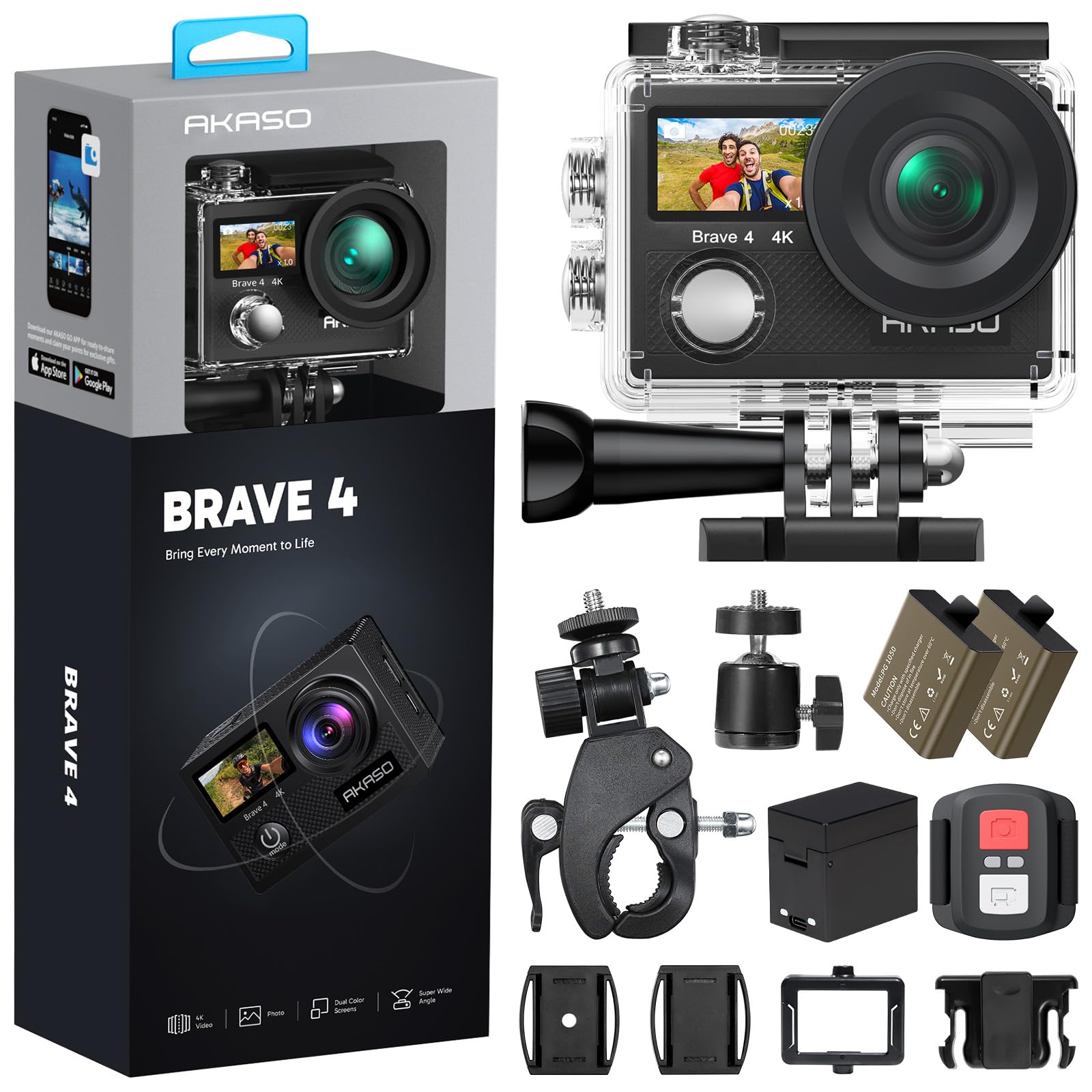
A 131ft case, two batteries, a dual charger and a bag of mounts arrive in the same box, which makes the Brave 4 a complete dive kit rather than a camera you then have to outfit. Forty meters is a genuine scuba rating, and it's the main reason this is the camera we point first-time divers toward.

Inside the case it's a 4K/30 camera with 20MP stills, electronic stabilization and a 170° lens you can narrow to 140°, 110° or 70°. That last detail matters more underwater than it sounds: a wide lens pushes everything away from you, while a tighter angle lets a reef wall fill the frame when you're nose-to-nose with it. The 2-inch screen is the sort of thing that only proves itself once the camera is sealed in plastic and your hands are cold.

What we like most is how little it asks of you. The charger tops both cells at once, the mounts cover a helmet, a bar and a pole, and the case has held up in salt water. Picture quality is good rather than great — clean and watchable in bright, shallow water, and asking more of a small sensor than it can give as the light goes. For a first dive camera, that's a trade most people will happily take.

Pros

  • 131ft waterproof case included
  • Adjustable 170° to 70° field of view
  • Two batteries and a dual charger
  • Mounts for nearly any rig

Cons

  • Runtime falls short in long continuous takes
Our verdict

The one we point first-time divers toward: a real 131ft case, two batteries and every mount in the box, with footage that's good rather than stunning.

Check Latest Price
4

Best Complete Starter Kit

TIMNUT C16

85 /100
Keeper Score Excellent

Key details

Runtime
240 minutes
Max Video
4K/60fps
Included Card
64GB
Waterproof Case
131ft (40m)
Check Price on Amazon

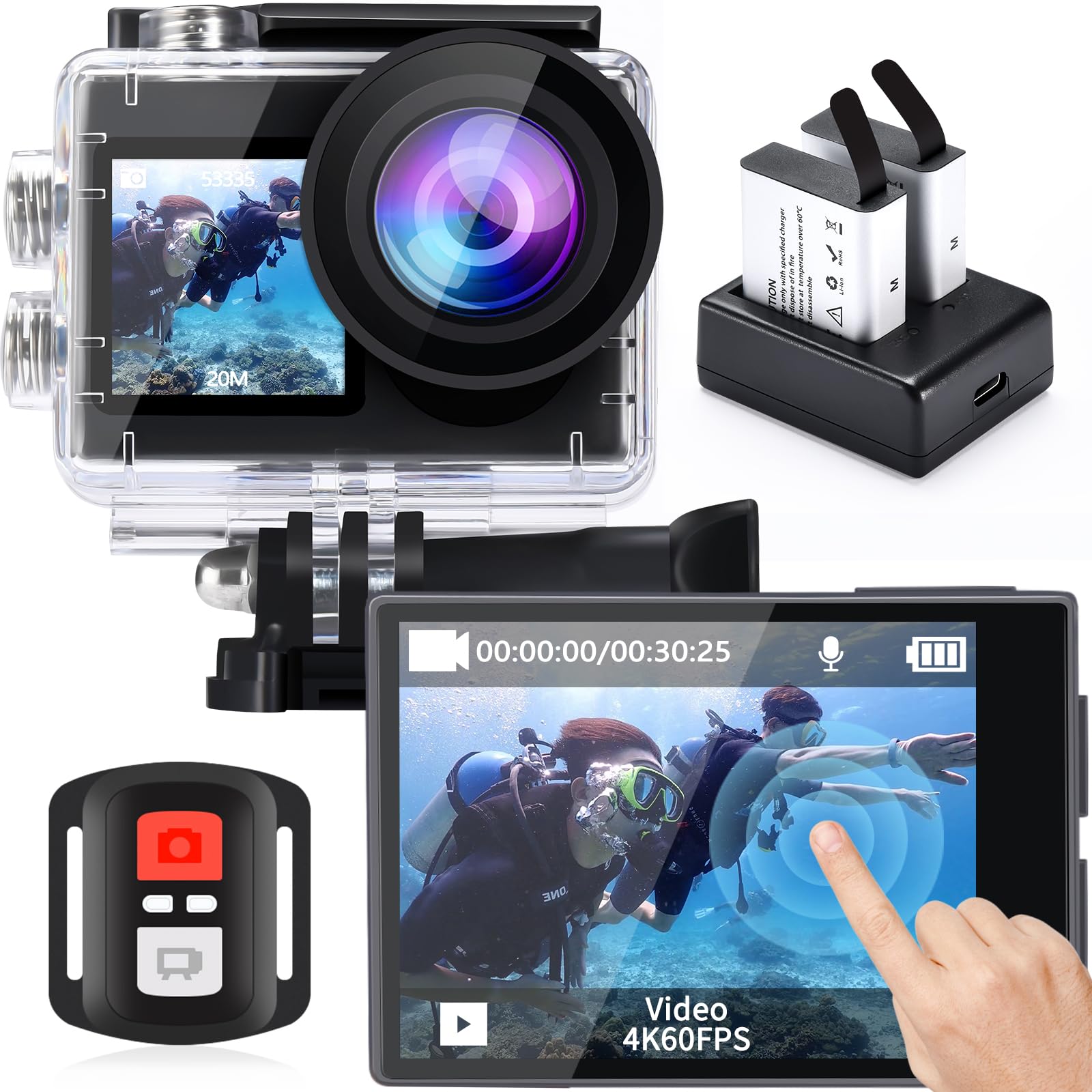
For a first dive trip, the C16 is the least fussy thing here. A 64GB card is in the box alongside two 1350mAh batteries, a 131ft case and a mount kit, so there's nothing left to order before you pack — and the card is the piece almost everyone forgets until the night before.

It shoots 4K at 60fps, and it lists a pre-recording mode: the camera runs a buffer so that pressing record saves the few seconds before you pressed it. Underwater that's the difference between a clip of a turtle's back and a clip of a turtle swimming past. We stopped thinking of the 2.4G remote as a gimmick the moment the camera went out on a pole.

Expect it to be at its best in bright, shallow water. The gap between this and a DJI widens as you descend — that's what the extra money buys — but on a sunlit reef at 40 or 50 feet the footage holds up better than the category's reputation suggests. Divers who never leave the shallows get more out of this than out of a premium body they're afraid to scratch.

Pros

  • 64GB card included, ready to shoot
  • 131ft case and two batteries
  • Pre-recording buffer catches the moment
  • 2.4G remote for pole-mounted shots

Cons

  • Stabilization stops at 4K/30
Our verdict

The complete starter kit: 131ft case, 64GB card, two batteries and mounts in one box, for divers who want watchable footage without shopping for accessories.

Check Latest Price
5

8K and Cropping

DJI Osmo Action 6

90 /100
Keeper Score Outstanding

Key details

Sensor
1/1.1-inch
Battery
4 hours
Aperture
f/2.0-f/4.0
Max Video
8K
Check Price on Amazon

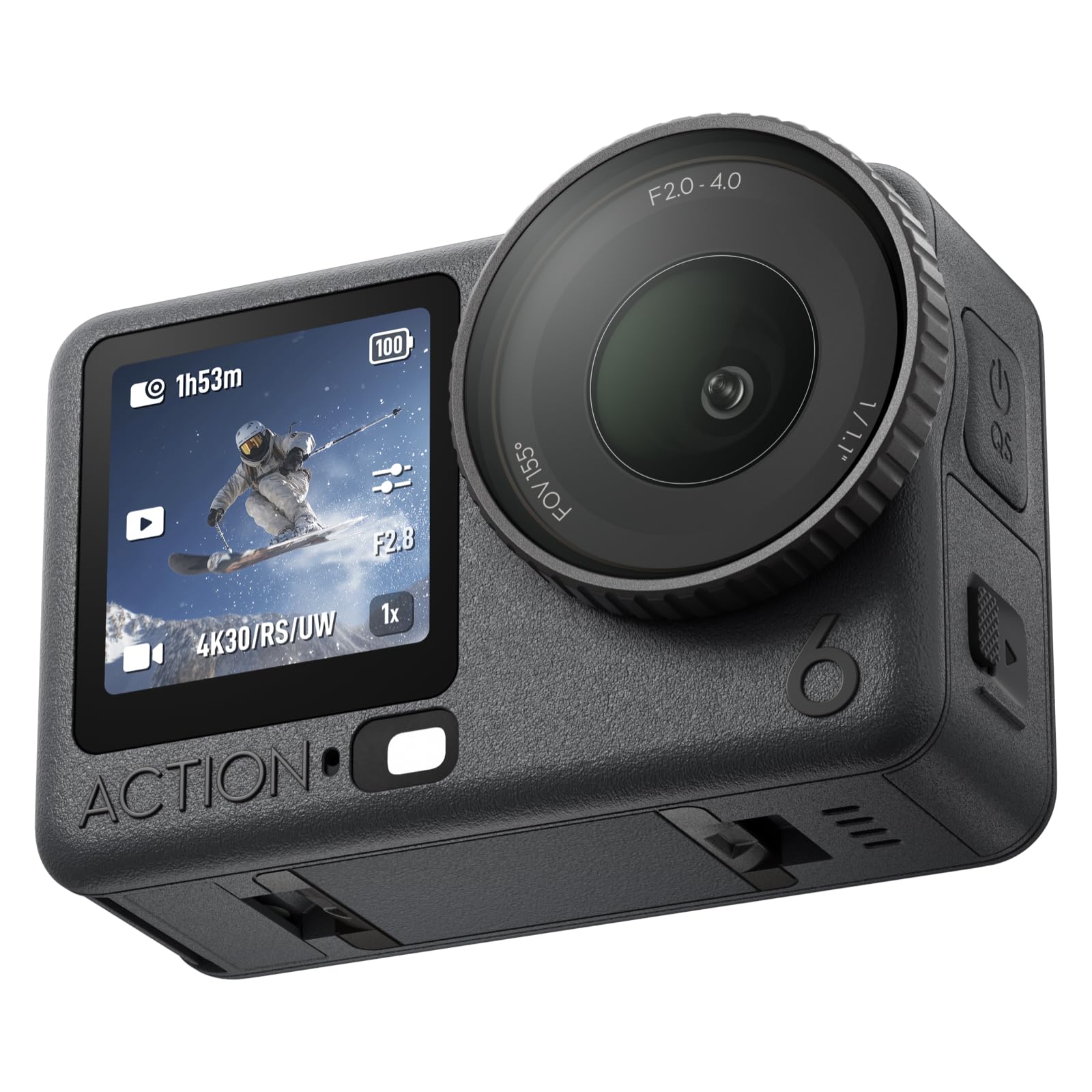
The Action 6 is the most expensive camera in this group, and the case for it is narrower than that suggests. What the money buys is an 8K sensor behind a variable aperture that closes from f/2.0 to f/4.0 — the only camera here that can stop down in bright, clear water instead of leaning entirely on shutter speed.

It's also the largest sensor of the set at 1/1.1 inches, and we like the square shape more than we expected to: shoot once, decide the crop later, and pull a vertical clip out of the same frame you used for a wide shot. RockSteady 3.0 handles the shake, and 360° HorizonSteady handles roll — the one that matters on a tray, when the swell turns you slightly sideways and the surface line starts tilting.

Four hours of battery and 50GB of built-in storage put it in the same endurance class as the Action 5 Pro, and DJI rates it down to -20°C, which matters for cold-water and cold-climate shooting. Both are the kind of headroom you stop noticing on a good day and miss badly on a long one.

Our reservation is value rather than capability. For dive footage specifically, 8K is the least useful thing the Action 6 adds: you're buying crop room on a 4K timeline, not better color in blue water, and the Action 5 Pro already has the sensor and the battery that get you most of the way. If you crop hard or deliver to clients, the extra is easy to justify. If your clips end up on a phone screen, it isn't.

Pros

  • Variable f/2.0-f/4.0 aperture in 8K
  • Largest sensor in this set at 1/1.1 inch
  • Four hours of battery plus 50GB built in

Cons

  • Priciest here; dive footage gains least from 8K
Our verdict

The most capable camera here and the hardest to justify: 8K, a variable aperture and the biggest sensor, for shooters who will use the crop and the color depth.

Check Latest Price
6

Value GoPro

GoPro HERO12 Black

89 /100
Keeper Score Excellent

Key details

Photo
27MP
Battery
64 minutes
Max Video
5.3K60
Native Waterproof
33ft (10m)
Check Price on Amazon

The HERO12 delivers the same core footage as the HERO13 — 5.3K at 60fps, 27MP photos, HyperSmooth — for appreciably less money, and it carries the same 33ft native rating, which means the same thing for a diver: fine for snorkeling, housing required for scuba.

We rate it the better-value GoPro for dive use, and the reason is in the picture rather than the spec sheet. HDR video holds on to highlight detail, which is exactly what you need when surface glare is blowing out the top third of the frame, and HyperSmooth 6.0 keeps a handheld drift from turning into a wobble. The 5.3K frame is worth having for the crop, since you can punch in on a small subject and still land on a 4K timeline.

One thing to know: this camera runs warm and can shut itself down on long takes. That's mostly a land problem — a housing sitting in cold water sheds heat far better than a camera on a dashboard — but if you also want it for stationary recording indoors, allow for it. Its real home is on a tray or a pole, in the water, in short bursts.

Pros

  • HERO13-grade 5.3K footage for less
  • HDR protects bright surface highlights
  • HyperSmooth 6.0 stabilization

Cons

  • About 64 minutes, so one dive per charge
Our verdict

The value GoPro for divers: the HERO13's core footage for appreciably less money, with HDR that rescues blown-out surface glare and stabilization that holds steady.

Check Latest Price
7

Shallow Reef Dives

icefox i8

84 /100
Keeper Score Excellent

Key details

Runtime
Up to 2 hours each
Batteries
2 x 1350mAh
Max Video
4K
Waterproof Case
98ft (30m)
Check Price on Amazon

Ninety-eight feet is the rating on the icefox i8's housing — 30 meters, which covers most recreational dives but stops short of a full-depth one. Check that against the sites you actually dive and the certification you hold. Staying above 30m, it's plenty; going past it, it isn't.

Inside the case it's a 20MP, 4K camera with a 2-inch screen, a 170° lens and digital stabilization. The battery claim is the generous part: two 1350mAh cells at up to two hours each, so four hours across the pair, which is as much as any budget camera here claims and enough to cover a two-tank day without hunting for a charger.

What we like is that the kit is complete enough to use on day one, with a bike mount, a rotating screw, quick-release buckles and a case that has held up in the water. Where it's thinner than the AKASO is polish: the menus take patience, and the stabilization is digital rather than the horizon-locking kind, so surge still shows unless you're steady. For a camera that lives in a dry bag, comes out for reef dives and gets handed to a teenager on a family trip, none of that is disqualifying.

Pros

  • 30m housing covers most recreational dives
  • Two batteries, four hours combined
  • Complete mount kit in the box
  • Small and light enough for a dry bag

Cons

  • App pairing is fiddly
Our verdict

A 30m housing, four hours across two batteries and a full mount kit for very little money — the pick for shallow reef dives and knockaround travel.

Check Latest Price

How We Tested Action Cameras for Diving

We started by gathering every action camera sold for diving, from budget no-name kits up through the flagship models, then cut anything without a native depth rating, a user-replaceable battery, or a standard mounting thread that existing accessories would fit. That left 12 cameras, all bought at retail so nobody could send us a hand-picked unit.

Testing ran for eight months and followed the cameras into the water rather than onto a bench. In the pool we sank each one to the bottom of a 12-foot deep end, worked the buttons and touchscreens underwater, and ran 20-minute continuous clips to see whether anything fogged behind the lens. On boat dives to 60 and 80 feet we checked the seals before and after every entry, rinsed each camera in fresh water on the ride back, and logged every drop, splash, and accidental dunking.

Back on land we watched the footage on a proper monitor and asked concrete questions: did sand still look like sand at 30 feet, or had the white balance pushed everything green? Did the horizon stay level while we finned hard? With 3mm gloves on, could we switch modes without stabbing at the wrong icon? We also counted what came in the box, since a camera with two batteries and a decent mount kit saves you a separate shopping trip.

Battery and heat were the quiet dealbreakers. We timed continuous high-frame-rate recording until each camera shut itself off, then repeated it in cold lake water where batteries fade faster. We left the cameras in a black dry bag on a sunbaked deck between dives to see which ones overheated and locked out, and we tested wireless transfer of a full day's clips to a phone while still on the boat. After eight months and dozens of dives, no unit flooded — but several were retired early for reliability reasons that had nothing to do with water.

How to Choose an Action Camera for Scuba Diving

Read the depth rating, not the word waterproof

Every camera here says waterproof somewhere on the box. What matters is the number next to it. A native rating of 33ft (10m), which is what the GoPro HERO13 and HERO12 carry, covers snorkeling and the first few meters of a dive, but a recreational dive runs well past that, so those cameras go into a housing before they go on a dive. DJI calls its cameras waterproof too, without quoting a depth in the specifications, so confirm the figure before you commit to a site.

The budget kits take the opposite approach. The AKASO Brave 4 and TIMNUT C16 ship with a sealed case rated to 131ft, and the icefox i8's case is rated to 98ft, which makes them dive-ready on day one. That's a genuine advantage and the biggest single reason to look down-market at all.

Battery life is measured in dives, not hours

You can't open a housing at 60 feet, so the question isn't total runtime but whether one charge clears one dive. A 45-to-60-minute dive plus a safety stop is the unit to plan around. The Osmo Action 5 Pro lists four hours per cell; the HERO12 lists about an hour, which makes a spare battery part of the kit rather than an afterthought.

Budget cameras usually bundle two cells and a dual charger, which is one of their better arguments. Carry cells in a dry bag and change them on the surface, never on a wet deck where a splash can reach an open compartment.

Low light decides the footage you bring home

Water absorbs light and color with depth, starting with red, so the deeper you go the harder the camera has to work with very little. Sensor size and pixel size do more for that than resolution: the DJI models here use 1/1.3-inch and 1/1.1-inch sensors, and 10-bit color or a log profile gives you room to pull the blue back out in editing.

If you're shopping at the budget end, plan your dives around good light, shoot shallow, and set a manual white balance or fit a red filter instead of trusting auto. Auto white balance is why so much amateur dive footage comes back the same shade of green regardless of what was actually down there.

A housing lives or dies on the seal

A flood ends the trip. Before every dive, check the O-ring for sand and hair, seat it dry, and close the case on land rather than in the wind. A silica sachet inside cuts fogging on a cold descent, and a fresh-water rinse after the last dive of the day keeps salt from stiffening the seal over a season.

Test a new housing in a sink or a bucket before it goes near the ocean. A leak you find at home costs you a towel; a leak you find at 80 feet costs you the camera.

Frequently Asked Questions

Final Verdict

If we were packing a dive bag tomorrow, the DJI Osmo Action 5 Pro is the camera that goes in it: four hours of battery, a sensor that copes with blue-green light, and 47GB of storage so a forgotten card doesn't cost you the second dive. Confirm the depth rating against the sites you dive and add a housing if you need one.

On a tight budget, the AKASO Brave 4 arrives ready to dive to 131ft for a fraction of the money. You trade image quality, not capability.