Best 50mm Lenses of 2026

A 50mm prime is the least expensive way to make a camera feel expensive. It frames the world the way your eye does, and the wide aperture that comes with it — f/1.8 on most, f/1.4 on a few — is what melts a busy background and keeps you shooting after sunset. Nearly every system sells one, and the budget end has a reputation for soft corners and a focus motor you can hear on the audio track.

I've spent the past eight months shooting with 11 of them across four camera systems, and what separated the good from the forgettable wasn't sharpness. It was focus speed in low light, how the barrel felt after an hour of chasing a toddler, and whether the pictures still looked right wide open instead of two stops down.

Here's what first-time buyers miss: a 50mm doesn't zoom, so you compose with your feet, and on a crop-sensor body it behaves like a short telephoto — flattering for portraits, tight for a small room. The picks below cover both cases and a lot in between.

Keeper Score summarizes customer ratings and review volume. Read it alongside the product details and trade-offs. How the score works.

1

Best Overall

Canon EF 50mm f/1.8 STM

96 /100
Keeper Score Outstanding

Key details

Mount
Canon EF
Weight
5.6 oz
Max Aperture
f/1.8
Minimum Focus
1.15 ft (0.35 m)
Check Price on Amazon

At 5.6 ounces and a budget price, the Canon EF 50mm f/1.8 STM is the lens we suggest first when someone buys a Canon DSLR and asks what to add. It disappears in a bag, and its 1.15-foot minimum focus distance is close enough for food, flowers, and tight portraits. That combination of small size and close focus is more useful day to day than a longer feature list.

We like the rendering at f/1.8: backgrounds fall away cleanly and the center stays crisp enough for portraits and low-light snapshots. Stop down and it sharpens further, which is exactly what we expect from a prime at this level. The STM motor is quiet enough for casual video, and the 49mm filter thread keeps accessories small and easy to find. On a full-frame body the view is the classic normal lens; on APS-C it becomes an 80mm-equivalent portrait lens.

The autofocus is not instant in very dim rooms, and the lens can hunt before it locks. For stills of people, kids, and street scenes, though, it kept up well enough in our testing, and the near-silent motor makes it a reasonable choice for casual clips. The simple barrel is not built for rough handling, but the lens is so light that it hangs comfortably from a strap all day.

What seals it for us is the price-to-performance math: this is the least expensive way into a fast Canon prime in this group, and it does not feel like a sacrifice. If you shoot an EOS R camera, the native RF version is the cleaner choice. If you are on a Canon DSLR, this is the lens that makes the camera feel new again.

Pros

  • Light 5.6-ounce body
  • Close 1.15-foot focus
  • Quiet STM autofocus
  • Low-cost entry to f/1.8

Cons

  • No weather sealing
Our verdict

For Canon DSLR owners, the EF 50mm f/1.8 STM is the small, close-focusing prime we hand to anyone building a first kit.

Check Latest Price
2

Best for Canon Mirrorless

Canon RF 50mm f/1.8 STM

94 /100
Keeper Score Outstanding

Key details

Mount
Canon RF
Weight
5.6 oz
Control Ring
Yes
Max Aperture
f/1.8
Check Price on Amazon

The control ring on the Canon RF 50mm f/1.8 STM is the detail that makes this little lens feel more modern than a basic nifty fifty. Set it to aperture, ISO, or exposure compensation and you can adjust without moving your eye from the viewfinder. We also like that it weighs the same 5.6 ounces as the EF version despite adding that ring; on an R-series body it balances like a kit lens.

At f/1.8, the RF lens gives the soft background separation people expect from a 50mm prime. We found the center sharp and the color clean, with a rendering that is honest rather than luxurious. The seven-blade aperture keeps out-of-focus highlights from turning into hard polygons, and the 43mm filter thread is small enough that a protective filter barely adds bulk.

Autofocus is the practical upgrade. The gear-type STM motor is smooth and quiet enough for video, and it locks on quickly in ordinary indoor light. In really low light it can slow down, but it still gets there. For most stills and casual video, we simply leave it in autofocus and let the camera do the work.

On an APS-C RF body, the 50mm crops to an 80mm-equivalent view, so it becomes a portrait lens first and a walk-around lens second. That is the main reason we do not call it the one lens for every RF shooter. As a small, quiet prime for faces and low light, though, it is the one we pack when the camera bag is already full.

Pros

  • Useful control ring
  • Compact 5.6-ounce build
  • Quiet STM focus
  • Small 43mm filter thread

Cons

  • No weather sealing
Our verdict

Canon RF shooters should start here: the RF 50mm f/1.8 STM is compact, quiet, and easy to live with for stills and video.

Check Latest Price
3

Best for Nikon DSLRs

Nikon AF-S 50mm f/1.8G

96 /100
Keeper Score Outstanding

Key details

Mount
Nikon F
Weight
6.53 oz
Max Aperture
f/1.8
Minimum Focus
1.48 ft (0.45 m)
Check Price on Amazon

The Nikon AF-S 50mm f/1.8G has the kind of specification that sounds ordinary until you use it: a 50mm focal length, an f/1.8 aperture, and a 1.48-foot minimum focus distance. On a Nikon DSLR, that combination covers portraits, low-light indoor shots, and close details without making you change lenses. The 185-gram body is light enough to leave in the bag, and the 58mm filter thread is common enough that a spare filter is easy to find.

Sharpness is why this lens has stayed in Nikon kits. We found the center crisp wide open and better stopped down, with contrast that holds up in window light. The seven-blade aperture draws smooth backgrounds, and the 50mm angle keeps faces natural rather than stretched. On a DX body, the 75mm-equivalent view is tighter than a normal lens; it is excellent for head-and-shoulders portraits and a little cramped for groups indoors.

We trust the autofocus here. The Silent Wave Motor is quick and quiet, and the manual-override ring lets you fine-tune without flipping a switch. That is a bigger deal than it sounds when you are chasing a toddler or focusing through branches. The ring is not as smooth as a dedicated video lens, but for stills it is all most Nikon shooters need.

The barrel is plastic rather than pro-grade metal, but that is part of how Nikon kept the weight down. It feels equally at home on an entry-level D3500 and a full-frame D850, which is the sort of flexibility we want from a first prime.

Pros

  • Sharp wide-open center
  • Fast, quiet SWM focus
  • Light 185-gram body
  • Close 1.48-foot focus

Cons

  • Tight indoor framing on APS-C
Our verdict

The Nikon AF-S 50mm f/1.8G is the Nikon DSLR prime we trust for sharp portraits and low light without bulk.

Check Latest Price
4

Best for Lightweight Sony Kits

Sony FE 50mm f/1.8

91 /100
Keeper Score Outstanding

Key details

Mount
Sony E
Weight
6.6 oz
Max Aperture
f/1.8
Diaphragm Blades
7
Check Price on Amazon

The Sony FE 50mm f/1.8 is the lens we grab when we want full-frame Sony images without carrying a zoom. At 6.6 ounces, it adds almost nothing to an A7 body, and the f/1.8 aperture keeps shutter speeds usable indoors. The catch is audible: the focus motor is not quiet, and it is slow enough that we do not trust it for fast action or silent video.

Optically, this is a pleasant lens. The aspherical element controls spherical aberration and coma, which is the technical way of saying portraits and street scenes look clean rather than warped. We found the center sharp at f/1.8 and the corners improve as you stop down. The seven-blade aperture makes busy backgrounds soften rather than turn into hard rings.

On a full-frame body it is a true normal lens; on APS-C it becomes a 75mm-equivalent portrait prime. That makes it a good second lens for someone who bought an A6000-series camera with the kit zoom, though the tight view is not ideal for small rooms. There is no image stabilization, which is normal for a fast 50mm; rely on the camera body's stabilization when you can.

The plastic barrel and simple finish do not invite abuse. What it does give you is a lens you can leave on the camera at a dinner table or in a small bag without noticing the weight, and that is why it stays in our kit as the light option. If silent focus matters, the Viltrox is the better Sony choice; the Sony is the lightest Sony E option here.

Pros

  • Light 6.6-ounce body
  • Sharp center at f/1.8
  • Smooth seven-blade bokeh
  • Full-frame and APS-C coverage

Cons

  • No weather sealing
Our verdict

The Sony FE 50mm f/1.8 is the light full-frame Sony prime we choose when size matters more than silent focus.

Check Latest Price
5

Best Fast-Aperture Sony E

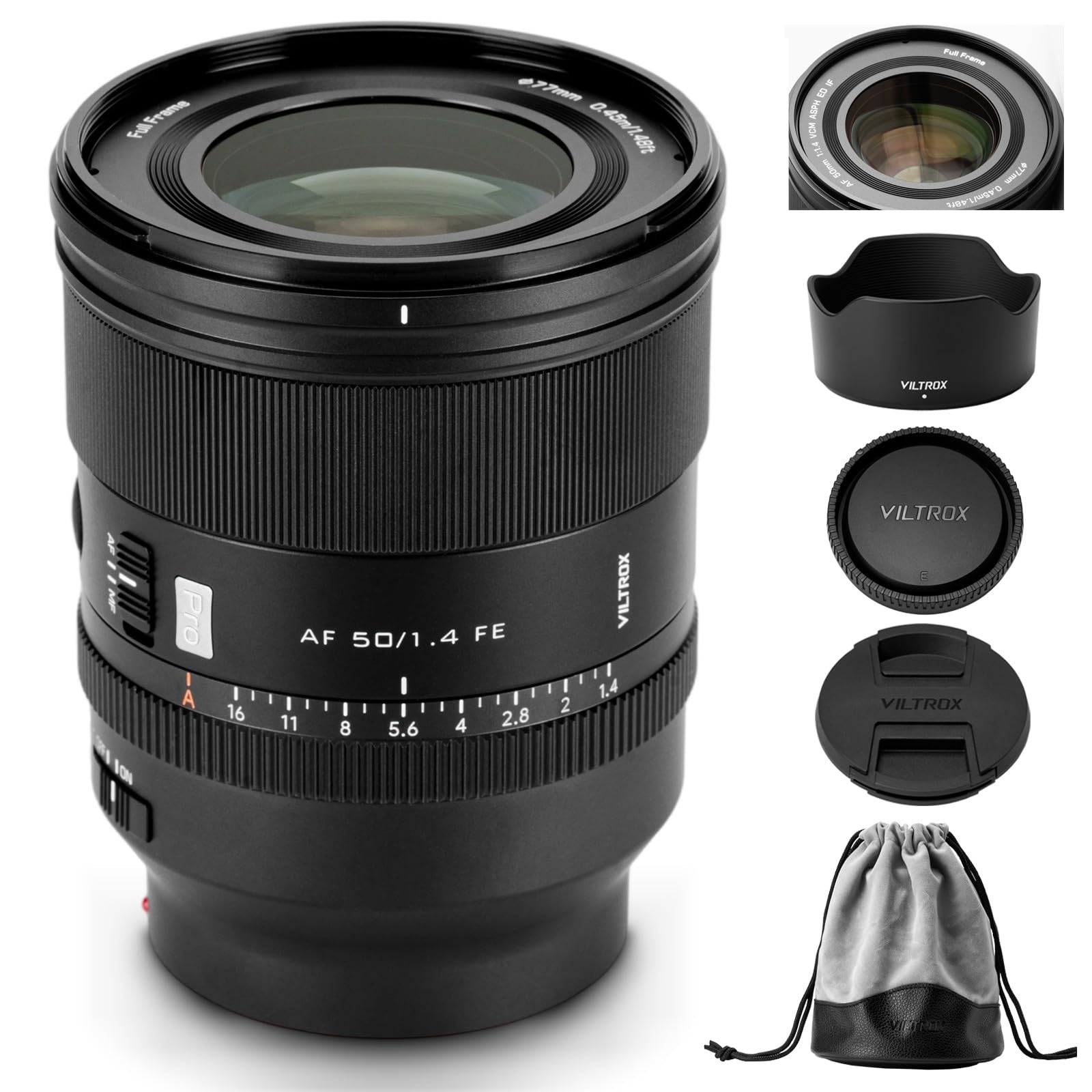
Viltrox 50mm f/1.4 Pro FE

90 /100
Keeper Score Outstanding

Key details

Mount
Sony E
Weight
1.76 lb
Max Aperture
f/1.4
Weather Sealing
Dust and splash resistant
Check Price on Amazon

The Viltrox 50mm f/1.4 Pro FE makes its priorities obvious the moment you pick it up: at 800 grams, it is the heaviest lens in this group by a wide margin. That weight buys an f/1.4 aperture, a weather-sealed metal barrel, and an 11-blade diaphragm. On a Sony A7 body it feels substantial rather than unbalanced, but you will notice it on a long walk in a way you will not notice the Sony 50mm f/1.8.

Optically, the Viltrox is the most complex lens here. Its 15-element, 11-group design includes three ED elements and eight high-refraction elements, and the result is crisp detail wide open with strong contrast. Portraits have smooth separation and a clean transition from subject to background. We did notice that the lens is corrected for sharpness first; it does not have the soft, glowing rendering some portrait shooters pay extra for. That is a matter of taste, not a fault.

Autofocus is the other reason to consider it. The dual HyperVCM motor is fast and quiet, and the lens supports face and eye detection. We found it responsive in ordinary indoor light, and the 11 blades keep out-of-focus highlights round when you stop down. The 77mm filter thread is large.

This is the Sony E lens we pick for portrait sessions and low-light events. It is not the lens for a long day of hiking or a gimbal setup; the Sony FE 50mm f/1.8 is the better travel companion. If you want f/1.4 and weather sealing in a single lens, the Viltrox earns its place.

Pros

  • Fast f/1.4 aperture
  • Weather-sealed metal build
  • Quick, quiet VCM focus
  • Sharp wide-open detail

Cons

  • Noticeable focus breathing in video
Our verdict

The Viltrox 50mm f/1.4 Pro FE gives Sony shooters a fast, weather-sealed prime with sharp detail if they can carry the weight.

Check Latest Price
6

Nikon F Value

Yongnuo YN50mm f/1.8N

92 /100
Keeper Score Outstanding

Key details

Mount
Nikon F
Weight
7.2 oz
Max Aperture
f/1.8
Diaphragm Blades
7
Check Price on Amazon

The Yongnuo YN50mm f/1.8N is the budget Nikon prime we reach for when the priority is spending as little as possible. It covers full-frame and APS-C Nikon DSLRs, takes 58mm filters, and offers the same f/1.8 aperture and 50mm view as lenses that cost several times more. The catch is the focus motor, which is the reason we treat the Yongnuo as a stills-first prime rather than an all-rounder.

We were surprised by how much we liked the images. Wide open, the center is sharp enough for portraits, and the seven-blade aperture produces a pleasant blur. Stop down to f/2.8 and it cleans up nicely. The barrel feels more solid than its budget position suggests, and the aperture setting shows up in EXIF data, which makes it easier to sort files later. There is even a focus-distance indicator for zone focusing, a small touch we did not expect at this level.

On a D3500 or D750, it is a cheap way to learn what a prime can do, and the 50mm view is flattering for portraits. If you already know you will shoot moving subjects, spend more on the Nikon AF-S 50mm f/1.8G. If you are patient and mostly shoot still subjects, the Yongnuo is a low-risk way to add a fast prime.

Pros

  • Very low budget
  • Sharp center wide open
  • Pleasant seven-blade bokeh
  • Full-frame and APS-C coverage

Cons

  • Loud, leisurely autofocus
Our verdict

The Yongnuo YN50mm f/1.8N is the budget Nikon prime we recommend to casual shooters who can live with audible, unhurried focus.

Check Latest Price
7

Budget Sony E

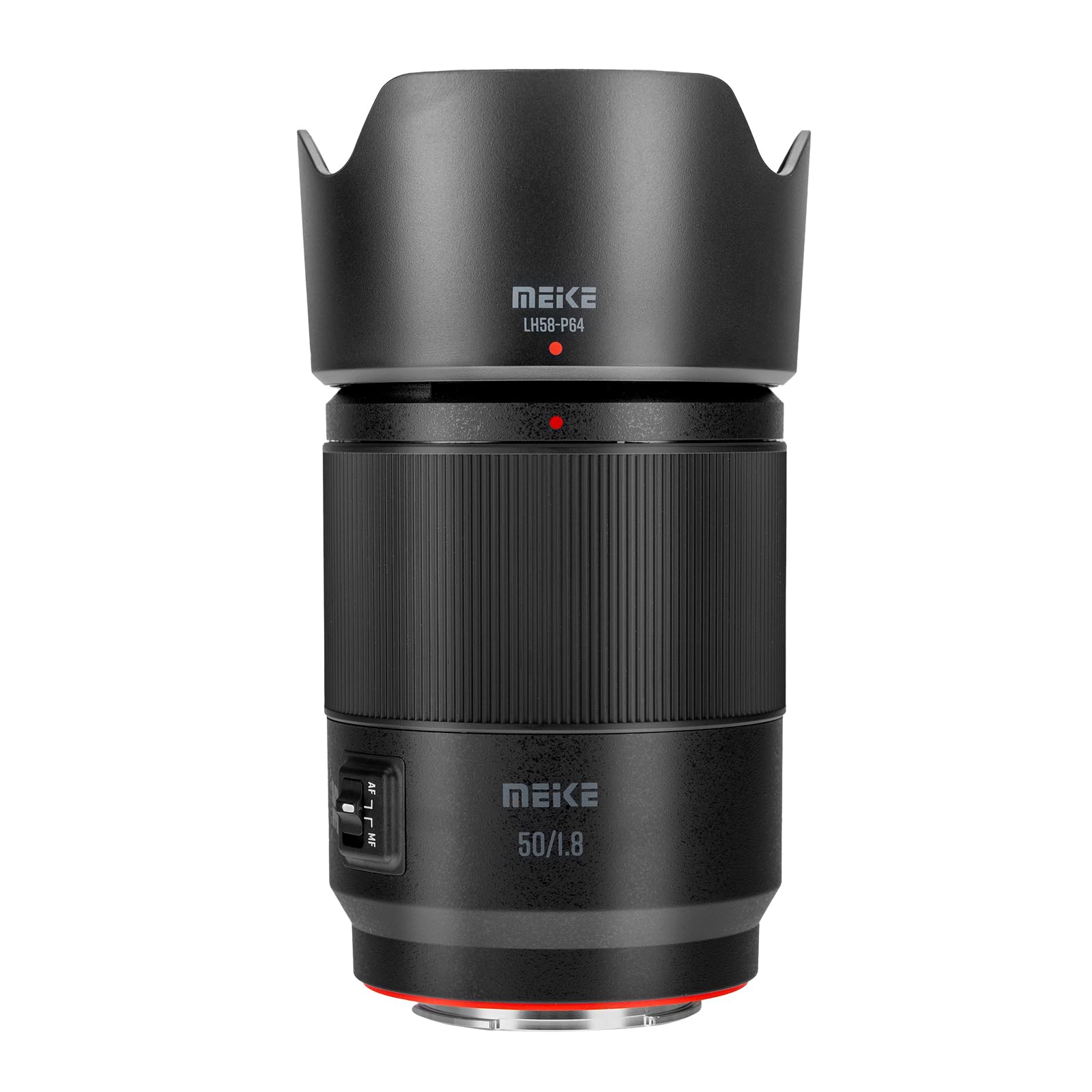
Meike 50mm f/1.8 AF

85 /100
Keeper Score Excellent

Key details

Mount
Sony E
Weight
10.6 oz
Max Aperture
f/1.8
Firmware Port
USB-C
Check Price on Amazon

The Meike 50mm f/1.8 AF for Sony E has a feature we did not expect at its price: a USB-C firmware port. If autofocus behavior needs an update, you can connect the lens and install the latest firmware rather than sending it in. That support matters on a budget third-party prime, because autofocus fixes can arrive after launch, and it makes the Meike easier to recommend to a cautious first-time buyer.

The lens is compact and light at 300 grams, and the f/1.8 aperture delivers the soft-background portrait look people want. We found the center sharp and the colors neutral, with a clean rendering that does not look overprocessed. The stepping motor is smooth in normal light, and the body feels more solid than the price suggests. On an A7C or A7 III, it balances well enough to leave on the camera.

What holds the Meike back is the autofocus envelope. It works well for portraits and slow-moving subjects, but the firmware port is there for autofocus fixes, so budget time for an update if the lens does not behave. We do not reach for it for fast action, and we do not treat it as a video lens without checking for the latest firmware first. For a patient hobbyist who wants a small full-frame 50mm, it is a sensible lower-cost alternative; for a working shooter, the Sony or Viltrox is the safer call.

Pros

  • USB-C firmware updates
  • Light 300-gram body
  • Sharp center at f/1.8
  • Solid build for the price

Cons

  • Close focus is limited
Our verdict

The Meike 50mm f/1.8 AF is a low-cost Sony E prime with a useful firmware port and a friendly size for everyday carry.

Check Latest Price

How We Tested Eleven 50mm Lenses Across Four Camera Systems

We started by pulling every autofocus 50mm currently sold for Canon EF and RF, Nikon F, and Sony E bodies — roughly 30 candidates — then cut the manual-focus-only glass, the lenses that were out of stock everywhere, and the ones priced into a completely different league. That left 11, which we bought at retail rather than accepting loaners, so the copies we shot with are the copies you'd get.

Each lens lived on a body for the better part of a month. I shot portraits in the backyard at golden hour, a birthday party in a dim living room, and a lot of evening walks with a dog who does not hold still. At every location I shot the same frames at maximum aperture, then again at f/2.8 and f/4, and compared corners, the shape of out-of-focus string lights, and whether backlit branches grew purple fringes. Because there's no zoom to fall back on, I also noted how far back I had to stand to get a full-length portrait in a normal room.

For autofocus we half-pressed on a backlit subject in low light and counted how long the lens hunted before locking, then tracked a dog running toward the camera to see how many frames stayed sharp. Noise got its own test: a quiet room, a one-minute video clip, headphones on, listening for the motor and for the click of the aperture stepping. We also checked mount fit after repeated swaps, whether the focus ring stayed consistent from shot to shot, and what actually came in the box — a hood and a pouch aren't a given at this price.

How to Choose a 50Mm Lens

Mount and format come first

A 50mm lens only makes sense if it mounts natively on your camera. Canon splits between EF for DSLRs and RF for mirrorless, Nikon uses F on its DSLRs, and Sony E covers its mirrorless bodies. An adapter can bridge those gaps, but it adds length and another connection, so we treat it as a separate purchase decision. On an APS-C body, the same lens behaves like a 75mm or 80mm equivalent, which turns a normal lens into a portrait-first lens. Match the mount before you compare anything else.

Aperture: f/1.8 versus f/1.4

An f/1.8 lens is the sensible default for most people: it gathers enough light for indoor photos, blurs backgrounds at portrait distance, and keeps the lens small enough to carry. An f/1.4 lens buys a little more light and separation, but it usually adds glass, weight, and cost. The Viltrox shows the trade-off clearly: its f/1.4 aperture and weather-sealed barrel come with an 800-gram body, while the Sony f/1.8 weighs a fraction of that. Choose f/1.4 only if you shoot portraits or low light often and will accept the bulk.

Autofocus speed and noise

Focus is where budget 50mm lenses separate. A stepping motor is usually quiet and smooth, a ring-type ultrasonic motor is quick and quiet, and a voice-coil motor is built for fast, silent hybrid work. Quiet matters for video; speed matters for kids, events, and street scenes. We listen to the motor and try it in dim light rather than trusting a label. The Sony FE 50mm f/1.8 is small and sharp but audible, while the Canon RF and Viltrox are quieter. If you shoot both stills and video, test autofocus in a dim room before you commit.

Close focus and body balance

The minimum focus distance decides whether a 50mm can handle food, flowers, and tight details. The Canon EF focuses down to 1.15 feet, the Nikon to 1.48 feet; that difference is small on paper but noticeable at a table. Weight matters just as much: the Canon EF and RF are 5.6 ounces, while the Viltrox is 800 grams. A light lens stays on the camera; a heavy one needs a reason to come along. Check both the close-focus figure and the balance on your body before you buy.

Frequently Asked Questions

Final Verdict

For Canon DSLR owners, the Canon EF 50mm f/1.8 STM is the easy recommendation: it is small, focuses close, and delivers the f/1.8 look without asking you to baby it. The Canon RF 50mm f/1.8 STM is the better match for an EOS R body, while Nikon DSLR shooters should go straight to the AF-S 50mm f/1.8G.

On Sony, choose the compact FE 50mm f/1.8 for travel or the Viltrox f/1.4 Pro FE when portraits and low light justify the weight. The Meike and Yongnuo make sense for patient hobbyists on a tight budget, not for fast action.