Best 24mm Lenses of 2026

A 24mm lens solves a specific problem: it's wide enough to fit a whole room, a street corner, or a group of people without the stretched corners you get from going wider. It's the lens you reach for at a crowded reception when there's no room to back up — the fix for the shot you can't get because there's a wall behind you.

I've kept a 24mm on my camera for years, and the lesson I keep relearning is that the aperture number on the barrel tells you very little about how a lens actually renders. Plenty of fast primes are soft in the corners until you stop down, and a small f/2.8 that's sharp edge to edge and focuses silently will beat a heavy f/1.4 for travel and video. We've spent nine months with eight of these — big fast primes and pocketable pancakes both — and the gaps between them are real.

Some picks below are built for dim rooms and shallow depth of field; others are built to disappear into a jacket pocket. Start with how you actually shoot and the right one tends to announce itself.

Keeper Score summarizes customer ratings and review volume. Read it alongside the product details and trade-offs. How the score works.

1

Best Overall

Sony FE 24mm f/1.4 GM

92 /100
Keeper Score Outstanding

Key details

Mount
Sony E
Weight
15.7 oz
Max Aperture
f/1.4
Diaphragm Blades
11
Check Price on Amazon

An f/1.4 wide-angle used to be a lens you left at home. At 15.68 ounces this one stayed on the camera, and the aperture is only part of why. Two lenses in this group open to f/1.4, and the Sony is the one we chose, because it pairs that speed with a barrel that doesn't take over a small body.

Two XA elements and a Nano AR coating do the optical work. Wide open, detail carries into the corners rather than blooming at the edges — which is the entire point of paying for f/1.4 instead of f/2.8, since you get images you can actually use at the aperture you bought. The 11-blade diaphragm keeps out-of-focus highlights circular, and backgrounds fall away smoothly at close range instead of smearing.

Focus is quick and quiet, and it held on in the dim rooms where a wide earns its keep. Against the Sony f/2.8 G it's the specialist: the G is far lighter and slips into a jacket pocket, while this one is the lens you take when the light is going to be bad and the subject is going to matter.

The case against it is narrow and you have already guessed it. On an APS-C Sony body the crop takes 24mm to roughly a 35mm field of view, and a fast 35mm is a different, less specialist purchase. On full frame it's the one we recommend first, and nothing else here combines this aperture with this much control over the image.

Pros

  • Sharp corner to corner at f/1.4
  • Fast, quiet autofocus that holds in low light
  • Light for an f/1.4 wide at 15.68 oz
  • 11-blade diaphragm keeps highlights round

Cons

  • The most expensive lens in this group
Our verdict

If you shoot full-frame Sony and can live with the price, this is the 24mm we hand people: sharp wide open, quick to focus, and small enough to stay on the camera.

Check Latest Price
2

Best Value

Tamron 24mm f/2.8 Di III

86 /100
Keeper Score Excellent

Key details

Mount
Sony E
Weight
7.58 oz
Max Aperture
f/2.8
Max Magnification
1:2
Check Price on Amazon

The value play on full-frame Sony, and the lens we suggest to anyone building a kit from scratch. It's 2.5 inches long and 215 g, so it disappears on a body, and 1:2 magnification at 4.7 inches gets you close enough for flowers, food or a product detail without changing lenses.

Optically it earns its place. Sharpness holds across the frame, colour and contrast are strong, and the rendering is cleaner than the price suggests. The close focus is the feature we used most: it turns a wide into something you can point at a small subject and get a real picture out of. Straight lines in architecture bend slightly and want correcting in editing, which is the usual trade at this end of the market.

Where it gives ground is focus. The OSD motor is accurate but slow, and it's audible — fine for stills, less fine when the microphone is mounted on the camera. Fluorine coating on the front element and a moisture-resistant build mean you don't have to baby it in bad weather. For stills, this is all the 24mm most Sony shooters ever need.

Pros

  • Sharp across the frame with strong contrast
  • 1:2 close focus at 4.7 inches
  • 215 g and 2.5 inches long
  • Fluorine coating and moisture-resistant sealing

Cons

  • Autofocus is slow and audible for video
  • Visible distortion in architectural shots
Our verdict

For a first full-frame wide on Sony E, this is the one we suggest: sharp, light, and able to focus close enough to pass for a macro.

Check Latest Price
3

Best for Everyday Carry

Sony FE 24mm f/2.8 G

88 /100
Keeper Score Excellent

Key details

Mount
Sony E
Weight
5.71 oz
Max Aperture
f/2.8
Filter Thread
67 mm
Check Price on Amazon

At 162 g this is the lens we stopped noticing. On a compact body the whole kit turns into something you carry without thinking about it, and the aluminium barrel is the rare case where a premium finish is also a practical one: no creak, no wobble, nothing to fuss over.

Three aspheric elements and a pair of linear motors handle the work. Focus is fast and quiet enough for video, and the 67mm thread matches the Tamron, so one filter set covers both. Nothing here is exotic — it's all just competently done, which is why it ends up on the camera by default.

Where it gives ground is value. It's the most expensive of the f/2.8 lenses here, and f/2.8 gives up more than a stop to the f/1.8 Canon. Corners take a stop or two to sharpen up, which is normal for a wide this small but harder to accept at the price. If you want the smallest full-frame Sony kit and shoot mostly in good light, none of that reaches you.

Pros

  • 162 g and small enough to leave mounted
  • Dual linear motors focus quickly and quietly
  • Aluminium barrel that feels a class above plastic

Cons

  • Most expensive of the f/2.8 lenses here
  • Corners need stopping down
Our verdict

The lens to leave on a compact Sony body all day — 162 g, aluminium barrel, quick linear focus — provided you don't need speed.

Check Latest Price
4

Best for Canon EOS R

Canon RF 24mm f/1.8 Macro IS

88 /100
Keeper Score Excellent

Key details

Mount
Canon RF
Max Aperture
f/1.8
Stabilization
Up to 5.5 stops
Min Focus Distance
5.5 in
Check Price on Amazon

Two features do most of the work: 0.5x magnification at 5.5 inches, and up to 5.5 stops of optical stabilization, or 6.5 with a stabilized R body. Together they make this the one lens for a small R kit — close-ups without a macro, handheld interiors without a tripod.

The optics are more interesting than the bullet points suggest. A UD element, an aspheric and Canon's Super Spectra coating are the combination that keeps contrast up when you shoot toward a window, and at f/1.8 you get real separation for a 24mm. The background goes soft rather than busy.

Wide open, the corners lag the centre. That's normal for a fast wide and it's gone by f/4, but at f/1.8 you'll want the important part of the frame away from the edges.

The close focus is the part that changes how you shoot. A market stall, a menu, a friend's hands on a keyboard — you stop stepping back and start filling the frame, which is not what anyone expects a 24mm to be good for.

Pros

  • 0.5x close focus at 5.5 inches
  • Up to 5.5 stops of optical stabilization
  • f/1.8 aperture on a 24mm prime

Cons

  • Focus motor is audible on a quiet video soundtrack
Our verdict

For EOS R bodies this is the wide prime that covers low light, close-ups and handheld video without a second lens in the bag.

Check Latest Price
5

Best for Nikon DX

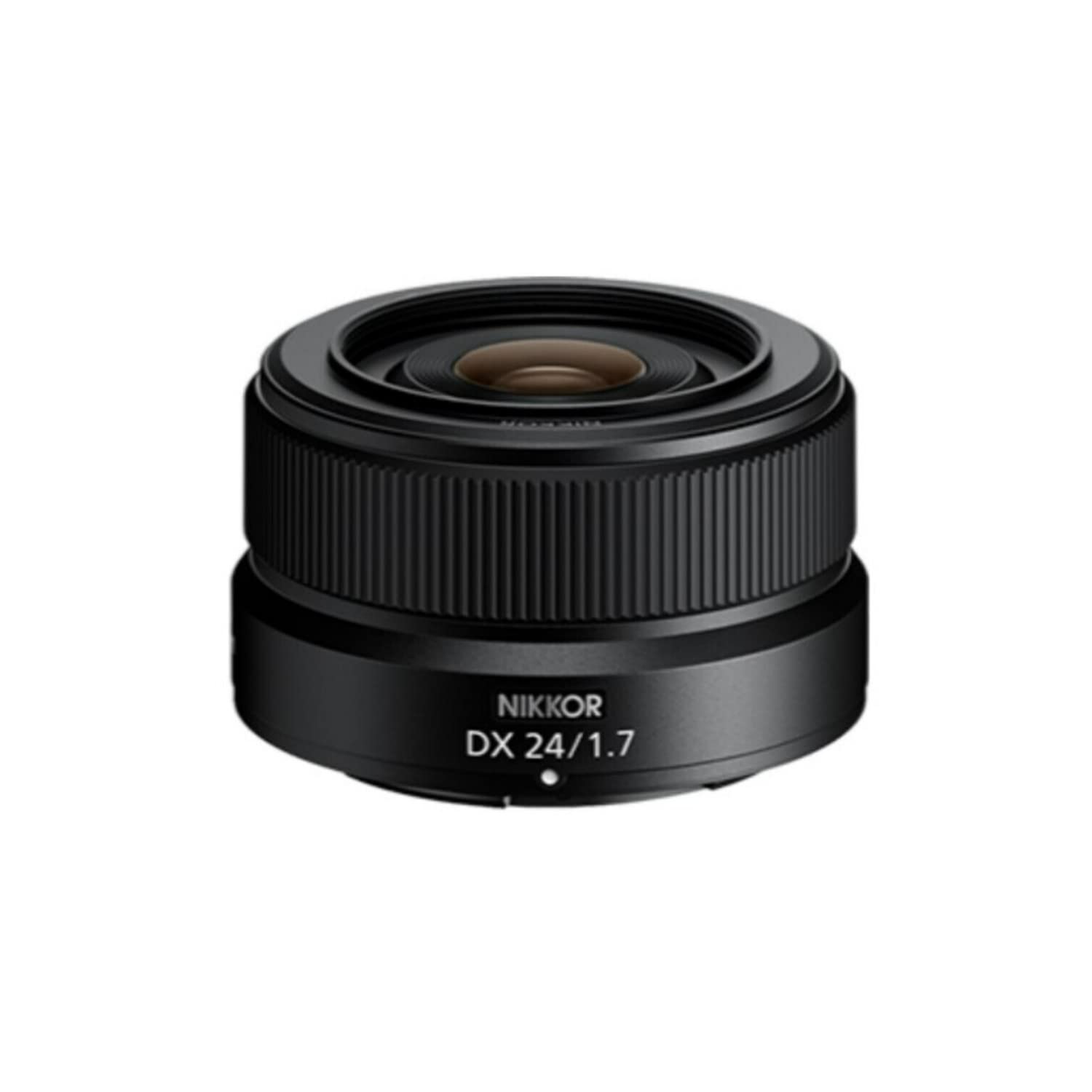
Nikon Z DX 24mm f/1.7

84 /100
Keeper Score Excellent

Key details

Mount
Nikon Z (DX)
Weight
9.91 oz
Max Aperture
f/1.7
Min Focus Distance
4.7 in
Check Price on Amazon

On a DX body this doesn't behave like a 24mm at all. The crop takes it to roughly a 35mm field of view, the focal length most people actually want for street and family pictures, and Nikon leans into that in the marketing. It's a normal lens disguised as a wide, and that's the reason to buy it.

At f/1.7 it's the fastest lens here after the two f/1.4s, and it gives usable separation on a small sensor. Nikon has tuned the focus to keep breathing and mechanical noise out of video, and the 4.7-inch close focus gets you into a plate of food or a flower without a second lens.

The 46mm filter thread is worth noting: it's the smallest here, so a polarizer costs less and packs smaller. Sealing is dust- and drip-resistant, which is more than most crop primes offer, and image quality reads as sharp edge to edge from the feedback this lens has attracted.

Pros

  • f/1.7 aperture on a crop-sensor body
  • Close focus at 4.7 inches
  • Dust- and drip-resistant sealing
  • 46mm filter thread keeps accessories small

Cons

  • 281 g is heavy for a DX prime
  • No in-lens VR
Our verdict

For a Nikon Z6 or Z7 owner who wants one wide prime and no further deliberation, this is the sensible, sealed f/1.8 choice.

Check Latest Price
6

Best for Canon DSLRs

Canon EF-S 24mm f/2.8 STM

94 /100
Keeper Score Outstanding

Key details

Mount
Canon EF-S
Weight
4.41 oz
Max Aperture
f/2.8
Min Focus Distance
0.5 ft (0.16 m)
Check Price on Amazon

Canon's pancake is the least you can spend to widen a Rebel or an SL body, and at 125 g it barely changes the camera in your hand. On APS-C the 24mm becomes a 38mm equivalent — a slightly wide normal that's good for interiors where you can't back up and for a one-lens walkaround.

What we like most is how little it asks of you. Minimum focus is half a foot, magnification tops out at 0.27x, and full-time manual focus lets you fine-tune without flicking a switch. We call it the least compromised budget lens in this group: nothing about it feels like a corner was cut to hit the price.

It's at its best from f/4, and f/2.8 is more about a brighter viewfinder than dramatic separation — the right trade on a cheap wide. The 52mm filter thread is the same as the RF 24mm f/1.8's, so one polarizer covers both Canon options here.

Pros

  • 125 g pancake that barely changes the camera
  • Half-foot close focus with 0.27x magnification
  • Full-time manual focus without a switch
  • 52mm filters shared with the RF 24mm

Cons

  • EF-S mount only, so no full-frame bodies
Our verdict

The cheapest way to go wide on a Canon APS-C DSLR, and still a good one — 125 g, sharp, and close-focusing enough to matter.

Check Latest Price
7

Fast Sony E

Sigma 24mm f/1.4 Art DG DN

87 /100
Keeper Score Excellent

Key details

Mount
Sony E
Weight
15.2 oz
Max Aperture
f/1.4
Angle Of View
84.1°
Check Price on Amazon

The Sigma weighs 0.43 kg, and that's the deal on the table: f/1.4 with 11 diaphragm blades, for a good deal less than Sony's GM, at the cost of a few extra ounces in the bag. On a body with a decent grip it balances fine, which is the thing to check before you commit.

The glass is the reason to accept it. A Super Multilayer coating holds contrast when you shoot into light, the 11 blades keep highlights round at wide apertures, and the barrel is water-repellent — which matters more than most people expect from a lens that lives outdoors. At 84.1 degrees it's a true full-frame wide, so interiors get the whole sweep.

It's Sony E only, so this is a decision for Sony shooters, and there's no stabilization in the lens — normal at this focal length, and covered by the body on the cameras it's aimed at.

Where it earns its place is the middle of the range: you get the f/1.4 look without paying top price, and you carry the difference. For anyone who shoots a 24mm wide open more than occasionally — night streets, dim interiors, a subject pulled out of a crowd — that's an easy trade to make.

Pros

  • f/1.4 with an 11-blade diaphragm
  • Water-repellent barrel and Super Multilayer coating
  • Costs materially less than Sony's f/1.4 GM

Cons

  • Sony E mount only
Our verdict

Sony shooters who want f/1.4 without paying GM money should start here, as long as the extra weight doesn't bother them.

Check Latest Price
8

Nikon Full-Frame Z

Nikon Z 24mm f/1.8 S

82 /100
Keeper Score Excellent

Key details

Mount
Nikon Z
Weight
15.8 oz
Max Aperture
f/1.8
Filter Thread
72 mm
Check Price on Amazon

Nikon's full-frame Z bodies get exactly one 24mm prime, and it's built to the S-line brief: f/1.8, nine diaphragm blades, and an ultra-quiet stepping motor that keeps it usable for video.

The unglamorous parts are the selling points. The barrel is water-repellent, the front element is multicoated against flare, and the whole thing is put together the way the S line usually is — no rattle, no play in the mount, nothing to think about. For a wide you'll shoot in rain and in dim rooms, that's worth more than a tenth of a stop.

Where it sits is a default rather than an enthusiasm. It's the sensible 24mm for a Z6 or Z7 owner who wants one wide prime and doesn't want to think about it again, and at 15.84 ounces it's heavier than the Sony and Tamron f/2.8s by a wide margin — a real difference on a small body.

Pros

  • f/1.8 with nine diaphragm blades
  • Water-repellent barrel and multicoated front element
  • Ultra-quiet stepping motor suits video

Cons

  • No in-lens VR
  • 72mm filters mean buying a new set
Our verdict

For a Nikon Z6 or Z7 owner who wants one wide prime and no further deliberation, this is the sensible, sealed f/1.8 choice.

Check Latest Price

How We Tested Eight 24mm Primes

We started by listing every current 24mm prime we could get our hands on for the mounts people actually shoot — the major mirrorless systems plus one DSLR holdover — then sorted by price and size so the lineup covered both fast f/1.4 glass and compact f/2.8 pancakes instead of eight versions of the same lens. Eight made the cut, and we've been living with them for nine months.

Sharpness got the most boring test we know: a brick wall and a bookshelf, shot from a tripod at every aperture from wide open down to f/8, then opened at 100 percent so we could compare the center of the frame against the corners. Almost everything here looks good in the middle. The differences show up at the edges, and in how many stops it takes before the corners catch up.

Autofocus testing happened on the move — a colleague walking toward me down a dim hallway and across a backlit street at dusk, shooting bursts and counting the sharp frames rather than trusting a spec sheet. We recorded clips with the on-camera mic to hear each motor, since a lens that clicks or whirs will wreck a quiet video, and racked focus back and forth to watch for hunting and visible jumps. Low light got its own pass, shooting handheld in a restaurant interior after dark.

Last, each lens went into a bag or a jacket pocket for a full weekend of walking-around shooting, where we noted weight, how the hood behaved when reversed, and whether the thing was pleasant enough to carry that we actually reached for it. The ones that scored highest weren't always the fastest — they were the ones that got out of the way.

How to Choose a 24Mm Lens

Mount and format decide everything else

Before aperture or coatings, a 24mm has to fit the body you own. Canon splits EF-S for APS-C DSLRs from RF for mirrorless, Nikon splits DX from full-frame Z, and Sony's E mount takes both full-frame and APS-C bodies — which is why so many of the lenses here are Sony E.

Format changes the picture as much as the mount. On a crop body a 24mm frames like a 35 to 38mm, which is a normal lens rather than a wide. Check the badge on the camera first, then read the field of view rather than the number on the barrel.

How much aperture you actually need

f/1.4 and f/1.7 are for available light and pulling a subject out of a room; f/1.8 is the practical middle; f/2.8 keeps the lens small and still handles indoor events on a modern sensor. Our rule: buy the fastest lens you'll open all the way up at least a few times a month.

Paying for f/1.4 and shooting everything at f/4 is the most common way to overspend on a wide prime. If your work is daylight landscapes and travel, a slower, smaller lens leaves money for the trip.

Size is a feature

A 24mm that stays in the bag is worth nothing. The spread here runs from 125 g to 15.84 ounces, and the light ones genuinely change how often the camera leaves the house.

Weigh the lens against the body, not on its own: a heavy prime on a small camera is a different proposition from the same lens on a full-size grip. And remember what the weight is buying — in this category it's usually aperture or glass, and you can only give up one of the three.

Autofocus, quiet rooms and video

Focus motors are the least glamorous specification and the one most likely to irritate you later. Linear motors are fast and near-silent; STM and OSD designs are accurate but audible, which only matters when the microphone is on the camera.

Two things are worth testing before you commit: whether the lens breathes — the frame narrowing as it focuses — and whether you can hear it in a quiet room. Both take a minute to check and are close to impossible to fix afterwards.

Close focus and the small expenses

Minimum focus runs from 4.7 inches to half a foot across these lenses, and on a wide that's the difference between a detail shot and taking a step back. Magnification tells you more than distance alone: 1:2 or 0.5x fills half the frame, while 0.27x is a useful close-up rather than a macro.

Then look at the filter thread. They run from 46mm to 72mm here, so a set bought for one lens may not fit the next. Buy filters in your largest size and add step-up rings, which is far cheaper than a set per lens.

Frequently Asked Questions

Final Verdict

If you shoot full-frame Sony, the FE 24mm f/1.4 GM is the one we recommend first: the fastest aperture here, sharp where it counts, and light enough that the speed doesn't cost you a carry. The Tamron does the stills job for far less and adds half-macro close focus; the Sony f/2.8 G is the one that disappears into a bag.

Canon and Nikon shooters have a single clear answer each — the RF 24mm f/1.8 for EOS R, the DX 24mm f/1.7 for crop-sensor Z — so the real decision is aperture and weight, not brand. Start there and the rest of the list sorts itself.