Best Tripods of 2026

A tripod is a tug-of-war: legs light enough to carry all day, a platform rigid enough that your camera doesn't drift mid-exposure. Most models lean hard one way — featherweight travel sticks that shiver in a breeze, or heavy legs you'd only move from the closet to the car. The advertised load rating, meanwhile, is a ceiling rather than a comfort zone; a tripod is happiest carrying well under the number printed on it.

I've had a leg fold under a mirrorless body, and I've owned one so heavy it never left the house. Over the past eight months, my team and I have set up and packed away 14 tripods, from compact aluminum travel models to tall stands built for spotting scopes. What decided it was how quickly the leg locks snapped open, whether a ball head or a pan head suited the way you shoot, and whether anything had loosened up by month four.

The picks below split along that same line: some disappear into a daypack, others are built to stay planted in one spot. Read for the one that matches how you actually shoot — the second tripod people buy is often the exact opposite of the first.

Keeper Score summarizes customer ratings and review volume. Read it alongside the product details and trade-offs. How the score works.

1

Best Overall

XXZU 75-Inch Tripod

93 /100
Keeper Score Outstanding

Key details

Head Type
Ball head
Folded Size
36.5cm/14.37in
Load Capacity
17.6 lb
Maximum Height
75 inches
Check Price on Amazon

A 75-inch tripod that folds to 14.37 inches is already useful; the XXZU goes further by turning its center column into a monopod. That combination earned it our top pick. It covers tall group shots, overhead phone framing, and a hiking stick without making you buy a separate monopod.

The 17.64-pound load rating gives it room for a mirrorless camera and a modest lens, not just a phone. We like the ball head for quick portrait-to-landscape changes, and the remote is a genuine help when you are filming alone. The three leg sections use flip locks, which are easy to set with one hand while the other holds a camera. The detachable column turns into a 43.9-inch monopod, a useful height for steadying a phone or a small camera on a hike.

The phone clamp deserves a firm check before you tilt the head with a large handset in a case. The three-level leg angles help on uneven ground, though they do not turn it into a heavy studio stand. For travel, family photos, and mixed camera-and-phone days, that is a fair trade for the height and folded size. The monopod conversion is the bonus that keeps it in our bag.

Pros

  • Folds to 14.37 inches but reaches 75 inches
  • 17.64-pound load supports camera and phone
  • Center column converts to a monopod
  • Ball head and remote simplify framing

Cons

  • Full-height stability needs a sheltered spot
Our verdict

We recommend the XXZU as the best all-around tripod for most shoppers: it reaches 75 inches, folds small, carries a real camera, and adds a monopod.

Check Latest Price
2

Best Travel Tripod

K&F Concept 64-Inch Travel Tripod

93 /100
Keeper Score Outstanding

Key details

Head Type
Ball head
Folded Size
15.5''/39.5cm
Load Capacity
17.6 lb
Maximum Height
64.1 in
Check Price on Amazon

At 15.5 inches folded and 1.15 kilograms, the K&F Concept is the tripod we pack when the camera bag is already full. It is a travel tripod first, and that shapes everything about it.

The 17.6-pound load rating is the reason it earns a runner-up spot rather than staying a niche travel pick. We like the 36mm ball head for quick framing, and the four-section legs let it go from 20.4 inches to 64.1 inches without a separate short column. The center column also inverts for low-angle work, which is more useful than it sounds for flower and ground-level shots. The head accepts Arca-Swiss plates, so it fits a common quick-release system.

The leg locks are the part to watch. This is a light four-section tripod, and a clamp that is not fully closed can let a leg slide when you load the head. Set each one firmly before you trust a camera to it. A phone holder is included, but there is no remote in the box; add one for solo phone work. The reward is a compact stills tripod that fits in carry-on luggage and handles a camera well beyond phone weight.

Pros

  • Folds to 15.5 inches for carry-on bags
  • 17.6-pound load capacity for camera kits
  • Ball head with an invertible center column

Cons

  • Tall setup can feel light in wind
Our verdict

For travel and stills, we choose the K&F Concept: it folds small, carries a real camera load, and its ball head is quick to frame.

Check Latest Price
3

Best Budget Full-Size

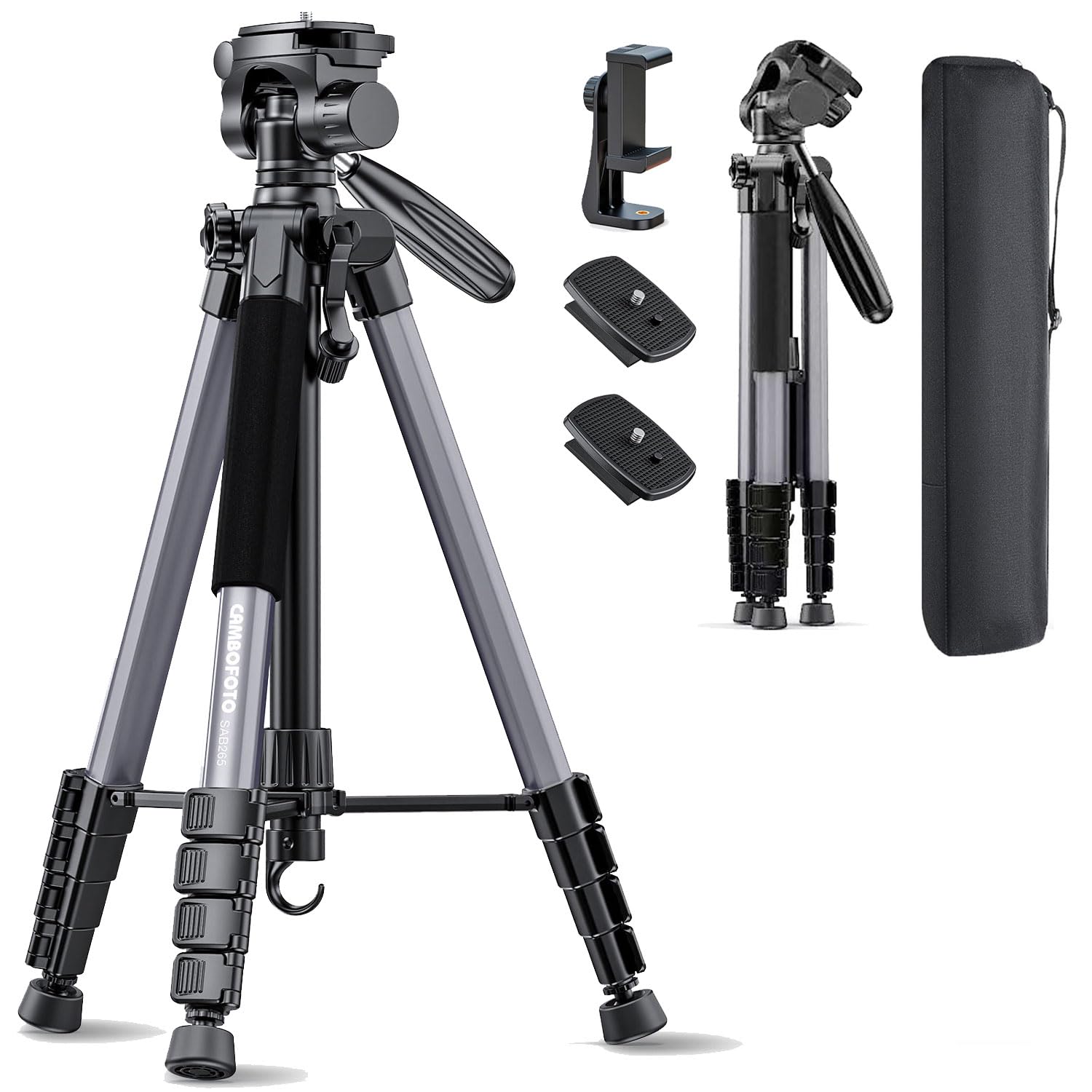
CAMBOFOTO 74-Inch Tripod

92 /100
Keeper Score Outstanding

Key details

Head Type
Pan head
Folded Size
20.5 in
Load Capacity
8.8 lb
Maximum Height
74 in
Check Price on Amazon

The CAMBOFOTO is the tripod we point to when someone wants a full-height camera stand without paying travel-tripod money. At 74 inches, it reaches eye level and above, and the 8.8-pound load rating covers a DSLR or mirrorless body with a kit lens.

The three-way pan head is the reason to choose it over a ball-head travel tripod. Panning is smoother for video, and the handle gives you a controlled tilt instead of a loose ball. A bubble level helps you square the horizon, and the quick-release plate and included phone mount make it a sensible first tripod for someone moving between camera and phone.

The trade-off is packed size. At 20.5 inches folded and 2.8 pounds, it is a daypack tripod rather than a pocket one, and the four-section legs can feel busy when you are setting up in a hurry. At full height, a light bump travels up the frame, so keep the center column down when you can. For backyard video, events, and learning camera fundamentals, it is a lot of tripod for the role.

Pros

  • 74-inch height for eye-level shots
  • 8.8-pound load supports DSLR or mirrorless
  • Pan head with phone mount included

Cons

  • Pan head is slower to switch for stills
Our verdict

We recommend the CAMBOFOTO for budget-minded camera and phone shooters who want full height and a smooth pan head.

Check Latest Price
4

Best for Heavy Gear

SmallRig CT-10 Tripod

88 /100
Keeper Score Excellent

Key details

Head Type
Ball head
Folded Size
43cm
Load Capacity
33 lb
Maximum Height
71 in
Check Price on Amazon

A 33-pound payload rating is the headline on the SmallRig CT-10, and it is not decoration: this is the one we reach for when the camera has a long lens, a cage, or a monitor attached. The magnesium aluminum alloy build and 36mm ball head make the rating believable.

The 2-in-1 design is the reason it earns a place here. You can pull the center column out as a monopod for hiking or events, then put it back for a stable three-legged setup. The ball head handles portrait and landscape, and the 71-inch top height is enough for eye-level video. At 3.4 pounds, it is heavier than the travel picks, but that weight is part of why it feels more substantial with a real camera. The folded length is 16.9 inches, so it still fits a large backpack.

The 3.4-pound weight is noticeable on a long hike, and the four-section legs take a little more handling than a simple three-section travel tripod. That is the price for the payload and the monopod. For heavy gear and creators who want a monopod built in, it is a strong choice.

Pros

  • 33-pound payload for long lenses and cages
  • Converts to a monopod
  • Folded length is 16.9 inches

Cons

  • Locking hardware needs firm tightening
Our verdict

We recommend the SmallRig CT-10 for heavy camera rigs and creators who want a monopod built in.

Check Latest Price
5

Best Lightweight Camera Tripod

Amazon Basics 50-Inch Tripod

91 /100
Keeper Score Outstanding

Key details

Head Type
3-way pan head
Folded Size
3.3 x 2.9 x 16.9 inches
Load Capacity
4.4 lb
Maximum Height
50 in
Check Price on Amazon

The Amazon Basics 50-inch tripod is not the one we hand someone with a full-frame camera and a heavy zoom. It is the one we keep for a small mirrorless body, a compact camera, or a phone.

At 1.23 pounds, it disappears into a daypack, and the lever-lock legs are simple to extend. The three-way head gives you tilt and swivel, the quick-release plate speeds up switching, and the bubble level helps on uneven ground. The height range runs from 16.1 to 50 inches, so it works on a tabletop and at standing height. The included bag is basic but useful. The folded package is 16.9 inches long, so it fits a daypack but not a jacket pocket.

The 4.4-pound limit is the line to respect. A light camera and lens is fine; a heavy zoom or a long lens will make the head droop and the legs feel nervous. For a first tripod, a travel kit, or a phone stand that happens to take a small camera, it is an easy recommendation. The simple controls also make it a good tripod to leave in the car for unexpected shots.

Pros

  • Weighs 1.23 pounds with carry bag
  • 50-inch height for tabletop to standing shots
  • Three-way head and quick-release plate

Cons

  • Plastic fittings reduce long-term confidence
  • Taller setups feel nervous in wind
Our verdict

We recommend the Amazon Basics tripod for light camera and phone kits where low weight and simple setup matter more than heavy-camera stability.

Check Latest Price
6

Best Phone Tripod

Liphisy 64-Inch Phone Tripod

93 /100
Keeper Score Outstanding

Key details

Head Type
Ball head
Folded Size
17.72 x 3.46 x 2.4 inches
Maximum Height
64 in
Remote Control
Included
Check Price on Amazon

The Liphisy 64-inch tripod is built around the phone, not adapted to it: a wireless remote, a 360-degree holder, and a 210-degree head make solo shooting the main event.

The 17-inch minimum is low enough for tabletop framing, and the 64-inch top gets you to eye level for talking-head video. We like the ball head for switching to portrait without unscrewing the phone, and the aluminum-and-stainless build feels more substantial than the price suggests. The remote is handy when you are filming alone, though it is the first accessory to test before a trip. The folded package is long and slim rather than short and stubby, so it slides into a backpack beside a laptop.

The phone clamp needs a firm set with a large handset, and the remote can take a few tries to pair. Those are the compromises for a compact, tall phone tripod that also accepts a light camera. The two-year manufacturer warranty is a useful cushion. For phone-first creators, the convenience is worth it. It is not the tripod we choose for a DSLR, but it is the one we reach for when the phone is the camera.

Pros

  • 64-inch height with 17-inch minimum
  • Wireless remote for solo shooting
  • Ball head rotates for portrait and landscape

Cons

  • Full-height wobble in busy spaces
Our verdict

We recommend the Liphisy 64-inch for phone-first creators who want a remote and a tall, compact stand without moving up to a camera tripod.

Check Latest Price
7

Tall Video Setups

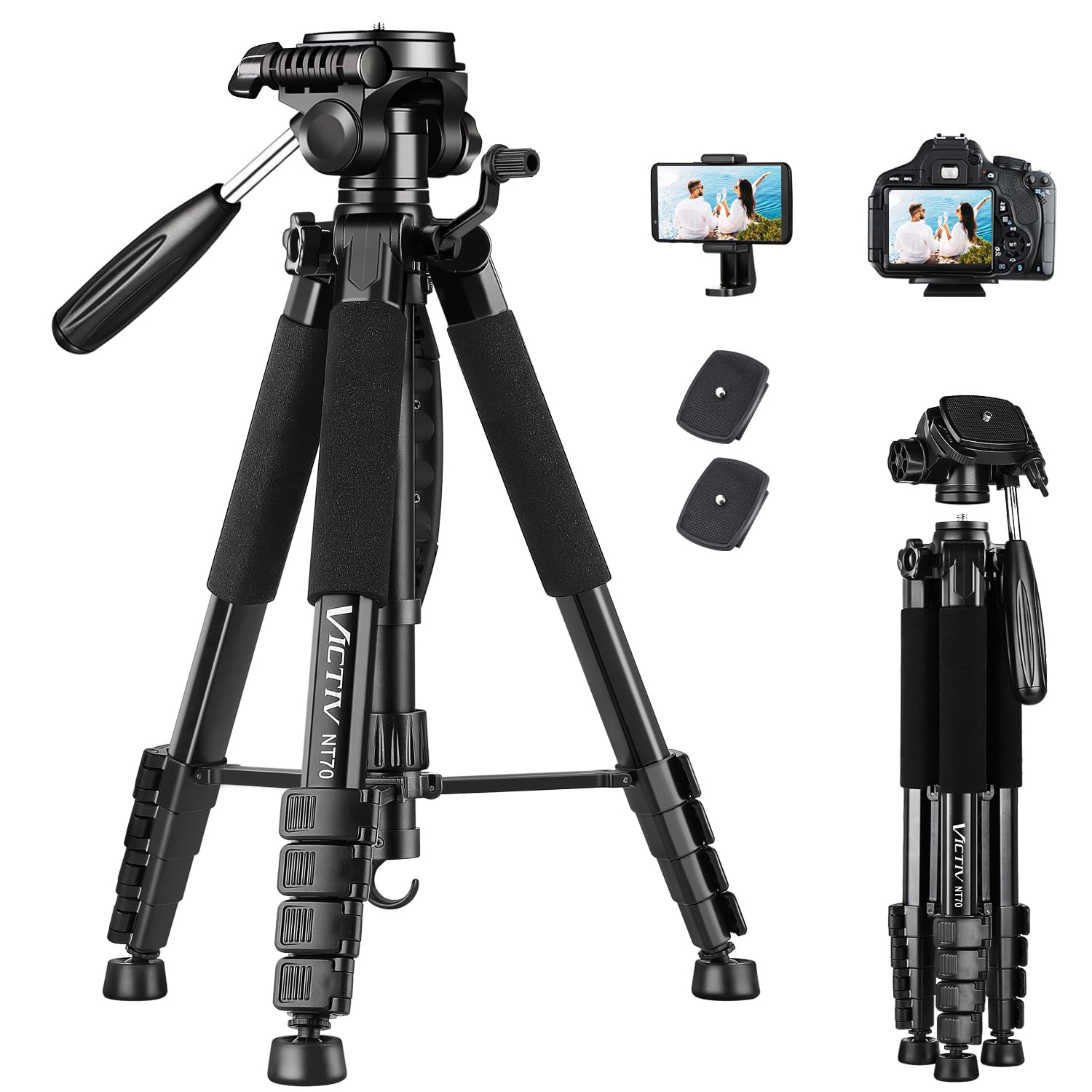
VICTIV 74-Inch Tripod

93 /100
Keeper Score Outstanding

Key details

Head Type
3-way pan head
Folded Size
20 in
Load Capacity
9.5 lb
Maximum Height
74 in
Check Price on Amazon

The VICTIV is the tall, conventional video tripod in this group: 74 inches, a three-way pan head, and a 9.5-pound load rating. It is built for framing a camera at eye level and panning across a scene, not for folding into a jacket pocket.

The pan handle and separate tilt and pan locks are what make it feel more like a video stand than a ball-head travel tripod. You can make a slow pan without fighting the head, and the quick-release plate lets you move the camera off between setups. A phone holder and an extra plate are included, which makes it easy to switch between a camera and a phone.

The 3-pound weight is noticeable on a long carry, but it helps the tripod settle once it is planted. The head is not a true fluid head, so a slow pan still needs a light touch. The four-section legs give you a wide height range, though the setup takes a little more handling than a three-section model.

For event video, church streaming, and anyone who wants a tall pan head without a fluid-head budget, the VICTIV is a sensible pick. It is not the travel tripod we grab for a hike, but it is the one we set up when the camera needs to pan.

Pros

  • 74-inch height for event and group video
  • 9.5-pound load for camera and lens
  • Three-way pan head with phone mount

Cons

  • 20-inch folded length is long for travel
  • Head and leg locks need firm tightening
Our verdict

We recommend the VICTIV for video shooters who want a tall pan head and a phone mount without stepping up to a fluid-head rig.

Check Latest Price
8

Solo Phone Shooting

RISEOFLE 71-Inch Phone Tripod

89 /100
Keeper Score Excellent

Key details

Folded Size
31 cm
Load Capacity
4.4 lb
Maximum Height
71 in
Remote Control
Included
Check Price on Amazon

At 12.2 inches folded and 264 grams, the RISEOFLE is a selfie stick first and a tripod second, and that is the right way to judge it.

The 71-inch reach is the surprise: it gets a phone above a crowd or into a full-body frame without a second person. The 360-degree holder rotates between portrait and landscape, and the wireless remote makes solo photos and short videos easier. The aluminum pole feels more solid than the plastic phone cradle, and the folded package disappears into a tote.

The 2 kg limit and light legs tell you not to hang a camera from it. Even a phone can shift in the clamp if you use a thick case, so tighten it firmly and check the angle before you step away. Keep the top sections down unless you need the height. The remote pairs simply when it works, but it is the first thing to test before a trip.

For solo phone shooting, travel, and group photos, the RISEOFLE earns its place as the budget selfie-stick tripod. It is not a camera tripod, and we do not ask it to be. It is the one we toss in a bag when the phone is the only camera we plan to use.

Pros

  • Folds to 12.2 inches and weighs 264 g
  • Reaches 71 inches with a wireless remote

Cons

  • Full-height wobble in wind
Our verdict

We recommend the RISEOFLE as a budget selfie-stick tripod for phone shooters who value a tiny folded size and tall reach.

Check Latest Price

How We Tested Tripods, Indoors and Out

We started by gathering every tripod we could find that claimed a maximum height over 60 inches, came with a phone mount, and cost less than a decent lens. From there we filtered on folded length, advertised load rating, head type, and — most usefully — the complaints that repeated in reviews: wobble at full extension and clamps that let go of a phone. Fourteen made the cut, and we've spent the last eight months with them.

Each one got the same treatment. I set it up and broke it down alone with a stopwatch running, then raised it to full height and pressed on the top plate to see how much it flexed. I locked and unlocked every leg clasp a few dozen times, splayed the legs on uneven ground, and dropped a bare phone — no case, no grip — into each clamp to see whether it held through a full pan or slowly tilted downward. Remote shutters got paired, monopods got separated from their tripod halves, and center columns got flipped for low angles.

Outdoors, we shot timelapses on a breezy rooftop and on gravel, noting which legs crept and which feet slipped. Everything was then packed into its own bag and carried — on walks, in the car, on a couple of flights — and checked afterward for scratches on the finish, grit in the joints, and bolts that had worked loose. We also counted what actually came in the box, since at similar prices a remote, a spare quick-release plate, and a carry bag that isn't tissue-thin are often the whole difference.

How to Choose a Tripod

Choose the Head for Your Shooting Style

Ball heads are quicker for stills and travel: one clamp loosens the camera for portrait, landscape, or a slight tilt. Three-way pan heads separate pan and tilt, which makes smooth video moves easier and gives you a handle to control. We prefer a ball head for a camera that moves between formats and a pan head for event video, church streaming, or panoramas. Our travel picks use ball heads; the video-leaning picks use pan heads. If you shoot both, pick the head that matches most of your work and accept a slower second-best.

Balance Height Against Stability

A tripod's maximum height is often reached with the center column raised, which is the least stable position. Look for a tripod that puts the camera at eye level with the column down, then use the extra height only when you need it. A 60-inch tripod can be enough for many shooters at eye level; a 74-inch model gives more room for overhead or group shots but is more vulnerable in wind. Keep the leg sections lower before you raise the column.

Check Load Capacity and Locking Hardware

Load capacity should cover the camera body, lens, cage, and anything hanging off the head, with headroom for a heavier lens later. A high rating does not guarantee a still base at full height; light legs and a raised column can still move in wind. Check that every leg lock closes firmly and that the quick-release plate seats with a clear stop. If the tripod has a center hook, a small bag of ballast can help on a breezy day.

Decide How Much Phone Convenience You Need

Phone mounts vary in clamp width and grip, and a large handset in a thick case is the usual mismatch. Check the clamp range before you buy, and test the remote before a trip; pairing can take a few tries. A phone-first tripod can be lighter and taller than a camera tripod for the same budget, but it will not carry a DSLR safely. If you shoot both, choose a camera tripod with a phone holder and add a remote separately.

Frequently Asked Questions

Final Verdict

For most people, the XXZU 75-inch is the tripod we recommend first. It reaches full height without turning into a long package, carries a camera-and-lens kit, and adds a monopod for travel. If you mainly shoot stills on the go, the K&F Concept is the better travel companion: it folds smaller and its ball head is quicker to frame. Choose the XXZU for height and versatility, the K&F for a lighter stills kit, and the Liphisy 64 if your camera never leaves your phone.