Best Tripods for Astrophotography of 2026

A tripod for astrophotography isn't really a stand. It's the piece of gear holding your sensor perfectly still while it gathers light for 30 seconds, a minute, five minutes at a time, and any flex in the legs, any lock that creeps, any plate that shifts under a long lens turns up in the file as trailed stars you can't retouch away. I've re-shot more frames than I'd like to admit because a tripod that felt fine in daylight quietly gave up after dark.

So I went at this the way I'd tell a friend to: stability first, then everything that makes a heavy kit bearable to actually carry. Over nine months, we've put 12 tripods through real nights — a suburban backyard, an open field where the wind never let up, and a February night that froze the dew solid — weighing portability against how dead-still each one sat during long exposures, and checking whether the ball heads, Arca-type plates, and twist locks still felt secure once everything was cranked down.

One thing worth knowing before you shop: a center column is a convenience, not a free upgrade. Raising it is the fastest way to give back the rigidity you just paid for, and on most nights you want the legs doing the work. A tripod you dread carrying also tends to stay in the car, so the right answer is usually the stiffest one you'll genuinely haul to a dark site. Below, the picks run from backyard rigs to something you can strap to a pack.

Keeper Score summarizes customer ratings and review volume. Read it alongside the product details and trade-offs. How the score works.

1

Best Overall

ARTCISE AS90C

90 /100
Keeper Score Outstanding

Key details

Weight
9.9 lb
Leg Diameter
40 mm
Load Capacity
88 lb
Maximum Height
61.8 inches
Check Price on Amazon

The 40mm leg tubes and 75mm bowl are the reason this is our top pick. We set the ARTCISE up low, dropped a tracker and a small refractor onto the flat plate, and the leg set felt planted rather than springy. The bowl makes leveling a camera or mount a two-handed job instead of a four-corner fight, which matters when you are aligning in the dark. The 88-pound load rating is far more than most astro rigs need, but that headroom is why we trust it with a heavier scope or a long lens.

The carbon fiber legs and four-section design hold the whole package to 9.9 pounds, which is light for a tripod this stiff. The 23-inch folded length means it rides in a car or a large pack rather than a daypack. The flat quick-release plate and the 75mm bowl option cover both a camera-and-tracker setup and a heavier mount, and the 3.9-inch minimum height lets you get the camera close to the ground for wide-field work. We like that each leg can be splayed independently on uneven ground.

If you are carrying a light mirrorless camera and a tiny tracker, this is more tripod than you need. But for a long exposure that cannot afford a gust or a creeping leg, the extra mass and wide legs are the point. We keep coming back to it for the nights when the setup stays in one place for hours.

Pros

  • 40mm legs and 88-pound load rating
  • 75mm bowl simplifies leveling
  • Drops to 3.9 inches for low shots
  • Rock-solid under long exposures

Cons

  • 9.9-pound weight is a lot for a long hike
Our verdict

For a heavy tracker or scope that needs to sit still for minutes, this is the tripod we trust most; the 75mm bowl makes it easy to level.

Check Latest Price
2

Best for Star Trackers

Sky-Watcher Star Adventurer

89 /100
Keeper Score Excellent

Key details

Weight
4.9 lb
Folded Size
18 inches
Maximum Height
54 inches
Mount Compatibility
Star Adventurer, GTi, AZ-GT, AZ5
Check Price on Amazon

The Star Adventurer tripod is a bare astronomy base, not a general camera tripod. Its 3/8-inch thread is the detail that tells you what it is for: it matches Star Adventurer mounts, the GTi, AZ-GT series, and AZ5 heads, and it also works with the Seestar S50 and S30. If your rig already has a ball head and a 1/4-inch camera screw, this is not the base you are looking for.

What we like is the lack of translation. The 4.9-pound aluminum frame opens to 54 inches, folds to 18 inches, and feels rigid with a small scope on top. There is no head to sag or adjust, so once the mount is on, the tripod gets out of the way. For a Star Adventurer or Seestar, that simplicity is more useful than a taller, heavier studio tripod.

The 54-inch maximum height is the boundary: it is fine for seated or low viewing, less so if you are tall and want to work standing. The three-section legs and 1.3-inch leg diameter keep the folded package small, and the simple leg locks are easy to operate with gloves once you learn them. It is not the base we choose for a large refractor, but for a tracker and camera it is the right size.

Pros

  • Direct fit for Star Adventurer and Seestar mounts
  • Rigid 4.9-pound aluminum frame
  • Folds to 18 inches
  • 3/8-inch astronomy mount thread

Cons

  • 54-inch maximum height is low for standing use
Our verdict

If your astrophotography rig starts with a Star Adventurer or Seestar, this is the simple, rigid base we recommend first.

Check Latest Price
3

Best Ultralight Travel

Sirui AM-284

86 /100
Keeper Score Excellent

Key details

Weight
2.7 lb
Folded Size
17.8 inches
Load Capacity
33 lb
Maximum Height
47.2 inches
Check Price on Amazon

At 2.7 pounds, the AM-284 is the tripod that makes a long walk to a dark site feel less like a gear haul. The carbon legs pack to about 18 inches, and the 33-pound load rating is far more than a mirrorless camera, a small tracker, or a Seestar needs. The twist locks are smooth, and the leg angle stops at 22, 55, and 85 degrees let you splay the legs wide on uneven ground.

We like this one for the nights when the tracker is small and the hike is long. The included steel spikes bite into soft grass or sand, and the low center of gravity is exactly what a light astro rig wants. It is not the tripod for a large refractor, but it is the one we pack when every pound matters.

The carbon tubes and metal fittings feel more expensive than the rest of the travel kit, and the six-year warranty is a long one for a tripod. The 47.2-inch maximum height is the compromise, and you will feel it when you want to work standing. For wide-field imaging and low tracker setups, that is a fair trade; for visual astronomy with a tall scope, choose a taller base.

Pros

  • 2.7-pound carbon frame
  • 33-pound load capacity
  • Spiked feet for soft ground
  • Three leg-angle positions

Cons

  • 47.2-inch maximum height forces a low setup
Our verdict

The AM-284 is the travel tripod we take when the tracker, not our back, should carry the weight; just plan on working low.

Check Latest Price
4

Best for Tall Setups

Benro TMA47AXL

85 /100
Keeper Score Excellent

Key details

Weight
6.8 lb
Folded Size
31.3 inches
Load Capacity
44.1 lb
Maximum Height
85.1 inches
Check Price on Amazon

Three leg sections and an 85-inch maximum height are what make the TMA47AXL a different tool from the travel tripods here. Fewer joints mean fewer places for a long lens to shiver, and the extra height lets a tall photographer work without hunching. The 44-pound load rating is more than enough for a big refractor or a camera with a long telephoto.

We were impressed by how planted it feels for an aluminum tripod. The twist locks are oversized and easy to grip, the legs have interchangeable rubber and spike feet, and the center column reverses for low work. A camera body with a 600mm lens is the kind of load this tripod is built for, and the three-section legs give it a calm, solid feel in wind.

This is the pick for a tall user or a long-lens rig that lives near the car. When the wind is up and the scope is long, the extra mass and height are worth it. It is not the tripod we choose for a long backpack, but it is the one we want under a heavy setup that stays put.

Pros

  • 85-inch maximum height
  • 44-pound load capacity
  • Only three leg sections
  • Spiked and rubber feet included

Cons

  • 6.8-pound weight limits backpacking
  • 31-inch folded length is awkward to pack
Our verdict

For a tall refractor or a long lens that needs height and mass, the Mach3 is the aluminum workhorse we choose.

Check Latest Price
5

Best Budget Full-Size

Neewer TP77

92 /100
Keeper Score Outstanding

Key details

Weight
3.1 lb
Folded Size
19 inches
Load Capacity
34 lb
Maximum Height
77 inches
Check Price on Amazon

The TP77 is the full-size tripod we hand someone who wants height and load capacity without moving into premium territory. It reaches 77 inches, folds to 19 inches, and carries 34 pounds, which is more than enough for a camera, a ball head, and a small tracker. The four-section flip locks are quick to set with cold hands, and the center column has a second section for extra height.

For astrophotography, we keep it low. The three leg-angle positions let you splay the legs and drop the center column, and the 19-inch folded length means it can live in a pack. The ball head pans and tilts smoothly for framing, and one leg converts to a monopod for daytime use. That versatility is why it stays in the car.

The aluminum frame is not as calm as the carbon picks, but it is the one we start with when the budget is fixed. It holds a camera and a small tracker without fuss, and the height is there when you need it. Just do not expect it to settle a heavy refractor the way the top pick does.

Pros

  • 34-pound load rating
  • Folds to 19 inches
  • 77-inch maximum height
  • One leg converts to a monopod

Cons

  • Ball head can creep under heavy off-axis loads
Our verdict

The TP77 gives you height, load capacity, and a ball head for a budget price; we keep it low when the exposure gets long.

Check Latest Price
6

Best Budget Travel

K&F Concept 64-inch

93 /100
Keeper Score Outstanding

Key details

Weight
2.5 lb
Folded Size
15.5 inches
Load Capacity
17.6 lb
Maximum Height
64.1 inches
Check Price on Amazon

The 15.5-inch folded length is why this K&F comes along. It slips into a camera bag or a small suitcase, weighs 2.5 pounds, and opens to 64 inches, so it can serve as a travel tripod and a low astro base. The 36mm ball head has a usefully broad base, and the 17.6-pound load rating leaves room for a mirrorless camera and a small tracker.

The simple things are done well: the flip locks are fast, the center column inverts for low shots, and the short center column gets the camera closer to the ground. For wide-field astrophotography, that low setup is more valuable than a tall, spindly extension. The Arca-Swiss-compatible plate is easy to swap between a camera and a tracker.

At full extension it is more vulnerable to wind, and this is a lightweight travel tripod rather than a heavy-duty astro base. We treat it as a fair-weather, low-to-mid-height tripod and save the tall stuff for calmer nights.

We reach for it when the tripod has to disappear into a camera bag for a weekend trip. It is not the base for a big refractor, but for a camera, a small tracker, and a low setup, it earns its place.

Pros

  • Folds to 15.5 inches
  • 17.6-pound load rating
  • Inverted center column for low shots
  • Includes ball head and phone holder

Cons

  • Leg locks need a firm hand
Our verdict

A compact, light ball-head tripod that gets a camera and tracker to a dark site without much fuss, as long as you keep it low.

Check Latest Price
7

Backpacking

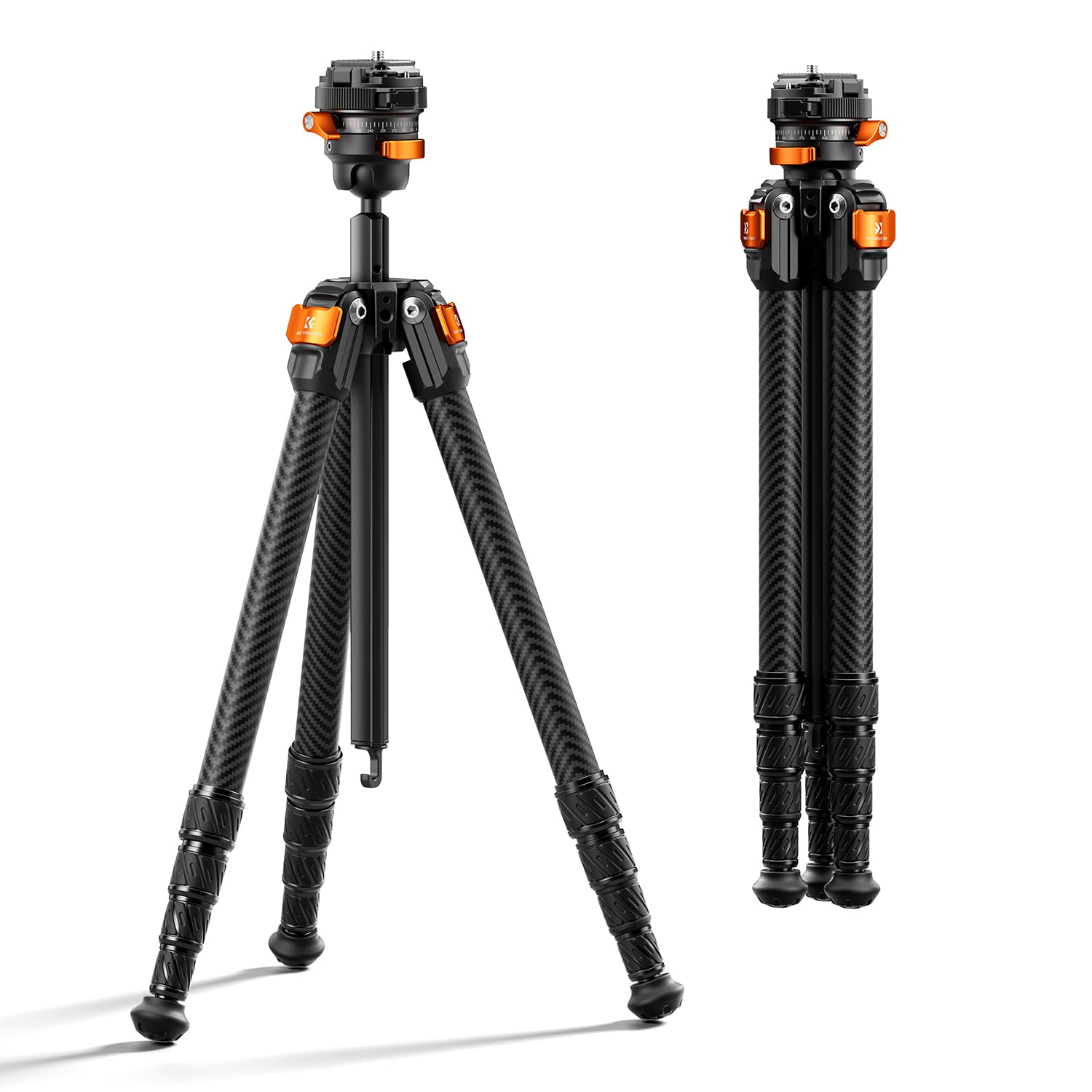
K&F Concept 60-inch Carbon

79 /100
Keeper Score Very Good

Key details

Weight
2 lb
Folded Size
16.5 inches
Load Capacity
13.2 lb
Maximum Height
60 inches
Check Price on Amazon

Two pounds is the number that makes the A225C2 worth a look. That is the carbon leg set and ball head together, folded to 16.5 inches with a 2.24-inch diameter, so it disappears into a daypack. For a small tracker, a mirrorless camera, and a wide lens, that is a compelling travel package.

The built-in hook is the detail we appreciate most. It takes up to 22 pounds of ballast, which lets you hang a backpack under the center column and settle the tripod in wind without adding permanent weight. The 60-inch maximum height and 15.6-inch minimum give you a useful range, and the Arca-compatible plate swaps between camera and tracker without tools.

The 13.2-pound load rating sets the boundary: this is a tripod for a small tracker and a light camera, not a large refractor or a heavy video head. We reach for it when the hike is long and the rig is small. It is not the most rigid tripod here, and it will not forgive a slack lock, but the weight and hook make it a practical backpacking choice for wide-field astrophotography.

Pros

  • Two-pound carbon frame
  • Folds to 16.5 inches
  • Built-in hook takes 22 pounds
  • Arca-compatible quick release

Cons

  • Leg locks can loosen over time
Our verdict

The carbon K&F is the one for a long walk with a small tracker; its hook and low weight matter more than its modest payload.

Check Latest Price

How We Tested These Tripods After Dark

The shortlist started as a spreadsheet: load capacity, leg diameter, folded length, weight, lock style, head type, and price. We crossed off anything that couldn't plausibly carry a star tracker plus a camera and a fast lens, then deliberately kept a spread of budgets and weights so the list wasn't all flagship carbon.

Twelve tripods then went outside for nine months. Most sessions happened in a suburban backyard with a streetlight bleeding in, some weekends at a darker site an hour out of town where wind came across open ground, and one long February night on frozen turf. We set each tripod up in the dark with a headlamp, then again wearing gloves, and timed how long it took to get the head level.

Stability got measured rather than eyeballed. Every tripod took 30-second and five-minute exposures of the same patch of sky, and we compared the files for stretched or doubled stars. We also thumped a leg mid-exposure and counted how long the frame kept shaking. Leg locking had its own check: we taped the leg sections at a set height, hung a heavy lens on the head, and looked for any creep by morning. Security meant twisting the camera on the plate and the plate in the clamp to see if anything shifted under load.

Portability and adjustability we judged the honest way, by packing each tripod into its own bag, weighing it, and walking a mile with it, then seeing how low it could sit for a horizon shot and how high it reached for the zenith. We noted finish wear and corrosion after a dewy night, and whether the price felt fair for what the legs and head actually did.

How to Choose a Tripod for Astrophotography

Start with the leg set, not the head

A payload rating tells you what the tripod can hold, not how still it will be at full extension. Fewer leg sections and wider tubes generally make a stiffer base; that is why the ARTCISE AS90C's 40mm legs and the Benro's three-section design feel calmer than a five-section travel tripod. If your rig is heavy, prioritize mass and leg diameter over folded size. The trap is buying the highest load rating and then extending every section on a windy night: a tall, skinny leg set can shiver even when it is well under its limit.

Match the mount, not just the camera

Astro mounts often use a 3/8-inch thread, while cameras use 1/4-inch; check both before you order. A 75mm leveling bowl, as on the ARTCISE, makes it easier to get the base level before you fine-tune the tracker. A ball head is convenient for framing, but it is not a substitute for a tracker, and it can creep under a heavy off-axis load. Decide whether you need a bare tripod for a Star Adventurer or Seestar, or a camera-first tripod with a head; the Sky-Watcher is the former.

Height range and low-angle work

Maximum height gets the attention, but minimum height matters more for wide-field astrophotography. A low setup is more stable and easier to aim at the sky; the ARTCISE drops to 3.9 inches, and the K&F 64 has an invertible center column. If you are tall or using a refractor, you need more height, but do not extend the center column unless you have to. The trap is choosing a tall tripod for standing use and then expecting it to be equally rigid at the top of its range.

Weight, folded size, and the walk in

Stability and portability pull against each other. The 9.9-pound ARTCISE is a car-to-site tripod; the 2.7-pound Sirui and 2.0-pound K&F 60 are for long walks with small rigs. A hook for ballast helps a light tripod settle in wind without adding permanent weight. If you fly, compare the folded length with your carry-on; a 15- to 19-inch tripod packs easily, while a 23- to 31-inch model is better checked or carried by car. Choose for the distance you actually walk, not the one you imagine.

Leg locks and cold-weather handling

Flip locks are fast with gloves; twist locks are less likely to snag but need a firm grip. Whichever you choose, practice setting up in the dark and check every lock before you walk away. On soft ground, switch to spikes if the tripod includes them; on rock or a deck, rubber feet are better. The trap is assuming a lock is tight because it feels tight through a glove. A final tug on each leg section before the exposure is cheap insurance.

Frequently Asked Questions

Final Verdict

Start with the ARTCISE AS90C if you want the most stable base here for a heavy tracker, a small refractor, or a long lens. Its 40mm legs and 75mm bowl are the reason it earns the top spot; the weight is the trade you make for that calm.

If your rig is a Star Adventurer or a Seestar, the Sky-Watcher is the simpler, lighter answer. For a long hike with a small tracker, choose the Sirui AM-284 and accept the lower working height. The right tripod is the one you will actually carry to a dark site and set up in the cold.