Best Thermal Scopes of 2026

A thermal scope doesn't show you the woods; it shows you the heat inside them. That's the appeal, and the trouble: a coyote at 200 yards comes through as a bright silhouette, and telling it from a hot stump depends on the sensor, the lens, and how the image is processed. Buy the wrong one and you're squinting at a smeary blob twenty minutes into a stand.

I've spent enough cold nights behind one to know a spec sheet won't sort them out. Refresh rate means nothing on paper and everything when you pan a treeline. Over the past nine months my team has run eight scopes through pre-dawn coyote stands and after-dark hog hunts, weighing image quality, accuracy, battery life, durability, ease of use, and value.

The headline features matter too — rangefinders built into the scope, clip-on and handheld modes that let one unit do several jobs, bodies light enough to carry all night. Below are the eight that earned a place on a rifle; a couple are just as happy in your hand.

Keeper Score summarizes customer ratings and review volume. Read it alongside the product details and trade-offs. How the score works.

1

Best Overall

oneleaf.ai Mars MT1000LRF

85 /100
Keeper Score Excellent

Key details

Sensor
640x512, 12 micron
Ranging
Laser rangefinder and ballistic calculator
Magnification
2x to 8x
Detection Range
1,969 yards
Check Price on Amazon

Two hundred and fifty yards is where the argument for this scope starts. A 640x512 sensor behind a 35mm lens holds the shape of an animal at that distance, and the 12-micron pixels and sub-20mK sensitivity keep that outline intact when the temperature drops and the background goes flat. We made it our top pick because it answers both halves of the job at once: it finds game at range, and it gives you enough detail to be certain before you chamber a round.

The laser rangefinder and ballistic calculator are what tip it. Range the animal and the scope works out the hold from one of seven stored ballistic sets, so swapping ammunition or rifles does not leave you guessing at the reticle. Eleven palettes is more than most hunters will ever use, but black-hot against frost and white-hot against wet ground earn their keep, and the 60Hz refresh keeps the picture smooth through a pan instead of smearing it.

At 1.2 pounds it sits midweight in this group, and it runs on standard 18650 cells rather than a sealed pack, which we prefer: a spare in your pocket beats waiting on a charger halfway through a night. The 2x base magnification gives you a view built for scanning, and the digital steps above it go as far as you need for the shot, with three years of manufacturer coverage behind the whole thing.

The interchangeable front lens is the detail we did not expect to care about. Change the lens and you change the field of view without buying a second scope, which suits a hunter working several kinds of ground in one season. Shots inside 150 yards in timber do not need a 640 sensor, though, and that is where the AGM Rattler V2 below makes far more sense.

Pros

  • 640x512 resolution separates animals from cover at range
  • Laser rangefinder with a seven-set ballistic calculator
  • Runs on standard 18650 cells, so spares travel easily
  • Interchangeable lenses change the field of view

Cons

  • Top magnification stops at 8x
  • The most expensive scope in this group
Our verdict

We made it our top pick because it is the one scope here that finds game at range, ranges it, and still has resolution in reserve for the shot.
Check Latest Price
2

Best Value

AGM Rattler V2 19-256

89 /100
Keeper Score Excellent

Key details

Sensor
256x192, 12 micron
Weight
6.34 oz
Battery
Two rechargeable batteries, up to 11.5 hours
Magnification
2.5x to 20x
Check Price on Amazon

Six and a third ounces barely registers on a rifle. Mount the Rattler V2 19-256 and the balance you built the gun around stays put, which is not true of the 1.2- and 1.4-pound scopes in this group. For still hunting and long walks in, that is the difference between carrying a thermal scope and carrying a rifle that happens to have one.

What the money buys is a close-range tool, and we are happy to say that plainly. The 19mm objective and 256x192 sensor are aimed squarely at timber, field edges and the 40-to-100-yard shot most hogs actually offer, not at judging an animal across a bean field. You get a claimed 11.5 hours from the two rechargeable batteries in the box, an IP67 housing rated from -22°F to 131°F, ten reticles and four color palettes, a stadiametric rangefinder for rough distance, and shot-activated recording with audio so the footage starts when the trigger breaks.

The menu is the part to practise. Reticle settings and the sub-menus are not self-explanatory, so sight it in during daylight and note what you changed before you are doing it by feel at two in the morning. Five years of coverage is generous at this end of the price range, and the box includes the mount, both batteries, a USB cable and a lens cloth, so there is nothing to buy before opening night.

Pros

  • Lightest scope here at 6.34 ounces
  • Two rechargeable batteries and a claimed 11.5 hours
  • Five-year manufacturer warranty
  • Shot-activated video recording with audio

Cons

  • Detail runs out around 100 yards
Our verdict

This is what we point a first-time thermal hunter at: light, affordable, and enough for timber ranges, as long as you sight it in before opening night.

Check Latest Price
3

Best for Open Ground

RIX Storm S2

86 /100
Keeper Score Excellent

Key details

Lens
25mm
Sensor
256x192
Magnification
3.5x to 14x
Detection Range
1,422 yards
Check Price on Amazon

Three and a half times is a lot of base magnification to build a scope around, and RIX committed to it: 3.5x to 14x behind a 25mm lens, with a 50Hz refresh and a 1,422-yard detection rating. The result is a scope that puts a lot of pixels on a distant shape rather than a wide view of everything in front of you, which is exactly the trade we want for field edges and cut crop.

The rest of the package supports that role. The aluminum body carries a button layout and a battery-bin cover designed to be worked with gloves on in the dark, a quick-detach mount comes in the box rather than sold as an extra, and the sub-25mK sensitivity holds the image together when the temperature spread between animal and ground is small. RIX's RET processing is doing real work on a 256x192 detector, though no algorithm adds detail that was never captured.

Where it lands for us: this is the scope for a hunter who glasses a field, picks out a shape at 200 yards and wants 14x to confirm it before the shot. Move it between rifles with the QD lever and confirm zero before you hunt, because the mount is quick rather than clairvoyant. For the money it covers more ground than anything else here at its base magnification.

Pros

  • 3.5x to 14x covers field-edge work and long looks
  • Controls and battery cover built for gloved hands
  • Quick-detach mount included in the box
  • 1,422-yard detection rating from a 25mm lens

Cons

  • Tight 7-degree field of view up close
Our verdict

We like it best for open ground, where the 3.5x base and 14x top turn a field-edge shape into a target you can identify.

Check Latest Price
4

Best Image Detail

RIX Storm S3

87 /100
Keeper Score Excellent

Key details

Lens
35mm
Sensor
384x288
Warranty
5 years
Detection Range
1,969 yards
Check Price on Amazon

The step from the Storm S2 to the S3 is short on paper. The sensor goes from 256x192 to 384x288, the lens from 25mm to 35mm, and the detection rating stretches to 1,969 yards. The part that matters is what happens when you push the magnification: digital zoom on a 256 detector starts to fall apart well before the top of its range, and with 384 behind it, 14x still shows you an animal rather than a smear.

Everything else is the S2's formula. Same aluminum housing, same button-and-bin-cover layout for gloved hands in the dark, same 50Hz refresh and sub-25mK sensitivity, and a 7.5-degree horizontal field of view that comes out slightly wider than its sibling's despite the longer lens. In humid, high-heat conditions that sensitivity is doing more for the image than any menu setting.

Our judgement is that this is the one to buy if resolution matters more to you than extras. What we like is that the money goes into the detector and the glass rather than into a feature list, and the five-year warranty says RIX expects it to stay on a rifle for a while. It is the quiet, competent choice in this group rather than the flashiest one.

Pros

  • 384x288 sensor adds real detail over a 256
  • 35mm lens with a 1,969-yard detection rating
  • Five-year warranty, the longest coverage here
  • Same glove-friendly controls as the Storm S2

Cons

  • Enhancement stops short of true 640 detail
Our verdict

Our pick when image detail matters more than extras: the 384 sensor holds up under magnification that turns a 256 into mush.

Check Latest Price
5

Best for Identification

DNT ThermNight TNC225R

84 /100
Keeper Score Excellent

Key details

Sensor
256x192 thermal plus digital night vision
Weight
1.4 lb
Ranging
Laser rangefinder and ballistic calculator
Magnification
3x to 12x
Check Price on Amazon

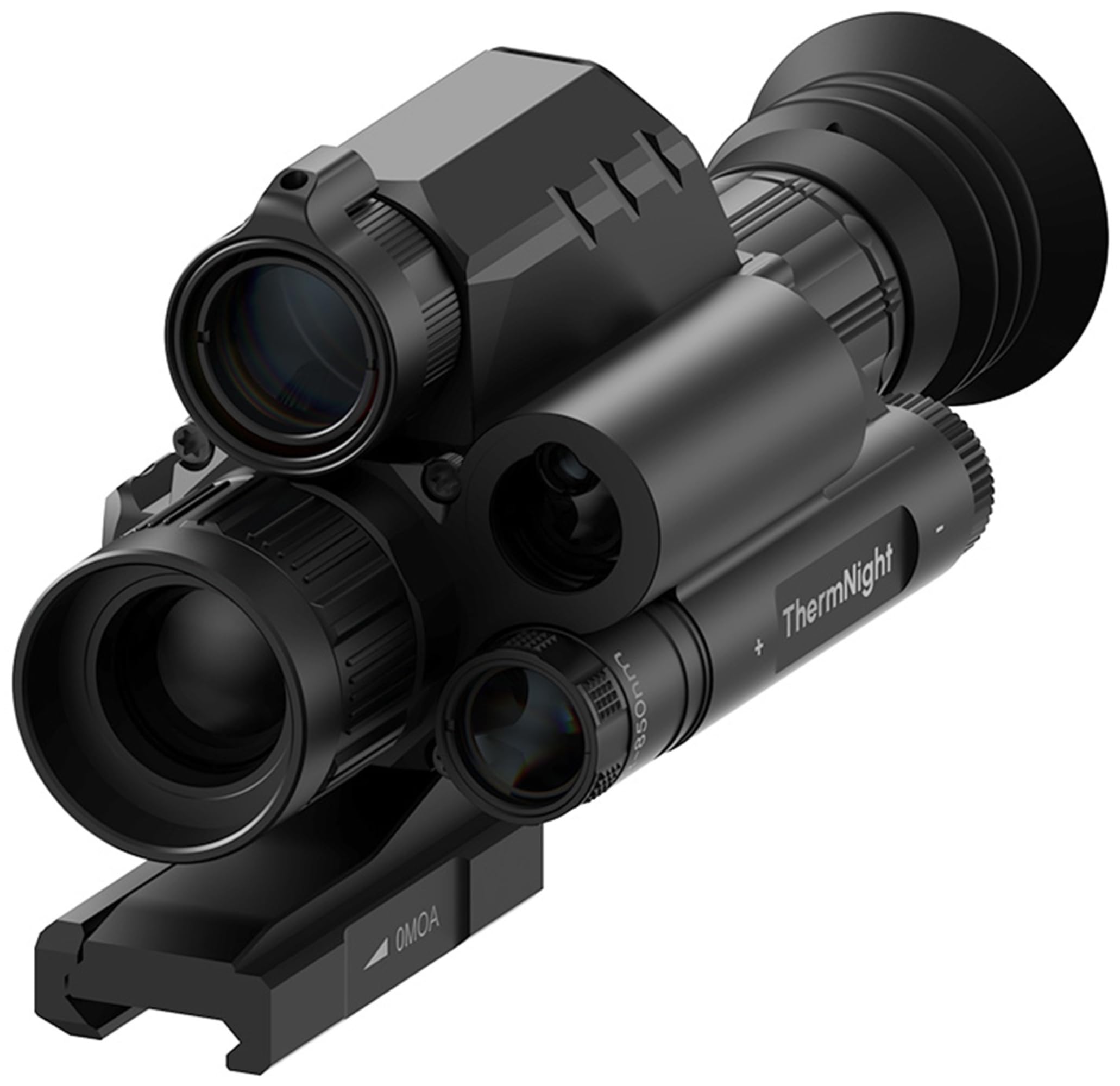
Thermal finds animals; it is less good at telling you what they are. A heat signature flattens fur, feathers and fabric into the same white blob, and past 200 yards that is how expensive mistakes happen. The ThermNight TNC225R answers that with two sensors in one housing: a 256x192 thermal channel for detection and a digital night-vision channel you switch to for identification.

The switch is a button press, and the scope keeps a separate zero for each channel, so flipping over does not send you back to the range to re-sight. A laser rangefinder feeds a ballistic calculator, and the IR illuminator detaches, which lets you run the 850nm unit in the box or fit the 940nm version that throws light your quarry is less likely to notice.

The mount is a short Picatinny with 6.5 centimeters of eye relief, and two batteries come in the box, which is worth having because a dual-channel scope asks more of a cell than a single-sensor one. Setup takes a session: two channels, two zeros and a ballistic menu need more configuring than anything else here, so arrive at the first hunt already familiar with it.

If we are choosing one scope for predator work around livestock, or for ground where a wrong call is expensive, it is this one, because identification is the whole job. If your hunting is open fields and long glassing sessions, the oneleaf's 640 sensor serves you better.

Pros

  • Thermal and digital night vision in one scope
  • Separate zero for each channel
  • Laser rangefinder with ballistic calculator
  • Detachable IR illuminator in 850nm or 940nm

Cons

  • 1.4 pounds is heavy on a light rifle
  • Two-year warranty is the shortest here
Our verdict

If identifying a target matters more than raw thermal resolution, this is the one we recommend, because the night-vision channel answers what heat alone cannot.

Check Latest Price
6

Best for Multiple Rifles

Sightmark Wraith Mini

82 /100
Keeper Score Excellent

Key details

Lens
35mm
Sensor
384x288
Zero Profiles
5
Detection Range
1,400 yards
Check Price on Amazon

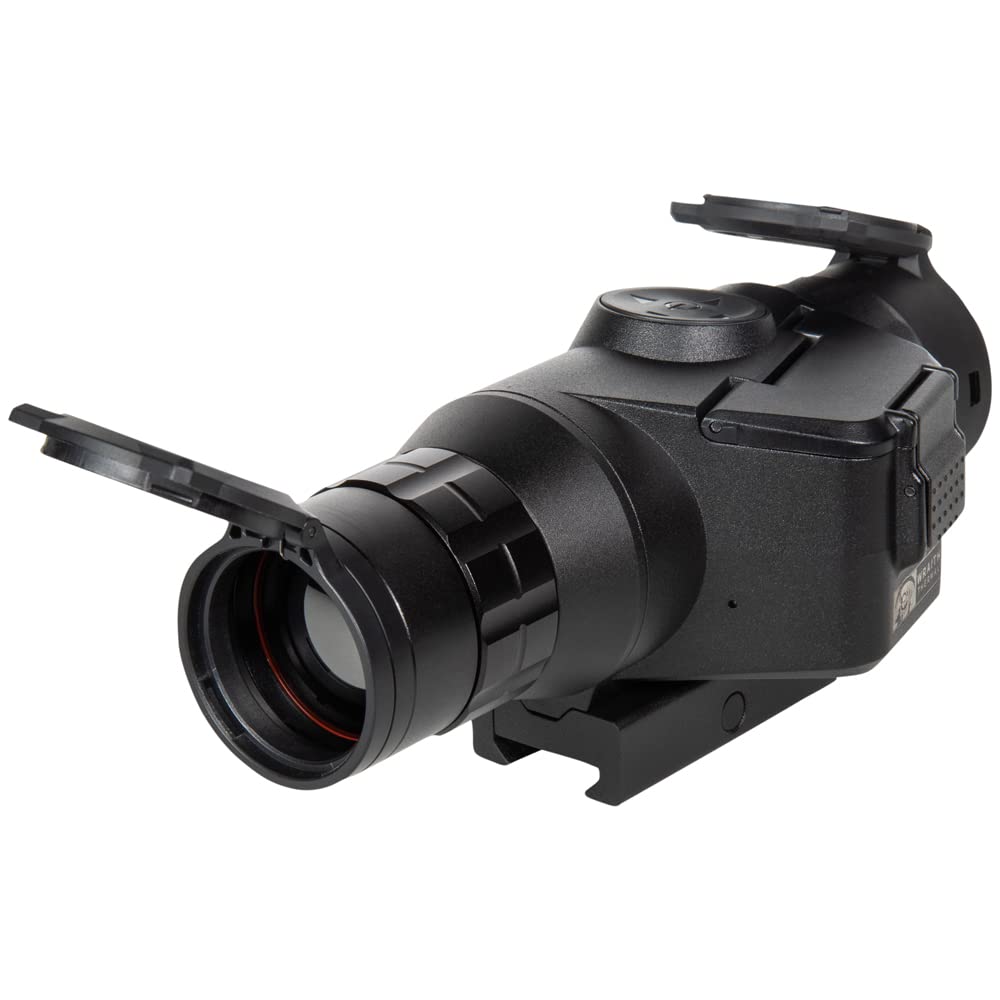
Five rifles, one scope. The Wraith Mini stores five zero profiles, so moving it from the truck gun to the coyote rifle is a matter of picking a profile instead of burning ammunition re-sighting. For anyone who owns more rifles than optics, that is a genuinely useful feature rather than a spec-sheet line, and it is the reason this one earned a spot.

Behind it sits a 384x288 sensor and a 35mm lens with a 1,400-yard detection rating, five thermal palettes and nine reticle colors. The built-in camera records video and audio, which is the sort of thing you ignore until the one night you wish you had not. A removable throw lever and flip-up covers come in the box rather than adding to the bill.

It is a 1.2-pound aluminum tube on a Picatinny mount with three years of warranty behind it. The 2x optical base gives a wide view, and the digital steps above it do the reaching when you need to look further, with the reticle staying put as you climb.

Our take is that this is the practical pick for a safe full of rifles rather than the sharpest image in the group. The sensor and lens are respectable, the profiles are the reason to choose it, and the build is solid aluminum. If your shots run long and the animal's shape is the question, the oneleaf does more for identification.

Pros

  • Five zero profiles for five rifles
  • 384x288 sensor behind a 35mm lens
  • Built-in camera records video and audio
  • Throw lever and flip-up covers included

Cons

  • Runs on disposable CR123A cells
Our verdict

Choose this one if the scope moves between rifles; the five profiles save you a re-zero every time, and the 384 sensor is respectable company.

Check Latest Price
7

Clip-On and Scanning

DNT Hydra HS225

79 /100
Keeper Score Very Good

Key details

Modes
Riflescope, clip-on and monocular
Sensor
256x192, 12 micron
Magnification
3x to 12x
Recoil Rating
.50 BMG / 800G
Check Price on Amazon

One housing, three jobs. The Hydra HS225 works as a standalone thermal riflescope, as a clip-on module ahead of a day scope, and as a handheld monocular, drawing on the same 256x192 sensor, 25mm lens and 12-micron pixels in every mode. Magnification steps through 3x, 4.5x, 6x, 9x and 12x rather than zooming continuously, so you pick a view instead of hunting for one.

The build is the part that stands out on paper: 6061 aluminum, IP67 sealing, and a rating to .50 BMG and 800G recoil, which is a spec worth having if you shoot a hard-kicking caliber. At 13.1 ounces it lands in the middle of this group, and the app streams the live view to a phone, which is more useful than it sounds when you are trying to show someone what you just watched walk out.

We like the clip-on mode best, because it is the one that changes how you hunt. Keep the day scope you already trust, add heat in front of it, and your reticle and your zero stay put. As a monocular it means glassing without sweeping a rifle around, which is both safer and less conspicuous on a piece of ground where you are not sure what is out there.

Whether the three-in-one idea works for you comes down to one measurement: the clip-on has to line up with your day scope's height and exit pupil. Check that before the season and buy somewhere with a return window, and one device covers scanning, stalking and the shot.

Pros

  • Riflescope, clip-on and monocular in one device
  • Rated to .50 BMG and 800G recoil
  • 6061 aluminum body with IP67 sealing
  • Live view streamed to a phone

Cons

  • 256x192 sensor caps detail at long range
Our verdict

We recommend it for the hunter who wants one device for scanning, clip-on and standalone use, and who values that flexibility over a sharper image.

Check Latest Price
8

Close-Range Use

ATN ThOR LTV

80 /100
Keeper Score Excellent

Key details

Mount
Dovetail
Sensor
160x120
Eye Relief
90mm
Magnification
3x to 9x
Check Price on Amazon

The ThOR LTV runs a 160x120 detector behind 12mm of objective glass, with 3x to 9x magnification, a 60Hz refresh and 90mm of eye relief. Those numbers describe a device built for the range where you could see the animal with your own eyes and want a sight picture after dark. The generous eye relief is the practical part: it is comfortable to get behind, which is not something every scope here can claim.

We kept coming back to it for a different reason: it is one of the simplest scopes here to actually run. One-shot zero gets you on paper in a single shot, the menus are among the easiest to work by feel in the dark, and HD recording is built in without an app or a subscription. For someone who wants thermal without a weekend of learning menus, that counts for a lot.

Two things to check before you order. The mount is listed as a dovetail rather than Picatinny, which is unusual here and means an adapter or a different rail on most American rifles. And ask ATN about recoil rating for your cartridge, since the specs do not state one and this is not the scope to experiment with on a heavy magnum.

Pros

  • Menus and controls are easy to work in the dark
  • 90mm of eye relief is comfortable to get behind
  • Onboard HD video recording
  • 60Hz refresh keeps the view smooth

Cons

  • 160x120 sensor limits detail to close range
Our verdict

It earns a place as a simple, close-range thermal for a rimfire or a backup rifle, not as the scope you take on a long open-country hunt.

Check Latest Price

How We Tested the Best Thermal Scopes

We built the shortlist from the specs that change a night in the field — sensor resolution, lens size, refresh rate, and whether a laser rangefinder, clip-on mode, or handheld mode came built in — then cut anything that couldn't be mounted solidly, carried for a mile, or bought without stretching past what the features justify. Eight scopes made the cut, and testing ran for nine months, from the first cool nights of fall through spring.

Each scope went on the same rifle and was zeroed at 100 yards on paper in daylight, then shot again after dark to confirm the point of impact held when the palette switched from white-hot to black-hot. For image quality, we scanned the same treeline, fence row, and open pasture at dusk with each one in turn, so every comparison was the same deer, the same cattle, and the same hot rock under identical conditions.

Battery life got its own night: continuous scanning in temperatures in the teens, noting when each unit quit and how easy it was to swap cells in the dark. Durability meant rain, frost, a few knocks against a truck bed, and hours on a sling. We judged ease of use the honest way, handing each scope to a friend who'd never run a thermal and timing how long it took to get a usable image and change a setting with gloves on.

What separated them was identification, not detection. Plenty of units picked up a heat signature at the far end of a field; far fewer let us say with confidence that it was a coyote and not a calf. We also pointed each built-in rangefinder at measured distances on the range, and weighed what the extras cost against what they actually saved us in the dark.

How to Choose a Thermal Scope

Resolution: Identify, Don't Just Detect

A 256x192 sensor shows you a heat source across a field; a 384 shows you its shape; a 640 lets you judge it. That ladder is most of what separates the prices here, and it is where we would put the budget first if your shots regularly run past 200 yards. The oneleaf's 640 sensor is the clearest example in this group of what the extra resolution actually buys.

The detection figure on the box is the trap. It describes a heat source against a cold background in good conditions, not the range at which you can decide whether that shape is legal game. Expect identification at roughly half the advertised detection distance. In thick cover inside 100 yards, a 256 like the AGM's is plenty, and paying for detail you never resolve is money wasted.

Lens and Field of View: Reach Against the Close Shot

A longer lens magnifies more and narrows the view. The AGM's 19mm gives 9.3 degrees, the RIX Storm S2's 25mm gives 7.0, and the Storm S3's 35mm gives 7.5 while reaching further. Base magnification matters just as much: the oneleaf starts at 2x and scans comfortably, while the RIX pair start at 3.5x and put more pixels on the animal.

Walk your ground before you choose. A 7-degree window at 30 yards is a straw, which matters far more to a caller working hogs in scrub than to someone watching a field edge. When we split the difference we prioritise the wider view and lean on digital zoom for the long look, because you can always zoom in and you cannot widen a fixed lens. The oneleaf's interchangeable front lens is the exception that lets you change the field of view without changing scopes.

Rangefinders, Ballistic Data and Saved Profiles

A laser rangefinder paired with a ballistic calculator removes the step where you put the rifle down, range with a separate unit and then guess the hold. The oneleaf and the DNT ThermNight both do it. Inside 150 yards with a flat-shooting cartridge, a stadiametric reticle like the AGM's is enough, and the electronics are money you do not need to spend.

Saved profiles are the underrated half of this. The Sightmark Wraith Mini holds five, so one scope can serve five rifles, and the oneleaf stores seven ballistic sets. If rifles rotate through your season, count profiles before you count anything else.

Batteries, Weight and the Mount

Three power systems show up in this group: rechargeable packs, with the AGM shipping two; standard 18650 cells on the oneleaf and the RIX scopes; and disposable CR123As on the Sightmark. We favour anything you can carry a spare of mid-hunt. Weight runs from 6.34 ounces on the AGM to 1.4 pounds on the ThermNight and the ATN, and a heavy scope on a light rifle changes how the gun swings.

Check the mount before you order. Picatinny is the norm here, but the ATN is listed as a dovetail, which usually means an adapter on an American centerfire. Recoil ratings are thinner on the ground: only the DNT Hydra states one, at .50 BMG and 800G, so ask the maker before you bolt anything to a magnum.

Frequently Asked Questions

Final Verdict

Buy the oneleaf.ai Mars MT1000LRF if you want one scope that finds game, ranges it and holds at distance. The 640 sensor is the difference between seeing an animal and knowing what it is, and the rangefinder earns its place every time you shoot past 200 yards.

If your hunting happens inside 100 yards in timber, the AGM Rattler V2 does that job at a third of the weight for a fraction of the money. And when identification rather than resolution is the problem, the DNT ThermNight's night-vision channel answers a question no amount of sensor detail settles.